

prEN 18314
(Main)Natural pozzolana and natural activated pozzolanic material - Definitions, specifications and conformity criteria
General Information
- Abstract
This document specifies requirements for chemical and physical properties of natural pozzolana and natural activated pozzolanic material for use as addition to concrete, and for use in mortar and grouts.
It also specifies requirements for conformity criteria.
- Status
- Not Published
- Publication Date
- 17-Jun-2027
- Technical Committee
- CEN/TC 104 - Concrete ( performance, production, placing and compliance criteria )
- Drafting Committee
- CEN/TC 104/WG 20 - New constituents for concrete
- Current Stage
- 4060 - Closure of enquiry - Enquiry
- Start Date
- 14-May-2026
- Due Date
- 10-Oct-2026
- Completion Date
- 14-May-2026

Overview
prEN 18314:2026 is a draft European Standard developed by CEN Technical Committee CEN/TC 104, focusing on natural pozzolana and natural activated pozzolanic materials. This standard sets out comprehensive requirements for the chemical and physical properties of these materials when used as additions in concrete, mortar, and grouts. It outlines definitions, technical specifications, and conformity criteria to ensure quality and consistent performance in building materials, supporting sustainable construction and the use of natural resources.
Key Topics
Definitions and Classification
- Provides clear definitions for natural pozzolana, natural activated pozzolanic material, and related quality control terms.
- Distinguishes natural pozzolana from industrial alternatives such as fly ash or silica fume.
Chemical and Physical Properties
- Specifies the required chemical composition, including key oxides (SiO₂, CaO, Al₂O₃, Fe₂O₃), clay content, chlorides, sulphates, alkalis, and total organic carbon.
- Stipulates physical requirements related to fineness, soundness, particle density, moisture content, water requirement, and reactivity (measured through heat of hydration or bound water content).
Testing and Assessment
- Mandates regular autocontrol testing by manufacturers to assess properties and statistical conformity.
- Provides detailed guidance on sample collection, test methods (aligned with EN 196, EN 451, and other relevant standards), and minimum testing frequencies.
Conformity Criteria
- Introduces statistical acceptance procedures for conformity evaluation.
- Sets single-result limit values for critical properties, ensuring batch-to-batch consistency.
Packaging, Labelling, and Documentation
- Describes labeling requirements to guarantee traceability.
- Recommends thorough quality documentation and internal control systems at factories.
Applications
prEN 18314 is crucial for manufacturers and users of construction materials who seek to:
- Enhance Performance of Concrete, Mortar, and Grouts:
- Use natural pozzolanic materials as supplementary cementitious additions to improve strength, durability, and other performance characteristics.
- Support Sustainable Construction:
- Encourage the use of naturally derived and activated materials, providing options with lower environmental impact compared to some traditional binders.
- Comply with European Construction Standards:
- Meet regulatory and market requirements for materials in civil engineering, ensuring alignment with EN 206 (concrete) and national regulations.
- Control Quality in Mass Production:
- Facilitate continuous quality control in manufacturing, from material receipt to final product, to guarantee conformity and traceability.
Related Standards
- EN 206 - Concrete - Specification, performance, production, and conformity
- EN 197-1 - Cement - Composition, specifications, and conformity criteria for common cements
- EN 196 Series - Methods of testing cement (Parts 1, 2, 3, 6, 7, 12)
- EN 451-2 - Method of testing fly ash - Determination of fineness by wet sieving
- EN 933-9 / EN 933-10 - Tests for aggregate fines
- EN 1097-5 - Water content determination for aggregates
- EN 13639 - Determination of total organic carbon in limestone
By adhering to prEN 18314, industry stakeholders can ensure that natural pozzolana and natural activated pozzolanic materials are consistently defined, tested, and certified to meet the needs of modern, sustainable construction across Europe.
Get Certified
Connect with accredited certification bodies for this standard

DIBt (Deutsches Institut für Bautechnik)
German Institute for Building Technology.
DIN CERTCO
DIN Group product certification.

Aboma Certification B.V.
Specialized in construction, metal, and transport sectors.
Sponsored listings
Frequently Asked Questions
prEN 18314 is a draft published by the European Committee for Standardization (CEN). Its full title is "Natural pozzolana and natural activated pozzolanic material - Definitions, specifications and conformity criteria". This standard covers: This document specifies requirements for chemical and physical properties of natural pozzolana and natural activated pozzolanic material for use as addition to concrete, and for use in mortar and grouts. It also specifies requirements for conformity criteria.
This document specifies requirements for chemical and physical properties of natural pozzolana and natural activated pozzolanic material for use as addition to concrete, and for use in mortar and grouts. It also specifies requirements for conformity criteria.
prEN 18314 is classified under the following ICS (International Classification for Standards) categories: 91.100.10 - Cement. Gypsum. Lime. Mortar. The ICS classification helps identify the subject area and facilitates finding related standards.
prEN 18314 is available in PDF format for immediate download after purchase. The document can be added to your cart and obtained through the secure checkout process. Digital delivery ensures instant access to the complete standard document.
Standards Content (Sample)
SLOVENSKI STANDARD
01-april-2026
Naravni pucolan in naravni aktivirani pucolanski material - Definicije, specifikacije
in merila skladnosti
Natural pozzolana and natural activated pozzolanic material - Definitions, specifications
and conformity criteria
Natürliche Puzzolane und natürlich aktivierte Puzzolane - Definitionen, Spezifikationen
und Konformitätskriterien
Pouzzolane naturelle et matériau pouzzolanique naturel activé - Définitions,
spécifications et critères de conformité
Ta slovenski standard je istoveten z: prEN 18314
ICS:
91.100.10 Cement. Mavec. Apno. Malta Cement. Gypsum. Lime.
Mortar
2003-01.Slovenski inštitut za standardizacijo. Razmnoževanje celote ali delov tega standarda ni dovoljeno.
DRAFT
EUROPEAN STANDARD
NORME EUROPÉENNE
EUROPÄISCHE NORM
February 2026
ICS 91.100.10
English Version
Natural pozzolana and natural activated pozzolanic
material - Definitions, specifications and conformity
criteria
Pouzzolane naturelle et matériau pouzzolanique Natürliche Puzzolane und natürlich aktivierte
naturel activé - Définitions, spécifications et critères de Puzzolane - Definitionen, Spezifikationen und
conformité Konformitätskriterien
This draft European Standard is submitted to CEN members for enquiry. It has been drawn up by the Technical Committee
CEN/TC 104.
If this draft becomes a European Standard, CEN members are bound to comply with the CEN/CENELEC Internal Regulations
which stipulate the conditions for giving this European Standard the status of a national standard without any alteration.
This draft European Standard was established by CEN in three official versions (English, French, German). A version in any other
language made by translation under the responsibility of a CEN member into its own language and notified to the CEN-CENELEC
Management Centre has the same status as the official versions.
CEN members are the national standards bodies of Austria, Belgium, Bulgaria, Croatia, Cyprus, Czech Republic, Denmark, Estonia,
Finland, France, Germany, Greece, Hungary, Iceland, Ireland, Italy, Latvia, Lithuania, Luxembourg, Malta, Netherlands, Norway,
Poland, Portugal, Republic of North Macedonia, Romania, Serbia, Slovakia, Slovenia, Spain, Sweden, Switzerland, Türkiye and
United Kingdom.
Recipients of this draft are invited to submit, with their comments, notification of any relevant patent rights of which they are
aware and to provide supporting documentation.
Warning : This document is not a European Standard. It is distributed for review and comments. It is subject to change without
notice and shall not be referred to as a European Standard.
EUROPEAN COMMITTEE FOR STANDARDIZATION
COMITÉ EUROPÉEN DE NORMALISATION
EUROPÄISCHES KOMITEE FÜR NORMUNG
CEN-CENELEC Management Centre: Rue de la Science 23, B-1040 Brussels
© 2026 CEN All rights of exploitation in any form and by any means reserved Ref. No. prEN 18314:2026 E
worldwide for CEN national Members.
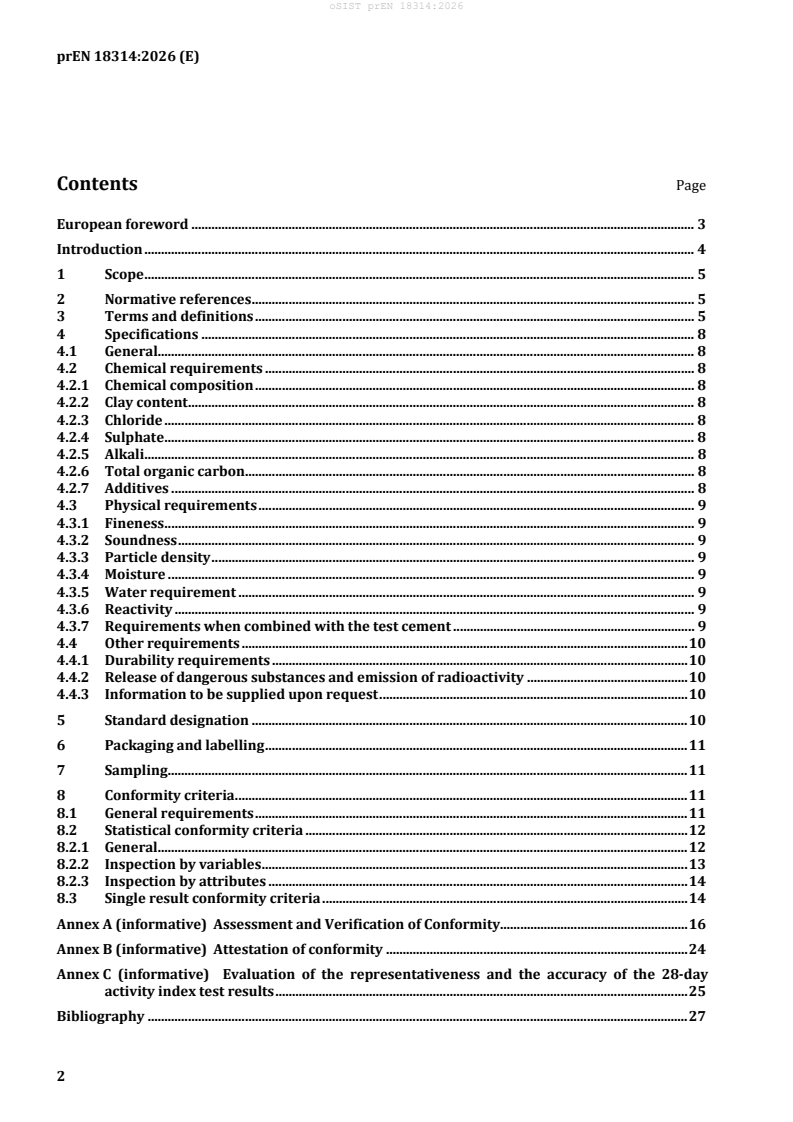
Contents Page
European foreword . 3
Introduction . 4
1 Scope . 5
2 Normative references . 5
3 Terms and definitions . 5
4 Specifications . 8
4.1 General. 8
4.2 Chemical requirements . 8
4.2.1 Chemical composition . 8
4.2.2 Clay content . 8
4.2.3 Chloride . 8
4.2.4 Sulphate . 8
4.2.5 Alkali. 8
4.2.6 Total organic carbon . 8
4.2.7 Additives . 8
4.3 Physical requirements . 9
4.3.1 Fineness . 9
4.3.2 Soundness . 9
4.3.3 Particle density . 9
4.3.4 Moisture . 9
4.3.5 Water requirement . 9
4.3.6 Reactivity . 9
4.3.7 Requirements when combined with the test cement . 9
4.4 Other requirements . 10
4.4.1 Durability requirements . 10
4.4.2 Release of dangerous substances and emission of radioactivity . 10
4.4.3 Information to be supplied upon request . 10
5 Standard designation . 10
6 Packaging and labelling . 11
7 Sampling . 11
8 Conformity criteria . 11
8.1 General requirements . 11
8.2 Statistical conformity criteria . 12
8.2.1 General. 12
8.2.2 Inspection by variables . 13
8.2.3 Inspection by attributes . 14
8.3 Single result conformity criteria . 14
Annex A (informative) Assessment and Verification of Conformity. 16
Annex B (informative) Attestation of conformity . 24
Annex C (informative) Evaluation of the representativeness and the accuracy of the 28-day
activity index test results . 25
Bibliography . 27
European foreword
This document (prEN 18314:2026) has been prepared by Technical Committee CEN/TC 104 “Concrete
and related products”, the secretariat of which is held by SN.
This document is currently submitted to the CEN Enquiry.
Introduction
Natural pozzolana and natural activated pozzolanic materials are typically siliceous or silico-aluminous
materials with pozzolanic properties; examples include materials of volcanic origin, diatomite earths,
calcined clays or shales. The use of natural pozzolanic materials in concrete production in some European
countries, based on national experience and tradition is a current trend.
If natural pozzolanic materials are out of the scope of this document, their suitability for use as additions
in concrete according to EN 206:2013+A2:2021 can also be established from national standards or
provisions or European Technical Approvals (ETA) valid in the place of use of the concrete and which
refer specifically to the use of the addition in concrete conforming to EN 206:2013+A2:2021.
When using natural pozzolanic materials conforming to this document, it can be noted that, apart from
the pozzolanic effect of the product, certain properties of fresh and hardened concrete can be affected.
Where relevant, such effects need to be considered in concrete mix design.
1 Scope
This document specifies requirements for chemical and physical properties of natural pozzolana and
natural activated pozzolanic material for use as addition to concrete, and for use in mortar and grouts.
It also specifies requirements for conformity criteria.
2 Normative references
The following documents are referred to in the text in such a way that some or all of their content
constitutes requirements of this document. For dated references, only the edition cited applies. For
undated references, the latest edition of the referenced document (including any amendments) applies.
EN 196-1, Methods of testing cement — Part 1: Determination of strength
EN 196-2, Methods of testing cement — Part 2: Chemical analysis of cement
EN 196-3, Methods of testing cement — Part 3: Determination of setting times and soundness
EN 196-6, Methods of testing cement — Part 6: Determination of fineness
EN 196-7, Methods of testing cement — Part 7: Methods of taking and preparing samples of cement
EN 196-12, Methods of testing cement — Part 12: Reactivity of cement constituents - Heat of hydration and
bound water content methods
EN 197-1, Cement — Part 1: Composition, specifications and conformity criteria for common cements
EN 451-2, Method of testing fly ash — Part 2: Determination of fineness by wet sieving
EN 933-9, Tests for geometrical properties of aggregates — Part 9: Assessment of fines - Methylene blue test
EN 933-10, Tests for geometrical properties of aggregates — Part 10: Assessment of fines - Grading of filler
aggregates (air jet sieving)
EN 1097-5, Tests for mechanical and physical properties of aggregates — Part 5: Determination of the
water content by drying in a ventilated oven
EN 13639, Determination of total organic carbon in limestone
3 Terms and definitions
For the purposes of this document, the following terms and definitions apply.
ISO and IEC maintain terminology databases for use in standardization at the following addresses:
— ISO Online browsing platform: available at https://www.iso.org/obp/
— IEC Electropedia: available at https://www.electropedia.org/
3.1
pozzolanic properties
propensity of a material to react with calcium hydroxide (Ca(OH) ) and water at ambient temperature to
form calcium silicate and calcium aluminate hydrates with cementitious properties that enable to obtain
or enhance specific concrete properties
3.2
addition
finely divided inorganic constituent used in concrete in order to improve certain properties or to achieve
special properties
[SOURCE: FprEN 206-1:2025, definition 3.2.1]
3.3
natural pozzolana
material of natural origin mainly comprised of silicate and aluminosilicate compounds that, when finely
ground, presents pozzolanic properties (3.1)
Note 1 to entry: The term “natural pozzolana” is used to differentiate from industrial pozzolana such as fly ash or
silica fume whose properties and performance requirements are set by other standards.
3.4
natural activated pozzolanic material
natural pozzolanic material activated by a specific treatment (thermal, chemical and/or mechanical)
intended to obtain pozzolanic properties (3.1) of the material
Note 1 to entry: Chemical activation does not include alkali activated binders like geopolymers.
3.5
autocontrol
continuous statistical quality control of the natural pozzolana and natural activated pozzolanic material
based on the testing of samples taken by the producer or their agent at point(s) of release from the
producing facility
3.6
control period
period of production and/or dispatch identified for the evaluation of the autocontrol test results
3.7
characteristic value
value of the required property outside of which lies a specified percentage, the percentile Pk, of all the
values of the population
3.8
single result limit value
limit value of a chemical or physical property which – for any single test result – in the case of an upper
limit is not to be exceeded or in the case of a lower limit is, as a minimum, to be reached
3.9
allowable probability of acceptance Consumer’s Risk (CR)
for a given sampling plan, the allowed probability of acceptance of natural pozzolana and natural
activated pozzolanic material with a characteristic value outside the specified minimum or maximum
values
3.10
sampling plan
specific plan which states the (statistical) sample size(s) to be used, the percentile P , and the allowable
k
probability of acceptance CR
3.11
spot sample
sample taken at the same time and from one and the same place, relating to the intended tests which can
be obtained by combining one or more immediately consecutive increments
3.12
certificate of conformity of the factory production control
document issued under the rules of the scheme for the Assessment and Verification of Conformity
indicating that adequate confidence is provided that factory production control is in conformity with the
relevant product specification standard
3.13
factory
facility used by a manufacturer for the production of a natural pozzolana and natural activated pozzolanic
material using equipment which is suitable for continuous mass production of a natural pozzolana and
natural activated pozzolanic material
Note 1 to entry: In particular, equipment for adequate grinding and/or selection and the necessary silo capacity for
the storage and dispatch of each natural pozzolana and natural activated pozzolanic material produced.
Note 2 to entry: This equipment and the production control applied allow the control of production with sufficient
accuracy to ensure that the requirements of this document are met.
3.14
new factory
factory for which the conformity of the factory production control has not been certified using this
document
3.15
existing factory
factory for which the conformity of the factory production control has already been certified using this
document
3.16
factory production control
documented, permanent and internal control of production in a factory
3.17
initial period
immediate period starting after the first issuing of the certificate of conformity of the factory production
control for natural pozzolana and natural activated pozzolanic material and at the latest from the first
dispatching of natural pozzolana and natural activated pozzolanic material
3.18
certification body
third-party conformity assessment body operating certification schemes
3.19
works’ quality documentation
documentation that provides information on the factory production control which is applied by a
manufacturer at a particular factory to ensure constancy of performance of the natural pozzolana and
natural activated pozzolanic material
4 Specifications
4.1 General
Natural pozzolana and natural activated pozzolanic material may be processed by any combination of
selection, blending, homogenization, drying, and grinding depending on their state of production or
deliveries.
Natural pozzolana and natural activated pozzolanic material may be supplied nominally dry or as a
suspension in water.
4.2 Chemical requirements
4.2.1 Chemical composition
The content of silicon dioxide (SiO ), calcium oxide (CaO), magnesium oxide (MgO), aluminium oxide
(Al2O3) and iron oxide (Fe2O3), shall be determined in accordance with EN 196-2. The contents expressed
in % by mass shall be declared, where specified.
4.2.2 Clay content
The clay content shall be determined by the methylene blue test in accordance with EN 933-9. The
contents expressed in g/kg shall be declared, where specified.
4.2.3 Chloride
—
The chloride (Cl ) content shall be determined in accordance with EN 196-2 and should not exceed
0,10 % by mass. Values exceeding 0,10 % by mass shall be declared.
4.2.4 Sulphate
) content shall be determined in accordance with EN 196-2 and should not exceed 3,0 %
The sulphate (SO3
by mass. Values exceeding 3,0 % by mass shall be declared.
4.2.5 Alkali
The total content of alkalis (Na Oeq) shall be determined in accordance with EN 196-2. Maximum values
shall be declared.
4.2.6 Total organic carbon
The total organic carbon content shall be determined in accordance with EN 13639.
The total organic carbon content expressed by mass of pozzolana shall be declared.
NOTE The determination of total organic content, together with other parameters like moisture content, gives
a much better characterization of constituents influencing the material’s performance. The loss on ignition of
natural pozzolana and natural activated pozzolanic materials summarizes the mass loss from different kind of
constituents which are ignited during the test. However, it is not possible to make a distinction between those
constituents and the assessment in which way they can affect the performance of the material.
4.2.7 Additives
The total quantity of additives such as grinding agents and rheology agents shall not exceed 1,0 % by
mass of pozzolana.
These additives shall not promote corrosion of the reinforcement or impair the properties of the concrete
or mortar made from the natural pozzolana or natural activated pozzolanic material.
4.3 Physical requirements
4.3.1 Fineness
The fineness of pozzolana shall be expressed as the mass proportion in percent of pozzolana retained
when sieved on a 200 µm mesh sieve and on a 45 μm mesh sieve. The residue on the 200 µm sieve shall
not exceed 5 % by mass.
The fineness shall be determined by wet sieving in accordance with EN 451-2, or by air jet sieving in
accordance with EN 933-10 and the results shall be declared.
Other sieves may be provided on request such as 63 µm mesh sieve instead of a 45 µm mesh sieve.
4.3.2 Soundness
The soundness shall be determined on 25 % natural pozzolana plus 75 % test cement (both by mass) in
accordance with EN 196-3 and shall not be greater than 10 mm.
4.3.3 Particle density
The particle density shall be determined in accordance with EN 196-6, and it shall be declared.
4.3.4 Moisture
Where the natural pozzolana or natural activated pozzolanic material is supplied nominally dry the
moisture content shall be determined in accordance with EN 1097-5 and declared in percentage by mass.
Where the natural pozzolana or natural activated pozzolanic material is supplied in a suspension, the dry
mass content of the suspension shall not deviate from the value declared by more than ± 2 % by mass of
the material when determined by drying a representative sample of at least 5 g of suspension in a well-
ventilated oven at (105 ± 5) °C to constant mass. Constant mass is achieved when the difference between
successive weight determinations during drying at (105 ± 5) °C, not less than least 1 h apart, is less than
0,2 %.
4.3.5 Water requirement
The water requirement shall be determined on 25 % pozzolana plus 75 % test cement (both by mass) in
accordance with EN 196-3. The determined value shall be declared.
4.3.6 Reactivity
Either heat of hydration or bound water content shall be determined in accordance with EN 196-12 and
shall be measured at 7 days.
Either heat of hydration or bound water content shall be used and declared to assess the reactivity.
The heat of hydration shall be at least 90 J/g of pozzolana.
The bound water content shall be at least 3.5 % by mass of dry paste.
4.3.7 Requirements when combined with the test cement
4.3.7.1 Test cement
The test cement shall conform to EN 197-1 and be CEM I with strength class 42,5 or higher. It shall also
be characterized by its fineness, tricalcium aluminate, and alkali contents as follows:
2 2
— fineness (Blaine): 300 m /kg - 460 m /kg;
— tricalcium aluminate: 6 %–12 % by mass;
— alkalis (Na O ): 0,5 – 1,2 % by mass.
2 eq
4.3.7.2 Initial setting time
The initial setting time shall be determined on 25 % natural pozzolana plus 75 % test cement (both by
mass) in accordance with EN 196-3 and shall not be more than twice as long as that of the test cement
specified in Clause 4.3.7.1, on its own.
4.3.7.3 Activity index
The activity index shall be expressed as the ratio (in percent) of the compressive strength of the
combination (by mass) of 25 % of pozzolana with 75 % of test cement, to the compressive strength of the
test cement on its own. The compressive strengths shall be determined in accordance with EN 196-1 and
the water: combination ratio and the water: cement ratio shall both be 0,50.
Preparation of standard mortar bars and determination of the compressive strength shall be carried out
in accordance with EN 196-1.
The activity index at 28 days and 90 days shall not be less than 75 % and 85 % of the strength of the test
cement, respectively. In the case, the activity index at 28 days exceeds 90 %, the testing at 90 days is not
necessary.
The mortar containing pozzolana may be mixed with an amount of superplasticizer (as seen in EN 934-2)
so that the mortar has a consistency equivalent to the reference mortar when tested by the flow table
method, as seen in EN 413-2. The type of superplasticizer and its amount by mass of cement shall be
declared.
4.4 Other requirements
4.4.1 Durability requirements
Natural pozzolana and natural activated pozzolanic material conforming to this document is deemed to
satisfy the durability requirements for concrete.
NOTE Requirements for concrete durability can be found in the concrete standard series EN 206 and national
regulations.
4.4.2 Release of dangerous substances and emission of radioactivity
Additional information for the release of dangerous substances and emission of radioactivity may be
supplied upon request where specified.
NOTE Requirements can be found in transposed European legislation and national laws, regulations and
administrative provisions.
4.4.3 Information to be supplied upon request
Additional information may be supplied upon request where specified.
5 Standard designation
Natural pozzolana and natural activated pozzolanic material shall be designated according to the type of
material:
EXAMPLE 1 Natural pozzolana is designated by
Natural pozzolana EN XXXXX
EXAMPLE 2 Natural activated pozzolanic material is designated by
Natural activated pozzolanic material EN XXXX
6 Packaging and labelling
Natural pozzolana and natural activated pozzolanic material may be delivered in suitable packages or by
means of suitable bulk-delivery transportation systems. The following information shall be marked on
the packages or in the case of bulk delivery, on the documents:
— number of this document;
— standard designation of the product;
— name or identification mark of the factory where the natural pozzolana and natural activated
pozzolanic material was manufactured;
— where appropriate, additional identification to distinguish between different natural pozzolana and
natural activated pozzolanic material produced in the same factory;
— if declared, the characteristics given in 4.2.1 and 4.2.2.
7 Sampling
Spot samples, equally distributed over the manufacturing period, shall be taken at the point of release
into packages or a system for bulk-delivery transportation or, alternatively, directly from bulk-delivery
transportation systems or packages, using the equipment and principles described in EN 196-7.
For the purpose of carrying out all the analyses and tests needed to show conformity or non-conformity
to the requirements set out in Clause 4, a representative laboratory sample of natural pozzolana or
natural activated pozzolanic material of at least 1 kg is required. This sample shall be obtained by
subdividing, such as quartering, a spot sample of at least 5 kg.
8 Conformity criteria
8.1 General requirements
The conformity of natural pozzolana and natural activated pozzolanic material covered by this document
shall be demonstrated by:
— Factory production control;
— Assessment of the performance of the natural pozzolana and natural activated pozzolanic material;
— Autocontrol testing of samples;
— Audit testing of samples taken at the factory;
— Initial inspection of the manufacturing plant and of factory production control;
— Continuing surveillance, assessment and evaluation of factory production.
NOTE Additional information about assessment and conformity are given in Annex A, Annex B and Annex C.
Conformity of natural pozzolana and natural activated pozzolanic material to this document shall be
continually evaluated on the basis of testing of spot samples.
The properties, test methods and the minimum testing frequencies for the autocontrol testing are
specified in Table 1.
Table 1 — Properties, test methods and minimum testing frequencies for the autocontrol testing
by the manufacturer or their agent and the statistical assessment procedure
a b c
Autocontrol testing Conformity
Property Test method
d
verification
Minimum testing Statistical
frequency assessment
procedure
Inspection by
Routine Initial Variables Attributes
situation period
Chloride EN 196-2 1/month 2/month X P/D
Sulphate EN 196-2 1/month 2/month X P/D
Alkalis EN 196-2 1/month 2/month X D
Total organic EN 13639 1/month 2/month X P
carbon
Fineness EN 451-2/EN 933-10 1/week 2/week X D
Soundness EN 196-3 1/month 2/month X P
Particle EN 196-6 1/month 2/month X D
density
Water EN 196-3 6/year 1/month X D
requirement
Reactivity EN 196-12 1/month 2/month X P
Initial setting EN 196-3 1/month 2/month X P
time
Activity index EN 196-1 2/month 4/month X P
a
Where allowed in the relevant parts of EN 196 or EN 451, methods other than those indicated may be used in
factory production control provided they give results equivalent to those obtained with the reference method.
b
The methods used to take and prepare samples shall be in accordance with EN 196-7.
c
A minimum of 10 samples shall be used for assessing the conformity and shall represent a period of not more
than 12 months and not less than 1 month.
d
P: Pass/fail, D: Declared value
8.2 Statistical conformity criteria
8.2.1 General
Conformity shall be formulated in terms of a statistical criterion based on:
a) the required characteristic values for chemical and physical properties as specified in Clause 4;
b) a percentile P of 10 % on which the required characteristic value is based;
k
c) an allowable probability of acceptance CR of 5 %.
Conformity to the requirements in this document shall be verified either by variables or by attributes, as
described in 8.2.2 and 8.2.3 and as specified in Table 1.
A minimum of ten samples shall be used for assessing the conformity and shall represent a period of not
more than twelve months and not less than one month.
8.2.2 Inspection by variables
For this inspection, the test results are assumed to be normally distributed. Conformity is verified when
Formulae (1) or (2), as relevant, are satisfied:
xk− ⋅≥s L (1)
...