


prEN 17542-5
(Main)Earthworks - Geotechnical laboratory tests - Part 5: Test method for measurement of one-dimensional swelling of soils under oedometric condition
Earthworks - Geotechnical laboratory tests - Part 5: Test method for measurement of one-dimensional swelling of soils under oedometric condition
This document describes the reference methods for the determination of swelling, swelling pressure, magnitude or potential of one-dimensional swelling of a soil when subjected, in the presence of water, to vertical stresses under oedometric conditions.
It is used to assess the behaviour of earthwork platform that may be affected by the presence of swelling soils.
These methods are used to determine three parameters related with the swelling of a soil: the swelling pressure, the swelling index and the constrained swelling pressure.
These test methods specify the technique for specimen preparation, apparatus and procedure for quantifying the amount of height change associated with swelling and procedures for reporting test results.
The procedures given in these test methods are applicable to undisturbed, remoulded, recompacted or reconstituted specimens.
Erdarbeiten - Geotechnische Laborversuche - Teil 5: Prüfverfahren zur Messung der eindimensionalen Quellung von Böden
Dieses Dokument beschreibt die Referenzverfahren zur Bestimmung des Schwellens, des Schwelldrucks, der Größenordnung oder des Potentials des Schwellens eines Bodens, wenn dieser bei Anwesenheit von Wasser unter Vertikalspannungen unter ödometrischen Bedingungen einem eindimensionalen Schwellen ausgesetzt wird.
Es wird verwendet, um das Verhalten von Plattformen für Erdarbeiten zu bewerten, die durch das Vorhandensein schwellfähiger Böden möglicherweise beeinträchtigt werden.
Diese Verfahren dienen zur Bestimmung von drei Kenngrößen, die mit dem Schwellen eines Bodens zusammenhängen: dem Schwelldruck, dem Schwellbeiwert und dem beschränkten Schwelldruck.
Diese Prüfverfahren legen die Technik für die Vorbereitung der Probekörper, die Prüfgeräte und das Verfahren zur Quantifizierung der mit dem Schwellen einhergehenden Höhenänderung sowie die Verfahren zur Angabe der Prüfergebnisse fest.
Die in diesen Prüfverfahren angegebenen Verfahren sind auf ungestörte, wiederaufbereitete, wiederverdichtete oder wiederhergestellte Probekörper anwendbar.
Terrassements - Essais géotechniques en laboratoire - Partie 5: Méthode d'essai pour le mesurage du gonflement unidimensionnel des sols en condition œdométrique
Zemeljska dela - Geotehnični laboratorijski preskusi - 5. del: Preskusna metoda za merjenje enodimenzionalnega nabrekanja tal v edometričnih pogojih
General Information
- Status
- Not Published
- Publication Date
- 19-Aug-2026
- Technical Committee
- CEN/TC 396 - Earthworks
- Drafting Committee
- CEN/TC 396/WG 8 - Test methods
- Current Stage
- 4599 - Dispatch of FV draft to CMC - Finalization for Vote
- Start Date
- 05-Mar-2026
- Due Date
- 05-Mar-2026
- Completion Date
- 05-Mar-2026
Overview
prEN 17542-5 (CEN) - "Earthworks - Geotechnical laboratory tests - Part 5" specifies reference laboratory methods for measuring one-dimensional swelling of soils under oedometric conditions. The standard defines procedures to quantify swelling behaviour when soils are brought into contact with water under vertical stress, and it establishes test practices for specimen preparation, apparatus, test conduct and reporting. It is intended to assess earthwork platforms and other infrastructure susceptible to swelling soils.
Key topics and technical requirements
Scope and purpose
- Measurement of one-dimensional swelling, swelling pressure (σsw), axial swelling index (Isw) and constrained swelling pressure (σcsw) for soils under oedometric (axially constrained) conditions.
- Applicable to undisturbed, remoulded, recompacted or reconstituted specimens.
Test methods
- Method A: One-dimensional wetting-induced swelling pressure - multiple specimens are loaded to different constant vertical stresses, submerged, and height changes measured to determine the stress corresponding to zero deformation.
- Method B:Axial swelling index - measures percentage height increase under a defined vertical stress (default example 10 kPa) after wetting.
- Method C:Constrained swelling pressure - loading-after-wetting at constant volume to determine equilibrium pressure required to balance swelling.
Specimen preparation
- Detailed procedures for preparing reconstituted and undisturbed specimens, including compaction or coring techniques and requirements to minimize water loss during preparation.
Equipment & measurement
- Use of an oedometer in accordance with EN ISO 17892-5, including loading cap, cell, porous discs, soaking tank and a height-measuring system. Water source (site or distilled) must be reported.
Reporting
- Prescribed test-report content and annexed example reports for each method (A, B, C).
Applications and users
- Practical for geotechnical engineers, soil laboratories, contractors, design consultants and asset owners involved in:
- Assessment and design of earthwork platforms, embankments, foundations, pavements and underground works where swelling soils may affect performance.
- Characterising swelling potential for mitigation design (drainage, compaction control, ground improvement).
- Quality control during construction of fills and recompacted layers.
Related standards
- EN ISO 17892-1 - Determination of water content
- EN ISO 17892-5 - Incremental loading oedometer test (equipment/procedures referenced)
- EN ISO 22475-1 - Sampling methods and groundwater measurements
Keywords: earthworks, geotechnical laboratory tests, one-dimensional swelling, oedometric, swelling pressure, axial swelling index, constrained swelling pressure, oedometer, prEN 17542-5, CEN.

Get Certified
Connect with accredited certification bodies for this standard

Zavod za gradbeništvo Slovenije (ZAG) - Inšpekcija
ZAG inspection body for construction products, structures, and materials.
Sponsored listings
Frequently Asked Questions
prEN 17542-5 is a draft published by the European Committee for Standardization (CEN). Its full title is "Earthworks - Geotechnical laboratory tests - Part 5: Test method for measurement of one-dimensional swelling of soils under oedometric condition". This standard covers: This document describes the reference methods for the determination of swelling, swelling pressure, magnitude or potential of one-dimensional swelling of a soil when subjected, in the presence of water, to vertical stresses under oedometric conditions. It is used to assess the behaviour of earthwork platform that may be affected by the presence of swelling soils. These methods are used to determine three parameters related with the swelling of a soil: the swelling pressure, the swelling index and the constrained swelling pressure. These test methods specify the technique for specimen preparation, apparatus and procedure for quantifying the amount of height change associated with swelling and procedures for reporting test results. The procedures given in these test methods are applicable to undisturbed, remoulded, recompacted or reconstituted specimens.
This document describes the reference methods for the determination of swelling, swelling pressure, magnitude or potential of one-dimensional swelling of a soil when subjected, in the presence of water, to vertical stresses under oedometric conditions. It is used to assess the behaviour of earthwork platform that may be affected by the presence of swelling soils. These methods are used to determine three parameters related with the swelling of a soil: the swelling pressure, the swelling index and the constrained swelling pressure. These test methods specify the technique for specimen preparation, apparatus and procedure for quantifying the amount of height change associated with swelling and procedures for reporting test results. The procedures given in these test methods are applicable to undisturbed, remoulded, recompacted or reconstituted specimens.
prEN 17542-5 is classified under the following ICS (International Classification for Standards) categories: 93.020 - Earthworks. Excavations. Foundation construction. Underground works. The ICS classification helps identify the subject area and facilitates finding related standards.
prEN 17542-5 is available in PDF format for immediate download after purchase. The document can be added to your cart and obtained through the secure checkout process. Digital delivery ensures instant access to the complete standard document.
Standards Content (Sample)
SLOVENSKI STANDARD
01-december-2025
Zemeljska dela - Geotehnični laboratorijski preskusi - 5. del: Preskusna metoda za
merjenje enodimenzionalnega nabrekanja tal v edometričnih pogojih
Earthworks - Geotechnical laboratory tests - Part 5: Test method for measurement of
one-dimensional swelling of soils under oedometric condition
Erdarbeiten - Geotechnische Laborversuche - Teil 5: Prüfverfahren zur Messung der
eindimensionalen Quellung von Böden
Ta slovenski standard je istoveten z: prEN 17542-5
ICS:
93.020 Zemeljska dela. Izkopavanja. Earthworks. Excavations.
Gradnja temeljev. Dela pod Foundation construction.
zemljo Underground works
2003-01.Slovenski inštitut za standardizacijo. Razmnoževanje celote ali delov tega standarda ni dovoljeno.
DRAFT
EUROPEAN STANDARD
NORME EUROPÉENNE
EUROPÄISCHE NORM
October 2025
ICS 93.020
English Version
Earthworks - Geotechnical laboratory tests - Part 5: Test
method for measurement of one-dimensional swelling of
soils under oedometric condition
Erdarbeiten - Geotechnische Laborversuche - Teil 5:
Prüfverfahren zur Messung der eindimensionalen
Quellung von Böden
This draft European Standard is submitted to CEN members for enquiry. It has been drawn up by the Technical Committee
CEN/TC 396.
If this draft becomes a European Standard, CEN members are bound to comply with the CEN/CENELEC Internal Regulations
which stipulate the conditions for giving this European Standard the status of a national standard without any alteration.
This draft European Standard was established by CEN in three official versions (English, French, German). A version in any other
language made by translation under the responsibility of a CEN member into its own language and notified to the CEN-CENELEC
Management Centre has the same status as the official versions.
CEN members are the national standards bodies of Austria, Belgium, Bulgaria, Croatia, Cyprus, Czech Republic, Denmark, Estonia,
Finland, France, Germany, Greece, Hungary, Iceland, Ireland, Italy, Latvia, Lithuania, Luxembourg, Malta, Netherlands, Norway,
Poland, Portugal, Republic of North Macedonia, Romania, Serbia, Slovakia, Slovenia, Spain, Sweden, Switzerland, Türkiye and
United Kingdom.
Recipients of this draft are invited to submit, with their comments, notification of any relevant patent rights of which they are
aware and to provide supporting documentation.
Warning : This document is not a European Standard. It is distributed for review and comments. It is subject to change without
notice and shall not be referred to as a European Standard.
EUROPEAN COMMITTEE FOR STANDARDIZATION
COMITÉ EUROPÉEN DE NORMALISATION
EUROPÄISCHES KOMITEE FÜR NORMUNG
CEN-CENELEC Management Centre: Rue de la Science 23, B-1040 Brussels
© 2025 CEN All rights of exploitation in any form and by any means reserved Ref. No. prEN 17542-5:2025 E
worldwide for CEN national Members.
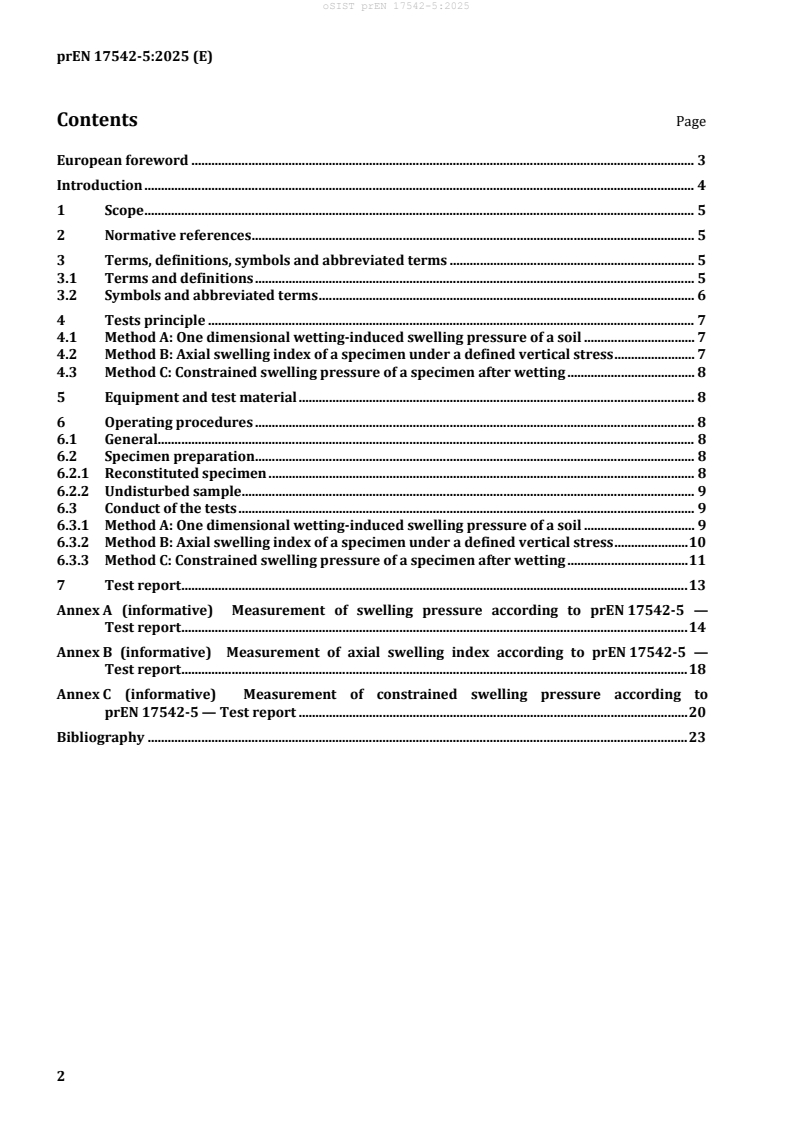
Contents Page
European foreword . 3
Introduction . 4
1 Scope . 5
2 Normative references . 5
3 Terms, definitions, symbols and abbreviated terms . 5
3.1 Terms and definitions . 5
3.2 Symbols and abbreviated terms . 6
4 Tests principle . 7
4.1 Method A: One dimensional wetting-induced swelling pressure of a soil . 7
4.2 Method B: Axial swelling index of a specimen under a defined vertical stress . 7
4.3 Method C: Constrained swelling pressure of a specimen after wetting . 8
5 Equipment and test material . 8
6 Operating procedures . 8
6.1 General. 8
6.2 Specimen preparation . 8
6.2.1 Reconstituted specimen . 8
6.2.2 Undisturbed sample . 9
6.3 Conduct of the tests . 9
6.3.1 Method A: One dimensional wetting-induced swelling pressure of a soil . 9
6.3.2 Method B: Axial swelling index of a specimen under a defined vertical stress . 10
6.3.3 Method C: Constrained swelling pressure of a specimen after wetting . 11
7 Test report . 13
Annex A (informative) Measurement of swelling pressure according to prEN 17542-5 —
Test report . 14
Annex B (informative) Measurement of axial swelling index according to prEN 17542-5 —
Test report . 18
Annex C (informative) Measurement of constrained swelling pressure according to
Bibliography . 23
European foreword
This document (prEN 17542-5:2025) has been prepared by Technical Committee CEN/TC 396
“Earthworks”, the secretariat of which is held by AFNOR.
This document is currently submitted to the CEN Enquiry.
Introduction
This document defines the terminology, specifies the characteristics of the apparatus, lays down the
procedure for carrying out a swelling potential test for soil by loading and wetting some specimens and
specifies the presentation of the results.
1 Scope
This document describes the reference methods for the determination of swelling, swelling pressure,
magnitude or potential of one-dimensional swelling of a soil when subjected, in the presence of water, to
vertical stresses under oedometric conditions.
It is used to assess the behaviour of earthwork platform that may be affected by the presence of swelling
soils.
These methods are used to determine three parameters related with the swelling of a soil: the swelling
pressure, the swelling index and the constrained swelling pressure.
These test methods specify the technique for specimen preparation, apparatus and procedure for
quantifying the amount of height change associated with swelling and procedures for reporting test
results.
The procedures given in these test methods are applicable to undisturbed, remoulded, recompacted or
reconstituted specimens.
2 Normative references
The following documents are referred to in the text in such a way that some or all of their content
constitutes requirements of this document. For dated references, only the edition cited applies. For
undated references, the latest edition of the referenced document (including any amendments) applies.
EN ISO 17892-1, Geotechnical investigation and testing — Laboratory testing of soil — Part 1:
Determination of water content (ISO 17892-1)
EN ISO 17892-5, Geotechnical investigation and testing - Laboratory testing of soil - Part 5: Incremental
loading oedometer test (ISO 17892-5)
EN ISO 22475-1, Geotechnical investigation and testing - Sampling methods and groundwater
measurements - Part 1: Technical principles for the sampling of soil, rock and groundwater (ISO 22475-1)
3 Terms, definitions, symbols and abbreviated terms
3.1 Terms and definitions
For the purposes of this document, the following terms and definitions apply.
ISO and IEC maintain terminology databases for use in standardization at the following addresses:
— ISO Online browsing platform: available at https://www.iso.org/obp/
— IEC Electropedia: available at https://www.electropedia.org/
3.1.1
oedometer
apparatus for axially loading a cylindrical-shaped specimen placed in a rigid cylinder and measuring its
variation (ΔH) of height (H)
Note 1 to entry: The upper and lower faces of the specimen, which may be submerged, are in contact with porous
or draining discs.
3.1.2
loading stress
σ
average total stress (σ) obtained by dividing the vertical axial force (N) by the cross-sectional area of the
cylindrical specimen, identical to that inside the oedometer
3.1.3
axial deformation
ΔH/H
deformation that occurs when an axial stress σ is applied to a specimen of laterally shrink-wrapped
material
3.1.4
swelling pressure
σ
sw
pressure that must be applied to the swelling soil so that when brought into contact with water at
atmospheric pressure, its corresponding vertical deformation is zero
3.1.5
constrained swelling pressure
σ
csw
pressure required to maintain constant volume to a swelling soil brought into contact with water
3.1.6
axial swelling index
I
sw
relative height increase of a laterally confined swelling soil, when brought into contact with water, under
a given axial loading stress
3.2 Symbols and abbreviated terms
For the purposes of this document, the following symbols and abbreviations apply:
A cross-sectional area of the specimen (mm )
D mean diameter of the oedometer ring (mm)
H height of the specimen before it is placed in water (mm)
i
H initial height of the specimen after placement in the oedometer and when subjected to
o
vertical stress due solely to the dead weight of the loading device (mm)
N axial force applied to the specimen (N)
Rsw swelling ratio (%)
e initial void ratio of the specimen at the start of the test
o
w water content of the specimen (%)
w water content of the specimen after unloading (%)
f
w initial water content of the specimen (%)
i
ΔH variation in height of the specimen under loading stress during the soaking phase
f
ΔH variation in height of the specimen under loading stress before any water is added
i
ρ dry density of the soil (Mg/m )
d
ρ dry density of the specimen after soaking (Mg/m )
df
ρ dry density of the test specimen before soaking (Mg/m )
di
σ loading stress applied to the specimen (kPa)
σ swelling pressure of the soil (kPa)
sw
σ’ vertical effective stress of the soil in situ (kPa)
v0
σ constrained swelling pressure of the soil (kPa)
csw
I axial swelling index, calculated as the relative increase in height of a specimen subjected to
sw
a vertical stress after wetting (%)
4 Tests principle
4.1 Method A: One dimensional wetting-induced swelling pressure of a soil
This test is carried out on at least four similar specimens. These may be prepared by the following
method, depending on the type of sample available:
— trimming from an undisturbed sample extruded from its sampling tube or from a block sample for
undisturbed soils,
— recompaction, remoulding, reconstitution or reconsolidation of disturbed soil, to specified conditions
in terms of water content, dry density and method of compaction (kneading, moist-tamping, or static).
Each soil sample is placed in a rigid cylindrical cell and a vertical constant stress is applied using
oedometric equipment in accordance with EN ISO 17892-5.
The test consists of applying a different vertical stress to each specimen, submerging them and measuring
the resulting variations in height.
This procedure is carried out to determine the swelling pressure σsw that is the stress corresponding to
zero deformation determined by a logarithmic representation of the variations in height ΔH/H according
the loading stresses applied.
4.2 Method B: Axial swelling index of a specimen under a defined vertical stress
This method is carried out to determine the swelling index of a soil, defined as the height increase
expressed as the percentage of the initial height of a specimen that is laterally confined and with a vertical
pressure.
The test is conducted to measure the one-dimensional wetting-induced swell strain of a single intact
specimen of natural soil, a reconstituted sample or a single intact specimen of compacted soil derived
from disturbed soil or an existing fill or embankment.
The specimen is loaded to a vertical stress of 10 kPa, for measuring the initial axial strain. Subsequently,
it is immersed to measure the wetting induced strain under that applied loading stress.
The axial swelling index is calculated, in percentage, with the following formula:
∆H
f
l × 100 (1)
sw
H
o
Sometimes it is required to know the swelling produced when a certain vertical pressure is applied. Then
proceed, as the previous section, replacing the vertical pressure of 10 kPa with the fixed pressure. The
ratio calculated should then refer to the vertical pressure applied, i.e; I (20 kPa) for a 20 kPa pressure
sw
applied.
=
4.3 Method C: Constrained swelling pressure of a specimen after wetting
This test is carried out for measuring the pressure that equilibrate the swelling of a compacted or natural
soil after wetting. This method can be referred to as loading-after-wetting test at constant volume.
The test is realized with an unaltered or a remolded sample, prepared according to EN ISO 17892-5. After
application of a light adjusting pressure, the cell is filled with water. From this moment, the load is
increased to maintain the deformation in the reference initial value. The equilibrium is reached when no
trend is observed in the evolution of deformation or pressure with time.
The constrained swelling pressure σ is the pressure applied on the specimen when reaching
csw
equilibrium. It is defined as the pressure that equilibrate the swelling of a compacted or natural soil under
volume constriction after wetting.
5 Equipment and test material
The oedometer equipment shall be in accordance with EN ISO 17892-5, including:
— a loading cap for applying pressures to the specimens;
— a cell in which the specimen is placed;
— two porous discs;
— a soaking tank;
— a measuring system allowing the height variations of the specimen as a function of time to be known.
In addition, the test requires the usual equipment for the extraction of samples from their container, the
preparation of the specimens and the determination of water contents and densities.
6 Operating procedures
6.1 General
The tests consist of applying a different but constant force to specimen and measuring the corresponding
axial deformation according to EN ISO 17892-5:
— in a first step without adding water;
— then in a second phase after having placed the specimen in the presence of water. If possible, the
water should be from the same location as the sample. If no, distilled water should be used. The origin
of the water shall be specified in the test report.
6.2 Specimen preparation
6.2.1 Reconstituted specimen
In the case of disturbed soil, the sample shall be prepared by compacting the material into a suitable
mould (e.g. a compaction mould), either at the required water content under the application of the
appropriate compaction effort or to achieve the specified dry density.
The sample shall be extruded from the mould and the test specimen shall be prepared according to
EN ISO 17892-5. The specimen is taken from the sample by pressing the ring of the oedometer in the form
of a cutting kit. The specimen shall then be smoothed and levelled at the upper and lower ends of the ring.
After levelling, any surface voids shall be filled. The preparation time should be kept as short as possible
to avoid water loss.
6.2.2 Undisturbed sample
The specimen is cored using the ring of the oedometer in the form of a cutting kit or cut to the dimensions
of the oedometer cell into which it is inserted, according to EN ISO 17892-5. It shall be levelled on both
sides of the ring or cell.
If multiple test specimens are used for the same test (see method A), they shall be taken from the same
sample at the same level. If the specimens are not homogeneous, the test shall be conducted at a different
level.
6.3 Conduct of the tests
6.3.1 Method A: One dimensional wetting-induced swelling pressure of a soil
6.3.1.1 Cell mounting
The specimen and the possible cutting ring of known geometric characteristics are weighed and then
introduced into the oedometer cell between the two porous discs.
The device for distributing the load on the specimen is placed in contact with the specimen and the system
for measuring the change in height of the specimen is set up. The mean stress due solely to the force
application device shall be less than 10 kPa.
6.3.1.2 Choice of the forces to be applied to the specimen
On the first specimen, a force is applied which, including the loading device, produces a loading stress of
10 kPa.
A stress shall be applied to the second specimen, the value of which is estimated so that the axial
deformation of the specimen in the presence of water is almost zero (less than 0,5 percent) or less
than 0,2 times the deformation of the first specimen.
The forces to be applied to the other specimens shall be chosen so as to have, in a graphical representation
(Ig(σ); ΔH /H), representative points best distributed between the values of the swelling
f i
pressure σ and 10 kPa.
sw
In the case of using undisturbed samples, one of the specimens shall be subjected to the effective vertical
stress under natural conditions.
6.3.1.3 Loading
The force corresponding to the test stress shall be applied for at least 2 h and until the change in height
of the specimen between two readings, spaced 1 h apart is less than 1/100 mm. Water is then introduced
into the soaking tank.
The force applied to the specimen is kept constant until its height stabilizes. The asymptotic value of the
height variation of the specimen is determined by plotting the heig
...
Questions, Comments and Discussion
Ask us and Technical Secretary will try to provide an answer. You can facilitate discussion about the standard in here.
Loading comments...