

EN 1114-3:2001+A1:2008
(Main + Amendment)Plastics and rubber machines - Extruders and extrusion lines - Part 3: Safety requirements for haul-offs
General Information
- Abstract
This European Standard contains the safety requirements for the design and construction of haul-offs used in extrusion lines for processing plastics and rubber for the hazards identified in clause 4. The following kinds of haul-offs are covered:
- caterpillar haul-offs;
- belt haul-offs;
- capstan haul-offs;
- belt capstan haul-offs;
- roller haul-offs.
The machine begins at the material inlet opening and ends at the material outlet.
Cutting units which are integrated with or attached to the haul-off are not covered.
Take-off devices used at film or sheet lines are not covered.
Chemical, toxicological and fire hazards which could occur for example in continuous vulcanisation plants due to the materials processed are not dealt with.
Unwinding and winding machines are not subject to this standard. They are being dealt with in a separate standard being produced by another working group of CEN/TC 145.
This document is not applicable to haul-offs which are manufactured before the date of publication by CEN of this document.
- Status
- Withdrawn
- Publication Date
- 07-Oct-2008
- Withdrawal Date
- 29-Sep-2026
- Technical Committee
- CEN/TC 145 - Rubber and plastics machines - Safety
- Drafting Committee
- CEN/TC 145/WG 3 - Extruders and extrusion lines - Safety
- Current Stage
- 9960 - Withdrawal effective - Withdrawal
- Start Date
- 04-Sep-2019
- Completion Date
- 30-Sep-2026
- Directive
- 2006/42/EC - Directive 2006/42/EC of the European Parliament and of the Council of 17 May 2006 on machinery, and amending Directive 95/16/EC (recast)OJ Ref: C, C 214 OJ Date: 08-Sep-2009


Relations
- Effective Date
- 19-Jan-2023
- Effective Date
- 29-Apr-2015
- Effective Date
- 09-Feb-2026
- Effective Date
- 09-Feb-2026
- Effective Date
- 28-Jan-2026
- Effective Date
- 28-Jan-2026
- Effective Date
- 28-Jan-2026
- Effective Date
- 28-Jan-2026
- Effective Date
- 28-Jan-2026
- Effective Date
- 28-Jan-2026
- Effective Date
- 28-Jan-2026
- Effective Date
- 28-Jan-2026
- Effective Date
- 28-Jan-2026
- Effective Date
- 28-Jan-2026
- Effective Date
- 28-Jan-2026
Get Certified
Connect with accredited certification bodies for this standard

DIN CERTCO
DIN Group product certification.

Smithers Quality Assessments
US management systems and product certification.
Sponsored listings
Frequently Asked Questions
EN 1114-3:2001+A1:2008 is a standard published by the European Committee for Standardization (CEN). Its full title is "Plastics and rubber machines - Extruders and extrusion lines - Part 3: Safety requirements for haul-offs". This standard covers: This European Standard contains the safety requirements for the design and construction of haul-offs used in extrusion lines for processing plastics and rubber for the hazards identified in clause 4. The following kinds of haul-offs are covered: - caterpillar haul-offs; - belt haul-offs; - capstan haul-offs; - belt capstan haul-offs; - roller haul-offs. The machine begins at the material inlet opening and ends at the material outlet. Cutting units which are integrated with or attached to the haul-off are not covered. Take-off devices used at film or sheet lines are not covered. Chemical, toxicological and fire hazards which could occur for example in continuous vulcanisation plants due to the materials processed are not dealt with. Unwinding and winding machines are not subject to this standard. They are being dealt with in a separate standard being produced by another working group of CEN/TC 145. This document is not applicable to haul-offs which are manufactured before the date of publication by CEN of this document.
This European Standard contains the safety requirements for the design and construction of haul-offs used in extrusion lines for processing plastics and rubber for the hazards identified in clause 4. The following kinds of haul-offs are covered: - caterpillar haul-offs; - belt haul-offs; - capstan haul-offs; - belt capstan haul-offs; - roller haul-offs. The machine begins at the material inlet opening and ends at the material outlet. Cutting units which are integrated with or attached to the haul-off are not covered. Take-off devices used at film or sheet lines are not covered. Chemical, toxicological and fire hazards which could occur for example in continuous vulcanisation plants due to the materials processed are not dealt with. Unwinding and winding machines are not subject to this standard. They are being dealt with in a separate standard being produced by another working group of CEN/TC 145. This document is not applicable to haul-offs which are manufactured before the date of publication by CEN of this document.
EN 1114-3:2001+A1:2008 is classified under the following ICS (International Classification for Standards) categories: 83.200 - Equipment for the rubber and plastics industries. The ICS classification helps identify the subject area and facilitates finding related standards.
EN 1114-3:2001+A1:2008 has the following relationships with other standards: It is inter standard links to EN 1114-3:2001, EN 1114-3:2019, EN 60529:1991, EN 60204-1:1997, EN ISO 11688-1:1998, EN ISO 4871:1996, EN 811:1996, EN 982:1996, EN ISO 11204:1995, EN 999:1998, EN 1088:1995, EN ISO 9614-2:1996, EN 418:1992, EN ISO 12100-2:2003, EN 954-1:1996. Understanding these relationships helps ensure you are using the most current and applicable version of the standard.
EN 1114-3:2001+A1:2008 is associated with the following European legislation: EU Directives/Regulations: 2006/42/EC, 98/37/EC; Standardization Mandates: M/079, M/396. When a standard is cited in the Official Journal of the European Union, products manufactured in conformity with it benefit from a presumption of conformity with the essential requirements of the corresponding EU directive or regulation.
EN 1114-3:2001+A1:2008 is available in PDF format for immediate download after purchase. The document can be added to your cart and obtained through the secure checkout process. Digital delivery ensures instant access to the complete standard document.
Standards Content (Sample)
2003-01.Slovenski inštitut za standardizacijo. Razmnoževanje celote ali delov tega standarda ni dovoljeno.Kunststoff- und Gummimaschinen - Extruder und Extrusionsanlagen - Teil 3: Sicherheitsanforderungen für AbzügeMachines pour les matières plastiques et le caoutchouc - Extrudeuses et lignes d'extrusion - Partie 3: Prescriptions de sécurité pour les extracteursPlastics and rubber machines - Extruders and extrusion lines - Part 3: Safety requirements for haul-offs83.200Oprema za gumarsko industrijo in industrijo polimernih materialovEquipment for the rubber and plastics industriesICS:Ta slovenski standard je istoveten z:EN 1114-3:2001+A1:2008SIST EN 1114-3:2001+A1:2008en01-december-2008SIST EN 1114-3:2001+A1:2008SLOVENSKI
STANDARD
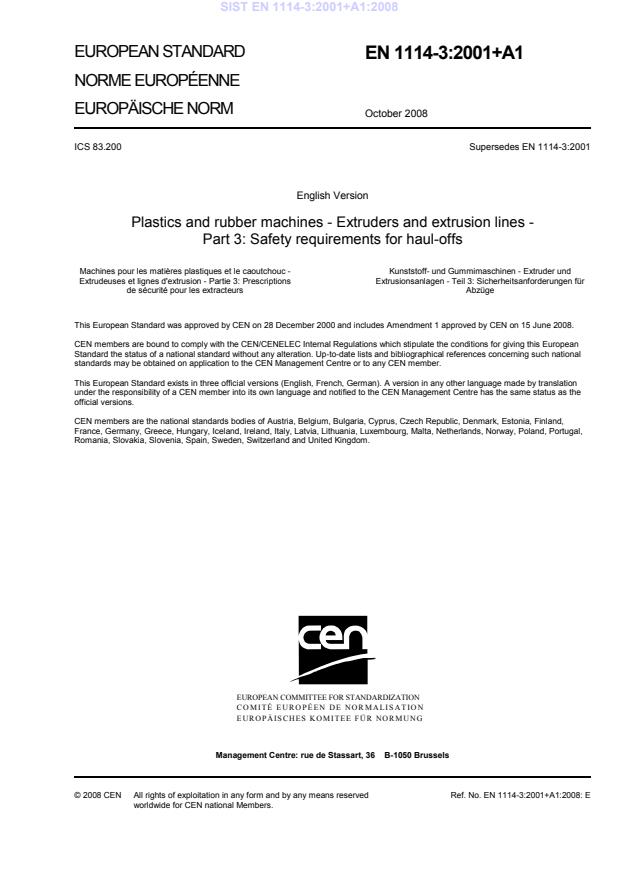
EUROPEAN STANDARD NORME EUROPÉENNE EUROPÄISCHE NORM
EN 1114-3:2001+A1
October 2008 ICS 83.200 Supersedes EN 1114-3:2001English Version
Plastics and rubber machines - Extruders and extrusion lines - Part 3: Safety requirements for haul-offs
Machines pour les matières plastiques et le caoutchouc - Extrudeuses et lignes d'extrusion - Partie 3: Prescriptions de sécurité pour les extracteurs
Kunststoff- und Gummimaschinen - Extruder und Extrusionsanlagen - Teil 3: Sicherheitsanforderungen für Abzüge This European Standard was approved by CEN on 28 December 2000 and includes Amendment 1 approved by CEN on 15 June 2008.
CEN members are bound to comply with the CEN/CENELEC Internal Regulations which stipulate the conditions for giving this European Standard the status of a national standard without any alteration. Up-to-date lists and bibliographical references concerning such national standards may be obtained on application to the CEN Management Centre or to any CEN member.
This European Standard exists in three official versions (English, French, German). A version in any other language made by translation under the responsibility of a CEN member into its own language and notified to the CEN Management Centre has the same status as the official versions.
CEN members are the national standards bodies of Austria, Belgium, Bulgaria, Cyprus, Czech Republic, Denmark, Estonia, Finland, France, Germany, Greece, Hungary, Iceland, Ireland, Italy, Latvia, Lithuania, Luxembourg, Malta, Netherlands, Norway, Poland, Portugal, Romania, Slovakia, Slovenia, Spain, Sweden, Switzerland and United Kingdom.
EUROPEAN COMMITTEE FOR STANDARDIZATION
COMITÉ EUROPÉEN DE NORMALISATION EUROPÄISCHES KOMITEE FÜR NORMUNG
Management Centre: rue de Stassart, 36
B-1050 Brussels © 2008 CEN All rights of exploitation in any form and by any means reserved worldwide for CEN national Members. Ref. No. EN 1114-3:2001+A1:2008: ESIST EN 1114-3:2001+A1:2008
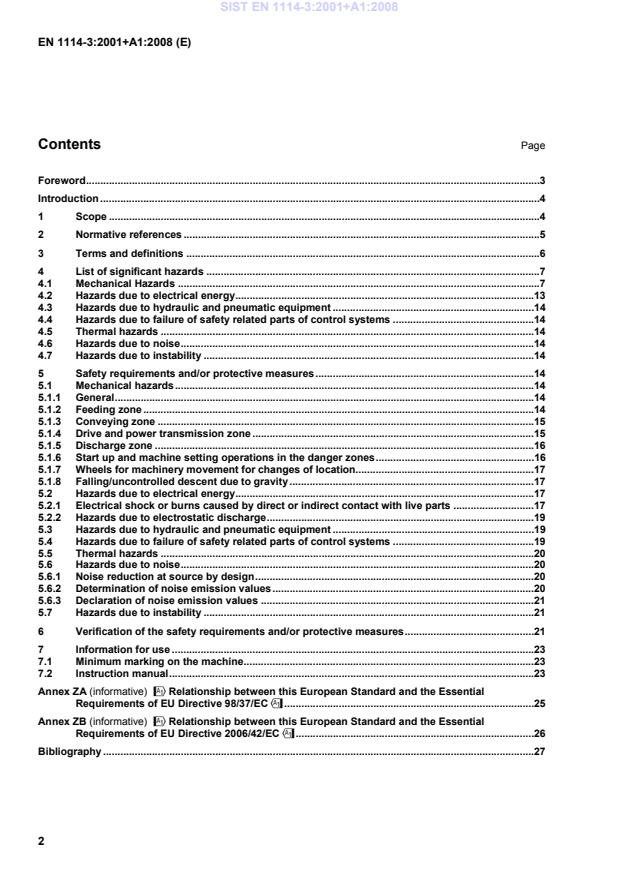
!Relationship between this European Standard and the Essential Requirements of EU Directive 98/37/EC".25 Annex ZB (informative)
!Relationship between this European Standard and the Essential Requirements of EU Directive 2006/42/EC".26 Bibliography.27
EN ISO 12100-2:2003 in the following clauses/sub-clauses: 2, 5, 5.1.1, 5.1.6, 5.5, 5.6.2, Table 2, 7.1, 7.2; minor changes in the Foreword and in sub-clauses 5.6.2 and 7.1, second and third indents." This document supersedes EN 1114-3:2001. The start and finish of text introduced or altered by amendment is indicated in the text by tags ! ". This European Standard has been prepared under a mandate given to CEN by the European Commission and the European Free Trade Association, and supports essential requirements of EU Directive(s). !For relationship with EU Directive(s), see informative Annexes ZA and ZB, which are integral parts of this document." This is the third in a series of standards on the safety of extruders and extrusion lines. Part 1 deals with extruders. Part 2 deals with die face pelletisers. According to the CEN/CENELEC Internal Regulations, the national standards organizations of the following countries are bound to implement this European Standard: Austria, Belgium, Bulgaria, Cyprus, Czech Republic, Denmark, Estonia, Finland, France, Germany, Greece, Hungary, Iceland, Ireland, Italy, Latvia, Lithuania, Luxembourg, Malta, Netherlands, Norway, Poland, Portugal, Romania, Slovakia, Slovenia, Spain, Sweden, Switzerland and United Kingdom.
3.2 caterpillar haul-off a device comprising two or more sets of linked elements equipped with gripping segments or lugs; one or more are driven. Grip is achieved when the elements are closed together by pressing the product between them (see figure 1).
3.3 belt haul-off a device comprising two counter-rotating belts set in line one above the other; one or both is driven. Grip is achieved when the belts are closed together by pressing the product between both belts (see figure 2).
3.4 capstan haul-off a device comprising one or more drums or wheels at least one of which is driven. Grip is achieved by the tension of the product, e.g. cables, flexible hoses, wrapped one or more times around the drum(s) or wheel(s) (see figure 3).
3.5 belt capstan haul-off a device comprising a wheel and a belt which covers at least partially the circumference of the wheel. The wheel, the belt or both are driven. Grip is achieved by pressing the product between the belt and the wheel (see figure 4).
3.6 roller haul-off a device comprising one or more sets of counter-rotating rolls set in line one above the other; one roller or both of each set is driven. Grip is achieved by pressing the product between the rollers (see figure 5). SIST EN 1114-3:2001+A1:2008
4 List of significant hazards 4.1 Mechanical Hazards Mechanical Hazards are: a
crushing b
cutting and severing c
shearing d
drawing in or trapping e
falling/uncontrolled descent due to gravity
These hazards are principally due to: the rotating parts of the drive and power transmission systems (a,b,c,d); the rotating drive rollers or wheel(s) or drum(s) with or without product (a, b, c, d); the moving parts of the conveying elements, such as caterpillars, belts, pressure rollers, return rollers, etc. with or without product (a,b,c,d,); the moving parts of the conveying element mountings during opening and closing (a, e); movement of the product through feed openings in guards (a,d); movement of the machine for changes of location (a).
a b c d e Feeding zone rotating drive rollers or wheel(s) or drum(s) with or without product x x x x
moving parts of the conveying elements, such as caterpillars, belts, back-up roller, deflection rollers, etc. with or without product x x x x
moving parts of the conveying element mountings during opening and closing x
x
movement of the product through feed openings in guards x
x
Conveying zone rotating drive rollers or wheel(s) or drum(s) with or without product x x x x
moving parts of the conveying elements, such as caterpillars, belts, pressure rollers, return rollers, etc. with or without product x x x x
moving parts of the conveying element mountings during opening and closing x
x Drive and power trans-mission zone rotating parts of the drive and power transmission systems x x x x
Discharge Zone rotating drive rollers or wheel(s) or drum(s) with or without product x x x x
moving parts of the conveying elements, such as caterpillars, belts, pressure rollers, return rollers, etc. with or without product x x x x
moving parts of the conveying element mountings during opening and closing x
x Movement of the wheels movement of the machine for changes of location x
Figures 1 to 5 show examples of haul-offs with danger zones
1) a = crushing hazards, b = cutting and severing hazards, c = shearing hazards, d = drawing in or trapping hazards, e = falling/uncontrolled descent due to gravity. SIST EN 1114-3:2001+A1:2008
Safety devices are not shown
Figure 1 — Example of the danger zones on a caterpillar haul-off
Safety devices are not shown Figure 2 — Example of the danger zones on a belt haul-off
Safety devices are not shown Figure 3 — Example of the danger zones on a capstan haul-off
Front view
Safety devices are not shown Rear view Figure 4 — Example of the danger zones on a belt capstan haul-off SIST EN 1114-3:2001+A1:2008
Safety devices are not shown Figure 5 — Example of the danger zones on a roller haul-off 4.2 Hazards due to electrical energy Electric shock or burns due for example to direct contact with parts that are live or with parts that have become live through electrical fault. Electric shock due to water carried over from upstream product cooling. Electric shock due to electrostatic phenomena. SIST EN 1114-3:2001+A1:2008
...