

EN 1047-1:2005
(Main)Secure storage units - Classification and methods of test for resistance to fire - Part 1: Data cabinets and diskette inserts
- Abstract
This part of this European Standard specifies requirements for fire resisting data cabinets and diskette inserts.
Two methods of test are specified to determine the ability of fire resisting data cabinets to protect temperature and humidity sensitive contents from the effects of fire: a fire endurance test and a fire shock and impact test. Two levels of fire severity (S 60 and S 120) based upon time of fire exposure; and three protection classes (P, D and DIS) are specified using the maximum temperature increases and humidity values permitted within the storage space of the data cabinet.
Diskette inserts (DI 60 P/DIS and DI 120 P/DIS) are installed in data cabinets of protection class S 60 P or S 120 P, respectively, and subjected to a fire endurance test (see 5.1.2).
Requirements are also specified for test specimens, the technical documentation for the test specimen, correlation of the test specimen with the technical documentation, preparation for type testing and test procedures.
A scheme to classify the fire resisting data cabinets and diskette inserts from the test results is also given (see Table 1).
Cabinets having the same design, protection and construction features (type and thickness of construction and protective materials, rebate geometry, locking, etc.) will only give the same fire protection classification as that of a test specimen if they are of similar internal dimensions. The maximum difference in internal dimensions (height, width and depth of the storage space, measured from wall to wall) to which the test classification could apply is + 15 %. Cabinets having internal dimensions which differ by more than this amount from that of the tested specimen should be submitted to an extra test.
The wall, ceiling and door thicknesses should not be below the specified minimum limit of the type-tested thickness by more than 3 %. ...
- Status
- Withdrawn
- Publication Date
- 04-Oct-2005
- Withdrawal Date
- 29-Sep-2026
- Technical Committee
- CEN/TC 263 - Secure storage of cash, valuables and data media
- Drafting Committee
- CEN/TC 263/WG 2 - Fire resistance
- Current Stage
- 9960 - Withdrawal effective - Withdrawal
- Start Date
- 21-Aug-2019
- Completion Date
- 30-Sep-2026



Relations
- Effective Date
- 22-Dec-2008
- Effective Date
- 26-Oct-2016
- Effective Date
- 09-Feb-2026
- Effective Date
- 09-Feb-2026
- Effective Date
- 28-Jan-2026
Get Certified
Connect with accredited certification bodies for this standard

BSI Group
BSI (British Standards Institution) is the business standards company that helps organizations make excellence a habit.

CIS Institut d.o.o.
Personal Protective Equipment (PPE) certification body. Notified Body NB-2890 for EU Regulation 2016/425 PPE.

Kiwa BDA Testing
Building and construction product certification.
Sponsored listings
Frequently Asked Questions
EN 1047-1:2005 is a standard published by the European Committee for Standardization (CEN). Its full title is "Secure storage units - Classification and methods of test for resistance to fire - Part 1: Data cabinets and diskette inserts". This standard covers: This part of this European Standard specifies requirements for fire resisting data cabinets and diskette inserts. Two methods of test are specified to determine the ability of fire resisting data cabinets to protect temperature and humidity sensitive contents from the effects of fire: a fire endurance test and a fire shock and impact test. Two levels of fire severity (S 60 and S 120) based upon time of fire exposure; and three protection classes (P, D and DIS) are specified using the maximum temperature increases and humidity values permitted within the storage space of the data cabinet. Diskette inserts (DI 60 P/DIS and DI 120 P/DIS) are installed in data cabinets of protection class S 60 P or S 120 P, respectively, and subjected to a fire endurance test (see 5.1.2). Requirements are also specified for test specimens, the technical documentation for the test specimen, correlation of the test specimen with the technical documentation, preparation for type testing and test procedures. A scheme to classify the fire resisting data cabinets and diskette inserts from the test results is also given (see Table 1). Cabinets having the same design, protection and construction features (type and thickness of construction and protective materials, rebate geometry, locking, etc.) will only give the same fire protection classification as that of a test specimen if they are of similar internal dimensions. The maximum difference in internal dimensions (height, width and depth of the storage space, measured from wall to wall) to which the test classification could apply is + 15 %. Cabinets having internal dimensions which differ by more than this amount from that of the tested specimen should be submitted to an extra test. The wall, ceiling and door thicknesses should not be below the specified minimum limit of the type-tested thickness by more than 3 %. ...
This part of this European Standard specifies requirements for fire resisting data cabinets and diskette inserts. Two methods of test are specified to determine the ability of fire resisting data cabinets to protect temperature and humidity sensitive contents from the effects of fire: a fire endurance test and a fire shock and impact test. Two levels of fire severity (S 60 and S 120) based upon time of fire exposure; and three protection classes (P, D and DIS) are specified using the maximum temperature increases and humidity values permitted within the storage space of the data cabinet. Diskette inserts (DI 60 P/DIS and DI 120 P/DIS) are installed in data cabinets of protection class S 60 P or S 120 P, respectively, and subjected to a fire endurance test (see 5.1.2). Requirements are also specified for test specimens, the technical documentation for the test specimen, correlation of the test specimen with the technical documentation, preparation for type testing and test procedures. A scheme to classify the fire resisting data cabinets and diskette inserts from the test results is also given (see Table 1). Cabinets having the same design, protection and construction features (type and thickness of construction and protective materials, rebate geometry, locking, etc.) will only give the same fire protection classification as that of a test specimen if they are of similar internal dimensions. The maximum difference in internal dimensions (height, width and depth of the storage space, measured from wall to wall) to which the test classification could apply is + 15 %. Cabinets having internal dimensions which differ by more than this amount from that of the tested specimen should be submitted to an extra test. The wall, ceiling and door thicknesses should not be below the specified minimum limit of the type-tested thickness by more than 3 %. ...
EN 1047-1:2005 is classified under the following ICS (International Classification for Standards) categories: 13.220.40 - Ignitability and burning behaviour of materials and products; 13.310 - Protection against crime; 35.020 - Information technology (IT) in general. The ICS classification helps identify the subject area and facilitates finding related standards.
EN 1047-1:2005 has the following relationships with other standards: It is inter standard links to EN 1047-1:1996, EN 1047-1:2019, EN 61515:2016, EN 60584-1:2013, EN 1363-1:1999. Understanding these relationships helps ensure you are using the most current and applicable version of the standard.
EN 1047-1:2005 is available in PDF format for immediate download after purchase. The document can be added to your cart and obtained through the secure checkout process. Digital delivery ensures instant access to the complete standard document.
Standards Content (Sample)
2003-01.Slovenski inštitut za standardizacijo. Razmnoževanje celote ali delov tega standarda ni dovoljeno.Wertbehältnisse - Klassifizierung und Methoden zur Prüfung des Widerstandes gegen Brand - Teil 1: Datensicherungsschränke und DisketteneinsätzeUnités de stockage en lieu sur - Classification et méthodes d'essai de résistance au feu - Partie 1: Meubles de rangement fermés et cartouches a disquettesSecure storage units - Classification and methods of test for resistance to fire - Part 1: Data cabinets and diskette inserts35.220.99Druge naprave za shranjevanje podatkovOther data storage devices13.310Varstvo pred kriminalomProtection against crime13.220.40Sposobnost vžiga in obnašanje materialov in proizvodov pri gorenjuIgnitability and burning behaviour of materials and productsICS:Ta slovenski standard je istoveten z:EN 1047-1:2005SIST EN 1047-1:2006en01-marec-2006SIST EN 1047-1:2006SLOVENSKI
STANDARDSIST EN 1047-1:19971DGRPHãþD
EUROPEAN STANDARDNORME EUROPÉENNEEUROPÄISCHE NORMEN 1047-1October 2005ICS 13.220.40; 13.310; 35.020Supersedes EN 1047-1:1996
English VersionSecure storage units - Classification and methods of test forresistance to fire - Part 1: Data cabinets and diskette insertsUnités de stockage en lieu sûr - Classification et méthodesd'essais de résistance au feu - Partie 1: Meubles ignifugeset containers pour supports sensiblesWertbehältnisse - Klassifizierung und Methoden zurPrüfung des Widerstandes gegen Brand - Teil 1:Datensicherungsschränke und DisketteneinsätzeThis European Standard was approved by CEN on 26 August 2005.CEN members are bound to comply with the CEN/CENELEC Internal Regulations which stipulate the conditions for giving this EuropeanStandard the status of a national standard without any alteration. Up-to-date lists and bibliographical references concerning such nationalstandards may be obtained on application to the Central Secretariat or to any CEN member.This European Standard exists in three official versions (English, French, German). A version in any other language made by translationunder the responsibility of a CEN member into its own language and notified to the Central Secretariat has the same status as the officialversions.CEN members are the national standards bodies of Austria, Belgium, Cyprus, Czech Republic, Denmark, Estonia, Finland, France,Germany, Greece, Hungary, Iceland, Ireland, Italy, Latvia, Lithuania, Luxembourg, Malta, Netherlands, Norway, Poland, Portugal, Slovakia,Slovenia, Spain, Sweden, Switzerland and United Kingdom.EUROPEAN COMMITTEE FOR STANDARDIZATIONCOMITÉ EUROPÉEN DE NORMALISATIONEUROPÄISCHES KOMITEE FÜR NORMUNGManagement Centre: rue de Stassart, 36
B-1050 Brussels© 2005 CENAll rights of exploitation in any form and by any means reservedworldwide for CEN national Members.Ref. No. EN 1047-1:2005: ESIST EN 1047-1:2006
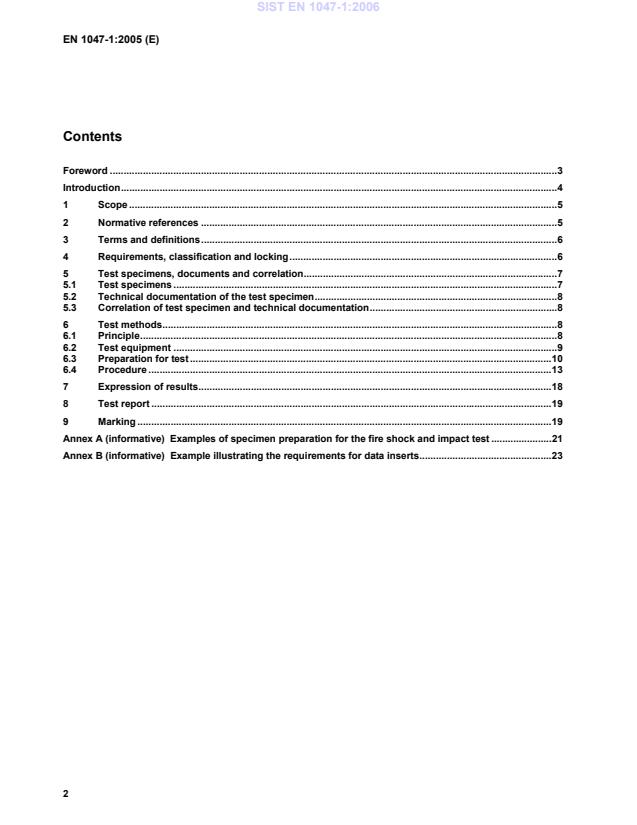
Examples of specimen preparation for the fire shock and impact test.21 Annex B (informative)
Example illustrating the requirements for data inserts.23
EN 1047-2 Secure storage units
Classification and methods of test for resistance to fire Part 2: Data rooms and data containers According to the CEN/CENELEC Internal Regulations, the national standards organizations of the following countries are bound to implement this European Standard: Austria, Belgium, Cyprus, Czech Republic, Denmark, Estonia, Finland, France, Germany, Greece, Hungary, Iceland, Ireland, Italy, Latvia, Lithuania, Luxembourg, Malta, Netherlands, Norway, Poland, Portugal, Slovakia, Slovenia, Spain, Sweden, Switzerland and United Kingdom. SIST EN 1047-1:2006
S 60 D/S 120 D (50 K) and S 60 DIS/S 120 DIS (30 K) for data cabinets as well as DI 60 P/DIS (30 K) and DI 120 P/DIS (30 K) for diskette inserts from a starting temperature of (21 ± 1) °C, and for the maximum relative humidity (85 %) for the D and DIS protection classes, as defined in this European Standard, refer to the relatively short-term stress due to high temperatures during a fire test. They are not normally experienced by data media stored in data cabinets and diskette inserts in the normal and correct way. SIST EN 1047-1:2006
1 Scope This part of this European Standard specifies requirements for fire resisting data cabinets and diskette inserts.
Two methods of test are specified to determine the ability of fire resisting data cabinets to protect temperature and humidity sensitive contents from the effects of fire: a fire endurance test and a fire shock and impact test. Two levels of fire severity (S 60 and S 120) based upon time of fire exposure; and three protection classes (P, D and DIS) are specified using the maximum temperature increases and humidity values permitted within the storage space of the data cabinet. Diskette inserts (DI 60 P/DIS and DI 120 P/DIS) are installed in data cabinets of protection class S 60 P or S 120 P, respectively, and subjected to a fire endurance test (see 5.1.2). Requirements are also specified for test specimens, the technical documentation for the test specimen, correlation of the test specimen with the technical documentation, preparation for type testing and test procedures. A scheme to classify the fire resisting data cabinets and diskette inserts from the test results is also given (see Table 1). Cabinets having the same design, protection and construction features (type and thickness of construction and protective materials, rebate geometry, locking, etc.) will only give the same fire protection classification as that of a test specimen if they are of similar internal dimensions. The maximum difference in internal dimensions (height, width and depth of the storage space, measured from wall to wall) to which the test classification could apply is + 15 %. Cabinets having internal dimensions which differ by more than this amount from that of the tested specimen should be submitted to an extra test. The wall, ceiling and door thicknesses should not be below the specified minimum limit of the type-tested thickness by more than 3 %.
Diskette inserts should only be installed in data cabinets having the same design as the series of protection class S 60 P and S 120 P, respectively, in which the insert has been tested in accordance with 5.1.2. Where several inserts are installed, they should be built in one beside the other or one above the other from bottom to top, respectively. The volume and total height of the installed inserts should not exceed 50 % of the total internal volume or 50 % of the internal height, respectively, of the data cabinets into which they are installed. The dimensions of the insert can be adapted by increasing the width and depth to the corresponding dimensions of the data cabinets. A reduction of these dimensions as well as a change of the height is only admitted within the specified tolerance.
The temperature increases during type-tests on data cabinets and diskette inserts will be considered in deciding the permitted diskette insert installations. For a permitted installation, the temperature increase of the intended data cabinet (∆Ta K) should not exceed the temperature increase of the tested data cabinet (∆Tb K) in which the diskette insert has been type-tested by more than the difference between the maximum value for the diskette insert (∆Ti K) and the maximum admissible temperature increase (30 K), i.e: ∆Ta - ∆Tb ≤ 30 K - ∆Ti (See example in Annex B). A description of the installation of the diskette inserts should be given in the technical documentation of the manufacturer.
2 Normative references The following referenced documents are indispensable for the application of this document. For dated references, only the edition cited applies. For undated references, the latest edition of the referenced document (including any amendments) applies. EN 1363-1:1999, Fire resistance tests – Part 1: General requirements EN 60584-1 Thermocouples – Part 1: Reference tables (IEC 60584-1:1995) SIST EN 1047-1:2006
diskette insert insert which is installed in a data cabinet of protection class S 60 P or S 120 P, respectively 3.3 media material holding data including paper documents, magnetic tapes, films, diskettes, cassettes, optical disks and video and audio cassettes 3.4 compartment part of a data cabinet which is closed with a separate door, lid or cover NOTE A compartment formed by inserting a shelf board is not a compartment within the meaning of this standard. 4 Requirements, classification and locking 4.1 Data cabinets and diskette inserts shall provide protection against the effects of fire (see Clause 6) and be classified as specified in Table 1. SIST EN 1047-1:2006
Table 1 — Protection class requirements
Protection class
Maximum temperature increase
Maximum relative
humidity 60 min 120 min
S 60 P S 120 P 150 K no requirement S 60 D S 120 D 50 K 85 % S 60 DIS S 120 DIS 30 K 85 % DI 60 P/DIS DI 120 P/DIS 30 K 85 %
Where S is the symbol applied to fire resisting data cabinets, DI the symbol for the diskette insert. The numerical values in the protection class are the duration of fire exposure during the type test in minutes; the letters characterise the types of media that can be protected in each class as follows: P Thermally sensitive paper documents, but excluding papers of grades which lose data below 170 °C. D Thermally and humidity sensitive media such as magnetic media and thermally sensitive documents, but excluding media which lose data below 70 °C and a relative air humidity above 85 %. DIS Thermally and humidity sensitive media such as diskettes, but excluding media which lose data below 50 °C and a relative air humidity above 85 %. NOTE P/DIS inserts only provide DIS protection when correctly installed in the appropriate P class data cabinet.
4.2 Data cabinets shall be fitted with a lock. 5 Test specimens, documents and correlation
5.1 Test specimens 5.1.1 Data cabinets Two identical data cabinets shall be available: one for the fire endurance test, the other for the fire shock and impact test. The test specimen for the fire endurance test shall be modified at its base for installing the measuring instrumentation (see 6.3.1 and Figure 2) and may have, but need not have a plinth.
The date(s) on which the test specimens were filled with protection materials shall be given. A statement of the protection class the test specimen shall be tested to shall be given. NOTE 2 In connection with the type test, the testing laboratory should mark three sets of the technical documentation with signature, stamp and date. One set is sent to the applicant. One set is added to the monitoring documentation for certification and quality assurance, and one set is kept in the testing files of the test laboratory. 5.3 Correlation of test specimen and technical documentation
Examine the correlation of the test specimens with the technical documentation before and after commencing the type test. Establish that the dimensions, design, materials and type of construction of the test specimens correspond to the technical documentation (see 5.2). Make a photographic record of the following construction details: the outside of the cabinet, the inside of the cabinet, rabbet edges, seals and plinth. The mass of the lighter test specimen (data cabinets) shall not deviate from the heavier by more than 10 %. For this comparison add the mass of the plinth specified (see 5.1) to the mass of the test specimen supplied for the fire endurance test if that test specimen was supplied with no plinth. 6 Test methods 6.1 Principle The fire endurance of the test specimen is assessed by heating and cooling in a furnace. The performance of the test specimen against fire shock and impact is assessed by a heating/cooling regime combined with a drop test. During these type tests the temperature and, where appropriate, the relative humidity in the interior of the test specimen is measured.
...