

ASTM D4806-21a
(Specification)Standard Specification for Denatured Fuel Ethanol for Blending with Gasolines for Use as Automotive Spark-Ignition Engine Fuel
General Information
- Abstract
ABSTRACT
This specification covers nominally anhydrous denatured fuel ethanol intended for blending with unleaded or leaded gasolines for use as a spark-ignition automotive engine fuel. Denatured fuel ethanol shall conform to the specified performance requirements for the following: ethanol content, methanol, solvent-washed gum, water content, denaturant content, inorganic chloride content, copper content, acidity, pHe, sulfur content, sulfate content, appearance, and specific gravity. The only denaturants used for fuel ethanol shall be natural gasoline, gasoline components, or unleaded gasoline at the minimum concentration prescribed. Prohibited denaturants include methanol which does not meet the specified requirement, pyrroles, turpentine, ketones, and tars (high-molecular weight pyrolysis products of fossil or nonfossil vegetable matter). Sampling, containers, and sample handling techniques, and the test methods for determining conformance to the specified requirements are given.
SCOPE
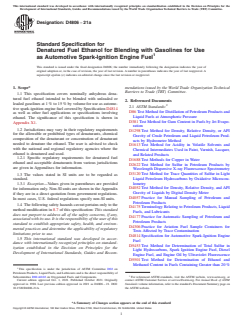
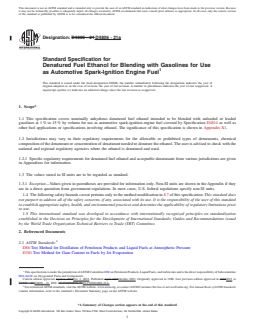
1.1 This specification covers nominally anhydrous denatured fuel ethanol intended to be blended with unleaded or leaded gasolines at 1 % to 15 % by volume for use as automotive spark-ignition engine fuel covered by Specification D4814 as well as other fuel applications or specifications involving ethanol. The significance of this specification is shown in Appendix X1.
1.2 Jurisdictions may vary in their regulatory requirements for the allowable or prohibited types of denaturants, chemical composition of the denaturant or concentration of denaturant needed to denature the ethanol. The user is advised to check with the national and regional regulatory agencies where the ethanol is denatured and used.
1.2.1 Specific regulatory requirements for denatured fuel ethanol and acceptable denaturants from various jurisdictions are given in Appendixes for information.
1.3 The values stated in SI units are to be regarded as standard.
1.3.1 Exception—Values given in parentheses are provided for information only. Non-SI units are shown in the Appendix if they are in a direct quotation from government regulations. In most cases, U.S. federal regulations specify non-SI units.
1.4 The following safety hazards caveat pertains only to the method modification in 8.7 of this specification: This standard does not purport to address all of the safety concerns, if any, associated with its use. It is the responsibility of the user of this standard to establish appropriate safety, health, and environmental practices and determine the applicability of regulatory limitations prior to use.
1.5 This international standard was developed in accordance with internationally recognized principles on standardization established in the Decision on Principles for the Development of International Standards, Guides and Recommendations issued by the World Trade Organization Technical Barriers to Trade (TBT) Committee.
- Status
- Published
- Publication Date
- 30-Sep-2021
- Technical Committee
- D02 - Petroleum Products, Liquid Fuels, and Lubricants
- Drafting Committee
- D02.A0.02 - Oxygenated Fuels and Components
Buy Documents
ASTM D4806-21a - Standard Specification for Denatured Fuel Ethanol for Blending with Gasolines for Use as Automotive Spark-Ignition Engine Fuel
REDLINE ASTM D4806-21a - Standard Specification for Denatured Fuel Ethanol for Blending with Gasolines for Use as Automotive Spark-Ignition Engine Fuel
Overview
ASTM D4806-21a: Standard Specification for Denatured Fuel Ethanol for Blending with Gasolines for Use as Automotive Spark-Ignition Engine Fuel provides essential requirements and guidelines for fuel ethanol intended for use in automotive spark-ignition engines. Issued by ASTM International, this standard ensures that denatured fuel ethanol meets specific quality and performance criteria, making it suitable for blending with both unleaded and leaded gasolines at concentrations between 1% and 15% by volume.
Denatured fuel ethanol is a key component in the production of gasoline-ethanol blends such as E10 and E15. This standard covers ethanol’s key properties, the types and concentrations of denaturants permitted, critical quality tests, and includes considerations for regulatory compliance and safety. The document is globally recognized and developed in accordance with international standardization principles.
Key Topics
- Physical and Chemical Requirements: ASTM D4806-21a specifies limits on ethanol content, water, methanol, sulfur, solvent-washed gum, inorganic chlorides, copper, acidity (as acetic acid), pHe, sulfate, appearance, and specific gravity.
- Permitted and Prohibited Denaturants: Only natural gasoline, gasoline blendstocks, or unleaded gasoline are allowed as denaturants. Methanol (not meeting requirements), turpentine, pyrroles, tars, and certain ketones are strictly prohibited to prevent harm to engine performance and emission systems.
- Sampling and Testing: The specification outlines requirements for proper sampling procedures, compatible containers, and reliable handling techniques to ensure representative and uncontaminated fuel samples.
- Regulatory Compliance: The standard recognizes that local, national, and regional regulations may influence denaturant types, composition, and concentration. Compliance with jurisdictional requirements is crucial for manufacturers and blenders.
- Workmanship and Appearance: Denatured fuel ethanol must be visually clear and free from sediment or undissolved matter at the point of custody transfer. It should also be resistant to phase separation at low temperatures.
- Blending and Documentation: Certified information on denaturant volumes and key quality characteristics must be maintained to meet regulatory and purchaser requirements.
Applications
- Automotive Fuel Blending: The main application of ASTM D4806-21a is to certify denatured ethanol used in blending with gasoline for use in spark-ignition internal combustion engines, as found in passenger vehicles and light-duty trucks.
- Quality Assurance for Fuel Producers: Refineries, fuel blenders, and ethanol producers rely on this standard to ensure that their ethanol meets industry and regulatory specifications before distribution.
- Regulatory Compliance: Organizations must demonstrate conformity with this standard’s requirements, especially in regulated markets such as the United States and California, where fuel quality, denaturant type, and composition are strictly controlled.
- Environmental and Emissions Control: By mandating limits on contaminants such as sulfur and methanol, ASTM D4806-21a supports initiatives to reduce vehicle emissions, improve air quality, and comply with renewable fuel standards.
- International Trade: As a globally recognized specification, adherence to ASTM D4806-21a facilitates cross-border trading of denatured fuel ethanol and gasoline blends.
Related Standards
- ASTM D4814: Specification for Automotive Spark-Ignition Engine Fuel, typically referenced for base gasoline.
- ASTM D5501: Test Method for Determination of Ethanol and Methanol Content in Fuels.
- ASTM D381: Test Method for Gum Content in Fuels by Jet Evaporation.
- ASTM D7923, E203, E1064: Test Methods for Water Content Determination in Fuels.
- ASTM D7795: Test Method for Acidity in Ethanol and Ethanol Blends.
- ASTM D6423: Test Method for Determination of pHe in Ethanol and Blends.
- ASTM D2622, D3120, D5453, D7039: Test Methods for Sulfur in Petroleum Products.
- ASTM D4057, E300: Practices for Sampling Petroleum and Industrial Chemicals.
- Regulatory References: U.S. Code of Federal Regulations (CFR), California Code of Regulations (CCR).
By following ASTM D4806-21a, stakeholders in the automotive fuel industry can ensure safe, efficient, and environmentally responsible blending and use of denatured fuel ethanol in gasoline applications. This standard helps safeguard engine performance, minimize emissions, and facilitate regulatory compliance throughout the fuel supply chain.
Relations
- Effective Date
- 01-Jan-2024
- Effective Date
- 01-Jan-2024
- Effective Date
- 01-Jan-2024
- Refers
ASTM D4175-23a - Standard Terminology Relating to Petroleum Products, Liquid Fuels, and Lubricants - Effective Date
- 15-Dec-2023
- Effective Date
- 01-Dec-2023
- Effective Date
- 01-Dec-2023
- Effective Date
- 01-Dec-2023
- Refers
ASTM D4175-23e1 - Standard Terminology Relating to Petroleum Products, Liquid Fuels, and Lubricants - Effective Date
- 01-Jul-2023
- Effective Date
- 01-Feb-2020
- Effective Date
- 01-Dec-2019
- Effective Date
- 01-Jul-2019
- Effective Date
- 01-Jun-2019
- Effective Date
- 01-Oct-2018
- Effective Date
- 01-Apr-2018
- Effective Date
- 01-Jan-2018
Buy Documents
ASTM D4806-21a - Standard Specification for Denatured Fuel Ethanol for Blending with Gasolines for Use as Automotive Spark-Ignition Engine Fuel
REDLINE ASTM D4806-21a - Standard Specification for Denatured Fuel Ethanol for Blending with Gasolines for Use as Automotive Spark-Ignition Engine Fuel
Get Certified
Connect with accredited certification bodies for this standard

Element Materials Technology
Materials testing and product certification.

ABS Group Brazil
ABS Group certification services in Brazil.

ABS Quality Evaluations Inc.
American Bureau of Shipping quality certification.
Sponsored listings
Frequently Asked Questions
ASTM D4806-21a is a technical specification published by ASTM International. Its full title is "Standard Specification for Denatured Fuel Ethanol for Blending with Gasolines for Use as Automotive Spark-Ignition Engine Fuel". This standard covers: ABSTRACT This specification covers nominally anhydrous denatured fuel ethanol intended for blending with unleaded or leaded gasolines for use as a spark-ignition automotive engine fuel. Denatured fuel ethanol shall conform to the specified performance requirements for the following: ethanol content, methanol, solvent-washed gum, water content, denaturant content, inorganic chloride content, copper content, acidity, pHe, sulfur content, sulfate content, appearance, and specific gravity. The only denaturants used for fuel ethanol shall be natural gasoline, gasoline components, or unleaded gasoline at the minimum concentration prescribed. Prohibited denaturants include methanol which does not meet the specified requirement, pyrroles, turpentine, ketones, and tars (high-molecular weight pyrolysis products of fossil or nonfossil vegetable matter). Sampling, containers, and sample handling techniques, and the test methods for determining conformance to the specified requirements are given. SCOPE 1.1 This specification covers nominally anhydrous denatured fuel ethanol intended to be blended with unleaded or leaded gasolines at 1 % to 15 % by volume for use as automotive spark-ignition engine fuel covered by Specification D4814 as well as other fuel applications or specifications involving ethanol. The significance of this specification is shown in Appendix X1. 1.2 Jurisdictions may vary in their regulatory requirements for the allowable or prohibited types of denaturants, chemical composition of the denaturant or concentration of denaturant needed to denature the ethanol. The user is advised to check with the national and regional regulatory agencies where the ethanol is denatured and used. 1.2.1 Specific regulatory requirements for denatured fuel ethanol and acceptable denaturants from various jurisdictions are given in Appendixes for information. 1.3 The values stated in SI units are to be regarded as standard. 1.3.1 Exception—Values given in parentheses are provided for information only. Non-SI units are shown in the Appendix if they are in a direct quotation from government regulations. In most cases, U.S. federal regulations specify non-SI units. 1.4 The following safety hazards caveat pertains only to the method modification in 8.7 of this specification: This standard does not purport to address all of the safety concerns, if any, associated with its use. It is the responsibility of the user of this standard to establish appropriate safety, health, and environmental practices and determine the applicability of regulatory limitations prior to use. 1.5 This international standard was developed in accordance with internationally recognized principles on standardization established in the Decision on Principles for the Development of International Standards, Guides and Recommendations issued by the World Trade Organization Technical Barriers to Trade (TBT) Committee.
ABSTRACT This specification covers nominally anhydrous denatured fuel ethanol intended for blending with unleaded or leaded gasolines for use as a spark-ignition automotive engine fuel. Denatured fuel ethanol shall conform to the specified performance requirements for the following: ethanol content, methanol, solvent-washed gum, water content, denaturant content, inorganic chloride content, copper content, acidity, pHe, sulfur content, sulfate content, appearance, and specific gravity. The only denaturants used for fuel ethanol shall be natural gasoline, gasoline components, or unleaded gasoline at the minimum concentration prescribed. Prohibited denaturants include methanol which does not meet the specified requirement, pyrroles, turpentine, ketones, and tars (high-molecular weight pyrolysis products of fossil or nonfossil vegetable matter). Sampling, containers, and sample handling techniques, and the test methods for determining conformance to the specified requirements are given. SCOPE 1.1 This specification covers nominally anhydrous denatured fuel ethanol intended to be blended with unleaded or leaded gasolines at 1 % to 15 % by volume for use as automotive spark-ignition engine fuel covered by Specification D4814 as well as other fuel applications or specifications involving ethanol. The significance of this specification is shown in Appendix X1. 1.2 Jurisdictions may vary in their regulatory requirements for the allowable or prohibited types of denaturants, chemical composition of the denaturant or concentration of denaturant needed to denature the ethanol. The user is advised to check with the national and regional regulatory agencies where the ethanol is denatured and used. 1.2.1 Specific regulatory requirements for denatured fuel ethanol and acceptable denaturants from various jurisdictions are given in Appendixes for information. 1.3 The values stated in SI units are to be regarded as standard. 1.3.1 Exception—Values given in parentheses are provided for information only. Non-SI units are shown in the Appendix if they are in a direct quotation from government regulations. In most cases, U.S. federal regulations specify non-SI units. 1.4 The following safety hazards caveat pertains only to the method modification in 8.7 of this specification: This standard does not purport to address all of the safety concerns, if any, associated with its use. It is the responsibility of the user of this standard to establish appropriate safety, health, and environmental practices and determine the applicability of regulatory limitations prior to use. 1.5 This international standard was developed in accordance with internationally recognized principles on standardization established in the Decision on Principles for the Development of International Standards, Guides and Recommendations issued by the World Trade Organization Technical Barriers to Trade (TBT) Committee.
ASTM D4806-21a is classified under the following ICS (International Classification for Standards) categories: 75.160.20 - Liquid fuels. The ICS classification helps identify the subject area and facilitates finding related standards.
ASTM D4806-21a has the following relationships with other standards: It is inter standard links to ASTM D4814-24, ASTM E203-24, ASTM E1064-24, ASTM D4175-23a, ASTM D4814-23a, ASTM D86-23ae1, ASTM D86-23a, ASTM D4175-23e1, ASTM D4814-20, ASTM D4814-19a, ASTM D5453-19a, ASTM D7923-19, ASTM D4814-18c, ASTM D4814-18a, ASTM D4814-18. Understanding these relationships helps ensure you are using the most current and applicable version of the standard.
ASTM D4806-21a is available in PDF format for immediate download after purchase. The document can be added to your cart and obtained through the secure checkout process. Digital delivery ensures instant access to the complete standard document.
Standards Content (Sample)
This international standard was developed in accordance with internationally recognized principles on standardization established in the Decision on Principles for the
Development of International Standards, Guides and Recommendations issued by the World Trade Organization Technical Barriers to Trade (TBT) Committee.
Designation:D4806 −21a
Standard Specification for
Denatured Fuel Ethanol for Blending with Gasolines for Use
as Automotive Spark-Ignition Engine Fuel
This standard is issued under the fixed designation D4806; the number immediately following the designation indicates the year of
original adoption or, in the case of revision, the year of last revision. A number in parentheses indicates the year of last reapproval. A
superscript epsilon (´) indicates an editorial change since the last revision or reapproval.
1. Scope* mendations issued by the World Trade Organization Technical
Barriers to Trade (TBT) Committee.
1.1 This specification covers nominally anhydrous dena-
tured fuel ethanol intended to be blended with unleaded or
2. Referenced Documents
leaded gasolines at 1 % to 15 % by volume for use as automo-
2.1 ASTM Standards:
tive spark-ignition engine fuel covered by Specification D4814
D86 Test Method for Distillation of Petroleum Products and
as well as other fuel applications or specifications involving
Liquid Fuels at Atmospheric Pressure
ethanol. The significance of this specification is shown in
D381 Test Method for Gum Content in Fuels by Jet Evapo-
Appendix X1.
ration
1.2 Jurisdictions may vary in their regulatory requirements
D1298 Test Method for Density, Relative Density, or API
for the allowable or prohibited types of denaturants, chemical
Gravity of Crude Petroleum and Liquid Petroleum Prod-
composition of the denaturant or concentration of denaturant
ucts by Hydrometer Method
needed to denature the ethanol. The user is advised to check
D1613 Test Method for Acidity in Volatile Solvents and
with the national and regional regulatory agencies where the
Chemical Intermediates Used in Paint, Varnish, Lacquer,
ethanol is denatured and used.
and Related Products
1.2.1 Specific regulatory requirements for denatured fuel
D1688 Test Methods for Copper in Water
ethanol and acceptable denaturants from various jurisdictions
D2622 Test Method for Sulfur in Petroleum Products by
are given in Appendixes for information.
Wavelength Dispersive X-ray Fluorescence Spectrometry
D3120 Test Method for Trace Quantities of Sulfur in Light
1.3 The values stated in SI units are to be regarded as
Liquid Petroleum Hydrocarbons by Oxidative Microcou-
standard.
lometry
1.3.1 Exception—Values given in parentheses are provided
D4052 Test Method for Density, Relative Density, and API
for information only. Non-SI units are shown in the Appendix
Gravity of Liquids by Digital Density Meter
if they are in a direct quotation from government regulations.
D4057 Practice for Manual Sampling of Petroleum and
In most cases, U.S. federal regulations specify non-SI units.
Petroleum Products
1.4 The following safety hazards caveat pertains only to the
D4175 Terminology Relating to Petroleum Products, Liquid
method modification in 8.7 of this specification: This standard
Fuels, and Lubricants
does not purport to address all of the safety concerns, if any,
D4177 Practice for Automatic Sampling of Petroleum and
associated with its use. It is the responsibility of the user of this
Petroleum Products
standard to establish appropriate safety, health, and environ-
D4306 Practice for Aviation Fuel Sample Containers for
mental practices and determine the applicability of regulatory
Tests Affected by Trace Contamination
limitations prior to use.
D4814 Specification for Automotive Spark-Ignition Engine
1.5 This international standard was developed in accor-
Fuel
dance with internationally recognized principles on standard-
D5453 Test Method for Determination of Total Sulfur in
ization established in the Decision on Principles for the
Light Hydrocarbons, Spark Ignition Engine Fuel, Diesel
Development of International Standards, Guides and Recom-
Engine Fuel, and Engine Oil by Ultraviolet Fluorescence
D5501 Test Method for Determination of Ethanol and
Methanol Content in Fuels Containing Greater than 20 %
This specification is under the jurisdiction of ASTM Committee D02 on
Petroleum Products, Liquid Fuels, and Lubricants and is the direct responsibility of
Subcommittee D02.A0.02 on Oxygenated Fuels and Components. For referenced ASTM standards, visit the ASTM website, www.astm.org, or
Current edition approved Oct. 1, 2021. Published October 2021. Originally contact ASTM Customer Service at service@astm.org. For Annual Book of ASTM
approved in 1988. Last previous edition approved in 2021 as D4806 – 21. DOI: Standards volume information, refer to the standard’s Document Summary page on
10.1520/D4806-21A. the ASTM website.
*A Summary of Changes section appears at the end of this standard
Copyright © ASTM International, 100 Barr Harbor Drive, PO Box C700, West Conshohocken, PA 19428-2959. United States
D4806−21a
Ethanol by Gas Chromatography 3. Terminology
D5580 Test Method for Determination of Benzene, Toluene,
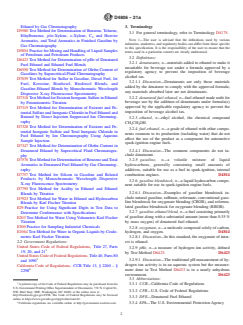
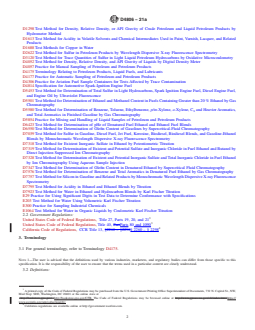
3.1 For general terminology, refer to Terminology D4175.
Ethylbenzene, p/m-Xylene, o-Xylene, C and Heavier
NOTE 1—The user is advised that the definitions used by various
Aromatics, and Total Aromatics in Finished Gasoline by
industries, marketers, and regulatory bodies can differ from those specific
Gas Chromatography
to this specification. It is the responsibility of the user to ensure that the
D5854 Practice for Mixing and Handling of Liquid Samples
terms used in a particular context are clearly understood.
of Petroleum and Petroleum Products
3.2 Definitions:
D6423 Test Method for Determination of pHe of Denatured
3.2.1 denaturants, n—materials added to ethanol to make it
Fuel Ethanol and Ethanol Fuel Blends
unsuitable for beverage use under a formula approved by a
D6550 Test Method for Determination of Olefin Content of
regulatory agency to prevent the imposition of beverage
Gasolines by Supercritical-Fluid Chromatography
alcohol tax.
D7039 Test Method for Sulfur in Gasoline, Diesel Fuel, Jet
3.2.1.1 Discussion—Denaturants are only those materials
Fuel, Kerosine, Biodiesel, Biodiesel Blends, and
added by the denaturer to comply with the approved formula;
Gasoline-Ethanol Blends by Monochromatic Wavelength
any materials absorbed later are not denaturants.
Dispersive X-ray Fluorescence Spectrometry
3.2.2 denatured fuel ethanol, n—fuel ethanol made unfit for
D7318 TestMethodforExistentInorganicSulfateinEthanol
beverage use by the addition of denaturants under formula(s)
by Potentiometric Titration
approved by the applicable regulatory agency to prevent the
D7319 Test Method for Determination of Existent and Po-
imposition of beverage alcohol tax.
tential Sulfate and Inorganic Chloride in Fuel Ethanol and
Butanol by Direct Injection Suppressed Ion Chromatog-
3.2.3 ethanol, n—ethyl alcohol, the chemical compound
raphy
CH CH OH.
3 2
D7328 Test Method for Determination of Existent and Po-
3.2.4 fuel ethanol, n—a grade of ethanol with other compo-
tential Inorganic Sulfate and Total Inorganic Chloride in
nents common to its production (including water) that do not
Fuel Ethanol by Ion Chromatography Using Aqueous
affect the use of the product as a component for automotive
Sample Injection
spark-ignition engine fuels.
D7347 Test Method for Determination of Olefin Content in
3.2.4.1 Discussion—The common components do not in-
Denatured Ethanol by Supercritical Fluid Chromatogra-
phy clude denaturant.
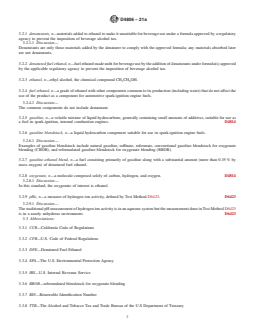
3.2.5 gasoline, n—a volatile mixture of liquid
D7576 Test Method for Determination of Benzene and Total
Aromatics in Denatured Fuel Ethanol by Gas Chromatog- hydrocarbons, generally containing small amounts of
additives, suitable for use as a fuel in spark-ignition, internal
raphy
D7757 Test Method for Silicon in Gasoline and Related combustion engines. D4814
Products by Monochromatic Wavelength Dispersive
3.2.6 gasoline blendstock, n—a liquid hydrocarbon compo-
X-ray Fluorescence Spectrometry
nent suitable for use in spark-ignition engine fuels.
D7795 Test Method for Acidity in Ethanol and Ethanol
3.2.6.1 Discussion—Examples of gasoline blendstock in-
Blends by Titration
clude natural gasoline, raffinate, reformate, conventional gaso-
D7923 Test Method for Water in Ethanol and Hydrocarbon
line blendstock for oxygenate blending (CBOB), and reformu-
Blends by Karl Fischer Titration
lated gasoline blendstock for oxygenate blending (RBOB).
E29 Practice for Using Significant Digits in Test Data to
3.2.7 gasoline-ethanol blend, n—a fuel consisting primarily
Determine Conformance with Specifications
of gasoline along with a substantial amount (more than 0.35 %
E203 Test Method for Water Using Volumetric Karl Fischer
by mass oxygen) of denatured fuel ethanol.
Titration
E300 Practice for Sampling Industrial Chemicals
3.2.8 oxygenate, n—a molecule composed solely of carbon,
E1064 Test Method for Water in Organic Liquids by Coulo-
hydrogen, and oxygen. D4814
metric Karl Fischer Titration
3.2.8.1 Discussion—In this standard, the oxygenate of inter-
2.2 Government Regulations: est is ethanol.
United States Code of Federal Regulations, Title 27, Parts
3.2.9 pHe, n—a measure of hydrogen ion activity, defined
19, 20, and 21
by Test Method D6423. D6423
UnitedStatesCodeofFederalRegulations, Title40,Parts80
3.2.9.1 Discussion—The traditional pH measurement of hy-
and 1090
drogen ion activity is in an aqueous system but the measure-
California Code of Regulations, CCR Title 13, § 2260 – §
ment done in Test Method D6423 is in a nearly anhydrous
environment. D6423
3.3 Abbreviations:
Aprinted copy of the Code of Federal Regulations may be purchased from the
3.3.1 CCR—California Code of Regulations
U.S. Government Printing Office Superintendent of Documents, 732 N. Capitol St.,
3.3.2 CFR—U.S. Code of Federal Regulations
NW, Mail Stop: SDE, Washington, DC 20401 or the online store at
http://bookstore.gpo.gov/CFR. The Code of Federal Regulations may be browsed
3.3.3 DFE—Denatured Fuel Ethanol
online at https://www.govinfo.gov/app/collection/cfr/.
California regulations are available online at http://government.westlaw.com. 3.3.4 EPA—The U.S. Environmental Protection Agency
D4806−21a
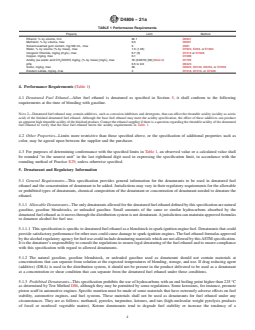
TABLE 1 Performance Requirements
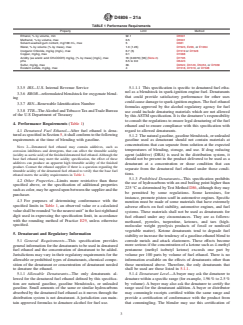
Property Limit Method
Ethanol, % by volume, min 92.1 D5501
Methanol, % by volume, max 0.5 D5501
Solvent-washed gum content, mg/100 mL, max 5 D381
Water, % by volume (% by mass), max 1.0 (1.26) D7923, E203,or E1064
Inorganic Chloride, mg/kg (mg/L), max 6.7 (5) D7319 or D7328
Copper, mg/kg, max 0.1 D1688
Acidity (as acetic acid CH COOH) mg/kg, (% by mass) [mg/L], max 70 (0.0070) [56] (Note 2) D7795
pHe 6.5to9.0 D6423
Sulfur, mg/kg, max 30. D2622, D3120, D5453,or D7039
Existent sulfate, mg/kg, max 4 D7318, D7319,or D7328
3.3.5 IRS—U.S. Internal Revenue Service 5.1.1.1 This specification is specific to denatured fuel etha-
nol as a blendstock in spark-ignition engine fuel. Denaturants
3.3.6 RBOB—reformulated blendstock for oxygenate blend-
that could provide satisfactory performance for other uses
ing
could cause damage to spark-ignition engines.The fuel ethanol
3.3.7 RIN—Renewable Identification Number
formulas approved by the alcohol regulatory agency for fuel
3.3.8 TTB—TheAlcoholandTobaccoTaxandTradeBureau
use could include denaturing materials which are not allowed
of the U.S Department of Treasury
by thisASTM specification. It is the denaturer’s responsibility
to consult the regulations to ensure legal denaturing of the fuel
4. Performance Requirements (Table 1)
ethanol and to ensure compliance with this specification with
4.1 Denatured Fuel Ethanol—After fuel ethanol is dena- regard to allowed denaturants.
turedasspecifiedinSection5,itshallconformtothefollowing 5.1.2 The natural gasoline, gasoline blendstock, or unleaded
requirements at the time of blending with gasoline. gasoline used as denaturant should not contain materials at
concentrations that can separate from solution at the expected
NOTE 2—Denatured fuel ethanol may contain additives, such as
temperatures of blending, storage, and use. If drag reducing
corrosion inhibitors and detergents, that can affect the titratable acidity
agent (additive) (DRA) is used in the distribution system, it
(acidityasaceticacid)ofthefinisheddenaturedfuelethanol.Althoughthe
base fuel ethanol may meet the acidity specification, the effect of these
should not be present in the product delivered to be used as a
additives can produce an apparent high titratable acidity of the finished
denaturant at a concentration or shear condition that can
product. Contact the ethanol supplier if there is a question regarding the
separate from the denatured fuel ethanol under those condi-
titratable acidity of the denatured fuel ethanol to verify that the base fuel
tions.
ethanol meets the acidity requirements in Table 1.
5.1.3 Prohibited Denaturants—This specification prohibits
4.2 Other Properties—Limits more restrictive than those
the use of hydrocarbons with an end boiling point higher than
specified above, or the specification of additional properties
225 °C as determined by Test Method D86, although they may
suchascolor,maybeagreeduponbetweenthesupplierandthe
be permitted by some regulations. Some kerosines, for
purchaser.
instance, promote piston scuff in automotive engines. Specific
4.3 For purposes of determining conformance with the
mention must be made of some materials that have extremely
specified limits in Table 1, an observed value or a calculated
adverse effects on fuel stability, automotive engines, and fuel
valueshallberounded“tothenearestunit”inthelastrighthand
systems. These materials shall not be used as denaturants for
digit used in expressing the specification limit, in accordance
fuel ethanol under any circumstances. They are as follows:
with the rounding method of Practice E29, unless otherwise
methanol, pyrroles, turpentine, ketones, and tars (high-
specified.
molecular weight pyrolysis products of fossil or nonfossil
vegetable matter). Ketone denaturants tend to degrade fuel
5. Denaturant and Regulatory Information
stability or increase the tendency of a gasoline-ethanol blend to
5.1 General Requirements—This specification provides corrode metals and attack elastomers. These effects become
general information for the denaturants to be used in denatured more serious if the concentration of a ketone such as 4-methyl
fuel ethanol and the concentration of denaturant to be added. pentanone (methyl isobutyl ketone) exceeds one part by
Jurisdictions may vary in their regulatory requirements for the volume per 100 parts by volume of fuel ethanol. There is no
allowable or prohibited types of denaturants, chemical compo- information available on the effects of denaturants other than
sition of the denaturant or concentration of denaturant needed those mentioned above. Therefore, the only denaturants that
shall be used are those listed in 5.1.1.
to denature the ethanol.
5.1.1 Allowable Denaturants—The only denaturants al- 5.1.4 Denaturant Level—A buyer may ask the denaturer to
lowed for the denatured fuel ethanol defined by this specifica- denature within a specific range (for example, 1.96 % to 2.5 %
tion are natural gasoline, gasoline blendstocks, or unleaded by volume). A buyer may also ask the denaturer to certify the
gasoline. Small amounts of the same or similar hydrocarbons range used for the denaturant addition. A buyer or distributor
absorbed by the denatured fuel ethanol as it moves through the may commingle receipts certified within the same range and
distribution system is not denaturant. A jurisdiction can main- provide a certification of conformance with the product from
tain approved formulas to denature alcohol for fuel use. that commingling. The blender may use this certification of
D4806−21a
conformance for the product to demonstrate compliance with 7.3 The correct sample volume and appropriate container
the denaturant limits. If the product is shipped directly from a selection are important decisions that can impact test results.
denaturer to a blender, the initial certification from the dena- Refer to Practice D4306 for aviation fuel container selection
turer may be used to demonstrate compliance. Compliance for tests sensitive to trace contamination. Refer to Practice
with the denaturant limit cannot be determined analytically. D5854 for procedures on container selection and sample
Complianceshallbebasedontheinformationfromtheoriginal mixing and handling. All sampling and storage containers
denaturer. The maximum concentration of denaturant allowed should be evaluated for durability, compatibility, and contami-
in this specification is5%by volume. nation of denatured fuel ethanol prior to use. If samples must
be collected in metal containers, do not use soldered metal
5.2 Regulatory Information for Denaturants and Denatured
containers. Soldering flux in the containers and the lead in the
Fuel Ethanol:
solder can contaminate the sample.
5.2.1 Users of this specification are advised to consult with
the applicable regulatory agency for specific requirements for 7.4 Sample Size—Aminimumofabout1Lisrecommended.
denaturants (types, composition, and amounts) and denatured If specific gravity is to be determined by a hydrometer method,
fuel ethanol in their jurisdictions. The requirements can be additionalvolumemayberequired.Thisdependsonthesizeof
covered by regulations specific to a jurisdiction or by multiple the hydrometer.
regulations due to overlapping jurisdictions. Appendixes have
7.5 Lot Size—A lot shall normally consist of the amount
been developed to provide information for several jurisdictions
contained in a tanker compartment or other bulk container in
describing the requirements within the designated jurisdiction:
which it is delivered. If this definition does not apply, the
5.2.1.1 Appendix X2, Regulatory Requirements for Califor-
definition of a lot must be agreed upon between the supplier
nia.
and purchaser.
5.2.1.2 Appendix X3, Regulatory Requirements for the
NOTE 5—See Sections 5, 6, and 7 on Significance, Safety, and
United States.
Statistical Considerations, respectively, of Practice E300 for a detailed
discussion of the statistics of sampling.
6. Workmanship
6.1 At the point of custody transfer, the denatured fuel
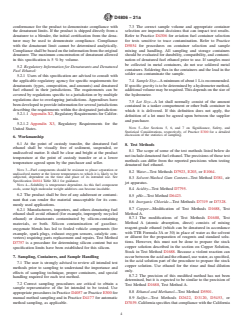
8. Test Methods
ethanol shall be visually free of sediment, suspended, or
8.1 The scope of some of the test methods listed below do
undissolved matter. It shall be clear and bright at the product
not include denatured fuel ethanol. The precisions of those test
temperature at the point of custody transfer or at a lower
methods can differ from the reported precisions when testing
temperature agreed upon by the purchaser and seller.
denatured fuel ethanol.
NOTE 3—Fuel components should be resistant to phase separation or
8.2 Water—Test Methods D7923, E203,or E1064.
undissolved matter at the lowest temperatures to which it is likely to be
subjected, dependent on the time and place of its intended use. See
8.3 Solvent-Washed Gum Content—Test Method D381, air
Specification D4814 Table X8.1 for guidance.
jet apparatus.
NOTE 4—Solubility is temperature dependent. As this fuel component
cools, some high molecular weight additives can become insoluble.
8.4 Acidity—Test Method D7795.
6.2 The product shall be free of any adulterant or contami-
8.5 pHe—Test Method D6423.
nant that can render the material unacceptable for its com-
8.6 Inorganic Chloride—Test Methods D7319 or D7328.
monly used applications.
8.7 Copper—Modification of Test Methods D1688, Test
6.2.1 Manufacturers, importers, and others denaturing fuel
Method A.
ethanol shall avoid ethanol (for example, improperly recycled
8.7.1 The modifications of Test Methods D1688, Test
ethanol) or denaturants contaminated by silicon-containing
Method A (atomic absorption, direct) consists of mixing
materials, or both. Silicon contamination of gasoline-
reagent-grade ethanol (which can be denatured in accordance
oxygenate blends has led to fouled vehicle components (for
with TTB Formula 3A or 30) in place of water as the solvent
example, spark plugs, exhaust oxygen sensors, catalytic con-
or diluent for the preparation of reagents and standard solu-
verters) requiring parts replacement and repairs. Test Method
tions. However, this must not be done to prepare the stock
D7757 is a procedure for determining silicon content but no
copper solution described in the section on Copper Solution,
specification limits have been established for this silicon.
Stock in Test Method D1688. Because a violent reaction can
7. Sampling, Containers, and Sample Handling occur between the acid and the ethanol, use water, as specified,
in the acid solution part of the procedure to prepare the stock
7.1 The user is strongly advised to review all intended test
copper solution. Use ethanol for the rinse and final dilution
methods prior to sampling to understand the importance and
only.
effects of sampling technique, proper containers, and special
8.7.2 The precision of this modified method has not been
handling required for each test method.
determined, but it is expected to be similar to the precision of
7.2 Correct sampling procedures are critical to obtain a
Test Method D1688, Test Method A.
sample representative of the lot intended to be tested. Use
8.8 Ethanol and Methanol—Test Method D5501.
appropriate procedures in Practice D4057 or Practice E300 for
manual method sampling and in Practice D4177 for automatic 8.9 Sulfur—Test Methods D2622, D3120, D5453,or
method sampling, as applicable. D7039.CaliforniaspecifiesthatcompliancewiththeCalifornia
D4806−21a
sulfur standard for denatured ethanol shall be determined using ethanol volumes) at the time of denaturing. There is no
Test Method D5453 – 93. EPA allows Test Methods standardized test procedure or calculation to directly or indi-
ε1
D3120–06 , D5453 – 08a, or D7039 – 07 for measuring
rectly determine the denaturant content in denatured fuel
sulfur in gasoline as long as these alternative test method
ethanol.
results are correlated to the EPA designated Test Method
D2622 – 05 when determining compliance with Federal EPA
9. Keywords
sulfur standards.
9.1 acidity; automotive spark-ignition engine fuel; base
8.10 Existent Sulfate—Test
...
This document is not an ASTM standard and is intended only to provide the user of an ASTM standard an indication of what changes have been made to the previous version. Because
it may not be technically possible to adequately depict all changes accurately, ASTM recommends that users consult prior editions as appropriate. In all cases only the current version
of the standard as published by ASTM is to be considered the official document.
Designation: D4806 − 21 D4806 − 21a
Standard Specification for
Denatured Fuel Ethanol for Blending with Gasolines for Use
as Automotive Spark-Ignition Engine Fuel
This standard is issued under the fixed designation D4806; the number immediately following the designation indicates the year of
original adoption or, in the case of revision, the year of last revision. A number in parentheses indicates the year of last reapproval. A
superscript epsilon (´) indicates an editorial change since the last revision or reapproval.
1. Scope*
1.1 This specification covers nominally anhydrous denatured fuel ethanol intended to be blended with unleaded or leaded
gasolines at 1 % to 15 % by volume for use as automotive spark-ignition engine fuel covered by Specification D4814 as well as
other fuel applications or specifications involving ethanol. The significance of this specification is shown in Appendix X1.
1.2 Jurisdictions may vary in their regulatory requirements for the allowable or prohibited types of denaturants, chemical
composition of the denaturant or concentration of denaturant needed to denature the ethanol. The user is advised to check with the
national and regional regulatory agencies where the ethanol is denatured and used.
1.2.1 Specific regulatory requirements for denatured fuel ethanol and acceptable denaturants from various jurisdictions are given
in Appendixes for information.
1.3 The values stated in SI units are to be regarded as standard.
1.3.1 Exception—Values given in parentheses are provided for information only. Non-SI units are shown in the Appendix if they
are in a direct quotation from government regulations. In most cases, U.S. federal regulations specify non-SI units.
1.4 The following safety hazards caveat pertains only to the method modification in 8.7 of this specification: This standard does
not purport to address all of the safety concerns, if any, associated with its use. It is the responsibility of the user of this standard
to establish appropriate safety, health, and environmental practices and determine the applicability of regulatory limitations prior
to use.
1.5 This international standard was developed in accordance with internationally recognized principles on standardization
established in the Decision on Principles for the Development of International Standards, Guides and Recommendations issued
by the World Trade Organization Technical Barriers to Trade (TBT) Committee.
2. Referenced Documents
2.1 ASTM Standards:
D86 Test Method for Distillation of Petroleum Products and Liquid Fuels at Atmospheric Pressure
D381 Test Method for Gum Content in Fuels by Jet Evaporation
This specification is under the jurisdiction of ASTM Committee D02 on Petroleum Products, Liquid Fuels, and Lubricants and is the direct responsibility of Subcommittee
D02.A0.02 on Oxygenated Fuels and Components.
Current edition approved April 1, 2021Oct. 1, 2021. Published April 2021October 2021. Originally approved in 1988. Last previous edition approved in 20202021 as
D4806 – 20.D4806 – 21. DOI: 10.1520/D4806-21.10.1520/D4806-21A.
For referenced ASTM standards, visit the ASTM website, www.astm.org, or contact ASTM Customer Service at service@astm.org. For Annual Book of ASTM Standards
volume information, refer to the standard’s Document Summary page on the ASTM website.
*A Summary of Changes section appears at the end of this standard
Copyright © ASTM International, 100 Barr Harbor Drive, PO Box C700, West Conshohocken, PA 19428-2959. United States
D4806 − 21a
D1298 Test Method for Density, Relative Density, or API Gravity of Crude Petroleum and Liquid Petroleum Products by
Hydrometer Method
D1613 Test Method for Acidity in Volatile Solvents and Chemical Intermediates Used in Paint, Varnish, Lacquer, and Related
Products
D1688 Test Methods for Copper in Water
D2622 Test Method for Sulfur in Petroleum Products by Wavelength Dispersive X-ray Fluorescence Spectrometry
D3120 Test Method for Trace Quantities of Sulfur in Light Liquid Petroleum Hydrocarbons by Oxidative Microcoulometry
D4052 Test Method for Density, Relative Density, and API Gravity of Liquids by Digital Density Meter
D4057 Practice for Manual Sampling of Petroleum and Petroleum Products
D4175 Terminology Relating to Petroleum Products, Liquid Fuels, and Lubricants
D4177 Practice for Automatic Sampling of Petroleum and Petroleum Products
D4306 Practice for Aviation Fuel Sample Containers for Tests Affected by Trace Contamination
D4814 Specification for Automotive Spark-Ignition Engine Fuel
D5453 Test Method for Determination of Total Sulfur in Light Hydrocarbons, Spark Ignition Engine Fuel, Diesel Engine Fuel,
and Engine Oil by Ultraviolet Fluorescence
D5501 Test Method for Determination of Ethanol and Methanol Content in Fuels Containing Greater than 20 % Ethanol by Gas
Chromatography
D5580 Test Method for Determination of Benzene, Toluene, Ethylbenzene, p/m-Xylene, o-Xylene, C and Heavier Aromatics,
and Total Aromatics in Finished Gasoline by Gas Chromatography
D5854 Practice for Mixing and Handling of Liquid Samples of Petroleum and Petroleum Products
D6423 Test Method for Determination of pHe of Denatured Fuel Ethanol and Ethanol Fuel Blends
D6550 Test Method for Determination of Olefin Content of Gasolines by Supercritical-Fluid Chromatography
D7039 Test Method for Sulfur in Gasoline, Diesel Fuel, Jet Fuel, Kerosine, Biodiesel, Biodiesel Blends, and Gasoline-Ethanol
Blends by Monochromatic Wavelength Dispersive X-ray Fluorescence Spectrometry
D7318 Test Method for Existent Inorganic Sulfate in Ethanol by Potentiometric Titration
D7319 Test Method for Determination of Existent and Potential Sulfate and Inorganic Chloride in Fuel Ethanol and Butanol by
Direct Injection Suppressed Ion Chromatography
D7328 Test Method for Determination of Existent and Potential Inorganic Sulfate and Total Inorganic Chloride in Fuel Ethanol
by Ion Chromatography Using Aqueous Sample Injection
D7347 Test Method for Determination of Olefin Content in Denatured Ethanol by Supercritical Fluid Chromatography
D7576 Test Method for Determination of Benzene and Total Aromatics in Denatured Fuel Ethanol by Gas Chromatography
D7757 Test Method for Silicon in Gasoline and Related Products by Monochromatic Wavelength Dispersive X-ray Fluorescence
Spectrometry
D7795 Test Method for Acidity in Ethanol and Ethanol Blends by Titration
D7923 Test Method for Water in Ethanol and Hydrocarbon Blends by Karl Fischer Titration
E29 Practice for Using Significant Digits in Test Data to Determine Conformance with Specifications
E203 Test Method for Water Using Volumetric Karl Fischer Titration
E300 Practice for Sampling Industrial Chemicals
E1064 Test Method for Water in Organic Liquids by Coulometric Karl Fischer Titration
2.2 Government Regulations:
United States Code of Federal Regulations, Title 27, Parts 19, 20, and 21
United States Code of Federal Regulations, Title 40, PartParts 80 and 1090
California Code of Regulations, CCR Title 13, §2260 – §2298§ 2260 – § 2298
3. Terminology
3.1 For general terminology, refer to Terminology D4175.
NOTE 1—The user is advised that the definitions used by various industries, marketers, and regulatory bodies can differ from those specific to this
specification. It is the responsibility of the user to ensure that the terms used in a particular context are clearly understood.
3.2 Definitions:
A printed copy of the Code of Federal Regulations may be purchased from the U.S. Government Printing Office Superintendent of Documents, 732 N. Capitol St., NW,
Mail Stop: SDE, Washington, DC 20401 or the online store at
http://bookstore.gpo.gov/. http://bookstore.gpo.gov/CFR. The Code of Federal Regulations may be browsed online at http://www.gpoaccess.gov/cfr/index.html.https://
www.govinfo.gov/app/collection/cfr/.
California regulations are available online at http://government.westlaw.com.
D4806 − 21a
3.2.1 denaturants, n—materials added to ethanol to make it unsuitable for beverage use under a formula approved by a regulatory
agency to prevent the imposition of beverage alcohol tax.
3.2.1.1 Discussion—
Denaturants are only those materials added by the denaturer to comply with the approved formula; any materials absorbed later
are not denaturants.
3.2.2 denatured fuel ethanol, n—fuel ethanol made unfit for beverage use by the addition of denaturants under formula(s) approved
by the applicable regulatory agency to prevent the imposition of beverage alcohol tax.
3.2.3 ethanol, n—ethyl alcohol, the chemical compound CH CH OH.
3 2
3.2.4 fuel ethanol, n—a grade of ethanol with other components common to its production (including water) that do not affect the
use of the product as a component for automotive spark-ignition engine fuels.
3.2.4.1 Discussion—
The common components do not include denaturant.
3.2.5 gasoline, n—a volatile mixture of liquid hydrocarbons, generally containing small amounts of additives, suitable for use as
a fuel in spark-ignition, internal combustion engines. D4814
3.2.6 gasoline blendstock, n—a liquid hydrocarbon component suitable for use in spark-ignition engine fuels.
3.2.6.1 Discussion—
Examples of gasoline blendstock include natural gasoline, raffinate, reformate, conventional gasoline blendstock for oxygenate
blending (CBOB), and reformulated gasoline blendstock for oxygenate blending (RBOB).
3.2.7 gasoline-ethanol blend, n—a fuel consisting primarily of gasoline along with a substantial amount (more than 0.35 % by
mass oxygen) of denatured fuel ethanol.
3.2.8 oxygenate, n—a molecule composed solely of carbon, hydrogen, and oxygen. D4814
3.2.8.1 Discussion—
In this standard, the oxygenate of interest is ethanol.
3.2.9 pHe, n—a measure of hydrogen ion activity, defined by Test Method D6423. D6423
3.2.9.1 Discussion—
The traditional pH measurement of hydrogen ion activity is in an aqueous system but the measurement done in Test Method D6423
is in a nearly anhydrous environment. D6423
3.3 Abbreviations:
3.3.1 CCR—California Code of Regulations
3.3.2 CFR—U.S. Code of Federal Regulations
3.3.3 DFE—Denatured Fuel Ethanol
3.3.4 EPA—The U.S. Environmental Protection Agency
3.3.5 IRS—U.S. Internal Revenue Service
3.3.6 RBOB—reformulated blendstock for oxygenate blending
3.3.7 RIN—Renewable Identification Number
3.3.8 TTB—The Alcohol and Tobacco Tax and Trade Bureau of the U.S Department of Treasury
D4806 − 21a
TABLE 1 Performance Requirements
Property Limit Method
Ethanol, % by volume, min 92.1 D5501
Methanol, % by volume, max 0.5 D5501
Solvent-washed gum content, mg/100 mL, max 5 D381
Water, % by volume (% by mass), max 1.0 (1.26) D7923, E203, or E1064
Inorganic Chloride, mg/kg (mg/L), max 6.7 (5) D7319 or D7328
Copper, mg/kg, max 0.1 D1688
Acidity (as acetic acid CH COOH) mg/kg, (% by mass) [mg/L], max 70 (0.0070) [56] (Note 2) D7795
pHe 6.5 to 9.0 D6423
Sulfur, mg/kg, max 30. D2622, D3120, D5453, or D7039
Existent sulfate, mg/kg, max 4 D7318, D7319, or D7328
4. Performance Requirements (Table 1)
4.1 Denatured Fuel Ethanol—After fuel ethanol is denatured as specified in Section 5, it shall conform to the following
requirements at the time of blending with gasoline.
NOTE 2—Denatured fuel ethanol may contain additives, such as corrosion inhibitors and detergents, that can affect the titratable acidity (acidity as acetic
acid) of the finished denatured fuel ethanol. Although the base fuel ethanol may meet the acidity specification, the effect of these additives can produce
an apparent high titratable acidity of the finished product. Contact the ethanol supplier if there is a question regarding the titratable acidity of the denatured
fuel ethanol to verify that the base fuel ethanol meets the acidity requirements in Table 1.
4.2 Other Properties—Limits more restrictive than those specified above, or the specification of additional properties such as
color, may be agreed upon between the supplier and the purchaser.
4.3 For purposes of determining conformance with the specified limits in Table 1, an observed value or a calculated value shall
be rounded “to the nearest unit” in the last righthand digit used in expressing the specification limit, in accordance with the
rounding method of Practice E29, unless otherwise specified.
5. Denaturant and Regulatory Information
5.1 General Requirements—This specification provides general information for the denaturants to be used in denatured fuel
ethanol and the concentration of denaturant to be added. Jurisdictions may vary in their regulatory requirements for the allowable
or prohibited types of denaturants, chemical composition of the denaturant or concentration of denaturant needed to denature the
ethanol.
5.1.1 Allowable Denaturants—The only denaturants allowed for the denatured fuel ethanol defined by this specification are natural
gasoline, gasoline blendstocks, or unleaded gasoline. Small amounts of the same or similar hydrocarbons absorbed by the
denatured fuel ethanol as it moves through the distribution system is not denaturant. A jurisdiction can maintain approved formulas
to denature alcohol for fuel use.
5.1.1.1 This specification is specific to denatured fuel ethanol as a blendstock in spark-ignition engine fuel. Denaturants that could
provide satisfactory performance for other uses could cause damage to spark-ignition engines. The fuel ethanol formulas approved
by the alcohol regulatory agency for fuel use could include denaturing materials which are not allowed by this ASTM specification.
It is the denaturer’s responsibility to consult the regulations to ensure legal denaturing of the fuel ethanol and to ensure compliance
with this specification with regard to allowed denaturants.
5.1.2 The natural gasoline, gasoline blendstock, or unleaded gasoline used as denaturant should not contain materials at
concentrations that can separate from solution at the expected temperatures of blending, storage, and use. If drag reducing agent
(additive) (DRA) is used in the distribution system, it should not be present in the product delivered to be used as a denaturant
at a concentration or shear condition that can separate from the denatured fuel ethanol under those conditions.
5.1.3 Prohibited Denaturants—This specification prohibits the use of hydrocarbons with an end boiling point higher than 225 °C
as determined by Test Method D86, although they may be permitted by some regulations. Some kerosines, for instance, promote
piston scuff in automotive engines. Specific mention must be made of some materials that have extremely adverse effects on fuel
stability, automotive engines, and fuel systems. These materials shall not be used as denaturants for fuel ethanol under any
circumstances. They are as follows: methanol, pyrroles, turpentine, ketones, and tars (high-molecular weight pyrolysis products
of fossil or nonfossil vegetable matter). Ketone denaturants tend to degrade fuel stability or increase the tendency of a
D4806 − 21a
gasoline-ethanol blend to corrode metals and attack elastomers. These effects become more serious if the concentration of a ketone
such as 4-methyl pentanone (methyl isobutyl ketone) exceeds one part by volume per 100 parts by volume of fuel ethanol. There
is no information available on the effects of denaturants other than those mentioned above. Therefore, the only denaturants that
shall be used are those listed in 5.1.1.
5.1.4 Denaturant Level—A buyer may ask the denaturer to denature within a specific range (for example, 1.96 % to 2.5 % by
volume). A buyer may also ask the denaturer to certify the range used for the denaturant addition. A buyer or distributor may
commingle receipts certified within the same range and provide a certification of conformance with the product from that
commingling. The blender may use this certification of conformance for the product to demonstrate compliance with the denaturant
limits. If the product is shipped directly from a denaturer to a blender, the initial certification from the denaturer may be used to
demonstrate compliance. Compliance with the denaturant limit cannot be determined analytically. Compliance shall be based on
the information from the original denaturer. The maximum concentration of denaturant allowed in this specification is 5 % by
volume.
5.2 Regulatory Information for Denaturants and Denatured Fuel Ethanol:
5.2.1 Users of this specification are advised to consult with the applicable regulatory agency for specific requirements for
denaturants (types, composition, and amounts) and denatured fuel ethanol in their jurisdictions. The requirements can be covered
by regulations specific to a jurisdiction or by multiple regulations due to overlapping jurisdictions. Appendixes have been
developed to provide information for several jurisdictions describing the requirements within the designated jurisdiction:
5.2.1.1 Appendix X2, Regulatory Requirements for California.
5.2.1.2 Appendix X3, Regulatory Requirements for the United States.
6. Workmanship
6.1 At the point of custody transfer, the denatured fuel ethanol shall be visually free of sediment, suspended, or undissolved matter.
It shall be clear and bright at the product temperature at the point of custody transfer or at a lower temperature agreed upon by
the purchaser and seller.
NOTE 3—Fuel components should be resistant to phase separation or undissolved matter at the lowest temperatures to which it is likely to be subjected,
dependent on the time and place of its intended use. See Specification D4814 Table X8.1 for guidance.
NOTE 4—Solubility is temperature dependent. As this fuel component cools, some high molecular weight additives can become insoluble.
6.2 The product shall be free of any adulterant or contaminant that can render the material unacceptable for its commonly used
applications.
6.2.1 Manufacturers, importers, and others denaturing fuel ethanol shall avoid ethanol (for example, improperly recycled ethanol)
or denaturants contaminated by silicon-containing materials, or both. Silicon contamination of gasoline-oxygenate blends has led
to fouled vehicle components (for example, spark plugs, exhaust oxygen sensors, catalytic converters) requiring parts replacement
and repairs. Test Method D7757 is a procedure for determining silicon content but no specification limits have been established
for this silicon.
7. Sampling, Containers, and Sample Handling
7.1 The user is strongly advised to review all intended test methods prior to sampling to understand the importance and effects
of sampling technique, proper containers, and special handling required for each test method.
7.2 Correct sampling procedures are critical to obtain a sample representative of the lot intended to be tested. Use appropriate
procedures in Practice D4057 or Practice E300 for manual method sampling and in Practice D4177 for automatic method sampling,
as applicable.
7.3 The correct sample volume and appropriate container selection are important decisions that can impact test results. Refer to
Practice D4306 for aviation fuel container selection for tests sensitive to trace contamination. Refer to Practice D5854 for
procedures on container selection and sample mixing and handling. All sampling and storage containers should be evaluated for
D4806 − 21a
durability, compatibility, and contamination of denatured fuel ethanol prior to use. If samples must be collected in metal containers,
do not use soldered metal containers. Soldering flux in the containers and the lead in the solder can contaminate the sample.
7.4 Sample Size—A minimum of about 1 L is recommended. If specific gravity is to be determined by a hydrometer method,
additional volume may be required. This depends on the size of the hydrometer.
7.5 Lot Size—A lot shall normally consist of the amount contained in a tanker compartment or other bulk container in which it
is delivered. If this definition does not apply, the definition of a lot must be agreed upon between the supplier and purchaser.
NOTE 5—See Sections 5, 6, and 7 on Significance, Safety, and Statistical Considerations, respectively, of Practice E300 for a detailed discussion of the
statistics of sampling.
8. Test Methods
8.1 The scope of some of the test methods listed below do not include denatured fuel ethanol. The precisions of those test methods
can differ from the reported precisions when testing denatured fuel ethanol.
8.2 Water—Test Methods D7923, E203, or E1064.
8.3 Solvent-Washed Gum Content—Test Method D381, air jet apparatus.
8.4 Acidity—Test Method D7795.
8.5 pHe—Test Method D6423.
8.6 Inorganic Chloride—Test Methods D7319 or D7328.
8.7 Copper—Modification of Test Methods D1688, Test Method A.
8.7.1 The modifications of Test Methods D1688, Test Method A (atomic absorption, direct) consists of mixing reagent-grade
ethanol (which can be denatured in accordance with TTB Formula 3A or 30) in place of water as the solvent or diluent for the
preparation of reagents and standard solutions. However, this must not be done to prepare the stock copper solution described in
the section on Copper Solution, Stock in Test Method D1688. Because a violent reaction can occur between the acid and the
ethanol, use water, as specified, in the acid solution part of the procedure to prepare the stock copper solution. Use ethanol for the
rinse and final dilution only.
8.7.2 The precision of this modified method has not been determined, but it is expected to be similar to the precision of Test
Method D1688, Test Method A.
8.8 Ethanol and Methanol—Test Method D5501.
8.9 Sulfur—Test Methods D2622, D3120, D5453, or D7039. California specifies that compliance with the California sulfur
ε1
standard for denatured ethanol shall be determined using Test Method D5453 – 93. EPA allows Test Methods D3120 – 06 ,
D5453 – 08a, or D7039 – 07 for measuring sulfur in gasoline as long as these alternative test method results are correlated to the
EPA designated Test Method D2622 – 05 when determining compliance with Federal EPA sulfur standards.
8.10 Existent Sulfate—Test Methods D7318, D7319, or D7328.
8.11 Denaturant—The denaturant content is determined by the ratio of (metered denaturant) to (metered denaturant and ethanol
volumes) at the time of denaturing. There is no standardized test procedure or calculation to directly or indirectly determine the
denaturant content in denatured fuel ethanol.
D4806 − 21a
9. Keywords
9.1 acidity; automotive spark-ignition engine fuel; base gasoline; chloride ion; copper; corrosion inhibitors; denaturants; denatured
fuel ethanol; ethanol; fuel; fuel ethanol; gasoline; gasoline-ethanol blend; oxygenate; solvent-washed gum content; sulfate ion;
sulfur; water
APPENDIXES
(Nonmandatory Information)
...