

ASTM D1126-17
(Test Method)Standard Test Method for Hardness in Water
General Information
- Abstract
SIGNIFICANCE AND USE
5.1 Hardness salts in water, notably calcium and magnesium, are the primary cause of tube and pipe scaling, which frequently causes failures and loss of process efficiency due to clogging or loss of heat transfer, or both.
5.2 Hardness is caused by any polyvalent cations, but those other than Ca and Mg are seldom present in more than trace amounts. The term hardness was originally applied to water in which it was hard to wash; it referred to the soap-wasting properties of water. With most normal alkaline water, these soap-wasting properties are directly related to the calcium and magnesium content.
SCOPE
1.1 This test method covers the determination of hardness in water by titration. This test method is applicable to waters that are clear in appearance and free of chemicals that will complex calcium or magnesium. The lower detection limit of this test method is approximately 2 to 5 mg/L as CaCO3; the upper limit can be extended to all concentrations by sample dilution. It is possible to differentiate between hardness due to calcium ions and that due to magnesium ions by this test method.
1.2 This test method was tested on reagent water only. It is the user's responsibility to ensure the validity of the test method for waters of untested matrices.
1.3 The values stated in SI units are to be regarded as standard. No other units of measurement are included in this standard.
1.4 This standard does not purport to address all of the safety concerns, if any, associated with its use. It is the responsibility of the user of this standard to establish appropriate safety, health, and environmental practices and determine the applicability of regulatory limitations prior to use.
1.5 This international standard was developed in accordance with internationally recognized principles on standardization established in the Decision on Principles for the Development of International Standards, Guides and Recommendations issued by the World Trade Organization Technical Barriers to Trade (TBT) Committee.
- Status
- Published
- Publication Date
- 30-Nov-2017
- Technical Committee
- D19 - Water
- Drafting Committee
- D19.05 - Inorganic Constituents in Water

Overview
ASTM D1126-17: Standard Test Method for Hardness in Water sets forth a titration-based procedure for quantifying hardness in water samples. Water hardness is primarily due to calcium and magnesium ions, which can cause scale buildup, reduce heat transfer efficiency, and accelerate equipment failure in industrial and domestic settings. This method enables laboratories and water quality professionals to accurately determine water hardness and differentiate between calcium and magnesium hardness, ensuring the quality of water used in a range of applications.
Key aspects of ASTM D1126-17 include:
- Measurement of total, calcium, and magnesium hardness in water
- Applicability to clear water samples without chemical interferences
- Use of standardized reagents and titrimetric techniques
The standard is developed in accordance with internationally recognized best practices under the World Trade Organization’s guidelines for technical barriers to trade.
Key Topics
- Definition of Water Hardness: Hardness results from dissolved polyvalent cations, mainly calcium and magnesium. Other cations are usually insignificant.
- Significance in Water Systems: Hardness salts contribute to scaling and operational inefficiency in tubes and pipes, increasing maintenance and operational costs.
- Test Applicability: The method is suitable for clear, uncolored water samples and is not reliable for samples containing substances that complex calcium or magnesium, or highly colored water.
- Titration Technique: The procedure uses disodium ethylenediamine tetraacetate (EDTA) as a titrant, and color change is observed with Chrome Black T indicator.
- Result Differentiation: It distinguishes total hardness, calcium hardness, and, by calculation, magnesium hardness.
- Accuracy: The lower detection limit is approximately 2 to 5 mg/L as CaCO₃, expandable by sample dilution.
Applications
- Industrial Water Treatment: Monitoring and controlling hardness to prevent scaling in boilers, heat exchangers, and cooling towers.
- Municipal Water Supply: Ensuring water quality for public consumption and distribution, as excessive hardness may cause taste issues and soap inefficiency.
- Commercial and Domestic Water Systems: Protecting plumbing, appliances, and heating systems by managing scaling potential.
- Laboratory Water Analysis: Providing an established method for characterization of water in quality control processes within environmental, chemical, and industrial laboratories.
Quality control is emphasized through the analysis of check standards and laboratory control samples, ensuring the reliability of test results within defined precision and bias parameters.
Related Standards
For comprehensive water quality analysis and consistent sampling, consult these ASTM standards:
- ASTM D1066: Practice for Sampling Steam
- ASTM D1129: Terminology Relating to Water
- ASTM D1193: Specification for Reagent Water
- ASTM D2777: Practice for Determination of Precision and Bias of Applicable Test Methods of Committee D19 on Water
- ASTM D3370: Practices for Sampling Water from Closed Conduits
- ASTM D5847: Practice for Writing Quality Control Specifications for Standard Test Methods for Water Analysis
Integration of ASTM D1126-17 with these related standards enables a robust approach to water hardness testing, data interpretation, and quality assurance, supporting regulatory compliance and operational efficiency in water management and analysis.
Keywords: water hardness, ASTM D1126-17, hardness in water, calcium hardness, magnesium hardness, titration, water analysis, scale prevention, water quality standards, EDTA titration
Relations
- Effective Date
- 01-May-2020
- Effective Date
- 01-Aug-2018
- Effective Date
- 01-Aug-2018
- Effective Date
- 15-Jun-2012
- Effective Date
- 15-Jun-2011
- Effective Date
- 01-Dec-2010
- Effective Date
- 01-Mar-2010
- Effective Date
- 01-Oct-2008
- Effective Date
- 15-Jan-2008
- Effective Date
- 01-Dec-2007
- Effective Date
- 15-Dec-2006
- Effective Date
- 01-Sep-2006
- Effective Date
- 01-Sep-2006
- Effective Date
- 15-Aug-2006
- Effective Date
- 01-Mar-2006
Get Certified
Connect with accredited certification bodies for this standard

CIS Institut d.o.o.
Personal Protective Equipment (PPE) certification body. Notified Body NB-2890 for EU Regulation 2016/425 PPE.

Kiwa BDA Testing
Building and construction product certification.
Kmetijski inštitut Slovenije
Agricultural Institute of Slovenia. Soil testing, plant health, agricultural product analysis.
Sponsored listings
Frequently Asked Questions
ASTM D1126-17 is a standard published by ASTM International. Its full title is "Standard Test Method for Hardness in Water". This standard covers: SIGNIFICANCE AND USE 5.1 Hardness salts in water, notably calcium and magnesium, are the primary cause of tube and pipe scaling, which frequently causes failures and loss of process efficiency due to clogging or loss of heat transfer, or both. 5.2 Hardness is caused by any polyvalent cations, but those other than Ca and Mg are seldom present in more than trace amounts. The term hardness was originally applied to water in which it was hard to wash; it referred to the soap-wasting properties of water. With most normal alkaline water, these soap-wasting properties are directly related to the calcium and magnesium content. SCOPE 1.1 This test method covers the determination of hardness in water by titration. This test method is applicable to waters that are clear in appearance and free of chemicals that will complex calcium or magnesium. The lower detection limit of this test method is approximately 2 to 5 mg/L as CaCO3; the upper limit can be extended to all concentrations by sample dilution. It is possible to differentiate between hardness due to calcium ions and that due to magnesium ions by this test method. 1.2 This test method was tested on reagent water only. It is the user's responsibility to ensure the validity of the test method for waters of untested matrices. 1.3 The values stated in SI units are to be regarded as standard. No other units of measurement are included in this standard. 1.4 This standard does not purport to address all of the safety concerns, if any, associated with its use. It is the responsibility of the user of this standard to establish appropriate safety, health, and environmental practices and determine the applicability of regulatory limitations prior to use. 1.5 This international standard was developed in accordance with internationally recognized principles on standardization established in the Decision on Principles for the Development of International Standards, Guides and Recommendations issued by the World Trade Organization Technical Barriers to Trade (TBT) Committee.
SIGNIFICANCE AND USE 5.1 Hardness salts in water, notably calcium and magnesium, are the primary cause of tube and pipe scaling, which frequently causes failures and loss of process efficiency due to clogging or loss of heat transfer, or both. 5.2 Hardness is caused by any polyvalent cations, but those other than Ca and Mg are seldom present in more than trace amounts. The term hardness was originally applied to water in which it was hard to wash; it referred to the soap-wasting properties of water. With most normal alkaline water, these soap-wasting properties are directly related to the calcium and magnesium content. SCOPE 1.1 This test method covers the determination of hardness in water by titration. This test method is applicable to waters that are clear in appearance and free of chemicals that will complex calcium or magnesium. The lower detection limit of this test method is approximately 2 to 5 mg/L as CaCO3; the upper limit can be extended to all concentrations by sample dilution. It is possible to differentiate between hardness due to calcium ions and that due to magnesium ions by this test method. 1.2 This test method was tested on reagent water only. It is the user's responsibility to ensure the validity of the test method for waters of untested matrices. 1.3 The values stated in SI units are to be regarded as standard. No other units of measurement are included in this standard. 1.4 This standard does not purport to address all of the safety concerns, if any, associated with its use. It is the responsibility of the user of this standard to establish appropriate safety, health, and environmental practices and determine the applicability of regulatory limitations prior to use. 1.5 This international standard was developed in accordance with internationally recognized principles on standardization established in the Decision on Principles for the Development of International Standards, Guides and Recommendations issued by the World Trade Organization Technical Barriers to Trade (TBT) Committee.
ASTM D1126-17 is classified under the following ICS (International Classification for Standards) categories: 13.060.50 - Examination of water for chemical substances. The ICS classification helps identify the subject area and facilitates finding related standards.
ASTM D1126-17 has the following relationships with other standards: It is inter standard links to ASTM D1129-13(2020)e2, ASTM D1066-18e1, ASTM D1066-18, ASTM D2777-12, ASTM D1066-11, ASTM D3370-10, ASTM D1129-10, ASTM D3370-08, ASTM D2777-08, ASTM D3370-07, ASTM D1066-06, ASTM D1129-06a, ASTM D1129-06ae1, ASTM D2777-06, ASTM D1193-06. Understanding these relationships helps ensure you are using the most current and applicable version of the standard.
ASTM D1126-17 is available in PDF format for immediate download after purchase. The document can be added to your cart and obtained through the secure checkout process. Digital delivery ensures instant access to the complete standard document.
Standards Content (Sample)
This international standard was developed in accordance with internationally recognized principles on standardization established in the Decision on Principles for the
Development of International Standards, Guides and Recommendations issued by the World Trade Organization Technical Barriers to Trade (TBT) Committee.
Designation: D1126 − 17
Standard Test Method for
Hardness in Water
This standard is issued under the fixed designation D1126; the number immediately following the designation indicates the year of
original adoption or, in the case of revision, the year of last revision. A number in parentheses indicates the year of last reapproval. A
superscript epsilon (´) indicates an editorial change since the last revision or reapproval.
This standard has been approved for use by agencies of the U.S. Department of Defense.
1. Scope* D2777 Practice for Determination of Precision and Bias of
Applicable Test Methods of Committee D19 on Water
1.1 Thistestmethodcoversthedeterminationofhardnessin
D3370 Practices for Sampling Water from Closed Conduits
water by titration. This test method is applicable to waters that
D5847 Practice for Writing Quality Control Specifications
are clear in appearance and free of chemicals that will complex
for Standard Test Methods for Water Analysis
calcium or magnesium. The lower detection limit of this test
methodisapproximately2to5mg/LasCaCO ;theupperlimit
3. Terminology
can be extended to all concentrations by sample dilution. It is
possible to differentiate between hardness due to calcium ions
3.1 Definitions:
and that due to magnesium ions by this test method.
3.1.1 For definitions of terms used in this standard, refer to
Terminology D1129.
1.2 This test method was tested on reagent water only. It is
the user’s responsibility to ensure the validity of the test
3.2 Definitions of Terms Specific to This Standard:
method for waters of untested matrices.
3.2.1 equivalent per million (epm), n—a unit chemical
1.3 The values stated in SI units are to be regarded as equivalent weight of solute per million unit weights of solu-
standard. No other units of measurement are included in this tion.
standard.
3.2.2 laboratory control sample (LCS), n—a solution with
1.4 This standard does not purport to address all of the
certified hardness.
safety concerns, if any, associated with its use. It is the
responsibility of the user of this standard to establish appro-
4. Summary of Test Method
priate safety, health, and environmental practices and deter-
4.1 Calcium and magnesium ions in water are sequestered
mine the applicability of regulatory limitations prior to use.
by the addition of disodium ethylenediamine tetraacetate. The
1.5 This international standard was developed in accor-
endpointofthereactionisdetectedbymeansofChromeBlack
dance with internationally recognized principles on standard-
T , which has a red color in the presence of calcium and
ization established in the Decision on Principles for the
magnesium and a blue color when they are sequestered.
Development of International Standards, Guides and Recom-
mendations issued by the World Trade Organization Technical
5. Significance and Use
Barriers to Trade (TBT) Committee.
5.1 Hardness salts in water, notably calcium and
2. Referenced Documents
magnesium, are the primary cause of tube and pipe scaling,
which frequently causes failures and loss of process efficiency
2.1 ASTM Standards:
D1066 Practice for Sampling Steam due to clogging or loss of heat transfer, or both.
D1129 Terminology Relating to Water
5.2 Hardness is caused by any polyvalent cations, but those
D1193 Specification for Reagent Water
other than Ca and Mg are seldom present in more than trace
amounts. The term hardness was originally applied to water in
which it was hard to wash; it referred to the soap-wasting
This test method is under the jurisdiction of ASTM Committee D19 on Water
and is the direct responsibility of Subcommittee D19.05 on Inorganic Constituents
properties of water. With most normal alkaline water, these
in Water.
soap-wasting properties are directly related to the calcium and
Current edition approved Dec. 1, 2017. Published December 2017. Originally
magnesium content.
approved in 1950. Last previous edition approved in 2012 as D1126 – 12. DOI:
10.1520/D1126-17.
For referenced ASTM standards, visit the ASTM website, www.astm.org, or
contact ASTM Customer Service at service@astm.org. For Annual Book of ASTM
Standards volume information, refer to the standard’s Document Summary page on 3–Hydroxy–4-(1–hydroxy-2–napththyl) azo-7–nitro–1 naphthalenesulfonic
the ASTM website. acid, sodium salt, Color Index 14645.
*A Summary of Changes section appears at the end of this standard
Copyright © ASTM International, 100 Barr Harbor Drive, PO Box C700, West Conshohocken, PA 19428-2959. United States
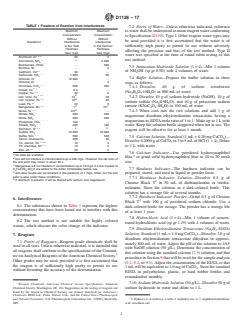
D1126 − 17
TABLE 1 Freedom of Reaction from Interferences
7.2 Purity of Water—Unless otherwise indicated, reference
Maximum Maximum to water shall be understood to mean reagent water conforming
Concentration Concentration
to Specification D1193, Type I. Other reagent water types may
Without Without
be used provided it is first ascertained that the water is of
Substance Interference Interference
in the Total in the Calcium sufficiently high purity to permit its use without adversely
Hardness Hardness
affecting the precision and bias of the test method. Type II
Test, mg/L Test, mg/L
water was specified at the time of round robin testing of this
+++
Aluminum, Al 20 5
+ A
test method.
Ammonium, NH 2 000
−
Bicarbonate, HCO . 500
7.3 Ammonium Hydroxide Solution(1+4)—Mix 1 volume
Bromine, Br . 2
++
Cadmium, Cd 20 . of NH OH (sp gr 0.90) with 4 volumes of water.
−−
Carbonate, CO 1 000 50
− 7.4 Buffer Solution—Prepare the buffer solution in three
Chloride, Cl 10 000 .
Chlorine, Cl . 2
steps as follows:
−−
Chromate, CrO 500 500
7.4.1 Dissolve 40 g of sodium tetraborate
++
Cobalt, Co 0.3 .
++ (Na B O ·10H O) in 800 mL of water.
Copper, Cu 20 2 2 4 7 2
+++ B
Iron, ferric, Fe 10 20
7.4.2 Dissolve 10 g of sodium hydroxide (NaOH), 10 g of
++ B
Iron, ferrous, Fe 10 20
sodium sulfide (Na S·9H O), and 10 g of potassium sodium
++ 2 2
Lead, Pb 20 5
++ C C
tartrate (KNaC O ·4H O) in 100 mL of water.
Manganese, Mn 1 10 4 6 2
++ D
Nickel, Ni 0.5 . 7.4.3 When cool mix the two solutions and add1gof
−
Nitrate, NO 500 500
magnesium disodium ethylenediamine tetraacetate, having a
−
Nitrite, NO 500 500
−−− magnesium-to-EDTAmole ratio of 1 to 1. Make up to 1 Lwith
Phosphate, PO 100 .
−−
Silicate, SiO 200 100
3 water. Keep the solution bottle stoppered when not in use. The
++ EE
Strontium, Sr
reagent will be effective for at least 1 month.
−−
Sulfate, SO 10 000 10 000
−−
Sulfite, SO 500 500
7.5 Calcium Solution, Standard (1 mL = 0.20 mg CaCO )—
Tannin, Quebracho 200 50
Dissolve0.2000gofCaCO in3to5mLofHCl(1 + 4).Dilute
+ +++
Tin, stannic, Sn 10 5
++
Tin, stannous, Sn 10 5 to 1 L with water.
++
Zinc, Zn 20 5
7.6 Calcium Indicator—Use powdered hydroxynaphthol
A
No data are available. 5
B blue, or grind solid hydroxynaphthol blue to 40 to 50 mesh
Iron will not interfere in concentrations up to 200 mg/L. However, the red color of
size.
the end point may return in about 30 s.
C
Manganese will not interfere in concentrations up to 10 mg/L if a few crystals of
7.7 Hardness Indicator—The hardness indicator can be
K Fe(CN) ·3H O are added to the buffer immediately before use.
4 6 2
D
Accurate results can be obtained in the presence of 1 mg/L nickel, but the end
prepared, stored, and used in liquid or powder form.
point is slow under these conditions.
7.7.1 Hardness Indicator Solution—Dissolve 0.5 g of
E
If strontium is present, it will be titrated with calcium and magnesium.
Chrome Black T in 50 mL of diethanolamine or trietha-
nolamine. Store the solution in a dark-colored bottle. This
solution has a storage life of several months.
7.7.2 Hardness Indicator Powder—Grind 0.5 g of Chrome
6. Interferences
Black T with 100 g of powdered sodium chloride. Use a
6.1 The substances shown in Table 1 represent the highest
dark-colored bottle for storage. The powder has a storage life
concentrations that have been found not to interfere with this
of at least 1 year.
determination.
7.8 Hydrochloric Acid (1+4)—Mix 1 volume of concen-
6.2 The test method is not suitable for highly colored
trated hydrochloric acid (sp gr 1.19) with 4 volumes of water.
waters, which obscure the color change of the indicator.
7.9 Disodium Ethylenediamine Tetraacetate (Na H EDTA)
2 2
Solution, Standard (1 mL = 1.0 mg CaCO )—Dissolve 3.8 g of
7. Reagents
disodium ethylenediamine tetraacetate dihydrate in approxi-
7.1 Purity of Reagents—Reagent grade chemicals shall be
mately 800 mL of water. Adjust the pH of the solution to 10.5
used in all tests. Unless otherwise indicated, it is intended that
with NaOH solution (50 g/L). Determine the concentration of
all reagents shall conform to the specifications of the Commit-
this solution using the standard calcium
...
This document is not an ASTM standard and is intended only to provide the user of an ASTM standard an indication of what changes have been made to the previous version. Because
it may not be technically possible to adequately depict all changes accurately, ASTM recommends that users consult prior editions as appropriate. In all cases only the current version
of the standard as published by ASTM is to be considered the official document.
Designation: D1126 − 12 D1126 − 17
Standard Test Method for
Hardness in Water
This standard is issued under the fixed designation D1126; the number immediately following the designation indicates the year of
original adoption or, in the case of revision, the year of last revision. A number in parentheses indicates the year of last reapproval. A
superscript epsilon (´) indicates an editorial change since the last revision or reapproval.
This standard has been approved for use by agencies of the U.S. Department of Defense.
1. Scope*
1.1 This test method covers the determination of hardness in water by titration. This test method is applicable to waters that are
clear in appearance and free of chemicals that will complex calcium or magnesium. The lower detection limit of this test method
is approximately 2 to 5 mg/L as CaCO ; the upper limit can be extended to all concentrations by sample dilution. It is possible
to differentiate between hardness due to calcium ions and that due to magnesium ions by this test method.
1.2 This test method was tested on reagent water only. It is the user’s responsibility to ensure the validity of the test method
for waters of untested matrices.
1.3 The values stated in SI units are to be regarded as standard. No other units of measurement are included in this standard.
1.4 This standard does not purport to address all of the safety concerns, if any, associated with its use. It is the responsibility
of the user of this standard to establish appropriate safety safety, health, and healthenvironmental practices and determine the
applicability of regulatory limitations prior to use.
1.5 This international standard was developed in accordance with internationally recognized principles on standardization
established in the Decision on Principles for the Development of International Standards, Guides and Recommendations issued
by the World Trade Organization Technical Barriers to Trade (TBT) Committee.
2. Referenced Documents
2.1 ASTM Standards:
D1066 Practice for Sampling Steam
D1129 Terminology Relating to Water
D1193 Specification for Reagent Water
D2777 Practice for Determination of Precision and Bias of Applicable Test Methods of Committee D19 on Water
D3370 Practices for Sampling Water from Closed Conduits
D5847 Practice for Writing Quality Control Specifications for Standard Test Methods for Water Analysis
3. Terminology
3.1 Definitions—For definitions of terms used in this test method, refer to Terminology D1129.
3.1 Definitions:
3.1.1 For definitions of terms used in this standard, refer to Terminology D1129.
3.2 Definitions of Terms Specific to This Standard:
3.2.1 equivalent per million (epm), n—a unit chemical equivalent weight of solute per million unit weights of solution.
3.2.2 laboratory control sample (LCS), n—a solution with certified hardness.
4. Summary of Test Method
4.1 Calcium and magnesium ions in water are sequestered by the addition of disodium ethylenediamine tetraacetate. The end
point of the reaction is detected by means of Chrome Black T , which has a red color in the presence of calcium and magnesium
and a blue color when they are sequestered.
This test method is under the jurisdiction of ASTM Committee D19 on Water and is the direct responsibility of Subcommittee D19.05 on Inorganic Constituents in Water.
Current edition approved March 1, 2012Dec. 1, 2017. Published March 2012December 2017. Originally approved in 1950. Last previous edition approved in 20072012
ε1
as D1126 – 02 (2007)D1126 – 12. . DOI: 10.1520/D1126-12.10.1520/D1126-17.
For referenced ASTM standards, visit the ASTM website, www.astm.org, or contact ASTM Customer Service at service@astm.org. For Annual Book of ASTM Standards
volume information, refer to the standard’s Document Summary page on the ASTM website.
3–Hydroxy–4-(1–hydroxy-2–napththyl) azo-7–nitro–1 naphthalenesulfonic acid, sodium salt, Color Index 14645.
*A Summary of Changes section appears at the end of this standard
Copyright © ASTM International, 100 Barr Harbor Drive, PO Box C700, West Conshohocken, PA 19428-2959. United States
D1126 − 17
TABLE 1 Freedom of Reaction from Interferences
Maximum Maximum
Concentration Concentration
Without Without
Substance Interference Interference
in the Total in the Calcium
Hardness Hardness
Test, mg/L Test, mg/L
+ + +
Aluminum, Al 20 5
+ A
Ammonium, NH 2 000
−
Bicarbonate, HCO . 500
Bromine, Br . 2
+ +
Cadmium, Cd 20 .
− −
Carbonate, CO 1 000 50
−
Chloride, Cl 10 000 .
Chlorine, Cl . 2
− −
Chromate, CrO 500 500
+ +
Cobalt, Co 0.3 .
+ +
Copper, Cu 20 2
+ ++ B
Iron, ferric, Fe 10 20
+ + B
Iron, ferrous, Fe 10 20
++
Lead, Pb 20 5
+ + C C
Manganese, Mn 1 10
+ + D
Nickel, Ni 0.5 .
−
Nitrate, NO 500 500
−
Nitrite, NO 500 500
− − −
Phosphate, PO 100 .
− −
Silicate, SiO 200 100
+ + E E
Strontium, Sr
− −
Sulfate, SO 10 000 10 000
− −
Sulfite, SO 500 500
Tannin, Quebracho 200 50
+ +++
Tin, stannic, Sn 10 5
+ +
Tin, stannous, Sn 10 5
++
Zinc, Zn 20 5
A
No data are available.
B
Iron will not interfere in concentrations up to 200 mg/L. However, the red color of
the end point may return in about 30 s.
C
Manganese will not interfere in concentrations up to 10 mg/L if a few crystals of
K Fe(CN) ·3H O are added to the buffer immediately before use.
4 6 2
D
Accurate results can be obtained in the presence of 1 mg/L nickel, but the end
point is slow under these conditions.
E
If strontium is present, it will be titrated with calcium and magnesium.
5. Significance and Use
5.1 Hardness salts in water, notably calcium and magnesium, are the primary cause of tube and pipe scaling, which frequently
causes failures and loss of process efficiency due to clogging or loss of heat transfer, or both.
5.2 Hardness is caused by any polyvalent cations, but those other than Ca and Mg are seldom present in more than trace
amounts. The term hardness was originally applied to water in which it was hard to wash; it referred to the soap-wasting properties
of water. With most normal alkaline water, these soap-wasting properties are directly related to the calcium and magnesium
content.
6. Interferences
6.1 The substances shown in Table 1 represent the highest concentrations that have been found not to interfere with this
determination.
6.2 The test method is not suitable for highly colored waters, which obscure the color change of the indicator.
7. Reagents
7.1 Purity of Reagents—Reagent grade chemicals shall be used in all tests. Unless otherwise indicated, it is intended that all
reagents shall conform to the specifications of the Committee on Analytical Reagents of the American Chemical Society. Other
grades may be used, provided it is first ascertained that the reagent is of sufficiently high purity to permit its use without lessening
the accuracy of the determination.
Reagent Chemicals, American Chemical Society Specifications, American Chemical Society, Washington, DC. For Suggestions on the testing of reagents not listed by
the American Chemical Society, see Annual Standards for Laboratory Chemicals, BDH Ltd., Poole, Dorset, U.K., and the United States Pharmacopeia and National
Formulary, U.S. Pharmacopeial Convention, Inc. (USPC), Rockville, MD.
D1126 − 17
7.2 Purity of Water—Unless otherwise indicated, reference to water shall be understood to mean reagent water conforming to
Specification D1193, Type I. Other reagent water types may be used provided it is first ascertained that the water is of sufficiently
high purity to permit its use without adversely affecting the precision and bias of the test method. Type II water was specified at
the time of round robin testing of this test method.
7.3 Ammonium Hydroxide Solution (1 + 4)—Mix 1 volume of NH OH (sp gr 0.90) with 4 volumes of water.
7.4 Buffer Solution—Prepare the buffer solution in three steps as follows:
7.4.1 Dissolve 40 g of sodium tetraborate (Na B O ·10H O) in 800 mL of water.
2 4 7 2
7.4.2 Dissolve 10 g of sodium hydroxide (NaOH), 10 g of sodium sulfide (Na S·9H O), and 10 g of potassium sodium tartrate
2 2
(KNaC O ·4H O) in 100 mL of water.
4 6 2
7.4.3 When cool mix the two solutions and add 1 g of magnesium disodium ethylenediamine tetraacetate, having a
magnesium-to-EDTA mole ratio of 1 to 1. Make up to 1 L with water. Keep the solution bottle stoppered when not in use. The
reagent will be effective for at least 1 month.
7.5 Calcium Solution, Standard (1 mL = 0.20 mg CaCO )—Dissolve 0.2000 g of CaCO in 3 to 5 mL of HCl (1 + 4). Dilute
3 3
to 1 L with water.
7.6 Calcium Indicator—Use powdered hydroxynaphthol blue, or grind solid hydroxynaphthol blue to 40 to 50 mesh size.
7.7 Hardness Indicator—The hardness indicator can be prepared, stored, and used in liquid or powder form.
7.7.1 Hardness Indicator Solution—Dissolve 0.5 g of Chrome Black T in 50 mL of diethanolamine or triethanolamine. Store
the solution in a dark-colored bottle. This solution has a storage life of several mont
...