


ASTM D6169/D6169M-13
(Guide)Standard Guide for Selection of Soil and Rock Sampling Devices Used With Drill Rigs for Environmental Investigations
Standard Guide for Selection of Soil and Rock Sampling Devices Used With Drill Rigs for Environmental Investigations
SIGNIFICANCE AND USE
4.1 Direct observation of the subsurface by the collection of soil and rock samples is an essential part of site characterization for environmental purposes (see 7.1.7 of Guide D5730). This guide provides information on the major types of soil and rock sampling devices used on drill rigs to assist in selection of devices that are suitable for known site geologic conditions, and provide samples that meet project objectives. This guide should not be used as a substitute for consulting with someone experienced in sampling soil or rock in similar formations before determining the best method and type of sampling.
4.2 This guide should be used in conjunction with Guides D2113 and D6151 and drilling method-specific guides (see Guides D5781, D5782, D5783, D5784, D5872, D5875 and D5876) as part of developing a detailed site investigation and sampling plan (see 5.1.5 of Guide D5730) for sites that require mobilization of a drill rig for subsurface investigations. The selection of drilling methods and sampling devices goes hand-in-hand. In some cases soil sample requirements may influence choice of drilling method, or conversely, types of available drill rigs may influence choice of sampling devices.
4.3 This guide should be used in conjunction with Guide D5434 for field logging of soil and rock samples, Practice D5911 for data elements to identify a soil sampling site, and where appropriate, Practice D4220, for preserving and transporting soil samples, Practice D5070 for preserving and transporting rock core samples, Practice D3694 for preparation of sample containers and for preservation of organic constituents, and Practice D5088 for decontamination of field equipment used at waste sites.Note 1—The quality of the result produced by this standard is dependent on the competence of the personnel performing it, and the suitability of the equipment and facilities used. Agencies that meet the criteria of Practice D3740 are generally considered capable of competent and obje...
SCOPE
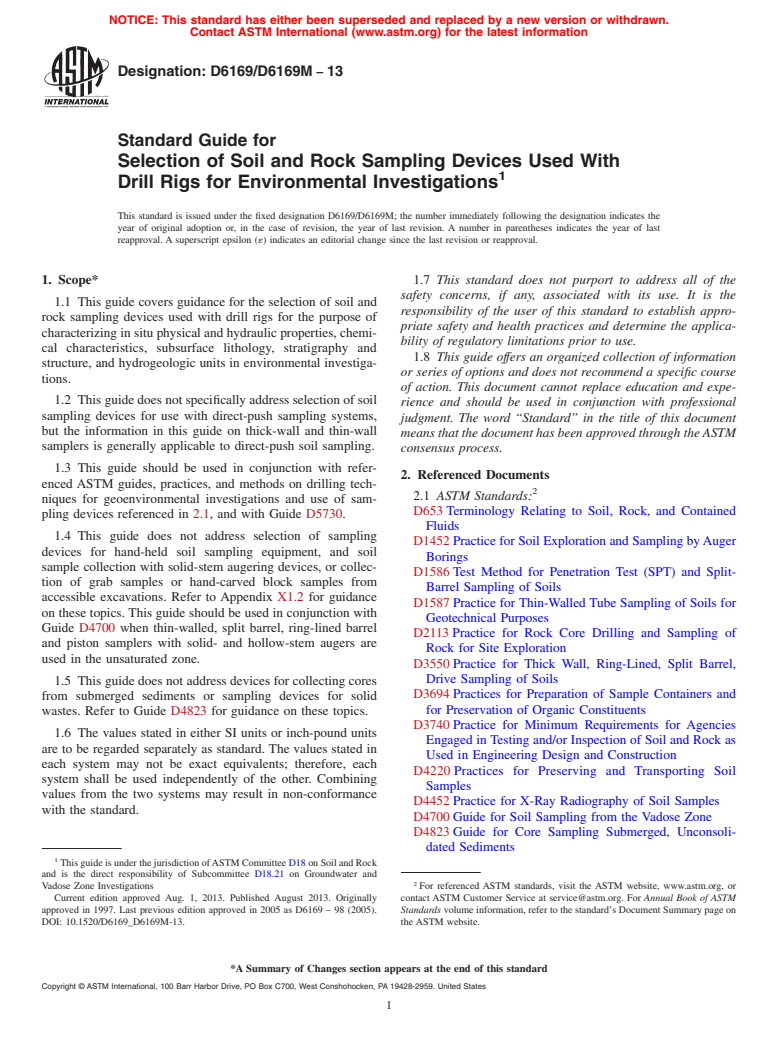
1.1 This guide covers guidance for the selection of soil and rock sampling devices used with drill rigs for the purpose of characterizing in situ physical and hydraulic properties, chemical characteristics, subsurface lithology, stratigraphy and structure, and hydrogeologic units in environmental investigations.
1.2 This guide does not specifically address selection of soil sampling devices for use with direct-push sampling systems, but the information in this guide on thick-wall and thin-wall samplers is generally applicable to direct-push soil sampling.
1.3 This guide should be used in conjunction with referenced ASTM guides, practices, and methods on drilling techniques for geoenvironmental investigations and use of sampling devices referenced in 2.1, and with Guide D5730.
1.4 This guide does not address selection of sampling devices for hand-held soil sampling equipment, and soil sample collection with solid-stem augering devices, or collection of grab samples or hand-carved block samples from accessible excavations. Refer to Appendix X1.2 for guidance on these topics. This guide should be used in conjunction with Guide D4700 when thin-walled, split barrel, ring-lined barrel and piston samplers with solid- and hollow-stem augers are used in the unsaturated zone.
1.5 This guide does not address devices for collecting cores from submerged sediments or sampling devices for solid wastes. Refer to Guide D4823 for guidance on these topics.
1.6 The values stated in either SI units or inch-pound units are to be regarded separately as standard. The values stated in each system may not be exact equivalents; therefore, each system shall be used independently of the other. Combining values from the two systems may result in non-conformance with the standard.
1.7 This standard does not purport to address all of the safety concerns, if any, associated with its use. It is the responsibility of the user of this sta...
General Information
Buy Standard


Standards Content (Sample)
NOTICE: This standard has either been superseded and replaced by a new version or withdrawn.
Contact ASTM International (www.astm.org) for the latest information
Designation: D6169/D6169M − 13
Standard Guide for
Selection of Soil and Rock Sampling Devices Used With
1
Drill Rigs for Environmental Investigations
This standard is issued under the fixed designation D6169/D6169M; the number immediately following the designation indicates the
year of original adoption or, in the case of revision, the year of last revision. A number in parentheses indicates the year of last
reapproval. A superscript epsilon (´) indicates an editorial change since the last revision or reapproval.
1. Scope* 1.7 This standard does not purport to address all of the
safety concerns, if any, associated with its use. It is the
1.1 This guide covers guidance for the selection of soil and
responsibility of the user of this standard to establish appro-
rock sampling devices used with drill rigs for the purpose of
priate safety and health practices and determine the applica-
characterizing in situ physical and hydraulic properties, chemi-
bility of regulatory limitations prior to use.
cal characteristics, subsurface lithology, stratigraphy and
1.8 This guide offers an organized collection of information
structure, and hydrogeologic units in environmental investiga-
or series of options and does not recommend a specific course
tions.
of action. This document cannot replace education and expe-
1.2 This guide does not specifically address selection of soil
rience and should be used in conjunction with professional
sampling devices for use with direct-push sampling systems,
judgment. The word “Standard” in the title of this document
but the information in this guide on thick-wall and thin-wall
means that the document has been approved through theASTM
samplers is generally applicable to direct-push soil sampling.
consensus process.
1.3 This guide should be used in conjunction with refer-
2. Referenced Documents
enced ASTM guides, practices, and methods on drilling tech-
2
2.1 ASTM Standards:
niques for geoenvironmental investigations and use of sam-
D653 Terminology Relating to Soil, Rock, and Contained
pling devices referenced in 2.1, and with Guide D5730.
Fluids
1.4 This guide does not address selection of sampling
D1452 Practice for Soil Exploration and Sampling byAuger
devices for hand-held soil sampling equipment, and soil
Borings
sample collection with solid-stem augering devices, or collec-
D1586 Test Method for Penetration Test (SPT) and Split-
tion of grab samples or hand-carved block samples from
Barrel Sampling of Soils
accessible excavations. Refer to Appendix X1.2 for guidance
D1587 Practice for Thin-Walled Tube Sampling of Soils for
on these topics. This guide should be used in conjunction with
Geotechnical Purposes
Guide D4700 when thin-walled, split barrel, ring-lined barrel
D2113 Practice for Rock Core Drilling and Sampling of
and piston samplers with solid- and hollow-stem augers are
Rock for Site Exploration
used in the unsaturated zone.
D3550 Practice for Thick Wall, Ring-Lined, Split Barrel,
Drive Sampling of Soils
1.5 This guide does not address devices for collecting cores
D3694 Practices for Preparation of Sample Containers and
from submerged sediments or sampling devices for solid
for Preservation of Organic Constituents
wastes. Refer to Guide D4823 for guidance on these topics.
D3740 Practice for Minimum Requirements for Agencies
1.6 The values stated in either SI units or inch-pound units
Engaged in Testing and/or Inspection of Soil and Rock as
are to be regarded separately as standard. The values stated in
Used in Engineering Design and Construction
each system may not be exact equivalents; therefore, each
D4220 Practices for Preserving and Transporting Soil
system shall be used independently of the other. Combining
Samples
values from the two systems may result in non-conformance
D4452 Practice for X-Ray Radiography of Soil Samples
with the standard.
D4700 Guide for Soil Sampling from the Vadose Zone
D4823 Guide for Core Sampling Submerged, Unconsoli-
dated Sediments
1
ThisguideisunderthejurisdictionofASTMCommitteeD18onSoilandRock
and is the direct responsibility of Subcommittee D18.21 on Groundwater and
2
Vadose Zone Investigations For referenced ASTM standards, visit the ASTM website, www.astm.org, or
Current edition approved Aug. 1, 2013. Published August 2013. Originally contact ASTM Customer Service at service@astm.org. For Annual Book of ASTM
approved in 1997. Last previous edition approved in 2005 as D6169 – 98 (2005). Standards volume information, refer to the standard’s Document Summary page on
DOI: 10.1520/D6169_D6169M-13. the ASTM website.
*A Summary of Changes section appears at the end of this standard
Copyright © ASTM International, 100 Barr Harbor Drive, PO Box C700, West Conshohocken, PA 19428-2959. United States
1
---------------------- Page: 1 ----------------------
D6169/D6169M − 13
D5079 Practice
...
This document is not an ASTM standard and is intended only to provide the user of an ASTM standard an indication of what changes have been made to the previous version. Because
it may not be technically possible to adequately depict all changes accurately, ASTM recommends that users consult prior editions as appropriate. In all cases only the current version
of the standard as published by ASTM is to be considered the official document.
Designation: D6169 − 98 (Reapproved 2005) D6169/D6169M − 13
Standard Guide for
Selection of Soil and Rock Sampling Devices Used With
1
Drill Rigs for Environmental Investigations
This standard is issued under the fixed designation D6169;D6169/D6169M; the number immediately following the designation indicates
the year of original adoption or, in the case of revision, the year of last revision. A number in parentheses indicates the year of last
reapproval. A superscript epsilon (´) indicates an editorial change since the last revision or reapproval.
1. Scope Scope*
1.1 This guide covers guidance for the selection of soil and rock sampling devices used with drill rigs for the purpose of
characterizing in situ physical and hydraulic properties, chemical characteristics, subsurface lithology, stratigraphy and structure,
and hydrogeologic units in environmental investigations.
1.2 This guide does not specifically address selection of soil sampling devices for use with direct-push sampling systems, but
the information in this guide on thick-wall and thin-wall samplers is generally applicable to direct-push soil sampling.
1.3 This guide should be used in conjunction with referenced ASTM guides, practices, and methods on drilling techniques for
geoenvironmental investigations and use of sampling devices referenced in 2.1, and with Guide D5730.
1.4 This guide does not address selection of sampling devices for hand-held soil sampling equipment, and soil sample collection
with solid-stem augering devices, or collection of grab samples or hand-carved block samples from accessible excavations. Refer
to Appendix X1.2 for guidance on these topics. This guide should be used in conjunction with Guide D4700 when thin-walled,
split barrel, ring-lined barrel and piston samplers with solid- and hollow-stem augers are used in the unsaturated zone.
1.5 This guide does not address devices for collecting cores from submerged sediments or sampling devices for solid wastes.
Refer to Guide D4823 for guidance on these topics.
1.6 The values stated in either SI units or inch-pound units are to be regarded separately as the standard. However, dimensions
of materials used in the drilling industry are given in English units by convention, therefore, English units are used where necessary
in this guide.standard. The values stated in each system may not be exact equivalents; therefore, each system shall be used
independently of the other. Combining values from the two systems may result in non-conformance with the standard.
1.7 This standard does not purport to address all of the safety concerns, if any, associated with its use. It is the responsibility
of the user of this standard to establish appropriate safety and health practices and determine the applicability of regulatory
limitations prior to use.
1.8 This guide offers an organized collection of information or series of options and does not recommend a specific course of
action. This document cannot replace education and experience and should be used in conjunction with professional
judgement.judgment. The word “Standard” in the title of this document means that the document has been approved through the
ASTM consensus process.
2. Referenced Documents
2
2.1 ASTM Standards:
D657D653 Specification for Isopropyl AcetateTerminology Relating to Soil, Rock, and Contained Fluids (Withdrawn 1977)
D1452 Practice for Soil Exploration and Sampling by Auger Borings
D1586 Test Method for Penetration Test (SPT) and Split-Barrel Sampling of Soils
D1587 Practice for Thin-Walled Tube Sampling of Soils for Geotechnical Purposes
D2113 Practice for Rock Core Drilling and Sampling of Rock for Site Investigation
D3550 Practice for Thick Wall, Ring-Lined, Split Barrel, Drive Sampling of Soils
D3694 Practices for Preparation of Sample Containers and for Preservation of Organic Constituents
1
This guide is under the jurisdiction of ASTM Committee D18 on Soil and Rock and is the direct responsibility of Subcommittee D18.21 on Groundwater and Vadose
Zone Investigations
Current edition approved Jan. 1, 2005Aug. 1, 2013. Published February 2005August 2013. Originally approved in 1997. Last previous edition approved in 19982005 as
D6169–98. DOI: 10.1520/D6169-98R05. – 98 (2005). DOI: 10.1520/D6169_D6169M-13.
2
For referenced ASTM standards, visit the ASTM website, www.astm.org, or contact ASTM Customer Service at service@astm.org. For Annual Book of ASTM Standards
volume information, refer to the standard’s Document Summary page on the ASTM website.
*A Summary of Changes section appear
...
Questions, Comments and Discussion
Ask us and Technical Secretary will try to provide an answer. You can facilitate discussion about the standard in here.