

ASTM G48-11(2020)e1
(Test Method)Standard Test Methods for Pitting and Crevice Corrosion Resistance of Stainless Steels and Related Alloys by Use of Ferric Chloride Solution
General Information
- Abstract
SIGNIFICANCE AND USE
4.1 These test methods describe laboratory tests for comparing the resistance of stainless steels and related alloys to the initiation of pitting and crevice corrosion. The results may be used for ranking alloys in order of increasing resistance to pitting and crevice corrosion initiation under the specific conditions of these methods. Methods A and B are designed to cause the breakdown of Type 304 at room temperature.
4.2 The use of ferric chloride solutions is justified because it is related to, but not the same as, that within a pit or crevice site on a ferrous alloy in chloride bearing environments (1, 2).3 The presence of an inert crevice former of consistent dimension on a surface is regarded as sufficient specification of crevice geometry to assess relative crevice corrosion susceptibility.
4.3 The relative performance of alloys in ferric chloride solution tests has been correlated to performance in certain real environments, such as natural seawater at ambient temperature (3) and strongly oxidizing, low pH, chloride containing environments (4), but several exceptions have been reported (4-7).
4.4 Methods A, B, C, D, E, and F can be used to rank the relative resistance of stainless steels and nickel base alloys to pitting and crevice corrosion in chloride-containing environments. No statement can be made about resistance of alloys in environments that do not contain chlorides.
4.4.1 Methods A, B, C, D, E, and F were designed to accelerate the time to initiate localized corrosion relative to most natural environments. Consequently, the degree of corrosion damage that occurs during testing will generally be greater than that in natural environments in any similar time period.
4.4.2 No statement regarding localized corrosion propagation can be made based on the results of Methods A, B, C, D, E, or F.
4.4.3 Surface preparation can significantly influence results. Therefore, grinding and pickling of the specimen will mean that the results may not...
SCOPE
1.1 These test methods cover procedures for the determination of the resistance of stainless steels and related alloys to pitting and crevice corrosion (see Terminology G193) when exposed to oxidizing chloride environments. Six procedures are described and identified as Methods A, B, C, D, E, and F.
1.1.1 Method A—Ferric chloride pitting test.
1.1.2 Method B—Ferric chloride crevice test.
1.1.3 Method C—Critical pitting temperature test for nickel-base and chromium-bearing alloys.
1.1.4 Method D—Critical crevice temperature test for nickel-base and chromium-bearing alloys.
1.1.5 Method E—Critical pitting temperature test for stainless steels.
1.1.6 Method F—Critical crevice temperature test for stainless steels.
1.2 Method A is designed to determine the relative pitting resistance of stainless steels and nickel-base, chromium-bearing alloys, whereas Method B can be used for determining both the pitting and crevice corrosion resistance of these alloys. Methods C, D, E, and F allow for a ranking of alloys by minimum (critical) temperature to cause initiation of pitting corrosion and crevice corrosion, respectively, of stainless steels, nickel-base and chromium-bearing alloys in a standard ferric chloride solution.
1.3 These tests may be used to determine the effects of alloying additives, heat treatment, and surface finishes on pitting and crevice corrosion resistance.
1.4 The values stated in SI units are to be regarded as standard. The values given in parentheses after SI units are provided for information only and are not considered standard.
1.5 This standard does not purport to address all of the safety concerns, if any, associated with its use. It is the responsibility of the user of this standard to establish appropriate safety, health, and environmental practices and determine the applicability of regulatory limitations prior to use.
1.6 This international standard was developed in a...
- Status
- Published
- Publication Date
- 31-Oct-2020
- Technical Committee
- G01 - Corrosion of Metals
- Drafting Committee
- G01.05 - Laboratory Corrosion Tests
Overview
ASTM G48-11(2020)e1, published by ASTM International, is a key standard outlining laboratory test methods for evaluating the pitting and crevice corrosion resistance of stainless steels and related alloys. These test methods use ferric chloride solutions to simulate aggressive chloride environments, providing data that enables the ranking of alloys based on their susceptibility to localized corrosion. The standard is widely recognized in materials testing, quality assurance, and corrosion engineering across industries dealing with stainless steels and nickel-based alloys.
Key Topics
- Test Methods: ASTM G48 describes six distinct procedures (Methods A-F) to assess corrosion performance:
- Method A: Ferric chloride pitting test.
- Method B: Ferric chloride crevice test.
- Methods C-D: Critical pitting and crevice temperature tests for nickel-base and chromium-bearing alloys.
- Methods E-F: Critical pitting and crevice temperature tests for stainless steels.
- Laboratory Testing: The procedures use standardized laboratory conditions to accelerate and replicate the conditions that can lead to pitting and crevice corrosion in real-world applications.
- Comparative Resistance Ranking: Results from these tests allow for relative ranking of alloys according to their resistance to the initiation of pitting and crevice corrosion under test conditions.
- Test Solution Justification: Ferric chloride solution is used as it mirrors the aggressive environments found in natural seawater and other chloride-containing environments, though it is more severe and not an exact match for all service conditions.
- Test Specimens and Preparation: Proper specimen preparation, including surface finish and dimensions, is critical to obtaining reproducible and meaningful results. Surface grinding or pickling may affect the passive protective layer typical in stainless steels.
- Limitations: The standard's test environments are highly aggressive, often causing more pronounced corrosion than natural environments over the same period. Results apply primarily to chloride-containing settings and focus on corrosion initiation rather than propagation.
Applications
ASTM G48 is utilized in industries with demanding corrosion-resistance requirements, including marine, chemical processing, oil & gas, and power generation. The standard is applied in:
- Alloy Selection & Development: Comparing the corrosion resistance of candidate materials for new projects or environments.
- Quality Assurance: Verifying that stainless steel or nickel-based alloy components meet minimum corrosion resistance requirements specified in procurement or regulatory standards.
- Failure Analysis: Using test results to investigate the suitability of materials implicated in corrosion-related failures.
- Process Optimization: Assessing how variables such as alloying elements, heat treatment, or surface finishing affect corrosion performance.
- Certification & Procurement: Providing documented proof of material performance for end users and certifying agencies.
Related Standards
ASTM G48 references other important standards and guides, including:
- ASTM G193: Terminology and Acronyms Relating to Corrosion
- ASTM G46: Guide for Examination and Evaluation of Pitting Corrosion
- ASTM G1: Practice for Preparing, Cleaning, and Evaluating Corrosion Test Specimens
- ASTM D1193: Specification for Reagent Water
- ASTM A262: Practices for Detecting Susceptibility to Intergranular Attack in Austenitic Stainless Steels
- ASTM E691: Practice for Conducting an Interlaboratory Study to Determine the Precision of a Test Method
Each related standard contributes to the robustness and reproducibility of corrosion testing and reporting, ensuring global comparability and compliance.
ASTM G48-11(2020)e1 remains an essential standard for ensuring the reliability and service life of stainless steel and related alloys in aggressive environments, supporting safe and efficient material selection across multiple global sectors.
Relations
- Effective Date
- 01-May-2013
- Effective Date
- 01-May-2013
- Effective Date
- 01-May-2013
- Effective Date
- 01-Dec-2011
- Effective Date
- 01-Nov-2011
- Effective Date
- 01-Apr-2010
- Effective Date
- 01-Sep-2009
- Effective Date
- 01-Oct-2008
- Effective Date
- 01-May-2008
- Effective Date
- 01-Mar-2008
- Effective Date
- 01-Mar-2006
- Effective Date
- 01-Nov-2005
- Effective Date
- 01-May-2005
- Refers
ASTM G1-03 - Standard Practice for Preparing, Cleaning, and Evaluating Corrosion Test Specimens - Effective Date
- 01-Oct-2003
- Effective Date
- 10-Sep-2003
Get Certified
Connect with accredited certification bodies for this standard

Element Materials Technology
Materials testing and product certification.

Inštitut za kovinske materiale in tehnologije
Institute of Metals and Technology. Materials testing, metallurgical analysis, NDT.
Sponsored listings
Frequently Asked Questions
ASTM G48-11(2020)e1 is a standard published by ASTM International. Its full title is "Standard Test Methods for Pitting and Crevice Corrosion Resistance of Stainless Steels and Related Alloys by Use of Ferric Chloride Solution". This standard covers: SIGNIFICANCE AND USE 4.1 These test methods describe laboratory tests for comparing the resistance of stainless steels and related alloys to the initiation of pitting and crevice corrosion. The results may be used for ranking alloys in order of increasing resistance to pitting and crevice corrosion initiation under the specific conditions of these methods. Methods A and B are designed to cause the breakdown of Type 304 at room temperature. 4.2 The use of ferric chloride solutions is justified because it is related to, but not the same as, that within a pit or crevice site on a ferrous alloy in chloride bearing environments (1, 2).3 The presence of an inert crevice former of consistent dimension on a surface is regarded as sufficient specification of crevice geometry to assess relative crevice corrosion susceptibility. 4.3 The relative performance of alloys in ferric chloride solution tests has been correlated to performance in certain real environments, such as natural seawater at ambient temperature (3) and strongly oxidizing, low pH, chloride containing environments (4), but several exceptions have been reported (4-7). 4.4 Methods A, B, C, D, E, and F can be used to rank the relative resistance of stainless steels and nickel base alloys to pitting and crevice corrosion in chloride-containing environments. No statement can be made about resistance of alloys in environments that do not contain chlorides. 4.4.1 Methods A, B, C, D, E, and F were designed to accelerate the time to initiate localized corrosion relative to most natural environments. Consequently, the degree of corrosion damage that occurs during testing will generally be greater than that in natural environments in any similar time period. 4.4.2 No statement regarding localized corrosion propagation can be made based on the results of Methods A, B, C, D, E, or F. 4.4.3 Surface preparation can significantly influence results. Therefore, grinding and pickling of the specimen will mean that the results may not... SCOPE 1.1 These test methods cover procedures for the determination of the resistance of stainless steels and related alloys to pitting and crevice corrosion (see Terminology G193) when exposed to oxidizing chloride environments. Six procedures are described and identified as Methods A, B, C, D, E, and F. 1.1.1 Method A—Ferric chloride pitting test. 1.1.2 Method B—Ferric chloride crevice test. 1.1.3 Method C—Critical pitting temperature test for nickel-base and chromium-bearing alloys. 1.1.4 Method D—Critical crevice temperature test for nickel-base and chromium-bearing alloys. 1.1.5 Method E—Critical pitting temperature test for stainless steels. 1.1.6 Method F—Critical crevice temperature test for stainless steels. 1.2 Method A is designed to determine the relative pitting resistance of stainless steels and nickel-base, chromium-bearing alloys, whereas Method B can be used for determining both the pitting and crevice corrosion resistance of these alloys. Methods C, D, E, and F allow for a ranking of alloys by minimum (critical) temperature to cause initiation of pitting corrosion and crevice corrosion, respectively, of stainless steels, nickel-base and chromium-bearing alloys in a standard ferric chloride solution. 1.3 These tests may be used to determine the effects of alloying additives, heat treatment, and surface finishes on pitting and crevice corrosion resistance. 1.4 The values stated in SI units are to be regarded as standard. The values given in parentheses after SI units are provided for information only and are not considered standard. 1.5 This standard does not purport to address all of the safety concerns, if any, associated with its use. It is the responsibility of the user of this standard to establish appropriate safety, health, and environmental practices and determine the applicability of regulatory limitations prior to use. 1.6 This international standard was developed in a...
SIGNIFICANCE AND USE 4.1 These test methods describe laboratory tests for comparing the resistance of stainless steels and related alloys to the initiation of pitting and crevice corrosion. The results may be used for ranking alloys in order of increasing resistance to pitting and crevice corrosion initiation under the specific conditions of these methods. Methods A and B are designed to cause the breakdown of Type 304 at room temperature. 4.2 The use of ferric chloride solutions is justified because it is related to, but not the same as, that within a pit or crevice site on a ferrous alloy in chloride bearing environments (1, 2).3 The presence of an inert crevice former of consistent dimension on a surface is regarded as sufficient specification of crevice geometry to assess relative crevice corrosion susceptibility. 4.3 The relative performance of alloys in ferric chloride solution tests has been correlated to performance in certain real environments, such as natural seawater at ambient temperature (3) and strongly oxidizing, low pH, chloride containing environments (4), but several exceptions have been reported (4-7). 4.4 Methods A, B, C, D, E, and F can be used to rank the relative resistance of stainless steels and nickel base alloys to pitting and crevice corrosion in chloride-containing environments. No statement can be made about resistance of alloys in environments that do not contain chlorides. 4.4.1 Methods A, B, C, D, E, and F were designed to accelerate the time to initiate localized corrosion relative to most natural environments. Consequently, the degree of corrosion damage that occurs during testing will generally be greater than that in natural environments in any similar time period. 4.4.2 No statement regarding localized corrosion propagation can be made based on the results of Methods A, B, C, D, E, or F. 4.4.3 Surface preparation can significantly influence results. Therefore, grinding and pickling of the specimen will mean that the results may not... SCOPE 1.1 These test methods cover procedures for the determination of the resistance of stainless steels and related alloys to pitting and crevice corrosion (see Terminology G193) when exposed to oxidizing chloride environments. Six procedures are described and identified as Methods A, B, C, D, E, and F. 1.1.1 Method A—Ferric chloride pitting test. 1.1.2 Method B—Ferric chloride crevice test. 1.1.3 Method C—Critical pitting temperature test for nickel-base and chromium-bearing alloys. 1.1.4 Method D—Critical crevice temperature test for nickel-base and chromium-bearing alloys. 1.1.5 Method E—Critical pitting temperature test for stainless steels. 1.1.6 Method F—Critical crevice temperature test for stainless steels. 1.2 Method A is designed to determine the relative pitting resistance of stainless steels and nickel-base, chromium-bearing alloys, whereas Method B can be used for determining both the pitting and crevice corrosion resistance of these alloys. Methods C, D, E, and F allow for a ranking of alloys by minimum (critical) temperature to cause initiation of pitting corrosion and crevice corrosion, respectively, of stainless steels, nickel-base and chromium-bearing alloys in a standard ferric chloride solution. 1.3 These tests may be used to determine the effects of alloying additives, heat treatment, and surface finishes on pitting and crevice corrosion resistance. 1.4 The values stated in SI units are to be regarded as standard. The values given in parentheses after SI units are provided for information only and are not considered standard. 1.5 This standard does not purport to address all of the safety concerns, if any, associated with its use. It is the responsibility of the user of this standard to establish appropriate safety, health, and environmental practices and determine the applicability of regulatory limitations prior to use. 1.6 This international standard was developed in a...
ASTM G48-11(2020)e1 is classified under the following ICS (International Classification for Standards) categories: 77.060 - Corrosion of metals. The ICS classification helps identify the subject area and facilitates finding related standards.
ASTM G48-11(2020)e1 has the following relationships with other standards: It is inter standard links to ASTM E691-13, ASTM A262-13, ASTM G46-94(2013), ASTM G1-03(2011), ASTM E691-11, ASTM A262-10, ASTM E1338-09, ASTM E691-08, ASTM G107-95(2008), ASTM A262-02a(2008), ASTM D1193-06, ASTM E691-05, ASTM G46-94(2005), ASTM G1-03, ASTM E1338-97(2003). Understanding these relationships helps ensure you are using the most current and applicable version of the standard.
ASTM G48-11(2020)e1 is available in PDF format for immediate download after purchase. The document can be added to your cart and obtained through the secure checkout process. Digital delivery ensures instant access to the complete standard document.
Standards Content (Sample)
This international standard was developed in accordance with internationally recognized principles on standardization established in the Decision on Principles for the
Development of International Standards, Guides and Recommendations issued by the World Trade Organization Technical Barriers to Trade (TBT) Committee.
´1
Designation: G48 − 11 (Reapproved 2020)
Standard Test Methods for
Pitting and Crevice Corrosion Resistance of Stainless
Steels and Related Alloys by Use of Ferric Chloride
Solution
ThisstandardisissuedunderthefixeddesignationG48;thenumberimmediatelyfollowingthedesignationindicatestheyearoforiginal
adoptionor,inthecaseofrevision,theyearoflastrevision.Anumberinparenthesesindicatestheyearoflastreapproval.Asuperscript
epsilon (´) indicates an editorial change since the last revision or reapproval.
ε NOTE—Replaced Terminology G15 with Terminology G193, and other editorial changes made throughout in Dec. 2020.
1. Scope 1.5 This standard does not purport to address all of the
safety concerns, if any, associated with its use. It is the
1.1 These test methods cover procedures for the determina-
responsibility of the user of this standard to establish appro-
tion of the resistance of stainless steels and related alloys to
priate safety, health, and environmental practices and deter-
pitting and crevice corrosion (see Terminology G193) when
mine the applicability of regulatory limitations prior to use.
exposed to oxidizing chloride environments. Six procedures
1.6 This international standard was developed in accor-
are described and identified as Methods A, B, C, D, E, and F.
dance with internationally recognized principles on standard-
1.1.1 Method A—Ferric chloride pitting test.
ization established in the Decision on Principles for the
1.1.2 Method B—Ferric chloride crevice test.
Development of International Standards, Guides and Recom-
1.1.3 Method C—Criticalpittingtemperaturetestfornickel-
mendations issued by the World Trade Organization Technical
base and chromium-bearing alloys.
Barriers to Trade (TBT) Committee.
1.1.4 Method D—Critical crevice temperature test for
nickel-base and chromium-bearing alloys.
2. Referenced Documents
1.1.5 Method E—Critical pitting temperature test for stain-
2.1 ASTM Standards:
less steels.
A262Practices for Detecting Susceptibility to Intergranular
1.1.6 Method F—Critical crevice temperature test for stain-
Attack in Austenitic Stainless Steels
less steels.
D1193Specification for Reagent Water
1.2 Method A is designed to determine the relative pitting
E691Practice for Conducting an Interlaboratory Study to
resistance of stainless steels and nickel-base, chromium-
Determine the Precision of a Test Method
bearing alloys, whereas Method B can be used for determining
E1338Guide for Identification of Metals and Alloys in
boththepittingandcrevicecorrosionresistanceofthesealloys.
Computerized Material Property Databases
Methods C, D, E, and F allow for a ranking of alloys by
G1Practice for Preparing, Cleaning, and Evaluating Corro-
minimum (critical) temperature to cause initiation of pitting
sion Test Specimens
corrosion and crevice corrosion, respectively, of stainless
G46Guide for Examination and Evaluation of Pitting Cor-
steels, nickel-base and chromium-bearing alloys in a standard
rosion
ferric chloride solution.
G107Guide for Formats for Collection and Compilation of
1.3 These tests may be used to determine the effects of
Corrosion Data for Metals for Computerized Database
alloying additives, heat treatment, and surface finishes on
Input
pitting and crevice corrosion resistance.
G193Terminology and Acronyms Relating to Corrosion
1.4 The values stated in SI units are to be regarded as
3. Terminology
standard. The values given in parentheses after SI units are
providedforinformationonlyandarenotconsideredstandard. 3.1 Definitions of Terms Specific to This Standard:
3.1.1 critical crevice temperature, n—the minimum tem-
perature (°C) to produce crevice attack at least 0.025mm
These test methods are under the jurisdiction of ASTM Committee G01 on
Corrosion of Metals and are the direct responsibility of Subcommittee G01.05 on
Laboratory Corrosion Tests. For referenced ASTM standards, visit the ASTM website, www.astm.org, or
Current edition approved Nov. 1, 2020. Published December 2020. Originally contact ASTM Customer Service at service@astm.org. For Annual Book of ASTM
approved in 1976. Last previous edition approved in 2015 as G48–11 (2015). DOI: Standards volume information, refer to the standard’s Document Summary page on
10.1520/G0048-11R20E01. the ASTM website.
Copyright © ASTM International, 100 Barr Harbor Drive, PO Box C700, West Conshohocken, PA 19428-2959. United States
´1
G48 − 11 (2020)
NOTE 2—When testing as-welded, cylindrical, or other non-flat
(0.001in.) deep on the bold surface of the specimen beneath
samples, the standard crevice formers will not provide uniform contact.
the crevice washer, edge attack ignored.
The use of contoured crevice formers may be considered in such
3.1.2 critical pitting temperature, n—the minimum tem-
situations, but the use of a pitting test (Practices A, C, or E) should be
considered.
perature (°C) to produce pitting attack at least 0.025mm
(0.001in.) deep on the bold surface of the specimen, edge
5. Apparatus
attack ignored.
5.1 Glassware—Methods A, B, C, D, E, and F provide an
3.2 The terminology used herein, if not specifically defined
option to use either wide mouth flasks or suitable sized test
otherwise, shall be in accordance with Terminology G193.
tubes.Condensersarerequiredforelevatedtemperaturetesting
Definitions provided herein and not given in Terminology
when solution evaporation may occur. Glass cradles or hooks
G193 are limited only to this standard.
also may be required.
5.1.1 Flask Requirements, 1000mL wide mouth. Tall form
4. Significance and Use
or Erlenmeyer flasks can be used. The mouth of the flask shall
4.1 These test methods describe laboratory tests for com-
have a diameter of about 40 mm (1.6 in.) to allow passage of
paringtheresistanceofstainlesssteelsandrelatedalloystothe
the test specimen and the support.
initiation of pitting and crevice corrosion. The results may be
5.1.2 Test Tube Requirements, the diameter of the test tube
used for ranking alloys in order of increasing resistance to
shall also be about 40 mm (1.6 in.) in diameter. If testing
pitting and crevice corrosion initiation under the specific
requires use of a condenser (described below), the test tube
conditions of these methods. MethodsAand B are designed to
length shall be about 300 mm (about 12 in.); otherwise, the
cause the breakdown of Type 304 at room temperature.
length can be about 150mm to 200 mm (about 6 in. to 8 in.).
4.2 Theuseofferricchloridesolutionsisjustifiedbecauseit
5.1.3 Condensers, Vents and Covers:
isrelatedto,butnotthesameas,thatwithinapitorcrevicesite
5.1.3.1 Avariety of condensers may be used in conjunction
onaferrousalloyinchloridebearingenvironments (1, 2). The
with the flasks described in 5.1.1. These include the cold
presence of an inert crevice former of consistent dimension on
finger-type (see, for example, Practices A262, Practice C) or
a surface is regarded as sufficient specification of crevice
Allihn type condensers having straight tube ends or tapered
geometry to assess relative crevice corrosion susceptibility.
ground joints. Straight end condensers can be inserted through
a bored rubber stopper. Likewise, a simple U tube condenser
4.3 The relative performance of alloys in ferric chloride
can be fashioned.
solutiontestshasbeencorrelatedtoperformanceincertainreal
environments, such as natural seawater at ambient temperature
NOTE3—Theuseofgroundjointcondensersrequiresthatthemouthof
(3) and strongly oxidizing, low pH, chloride containing envi-
the flask have a corresponding joint.
ronments (4), but several exceptions have been reported (4-7).
5.1.3.2 U Tube Condensers, fitted through holes in an
4.4 Methods A, B, C, D, E, and F can be used to rank the appropriatesizerubberstoppercanbeusedinconjunctionwith
relative resistance of stainless steels and nickel base alloys to the 300mm test tube described in 5.1.2.
pitting and crevice corrosion in chloride-containing environ- 5.1.3.3 When evaporation is not a significant problem,
ments. No statement can be made about resistance of alloys in flasks can be covered with a watch glass. Also, flasks as well
environments that do not contain chlorides. as test tubes can be covered with loosely fitted stoppers or
4.4.1 Methods A, B, C, D, E, and F were designed to plastic or paraffin type wraps.
accelerate the time to initiate localized corrosion relative to
NOTE 4—Venting must always be considered due to the possible build
most natural environments. Consequently, the degree of corro-
up of gas pressure that may result from the corrosion process.
siondamagethatoccursduringtestingwillgenerallybegreater
5.1.4 Specimen Supports:
than that in natural environments in any similar time period.
5.1.4.1 One advantage of using test tubes is that specimen
4.4.2 No statement regarding localized corrosion propaga-
supportsarenotrequired.However,placementofthespecimen
tion can be made based on the results of MethodsA, B, C, D,
does create the possible opportunity for crevice corrosion to
E, or F.
occur along the edge.
4.4.3 Surfacepreparationcansignificantlyinfluenceresults.
Therefore, grinding and pickling of the specimen will mean NOTE 5—See 14.2 concerning edge attack.
that the results may not be representative of the conditions of
5.1.4.2 When using flasks, specimens can be supported on
the actual piece from which the sample was taken.
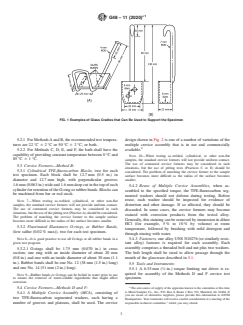
cradles or hooks. Cradles, such as those shown in Fig. 1,
eliminate the necessity for drilling a support hole in the test
NOTE 1—Grinding or pickling on stainless steel surfaces may destroy
the passive layer. A 24h air passivation after grinding or pickling is specimen. While the use of hooks requires that a specimen
sufficient to minimize these differences (8).
supportholebeprovided,thehooks,ascontrastedtothecradle,
are easier to fashion. Moreover, they create only one potential
4.4.4 The procedures in Methods C, D, E, and F for
crevice site whereas multiple sites are possible with the cradle.
measuring critical pitting corrosion temperature and critical
crevice corrosion temperature have no bias because the values
NOTE 6—A TFE-fluorocarbon cradle may be substituted for glass.
are defined only in terms of these test methods.
5.1.4.3 TheuseofsupportsforMethodsB,D,andFcrevice
corrosion specimens is optional.
Theboldfacenumbersinparenthesesrefertothelistofreferencesattheendof
this standard. 5.2 Water or Oil Bath, constant temperature.
´1
G48 − 11 (2020)
FIG. 1 Examples of Glass Cradles that Can Be Used to Support the Specimen
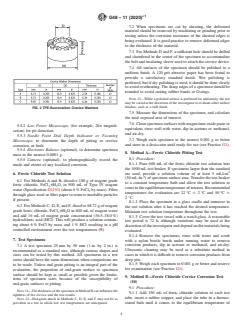
5.2.1 ForMethodsAandB,therecommendedtesttempera- design shown in Fig. 2 is one of a number of variations of the
tures are 22°C 62°Cor50°C 6 2°C, or both. multiple crevice assembly that is in use and commercially
5.2.2 For Methods C, D, E, and F, the bath shall have the available.
capability of providing constant temperature between 0°C and
NOTE 10—When testing as-welded, cylindrical, or other non-flat
85°C 6 1°C.
samples, the standard crevice formers will not provide uniform contact.
The use of contoured crevice formers may be considered in such
5.3 Crevice Formers—Method B:
situations, but the use of pitting tests (Practices C or E) should be
5.3.1 Cylindrical TFE-fluorocarbon Blocks, two for each
considered. The problem of matching the crevice former to the sample
test specimen. Each block shall be 12.7mm (0.5 in.) in
surface becomes more difficult as the radius of the surface becomes
diameter and 12.7mm high, with perpendicular grooves smaller.
1.6mm(0.063in.)wideand1.6mmdeepcutinthetopofeach
5.4.2 Reuse of Multiple Crevice Assemblies, when as-
cylinderforretentionoftheO-ringorrubberbands.Blockscan
sembled to the specified torque, the TFE-fluorocarbon seg-
be machined from bar or rod stock.
mented washers should not deform during testing. Before
reuse, each washer should be inspected for evidence of
NOTE 7—When testing as-welded, cylindrical, or other non-flat
samples, the standard crevice formers will not provide uniform contact. distortion and other damage. If so affected, they should be
The use of contoured crevice formers may be considered in such
discarded. In some cases, the crevice formers may become
situations,buttheuseofthepittingtest(PracticeA)shouldbeconsidered.
stained with corrosion products from the tested alloy.
The problem of matching the crevice former to the sample surface
Generally,thisstainingcanberemovedbyimmersionindilute
becomes more difficult as the radius of the surface becomes smaller.
HCl (for example, 5 % to 10 % by volume) at room
5.3.2 Fluorinated Elastomers O-rings, or Rubber Bands,
temperature, followed by brushing with mild detergent and
(low sulfur (0.02% max)), two for each test specimen.
through rinsing with water.
NOTE 8—It is good practice to use all O-rings or all rubber bands in a 5.4.3 Fasteners, one alloy UNS N10276 (or similarly resis-
given test program.
tant alloy) fastener is required for each assembly. Each
assembly comprises a threaded bolt and nut plus two washers.
5.3.2.1 O-rings shall be 1.75 mm (0.070 in.) in cross
The bolt length shall be sized to allow passage through the
section; one ring with an inside diameter of about 20 mm
mouth of the glassware described in 5.1.
(0.8in.) and one with an inside diameter of about 30 mm (1.1
in.). Rubber bands shall be one No. 12 (38mm (1.5in.) long)
5.5 Tools and Instruments:
and one No. 14 (51mm (2in.) long). 1
5.5.1 A 6.35mm ( ⁄4in.) torque limiting nut driver is re-
quired for assembly of the Methods D and F crevice test
NOTE 9—Rubber bands or O-rings can be boiled in water prior to use
specimen.
to ensure the removal of water-soluble ingredients that might affect
corrosion.
The sole source of supply of the apparatus known to the committee at this time
5.4 Crevice Formers—Methods D and F:
is Metal Samples Co., Inc., P.O. Box 8, Route 1 Box 152, Munford, AL 36268. If
5.4.1 A Multiple Crevice Assembly (MCA), consisting of
you are aware of alternative suppliers, please provide this information to ASTM
two TFE-fluorocarbon segmented washers, each having a
Headquarters.Your comments will receive careful consideration at a meeting of the
number of grooves and plateaus, shall be used. The crevice responsible technical committee, which you may attend.
´1
G48 − 11 (2020)
7.2 When specimens are cut by shearing, the deformed
material should be removed by machining or grinding prior to
testing unless the corrosion resistance of the sheared edges is
being evaluated. It is good practice to remove deformed edges
to the thickness of the material.
7.3 For Methods D and F, a sufficient hole should be drilled
and chamfered in the center of the specimen to accommodate
theboltandinsulatingsleeveusedtoattachthecrevicedevice.
7.4 All surfaces of the specimen should be polished to a
uniform finish. A 120grit abrasive paper has been found to
provide a satisfactory standard finish. Wet polishing is
preferred,butifdrypolishingisused,itshouldbedoneslowly
toavoidoverheating.Thesharpedgesofaspecimenshouldbe
rounded to avoid cutting rubber bands or O-rings.
NOTE 13—While a polished surface is preferred for uniformity, the test
maybevariedatthediscretionoftheinvestigatortoevaluateothersurface
finishes, such as a mill finish.
FIG. 2 TFE-fluorocarbon Crevice Washers
7.5 Measure the dimensions of the specimen, and calculate
the total exposed area of interest.
7.6 Cleanspecimensurfaceswithmagnesiumoxidepasteor
5.5.2 Low Power Microscope, (for example, 20× magnifi-
equivalent, rinse well with water, dip in acetone or methanol,
cation) for pit detection.
and air-dry.
5.5.3 Needle Point Dial Depth Indicator or Focusing
7.7 Weigh each specimen to the nearest 0.001 g or better
Microscope, to determine the depth of pitting or crevice
and store in a desiccator until ready for use (see Practice G1).
corrosion, or both.
5.5.4 Electronic Balance (optional), to determine specimen
8. Method A—Ferric Chloride Pitting Test
mass to the nearest 0.0001 g.
8.1 Procedure:
5.5.5 Camera (optional), to photographically record the
8.1.1 Pour 600 mL of the ferric chloride test solution into
mode and extent of any localized corrosion.
the 1000mLtest beaker. If specimens larger than the standard
are used, provide a solution volume of at least 5 mL/cm
6. Ferric Chloride Test Solution
(30mL⁄in. ) of specimen surface area.Transfer the test beaker
6.1 For Methods A and B, dissolve 100 g of reagent grade
to a constant temperature bath and allow the test solution to
ferric chloride, FeCl ·6H O, in 900 mL of Type IV reagent
3 2
cometotheequilibriumtemperatureofinterest.Recommended
water (Specification D1193) (about 6% FeCl by mass). Filter
temperatures for evaluation are 22°C 6 2°C and 50°C 6
throughglasswoolorfilterpapertoremoveinsolubleparticles
2°C.
if present.
8.1.2 Place the specimen in a glass cradle and immerse in
6.2 For Methods C, D, E, and F, dissolve 68.72 g of reagent
the test solution after it has reached the desired temperature.
grade ferric chloride, FeCl ·6H O in 600 mL of reagent water
3 2 Maintain test solution temperature throughout the test.
and add 16 mL of reagent grade concentrated (36.5–38.0%)
8.1.3 Cover the test vessel with a watch glass.Areasonable
hydrochloric acid (HCl). This will produce a solution contain-
test period is 72 h, although variations may be used at the
ing about 6% FeCl by mass and 1% HCl resulting in a pH
discretionoftheinvestigatoranddependonthematerialsbeing
controlled environment over the test temperatures (9).
evaluated.
8.1.4 Remove the specimens, rinse with water and scrub
7. Test Specimens
with a nylon bristle brush under running water to remove
corrosion products, dip in acetone or methanol, and air-dry.
7.1 A test specimen 25mm by 50 mm (1in. by 2 in.) is
Ultrasonic cleaning may be used as a substitute method in
recommended as a standard size, although various shapes and
cases in which it is difficult to remove corrosion products from
sizes can be tested by this method. All specimens in a test
deep pits.
series should have the same dimensions when comparisons are
8.1.5 Weigh each specimen to 0.001 g or better and reserve
to be made. Unless end-grain pitting is an integral part of the
for examination (see Practice G1).
evaluation, the proportion of end-grain surface to specimen
surface should be kept as small as possible given the limita-
9. Method B—Ferric Chloride Crevice Corrosion Test
tions of specimen sizes because of the susceptibility of
(10)
end-grain surfaces to pitting.
9.1 Procedure:
NOTE11—ThethicknessofthespecimeninMethodBcaninfluencethe
9.1.1 Add 150 mL of ferric chloride solution to each test
tightness of the crevice and the test results.
tube, insert a rubber stopper, and place the tube in a thermo-
NOTE 12—End-grain attack in Methods C, D, E, and F may not be as
prevalent in a test in which low test temperatures are anticipated. stated bath until it comes to the equilibrium temperature of
´1
G48 − 11 (2020)
10.1.1 Pour 600 mLof acidified ferric chloride test solution
intothetestcontainer.Ifspecimenslargerthanthestandardare
used, provide a solution volume of at least 5 mL/cm
(30mL⁄in. ) of surface area. Cover the container with a watch
glass, transfer to a constant temperature bath, and allow to
come to the equilibrium temperature of interest. Verify the
temperature before starting the test.
10.1.2 If test tubes are used instead of a 1000mL test
container, 150 mL of test solution shall be added.
10.1.3 Place the specimen in a glass cradle and immerse in
the test solution after it has reached the desired temperature.
The starting temperature may be estimated by the following
equation (10, 11).
(a)Specimen After Test with Attack at Four Crevices
Under Rubber Bands and Under One Block CPT °C 5 2.5 3%Cr 1 7.6 3%Mo 1 31.9 3%N 241.0
~ ! ~ ! ~ ! ~ !
(b)Assembled Crevice Test Specimen
(1)
FIG. 3 Ferric Chloride Crevice Test Specimen
Testing shall begin at the nearest increment of 5°C, esti-
matedbytheaboveequation.Theminimumtemperatureoftest
is0°Candthemaximumtemperatureoftestis85°C.Nomore
interest. Recommended temperatures for evaluation are 22°C
than one specimen shall be placed in a test container. Replace
6 2°C and 50°C 6 2°C.
the watch glass on the container. Maintain the temperature
9.1.2 Fasten two TFE-fluorocarbon blocks to the test speci-
(61°C(61.8°F))throughoutthetestperiod.Thestandardtest
menwithO-ringsoradoubleloopofeachoftworubberbands
periodis72h.Thistestperiodwasevaluatedbyinterlaboratory
as shown in Fig. 3. Use plastic gloves to avoid hand contact
testing, 16.1.2, and is required to produce attack on some
withmetalsurfacesduringthisoperation.UsethesmallO-ring
highly corrosion resistant nickel-based alloys. The test period
or the No. 12 rubber band for the 25mm (1in.) dimension and
must be reported as indicated in 15.1.
the large O-ring or the No. 14 rubber band for the 50mm
NOTE 16—Critical pitting or crevice testing is likely to require three to
(2in.) dimension.
five replicate samples to determine the critical temperature for each
9.1.3 After the test solution has reached the desired
alloy/condition.
temperature, tilt the tube at a 45° angle and slide the test
NOTE 17—While testing may be done at a higher temperature, 85°C
specimen to the bottom of the tube, replace the stopper, and
was the maximum temperature of the test in the round robin.
return the tube to the bath.
10.1.4 At the end of the test period, remove the specimen,
9.1.4 A reasonable test period is 72 h, although variations
rinsewithwater,scrubwithanylonbristlebrushunderrunning
maybeusedatthediscretionoftheinvestigatoranddependon
water to remove corrosion products, dip in acetone or
the materials being evaluated. Specimens may be inspected at
methanol, and dry.
intervals by decanting the test solution into a clean beaker and
10.1.5 Inspection is done in accordance with Section 14.
sliding the specimen from the test tube. Rinse the specimen in
Pitting corrosion is considered to be present if the local attack
water and examine under the four points of contact for the
is 0.025 mm (0.001 in.) or greater in depth.
O-rings or rubber bands and under both TFE-fluorocarbon
10.1.5.1 If minimum or greater pitting attack is observed,
blocks. If further exposure is required, the specimen and
lowerthebathtemperature5°C,andusinganewspecimenand
solutionshouldbereturnedtothetesttubebeforethespecimen
fresh solution, repeat steps 10.1.1 to 10.1.5,or
drys and the test tube should be immediately returned to the
10.1.5.2 If less than minimum pitting attack is observed,
bath.
raise the bath temperature 10°C, and using a new specimen
NOTE 14—The removal of specimens for inspection may affect the rate
and fresh solution, repeat steps 10.1.1 – 10.1.5.
of corrosion, and caution should be observed when comparing these
results with those obtained from constant immersion tests.
11. Method D—Critical Crevice Temperature Test for
Nickel-Based and Chromium-Bearing Alloys (12):
9.1.5 After the test has been completed, remove the test
NOTE 18—See Table 1.
specimens, rinse with water, and scrub with a nylon bristle
brushunderrunningwatertoremovecorrosionproducts,dipin 11.1 Procedure:
acetone or methanol, and air-dry. Ultrasonic cleaning may be
11.1.1 Apply the two crevice washers to the specimen. A
used in those cases in which it is difficult to remove corrosion TFE-fluorocarbontubularsleeve(forelectricalisolation),anda
products from deep pits or crevices.
bolt, a nut, and flat washers of UNS N10276 may be used to
9.1.6 Weigh each specimen to the nearest 0.001 g or better fastenthecrevicewasherstothespecimen,asillustratedinFig.
and reserve for examination.
4. Insulating sleeves shall be used around the bolt and the
specimen shall be checked for electrical contact with the bolt.
10. Method C—Critical Pitting Temperature Test for
The torque on the bolt influences the tightness of the crevice
Nickel-Base and Chromium-Bearing Alloys:
and the test results. A torque of 0.28 Nm (40 in.-oz) shall be
NOTE 15—See Table 1. 1
applied using a 6.35mm ( ⁄4in.) drive torque limiting nut-
10.1 Procedure: driver. The torque must be reported as indicated in 15.1.
´1
G48 − 11 (2020)
TABLE 1 Results of First Interlaboratory Test Program
NOTE 1—Minimum temperature (°C) to produce attack at least 0.025mm (0.001in.) deep on bold surface of specimen. Edge attack ignored.
Method C—CPT Critical Pitting Corrosion Temperature (C) Method D—CCT Critical Crevice Corrosion Temperature (C)
Alloy/Laboratory
UNS S31603 UNS N08367 UNS S44735 UNS N06022 UNS S31603 UNS N08367 UNS S44735 UNS N06022
A A A
1 20/20/20 75/ / 85/85/85 >85/>85/>85 <0/<0<0 30/30/30 42/35/42 50/ /50
A
2 20/20/20 70/70/70 80/80/80 >85/>85/>85 <0/<0<0 25/25/25 35/35/ 50/55/55
3 20/20/20 85/85/85 75/85/85 >85/>85/>85 <0/<0/<0 25/30/30 35/40/40 55/60/60
4 19/19 75/80 81/81 >85/>85 <0/<0 34/34 40/40 67/67
5 20/20/20 75/75/75 70/70/75 >85/>85/>85 <0/<0/<0 20/20/20 45/45/45
6 20/20 75/80 75/85 >85/>85 <0/<0 30/30 40/40 55/55
A
Test run but no attack observed.
FIG. 4 Method D and F Crevice Assembly
NOTE 19—The torque of 0.28 Nm (40 in.-oz) was evaluated by
Note 15). No more than one specimen shall be placed in a test
inter-laboratory testing, 16.1.2.
container. Replace the watch glass on the container and
NOTE 20—(a) Titanium bolts, nuts, and flat washers may also be used
maintain the temperature (61°C (61.8°F)) throughout the
toattachthecrevicewasherstothespecimen.(b)Differentcrevicedevices
test period. The standard test period is 72 h. This test period
may give different results for the same torque.
wasevaluatedbyinterlaboratorytesting,16.1.2,andisrequired
11.1.2 Pour 600 mLof acidified ferric chloride test solution
to produce attack on some highly corrosion resistant nickel-
into the 1000mL test container. Cover the container with a
based alloys (12, 13). The test period must be reported as
watch glass, transfer to a constant temperature bath, and allow
indicated in 15.1.
to come to equilibrium temperature of interest. Verify the
11.1.5 At the end of t
...