

ASTM D6756-17
(Test Method)Standard Test Method for Determination of the Red Dye Concentration and Estimation of the ASTM Color of Diesel Fuel and Heating Oil Using a Portable Visible Spectrophotometer
General Information
- Abstract
SIGNIFICANCE AND USE
5.1 In the United States, high sulfur content (defined by the United States Environmental Protection Agency (USEPA)) middle distillate products and diesel fuel used for off-road purposes, other than aviation turbine fuel, are required by government agencies to contain red dye. The dye concentration required to be present in high-sulfur and off-road diesel products is regulated by the United States Environmental Protection Agency and the United States Internal Revenue Service, respectively.
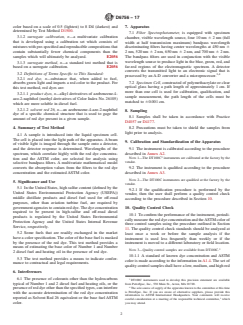
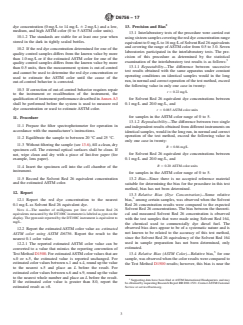
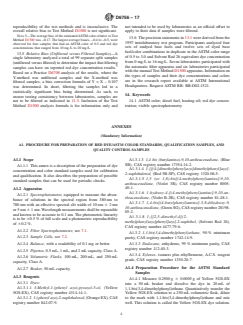
5.2 Some fuels that are readily exchanged in the market have a color specification. The color of the base fuel is masked by the presence of the red dye. This test method provides a means of estimating the base color of Number 1 and Number 2 diesel fuel and heating oil in the presence of red dye.
5.3 The test method provides a means to indicate conformance to contractual and legal requirements.
SCOPE
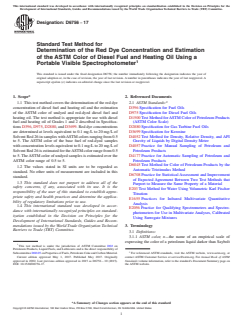
1.1 This test method covers the determination of the red dye concentration of diesel fuel and heating oil and the estimation of the ASTM color of undyed and red-dyed diesel fuel and heating oil. The test method is appropriate for use with diesel fuel and heating oil of Grades 1 and 2 described in Specifications D396, D975, D2880, and D3699. Red dye concentrations are determined at levels equivalent to 0.1 mg/L to 20 mg/L of Solvent Red 26 in samples with ASTM colors ranging from 0.5 to 5. The ASTM color of the base fuel of red-dyed samples with concentration levels equivalent to 0.1 mg/L to 20 mg/L of Solvent Red 26 is estimated for the ASTM color range from 0.5 to 5. The ASTM color of undyed samples is estimated over the ASTM color range of 0.5 to 5.
1.2 The values stated in SI units are to be regarded as standard. No other units of measurement are included in this standard.
1.3 This standard does not purport to address all of the safety concerns, if any, associated with its use. It is the responsibility of the user of this standard to establish appropriate safety and health practices and determine the applicability of regulatory limitations prior to use.
1.4 This international standard was developed in accordance with internationally recognized principles on standardization established in the Decision on Principles for the Development of International Standards, Guides and Recommendations issued by the World Trade Organization Technical Barriers to Trade (TBT) Committee.
- Status
- Published
- Publication Date
- 30-Apr-2017
- Technical Committee
- D02 - Petroleum Products, Liquid Fuels, and Lubricants
- Drafting Committee
- D02.05 - Properties of Fuels, Petroleum Coke and Carbon Material
Buy Documents
ASTM D6756-17 - Standard Test Method for Determination of the Red Dye Concentration and Estimation of the ASTM Color of Diesel Fuel and Heating Oil Using a Portable Visible Spectrophotometer
REDLINE ASTM D6756-17 - Standard Test Method for Determination of the Red Dye Concentration and Estimation of the ASTM Color of Diesel Fuel and Heating Oil Using a Portable Visible Spectrophotometer
Overview
ASTM D6756-17 establishes the standard test method for determining the red dye concentration and estimating the ASTM color of diesel fuel and heating oil using a portable visible spectrophotometer. This method is crucial for compliance with United States Environmental Protection Agency (USEPA) and Internal Revenue Service (IRS) regulations, which mandate the presence of specific dye concentrations in certain grades of diesel and heating oil, especially those with higher sulfur content and those used for off-road purposes. The method covers both dyed and undyed fuels, focusing on Grades 1 and 2 as defined in related ASTM specifications.
Key Topics
- Red Dye Concentration: Specifies techniques for quantifying Solvent Red 26 equivalent concentrations between 0.1 mg/L and 20 mg/L in diesel fuel and heating oil.
- ASTM Color Estimation: Provides a means to estimate the ASTM color of the base fuel within the 0.5 to 5 color range, even in the presence of red dye.
- Visible Spectrophotometry: Utilizes portable spectrophotometers to measure light absorption at prescribed wavelengths to detect dye levels and estimate color.
- Regulatory Compliance: Ensures conformity with legal and contractual fuel marking requirements, assisting in enforcement against tax evasion and environmental infractions.
- Quality Control and Instrument Calibration: Details procedures for calibrating and qualifying instruments, as well as regular quality control checks to maintain reliable results.
Applications
ASTM D6756-17 is widely used in various sectors where diesel fuel and heating oil must be monitored for regulatory and commercial reasons:
- Compliance Verification: Used by refineries, distributors, and regulatory agencies to confirm that red dye concentrations meet USEPA/IRS mandates, especially for high-sulfur and off-road diesel.
- Fuel Quality Assessment: Supports fuel exchanges where color specification is part of commercial agreements by allowing estimation of base fuel color despite dye presence.
- Contract and Legal Enforcement: Provides critical evidence of dye and color levels to demonstrate compliance with fuel marking laws and contractual terms.
- Portable Field Testing: The use of portable spectrophotometers enables on-site testing at production, storage, and distribution points, ensuring rapid and accurate determination of fuel status.
- Testing Laboratories: Accredited labs use this method to produce traceable, standardized results for clients requiring documented verification of fuel characteristics.
Related Standards
Several ASTM standards are referenced and are commonly used in conjunction with ASTM D6756-17 to provide a comprehensive approach to fuel analysis and quality assurance:
- ASTM D396 - Specification for Fuel Oils
- ASTM D975 - Specification for Diesel Fuel Oils
- ASTM D1500 - Test Method for ASTM Color of Petroleum Products (ASTM Color Scale)
- ASTM D2880 - Specification for Gas Turbine Fuel Oils
- ASTM D3699 - Specification for Kerosine
- ASTM D4052 - Test Method for Density, Relative Density, and API Gravity of Liquids by Digital Density Meter
- ASTM D4057/D4177 - Practices for Sampling of Petroleum and Petroleum Products
- ASTM D6045 - Test Method for Color of Petroleum Products by the Automatic Tristimulus Method
Practical Value
Implementing ASTM D6756-17 enables stakeholders to:
- Demonstrate regulatory compliance in fuel distribution and tax administration.
- Prevent fraudulent fuel use by identifying off-road diesel.
- Enhance quality control during fuel production and transfer.
- Maintain traceable and repeatable testing procedures across the fuel industry.
For organizations involved in the production, distribution, regulation, or testing of diesel and heating oil, ASTM D6756-17 provides a robust, standardized method for red dye detection and ASTM color estimation, supporting both compliance and product quality objectives.
Relations
- Effective Date
- 01-May-2017
- Effective Date
- 01-Mar-2024
- Effective Date
- 01-Mar-2024
- Effective Date
- 01-Jan-2024
- Effective Date
- 15-Dec-2023
- Effective Date
- 15-Dec-2019
- Effective Date
- 01-May-2019
- Effective Date
- 01-May-2019
- Effective Date
- 01-Feb-2019
- Effective Date
- 01-Dec-2018
- Effective Date
- 01-Oct-2018
- Effective Date
- 01-Oct-2018
- Effective Date
- 01-Oct-2018
- Effective Date
- 01-May-2018
- Effective Date
- 01-May-2018
Buy Documents
ASTM D6756-17 - Standard Test Method for Determination of the Red Dye Concentration and Estimation of the ASTM Color of Diesel Fuel and Heating Oil Using a Portable Visible Spectrophotometer
REDLINE ASTM D6756-17 - Standard Test Method for Determination of the Red Dye Concentration and Estimation of the ASTM Color of Diesel Fuel and Heating Oil Using a Portable Visible Spectrophotometer
Get Certified
Connect with accredited certification bodies for this standard

ECOCERT
Organic and sustainability certification.

Eurofins Food Testing Global
Global leader in food, environment, and pharmaceutical product testing.

Intertek Bangladesh
Intertek certification and testing services in Bangladesh.
Sponsored listings
Frequently Asked Questions
ASTM D6756-17 is a standard published by ASTM International. Its full title is "Standard Test Method for Determination of the Red Dye Concentration and Estimation of the ASTM Color of Diesel Fuel and Heating Oil Using a Portable Visible Spectrophotometer". This standard covers: SIGNIFICANCE AND USE 5.1 In the United States, high sulfur content (defined by the United States Environmental Protection Agency (USEPA)) middle distillate products and diesel fuel used for off-road purposes, other than aviation turbine fuel, are required by government agencies to contain red dye. The dye concentration required to be present in high-sulfur and off-road diesel products is regulated by the United States Environmental Protection Agency and the United States Internal Revenue Service, respectively. 5.2 Some fuels that are readily exchanged in the market have a color specification. The color of the base fuel is masked by the presence of the red dye. This test method provides a means of estimating the base color of Number 1 and Number 2 diesel fuel and heating oil in the presence of red dye. 5.3 The test method provides a means to indicate conformance to contractual and legal requirements. SCOPE 1.1 This test method covers the determination of the red dye concentration of diesel fuel and heating oil and the estimation of the ASTM color of undyed and red-dyed diesel fuel and heating oil. The test method is appropriate for use with diesel fuel and heating oil of Grades 1 and 2 described in Specifications D396, D975, D2880, and D3699. Red dye concentrations are determined at levels equivalent to 0.1 mg/L to 20 mg/L of Solvent Red 26 in samples with ASTM colors ranging from 0.5 to 5. The ASTM color of the base fuel of red-dyed samples with concentration levels equivalent to 0.1 mg/L to 20 mg/L of Solvent Red 26 is estimated for the ASTM color range from 0.5 to 5. The ASTM color of undyed samples is estimated over the ASTM color range of 0.5 to 5. 1.2 The values stated in SI units are to be regarded as standard. No other units of measurement are included in this standard. 1.3 This standard does not purport to address all of the safety concerns, if any, associated with its use. It is the responsibility of the user of this standard to establish appropriate safety and health practices and determine the applicability of regulatory limitations prior to use. 1.4 This international standard was developed in accordance with internationally recognized principles on standardization established in the Decision on Principles for the Development of International Standards, Guides and Recommendations issued by the World Trade Organization Technical Barriers to Trade (TBT) Committee.
SIGNIFICANCE AND USE 5.1 In the United States, high sulfur content (defined by the United States Environmental Protection Agency (USEPA)) middle distillate products and diesel fuel used for off-road purposes, other than aviation turbine fuel, are required by government agencies to contain red dye. The dye concentration required to be present in high-sulfur and off-road diesel products is regulated by the United States Environmental Protection Agency and the United States Internal Revenue Service, respectively. 5.2 Some fuels that are readily exchanged in the market have a color specification. The color of the base fuel is masked by the presence of the red dye. This test method provides a means of estimating the base color of Number 1 and Number 2 diesel fuel and heating oil in the presence of red dye. 5.3 The test method provides a means to indicate conformance to contractual and legal requirements. SCOPE 1.1 This test method covers the determination of the red dye concentration of diesel fuel and heating oil and the estimation of the ASTM color of undyed and red-dyed diesel fuel and heating oil. The test method is appropriate for use with diesel fuel and heating oil of Grades 1 and 2 described in Specifications D396, D975, D2880, and D3699. Red dye concentrations are determined at levels equivalent to 0.1 mg/L to 20 mg/L of Solvent Red 26 in samples with ASTM colors ranging from 0.5 to 5. The ASTM color of the base fuel of red-dyed samples with concentration levels equivalent to 0.1 mg/L to 20 mg/L of Solvent Red 26 is estimated for the ASTM color range from 0.5 to 5. The ASTM color of undyed samples is estimated over the ASTM color range of 0.5 to 5. 1.2 The values stated in SI units are to be regarded as standard. No other units of measurement are included in this standard. 1.3 This standard does not purport to address all of the safety concerns, if any, associated with its use. It is the responsibility of the user of this standard to establish appropriate safety and health practices and determine the applicability of regulatory limitations prior to use. 1.4 This international standard was developed in accordance with internationally recognized principles on standardization established in the Decision on Principles for the Development of International Standards, Guides and Recommendations issued by the World Trade Organization Technical Barriers to Trade (TBT) Committee.
ASTM D6756-17 is classified under the following ICS (International Classification for Standards) categories: 71.040.50 - Physicochemical methods of analysis. The ICS classification helps identify the subject area and facilitates finding related standards.
ASTM D6756-17 has the following relationships with other standards: It is inter standard links to ASTM D6756-10(2015), ASTM D1500-24, ASTM D6708-24, ASTM E203-24, ASTM D975-23a, ASTM D396-19a, ASTM D396-19, ASTM D6708-19, ASTM D975-19, ASTM D975-18a, ASTM D396-18a, ASTM D3699-18a, ASTM D2880-18a, ASTM D396-18, ASTM D2880-18. Understanding these relationships helps ensure you are using the most current and applicable version of the standard.
ASTM D6756-17 is available in PDF format for immediate download after purchase. The document can be added to your cart and obtained through the secure checkout process. Digital delivery ensures instant access to the complete standard document.
Standards Content (Sample)
This international standard was developed in accordance with internationally recognized principles on standardization established in the Decision on Principles for the
Development of International Standards, Guides and Recommendations issued by the World Trade Organization Technical Barriers to Trade (TBT) Committee.
Designation: D6756 − 17
Standard Test Method for
Determination of the Red Dye Concentration and Estimation
of the ASTM Color of Diesel Fuel and Heating Oil Using a
Portable Visible Spectrophotometer
This standard is issued under the fixed designation D6756; the number immediately following the designation indicates the year of
original adoption or, in the case of revision, the year of last revision.Anumber in parentheses indicates the year of last reapproval.A
superscript epsilon (´) indicates an editorial change since the last revision or reapproval.
1. Scope* 2. Referenced Documents
1.1 Thistestmethodcoversthedeterminationofthereddye 2.1 ASTM Standards:
concentration of diesel fuel and heating oil and the estimation D396Specification for Fuel Oils
of the ASTM color of undyed and red-dyed diesel fuel and D975Specification for Diesel Fuel Oils
heating oil. The test method is appropriate for use with diesel D1500Test Method forASTM Color of Petroleum Products
fuel and heating oil of Grades 1 and 2 described in Specifica- (ASTM Color Scale)
tionsD396,D975,D2880,andD3699.Reddyeconcentrations D2880Specification for Gas Turbine Fuel Oils
are determined at levels equivalent to 0.1mg⁄Lto 20mg⁄Lof D3699Specification for Kerosine
SolventRed26insampleswithASTMcolorsrangingfrom0.5 D4052Test Method for Density, Relative Density, and API
to 5. The ASTM color of the base fuel of red-dyed samples Gravity of Liquids by Digital Density Meter
withconcentrationlevelsequivalentto0.1mg⁄Lto20mg⁄Lof D4057Practice for Manual Sampling of Petroleum and
SolventRed26isestimatedfortheASTMcolorrangefrom0.5 Petroleum Products
to5.TheASTMcolorofundyedsamplesisestimatedoverthe D4177Practice for Automatic Sampling of Petroleum and
ASTM color range of 0.5 to 5. Petroleum Products
D6045Test Method for Color of Petroleum Products by the
1.2 The values stated in SI units are to be regarded as
Automatic Tristimulus Method
standard. No other units of measurement are included in this
D6708Practice for StatisticalAssessment and Improvement
standard.
of Expected Agreement Between Two Test Methods that
1.3 This standard does not purport to address all of the
Purport to Measure the Same Property of a Material
safety concerns, if any, associated with its use. It is the
E203Test Method for Water Using Volumetric Karl Fischer
responsibility of the user of this standard to establish appro-
Titration
priate safety and health practices and determine the applica-
E1655 Practices for Infrared Multivariate Quantitative
bility of regulatory limitations prior to use.
Analysis
1.4 This international standard was developed in accor-
E2056Practice for Qualifying Spectrometers and Spectro-
dance with internationally recognized principles on standard-
photometers for Use in MultivariateAnalyses, Calibrated
ization established in the Decision on Principles for the
Using Surrogate Mixtures
Development of International Standards, Guides and Recom-
mendations issued by the World Trade Organization Technical
3. Terminology
Barriers to Trade (TBT) Committee.
3.1 Definitions:
3.1.1 ASTM color, n—the name of an empirical scale of
expressing the color of a petroleum liquid darker than Saybolt
This test method is under the jurisdiction of ASTM Committee D02 on
Petroleum Products, Liquid Fuels, and Lubricants and is the direct responsibility of
SubcommitteeD02.05onPropertiesofFuels,PetroleumCokeandCarbonMaterial. For referenced ASTM standards, visit the ASTM website, www.astm.org, or
Current edition approved May 1, 2017. Published May 2017. Originally contact ASTM Customer Service at service@astm.org. For Annual Book of ASTM
approved in 2002. Last previous edition approved in 2015 as D6756–10 (2015). Standards volume information, refer to the standard’s Document Summary page on
DOI: 10.1520/D6756-17. the ASTM website.
*A Summary of Changes section appears at the end of this standard
Copyright © ASTM International, 100 Barr Harbor Drive, PO Box C700, West Conshohocken, PA 19428-2959. United States
D6756 − 17
color based on a scale of 0.5 (lightest) to 8 Dil (darkest) and 7. Apparatus
determined by Test Method D1500.
7.1 Filter Spectrophotometer, is equipped with specimen
3.1.2 surrogate calibration, n—a multivariate calibration
chamber, visible wavelength source, four 10nm 6 2nm (full
that is developed using a calibration set which consists of
width at half transmission maximum) bandpass wavelength
mixtureswithpre-specifiedandreproduciblecompositionsthat
discriminating filters having center wavelengths at 450nm 6
contain substantially fewer chemical components than the
2nm, 520nm 6 2nm, 650nm 6 2nm, and 700nm 6 2nm.
samples which will ultimately be analyzed. E2056
The bandpass filters are used in conjunction with the visible
wavelength source to produce light in the blue, green, red, and
3.1.3 surrogate method, n—a standard test method that is
far-red regions of the electromagnetic spectrum. A detector
based on a surrogate calibration. E2056
converts the transmitted light to an electronic signal that is
3.2 Definitions of Terms Specific to This Standard:
3,4
processed by an A-D converter and a microprocessor.
3.2.1 red dye, n—substance that, when added to fuel,
7.2 Specimen Cell, constructed of polymethacrylate or clear
absorbs green light and imparts a red color to the product. For
optical glass having a path length of approximately 1cm. If
this test method, red dyes are:
more than one cell is used for calibration, qualification, and
3.2.1.1 product dyes, n—alkyl derivatives of azobenzene-4-
sample measurement, the path length of the cells must be
azo-2-naphthol (methyl derivatives of Color Index No. 26105)
matched to 60.001cm.
which are more soluble in diesel fuel.
3.2.1.2 solvent red 26, n—an azobenzene-4-azo-2-naphthol
8. Sampling
dye of a specific chemical structure that is used to gage the
8.1 Samples shall be taken in accordance with Practice
amount of red dye present in a given sample.
D4057 or D4177.
4. Summary of Test Method 8.2 Precautions must be taken to shield the samples from
light prior to analysis.
4.1 A sample is introduced into the liquid specimen cell.
The cell is placed into the light path of the apparatus.Abeam
9. Calibration and Standardization of the Apparatus
of visible light is imaged through the sample onto a detector,
9.1 The instrument is calibrated according to the procedure
and the detector response is determined. Wavelengths of the
spectrum, which correlate highly with the red dye concentra- described in Annex A2.
NOTE 1—The DT100C instruments are calibrated at the factory by the
tion and the ASTM color, are selected for analysis using
vendor.
selective bandpass filters. A multivariate mathematical model
converts the absorption values from the filters to the red dye 9.2 The instrument is qualified according to the procedure
described in Annex A3.
concentration and the estimated ASTM color.
NOTE 2—The DT100C instruments are qualified at the factory by the
5. Significance and Use
vendor.
5.1 In the United States, high sulfur content (defined by the
9.2.1 If the qualification procedure is performed by the
United States Environmental Protection Agency (USEPA))
vendor, then the user shall perform a quality control check
middle distillate products and diesel fuel used for off-road
according to the procedure described in Section 10.
purposes, other than aviation turbine fuel, are required by
governmentagenciestocontainreddye.Thedyeconcentration
10. Quality Control Check
required to be present in high-sulfur and off-road diesel
10.1 Toconfirmtheperformanceoftheinstrument,periodi-
products is regulated by the United States Environmental
callymeasurethereddyeconcentrationandtheASTMcolorof
Protection Agency and the United States Internal Revenue
three control samples using the procedure outlined in Section
Service, respectively.
11. The quality control check standards should be analyzed at
5.2 Some fuels that are readily exchanged in the market
least once a week or before the sample analysis if the
haveacolorspecification.Thecolorofthebasefuelismasked
instrument is used less frequently than weekly or if the
by the presence of the red dye. This test method provides a
instrument is moved to a different laboratory or field location.
means of estimating the base color of Number 1 and Number
NOTE 3—Quality control samples are available from DT100C.
2 diesel fuel and heating oil in the presence of red dye.
10.1.1 A standard of known dye concentration and ASTM
5.3 The test method provides a means to indicate confor-
color is made according to the information in A1.4. The set of
mance to contractual and legal requirements.
qualitycontrolsamplesshallhavealow,medium,andhighred
6. Interferences
6.1 The presence of colorants other than the hydrocarbons 3
DT100C instruments used to develop this precision statement are available
typical of Number 1 and 2 diesel fuel and heating oils, or the
from PetroSpec, Inc., 530 Main St., Acton, MA 01720.
Thesolesourceofsupplyoftheapparatusknowntothecommitteeatthistime
presenceofreddyeotherthanthespecifiedtypes,caninterfere
is PetroSpec, Inc. If you are aware of alternative suppliers, please provide this
with the accurate determination of the red dye concentration
information to ASTM International Headquarters. Your comments will receive
reported as Solvent Red 26 equivalent or the base fuelASTM
careful consideration at a meeting of the responsible technical committee, which
color. you may attend.
D6756 − 17
dye concentration (0mg⁄L to 14mg⁄L 6 2mg⁄L) and a low, 13. Precision and Bias
medium, and high ASTM color (0 to 5 ASTM color units).
13.1 Interlaboratory tests of the procedure were carried out
10.1.2 The standards are stable for at least one year when
usingsixteensamplescoveringthereddyeconcentrationrange
stored in the dark in tightly sealed bottles.
equivalentto0mg⁄Lto16mg⁄LofSolventRed26equivalents
and covering the range ofASTM color from 0.5 to 3.0. Seven
10.2 If the red dye concentration determined for one of the
laboratories participated in the interlaboratory tests. The pre-
quality control samples differs from the known value by more
cision of this procedure as determined by the statistical
than 1.0mg⁄L or if the estimated ASTM color for one of the
examination of the interlaboratory test results is as follows:
quality control samples differs from the known value by more
13.1.1 Repeatability—The difference between successive
than 0.5 units, then the measurement system is out-of-control
test results obtained with the same apparatus under constant
and cannot be used to determine the red dye concentration or
operating conditions on identical samples would in the long
used to estimate the ASTM color until the cause of the
run,innormalandcorrectoperationofthetestmethod,exceed
out-of-control behavior is corrected.
the following value in only one case in twenty:
10.3 If correction of out-of-control behavior requires repair
r 50.22mg/L
to the instrument or recalibration of the instrument, the
for Solvent Red 26 equivalent dye concentrations between
qualificationofinstrumentperformancedescribedinAnnexA3
shall be performed before the system is used to measure red 0.1mg⁄L and 20.0mg⁄L, and
dye concentration or used to estimate ASTM color.
r 5 0.085 ASTMcolorunits
for samples in the ASTM color range of 0 to 5.
11. Procedure
13.1.2 Reproducibility—The difference between two single
11.1 Prepare the filter spectrophotometer for operation in
andindependentresultsobtainedfromdifferentinstrumentson
accordance with the manufacturer’s instructions.
identicalsamples,wouldinthelongrun,innormalandcorrect
operation of the test method, exceed the following value in
11.2 Equilibrate the sample to between 20°C and 25°C.
only one case in twenty:
11.3 Without filtering the sample (see 13.6), fill a clean, dry
R 50.86mg/L
specimen cell. The external optical surfaces shall be clean. If
not, wipe clean and dry with a piece of lint-free paper (for for Solvent Red 26 equivalent dye concentrations between
example, lens paper). 0.1mg⁄L and 20.0mg⁄L, and
R 5 0.20 ASTMcolorunits
11.4 Insert the specimen cell into the cell chamber of the
instrument.
for samples in the ASTM color range of 0 to 5.
11.5 Record the Solvent Red 26 equivalent concentration
13.2 Bias—Since there is no accepted reference material
and the estimated ASTM color.
suitable for determining the bias for the procedure in this test
method, bias has not been determined.
12. Report
13.3 Relative Bias (Dye Concentration)—Some relative
bias, among certain samples, was observed when the Solvent
12.1 Report the red dye concentration to the nearest
Red 26 concentration results were compared to the expected
0.1mg⁄L as Solvent Red 26 equivalent dye.
Solvent Red 26 concentrations. The bias between the theoreti-
NOTE 4—The number of milligrams per litre of Solvent Red 26
equivalents measured by the DT100C instrument is labeled as ppm on the cal and measured Solvent Red 26 concentration is observed
display.TheppmunitreportedbytheDT100Cinstrumentisequivalentto
with the test samples that were made using Solvent Red 164,
mg/L.
the chemical used to commercially dye diesel fuel. The
observed bias does appear to be of a systematic nature and is
12.2 Report the estimated ASTM color value as: estimated
not known to be related to the accuracy of this test method,
ASTM color using ASTM D6756. Report the result to the
since the Solvent Red 26 equivalency of the Solvent Red 164
nearest 0.1 color value.
used in sample preparation has not been determined, only
12.2.1 The reported estimated ASTM color value can be
estimated.
converted to a value that mimics the reporting convention of
TestMethodD1500.ForestimatedASTMcolorvaluesthatare
13.4 Relative Bias (ASTM Color)—Relative bias, for one
x.0 or x.5, the estimated value is reported unchanged. For sample,wasobservedwhenthecolorresultswerecomparedto
estimatedcolorvaluesbetweenx.1andx.4,roundupthevalue
the Test Method D1500 results; however, this bias is near the
to the nearest x.5 and place an L before the result. For
estimatedcolorvaluesbetweenx.6andx.9,roundupthevalue
to the nearest whole number and place an L before the result.
Supporting data have been filed atASTM International Headquarters and may
If the estimated color value is greater than 8.0, report the
beobtainedbyrequestingResearchReportRR:D02-1521.ContactASTMCustomer
estimated result as >8.
Service at service@astm.org.
D6756 − 17
reproducibility of the test methods and is inconclusive. The not intended to be used by laboratories as an official offset to
overall relative bias to Test Method D1500 is not significant. apply to their data if samples were filtered.
NOTE5—TheaveragebiasoftheestimatedASTMcolorrelativetoTest
13.6 Theprecisionstatementsin13.1werederivedfromthe
Method D1500 was −0.17. The largest average biases, −0.4 to −0.5, were
1997 interlaboratory test program. Participants analyzed four
observed for four samples that had an ASTM color of 0.5 and red dye
sets of undyed base fuels and twelve sets of dyed base
concentrations that ranged from 10mg⁄L to 20mg⁄L.
fuel/color combinations in duplicate in theASTM color range
13.5 Relative Bias (Unfiltered versus Filtered Samples)—A
of 0.5 to 3.0 and Solvent Red 26 equivalent dye concentration
single laboratory analyzed a total of 99 separate split samples
from 0mg⁄Lto 16mg⁄L. Seven laboratories participated with
(unfilteredversusfiltered)todeterminetheimpactthatfiltering
the automatic filter apparatus and six laboratories participated
samples can have on reported red dye concentration results.
withthemanualTestMethodD1500apparatus.Informationon
Based on a Practice D6708 analysis of the results, where the
the types of samples and their dye concentrations and colors
Y-method was unfiltered samples and the X-method was
are in the research report available at ASTM International
filtered samples, a bias correction formula of Y = X – 0.107
Headquarters. Request ASTM RR: RR:D02-1521.
was determined. In short, filtering the samples led to a
statistically significant bias being determined. As such, to
14. Keywords
ensure testing consistency between laboratories, samples are
not to be filtered as indicated in 11.3. Inclusion of the Test 14.1 ASTM color; diesel fuel, heating oil; red dye concen-
Method D1500 analysis formula is for information only and tration; visible spectrophotometry
ANNEXES
(Mandatory Information)
A1. PROCEDURE FOR PREPARATION OF RED DYE/ASTM COLOR STANDARDS, QUALIFICATION SAMPLES, AND
QUALITY CONTROL SAMPLES
A1.1 Scope A1.3.1.3 1,4 bis (butylamino)-9,10-anthracenedione, (Blue
SB), CAS registry number 17354-14-2.
A1.1.1 This annex is a description of the preparation of dye
A1.3.1.4 1-[[(4-[dimethylphenyl)azo]dimethylphenyl]azo]-
concentration and color standard samples used for calibration
2-naphthalenol, (Red 5B-SP), CAS registry 1320-06-5.
and qualification. It also describes the preparation of possible
A1.3.1.5 1,5 (or 1,8)-bis[(4-methylphenyl)amino]-9,10-
standard samples that can be used for periodic checks.
anthracenedione, (Violet 3R), CAS registry number 8005-
40-1.
A1.2 Apparatus
A1.3.1.6 1-hydroxy-4-[(4-methylphenyl)amino]-9,10-an-
A1.2.1 Spectrophotometer, equipped to measure the absor-
thracenedione, (Violet B-2R), CAS registry number 81-48-1.
bance of solutions in the spectral region from 380nm to
A1.3.1.7 1,4-bis[(4-butylphenyl)amino]-5,8-dihydroxy-9,
780nm with an effective spectral slit width of 10nm 62nm
10-anthracenedione,(GreenSG),CASregistrynumber28198-
or5nm 61nm.Wavelengthmeasurementsshallberepeatable
05-2.
and known to be accurate to 0.1nm.The photometric linearity
A1.3.1.8 1-[[2,5-dimethyl-4[(2-
is to be 60.5% of full scale and a photometric reproducibility
methylphenyl)azo]phenyl]azo]-2-naphthol, (Solvent Red 26),
of 60.2%.
CAS registry number 4477-79-6.
A1.2.2 Filter Spectrophotometer, see 7.1.
A1.3.2 1,1-bis(3,4-dimethylphenyl)ethane, 90% minimum
A1.2.3 Sample Cells, see 7.2.
purity, CAS registry number 1742-14-9.
A1.2.4 Balance, with a readability of 0.1mg or better.
A1.3.3 Dodecane, anhydrous, 99% minimum purity, CAS
registry number 112-40-3.
A1.2.5 Pipettes, 0.5mL, 1mL, and 2mLcapacity, ClassA.
A1.3.4 Xylenes- isomers plus ethylbenzene, A.C.S. reagent
A1.2.6 Volumetric Flasks, 100mL, 200mL, and 250mL
grade, CAS registry number 1330-20-7.
capacity, Class A.
A1.4 Preparation Procedure for the ASTM Standard
A1.2.7 Beaker, 50mL capacity.
Samples
A1.3 Reagents
A1.4.1 Measure 0.2500g 6 0.0005g of Yellow 5GS-EX
A1.3.1 Dyes:
into a 50mL beaker and dissolve the dye in 20mL of
A1.3.1.1 3-Methyl-1-(phenyl azo)-pyrazol-5-ol, (Yellow
1,1-bis(3,4-dimethylphenyl)ethane. Quantitatively transfer the
5GS-EX), CAS registry number 4314-14-1. Yellow 5GS-EX solution to a 250mL volumetric flask, dilute
A1.3.1.2 1-(phenylazo)-2-naphthalenol,(OrangeEX),CAS to the mark with 1,1-bis(3,4-dimethylphenyl)ethane and mix
registry number 842-07-9. well. This solution is called the Yellow 5GS-EX dye solution.
D6756 − 17
A1.4.2 RepeattheaboveprocedurefortheOrangeEX,Blue where:
SB, Red 5B-SP, Violet 3R, Violet B-2R, and Green SG. These
C = concentration Solvent Red 26 solution, mg/L, and
i
solutions are called Orange EX dye solution, the Blue SB dye
W = mass of the solid Solvent Red 26, mg.
solution, the Red 5B-SP dye solution, the Violet 3R dye
A1.4.6 PreparetheASTMmixeddyesolutionsbyweighing
solution, the Violet B-2R dye solution, and the Green SG dye
into separate amber glass bottles the dye
...
This document is not an ASTM standard and is intended only to provide the user of an ASTM standard an indication of what changes have been made to the previous version. Because
it may not be technically possible to adequately depict all changes accurately, ASTM recommends that users consult prior editions as appropriate. In all cases only the current version
of the standard as published by ASTM is to be considered the official document.
Designation: D6756 − 10 (Reapproved 2015) D6756 − 17
Standard Test Method for
Determination of the Red Dye Concentration and Estimation
of the ASTM Color of Diesel Fuel and Heating Oil Using a
Portable Visible Spectrophotometer
This standard is issued under the fixed designation D6756; the number immediately following the designation indicates the year of
original adoption or, in the case of revision, the year of last revision. A number in parentheses indicates the year of last reapproval. A
superscript epsilon (´) indicates an editorial change since the last revision or reapproval.
1. Scope Scope*
1.1 This test method covers the determination of the red dye concentration of diesel fuel and heating oil and the estimation of
the ASTM color of undyed and red-dyed diesel fuel and heating oil. The test method is appropriate for use with diesel fuel and
heating oil of Grades 1 and 2 described in Specifications D396, D975, D2880, and D3699. Red dye concentrations are determined
at levels equivalent to 0.1 mg ⁄L to 20 mg ⁄L of Solvent Red 26 in samples with ASTM colors ranging from 0.5 to 5. The ASTM
color of the base fuel of red-dyed samples with concentration levels equivalent to 0.1 mg ⁄L to 20 mg ⁄L of Solvent Red 26 is
estimated for the ASTM color range from 0.5 to 5. The ASTM color of undyed samples is estimated over the ASTM color range
of 0.5 to 5.
1.2 The values stated in SI units are to be regarded as standard. No other units of measurement are included in this standard.
1.3 This standard does not purport to address all of the safety concerns, if any, associated with its use. It is the responsibility
of the user of this standard to establish appropriate safety and health practices and determine the applicability of regulatory
limitations prior to use.
1.4 This international standard was developed in accordance with internationally recognized principles on standardization
established in the Decision on Principles for the Development of International Standards, Guides and Recommendations issued
by the World Trade Organization Technical Barriers to Trade (TBT) Committee.
2. Referenced Documents
2.1 ASTM Standards:
D396 Specification for Fuel Oils
D975 Specification for Diesel Fuel Oils
D1500 Test Method for ASTM Color of Petroleum Products (ASTM Color Scale)
D2880 Specification for Gas Turbine Fuel Oils
D3699 Specification for Kerosine
D4052 Test Method for Density, Relative Density, and API Gravity of Liquids by Digital Density Meter
D4057 Practice for Manual Sampling of Petroleum and Petroleum Products
D4177 Practice for Automatic Sampling of Petroleum and Petroleum Products
D6045 Test Method for Color of Petroleum Products by the Automatic Tristimulus Method
D6708 Practice for Statistical Assessment and Improvement of Expected Agreement Between Two Test Methods that Purport
to Measure the Same Property of a Material
E203 Test Method for Water Using Volumetric Karl Fischer Titration
E1655 Practices for Infrared Multivariate Quantitative Analysis
E2056 Practice for Qualifying Spectrometers and Spectrophotometers for Use in Multivariate Analyses, Calibrated Using
Surrogate Mixtures
3. Terminology
3.1 Definitions:
This test method is under the jurisdiction of ASTM Committee D02 on Petroleum Products, Liquid Fuels, and Lubricants and is the direct responsibility of Subcommittee
D02.05 on Properties of Fuels, Petroleum Coke and Carbon Material.
Current edition approved Oct. 1, 2015May 1, 2017. Published December 2015May 2017. Originally approved in 2002. Last previous edition approved in 20102015 as
D6756 – 10.D6756 – 10 (2015). DOI: 10.1520/D6756-10R15.10.1520/D6756-17.
For referenced ASTM standards, visit the ASTM website, www.astm.org, or contact ASTM Customer Service at service@astm.org. For Annual Book of ASTM Standards
volume information, refer to the standard’s Document Summary page on the ASTM website.
*A Summary of Changes section appears at the end of this standard
Copyright © ASTM International, 100 Barr Harbor Drive, PO Box C700, West Conshohocken, PA 19428-2959. United States
D6756 − 17
3.1.1 ASTM color, n—the name of an empirical scale of expressing the color of a petroleum liquid darker than Saybolt color
based on a scale of 0.5 (lightest) to 8 Dil (darkest) and determined by Test Method D1500.
3.1.2 surrogate calibration, n—a multivariate calibration that is developed using a calibration set which consists of mixtures
with pre-specified and reproducible compositions that contain substantially fewer chemical components than the samples which
will ultimately be analyzed. E2056
3.1.3 surrogate method, n—a standard test method that is based on a surrogate calibration. E2056
3.2 Definitions of Terms Specific to This Standard:
3.2.1 red dye, n—substance that, when added to fuel, absorbs green light and imparts a red color to the product. For this test
method, red dyes are:
3.2.1.1 product dyes, n—alkyl derivatives of azobenzene-4-azo-2-naphthol (methyl derivatives of Color Index No. 26105)
which are more soluble in diesel fuel.
3.2.1.2 solvent red 26, n—an azobenzene-4-azo-2-naphthol dye of a specific chemical structure that is used to gage the amount
of red dye present in a given sample.
4. Summary of Test Method
4.1 A sample is introduced into the liquid specimen cell. The cell is placed into the light path of the apparatus. A beam of visible
light is imaged through the sample onto a detector, and the detector response is determined. Wavelengths of the spectrum, which
correlate highly with the red dye concentration and the ASTM color, are selected for analysis using selective bandpass filters. A
multivariate mathematical model converts the absorption values from the filters to the red dye concentration and the estimated
ASTM color.
5. Significance and Use
5.1 In the United States, high sulfur content (defined by the United States Environmental Protection Agency (USEPA)) middle
distillate products and diesel fuel used for off-road purposes, other than aviation turbine fuel, are required by government agencies
to contain red dye. The dye concentration required to be present in high sulfur high-sulfur and off-road diesel products is regulated
by the United States Environmental Protection Agency and the United States Internal Revenue Service, respectively.
5.2 Some fuels that are readily exchanged in the market have a color specification. The color of the base fuel is masked by the
presence of the red dye. This test method provides a means of estimating the base color of Number 1 and Number 2 diesel fuel
and heating oil in the presence of red dye.
5.3 The test method provides a means to indicate conformance to contractual and legal requirements.
6. Interferences
6.1 The presence of colorants other than the hydrocarbons typical of Number 1 and 2 diesel fuel and heating oils, or the presence
of red dye other than the specified types, can interfere with the accurate determination of the red dye concentration reported as
Solvent Red 26 equivalent or the base fuel ASTM color.
7. Apparatus
7.1 Filter Spectrophotometer, is equipped with specimen chamber, visible wavelength source, four 10 nm 6 2 nm (full width
at half transmission maximum) bandpass wavelength discriminating filters having center wavelengths at 450 nm 6 2 nm, 520 nm
6 2 nm, 650 nm 6 2 nm, and 700 nm 6 2 nm. The bandpass filters are used in conjunction with the visible wavelength source
to produce light in the blue, green, red, and far-red regions of the electromagnetic spectrum. A detector converts the transmitted
3,4
light to an electronic signal that is processed by an A-D converter and a microprocessor.
7.2 Specimen Cell, constructed of polymethacrylate or clear optical glass having a path length of approximately 1 cm. If more
than one cell is used for calibration, qualification, and sample measurement, the path length of the cells must be matched to
60.001 cm.
8. Sampling
8.1 Samples shall be taken in accordance with Practice D4057 or D4177.
8.2 Precautions must be taken to shield the samples from light prior to analysis.
9. Calibration and Standardization of the Apparatus
9.1 The instrument is calibrated according to the procedure described in Annex A2.
NOTE 1—The DT100C instruments are calibrated at the factory by the vendor.
DT100C instruments used to develop this precision statement are available from PetroSpec, Inc., 530 Main St., Acton, MA 01720.
The sole source of supply of the apparatus known to the committee at this time is PetroSpec, Inc. If you are aware of alternative suppliers, please provide this information
to ASTM International Headquarters. Your comments will receive careful consideration at a meeting of the responsible technical committee, which you may attend.
D6756 − 17
9.2 The instrument is qualified according to the procedure described in Annex A3.
NOTE 2—The DT100C instruments are qualified at the factory by the vendor.
9.2.1 If the qualification procedure is performed by the vendor, then the user shall perform a quality control check according
to the procedure described in Section 10.
10. Quality Control Check
10.1 To confirm the performance of the instrument, periodically measure the red dye concentration and the ASTM color of three
control samples using the procedure outlined in Section 11. The quality control check standards should be analyzed at least once
a week or before the sample analysis if the instrument is used less frequently than weekly or if the instrument is moved to a
different laboratory or field location.
NOTE 3—Quality control samples are available from DT100CDT100C. .
10.1.1 A standard of known dye concentration and ASTM color is made according to the information in A1.4. The set of quality
control samples shall have a low, medium, and high red dye concentration (0 mg ⁄L to 14 mg ⁄L 6 2 mg ⁄L) and a low, medium,
and high ASTM color (0 to 5 ASTM color units).
10.1.2 The standards are stable for at least one year when stored in the dark in tightly sealed bottles.
10.2 If the red dye concentration determined for one of the quality control samples differs from the known value by more than
1.0 mg ⁄L or if the estimated ASTM color for one of the quality control samples differs from the known value by more than 0.5
units, then the measurement system is out-of-control and cannot be used to determine the red dye concentration or used to estimate
the ASTM color until the cause of the out-of-control behavior is corrected.
10.3 If correction of out-of-control behavior requires repair to the instrument or recalibration of the instrument, the qualification
of instrument performance described in Annex A3 shall be performed before the system is used to measure red dye concentration
or used to estimate ASTM color.
11. Procedure
11.1 Prepare the filter spectrophotometer for operation in accordance with the manufacturer’s instructions.
11.2 Equilibrate the sample to between 20 °C and 25 °C.
11.3 Without filtering the sample (see 13.6), fill a clean, dry specimen cell. The external optical surfaces shall be clean. If not,
wipe clean and dry with a piece of lint-free paper (for example, lens paper).
11.4 Insert the specimen cell into the cell chamber of the instrument.
11.5 Record the Solvent Red 26 equivalent concentration and the estimated ASTM color.
12. Report
12.1 Report the red dye concentration to the nearest 0.1 mg ⁄L as Solvent Red 26 equivalent dye.
NOTE 4—The number of milligrams per litre of Solvent Red 26 equivalents measured by the DT100C instrument is labeled as ppm on the display. The
ppm unit reported by the DT100C instrument is equivalent to mg/L.
12.2 Report the estimated ASTM color value as: estimated ASTM color using ASTM D6756. Report the result to the nearest 0.1
color value.
12.2.1 The reported estimated ASTM color value can be converted to a value that mimics the reporting convention of the Test
Method D1500. For estimated ASTM color values that are x.0 or x.5, the estimated value is reported unchanged. For estimated
color values between x.1 and x.4, round up the value to the nearest x.5 and place an L before the result. For estimated color values
between x.6 and x.9, round up the value to the nearest whole number and place an L before the result. If the estimated color value
is greater than 8.0, report the estimated result as >8.
13. Precision and Bias
13.1 Interlaboratory tests of the procedure were carried out using sixteen samples covering the red dye concentration range
equivalent to 0 mg ⁄L to 16 mg ⁄L of Solvent Red 26 equivalents and covering the range of ASTM color from 0.5 to 3.0. Seven
laboratories participated in the interlaboratory tests. The precision of this procedure as determined by the statistical examination
of the interlaboratory test results is as follows:
13.1.1 Repeatability—The difference between successive test results obtained with the same apparatus under constant operating
conditions on identical samples would in the long run, in normal and correct operation of the test method, exceed the following
value in only one case in twenty:
Supporting data have been filed at ASTM International Headquarters and may be obtained by requesting Research Report RR:D02-1521. Contact ASTM Customer
Service at service@astm.org.
D6756 − 17
r 5 0.22 mg/L
for Solvent Red 26 equivalent dye concentrations between 0.1 mg ⁄L and 20.0 mg ⁄L, and
r 50.085 ASTM color units
for samples in the ASTM color range of 0 to 5.
13.1.2 Reproducibility—The difference between two single and independent results obtained from different instruments on
identical samples, would in the long run, in normal and correct operation of the test method, exceed the following value in only
one case in twenty:
R 5 0.86 mg/L
for Solvent Red 26 equivalent dye concentrations between 0.1 mg ⁄L and 20.0 mg ⁄L, and
R 50.20 ASTM color units
for samples in the ASTM color range of 0 to 5.
13.2 Bias—Since there is no accepted reference material suitable for determining the bias for the procedure in this test method,
bias has not been determined.
13.3 Relative Bias (Dye Concentration)—Some relative bias, among certain samples, was observed when the Solvent Red 26
concentration results were compared to the expected Solvent Red 26 concentrations. The bias between the theoretical and measured
Solvent Red 26 concentration is observed with the test samples that were made using Solvent Red 164, the chemical used to
commercially dye diesel fuel. The observed bias does appear to be of a systematic nature and is not known to be related to the
accuracy of this test method, since the Solvent Red 26 equivalency of the Solvent Red 164 used in sample preparation has not been
determined, only estimated.
13.4 Relative Bias (ASTM Color)—Relative bias, for one sample, was observed when the color results were compared to the
Test Method D1500 results; however, this bias is near the reproducibility of the test methods and is inconclusive. The overall
relative bias to Test Method D1500 is not significant.
NOTE 5—The average bias of the estimated ASTM color relative to Test Method D1500 was −0.17. The largest average biases, −0.4 to −0.5, were
observed for four samples that had an ASTM color of 0.5 and red dye concentrations that ranged from 10 mg ⁄L to 20 mg ⁄L.
13.5 Relative Bias (Unfiltered vs.versus Filtered Samples)—A single laboratory analyzed a total of 99 separate split samples
(unfiltered versus filtered) to determine the impact that filtering samples can have on reported red dye concentration results. Based
on a Practice D6708 analysis of the results, where the Y-method was unfiltered samples and the X-method was filtered samples,
a bias correction formula of Y = X – 0.107 was determined. In short, filtering the samples led to a statistically significant bias being
determined. As such, to ensure testing consistency between laboratories, samples are not to be filtered as indicated in 11.3.
Inclusion of the Test Method D1500 analysis formula is for information only and not intended to be used by laboratories as an
official offset to apply to their data if samples were filtered.
13.6 The precision statements in 13.1 were derived from the 1997 interlaboratory test program. Participants analyzed 4four sets
of undyed base fuels and 12twelve sets of dyed base fuel/color combinations in duplicate in the ASTM color range of 0.5 to 3.0
and Solvent Red 26 equivalent dye concentration from 0 mg ⁄L to 16 mg ⁄L. Seven laboratories participated with the automatic filter
apparatus and six laboratories participated with the manual Test Method D1500 apparatus. Information on the types of samples and
their dye concentrations and colors are in the research report available at ASTM International Headquarters. Request ASTM RR:
RR:D02-1521.
14. Keywords
14.1 ASTM color; diesel fuel, heating oil; red dye concentration; visible spectrophotometry
D6756 − 17
ANNEXES
(Mandatory Information)
A1. PROCEDURE FOR PREPARATION OF RED DYE/ASTM COLOR STANDARDS, QUALIFICATION SAMPLES, AND
QUALITY CONTROL SAMPLES
A1.1 Scope
A1.1.1 This annex is a description of the preparation of dye concentration and color standard samples used for calibration and
qualification. It also describes the preparation of possible standard samples that can be used for periodic checks.
A1.2 Apparatus
A1.2.1 Spectrophotometer, equipped to measure the absorbance of solutions in the spectral region from 380 nm to 780 nm with
an effective spectral slit width of 10 nm 6 2 nm or 5 nm 6 1 nm. Wavelength measurements shall be repeatable and known to be
accurate to 0.1 nm. The photometric linearity is to be 60.5 % of full scale and a photometric reproducibility of 60.2 %.
A1.2.2 Filter Spectrophotometer, see 7.1.
A1.2.3 Sample Cells, see 7.2.
A1.2.4 Balance, with a readability of 0.1 mg or better.
A1.2.5 Pipettes, 0.5 mL, 1 mL, and 2 mL capacity, Class A.
A1.2.6 Volumetric Flasks, 100 mL, 200 mL, and 250 mL capacity, Class A.
A1.2.7 Beaker, 50 mL capacity.
A1.3 Reagents
A1.3.1 Dyes:
A1.3.1.1 3-Methyl-1-(phenyl azo)-pyrazol-5-ol, (Yellow 5GS-EX), CAS registry number 4314-14-1.
A1.3.1.2 1-(phenyl azo)-2-naphthalenol, (Orange EX), CAS registry number 842-07-9.
A1.3.1.3 1,4 bis (butylamino)-9,10-anthracenedione, (Blue SB), CAS registry number 17354-14-2.
A1.3.1.4 1-[[(4-[dimethylphenyl)azo]dimethylphenyl]azo]-2-naphthalenol, (Red 5B-SP), CAS registry 1320-06-5.
A1.3.1.5 1,5 (or 1,8)-bis[(4-methylphenyl)amino]-9,10-anthracenedione, (Violet 3R), CAS registry number 8005-40-1.
A1.3.1.6 1-hydroxy-4-[(4-methylphenyl)amino]-9,10-anthracenedione, (Violet B-2R), CAS registry number 81-48-1.
A1.3.1.7 1,4-bis[(4-butylphenyl)amino]-5,8-dihydroxy-9,10-anthracenedione, (Green SG), CAS registry number 28198-05-2.
A1.3.1.8 1-[[2,5-dimethyl-4[(2-methylphenyl)azo]phenyl]azo]-2-naphthol, (Solvent Red 26), CAS registry number 4477-79-6.
A1.3.2 1,1-bis(3,4-dimethylphenyl)ethane, 90 % minimum purity, CAS registry number 1742-14-9.
A1.3.3 Dodecane, anhydrous, 99 % minimum purity, CAS registry number 112-40-3.
D6756 − 17
A1.3.4 Xylenes- isomers plus ethylbenzene,A.C.S. reagent grade, CAS registry number 1330-20-7.
A1.4 Preparation Procedure for the ASTM Standard Samples
A1.4.1 Measure 0.2500 g 6 0.0005 g of Yellow 5GS-EX into a 50 mL beaker and dissolve the dye in 20 mL of 1,1-bis(3,4-
dimethylphenyl)ethane. Quantitatively transfer the Yellow 5GS-EX solution to a 250 mL volumetric flask, dilute to the mark with
1,1-bis(3,4-dimethylphenyl)ethane and mix well. This solution is called the Yellow 5GS-EX dye solution.
A1.4.2 Repeat the above procedure for the Orange EX, Blue SB, Red 5B-SP, Violet 3R, Violet B-2RB-2R, and Green SG. These
solutions are called Orange EX dye solution, the Blue SB dye solution, the Red 5B-SP dye solution, the Violet 3R dye solution,
the Violet B-2R dye solution, and the Green SG dye solution, respectively.
A1.4.3 Pipette 2 mL of the Yellow 5GS-EX solution into a 200 mL volumetric flask, dilute to the mark with dodecane, and mix
well. Using separate flasks, repeat this procedure with the Orange EX dye solution, t
...