

ASTM D2774-21a
(Practice)Standard Practice for Underground Installation of Thermoplastic Pressure Piping
General Information
- Abstract
SIGNIFICANCE AND USE
4.1 This practice may not apply to products which shall be subject to failure at relatively low strains. For low ductility materials, the installed pipe/soil system shall be sufficiently rigid to prevent pipe deformations which could strain the piping material beyond its safe strain limit.
SCOPE
1.1 This practice governs procedures and references ASTM specifications for underground installation of thermoplastic pressure piping, 63 in. (1372 mm) nominal size and smaller. It is beyond the scope of this practice to describe these procedures in detail since it is recognized that significant differences exist in their implementation depending on kind and type of pipe material, pipe size and wall thickness, soil conditions, and the specific end use.
1.1.1 This practice assumes that over the range of anticipated operating conditions, including maximum external loading and minimum internal pressure, the soil/pipe system will offer sufficient structural stability to resist possible excessive diametrical deformation, or even collapse. In cases, particularly with large diameter thinner-walled pipe, for which the validity of this assumption may be in question, the selection of pipe and recommended installation conditions shall be determined by a qualified engineer.
1.1.2 Specific pipe characteristics and end-use requirements shall dictate addition to, or modification of the procedures stated or referenced herein.
1.2 The values stated in inch-pound units are to be regarded as standard. The values given in parentheses are mathematical conversions to SI units that are provided for information only and are not considered standard.
1.3 This standard does not purport to address all of the safety concerns, if any, associated with its use. It is the responsibility of the user of this standard to establish appropriate safety, health, and environmental practices and determine the applicability of regulatory limitations prior to use. Specific precautionary statements are given in Sections 10 and 11.
1.4 This international standard was developed in accordance with internationally recognized principles on standardization established in the Decision on Principles for the Development of International Standards, Guides and Recommendations issued by the World Trade Organization Technical Barriers to Trade (TBT) Committee.
- Status
- Published
- Publication Date
- 30-Jun-2021
- Technical Committee
- F17 - Plastic Piping Systems
- Drafting Committee
- F17.61 - Water
Buy Documents
ASTM D2774-21a - Standard Practice for Underground Installation of Thermoplastic Pressure Piping
REDLINE ASTM D2774-21a - Standard Practice for Underground Installation of Thermoplastic Pressure Piping
Overview
ASTM D2774-21a: Standard Practice for Underground Installation of Thermoplastic Pressure Piping provides guidelines and references for the proper underground installation of thermoplastic pressure piping systems up to 63 inches (1372 mm) in nominal size. Developed by ASTM International, this standard is essential for ensuring the structural integrity, serviceability, and longevity of buried thermoplastic pressure pipes. It covers general requirements for trenching, bedding, backfilling, joining, thrust restraint, and appurtenances, recognizing that installation methods can vary based on pipe material, size, soil conditions, and end-use requirements.
Key Topics
Scope of Application
- Applies to thermoplastic pressure piping systems buried underground, up to 63 in. (1372 mm) in nominal diameter.
- Procedures are not prescriptive but reference ASTM and AWWA standards to accommodate variations in pipe and soil conditions.
- For low ductility materials or questionable structural stability, an engineer must determine suitability and installation conditions.
Trenching and Bedding
- Trench width and depth must provide adequate space for joining, snaking, and compacting side fills.
- Trench bottoms should be smooth and free from rocks; when necessary, bedding materials should be used to protect pipes.
- Correct identification and classification of soils via ASTM standards is vital for proper bed preparation and long-term performance.
Pipe Placement and Jointing
- Pipes may be joined by various methods, including solvent cementing, heat fusion, mechanical fittings, and gasketed joints.
- Installer training and adherence to manufacturer recommendations are crucial for joint quality and pressure integrity.
- Thrust restraint (using mechanical devices or concrete blocks) is required at changes in direction, terminations, and where joints are not self-restraining.
Backfilling and Compaction
- Uniform and continuous support is required along the pipe's length.
- Backfill materials must be free of debris and compacted in layers to achieve stable embedment and minimize pipe deformation.
- Special provisions are provided for areas with groundwater movement or frost penetration.
Pressure and Leak Testing
- Pressure tests must be performed before the system is placed in service, typically with water as the test medium.
- Safety precautions during testing and careful inspection for leaks are mandatory.
Protection at Transitions and Appurtenances
- Protective sleeves or stable bedding are recommended at transitions between flexible and rigid piping.
- Heavy appurtenances such as valves or hydrants require independent support to avoid stressing plastic pipes.
- Specialized installation methods, including trenchless technologies, may be used as appropriate.
Applications
ASTM D2774-21a is widely used in:
- Municipal Water Distribution Systems: Ensuring buried water mains and service lines are installed safely and perform reliably over decades.
- Industrial and Commercial Plumbing: Specifying installation practices for pressure piping in factories, plants, and commercial facilities.
- Irrigation and Agricultural Water Supply: Providing guidelines for underground piping in irrigation networks and rural water delivery.
- Potable Water Systems: Including requirements for disinfection per AWWA C651 when piping will carry drinking water.
- Replacement and Rehabilitation Projects: Supporting the adoption of trenchless installation techniques and modern piping materials.
Related Standards
ASTM D2774-21a references and aligns with several important standards for thermoplastic piping installation and materials, including:
- ASTM D2487 / D2488: Soil classification and field identification for optimal bedding and backfill selection.
- ASTM F412: Terminology relating to plastic piping systems.
- ASTM F1668: Guide for construction procedures for buried plastic pipe.
- ASTM F1674: Testing joint restraint products for use with PVC pipe.
- AWWA C651: Standard for disinfecting water mains.
- Other ASTM Specifications: Covering CPVC, PE, and PVC piping materials, joints, and fittings (e.g., D1785, D2241, D2513, F441).
- Installation Guides: Such as AWWA Manuals and additional ASTM field practices (e.g., F2620 for heat fusion joining).
By adhering to ASTM D2774-21a and its referenced standards, project teams ensure the durability, safety, and regulatory compliance of underground thermoplastic pressure piping installations, minimizing risk and maximizing long-term value.
Relations
- Effective Date
- 01-Apr-2020
- Effective Date
- 01-Jan-2019
- Effective Date
- 01-Nov-2018
- Refers
ASTM D1600-18 - Standard Terminology for Abbreviated Terms Relating to Plastics (Withdrawn 2024) - Effective Date
- 01-Jan-2018
- Effective Date
- 15-Dec-2017
- Effective Date
- 15-Dec-2017
- Effective Date
- 01-Aug-2017
- Effective Date
- 15-Jul-2017
- Effective Date
- 01-Feb-2017
- Effective Date
- 15-Nov-2016
- Effective Date
- 01-Aug-2016
- Effective Date
- 01-Jun-2015
- Effective Date
- 01-Feb-2014
- Effective Date
- 01-Oct-2013
- Effective Date
- 15-Apr-2013
Buy Documents
ASTM D2774-21a - Standard Practice for Underground Installation of Thermoplastic Pressure Piping
REDLINE ASTM D2774-21a - Standard Practice for Underground Installation of Thermoplastic Pressure Piping
Get Certified
Connect with accredited certification bodies for this standard

Institut za varilstvo d.o.o. (Welding Institute)
Slovenia's leading welding institute since 1952. ISO 3834, EN 1090, pressure equipment certification, NDT personnel, welder qualification. Only IIW Au
Sponsored listings
Frequently Asked Questions
ASTM D2774-21a is a standard published by ASTM International. Its full title is "Standard Practice for Underground Installation of Thermoplastic Pressure Piping". This standard covers: SIGNIFICANCE AND USE 4.1 This practice may not apply to products which shall be subject to failure at relatively low strains. For low ductility materials, the installed pipe/soil system shall be sufficiently rigid to prevent pipe deformations which could strain the piping material beyond its safe strain limit. SCOPE 1.1 This practice governs procedures and references ASTM specifications for underground installation of thermoplastic pressure piping, 63 in. (1372 mm) nominal size and smaller. It is beyond the scope of this practice to describe these procedures in detail since it is recognized that significant differences exist in their implementation depending on kind and type of pipe material, pipe size and wall thickness, soil conditions, and the specific end use. 1.1.1 This practice assumes that over the range of anticipated operating conditions, including maximum external loading and minimum internal pressure, the soil/pipe system will offer sufficient structural stability to resist possible excessive diametrical deformation, or even collapse. In cases, particularly with large diameter thinner-walled pipe, for which the validity of this assumption may be in question, the selection of pipe and recommended installation conditions shall be determined by a qualified engineer. 1.1.2 Specific pipe characteristics and end-use requirements shall dictate addition to, or modification of the procedures stated or referenced herein. 1.2 The values stated in inch-pound units are to be regarded as standard. The values given in parentheses are mathematical conversions to SI units that are provided for information only and are not considered standard. 1.3 This standard does not purport to address all of the safety concerns, if any, associated with its use. It is the responsibility of the user of this standard to establish appropriate safety, health, and environmental practices and determine the applicability of regulatory limitations prior to use. Specific precautionary statements are given in Sections 10 and 11. 1.4 This international standard was developed in accordance with internationally recognized principles on standardization established in the Decision on Principles for the Development of International Standards, Guides and Recommendations issued by the World Trade Organization Technical Barriers to Trade (TBT) Committee.
SIGNIFICANCE AND USE 4.1 This practice may not apply to products which shall be subject to failure at relatively low strains. For low ductility materials, the installed pipe/soil system shall be sufficiently rigid to prevent pipe deformations which could strain the piping material beyond its safe strain limit. SCOPE 1.1 This practice governs procedures and references ASTM specifications for underground installation of thermoplastic pressure piping, 63 in. (1372 mm) nominal size and smaller. It is beyond the scope of this practice to describe these procedures in detail since it is recognized that significant differences exist in their implementation depending on kind and type of pipe material, pipe size and wall thickness, soil conditions, and the specific end use. 1.1.1 This practice assumes that over the range of anticipated operating conditions, including maximum external loading and minimum internal pressure, the soil/pipe system will offer sufficient structural stability to resist possible excessive diametrical deformation, or even collapse. In cases, particularly with large diameter thinner-walled pipe, for which the validity of this assumption may be in question, the selection of pipe and recommended installation conditions shall be determined by a qualified engineer. 1.1.2 Specific pipe characteristics and end-use requirements shall dictate addition to, or modification of the procedures stated or referenced herein. 1.2 The values stated in inch-pound units are to be regarded as standard. The values given in parentheses are mathematical conversions to SI units that are provided for information only and are not considered standard. 1.3 This standard does not purport to address all of the safety concerns, if any, associated with its use. It is the responsibility of the user of this standard to establish appropriate safety, health, and environmental practices and determine the applicability of regulatory limitations prior to use. Specific precautionary statements are given in Sections 10 and 11. 1.4 This international standard was developed in accordance with internationally recognized principles on standardization established in the Decision on Principles for the Development of International Standards, Guides and Recommendations issued by the World Trade Organization Technical Barriers to Trade (TBT) Committee.
ASTM D2774-21a is classified under the following ICS (International Classification for Standards) categories: 23.040.20 - Plastics pipes. The ICS classification helps identify the subject area and facilitates finding related standards.
ASTM D2774-21a has the following relationships with other standards: It is inter standard links to ASTM F412-20, ASTM F412-19, ASTM F1674-18, ASTM D1600-18, ASTM D2487-17, ASTM D2487-17e1, ASTM F412-17a, ASTM D2488-17, ASTM F412-17, ASTM F412-16a, ASTM F412-16, ASTM F412-15, ASTM D1600-14, ASTM E11-13, ASTM D1600-13. Understanding these relationships helps ensure you are using the most current and applicable version of the standard.
ASTM D2774-21a is available in PDF format for immediate download after purchase. The document can be added to your cart and obtained through the secure checkout process. Digital delivery ensures instant access to the complete standard document.
Standards Content (Sample)
This international standard was developed in accordance with internationally recognized principles on standardization established in the Decision on Principles for the
Development of International Standards, Guides and Recommendations issued by the World Trade Organization Technical Barriers to Trade (TBT) Committee.
Designation: D2774 − 21a An American National Standard
Standard Practice for
Underground Installation of Thermoplastic Pressure Piping
This standard is issued under the fixed designation D2774; the number immediately following the designation indicates the year of
original adoption or, in the case of revision, the year of last revision. A number in parentheses indicates the year of last reapproval. A
superscript epsilon (´) indicates an editorial change since the last revision or reapproval.
INTRODUCTION
Ingeneral,thermoplasticspressurepipingmaterialsbehaveasductilematerialsunderload,meaning
thattheycanundergoconsiderabledeformationwithoutdamage.Pipingmadefromsuchmaterialshas
theabilitytobendunderaloadwithoutbreakingandtodeforminotherways,whileofferingcontinued
resistance. This flexibility allows ductile thermoplastic pipe to activate through pipe deformation
lateral soil forces which create a pipe/soil system capable of safely supporting–even in pipes subject
to little or no internal pressure–the earth and superimposed loads which are encountered in most pipe
installations. However, proper installation techniques are required to ensure that the necessary support
at the bottom and passive soil pressures at the sides of the pipe are developed and maintained.
Soils in which trenches are dug shall be examined and identified and the trenches prepared and
backfilled in accordance with sound bedding procedures and this practice.
1. Scope* 1.3 This standard does not purport to address all of the
safety concerns, if any, associated with its use. It is the
1.1 This practice governs procedures and referencesASTM
responsibility of the user of this standard to establish appro-
specifications for underground installation of thermoplastic
priate safety, health, and environmental practices and deter-
pressure piping, 63 in. (1372 mm) nominal size and smaller. It
mine the applicability of regulatory limitations prior to use.
is beyond the scope of this practice to describe these proce-
Specific precautionary statements are given in Sections 10 and
dures in detail since it is recognized that significant differences
11.
exist in their implementation depending on kind and type of
1.4 This international standard was developed in accor-
pipe material, pipe size and wall thickness, soil conditions, and
dance with internationally recognized principles on standard-
the specific end use.
ization established in the Decision on Principles for the
1.1.1 This practice assumes that over the range of antici-
Development of International Standards, Guides and Recom-
pated operating conditions, including maximum external load-
mendations issued by the World Trade Organization Technical
ing and minimum internal pressure, the soil/pipe system will
Barriers to Trade (TBT) Committee.
offer sufficient structural stability to resist possible excessive
diametrical deformation, or even collapse. In cases, particu-
2. Referenced Documents
larly with large diameter thinner-walled pipe, for which the
2.1 ASTM Standards:
validity of this assumption may be in question, the selection of
D1600 Terminology forAbbreviatedTerms Relating to Plas-
pipe and recommended installation conditions shall be deter-
tics
mined by a qualified engineer.
D2487 Practice for Classification of Soils for Engineering
1.1.2 Specific pipe characteristics and end-use requirements
Purposes (Unified Soil Classification System)
shall dictate addition to, or modification of the procedures
D2488 Practice for Description and Identification of Soils
stated or referenced herein.
(Visual-Manual Procedures)
1.2 The values stated in inch-pound units are to be regarded
E11 Specification for Woven Wire Test Sieve Cloth and Test
as standard. The values given in parentheses are mathematical
Sieves
conversions to SI units that are provided for information only
F412 Terminology Relating to Plastic Piping Systems
and are not considered standard.
F1668 Guide for Construction Procedures for Buried Plastic
Pipe
This practice is under the jurisdiction of ASTM Committee F17 on Plastic
Piping Systems and is the direct responsibility of Subcommittee F17.61 on Water. For referenced ASTM standards, visit the ASTM website, www.astm.org, or
Current edition approved July 1, 2021. Published October 2021. Originally contact ASTM Customer Service at service@astm.org. For Annual Book of ASTM
approved in 1969. Last previous edition approved in 2021 as D2774 – 21. DOI: Standards volume information, refer to the standard’s Document Summary page on
10.1520/D2774-21A. the ASTM website.
*A Summary of Changes section appears at the end of this standard
Copyright © ASTM International, 100 Barr Harbor Drive, PO Box C700, West Conshohocken, PA 19428-2959. United States
D2774 − 21a
F1674 Test Method for Joint Restraint Products for Use with 5. Joining
PVC Pipe
5.1 Plastic pipe shall be joined together or to other pipes of
2.2 AWWA Standard:
dissimilar material using a number of different techniques.
C 651 Standard for Disinfecting Water Mains
Commonly used procedures, joining materials, and fittings are
defined by various standards. (See Appendix X1.) The tech-
3. Terminology
nique used shall be suitable for the particular pipes being
joined to one another. Manufacturers shall be consulted for
3.1 Definitions:
specific instructions not covered by existing specifications.
3.1.1 Definitions are in accordance with Terminology F412,
When requesting information, the intended service application
unless otherwise specified. Abbreviated terms are in accor-
shall be made known.
dance with Terminology D1600. Installation terminology used
in this practice is illustrated in Fig. 1.
5.2 Skill and knowledge on the part of the installer are
3.1.2 The term pipe refers to both pipe and tubing, unless
required using recommended techniques to obtain quality
specifically stated otherwise.
joints. Training of new installers shall be made under the
3.1.3 protective sleeve, n—a short section of pipe installed
guidance of skilled individuals. Detailed written procedures
over system piping where there is a transition from relatively
and visual aids used to train personnel are available from
rigidpipingorstructuretorelativelyflexiblepipingorstructure
piping and joining equipment manufacturers.
to protect the transition region from excessive bending or shear
5.3 The use of fittings and joining procedures which are not
stresses. For example, protective sleeves are installed at
covered by a recognized standard is subject to the judgment
connections between plastic or non-plastic mains and plastic
and discretion of the purchaser. Each fitting and joining
lateral branch or service lines (such as service or branch
procedure used shall be qualified by investigation, testing, and
connections to tapping tees or saddles), where plastic pipe
experiencetoestablishitssuitabilityandsafetyfortheintended
enters or exits a casing, or where plastic pipe penetrates a
service. Fittings and joints shall have long-term pressure
building or vault wall.
capabilities equal to or greater than the system’s maximum
anticipated sustained operating pressure.
4. Significance and Use
5.3.1 Thrusttransmittingjointssuchasheatfusedorsolvent
4.1 This practice may not apply to products which shall be
cemented, shall be capable of restraining maximum anticipated
subject to failure at relatively low strains. For low ductility
pipe pull-out forces generated by any unbalanced forces from
materials, the installed pipe/soil system shall be sufficiently
internal pressure or pipe expansion/contraction, or both.
rigid to prevent pipe deformations which could strain the
5.3.2 Gasketed and other non-thrust transmitting joints shall
piping material beyond its safe strain limit.
be restrained by means of properly engineered external re-
straints (thrust blocks) or joint restraint devices (see 7.3).
NOTE 1—Where there are unbalanced momentum forces and thrust is
transmitted through the joints, consideration shall be given to the design
capacity of each joint in the system to safely resist maximum anticipated
Available fromAmerican Water WorksAssociation (AWWA), 6666 W. Quincy
axial thrust (see 7.3). Where a piping section having thrust transmitting
Ave., Denver, CO 80235, http://www.awwa.org.
joints is connected to a piping section having non-thrust transmitting
joints, measures shall be taken to anchor or restrain the end of the thrust
transmitting joint section against longitudinal movement so that contrac-
tive forces shall not be transmitted and cause disjoining of non-thrust
transmitting joints.
6. Trenching-Recommended Installation Procedure
6.1 Trench Stability—During trench excavation, ensure that
the trench sides shall be stable under all working conditions.
The trench walls shall be sloped or appropriate supports
provided to comply with all applicable local, state, and federal
requirements for safety.
6.2 Trench Width—The width of the trench at any point
belowthetopofthepipeshallbesufficienttoprovideadequate
room for each of the following requirements: (1) joining the
pipe in the trench if this is required; (2) snaking of small-
diameter,heatfusedorsolventcementedpipefromside-to-side
along the bottom of the trench, when the effects of contraction
are not otherwise accommodated; (3) filling and compacting
the side fills; and (4) checking the elastomeric seal joints.
Minimum trench widths shall be permitted to be utilized with
most solvent-cemented and heat-fused pressure pipe materials
FIG. 1 Installation Terminology by joining the pipe outside the trench and lowering the pipe
D2774 − 21a
into the trench after adequate joint strength has been attained 6.5 “Trenchless’’ Installation—Some types of thermoplas-
(see 10.5). This practice shall be permitted to be used for tic pressure pipe shall be permitted to be installed using
gasket joint pipe, with manufacturers approval, providing care methods that do not require excavation.
is taken to not disassemble the joints during lowering.
7. Pipe Placement
6.3 Trench Bottom—Thetrenchbottomshallbepreparedfor
7.1 Pipe Joint Assembly—Pipe assembly shall be conducted
the direct replacement of the pipe and shall be continuous,
in accordance with the manufacturer’s published recommen-
relatively smooth, free of rocks, and provide uniform support.
dations. Above ground joining of pipe joined by solvent
For bell-ended or coupled pipe, suitable “bell-holes” shall be
cementing, heat fusion or some other thrust transmitting
provided at each joint to permit the joint to be assembled and
connection shall be permitted. After the joint is appropriately
the pipe to be supported properly.
“cured” (see Section 10) the pipe is lowered into the trench.
6.3.1 Where ledge rock, hardpan, or boulders are
Thispracticeshallbepermittedtobeusedforgasketjointpipe,
encountered, it shall be required to pad the trench bottom with
with manufacturers approval, providing care is taken to not
a bedding of at least 4 in. (100 mm) thickness of compacted
disassemble the joints during lowering.
Class I or II material (see Table 1). In situations where rapid
movement of water takes place through this bedding, the Class 7.2 Pipe Bending—Assembled thermoplastic pipe may be
I or II material used shall have gradation that prevents loss by
bent longitudinally if the bending radius is within limits
migration of any pipe embedment material (see 9.8). prescribed by the manufacturer. There shall be two limits, one
for pipe without joints and the other for pipe sections with
6.4 Trench Depth and Pipe Cover—Excavation for pipe
joints.
trenches shall be to the lines, grades, and dimensions shown on
the contract drawings. Sufficient cover shall be maintained to 7.3 Thrust Restraint—When installing piping systems with
adequately reduce the traffic or other concentrated and impact joints that cannot transmit the anticipated maximum longitu-
loads. dinal thrust, thrust restraint shall be required at changes in
6.4.1 Reliability and safety of service shall assume major direction, or terminal ends, to prevent joint disengagement.
importance in determining minimum cover for any intended 7.3.1 Where the piping system employs non-self restraining
service. Local, state, or federal codes shall also govern. Pipe joints(forexample,elastomericsealbellandspigottypejoints)
intended for winter water service shall have a minimum cover atpointswherelineshiftorjointseparationatsystemoperating
equal to or greater than the maximum expected frost penetra- pressurecanbeanticipated,thatis,pumpdischarge,directional
tion depth. changes, reducers and dead ends, thrust restraint shall be
6.4.2 Aminimum cover of 24 in. (610 mm) for pipe shall be required to prevent joint disengagement and ensure the proper
required when subjected to heavy overhead traffic. In areas of performance of the pressure piping system.
light overhead traffic a minimum cover of 12 in. to 18 in. (305 7.3.2 Where the piping system employs self-restraining
mm to 457 mm) is required. joints (for example flanges, heat fusion, mechanical joint
A
TABLE 1 Soil Classes
B,C
Class I crushed rock
D
100 % passing 1- ⁄2-in sieve ,# 15 % passing
#4 sieve,
# 25 % passing ⁄8-in sieve,# 12 % passing
#200 sieve
E
Class II clean, coarse grained soils GW, GP, SW, SP
or any soil beginning with one of these symbols
(can contain fines up to 12 %)
uniform fine sands (SP) with more than 50 %
passing
a #100 sieve should be treated as Class III
material
Class III coarse grained soils with fines GM, GC, SM, SC
or any soil beginning with one of these symbols
sandy or gravelly fine grained soils ML, CL
or any soil beginning with one of these symbols
with$ 30 % retained on #200 sieve
Class IV fine-grained soils or any soil beginning with one ML, CL
of these symbols
with# 30 % retained on #200 sieve
Class V fine-grained soils, organic soils high MH, CH, OL, OH, Pt
compressibility silts and clays, organic soil
A
Soil classification descriptions and symbols are in accordance with Practice D2487 and D2488.
B
For Class I, all particle faces shall be fractured.
C
See section 9.6 for additional restrictions on Class 1 material maximum particle size.
D
Sieves and sieve cloths shall be in accordance with Specification E11.
E
Materials such as broken coral, shells, slag, and recycled concrete (with less than 12 % passing a No 200 sieve) should be treated as Class II soils.
D2774 − 21a
restraint or solvent cement joints) at these points in the system, bedding soil beneath the plastic pipe.Additional information is
thrust blocking shall not be required for thrust restraint. available from manufacturers.
7.5.3 A protective sleeve shall be permitted to be split
7.4 Thrust Restraint Methods—Thrust restraint shall be
longitudinally for installation purposes, provided it is designed
achievedbyuseofmechanicalthrustrestraintdevicesorbyuse
for long term structural integrity as a longitudinally split
of concrete thrust blocking.
protective sleeve and includes external reinforcement such as
7.4.1 Mechanical Thrust Restraint Devices:
stainless steel band clamps.
7.4.1.1 Devices used for thrust restraint of PVC pipe shall
7.5.4 Whether a protective sleeve is installed or not, all
conform to Test Method F1674.
transition regions are fully encapsulated with stable, com-
7.4.1.2 Consult device manufacturer for design assistance.
pacted embedment materials. Take extra care during bedding
7.4.2 Cast In Place Concrete Thrust Block Construction:
and backfilling to provide firm and uniform support for the
7.4.2.1 The thrust block shall be constructed of cast in place
plastic pipe and transition region. See Section 9.
concrete having a compression strength of 2000 psi (14 MPa)
7.6 Service Connections:
or more. Precast concrete blocking, wood blocking, or stone
7.6.1 General—Service connections on thermoplastic pipe
blocking with wood wedges, are not acceptable.
aremadebymeansofasuitablesaddle,tappedcoupling,direct
7.4.2.2 The thrust block acts as an anchor between pipe or
taps, or service connector. These shall be installed in accor-
fitting and the solid trench wall. The size of the thrust block
dance with the manufacturer’s published recommendations.
shall be adequate to prevent pipe movement at the point of
7.6.2 Live Tapping—Service connections for tapping of
thrust. Consult the system designer.
pressurized lines are commercially available. Installation by
7.4.2.3 The thrust block cavity shall be hand dug into
the proposed trenchless methodology shall only be specified
undisturbed soil and framed, with soil or wood to hold freshly
afterconsultationandapprovalofthepipingmanufacturer.The
poured concrete. The earth bearing surfaces shall be undis-
specific published manufacturer’s recommendations for each
turbed.
design shall be followed when making a live tap.
7.4.2.4 Before pressurizing the line, adequate time shall be
7.6.3 Bends in Service Pipe—When establishing the loca-
required for the concrete thrust blocks to gain sufficient
tion of the tap, consideration shall be given to minimizing
strength.
service pipe bends near tap and house connections, since soil
7.4.2.5 Precast concrete thrust blocks shall not be used in
settlements at these points could result in excessive shear or
direct contact with thermoplastic fittings for buried pressure
pull-out loads. Bends in the service pipe shall not be closer
piping systems.
than 10 pipe diameters from any fitting or valve.The pipe shall
not be bent beyond the limits recommended by the manufac-
7.5 Protecting Transition Regions—A transition region be-
tween relatively rigid piping or structures and relatively turer. In the case of coiled pipe, these limits are often more
restrictive when bending the pipe against the natural curvature
flexible piping is subject to intensified localized bending or
shear stresses, especially during soil consolidation after initial than with the curvature. Service pipe or tubing which becomes
kinked during bending, handling, or installation shall not be
installation. In these transition regions, plastic pipe is protected
against excessive stresses with a protective sleeve and stable used. Take care in locating pipe bends and in conducting
bedding and backfill, or with stable bedding and backfill. The backfill operations to ensure that kinking will not develop
preferred practice is the combination of a protective sleeve and during or after installation.
stable bedding and backfill.
7.6.4 Service Connections—Depending on the materials
used and the recommendations of the pipe manufacturer, flare,
7.5.1 Protective sleeves are usually plastic tubes, either
extrudedforthepurposeorcutfromlengthsofplasticpipe,but insert, compression, solvent-cement, o
...
This document is not an ASTM standard and is intended only to provide the user of an ASTM standard an indication of what changes have been made to the previous version. Because
it may not be technically possible to adequately depict all changes accurately, ASTM recommends that users consult prior editions as appropriate. In all cases only the current version
of the standard as published by ASTM is to be considered the official document.
Designation: D2774 − 21 D2774 − 21a An American National Standard
Standard Practice for
Underground Installation of Thermoplastic Pressure Piping
This standard is issued under the fixed designation D2774; the number immediately following the designation indicates the year of
original adoption or, in the case of revision, the year of last revision. A number in parentheses indicates the year of last reapproval. A
superscript epsilon (´) indicates an editorial change since the last revision or reapproval.
INTRODUCTION
In general, thermoplastics pressure piping materials behave as ductile materials under load, meaning
that they can undergo considerable deformation without damage. Piping made from such materials has
the ability to bend under a load without breaking and to deform in other ways, while offering continued
resistance. This flexibility allows ductile thermoplastic pipe to activate through pipe deformation
lateral soil forces which create a pipe/soil system capable of safely supporting–even in pipes subject
to little or no internal pressure–the earth and superimposed loads which are encountered in most pipe
installations. However, proper installation techniques are required to ensure that the necessary support
at the bottom and passive soil pressures at the sides of the pipe are developed and maintained.
Soils in which trenches are dug shall be examined and identified and the trenches prepared and
backfilled in accordance with sound bedding procedures and this practice.
1. Scope*
1.1 This practice governs procedures and references ASTM specifications for underground installation of thermoplastic pressure
piping, 63 in. (1372 mm) nominal size and smaller. It is beyond the scope of this practice to describe these procedures in detail
since it is recognized that significant differences exist in their implementation depending on kind and type of pipe material, pipe
size and wall thickness, soil conditions, and the specific end use.
1.1.1 This practice assumes that over the range of anticipated operating conditions, including maximum external loading and
minimum internal pressure, the soil/pipe system will offer sufficient structural stability to resist possible excessive diametrical
deformation, or even collapse. In cases, particularly with large diameter thinner-walled pipe, for which the validity of this
assumption may be in question, the selection of pipe and recommended installation conditions shall be determined by a qualified
engineer.
1.1.2 Specific pipe characteristics and end-use requirements shall dictate addition to, or modification of the procedures stated or
referenced herein.
1.2 The values stated in inch-pound units are to be regarded as standard. The values given in parentheses are mathematical
conversions to SI units that are provided for information only and are not considered standard.
1.3 This standard does not purport to address all of the safety concerns, if any, associated with its use. It is the responsibility
of the user of this standard to establish appropriate safety, health, and environmental practices and determine the applicability of
regulatory limitations prior to use. Specific precautionary statements are given in Sections 10 and 11.
This practice is under the jurisdiction of ASTM Committee F17 on Plastic Piping Systems and is the direct responsibility of Subcommittee F17.61 on Water.
Current edition approved March 1, 2021July 1, 2021. Published March 2021October 2021. Originally approved in 1969. Last previous edition approved in 20202021 as
D2774 – 20.D2774 – 21. DOI: 10.1520/D2774-21.10.1520/D2774-21A.
*A Summary of Changes section appears at the end of this standard
Copyright © ASTM International, 100 Barr Harbor Drive, PO Box C700, West Conshohocken, PA 19428-2959. United States
D2774 − 21a
1.4 This international standard was developed in accordance with internationally recognized principles on standardization
established in the Decision on Principles for the Development of International Standards, Guides and Recommendations issued
by the World Trade Organization Technical Barriers to Trade (TBT) Committee.
2. Referenced Documents
2.1 ASTM Standards:
D1600 Terminology for Abbreviated Terms Relating to Plastics
D2487 Practice for Classification of Soils for Engineering Purposes (Unified Soil Classification System)
D2488 Practice for Description and Identification of Soils (Visual-Manual Procedures)
E11 Specification for Woven Wire Test Sieve Cloth and Test Sieves
F412 Terminology Relating to Plastic Piping Systems
F1668 Guide for Construction Procedures for Buried Plastic Pipe
F1674 Test Method for Joint Restraint Products for Use with PVC Pipe
2.2 AWWA Standard:
C 651 Standard for Disinfecting Water Mains
3. Terminology
3.1 Definitions:
3.1.1 Definitions are in accordance with Terminology F412, unless otherwise specified. Abbreviated terms are in accordance with
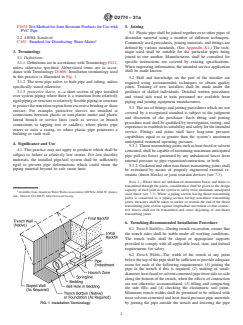
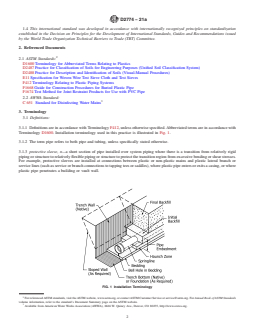
Terminology D1600. Installation terminology used in this practice is illustrated in Fig. 1.
3.1.2 The term pipe refers to both pipe and tubing, unless specifically stated otherwise.
3.1.3 protective sleeve, n—a short section of pipe installed over system piping where there is a transition from relatively rigid
piping or structure to relatively flexible piping or structure to protect the transition region from excessive bending or shear stresses.
For example, protective sleeves are installed at connections between plastic or non-plastic mains and plastic lateral branch or
service lines (such as service or branch connections to tapping tees or saddles), where plastic pipe enters or exits a casing, or where
plastic pipe penetrates a building or vault wall.
FIG. 1 Installation Terminology
For referenced ASTM standards, visit the ASTM website, www.astm.org, or contact ASTM Customer Service at service@astm.org. For Annual Book of ASTM Standards
volume information, refer to the standard’s Document Summary page on the ASTM website.
Available from American Water Works Association (AWWA), 6666 W. Quincy Ave., Denver, CO 80235, http://www.awwa.org.
D2774 − 21a
4. Significance and Use
4.1 This practice may not apply to products which shall be subject to failure at relatively low strains. For low ductility materials,
the installed pipe/soil system shall be sufficiently rigid to prevent pipe deformations which could strain the piping material beyond
its safe strain limit.
5. Joining
5.1 Plastic pipe shall be joined together or to other pipes of dissimilar material using a number of different techniques. Commonly
used procedures, joining materials, and fittings are defined by various standards. (See Appendix X1.) The technique used shall be
suitable for the particular pipes being joined to one another. Manufacturers shall be consulted for specific instructions not covered
by existing specifications. When requesting information, the intended service application shall be made known.
5.2 Skill and knowledge on the part of the installer are required using recommended techniques to obtain quality joints. Training
of new installers shall be made under the guidance of skilled individuals. Detailed written procedures and visual aids used to train
personnel are available from piping and joining equipment manufacturers.
5.3 The use of fittings and joining procedures which are not covered by a recognized standard is subject to the judgment and
discretion of the purchaser. Each fitting and joining procedure used shall be qualified by investigation, testing, and experience to
establish its suitability and safety for the intended service. Fittings and joints shall have long-term pressure capabilities equal to
or greater than the system’s maximum anticipated sustained operating pressure.
5.3.1 Thrust transmitting joints such as heat fused or solvent cemented, shall be capable of restraining maximum anticipated pipe
pull-out forces generated by any unbalanced forces from internal pressure or pipe expansion/contraction, or both.
5.3.2 Gasketed and other non-thrust transmitting joints shall be restrained by means of properly engineered external restraints
(thrust blocks) or joint restraint devices (see 7.3).
NOTE 1—Where there are unbalanced momentum forces and thrust is transmitted through the joints, consideration shall be given to the design capacity
of each joint in the system to safely resist maximum anticipated axial thrust (see 7.3). Where a piping section having thrust transmitting joints is connected
to a piping section having non-thrust transmitting joints, measures shall be taken to anchor or restrain the end of the thrust transmitting joint section against
longitudinal movement so that contractive forces shall not be transmitted and cause disjoining of non-thrust transmitting joints.
6. Trenching-Recommended Installation Procedure
6.1 Trench Stability—During trench excavation, ensure that the trench sides shall be stable under all working conditions. The
trench walls shall be sloped or appropriate supports provided to comply with all applicable local, state, and federal requirements
for safety.
6.2 Trench Width—The width of the trench at any point below the top of the pipe shall be sufficient to provide adequate room for
each of the following requirements: (1) joining the pipe in the trench if this is required; (2) snaking of small-diameter, heat fused
or solvent cemented pipe from side-to-side along the bottom of the trench, when the effects of contraction are not otherwise
accommodated; (3) filling and compacting the side fills; and (4) checking the elastomeric seal joints. Minimum trench widths shall
be permitted to be utilized with most solvent-cemented and heat-fused pressure pipe materials by joining the pipe outside the trench
and lowering the pipe into the trench after adequate joint strength has been attained (see 10.5). This practice shall be permitted
to be used for gasket joint pipe, with manufacturers approval, providing care is taken to not disassemble the joints during lowering.
6.3 Trench Bottom—The trench bottom shall be prepared for the direct replacement of the pipe and shall be continuous, relatively
smooth, free of rocks, and provide uniform support. For bell-ended or coupled pipe, suitable “bell-holes” shall be provided at each
joint to permit the joint to be assembled and the pipe to be supported properly.
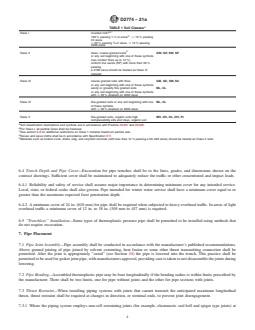
6.3.1 Where ledge rock, hardpan, or boulders are encountered, it shall be required to pad the trench bottom with a bedding of at
least 4 in. (100 mm) thickness of compacted Class I or II material (see Table 1). In situations where rapid movement of water takes
place through this bedding, the Class I or II material used shall have gradation that prevents loss by migration of any pipe
embedment material (see 9.8).
D2774 − 21a
A
TABLE 1 Soil Classes
B,C
Class I crushed rock
D
100 % passing 1- ⁄2-in sieve , # 15 % passing
#4 sieve,
# 25 % passing ⁄8-in sieve, # 12 % passing
#200 sieve
E
Class II clean, coarse grained soils GW, GP, SW, SP
or any soil beginning with one of these symbols
(can contain fines up to 12 %)
uniform fine sands (SP) with more than 50 %
passing
a #100 sieve should be treated as Class III
material
Class III coarse grained soils with fines GM, GC, SM, SC
or any soil beginning with one of these symbols
sandy or gravelly fine grained soils ML, CL
or any soil beginning with one of these symbols
with $ 30 % retained on #200 sieve
Class IV fine-grained soils or any soil beginning with one ML, CL
of these symbols
with # 30 % retained on #200 sieve
Class V fine-grained soils, organic soils high MH, CH, OL, OH, Pt
compressibility silts and clays, organic soil
A
Soil classification descriptions and symbols are in accordance with Practice D2487 and D2488.
B
For Class I, all particle faces shall be fractured.
C
See section 9.6 for additional restrictions on Class 1 material maximum particle size.
D
Sieves and sieve cloths shall be in accordance with Specification E11.
E
Materials such as broken coral, shells, slag, and recycled concrete (with less than 12 % passing a No 200 sieve) should be treated as Class II soils.
6.4 Trench Depth and Pipe Cover—Excavation for pipe trenches shall be to the lines, grades, and dimensions shown on the
contract drawings. Sufficient cover shall be maintained to adequately reduce the traffic or other concentrated and impact loads.
6.4.1 Reliability and safety of service shall assume major importance in determining minimum cover for any intended service.
Local, state, or federal codes shall also govern. Pipe intended for winter water service shall have a minimum cover equal to or
greater than the maximum expected frost penetration depth.
6.4.2 A minimum cover of 24 in. (610 mm) for pipe shall be required when subjected to heavy overhead traffic. In areas of light
overhead traffic a minimum cover of 12 in. to 18 in. (305 mm to 457 mm) is required.
6.5 “Trenchless’’ Installation—Some types of thermoplastic pressure pipe shall be permitted to be installed using methods that
do not require excavation.
7. Pipe Placement
7.1 Pipe Joint Assembly—Pipe assembly shall be conducted in accordance with the manufacturer’s published recommendations.
Above ground joining of pipe joined by solvent cementing, heat fusion or some other thrust transmitting connection shall be
permitted. After the joint is appropriately “cured” (see Section 10) the pipe is lowered into the trench. This practice shall be
permitted to be used for gasket joint pipe, with manufacturers approval, providing care is taken to not disassemble the joints during
lowering.
7.2 Pipe Bending—Assembled thermoplastic pipe may be bent longitudinally if the bending radius is within limits prescribed by
the manufacturer. There shall be two limits, one for pipe without joints and the other for pipe sections with joints.
7.3 Thrust Restraint—When installing piping systems with joints that cannot transmit the anticipated maximum longitudinal
thrust, thrust restraint shall be required at changes in direction, or terminal ends, to prevent joint disengagement.
7.3.1 Where the piping system employs non-self restraining joints (for example, elastomeric seal bell and spigot type joints) at
D2774 − 21a
points where line shift or joint separation at system operating pressure can be anticipated, that is, pump discharge, directional
changes, reducers and dead ends, thrust restraint shall be required to prevent joint disengagement and ensure the proper
performance of the pressure piping system.
7.3.2 Where the piping system employs self-restraining joints (for example flanges, heat fusion, mechanical joint restraint or
solvent cement joints) at these points in the system, thrust blocking shall not be required for thrust restraint.
7.4 Thrust Restraint Methods—Thrust restraint shall be achieved by use of mechanical thrust restraint devices or by use of
concrete thrust blocking.
7.4.1 Mechanical Thrust Restraint Devices:
7.4.1.1 Devices used for thrust restraint of PVC pipe shall conform to Test Method F1674.
7.4.1.2 Consult device manufacturer for design assistance.
7.4.2 Cast In Place Concrete Thrust Block Construction:
7.4.2.1 The thrust block shall be constructed of cast in place concrete having a compression strength of 2000 psi (14 MPa) or more.
Precast concrete blocking, wood blocking, or stone blocking with wood wedges, are not acceptable.
7.4.2.2 The thrust block acts as an anchor between pipe or fitting and the solid trench wall. The size of the thrust block shall be
adequate to prevent pipe movement at the point of thrust. Consult the system designer.
7.4.2.3 The thrust block cavity shall be hand dug into undisturbed soil and framed, with soil or wood to hold freshly poured
concrete. The earth bearing surfaces shall be undisturbed.
7.4.2.4 Before pressurizing the line, adequate time shall be required for the concrete thrust blocks to gain sufficient strength.
7.4.2.5 Precast concrete thrust blocks shall not be used in direct contact with thermoplastic fittings for buried pressure piping
systems.
7.5 Protecting Transition Regions—A transition region between relatively rigid piping or structures and relatively flexible piping
is subject to intensified localized bending or shear stresses, especially during soil consolidation after initial installation. In these
transition regions, plastic pipe is protected against excessive stresses with a protective sleeve and stable bedding and backfill, or
with stable bedding and backfill. The preferred practice is the combination of a protective sleeve and stable bedding and backfill.
7.5.1 Protective sleeves are usually plastic tubes, either extruded for the purpose or cut from lengths of plastic pipe, but they shall
be permitted to be any material of sufficient strength and durability. Protective sleeves extend from rigid piping of structure across
the transition region and along the plastic pipe for a length that ensures that plastic pipe at the transition region is not subject to
excessive stress. The protective sleeve is appropriately secured to remain in place during backfilling. Where plastic piping
penetrates a building or a vault wall, one end of the protective sleeve shall be embedded in the wall.
7.5.2 The diameter, wall thickness and length of the protective sleeve provide greater bending and shear resistance than the plastic
pipe it protects. The inside diameter of the protective sleeve has minimal clearance to the plastic pipe or the connection (including
any protective coating over the connection). The wall thickness of the protective sleeve shall be adequate to protect against shear
and bending The protective sleeve is of sufficient length (typically 12 in. (305 mm) or longer) to cover the transition region, and
extend such that the opposite end rests on undisturbed foundation soil or stable bedding soil beneath the plastic pipe. Additional
information is available from manufacturers.
7.5.3 A protective sleeve shall be permitted to be split longitudinally for installation purposes, provided it is designed for long term
structural integrity as a longitudinally split protective sleeve and includes external reinforcement such as stainless steel band
clamps.
7.5.4 Whether a protective sleeve is installed or not, all transition regions are fully encapsulated with stable, compacted
embedment materials. Take extra care during bedding and backfilling to provide firm and uniform support for the plastic pipe and
transition region. See Section 9.
D2774 − 21a
7.6 Service Connections:
7.6.1 General—Service connections on thermoplastic pipe are made by means of a suitable saddle, tapped coupling, direct taps,
or service connector. These shall be installed in accordance with the manufacturer’s published recommendations.
7.6.2 Live Tapping—Service connections for tapping of pressurized lines are commercially available. Installation by the proposed
trenchless methodology shall only be specified af
...