

ASTM D5651-21
(Test Method)Standard Test Method for Surface Bond Strength of Wood-Base Fiber and Particle Panel Materials
General Information
- Abstract
SIGNIFICANCE AND USE
3.1 This test method provides a measure of the bond quality of the fibers, or particles, at the surface of wood-base fiber and particle panel materials including particleboard, medium-density fiberboard (MDF) and oriented strand board (OSB). Surface bond strength is a measure of the strength and resistance to delamination of the bond between overlay materials and panel surfaces and is an important consideration when these overlay materials, such as wood veneers, saturated papers, or plastic overlays, are to be bonded to the panel surface during secondary manufacturing.
SCOPE
1.1 This test method is a measure of the cohesive bond strength of the fibers, or particles, on the surface of wood-base fiber and particle panels (for example, particleboard and medium-density fiberboard) in the direction perpendicular to the plane of the panel.
1.1.1 To determine the internal cohesive bond strength of wood-base fiber and particle panels, use Section 11 of Test Methods D1037.
1.2 The values stated in SI units are to be regarded as the standard. The values given in parentheses are for information only.
1.3 This standard does not purport to address all of the safety concerns, if any, associated with its use. It is the responsibility of the user of this standard to establish appropriate safety, health, and environmental practices and determine the applicability of regulatory limitations prior to use.
1.4 This international standard was developed in accordance with internationally recognized principles on standardization established in the Decision on Principles for the Development of International Standards, Guides and Recommendations issued by the World Trade Organization Technical Barriers to Trade (TBT) Committee.
- Status
- Published
- Publication Date
- 30-Nov-2021
- Technical Committee
- D07 - Wood
- Drafting Committee
- D07.03 - Panel Products
Buy Documents


ASTM D5651-21 - Standard Test Method for Surface Bond Strength of Wood-Base Fiber and Particle Panel Materials

REDLINE ASTM D5651-21 - Standard Test Method for Surface Bond Strength of Wood-Base Fiber and Particle Panel Materials
Overview
ASTM D5651-21: Standard Test Method for Surface Bond Strength of Wood-Base Fiber and Particle Panel Materials provides a reliable method for measuring the cohesive bond strength at the surface of wood-based panels such as particleboard, medium-density fiberboard (MDF), and oriented strand board (OSB). This standard is vital in determining the bond quality and resistance to delamination when overlay materials like wood veneers, saturated papers, or plastic overlays are applied to panel surfaces during secondary manufacturing processes. Accurate measurement of surface bond strength supports quality assurance and material selection for manufacturers, specifiers, and quality control labs.
Key Topics
- Surface Bond Strength Measurement: The method evaluates the strength of the bond at the panel surface, perpendicular to the panel plane, which is crucial for overlays and adhesives.
- Applicability: Suitable for wood-based panel products including MDF, particleboard, and OSB.
- Panel Preparation and Conditioning: Panels must be conditioned to consistent temperature and relative humidity, ensuring repeatable and accurate test results.
- Testing Apparatus: The procedure specifies apparatus requirements, including the use of a test cylinder with defined dimensions and mounting fixtures for uniform load application.
- Sample Preparation and Adhesive Application: Guidance is provided on specimen size, adhesive type and quantity, and test cylinder preparation to standardize surface contact.
- Data Reporting: Results are reported as maximum stress required to separate the surface, in either N/mm² or psi, with requirements for documenting test conditions, adhesive type, and panel descriptions.
- Statistical Analysis: While the method provides results to be used for compliance or comparison, specific statistical precision and bias statements are not included.
Applications
ASTM D5651-21 is widely applied in the wood products and furniture industries to:
- Evaluate Overlay Adhesion: Essential for manufacturers bonding overlays, such as decorative veneers or laminates, to MDF, particleboard, or OSB for cabinetry, flooring, wall panels, and furniture.
- Quality Control: Used by production facilities and testing laboratories to ensure consistent adhesion quality in manufactured panels, particularly where surface treatments or secondary laminations are applied.
- Material Selection: Helps designers, engineers, and product developers compare the bond strength of different wood-based panels and overlay combinations, aiding material selection for durability and performance.
- Compliance and Certification: Provides conformity with industry and buyer specifications that reference ASTM standards for surface bond strength.
Related Standards
- ASTM D1037: Test Methods for Evaluating Properties of Wood-Base Fiber and Particle Panel Materials - referenced for determining internal cohesive strength of panels.
- ASTM E122: Practice for Calculating Sample Size to Estimate the Average for a Characteristic of a Lot or Process - referenced for statistically valid sampling practices.
Keywords
Surface bond strength, wood-base panels, particleboard, MDF, oriented strand board, overlay adhesive, delamination resistance, ASTM D5651-21, wood veneer bonding, laminate adhesion, panel testing, quality assurance.
Summary
ASTM D5651-21 establishes a standardized approach for assessing the surface bond strength of wood-based fiber and particle panels, underpinning quality and reliability in finished products. By following the defined procedures, industry stakeholders can ensure that overlays adhere securely, mitigating failures and enhancing the lifespan and performance of engineered wood panels in various applications.
Relations
- Effective Date
- 01-Aug-2011
- Effective Date
- 01-Aug-2009
- Effective Date
- 01-Oct-2007
- Effective Date
- 15-Oct-2006
- Effective Date
- 15-Oct-2006
- Effective Date
- 10-Oct-2000
- Effective Date
- 10-Oct-2000
- Effective Date
- 10-Apr-1999
Buy Documents
ASTM D5651-21 - Standard Test Method for Surface Bond Strength of Wood-Base Fiber and Particle Panel Materials
REDLINE ASTM D5651-21 - Standard Test Method for Surface Bond Strength of Wood-Base Fiber and Particle Panel Materials
Get Certified
Connect with accredited certification bodies for this standard

DIN CERTCO
DIN Group product certification.

Smithers Quality Assessments
US management systems and product certification.
Sponsored listings
Frequently Asked Questions
ASTM D5651-21 is a standard published by ASTM International. Its full title is "Standard Test Method for Surface Bond Strength of Wood-Base Fiber and Particle Panel Materials". This standard covers: SIGNIFICANCE AND USE 3.1 This test method provides a measure of the bond quality of the fibers, or particles, at the surface of wood-base fiber and particle panel materials including particleboard, medium-density fiberboard (MDF) and oriented strand board (OSB). Surface bond strength is a measure of the strength and resistance to delamination of the bond between overlay materials and panel surfaces and is an important consideration when these overlay materials, such as wood veneers, saturated papers, or plastic overlays, are to be bonded to the panel surface during secondary manufacturing. SCOPE 1.1 This test method is a measure of the cohesive bond strength of the fibers, or particles, on the surface of wood-base fiber and particle panels (for example, particleboard and medium-density fiberboard) in the direction perpendicular to the plane of the panel. 1.1.1 To determine the internal cohesive bond strength of wood-base fiber and particle panels, use Section 11 of Test Methods D1037. 1.2 The values stated in SI units are to be regarded as the standard. The values given in parentheses are for information only. 1.3 This standard does not purport to address all of the safety concerns, if any, associated with its use. It is the responsibility of the user of this standard to establish appropriate safety, health, and environmental practices and determine the applicability of regulatory limitations prior to use. 1.4 This international standard was developed in accordance with internationally recognized principles on standardization established in the Decision on Principles for the Development of International Standards, Guides and Recommendations issued by the World Trade Organization Technical Barriers to Trade (TBT) Committee.
SIGNIFICANCE AND USE 3.1 This test method provides a measure of the bond quality of the fibers, or particles, at the surface of wood-base fiber and particle panel materials including particleboard, medium-density fiberboard (MDF) and oriented strand board (OSB). Surface bond strength is a measure of the strength and resistance to delamination of the bond between overlay materials and panel surfaces and is an important consideration when these overlay materials, such as wood veneers, saturated papers, or plastic overlays, are to be bonded to the panel surface during secondary manufacturing. SCOPE 1.1 This test method is a measure of the cohesive bond strength of the fibers, or particles, on the surface of wood-base fiber and particle panels (for example, particleboard and medium-density fiberboard) in the direction perpendicular to the plane of the panel. 1.1.1 To determine the internal cohesive bond strength of wood-base fiber and particle panels, use Section 11 of Test Methods D1037. 1.2 The values stated in SI units are to be regarded as the standard. The values given in parentheses are for information only. 1.3 This standard does not purport to address all of the safety concerns, if any, associated with its use. It is the responsibility of the user of this standard to establish appropriate safety, health, and environmental practices and determine the applicability of regulatory limitations prior to use. 1.4 This international standard was developed in accordance with internationally recognized principles on standardization established in the Decision on Principles for the Development of International Standards, Guides and Recommendations issued by the World Trade Organization Technical Barriers to Trade (TBT) Committee.
ASTM D5651-21 is classified under the following ICS (International Classification for Standards) categories: 83.180 - Adhesives. The ICS classification helps identify the subject area and facilitates finding related standards.
ASTM D5651-21 has the following relationships with other standards: It is inter standard links to ASTM E122-09e1, ASTM E122-09, ASTM E122-07, ASTM D1037-06, ASTM D1037-06a, ASTM E122-00, ASTM E122-99, ASTM D1037-99. Understanding these relationships helps ensure you are using the most current and applicable version of the standard.
ASTM D5651-21 is available in PDF format for immediate download after purchase. The document can be added to your cart and obtained through the secure checkout process. Digital delivery ensures instant access to the complete standard document.
Standards Content (Sample)
This international standard was developed in accordance with internationally recognized principles on standardization established in the Decision on Principles for the
Development of International Standards, Guides and Recommendations issued by the World Trade Organization Technical Barriers to Trade (TBT) Committee.
Designation: D5651 − 21
Standard Test Method for
Surface Bond Strength of Wood-Base Fiber and Particle
Panel Materials
This standard is issued under the fixed designation D5651; the number immediately following the designation indicates the year of
original adoption or, in the case of revision, the year of last revision. A number in parentheses indicates the year of last reapproval. A
superscript epsilon (´) indicates an editorial change since the last revision or reapproval.
1. Scope 3. Significance and Use
3.1 This test method provides a measure of the bond quality
1.1 This test method is a measure of the cohesive bond
of the fibers, or particles, at the surface of wood-base fiber and
strength of the fibers, or particles, on the surface of wood-base
particle panel materials including particleboard, medium-
fiber and particle panels (for example, particleboard and
density fiberboard (MDF) and oriented strand board (OSB).
medium-density fiberboard) in the direction perpendicular to
Surface bond strength is a measure of the strength and
the plane of the panel.
resistance to delamination of the bond between overlay mate-
1.1.1 To determine the internal cohesive bond strength of
rials and panel surfaces and is an important consideration when
wood-base fiber and particle panels, use Section 11 of Test
these overlay materials, such as wood veneers, saturated
Methods D1037.
papers, or plastic overlays, are to be bonded to the panel
1.2 The values stated in SI units are to be regarded as the
surface during secondary manufacturing.
standard. The values given in parentheses are for information
only.
4. Apparatus
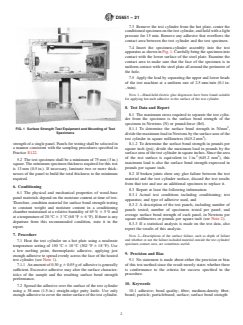
1.3 This standard does not purport to address all of the 4.1 The apparatus required for this test method is shown in
safety concerns, if any, associated with its use. It is the
Fig. 1.
responsibility of the user of this standard to establish appro- 4.1.1 The test cylinder shall be 28.7 mm (1.13 in.) in
2 2
priate safety, health, and environmental practices and deter-
diameter, providing a test surface area of 645.2 mm (1 in. ),
mine the applicability of regulatory limitations prior to use. and the cylinder length shall be approximately 25 mm (1 in.).
One face of this cylinder shall be smoothly finished for gluing,
1.4 This international standard was developed in accor-
while a threaded hole shall be placed in the center of the
dance with internationally recognized principles on standard-
opposite face and also aligned perpendicular to the gluing face.
ization established in the Decision on Principles for the
4.1.2 The lower test fixture shall consist of a 6-mm (0.25-
Development of International Standards, Guides and Recom-
in.) steel plate mounted in a plane perpendicular to the
mendations issued by the World Trade Organization Technical
direction of test. The mounting shall be such that this plate is
Barriers to Trade (TBT) Committee.
held rigidly and there is at least 60-mm (2.36-in.) clearance
beneath it to permit entry of the test assembly. This plate shall
2. Referenced Documents
have a hole drilled in the center that is 2 mm (0.08 in.) larger
2.1 ASTM Standards:
than the diameter of the test cylinder.
D1037 Test Methods for Evaluating Properties of Wood-
4.1.3 The upper arm of the test machine shall have a
Base Fiber and Particle Panel Materials
threaded means of engaging the threaded hole in the top of the
E122 Practice for Calculating Sample Size to Estimate,With
test cylinder so as to apply a force that shall move the test
Specified Precision, the Average for a Characteristic of a
cylinder in a direction perpendicular to the lower test fixture
Lot or Process
and surface of the test specimen. A self-aligning joint (univer-
sal joint) is required in the upper arm of the test fixture.
4.1.3.1 Alternate connecting devices such as a swivel and
This test method is under the jurisdiction of ASTM Committee D07 on Wood hook or ball and socket, are allowed for fixing the test cylinder
and is the direct responsibility of Subcommittee D07.03 on Panel Products.
to the upper arm of the test machine. If alternate connecting
Current edition approved Dec. 1, 2021. Published January 2022. Originally
devices are used, this shall be noted on the test report.
approved in 1995. Last previous edition approved in 2013 as D5651 – 13. DOI:
10.1520/D5651-21.
For referenced ASTM standards, visit the ASTM website, www.astm.org, or 5. Sampling and Test Specimens
contact ASTM Customer Service at service@astm.org. For Annual Book of ASTM
5.1 Aminimum of three tests from each panel surface to be
Standards volume information, refer to the standard’s Document Summary page on
the ASTM website. considered shall be made to determine the surface bond
Copyright © ASTM International, 100 Barr Harbor Drive, PO Box C700, West Conshohocken, PA 19428-2959. United States
D5651 − 21
7.3 Remove the test cylinder from the hot plate, center the
conditioned specimen on the test cylinder, and hold with a light
pressure for 15 min. Remove any adhesive that overflows the
contact area between the test cylinder and the test specimen.
7.4 Insert the specimen-cylinder assembly into the test
apparatus as shown in Fig. 1. Carefully bring the speci
...
This document is not an ASTM standard and is intended only to provide the user of an ASTM standard an indication of what changes have been made to the previous version. Because
it may not be technically possible to adequately depict all changes accurately, ASTM recommends that users consult prior editions as appropriate. In all cases only the current version
of the standard as published by ASTM is to be considered the official document.
Designation: D5651 − 13 D5651 − 21
Standard Test Method for
Surface Bond Strength of Wood-Base Fiber and Particle
Panel Materials
This standard is issued under the fixed designation D5651; the number immediately following the designation indicates the year of
original adoption or, in the case of revision, the year of last revision. A number in parentheses indicates the year of last reapproval. A
superscript epsilon (´) indicates an editorial change since the last revision or reapproval.
1. Scope
1.1 This test method is a measure of the cohesive bond strength of the fibers, or particles, on the surface of wood-base fiber and
particle panels (for example, particleboard and medium-density fiberboard) in the direction perpendicular to the plane of the panel.
1.1.1 To determine the internal cohesive bond strength of wood-base fiber and particle panels, use Section 11 of Test Methods
D1037.
1.2 The values stated in SI units are to be regarded as the standard. The values given in parentheses are for information only.
1.3 This test method standard does not purport to address all of the safety concerns, if any, associated with its use. It is the
responsibility of the user of this standard to establish appropriate safety safety, health, and healthenvironmental practices and
determine the applicability of regulatory limitations prior to use.
1.4 This international standard was developed in accordance with internationally recognized principles on standardization
established in the Decision on Principles for the Development of International Standards, Guides and Recommendations issued
by the World Trade Organization Technical Barriers to Trade (TBT) Committee.
2. Referenced Documents
2.1 ASTM Standards:
D1037 Test Methods for Evaluating Properties of Wood-Base Fiber and Particle Panel Materials
E122 Practice for Calculating Sample Size to Estimate, With Specified Precision, the Average for a Characteristic of a Lot or
Process
3. Significance and Use
3.1 This test method provides a measure of the bond quality of the fibers, or particles, at the surface of wood-base fiber and particle
panel materials including particleboard, medium-density fiberboard (MDF) and oriented strand board (OSB). Surface bond
strength is a measure of the strength and resistance to delamination of the bond between overlay materials and panel surfaces and
is an important consideration when these overlay materials, such as wood veneers, saturated papers, or plastic overlays, are to be
bonded to the panel surface during secondary manufacturing.
This test method is under the jurisdiction of ASTM Committee D07 on Wood and is the direct responsibility of Subcommittee D07.03 on Panel Products.
Current edition approved Aug. 1, 2013Dec. 1, 2021. Published September 2013January 2022. Originally approved in 1995. Last previous edition approved in 20082013
as D5651 – 95a (2008).D5651 – 13. DOI: 10.1520/D5651-13.10.1520/D5651-21.
For referenced ASTM standards, visit the ASTM website, www.astm.org, or contact ASTM Customer Service at service@astm.org. For Annual Book of ASTM Standards
volume information, refer to the standard’s Document Summary page on the ASTM website.
Copyright © ASTM International, 100 Barr Harbor Drive, PO Box C700, West Conshohocken, PA 19428-2959. United States
D5651 − 21
4. Apparatus
4.1 The apparatus required for this test method is shown in Fig. 1.
4.1.1 The test cylinder shall be 28.7 mm (1.13 in.) 28.7 mm (1.13 in.) in diameter, providing a test surface area of 645.2
mm645.2 mm (1 in.(1 in. ), and the cylinder length shall be approximately 25 mm (1 in.). 25 mm (1 in.). One face of this cylinder
shall be smoothly finished for gluing, while a threaded hole shall be placed in the center of the opposite face and also aligned
perpendicular to the gluing face.
4.1.2 The lower test fixture shall consist of a 6-mm (0.25- in.) steel plate mounted in a plane perpendicular to the direction of test.
The mounting shall be such that this plate is held rigidly and there is at least 60-mm (2.36-in.) clearance beneath it to permit entry
of the test assembly. This plate shall have a hole drilled in the center that is 2 mm (0.08 in.) 2 mm (0.08 in.) larger than the diameter
of the test cylinder.
4.1.3 The upper arm of the test machine shall have a threaded means of engaging the threaded hole in the top of the test cylinder
so as to apply a force that shall move the test cylinder in a direction perpendicular to the lower test fixture and surface of the test
specimen. A self-aligning joint (universal joint) is required in the upper arm of the test fixture.
4.1.3.1 Alternate connecting devices such as a swivel and hook or ball and socket, are allowed for fixing the test cylinder to the
upper arm of the test machine. If alternate connecting devices are used, this shall be noted on the test report.
5. Sampling and Test Specimens
5.1 A minimum of three tests from each panel surface to be considered shall be made to determine the surface bond strength of
a single panel. Panels for testing shall be selected in a manner consistent with the sampling procedures specified in Practice E122.
5.2 The test specimen shall be a minimum of 75 mm (3 in.) 75 mm (3 in.) square. The minimum specimen thickness required for
this test is 13 mm (0.5 in.). 13 mm (0.5 in.). If necessary, laminate two
...