

ASTM D7374-21
(Practice)Standard Practice for Evaluating Elevated Temperature Performance of Adhesives Used in End-Jointed Lumber
General Information
- Abstract
SIGNIFICANCE AND USE
5.1 End-jointed lumber studs used in fire resistance-rated assemblies shall be able to support the superimposed design load for the specified time under an elevated temperature exposure, when a wall assembly is exposed to a standard fire specified in Test Methods E119. Light-weight wood assemblies utilize gypsum wallboard or other types of membrane protection to accomplish a requisite fire resistance rating for the assembly. However, wood studs and the end joints in the studs shall resist the developed elevated temperature environment for the duration of the rating. This practice provides a method for evaluating the elevated temperature performance of an adhesive used in end-jointed lumber as compared with the elevated temperature performance of solid wood.
SCOPE
1.1 This practice is to be used to evaluate the elevated temperature performance of adhesives used in end-jointed lumber.
1.2 A symmetric wall assembly containing end-jointed lumber studs is exposed to a standard fire exposure specified in Test Methods E119.
1.3 The wall assembly shall sustain the applied load during a standard fire exposure specified in Test Methods E119 for a period of 60 min or more.
1.4 This practice is used to evaluate the performance of adhesives used in end-jointed lumber to heat and flame under controlled conditions, but it does not by itself incorporate all factors required for fire hazard or fire risk assessment under actual fire conditions.
1.5 The values stated in inch-pound units are to be regarded as standard. The values given in parentheses are mathematical conversions to SI units that are provided for information only and are not considered standard.
1.6 This standard does not purport to address all of the safety concerns, if any, associated with its use. It is the responsibility of the user of this standard to establish appropriate safety, health, and environmental practices and determine the applicability of regulatory limitations prior to use.
1.7 This international standard was developed in accordance with internationally recognized principles on standardization established in the Decision on Principles for the Development of International Standards, Guides and Recommendations issued by the World Trade Organization Technical Barriers to Trade (TBT) Committee.
- Status
- Published
- Publication Date
- 14-Jul-2021
- Technical Committee
- D07 - Wood
- Drafting Committee
- D07.02 - Lumber and Engineered Wood Products
Buy Documents


ASTM D7374-21 - Standard Practice for Evaluating Elevated Temperature Performance of Adhesives Used in End-Jointed Lumber

REDLINE ASTM D7374-21 - Standard Practice for Evaluating Elevated Temperature Performance of Adhesives Used in End-Jointed Lumber
Overview
ASTM D7374-21 outlines standard practices for evaluating the elevated temperature performance of adhesives used in end-jointed lumber. This standard is crucial for determining the reliability of adhesives in structural wood products used in fire resistance-rated assemblies, such as walls in buildings. By establishing uniform testing methods under controlled fire conditions, it ensures adhesives in end-jointed lumber maintain structural integrity during fire exposure, contributing to building safety and compliance with fire resistance requirements.
Key Topics
- Elevated Temperature Performance: The focus is on how adhesives in end-jointed lumber perform when exposed to high temperatures, simulating real fire scenarios.
- Fire Resistance Testing: A symmetric wall assembly with end-jointed lumber studs is subjected to a standard fire exposure following ASTM E119 test methods. The wall must sustain the prescribed design load for at least 60 minutes.
- Assembly Design: Specifies requirements for wall assembly construction, including the use of gypsum wallboard, mineral wool insulation, and proper fastener types and placements.
- Adhesive Evaluation: Performance assessment compares the adhesive-bonded joints' resilience under heat and flame to that of solid wood, informing product selection and safety.
- Controlled Conditions: The practice replicates fire exposure in a laboratory setting, providing consistent and repeatable results for material qualification, but it does not fully represent all real-world fire hazards or risks.
- Reporting Requirements: Documentation guidelines ensure that all relevant data-such as wall composition, adhesive type, joint configuration, and observed performance-are systematically recorded.
Applications
ASTM D7374-21 is widely utilized in industries involved in wood construction and engineered wood product manufacturing, particularly for:
- Building Code Compliance: Demonstrating that end-jointed lumber assemblies meet fire resistance requirements specified in building codes and regulations.
- Adhesive Product Development: Enabling adhesive manufacturers to validate the elevated temperature performance of their products for use in structural lumber applications.
- Quality Assurance: Serving as part of quality control protocols for manufacturers of finger-jointed and end-jointed lumber, ensuring consistent fire performance before products enter the market.
- Construction Projects: Assisting architects, engineers, and builders in specifying approved adhesives and joint types for fire resistance-rated wall assemblies in residential, commercial, and public structures.
- Third-Party Certification: Providing an accepted methodology for third-party certifiers and testing laboratories to assess and certify fire-resistance-rated assemblies made with end-jointed lumber.
Related Standards
To achieve full compliance and best results, ASTM D7374-21 is often referenced alongside the following standards:
- ASTM E119 - Standard Test Methods for Fire Tests of Building Construction and Materials
- ASTM C1396/C1396M - Specification for Gypsum Board
- ASTM D9 - Terminology Relating to Wood and Wood-Based Products
- ASTM D4688 - Test Method for Evaluating Structural Adhesives for Finger Jointing Lumber
- ASTM D6513 - Practice for Calculating the Superimposed Load on Wood-Frame Walls for Standard Fire-Resistance Tests
- ASTM F1667 - Specification for Driven Fasteners: Nails, Spikes, and Staples
- ANSI/AF&PA NDS - National Design Specification for Wood Construction
Keywords: elevated temperature performance, adhesives, end-jointed lumber, fire resistance, finger-joint, scarf joint, wall assembly, structural wood, ASTM D7374-21, building code compliance
Relations
- Effective Date
- 01-Oct-2019
- Effective Date
- 01-Nov-2018
- Effective Date
- 01-Nov-2018
- Effective Date
- 01-Sep-2018
- Effective Date
- 01-Sep-2018
- Effective Date
- 01-Jun-2018
- Effective Date
- 01-Mar-2018
- Effective Date
- 01-Mar-2017
- Effective Date
- 01-Jul-2016
- Effective Date
- 01-Apr-2016
- Effective Date
- 01-Sep-2015
- Effective Date
- 01-Jul-2015
- Effective Date
- 01-Oct-2014
- Effective Date
- 01-Oct-2014
- Effective Date
- 01-Feb-2014
Buy Documents
ASTM D7374-21 - Standard Practice for Evaluating Elevated Temperature Performance of Adhesives Used in End-Jointed Lumber
REDLINE ASTM D7374-21 - Standard Practice for Evaluating Elevated Temperature Performance of Adhesives Used in End-Jointed Lumber
Get Certified
Connect with accredited certification bodies for this standard

DIN CERTCO
DIN Group product certification.

Smithers Quality Assessments
US management systems and product certification.
Sponsored listings
Frequently Asked Questions
ASTM D7374-21 is a standard published by ASTM International. Its full title is "Standard Practice for Evaluating Elevated Temperature Performance of Adhesives Used in End-Jointed Lumber". This standard covers: SIGNIFICANCE AND USE 5.1 End-jointed lumber studs used in fire resistance-rated assemblies shall be able to support the superimposed design load for the specified time under an elevated temperature exposure, when a wall assembly is exposed to a standard fire specified in Test Methods E119. Light-weight wood assemblies utilize gypsum wallboard or other types of membrane protection to accomplish a requisite fire resistance rating for the assembly. However, wood studs and the end joints in the studs shall resist the developed elevated temperature environment for the duration of the rating. This practice provides a method for evaluating the elevated temperature performance of an adhesive used in end-jointed lumber as compared with the elevated temperature performance of solid wood. SCOPE 1.1 This practice is to be used to evaluate the elevated temperature performance of adhesives used in end-jointed lumber. 1.2 A symmetric wall assembly containing end-jointed lumber studs is exposed to a standard fire exposure specified in Test Methods E119. 1.3 The wall assembly shall sustain the applied load during a standard fire exposure specified in Test Methods E119 for a period of 60 min or more. 1.4 This practice is used to evaluate the performance of adhesives used in end-jointed lumber to heat and flame under controlled conditions, but it does not by itself incorporate all factors required for fire hazard or fire risk assessment under actual fire conditions. 1.5 The values stated in inch-pound units are to be regarded as standard. The values given in parentheses are mathematical conversions to SI units that are provided for information only and are not considered standard. 1.6 This standard does not purport to address all of the safety concerns, if any, associated with its use. It is the responsibility of the user of this standard to establish appropriate safety, health, and environmental practices and determine the applicability of regulatory limitations prior to use. 1.7 This international standard was developed in accordance with internationally recognized principles on standardization established in the Decision on Principles for the Development of International Standards, Guides and Recommendations issued by the World Trade Organization Technical Barriers to Trade (TBT) Committee.
SIGNIFICANCE AND USE 5.1 End-jointed lumber studs used in fire resistance-rated assemblies shall be able to support the superimposed design load for the specified time under an elevated temperature exposure, when a wall assembly is exposed to a standard fire specified in Test Methods E119. Light-weight wood assemblies utilize gypsum wallboard or other types of membrane protection to accomplish a requisite fire resistance rating for the assembly. However, wood studs and the end joints in the studs shall resist the developed elevated temperature environment for the duration of the rating. This practice provides a method for evaluating the elevated temperature performance of an adhesive used in end-jointed lumber as compared with the elevated temperature performance of solid wood. SCOPE 1.1 This practice is to be used to evaluate the elevated temperature performance of adhesives used in end-jointed lumber. 1.2 A symmetric wall assembly containing end-jointed lumber studs is exposed to a standard fire exposure specified in Test Methods E119. 1.3 The wall assembly shall sustain the applied load during a standard fire exposure specified in Test Methods E119 for a period of 60 min or more. 1.4 This practice is used to evaluate the performance of adhesives used in end-jointed lumber to heat and flame under controlled conditions, but it does not by itself incorporate all factors required for fire hazard or fire risk assessment under actual fire conditions. 1.5 The values stated in inch-pound units are to be regarded as standard. The values given in parentheses are mathematical conversions to SI units that are provided for information only and are not considered standard. 1.6 This standard does not purport to address all of the safety concerns, if any, associated with its use. It is the responsibility of the user of this standard to establish appropriate safety, health, and environmental practices and determine the applicability of regulatory limitations prior to use. 1.7 This international standard was developed in accordance with internationally recognized principles on standardization established in the Decision on Principles for the Development of International Standards, Guides and Recommendations issued by the World Trade Organization Technical Barriers to Trade (TBT) Committee.
ASTM D7374-21 is classified under the following ICS (International Classification for Standards) categories: 83.180 - Adhesives. The ICS classification helps identify the subject area and facilitates finding related standards.
ASTM D7374-21 has the following relationships with other standards: It is inter standard links to ASTM E119-19, ASTM E119-18ce1, ASTM E119-18c, ASTM F1667-18, ASTM E119-18b, ASTM E119-18a, ASTM E119-18, ASTM F1667-17, ASTM E119-16a, ASTM E119-16, ASTM F1667-15, ASTM E119-15, ASTM E119-14, ASTM C1396/C1396M-14a, ASTM C1396/C1396M-14. Understanding these relationships helps ensure you are using the most current and applicable version of the standard.
ASTM D7374-21 is available in PDF format for immediate download after purchase. The document can be added to your cart and obtained through the secure checkout process. Digital delivery ensures instant access to the complete standard document.
Standards Content (Sample)
This international standard was developed in accordance with internationally recognized principles on standardization established in the Decision on Principles for the
Development of International Standards, Guides and Recommendations issued by the World Trade Organization Technical Barriers to Trade (TBT) Committee.
Designation: D7374 − 21
Standard Practice for
Evaluating Elevated Temperature Performance of Adhesives
Used in End-Jointed Lumber
This standard is issued under the fixed designation D7374; the number immediately following the designation indicates the year of
original adoption or, in the case of revision, the year of last revision.Anumber in parentheses indicates the year of last reapproval.A
superscript epsilon (´) indicates an editorial change since the last revision or reapproval.
1. Scope 2. Referenced Documents
1.1 This practice is to be used to evaluate the elevated 2.1 ASTM Standards:
temperature performance of adhesives used in end-jointed C1396/C1396MSpecification for Gypsum Board
lumber. D9Terminology Relating to Wood and Wood-Based Prod-
ucts
1.2 Asymmetricwallassemblycontainingend-jointedlum-
D4688Test Method for Evaluating StructuralAdhesives for
ber studs is exposed to a standard fire exposure specified in
Finger Jointing Lumber
Test Methods E119.
D6513Practice for Calculating the Superimposed Load on
1.3 The wall assembly shall sustain the applied load during
Wood-frame Walls for Standard Fire-Resistance Tests
a standard fire exposure specified in Test Methods E119 for a
E119Test Methods for Fire Tests of Building Construction
period of 60 min or more.
and Materials
F1667SpecificationforDrivenFasteners:Nails,Spikes,and
1.4 This practice is used to evaluate the performance of
adhesives used in end-jointed lumber to heat and flame under Staples
controlled conditions, but it does not by itself incorporate all
2.2 Other Standards:
factors required for fire hazard or fire risk assessment under
ANSI/AF&PANDSNationalDesignSpecificationforWood
actual fire conditions.
Construction
1.5 The values stated in inch-pound units are to be regarded
3. Terminology
as standard. The values given in parentheses are mathematical
conversions to SI units that are provided for information only
3.1 Definitions:
and are not considered standard.
3.1.1 For general definitions of terms related to wood, refer
to Terminology D9.
1.6 This standard does not purport to address all of the
3.2 Definitions of Terms Specific to This Standard:
safety concerns, if any, associated with its use. It is the
3.2.1 end joint, n—joint formed by adhesive bonding of
responsibility of the user of this standard to establish appro-
machined, mated surfaces at the ends of two pieces of lumber.
priate safety, health, and environmental practices and deter-
3.2.1.1 Discussion—Typical end joint configurations in-
mine the applicability of regulatory limitations prior to use.
clude finger joints and scarf joints.
1.7 This international standard was developed in accor-
dance with internationally recognized principles on standard-
3.2.2 finger joint, n—endjointformedbymultipleinterlock-
ization established in the Decision on Principles for the
ing tapered profiles (“fingers”).
Development of International Standards, Guides and Recom-
3.2.3 scarf joint, n—end joint formed by a single tapered
mendations issued by the World Trade Organization Technical
profile.
Barriers to Trade (TBT) Committee.
1 2
This practice is under the jurisdiction ofASTM Committee D07 on Wood and For referenced ASTM standards, visit the ASTM website, www.astm.org, or
is the direct responsibility of Subcommittee D07.02 on Lumber and Engineered contact ASTM Customer Service at service@astm.org. For Annual Book of ASTM
Wood Products. Standards volume information, refer to the standard’s Document Summary page on
Current edition approved July 15, 2021. Published August 2021. Originally the ASTM website.
approved in 2008. Last previous edition approved in 2015 as D7374 – 08 (2015). Available from American Forest and Paper Association (AF&PA), 1111 19th
DOI: 10.1520/D7374-21. St., NW, Suite 800, Washington, DC 20036, http://www.afandpa.org.
Copyright © ASTM International, 100 Barr Harbor Drive, PO Box C700, West Conshohocken, PA 19428-2959. United States
D7374 − 21
3.2.4 end-jointed lumber—lumber containing one or more sive used in end-jointed lumber as compared with the elevated
end joints. temperature performance of solid wood.
4. Summary of Practice
6. Wall Assembly
4.1 This practice shall be used to evaluate end-jointed
6.1 A load-bearing wall meeting the following assembly
lumberadhesivesintendedforuseinend-jointedlumberbyfire
description shall be used.
testing a wall assembly under a vertical load associated with
6.1.1 Framing Elements:
the highest visual grade for the species group of Douglas
6.1.1.1 Studs—Nine pieces of 2×4 (nominal) end-jointed
Fir–Larch or Southern Pine.The results are deemed applicable
lumber shall be used for wall studs. Each piece of end-jointed
to all other species, grades, and joint configurations.
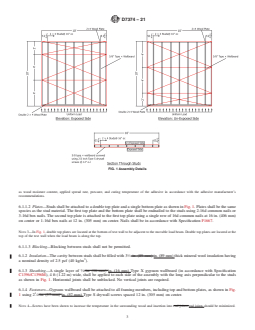
lumbershallbe115.5in.(2934mm)longandhaveatleastone
end joint within the middle third of the length. Studs shall be
NOTE 1—In the United States, the visual grade and species with the
symmetrically placed within the 10 ft (3.05 m) long by 10 ft
highest capacity in theANSI/AF&PANDS are Select Structural Douglas-
fir Larch and Dense Select Structural Southern Pine.
(3.05 m) high wall assembly with interior studs spaced 16 in.
(406 mm) on center as shown in Fig. 1. The moisture content
5. Significance and Use
of the end-jointed lumber shall be no greater than 15% at the
5.1 End-jointed lumber studs used in fire resistance-rated time of the fire test.
assemblies shall be able to support the superimposed design
NOTE 2—When producing end-jointed lumber for use in this standard
load for the specified
...
This document is not an ASTM standard and is intended only to provide the user of an ASTM standard an indication of what changes have been made to the previous version. Because
it may not be technically possible to adequately depict all changes accurately, ASTM recommends that users consult prior editions as appropriate. In all cases only the current version
of the standard as published by ASTM is to be considered the official document.
Designation: D7374 − 08 (Reapproved 2015) D7374 − 21
Standard Practice for
Evaluating Elevated Temperature Performance of Adhesives
Used in End-Jointed Lumber
This standard is issued under the fixed designation D7374; the number immediately following the designation indicates the year of
original adoption or, in the case of revision, the year of last revision. A number in parentheses indicates the year of last reapproval. A
superscript epsilon (´) indicates an editorial change since the last revision or reapproval.
1. Scope
1.1 This standard practice is to be used to evaluate the elevated temperature performance of adhesives used in end-jointed lumber.
1.2 A symmetric wall assembly containing end-jointed lumber studs is exposed to a standard fire exposure specified in Test
Methods E119.
1.3 The wall assembly shall sustain the applied load during a standard fire exposure specified in Test Methods E119 for a period
of 60 min or more.
1.4 This practice is used to evaluate the performance of adhesives used in end-jointed lumber to heat and flame under controlled
conditions, but it does not by itself incorporate all factors required for fire hazard or fire risk assessment under actual fire
conditions.
1.5 The values stated in inch-pound units are to be regarded as standard. The values given in parentheses are mathematical
conversions to SI units that are provided for information only and are not considered standard.
1.6 This standard does not purport to address all of the safety concerns, if any, associated with its use. It is the responsibility
of the user of this standard to establish appropriate safety safety, health, and healthenvironmental practices and determine the
applicability of regulatory limitations prior to use.
1.7 This international standard was developed in accordance with internationally recognized principles on standardization
established in the Decision on Principles for the Development of International Standards, Guides and Recommendations issued
by the World Trade Organization Technical Barriers to Trade (TBT) Committee.
2. Referenced Documents
2.1 ASTM Standards:
C1396/C1396M Specification for Gypsum Board
D9 Terminology Relating to Wood and Wood-Based Products
D4688 Test Method for Evaluating Structural Adhesives for Finger Jointing Lumber
D6513 Practice for Calculating the Superimposed Load on Wood-frame Walls for Standard Fire-Resistance Tests
E119 Test Methods for Fire Tests of Building Construction and Materials
This practice is under the jurisdiction of ASTM Committee D07 on Wood and is the direct responsibility of Subcommittee D07.02 on Lumber and Engineered Wood
Products.
Current edition approved May 1, 2015July 15, 2021. Published June 2015August 2021. Originally approved in 2008. Last previous edition approved in 20082015 as D7374
– 08. 08 (2015). DOI: 10.1520/D7374-08R15.10.1520/D7374-21.
For referenced ASTM standards, visit the ASTM website, www.astm.org, or contact ASTM Customer Service at service@astm.org. For Annual Book of ASTM Standards
volume information, refer to the standard’s Document Summary page on the ASTM website.
Copyright © ASTM International, 100 Barr Harbor Drive, PO Box C700, West Conshohocken, PA 19428-2959. United States
D7374 − 21
F1667 Specification for Driven Fasteners: Nails, Spikes, and Staples
2.2 Other Standards:
ANSI/AF&PA NDS National Design Specification for Wood Construction
3. Terminology
3.1 Definitions:
3.1.1 For general definitions of terms related to wood, refer to Terminology D9.
3.2 Definitions of Terms Specific to This Standard:
3.2.1 end-jointed lumber—end joint, n—lumber containing one or more end-joints.joint formed by adhesive bonding of machined,
mated surfaces at the ends of two pieces of lumber.
3.2.1.1 Discussion—
Typical end joint configurations include finger joints and scarf joints.
3.2.2 end-joints—finger joint, n—aend joint formed by bonding two pieces of lumber end-to-end, often by machining a set of
interlocking “fingers” (finger-joint) into each end of adjoining pieces, using an adhesive to form an adhesive bonded joint.multiple
interlocking tapered profiles (“fingers”).
3.2.3 scarf joint, n—end joint formed by a single tapered profile.
3.2.4 end-jointed lumber—lumber containing one or more end joints.
4. Summary of Practice
4.1 This practice shall be used to evaluate end-jointed lumber adhesives intended for use in end-jointed lumber by fire testing a
wall assembly under a vertical load associated with the highest visual grade for the species group of Douglas Fir–Larch or Southern
Pine. The results are deemed applicable to all other species, grades, and joint configurations.
NOTE 1—In the United States, the visual grade and species with the highest capacity in the ANSI/AF&PA NDS are Select Structural Douglas-fir Larch
and Dense Select Structural Southern Pine.
5. Significance and Use
5.1 End-jointed lumber studs used in fire resistance-rated assemblies shall be able to support the superimposed design load for the
specified time under an elevated temperature exposure, when a wall assembly is exposed to a standard fire specified in Test
Methods E119. Light-weight wood assemblies utilize gypsum wallboard or other types of membrane protection to accomplish a
requisite fire resistance rating for the assembly. However, wood studs and the end-joints end joints in the studs shall resist the
developed elevated temperature environment for the duration of the rating. This practice provides a method for evaluating the
elevated temperature performance of an adhesive used in end-jointed lumber as compared with the elevated temperature
performance of solid wood.
6. Wall Assembly
6.1 A load-bearing wall meeting the following assembly description shall be used.
6.1.1 Framing Elements:
6.1.1.1 Studs—Nine pieces of 2 × 4 (nominal) end-jointed lumber shall be used for
...