

ASTM D8134-18(2023)
(Guide)Standard Guide for Conducting Internal Hydrostatic Pressure Tests on United Nations (UN) IBC Design Types
General Information
- Abstract
SIGNIFICANCE AND USE
4.1 Dangerous goods (hazardous materials) regulations require performance tests to be conducted on packaging or IBC designs before being authorized for use. The regulations do not include standardized procedures for conducting performance tests and, because of this, may result in a non-uniform approach and differences in test results between testing facilities.
4.2 The purpose of this standard is to provide guidance and to establish a set of common practices for conducting hydrostatic pressure tests on IBC designs subjected to UN certification testing.
4.3 Intermediate bulk container designs are required to be tested in a sequence. This guide focuses on conducting the hydrostatic pressure test, which is preceded in the test sequence by the leakproofness test. The fittings and adaptors applied to the container for the hydrostatic pressure test may also be used for the leakproofness test.
SCOPE
1.1 This guide is intended to provide a standardized method and a set of basic instructions for performing hydrostatic pressure testing on Intermediate Bulk Containers (IBCs) designs as required by the United States Department of Transportation Title 49 Code of Federal Regulations (CFR) and the United Nations Recommendations on the Transport of Dangerous Goods (UN).
1.2 This guide focuses on composite and rigid plastic IBCs and is suitable for testing IBCs of any design or material type.
1.3 This guide provides information to help clarify various terms used as part of the United Nations (UN) certification process that may assist in determining the applicable test.
1.4 This guide provides the suggested minimum information that should be documented when conducting pressure testing.
1.5 This guide provides information for recommended equipment and fittings for conducting pressure tests.
1.6 This guide is based on the current information contained in 49 CFR 178.814.
1.7 When testing packaging designs intended for hazardous materials (dangerous goods), the user of this guide shall be trained in accordance with 49 CFR 172.700 and other applicable hazardous materials regulations such as the International Civil Aviation Organization (ICAO) Technical Instructions for the Safe Transport of Dangerous Goods by Air, the International Maritime Dangerous Goods Code (IMDG Code), and carrier rules such as the International Air Transport Association (IATA) Dangerous Goods Regulations.
1.8 Units—The values stated in SI units are to be regarded as the standard. No other units of measurement are included in this guide.
1.9 This standard does not purport to address all of the safety concerns, if any, associated with its use. It is the responsibility of the user of this standard to establish appropriate safety, health, and environmental practices and determine the applicability of regulatory limitations prior to use.
1.10 This international standard was developed in accordance with internationally recognized principles on standardization established in the Decision on Principles for the Development of International Standards, Guides and Recommendations issued by the World Trade Organization Technical Barriers to Trade (TBT) Committee.
- Status
- Published
- Publication Date
- 31-Oct-2023
- Technical Committee
- D10 - Packaging
- Drafting Committee
- D10.22 - Hazardous Materials
Overview
ASTM D8134-18(2023) provides essential guidance for conducting internal hydrostatic pressure tests on United Nations (UN) Intermediate Bulk Container (IBC) design types. Developed by ASTM International, this standard aims to establish consistent procedures for hydrostatic pressure testing, as required by regulations such as the US Department of Transportation Title 49 Code of Federal Regulations (49 CFR) and the United Nations Recommendations on the Transport of Dangerous Goods. The guide is particularly relevant for composite and rigid plastic IBCs but applies broadly to all IBC materials and designs.
Hydrostatic pressure tests verify the integrity and safety of IBCs intended for the transport of hazardous materials. This standard helps harmonize test methods and improve the reliability and comparability of results across testing facilities worldwide.
Key Topics
- Standardized Test Procedures: Offers step-by-step methods for performing hydrostatic pressure testing, reducing variation between facilities.
- Applicability: Focuses on various IBC types-including composite and rigid plastic-but suitable for any design or material.
- Test Sequence: Details that the hydrostatic pressure test follows the leakproofness test within the UN certification process.
- Required Equipment: Recommends equipment such as calibrated closing tools, pressure gauges, regulator valves, water supply tanks, hoses, and fittings.
- Preparation Steps: Guidance on container selection, inspection, fitting installation, filling with water, and proper closure preparation.
- Test Execution: Emphasizes gradual and continuous pressurization, accurate gauge placement, and full documentation.
- Reporting: Specifies minimum documentation requirements including container identity, equipment used, test conditions, and observations.
- Regulatory Alignment: Compliant with relevant hazardous materials regulations, including 49 CFR, ICAO Technical Instructions, and IMDG Code.
Applications
Hydrostatic pressure testing of IBCs is crucial for:
- UN IBC Certification: Ensuring container designs meet international standards for the transport of hazardous goods.
- Regulatory Compliance: Demonstrating adherence to 49 CFR, UN Model Regulations, and other transport safety rules.
- Quality Control: Confirming the structural integrity and leak resistance of new or modified IBCs before they are used.
- Performance Verification: Supporting manufacturers, regulatory agencies, and third-party testing labs in evaluating IBC reliability under pressure.
- Documentation: Facilitating traceability, auditability, and transparency in test results as part of regulatory or internal quality systems.
This standard is widely used by packaging engineers, safety professionals, hazardous materials shippers, and regulatory bodies involved in hazardous goods logistics.
Related Standards
For a comprehensive approach to IBC performance and hazardous material packaging, consider these related standards:
- ASTM D4919: Guide for Testing of Hazardous Materials (Dangerous Goods) Packagings
- ASTM D7660: Guide for Conducting Internal Pressure Tests on United Nations (UN) Packagings
- U.S. DOT 49 CFR Parts 100-199: U.S. Department of Transportation Hazardous Materials Regulations
- UN Recommendations on the Transport of Dangerous Goods, Model Regulations
- International Maritime Dangerous Goods (IMDG) Code
- International Civil Aviation Organization (ICAO) Technical Instructions
- International Air Transport Association (IATA) Dangerous Goods Regulations
Practical Value
Applying ASTM D8134-18(2023) ensures a uniform and reliable approach to IBC hydrostatic pressure testing. Organizations gain:
- Consistency: Reduces discrepancies in results between test labs.
- Safety Assurance: Enhances confidence in IBC performance under pressure.
- Regulatory Acceptance: Facilitates global acceptance and certification of IBC designs for hazardous materials transport.
- Efficient Documentation: Provides clear guidelines for recordkeeping and reporting, supporting regulatory compliance and quality management systems.
Using this standard is key for anyone involved in the design, testing, certification, or regulatory oversight of IBCs for dangerous goods transport.
Relations
- Effective Date
- 01-Nov-2023
- Effective Date
- 01-Nov-2023
Get Certified
Connect with accredited certification bodies for this standard

BRCGS (Brand Reputation Compliance Global Standards)
Global food safety and quality standards owner.
CIS Institut d.o.o.
Personal Protective Equipment (PPE) certification body. Notified Body NB-2890 for EU Regulation 2016/425 PPE.

Kiwa BDA Testing
Building and construction product certification.
Sponsored listings
Frequently Asked Questions
ASTM D8134-18(2023) is a guide published by ASTM International. Its full title is "Standard Guide for Conducting Internal Hydrostatic Pressure Tests on United Nations (UN) IBC Design Types". This standard covers: SIGNIFICANCE AND USE 4.1 Dangerous goods (hazardous materials) regulations require performance tests to be conducted on packaging or IBC designs before being authorized for use. The regulations do not include standardized procedures for conducting performance tests and, because of this, may result in a non-uniform approach and differences in test results between testing facilities. 4.2 The purpose of this standard is to provide guidance and to establish a set of common practices for conducting hydrostatic pressure tests on IBC designs subjected to UN certification testing. 4.3 Intermediate bulk container designs are required to be tested in a sequence. This guide focuses on conducting the hydrostatic pressure test, which is preceded in the test sequence by the leakproofness test. The fittings and adaptors applied to the container for the hydrostatic pressure test may also be used for the leakproofness test. SCOPE 1.1 This guide is intended to provide a standardized method and a set of basic instructions for performing hydrostatic pressure testing on Intermediate Bulk Containers (IBCs) designs as required by the United States Department of Transportation Title 49 Code of Federal Regulations (CFR) and the United Nations Recommendations on the Transport of Dangerous Goods (UN). 1.2 This guide focuses on composite and rigid plastic IBCs and is suitable for testing IBCs of any design or material type. 1.3 This guide provides information to help clarify various terms used as part of the United Nations (UN) certification process that may assist in determining the applicable test. 1.4 This guide provides the suggested minimum information that should be documented when conducting pressure testing. 1.5 This guide provides information for recommended equipment and fittings for conducting pressure tests. 1.6 This guide is based on the current information contained in 49 CFR 178.814. 1.7 When testing packaging designs intended for hazardous materials (dangerous goods), the user of this guide shall be trained in accordance with 49 CFR 172.700 and other applicable hazardous materials regulations such as the International Civil Aviation Organization (ICAO) Technical Instructions for the Safe Transport of Dangerous Goods by Air, the International Maritime Dangerous Goods Code (IMDG Code), and carrier rules such as the International Air Transport Association (IATA) Dangerous Goods Regulations. 1.8 Units—The values stated in SI units are to be regarded as the standard. No other units of measurement are included in this guide. 1.9 This standard does not purport to address all of the safety concerns, if any, associated with its use. It is the responsibility of the user of this standard to establish appropriate safety, health, and environmental practices and determine the applicability of regulatory limitations prior to use. 1.10 This international standard was developed in accordance with internationally recognized principles on standardization established in the Decision on Principles for the Development of International Standards, Guides and Recommendations issued by the World Trade Organization Technical Barriers to Trade (TBT) Committee.
SIGNIFICANCE AND USE 4.1 Dangerous goods (hazardous materials) regulations require performance tests to be conducted on packaging or IBC designs before being authorized for use. The regulations do not include standardized procedures for conducting performance tests and, because of this, may result in a non-uniform approach and differences in test results between testing facilities. 4.2 The purpose of this standard is to provide guidance and to establish a set of common practices for conducting hydrostatic pressure tests on IBC designs subjected to UN certification testing. 4.3 Intermediate bulk container designs are required to be tested in a sequence. This guide focuses on conducting the hydrostatic pressure test, which is preceded in the test sequence by the leakproofness test. The fittings and adaptors applied to the container for the hydrostatic pressure test may also be used for the leakproofness test. SCOPE 1.1 This guide is intended to provide a standardized method and a set of basic instructions for performing hydrostatic pressure testing on Intermediate Bulk Containers (IBCs) designs as required by the United States Department of Transportation Title 49 Code of Federal Regulations (CFR) and the United Nations Recommendations on the Transport of Dangerous Goods (UN). 1.2 This guide focuses on composite and rigid plastic IBCs and is suitable for testing IBCs of any design or material type. 1.3 This guide provides information to help clarify various terms used as part of the United Nations (UN) certification process that may assist in determining the applicable test. 1.4 This guide provides the suggested minimum information that should be documented when conducting pressure testing. 1.5 This guide provides information for recommended equipment and fittings for conducting pressure tests. 1.6 This guide is based on the current information contained in 49 CFR 178.814. 1.7 When testing packaging designs intended for hazardous materials (dangerous goods), the user of this guide shall be trained in accordance with 49 CFR 172.700 and other applicable hazardous materials regulations such as the International Civil Aviation Organization (ICAO) Technical Instructions for the Safe Transport of Dangerous Goods by Air, the International Maritime Dangerous Goods Code (IMDG Code), and carrier rules such as the International Air Transport Association (IATA) Dangerous Goods Regulations. 1.8 Units—The values stated in SI units are to be regarded as the standard. No other units of measurement are included in this guide. 1.9 This standard does not purport to address all of the safety concerns, if any, associated with its use. It is the responsibility of the user of this standard to establish appropriate safety, health, and environmental practices and determine the applicability of regulatory limitations prior to use. 1.10 This international standard was developed in accordance with internationally recognized principles on standardization established in the Decision on Principles for the Development of International Standards, Guides and Recommendations issued by the World Trade Organization Technical Barriers to Trade (TBT) Committee.
ASTM D8134-18(2023) is classified under the following ICS (International Classification for Standards) categories: 13.300 - Protection against dangerous goods; 55.180.99 - Other standards related to freight distribution of goods. The ICS classification helps identify the subject area and facilitates finding related standards.
ASTM D8134-18(2023) has the following relationships with other standards: It is inter standard links to ASTM D8134-18, ASTM D7660-20. Understanding these relationships helps ensure you are using the most current and applicable version of the standard.
ASTM D8134-18(2023) is available in PDF format for immediate download after purchase. The document can be added to your cart and obtained through the secure checkout process. Digital delivery ensures instant access to the complete standard document.
Standards Content (Sample)
This international standard was developed in accordance with internationally recognized principles on standardization established in the Decision on Principles for the
Development of International Standards, Guides and Recommendations issued by the World Trade Organization Technical Barriers to Trade (TBT) Committee.
Designation: D8134 − 18 (Reapproved 2023)
Standard Guide for
Conducting Internal Hydrostatic Pressure Tests on United
Nations (UN) IBC Design Types
This standard is issued under the fixed designation D8134; the number immediately following the designation indicates the year of
original adoption or, in the case of revision, the year of last revision. A number in parentheses indicates the year of last reapproval. A
superscript epsilon (´) indicates an editorial change since the last revision or reapproval.
1. Scope responsibility of the user of this standard to establish appro-
priate safety, health, and environmental practices and deter-
1.1 This guide is intended to provide a standardized method
mine the applicability of regulatory limitations prior to use.
and a set of basic instructions for performing hydrostatic
1.10 This international standard was developed in accor-
pressure testing on Intermediate Bulk Containers (IBCs) de-
dance with internationally recognized principles on standard-
signs as required by the United States Department of Trans-
ization established in the Decision on Principles for the
portation Title 49 Code of Federal Regulations (CFR) and the
Development of International Standards, Guides and Recom-
United Nations Recommendations on the Transport of Danger-
mendations issued by the World Trade Organization Technical
ous Goods (UN).
Barriers to Trade (TBT) Committee.
1.2 This guide focuses on composite and rigid plastic IBCs
and is suitable for testing IBCs of any design or material type.
2. Referenced Documents
1.3 This guide provides information to help clarify various
2.1 ASTM Standards:
terms used as part of the United Nations (UN) certification
D4919 Guide for Testing of Hazardous Materials (Danger-
process that may assist in determining the applicable test.
ous Goods) Packagings
D7660 Guide for Conducting Internal Pressure Tests on
1.4 This guide provides the suggested minimum informa-
United Nations (UN) Packagings
tion that should be documented when conducting pressure
testing.
2.2 Federal Standards:
U.S. Department of Transportation Code of Federal Regula-
1.5 This guide provides information for recommended
tions Title 49 Transportation (49 CFR) Parts 100-1993
equipment and fittings for conducting pressure tests.
2.3 UN Standard:
1.6 This guide is based on the current information contained
United Nations Recommendations on the Transport of Dan-
in 49 CFR 178.814.
gerous Goods, Model Regulations
1.7 When testing packaging designs intended for hazardous
2.4 IMDG Standard:
materials (dangerous goods), the user of this guide shall be
International Maritime Dangerous Goods Code (IMDG
trained in accordance with 49 CFR 172.700 and other appli-
Code)
cable hazardous materials regulations such as the International
Civil Aviation Organization (ICAO) Technical Instructions for
3. Terminology
the Safe Transport of Dangerous Goods by Air, the Interna-
3.1 Definitions:
tional Maritime Dangerous Goods Code (IMDG Code), and
3.1.1 bar, n—metric unit of atmospheric pressure equal to
carrier rules such as the International Air Transport Association
2 2
14.50 psi (lb/in. ), 1.02 kg/cm , 29.53 in.-Hg, or 0.9869
(IATA) Dangerous Goods Regulations.
atmosphere.
1.8 Units—The values stated in SI units are to be regarded
as the standard. No other units of measurement are included in
this guide.
For referenced ASTM standards, visit the ASTM website, www.astm.org, or
contact ASTM Customer Service at service@astm.org. For Annual Book of ASTM
1.9 This standard does not purport to address all of the
Standards volume information, refer to the standard’s Document Summary page on
safety concerns, if any, associated with its use. It is the
the ASTM website.
Available from Superintendent of Documents, U.S. Government Printing
Office, Washington, DC 20402-9371 (website: phmsa.dot.gov/hazmat).
1 4
This guide is under the jurisdiction of ASTM Committee D10 on Packaging and Available from the UN Economic Commission for Europe, Information
is the direct responsibility of Subcommittee D10.22 on Hazardous Materials. Service, Palais des Nations, CH-1211 Geneva 10 Switzerland (website: http://
Current edition approved Nov. 1, 2023. Published November 2023. Originally www.unece.org/trans/danger/danger.htm).
approved in 2018. Last previous edition approved in 2018 as D8134 – 18. DOI: Available from the International Marine Organization (IMO, 4 Albert
10.1520/D8134-18R23. Embankment, London, SE1 7SR United Kingdom (website: http://www.imo.org/)
Copyright © ASTM International, 100 Barr Harbor Drive, PO Box C700, West Conshohocken, PA 19428-2959. United States
D8134 − 18 (2023)
3.1.2 hydrostatic pressure test, n—internal pressure test 5.1.3 Regulator Valve, used to maintain an even pressure
conducted on a container or packaging filled with water and throughout the duration of the test and to maintain proper water
pressurized with water or other suitable means; regulatory pressure to test container.
reference sections: 49 CFR 178.814, UN 6.5.6.8, and IMDG 5.1.4 Pressure Station to distribute water from water supply
6.5.6.8. source through the regulator to the test container. Refer to
items (6) and (7) in Fig. 1.
3.1.3 kilopascal, kPa, n—unit of pressure in the SI system of
5.1.5 Hose or Piping, as required.
international units, the primary standard system used by the
5.1.6 Pressure Gauge(s), psi/kPa dual marked and cali-
United Nations (UN) and the U.S. Department of Transporta-
brated (digital preferred).
tion (DOT) throughout their respective regulations per 49 CFR
5.1.6.1 Gauge, to monitor water supply pressure.
171.10.
5.1.6.2 Gauge, to monitor pressure inside the test container.
3.1.3.1 Discussion—To convert kPa to psi, multiply by
5.1.6.3 All gauges used should be calibrated and have an
0.1450377 (95 kPa × 0.1450377 = 13.8 psi).
accuracy in the appropriate range.
3.1.4 intermediate bulk container (IBC), n—rigid or flexible
5.1.7 Connections (Fitting/Valves, Adaptors, Gaskets, and
portable packaging, other than a cylinder or portable tank,
Bushings) or other equally effective means, as needed.
which is designed for mechanical handling (as defined by 49
5.1.7.1 Fitting/Valve, for water inlet to test container.
CFR 171.8).
5.1.7.2 Fitting/Valve, for air release, drainage, and pressure
3.1.5 pounds per square inch, psi, n—unit of measure in the monitoring.
inch–pound (English) measurement system.
5.1.7.3 Fitting/Valve, for pressure monitoring (if this is not
combined with air release fitting).
3.1.5.1 Discussion—To convert psi to kPa, multiply by 6.89
(13.8 psi × 6.89 = 95 kPa). NOTE 1—When combining fittings and valves, take care to make sure
the assembly does not interfere with the reading on the gauge. A long
extension of the fitting may not provide an accurate pressure reading of the
4. Significance and Use
test container. Fittings extending above or beyond the test container
4.1 Dangerous goods (hazardous materials) regulations re- should be kept as short as possible to maintain accurate values and stable
fittings.
quire performance tests to be conducted on packaging or IBC
designs before being authorized for use. The regulations do not
5.1.8 Drill and appropriate drill bit.
include standardized procedures for conducting performance
5.1.9 Temperature Measuring Device, appropriately cali-
tests and, because of this, may result in a non-uniform
brated.
approach and differences in test results between testing facili-
5.1.10 0 to 60 min Timer with Audible Alarm.
ties.
5.2 Safety Equipment, recommended.
4.2 The purpose of this standard is to provide guidance and
5.2.1 Safety Glasses with Side Shield.
to establish a set of common practices for conducting hydro-
5.2.2 Gloves, fabric leather or rubber slip resistant, as
static pressure tests on IBC designs subjected to UN certifica-
appropriate.
tion testing.
6. Sample Size
4.3 Intermediate bulk container designs are required to be
tested in a sequence. This guide focuses on conducting the
6.1 One sample is required for IBC designs. Reference 49
hydrostatic pressure test, which is preceded in the test sequence
CFR 178.814.
by the leakproofness test. The fittings and adaptors applied to
the container for the hydrostatic pressure test may also be used
7. Container
for the leakproofness test.
7.1 Selection:
7.1.1 Randomly select an appropriate container to be tested.
5. Equipment
7.1.2 Visually inspect container to verify that all closures,
5.1 Recommended Test Equipment:
plugs, gasket, accessories, and so forth match the closing
5.1.1 Appropriate Packaging Closing Equipment (Cali-
instructions and to determine if the container has any blemishes
brated as Applicable)—Closing equipment, such as torque
or defects that would affect a proper seal (record any observa-
wrench, cover/closure crimping tools, and so forth, to prepare
tions). If necessary, clean off gaskets and other closure surfaces
the IBC design for transport.
to ensure a proper seal is accomplished.
5.1.2 Water Supply Source:
7.2 Preparation:
5.1.2.1 Water supply source system should be designed to
7.2.1 Location of Fittings and Gauges—Care should be
minimize water pressure fluctuations during the test.
taken not to attach fittings to container embossments or other
5.1.2.2 The water source can be building supplied water
geometries that could possibly compromise the integrity of the
provided fluctuations in pressure do not occur during the test.
container or invalidate the test. The report should describe in
5.1.2.3 It is recommended to have a separate water supply
general how many fittings are used and where fittings and
tank assembly to enable the use of air pressure over the top of
gauges are located. Photo documentation is recommended.
the water supply. Air pressure may be used to pressurize the
water supply tank to provide adequate water pressure to the test
NOTE 2—To reduce the possibility of inconsistent results between test
container in a timely fashion. Refer to Fig. 1. samples, gauges and fittings should be in the same location.
D8134 − 18 (2023)
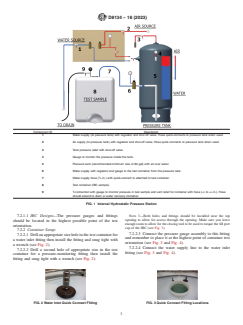
Component ID Description
1 Water supply (to pressure tank) with regulator and shut off valve. Hose quick-connects to pressure tank when used.
2 Air supply (to pressure tank) with regulator and shut-off valve. Hose quick-connects to pressure tank when used.
3 Tank pressure relief with shut-off valve.
4 Gauge to monitor the pressure inside the tank.
5 Pressure tank (recommended minimum size of 80 gal) with air over water.
6 Water supply with regulator and gauge to the test container from the pressure tank.
7 Water supply hose ( ⁄4 in.) with quick-connect to attached to test container.
8 Test container (IBC sample).
1 3
9 T-connection with gauge to monitor pressure in test sample and vent relief for container with hose ( ⁄2 to ⁄4 in.). Hose
should extend to drain or water recovery container.
FIG. 1 Internal Hydrostatic Pressure Station
NOTE 3—Both holes and fittings should be installed near the top
7.2.1.1 IBC Designs—The pressure gauges and fittings
opening to allow for access through
...