

ASTM D1305-16(2022)
(Specification)Standard Specification for Electrical Insulating Paper and Paperboard-Sulfate (Kraft) Layer Type
General Information
- Abstract
ABSTRACT
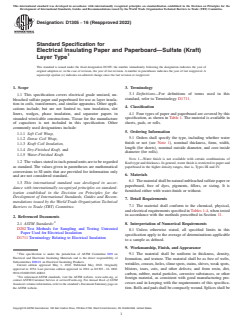
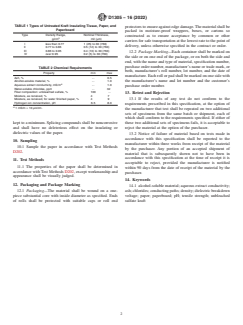
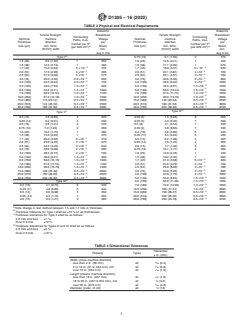
This specification covers electrically insulating, unbleached sulfate paper and paperboard used as layer insulation in coils, transformers, and other similar apparatus. The materials may also be used as turn insulation, slot liners, wedges, phase insulation, and separator papers in stranded wire/cable constructions. This specification does not include tissue for manufacture of capacitors. Other commonly used terms for the materials include soft coil wrap, dense coil wrap, kraft coil insulation, dry-finished kraft, and water-finished kraft. The materials covered in this specification are classified into four types according to density range and nominal thickness and should conform to the required values of ash content, alcohol-soluble material content, aqueous extract conductivity, water-soluble chloride content, fiber composition, moisture content, hydrogen ion concentration, pH, tensile strength, dielectric breakdown voltage, and conducting paths.
SCOPE
1.1 This specification covers electrical grade unsized, unbleached sulfate paper and paperboard for use as layer insulation in coils, transformers, and similar apparatus. Other applications include, but are not limited to, turn insulation, slot liners, wedges, phase insulation, and separator papers in stranded wire/cable constructions. Tissue for the manufacture of capacitors is not included in this specification. Other commonly used designations include:
1.1.1 Soft Coil Wrap,
1.1.2 Dense Coil Wrap,
1.1.3 Kraft Coil Insulation,
1.1.4 Dry-Finished Kraft, and
1.1.5 Water-Finished Kraft.
1.2 The values stated in inch-pound units are to be regarded as standard. The values given in parentheses are mathematical conversions to SI units that are provided for information only and are not considered standard.
1.3 This international standard was developed in accordance with internationally recognized principles on standardization established in the Decision on Principles for the Development of International Standards, Guides and Recommendations issued by the World Trade Organization Technical Barriers to Trade (TBT) Committee.
- Status
- Published
- Publication Date
- 30-Apr-2022
- Technical Committee
- D09 - Electrical and Electronic Insulating Materials
- Drafting Committee
- D09.01 - Electrical Insulating Products

Overview
ASTM D1305-16(2022): Standard Specification for Electrical Insulating Paper and Paperboard - Sulfate (Kraft) Layer Type defines the requirements for electrical grade, unsized, unbleached sulfate (kraft) paper and paperboard used as insulation in electrical equipment. These materials, also referred to as soft coil wrap, dense coil wrap, kraft coil insulation, dry-finished kraft, and water-finished kraft, are essential for providing electrical isolation in coils, transformers, and other similar apparatus. The standard ensures the performance, quality, and safety of insulating paper and paperboard for use in electrical applications, specifying requirements for properties like density, thickness, tensile strength, dielectric breakdown, chemical composition, and moisture content.
Key Topics
- Material Types: This standard covers four types of kraft insulating paper and paperboard, classified according to density and nominal thickness. The materials are available in forms such as sheets, pads, or rolls and can feature either a dry or water finish.
- Applications: Common uses include layer insulation in coils and transformers, turn insulation, slot liners, wedges, phase insulation, and separator papers in stranded wire and cable constructions.
- Physical and Chemical Requirements: The paper must meet strict specifications for ash content, alcohol-soluble material, aqueous extract conductivity, water-soluble chloride content, fiber composition, moisture, pH, and more.
- Electrical Performance: Dielectric breakdown voltage and the presence of conducting paths are tested to ensure reliable electrical insulation.
- Workmanship and Packaging: Materials must be free from defects and packed to prevent damage during transport and storage, with clear package marking for traceability.
- Non-inclusion: Tissue specifically for capacitor manufacture is not covered by this document.
Applications
Electrically insulating kraft paper and paperboard specified by ASTM D1305-16(2022) are widely used in the manufacturing and maintenance of electrical equipment, most notably in:
- Coils and Transformers: Serves as layer insulation to prevent electrical faults and improve durability and operational safety.
- Rotating Machinery: Used for slot liners and wedges in motors and generators, ensuring isolation between live components.
- Power Cables and Stranded Wires: Acts as turn insulation and separator paper, supporting electrical integrity in cable assemblies.
- Phase and Terminal Insulation: Provides reliable separation between electrical phases inside switchgear, circuit breakers, and similar devices.
- Custom Electrical Assemblies: Utilized wherever high-quality electrical insulation is critical and tissue paper is not specified or suitable.
These applications capitalize on the defined physical, chemical, and electrical requirements to maintain insulation performance, enhance safety, and ensure long service life of electrical systems.
Related Standards
To maximize performance and compatibility, manufacturers and engineers often reference ASTM D1305-16(2022) alongside related documents, including:
- ASTM D202 - Test Methods for Sampling and Testing Untreated Paper Used for Electrical Insulation
- ASTM D1711 - Terminology Relating to Electrical Insulation
Other relevant specifications may include standards for synthetic or composite insulating materials, depending on project needs. Using ASTM D1305 in conjunction with these related standards helps ensure overall quality control and compliance with international best practices for electrical insulation.
Keywords: ASTM D1305, electrical insulating paper, kraft paper insulation, sulfate paperboard, transformer insulation, coil wrap, electrical grade paper, insulation standards, dielectric strength, ASTM insulation standard
Relations
- Effective Date
- 01-Mar-2024
- Effective Date
- 01-Nov-2015
- Effective Date
- 01-Nov-2014
- Effective Date
- 01-May-2014
- Effective Date
- 01-Nov-2013
- Effective Date
- 01-Aug-2011
- Effective Date
- 01-May-2008
- Effective Date
- 01-May-2008
- Effective Date
- 10-Mar-2002
- Effective Date
- 10-Oct-1999
- Effective Date
- 10-Mar-1997
Get Certified
Connect with accredited certification bodies for this standard

IMQ S.p.A. (Certification)
Italian electrical product certification.

SLG Prüf- und Zertifizierungs GmbH
German testing and certification body.

UL Solutions
Global safety science company with testing, inspection and certification.
Sponsored listings
Frequently Asked Questions
ASTM D1305-16(2022) is a technical specification published by ASTM International. Its full title is "Standard Specification for Electrical Insulating Paper and Paperboard-Sulfate (Kraft) Layer Type". This standard covers: ABSTRACT This specification covers electrically insulating, unbleached sulfate paper and paperboard used as layer insulation in coils, transformers, and other similar apparatus. The materials may also be used as turn insulation, slot liners, wedges, phase insulation, and separator papers in stranded wire/cable constructions. This specification does not include tissue for manufacture of capacitors. Other commonly used terms for the materials include soft coil wrap, dense coil wrap, kraft coil insulation, dry-finished kraft, and water-finished kraft. The materials covered in this specification are classified into four types according to density range and nominal thickness and should conform to the required values of ash content, alcohol-soluble material content, aqueous extract conductivity, water-soluble chloride content, fiber composition, moisture content, hydrogen ion concentration, pH, tensile strength, dielectric breakdown voltage, and conducting paths. SCOPE 1.1 This specification covers electrical grade unsized, unbleached sulfate paper and paperboard for use as layer insulation in coils, transformers, and similar apparatus. Other applications include, but are not limited to, turn insulation, slot liners, wedges, phase insulation, and separator papers in stranded wire/cable constructions. Tissue for the manufacture of capacitors is not included in this specification. Other commonly used designations include: 1.1.1 Soft Coil Wrap, 1.1.2 Dense Coil Wrap, 1.1.3 Kraft Coil Insulation, 1.1.4 Dry-Finished Kraft, and 1.1.5 Water-Finished Kraft. 1.2 The values stated in inch-pound units are to be regarded as standard. The values given in parentheses are mathematical conversions to SI units that are provided for information only and are not considered standard. 1.3 This international standard was developed in accordance with internationally recognized principles on standardization established in the Decision on Principles for the Development of International Standards, Guides and Recommendations issued by the World Trade Organization Technical Barriers to Trade (TBT) Committee.
ABSTRACT This specification covers electrically insulating, unbleached sulfate paper and paperboard used as layer insulation in coils, transformers, and other similar apparatus. The materials may also be used as turn insulation, slot liners, wedges, phase insulation, and separator papers in stranded wire/cable constructions. This specification does not include tissue for manufacture of capacitors. Other commonly used terms for the materials include soft coil wrap, dense coil wrap, kraft coil insulation, dry-finished kraft, and water-finished kraft. The materials covered in this specification are classified into four types according to density range and nominal thickness and should conform to the required values of ash content, alcohol-soluble material content, aqueous extract conductivity, water-soluble chloride content, fiber composition, moisture content, hydrogen ion concentration, pH, tensile strength, dielectric breakdown voltage, and conducting paths. SCOPE 1.1 This specification covers electrical grade unsized, unbleached sulfate paper and paperboard for use as layer insulation in coils, transformers, and similar apparatus. Other applications include, but are not limited to, turn insulation, slot liners, wedges, phase insulation, and separator papers in stranded wire/cable constructions. Tissue for the manufacture of capacitors is not included in this specification. Other commonly used designations include: 1.1.1 Soft Coil Wrap, 1.1.2 Dense Coil Wrap, 1.1.3 Kraft Coil Insulation, 1.1.4 Dry-Finished Kraft, and 1.1.5 Water-Finished Kraft. 1.2 The values stated in inch-pound units are to be regarded as standard. The values given in parentheses are mathematical conversions to SI units that are provided for information only and are not considered standard. 1.3 This international standard was developed in accordance with internationally recognized principles on standardization established in the Decision on Principles for the Development of International Standards, Guides and Recommendations issued by the World Trade Organization Technical Barriers to Trade (TBT) Committee.
ASTM D1305-16(2022) is classified under the following ICS (International Classification for Standards) categories: 29.035.10 - Paper and board insulating materials. The ICS classification helps identify the subject area and facilitates finding related standards.
ASTM D1305-16(2022) has the following relationships with other standards: It is inter standard links to ASTM D1711-24, ASTM D1711-15, ASTM D1711-14a, ASTM D1711-14, ASTM D1711-13, ASTM D1711-11a, ASTM D202-08, ASTM D1711-08, ASTM D1711-02, ASTM D1711-99, ASTM D202-97(2002)e1. Understanding these relationships helps ensure you are using the most current and applicable version of the standard.
ASTM D1305-16(2022) is available in PDF format for immediate download after purchase. The document can be added to your cart and obtained through the secure checkout process. Digital delivery ensures instant access to the complete standard document.
Standards Content (Sample)
This international standard was developed in accordance with internationally recognized principles on standardization established in the Decision on Principles for the
Development of International Standards, Guides and Recommendations issued by the World Trade Organization Technical Barriers to Trade (TBT) Committee.
Designation:D1305 −16 (Reapproved 2022)
Standard Specification for
Electrical Insulating Paper and Paperboard—Sulfate (Kraft)
Layer Type
This standard is issued under the fixed designation D1305; the number immediately following the designation indicates the year of
original adoption or, in the case of revision, the year of last revision. A number in parentheses indicates the year of last reapproval. A
superscript epsilon (´) indicates an editorial change since the last revision or reapproval.
1. Scope 3. Terminology
3.1 Definitions—For definitions of terms used in this
1.1 This specification covers electrical grade unsized, un-
standard, refer to Terminology D1711.
bleached sulfate paper and paperboard for use as layer insula-
tion in coils, transformers, and similar apparatus. Other appli-
4. Classification
cations include, but are not limited to, turn insulation, slot
4.1 Four types of paper and paperboard are covered by this
liners, wedges, phase insulation, and separator papers in
stranded wire/cable constructions. Tissue for the manufacture specification, as shown in Table 1. The material is available in
sheets, pads, or rolls.
of capacitors is not included in this specification. Other
commonly used designations include:
5. Ordering Information
1.1.1 Soft Coil Wrap,
5.1 Orders shall specify the type, including whether water
1.1.2 Dense Coil Wrap,
finish or not (see Note 1), nominal thickness, form, width,
1.1.3 Kraft Coil Insulation,
length (for sheets), nominal outside diameter, and core inside
1.1.4 Dry-Finished Kraft, and
diameter (for rolls).
1.1.5 Water-Finished Kraft.
NOTE 1—Water finish is not available with certain combinations of
1.2 The values stated in inch-pound units are to be regarded
Kraft type and thickness. In general, water finish is restricted to paper and
as standard. The values given in parentheses are mathematical
paperboard in the higher density ranges, that is, Types III and IV.
conversions to SI units that are provided for information only
6. Materials
and are not considered standard.
6.1 Thematerialshallbenaturalunbleachedsulfatepaperor
1.3 This international standard was developed in accor-
paperboard, free of dyes, pigments, fillers, or sizing. It is
dance with internationally recognized principles on standard-
furnished either with water-finish or without.
ization established in the Decision on Principles for the
Development of International Standards, Guides and Recom-
7. Detail Requirements
mendations issued by the World Trade Organization Technical
7.1 The material shall conform to the chemical, physical,
Barriers to Trade (TBT) Committee.
andelectricalrequirementsspecifiedinTables1-4,whentested
in accordance with the methods prescribed in Section 11.
2. Referenced Documents
2.1 ASTM Standards: 8. Interpretation of Numerical Requirements
D202 Test Methods for Sampling and Testing Untreated
8.1 Unless otherwise stated, all specified limits in this
Paper Used for Electrical Insulation
specification apply to the average of determinations applicable
D1711 Terminology Relating to Electrical Insulation
to a sample as defined.
9. Workmanship, Finish, and Appearance
This specification is under the jurisdiction of ASTM Committee D09 on
9.1 The material shall be uniform in thickness, density,
Electrical and Electronic Insulating Materials and is the direct responsibility of
formation, and texture. The material shall be as free of welts,
Subcommittee D09.01 on Electrical Insulating Products.
wrinkles,creases,holes,slimespots,stains,shives,weakspots,
Current edition approved May 1, 2022. Published May 2022. Originally
blisters, tears, cuts, and other defects; and from resin, dirt,
approved in 1954. Last previous edition approved in 2016 as D1305 – 16. DOI:
9910.1520/D1305-16R22.
carbon, rubber, metal particles, corrosive substances, or other
For referenced ASTM standards, visit the ASTM website, www.astm.org, or
foreign material, as consistent with good manufacturing pro-
contact ASTM Customer Service at service@astm.org. For Annual Book of ASTM
cesses and in keeping with the requirements of this specifica-
Standards volume information, refer to the standard’s Document Summary page on
the ASTM website. tion.Rollsandpadsshallbecompactlywound.Splicesshallbe
Copyright © ASTM International, 100 Barr Harbor Drive, PO Box C700, West Conshohocken, PA 19428-2959. United States
D1305−16 (2022)
TABLE 1 Types of Untreated Kraft Insulating Tissue, Paper, and
protectorstoensureagainstedgedamage.Thematerialshallbe
Paperboard
packed in moisture-proof wrappers, boxes, or cartons so
Type Density Range, Nominal Thickness,
constructed as to ensure acceptance by common or other
g/cm mil (µm)
carriers for safe transportation at the lowest rate to the point of
I less than 0.77 1 (25) to 30 (760)
delivery, unless otherwise specified in the contract or order.
II 0.77 to 0.86 0.5 (12) to 30 (760)
III 0.86 to 0.95 0.4 (10) to 30 (760)
12.2 Package Marking—Each container shall be marked on
IV over 0.95 0.2 (5) to 30 (760)
the side or on one end of the package, or on both the side and
end, with the name and type of material, specification number,
purchase order number, manufacturer’s name or trade mark, or
TABLE 2 Chemical Requirements
both, manufacturer’s roll number, lot number, and the date of
Property min max
manufacture. Each roll or pad shall be marked on one side with
Ash, % . 0.5
the manufacturer’s name and lot number and the customer’s
Alcohol-soluble material, % . 1.0
A
Aqueous extract conductivity, mS/m . 1.0
purchase order number.
Water-soluble chlorides, ppm . 32
Fiber composition: unbleached sulfate, % 100 .
13. Retest and Rejection
Moisture, as received, % 4 7
Moisture, as received, for water finished paper, % 4 9 13.1 If the results of any test do not conform to the
Hydrogen ion concentration, pH 6.5 8.0
requirements prescribed in this specification, at the option of
A
1 mS/m = 10 µΩ/cm.
the manufacturer that test shall be repeated on two additional
sets of specimens from the same batch or shipment, each of
which shall conform to the requirements specified. If either of
kept to a minimum. Splicing compounds shall be noncorrosive these two additional sets of specimens fails, it is acceptable to
and shall have no deleterious effect on the insulating or reject the material at the option o
...