


ASTM C1705/C1705M-09(2016)
(Specification)Standard Specification for Structural Cementitious Panels
Standard Specification for Structural Cementitious Panels
ABSTRACT
This specification covers structural cementitious panels and defines minimum performance requirements for structural cementitious sheathing panels with respect to structural performance, dimensional stability performance, dimensional tolerance, noncombustibility, surface burning characteristics, long-term durability, water durability, mold resistance, density, moment capacity, and bending stiffness. Structural cementitious panels are non-combustible, water durable, fiber reinforced inorganic composite panels that can be used as floor, roof, and wall sheathing when fastened to supports spaced in accordance with the appropriate span rating. Qualification procedures and initial testing methods shall be conducted to demonstrate the performance characteristics of the panels. Statistical analysis shall also be performed for sampling and inspection of the panel samples.
SCOPE
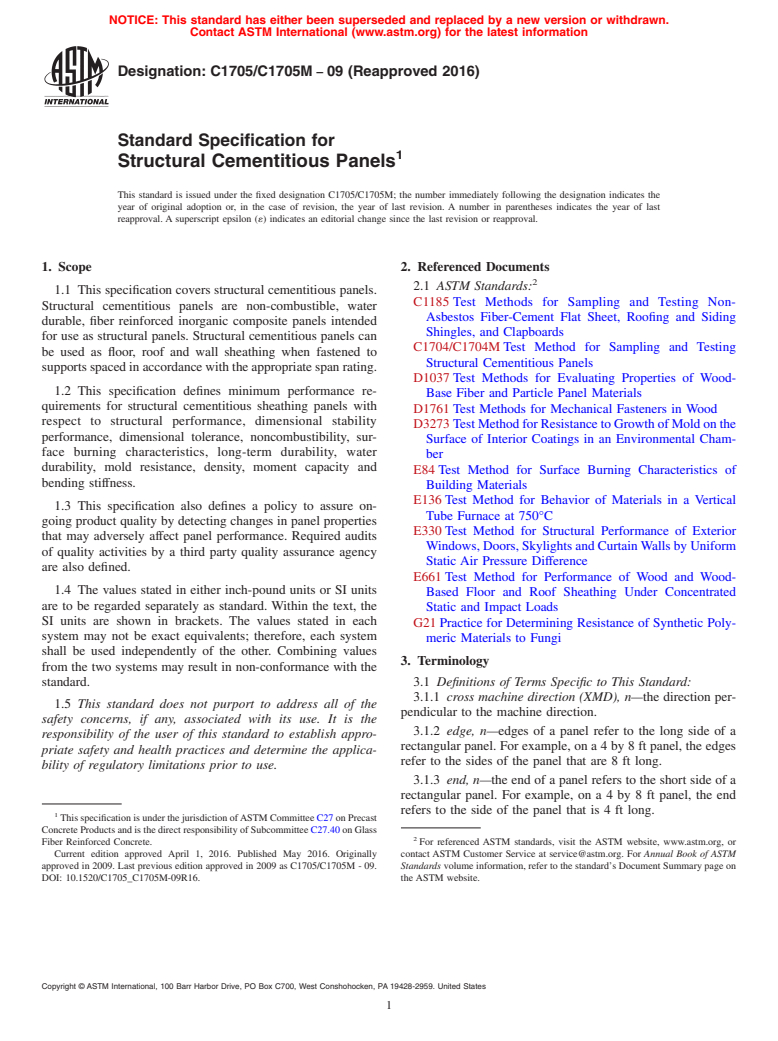
1.1 This specification covers structural cementitious panels. Structural cementitious panels are non-combustible, water durable, fiber reinforced inorganic composite panels intended for use as structural panels. Structural cementitious panels can be used as floor, roof and wall sheathing when fastened to supports spaced in accordance with the appropriate span rating.
1.2 This specification defines minimum performance requirements for structural cementitious sheathing panels with respect to structural performance, dimensional stability performance, dimensional tolerance, noncombustibility, surface burning characteristics, long-term durability, water durability, mold resistance, density, moment capacity and bending stiffness.
1.3 This specification also defines a policy to assure on-going product quality by detecting changes in panel properties that may adversely affect panel performance. Required audits of quality activities by a third party quality assurance agency are also defined.
1.4 The values stated in either inch-pound units or SI units are to be regarded separately as standard. Within the text, the SI units are shown in brackets. The values stated in each system may not be exact equivalents; therefore, each system shall be used independently of the other. Combining values from the two systems may result in non-conformance with the standard.
1.5 This standard does not purport to address all of the safety concerns, if any, associated with its use. It is the responsibility of the user of this standard to establish appropriate safety and health practices and determine the applicability of regulatory limitations prior to use.
General Information
Buy Standard
Standards Content (Sample)
NOTICE: This standard has either been superseded and replaced by a new version or withdrawn.
Contact ASTM International (www.astm.org) for the latest information
Designation: C1705/C1705M − 09 (Reapproved 2016)
Standard Specification for
Structural Cementitious Panels
This standard is issued under the fixed designation C1705/C1705M; the number immediately following the designation indicates the
year of original adoption or, in the case of revision, the year of last revision. A number in parentheses indicates the year of last
reapproval. A superscript epsilon (´) indicates an editorial change since the last revision or reapproval.
1. Scope 2. Referenced Documents
2.1 ASTM Standards:
1.1 This specification covers structural cementitious panels.
C1185 Test Methods for Sampling and Testing Non-
Structural cementitious panels are non-combustible, water
Asbestos Fiber-Cement Flat Sheet, Roofing and Siding
durable, fiber reinforced inorganic composite panels intended
Shingles, and Clapboards
for use as structural panels. Structural cementitious panels can
C1704/C1704M Test Method for Sampling and Testing
be used as floor, roof and wall sheathing when fastened to
Structural Cementitious Panels
supports spaced in accordance with the appropriate span rating.
D1037 Test Methods for Evaluating Properties of Wood-
1.2 This specification defines minimum performance re-
Base Fiber and Particle Panel Materials
quirements for structural cementitious sheathing panels with
D1761 Test Methods for Mechanical Fasteners in Wood
respect to structural performance, dimensional stability
D3273 Test Method for Resistance to Growth of Mold on the
performance, dimensional tolerance, noncombustibility, sur-
Surface of Interior Coatings in an Environmental Cham-
face burning characteristics, long-term durability, water
ber
durability, mold resistance, density, moment capacity and
E84 Test Method for Surface Burning Characteristics of
bending stiffness.
Building Materials
E136 Test Method for Behavior of Materials in a Vertical
1.3 This specification also defines a policy to assure on-
Tube Furnace at 750°C
going product quality by detecting changes in panel properties
E330 Test Method for Structural Performance of Exterior
that may adversely affect panel performance. Required audits
Windows, Doors, Skylights and Curtain Walls by Uniform
of quality activities by a third party quality assurance agency
Static Air Pressure Difference
are also defined.
E661 Test Method for Performance of Wood and Wood-
1.4 The values stated in either inch-pound units or SI units
Based Floor and Roof Sheathing Under Concentrated
are to be regarded separately as standard. Within the text, the
Static and Impact Loads
SI units are shown in brackets. The values stated in each
G21 Practice for Determining Resistance of Synthetic Poly-
system may not be exact equivalents; therefore, each system
meric Materials to Fungi
shall be used independently of the other. Combining values
3. Terminology
from the two systems may result in non-conformance with the
standard. 3.1 Definitions of Terms Specific to This Standard:
3.1.1 cross machine direction (XMD), n—the direction per-
1.5 This standard does not purport to address all of the
pendicular to the machine direction.
safety concerns, if any, associated with its use. It is the
3.1.2 edge, n—edges of a panel refer to the long side of a
responsibility of the user of this standard to establish appro-
rectangular panel. For example, on a 4 by 8 ft panel, the edges
priate safety and health practices and determine the applica-
refer to the sides of the panel that are 8 ft long.
bility of regulatory limitations prior to use.
3.1.3 end, n—the end of a panel refers to the short side of a
rectangular panel. For example, on a 4 by 8 ft panel, the end
refers to the side of the panel that is 4 ft long.
This specification is under the jurisdiction of ASTM Committee C27 on Precast
Concrete Products and is the direct responsibility of Subcommittee C27.40 on Glass
Fiber Reinforced Concrete. For referenced ASTM standards, visit the ASTM website, www.astm.org, or
Current edition approved April 1, 2016. Published May 2016. Originally contact ASTM Customer Service at service@astm.org. For Annual Book of ASTM
approved in 2009. Last previous edition approved in 2009 as C1705/C1705M - 09. Standards volume information, refer to the standard’s Document Summary page on
DOI: 10.1520/C1705_C1705M-09R16. the ASTM website.
Copyright © ASTM International, 100 Barr Harbor Drive, PO Box C700, West Conshohocken, PA 19428-2959. United States
C1705/C1705M − 09 (2016)
3.1.4 fiber reinforced inorganic composite, n—a composite 3.1.15 span rating, n—the recommended maximum center-
material composed primarily of inorganic matrix materials to-center support spacing in inches for the specified end use
reinforced primarily with inorganic fibers. Inorganic aggre- under normal use conditions.
gates may be combined with the inorganic matrix.
3.1.16 specimen, n—the individual test piece cut from a
3.1.5 machine direction (MD), n—the direction the board sample panel.
travels during manufacture.
3.1.17 structural cementitious panel, n—non-combustible,
3.1.6 noncombustibility, n—term intended to describe prod- water durable, fiber-reinforced inorganic composite panels
ucts that do not ignite and/or burn when subjected to fire. Test intended for use as structural panels.
methods are generally specified by reputable agencies such as
3.1.18 test exposure condition, n—the condition to which a
ASTM, Factory Mutual, Underwriters Lab Inc., etc.
panel is subjected prior to test. Generally, such conditions are
3.1.7 performance standard, n—a standard for products referred to as the dry or wet conditions.
based on performance. Performance is measured by tests that
3.1.19 test specimen, n—specimens cut from a sample panel
approximate end-use conditions.
that are used for testing.
3.1.8 plant specification, n—the plant specification is unique
3.1.20 water durability, n—performance of a product after
to each qualified product under a given performance standard.
sustained immersion in water for a specified period of time.
The specification is used in the plant quality program as
audited under the approved quality control program.
4. Performance Specifications for Structural
3.1.9 qualification policy, n—policy that describes the pro- Cementitious Panels
cedures by which a plant may obtain span rating privileges for
4.1 Structural cementitious panels are fiber-reinforced inor-
performance-rated products policy.
ganic composite panels intended for use as structural panels.
3.1.10 quality assurance policy, n—policy covering the
When used as a floor sheathing panel, structural cementitious
third-party auditing of plant’s quality control program.
panels can be used as a combination subfloor and underlayment
(single floor grade) or as a sheathing grade panel, which when
3.1.11 reference value, n—the numerical value established
used as a floor requires an underlayment panel on top of it. In
for the plant specification for a given mechanical or physical
either case, panels must be fastened to supports spaced in
property.
accordance with the panel’s span rating. Sections 5 through 13
3.1.12 sample average, n—the average test value, obtained
describe qualification procedures and initial testing required to
by summing the observations and dividing by the number of
demonstrate that the panel’s performance characteristics meet
tests.
the requirements of this standard.
3.1.13 sample panel, n—a structural cementitious panel
from which test specimens are cut and conditioned as neces-
5. Structural Performance
sary.
5.1 Concentrated Loads—Panels shall be tested according
3.1.14 sample standard deviation, n—a measure of test
to the procedures of Test Method E661 for concentrated static
variation. Calculated as:
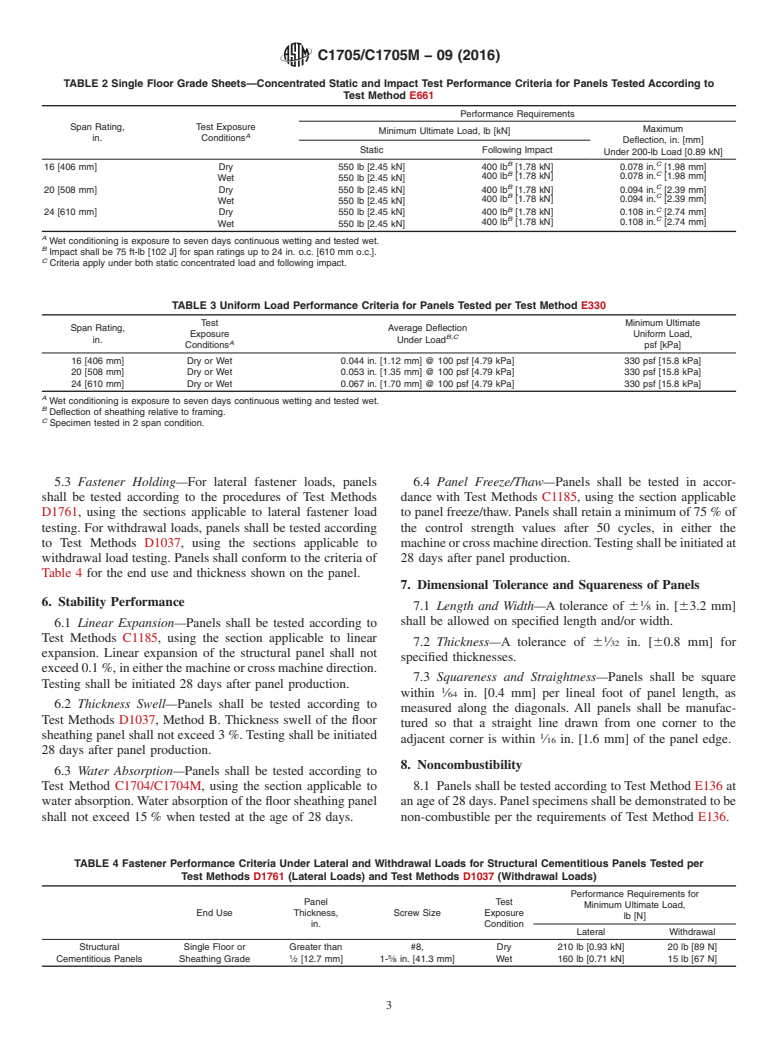
and impact loads. Panels shall conform to the criteria of Tables
1 and 2 for the end use and span shown on the panel.
S 5 =@ x 2 ~ x! /n#/n 2 1 (1)
( (
5.2 Uniform Loads—Panels shall be tested according to the
where:
procedures of Test Method E330 for uniform loads. Uniform
S = sample standard deviation,
loads shall be applied in both the positive and negative
x = test observation, and
directions. Panels shall conform to the performance values of
n = number of observations.
Table 3 for the end use and span shown on the panel.
TABLE 1 Sheathing Grade Sheets—Concentrated Static and Impact Test Performance Criteria for Panels Tested According to
Test Method E661
Performance Requirements
Span Rating, Test Exposure
Maximum
Minimum Ultimate Load, lb [kN]
A
in. Conditions
Deflection, in. [mm]
Static Following Impact
Under 200-lb Load [0.89 kN]
B C
16 [406 mm] Dry 400 lb [1.78 kN] 400 lb [1.78 kN] 0.125 in. [3.18 mm]
B C
400 lb [1.78 kN] 0.125 in. [3.18 mm]
Wet 400 lb [1.78 kN]
B C
20 [508 mm] Dry 400 lb [1.78 kN] 400 lb [1.78 kN] 0.125 in. [3.18 mm]
B C
400 lb [1.78 kN] 0.125 in. [3.18 mm]
Wet 400 lb [1.78 kN]
B C
24 [610 mm] Dry 400 lb [1.78 kN] 400 lb [1.78 kN] 0.125 in. [3.18 mm]
B C
400 lb [1.78 kN] 0.125 in. [3.18 mm]
Wet 400 lb [1.78 kN]
A
Wet conditioning is exposure to seven days continuous wetting and tested wet.
B
Impact shall be 75 ft-lb [102 J] for span ratings up to 24 in. o.c [610 mm o.c.].
C
Criteria apply under both static concentrated load and following impact.
C1705/C1705M − 09 (2016)
TABLE 2 Single Floor Grade Sheets—Concentrated Static and Impact Test Performance Criteria for Panels Tested According to
Test Method E661
Performance Requirements
Span Rating, Test Exposure
Maximum
Minimum Ultimate Load, lb [kN]
A
in. Conditions
Deflection, in. [mm]
Static Following Impact
Under 200-lb Load [0.89 kN]
B C
16 [406 mm] Dry 550 lb [2.45 kN] 400 lb [1.78 kN] 0.078 in. [1.98 mm]
B C
400 lb [1.78 kN] 0.078 in. [1.98 mm]
Wet 550 lb [2.45 kN]
B C
20 [508 mm] Dry 550 lb [2.45 kN] 400 lb [1.78 kN] 0.094 in. [2.39 mm]
B C
400 lb [1.78 kN] 0.094 in. [2.39 mm]
Wet 550 lb [2.45 kN]
B C
24 [610 mm] Dry 550 lb [2.45 kN] 400 lb [1.78 kN] 0.108 in. [2.74 mm]
B C
400 lb [1.78 kN] 0.108 in. [2.74 mm]
Wet 550 lb [2.45 kN]
A
Wet conditioning is exposure to seven days continuous wetting and tested wet.
B
Impact shall be 75 ft-lb [102 J] for span ratings up to 24 in. o.c. [610 mm o.c.].
C
Criteria apply under both static concentrated load and following impact.
TABLE 3 Uniform Load Performance Criteria for Panels Tested per Test Method E330
Test Minimum Ultimate
Span Rating, Average Deflection
Exposure Uniform Load,
B,C
in. Under Load
A
Conditions psf [kPa]
16 [406 mm] Dry or Wet 0.044 in. [1.12 mm] @ 100 psf [4.79 kPa] 330 psf [15.8 kPa]
20 [508 mm] Dry or Wet 0.053 in. [1.35 mm] @ 100 psf [4.79 kPa] 330 psf [15.8 kPa]
24 [610 mm] Dry or Wet 0.067 in. [1.70 mm] @ 100 psf [4.79 kPa] 330 psf [15.8 kPa]
A
Wet conditioning is exposure to seven days continuous wetting and tested wet.
B
Deflection of sheathi
...
This document is not an ASTM standard and is intended only to provide the user of an ASTM standard an indication of what changes have been made to the previous version. Because
it may not be technically possible to adequately depict all changes accurately, ASTM recommends that users consult prior editions as appropriate. In all cases only the current version
of the standard as published by ASTM is to be considered the official document.
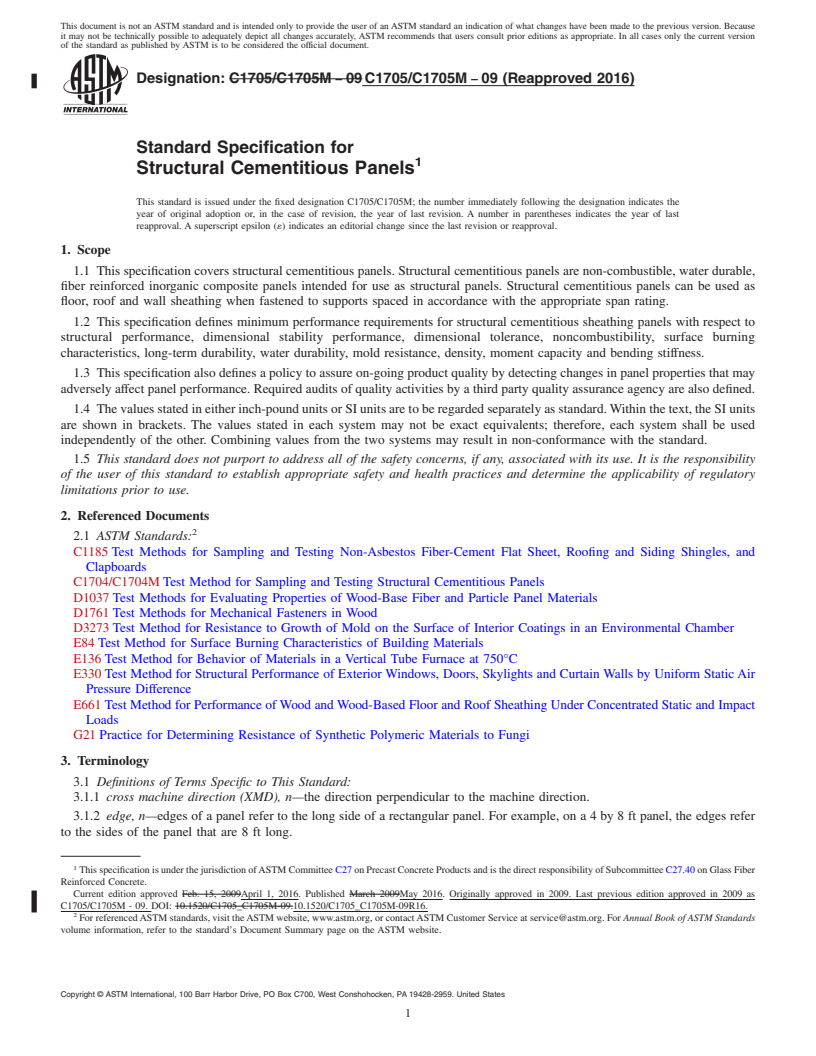
Designation: C1705/C1705M − 09 C1705/C1705M − 09 (Reapproved 2016)
Standard Specification for
Structural Cementitious Panels
This standard is issued under the fixed designation C1705/C1705M; the number immediately following the designation indicates the
year of original adoption or, in the case of revision, the year of last revision. A number in parentheses indicates the year of last
reapproval. A superscript epsilon (´) indicates an editorial change since the last revision or reapproval.
1. Scope
1.1 This specification covers structural cementitious panels. Structural cementitious panels are non-combustible, water durable,
fiber reinforced inorganic composite panels intended for use as structural panels. Structural cementitious panels can be used as
floor, roof and wall sheathing when fastened to supports spaced in accordance with the appropriate span rating.
1.2 This specification defines minimum performance requirements for structural cementitious sheathing panels with respect to
structural performance, dimensional stability performance, dimensional tolerance, noncombustibility, surface burning
characteristics, long-term durability, water durability, mold resistance, density, moment capacity and bending stiffness.
1.3 This specification also defines a policy to assure on-going product quality by detecting changes in panel properties that may
adversely affect panel performance. Required audits of quality activities by a third party quality assurance agency are also defined.
1.4 The values stated in either inch-pound units or SI units are to be regarded separately as standard. Within the text, the SI units
are shown in brackets. The values stated in each system may not be exact equivalents; therefore, each system shall be used
independently of the other. Combining values from the two systems may result in non-conformance with the standard.
1.5 This standard does not purport to address all of the safety concerns, if any, associated with its use. It is the responsibility
of the user of this standard to establish appropriate safety and health practices and determine the applicability of regulatory
limitations prior to use.
2. Referenced Documents
2.1 ASTM Standards:
C1185 Test Methods for Sampling and Testing Non-Asbestos Fiber-Cement Flat Sheet, Roofing and Siding Shingles, and
Clapboards
C1704/C1704M Test Method for Sampling and Testing Structural Cementitious Panels
D1037 Test Methods for Evaluating Properties of Wood-Base Fiber and Particle Panel Materials
D1761 Test Methods for Mechanical Fasteners in Wood
D3273 Test Method for Resistance to Growth of Mold on the Surface of Interior Coatings in an Environmental Chamber
E84 Test Method for Surface Burning Characteristics of Building Materials
E136 Test Method for Behavior of Materials in a Vertical Tube Furnace at 750°C
E330 Test Method for Structural Performance of Exterior Windows, Doors, Skylights and Curtain Walls by Uniform Static Air
Pressure Difference
E661 Test Method for Performance of Wood and Wood-Based Floor and Roof Sheathing Under Concentrated Static and Impact
Loads
G21 Practice for Determining Resistance of Synthetic Polymeric Materials to Fungi
3. Terminology
3.1 Definitions of Terms Specific to This Standard:
3.1.1 cross machine direction (XMD), n—the direction perpendicular to the machine direction.
3.1.2 edge, n—edges of a panel refer to the long side of a rectangular panel. For example, on a 4 by 8 ft panel, the edges refer
to the sides of the panel that are 8 ft long.
This specification is under the jurisdiction of ASTM Committee C27 on Precast Concrete Products and is the direct responsibility of Subcommittee C27.40 on Glass Fiber
Reinforced Concrete.
Current edition approved Feb. 15, 2009April 1, 2016. Published March 2009May 2016. Originally approved in 2009. Last previous edition approved in 2009 as
C1705/C1705M - 09. DOI: 10.1520/C1705_C1705M-09.10.1520/C1705_C1705M-09R16.
For referenced ASTM standards, visit the ASTM website, www.astm.org, or contact ASTM Customer Service at service@astm.org. For Annual Book of ASTM Standards
volume information, refer to the standard’s Document Summary page on the ASTM website.
Copyright © ASTM International, 100 Barr Harbor Drive, PO Box C700, West Conshohocken, PA 19428-2959. United States
C1705/C1705M − 09 (2016)
3.1.3 end, n—the end of a panel refers to the short side of a rectangular panel. For example, on a 4 by 8 ft panel, the end refers
to the side of the panel that is 4 ft long.
3.1.4 fiber reinforced inorganic composite, n—a composite material composed primarily of inorganic matrix materials
reinforced primarily with inorganic fibers. Inorganic aggregates may be combined with the inorganic matrix.
3.1.5 machine direction (MD), n—the direction the board travels during manufacture.
3.1.6 noncombustibility, n—term intended to describe products that do not ignite and/or burn when subjected to fire. Test
methods are generally specified by reputable agencies such as ASTM, Factory Mutual, Underwriters Lab Inc., etc.
3.1.7 performance standard, n—a standard for products based on performance. Performance is measured by tests that
approximate end-use conditions.
3.1.8 plant specification, n—the plant specification is unique to each qualified product under a given performance standard. The
specification is used in the plant quality program as audited under the approved quality control program.
3.1.9 qualification policy, n—policy that describes the procedures by which a plant may obtain span rating privileges for
performance-rated products policy.
3.1.10 quality assurance policy, n—policy covering the third-party auditing of plant’s quality control program.
3.1.11 reference value, n—the numerical value established for the plant specification for a given mechanical or physical
property.
3.1.12 sample average, n—the average test value, obtained by summing the observations and dividing by the number of tests.
3.1.13 sample panel, n—a structural cementitious panel from which test specimens are cut and conditioned as necessary.
3.1.14 sample standard deviation, n—a measure of test variation. Calculated as:
S 5=@ x 2~ x! /n#/n 2 1 (1)
( (
where:
S = sample standard deviation,
x = test observation, and
n = number of observations.
3.1.15 span rating, n—the recommended maximum center-to-center support spacing in inches for the specified end use under
normal use conditions.
3.1.16 specimen, n—the individual test piece cut from a sample panel.
3.1.17 structural cementitious panel, n—non-combustible, water durable, fiber-reinforced inorganic composite panels intended
for use as structural panels.
3.1.18 test exposure condition, n—the condition to which a panel is subjected prior to test. Generally, such conditions are
referred to as the dry or wet conditions.
3.1.19 test specimen, n—specimens cut from a sample panel that are used for testing.
3.1.20 water durability, n—performance of a product after sustained immersion in water for a specified period of time.
4. Performance Specifications for Structural Cementitious Panels
4.1 Structural cementitious panels are fiber-reinforced inorganic composite panels intended for use as structural panels. When
used as a floor sheathing panel, structural cementitious panels can be used as a combination subfloor and underlayment (single floor
grade) or as a sheathing grade panel, which when used as a floor requires an underlayment panel on top of it. In either case, panels
must be fastened to supports spaced in accordance with the panel’s span rating. Sections 5 through 13 describe qualification
procedures and initial testing required to demonstrate that the panel’s performance characteristics meet the requirements of this
standard.
5. Structural Performance
5.1 Concentrated Loads—Panels shall be tested according to the procedures of Test Method E661 for concentrated static and
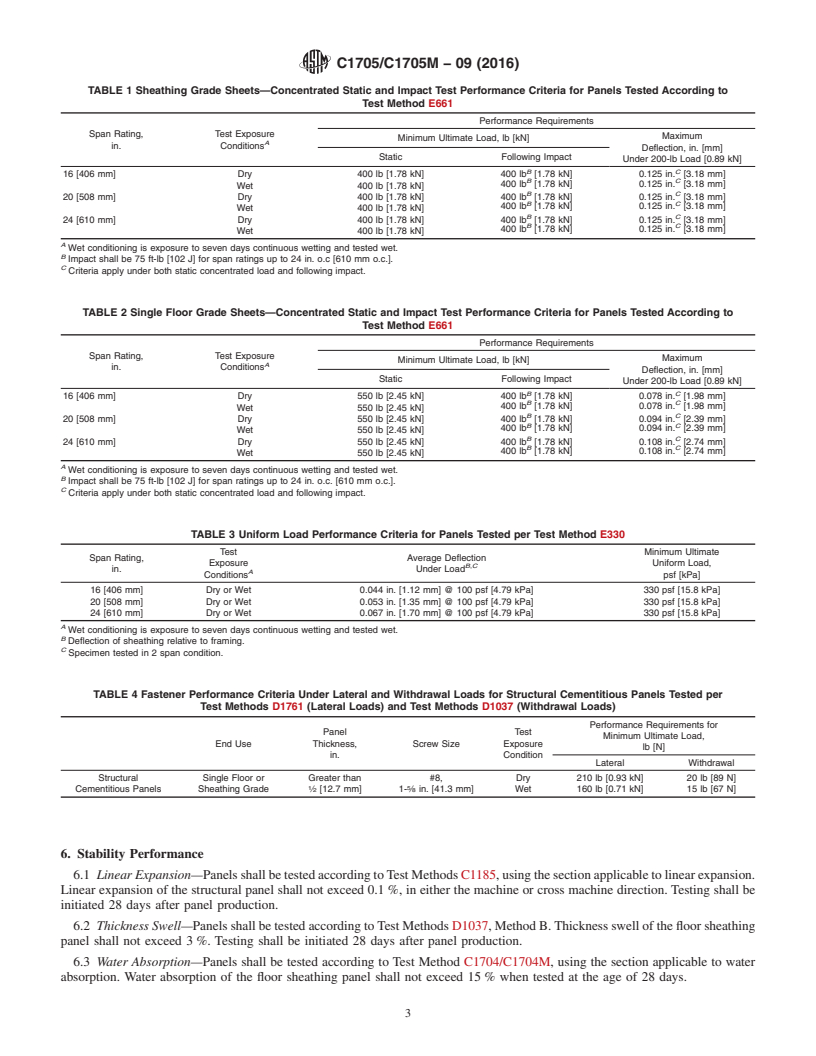
impact loads. Panels shall conform to the criteria of Tables 1 and 2 for the end use and span shown on the panel.
5.2 Uniform Loads—Panels shall be tested according to the procedures of Test Method E330 for uniform loads. Uniform loads
shall be applied in both the positive and negative directions. Panels shall conform to the performance values of Table 3 for the end
use and span shown on the panel.
5.3 Fastener Holding—For lateral fastener loads, panels shall be tested according to the procedures of Test Methods D1761,
using the sections applicable to lateral fastener load testing. For withdrawal loads, panels shall be tested according to Test Methods
D1037, using the sections applicable to withdrawal load testing. Panels shall conform to the criteria of Table 4 for the end use and
thickness shown on the panel.
C1705/C1705M − 09 (2016)
TABLE 1 Sheathing Grade Sheets—Concentrated Static and Impact Test Performance Criteria for Panels Tested According to
Test Method E661
Performance Requirements
Span Rating, Test Exposure
Maximum
Minimum Ultimate Load, lb [kN]
A
in. Conditions
Deflection, in. [mm]
Static Following Impact
Under 200-lb Load [0.89 kN]
B C
16 [406 mm] Dry 400 lb [1.78 kN] 400 lb [1.78 kN] 0.125 in. [3.18 mm]
B C
400 lb [1.78 kN] 0.125 in. [3.18 mm]
Wet 400 lb [1.78 kN]
B C
20 [508 mm] Dry 400 lb [1.78 kN] 400 lb [1.78 kN] 0.125 in. [3.18 mm]
B C
400 lb [1.78 kN] 0.125 in. [3.18 mm]
Wet 400 lb [1.78 kN]
B C
24 [610 mm] Dry 400 lb [1.78 kN] 400 lb [1.78 kN] 0.125 in. [3.18 mm]
B C
400 lb [1.78 kN] 0.125 in. [3.18 mm]
Wet 400 lb [1.78 kN]
A
Wet conditioning is exposure to seven days continuous wetting and tested wet.
B
Impact shall be 75 ft-lb [102 J] for span ratings up to 24 in. o.c [610 mm o.c.].
C
Criteria apply under both static concentrated load and following impact.
TABLE 2 Single Floor Grade Sheets—Concentrated Static and Impact Test Performance Criteria for Panels Tested According to
Test Method E661
Performance Requirements
Span Rating, Test Exposure
Maximum
Minimum Ultimate Load, lb [kN]
A
in. Conditions
Deflection, in. [mm]
Static Following Impact
Under 200-lb Load [0.89 kN]
B C
16 [406 mm] Dry 550 lb [2.45 kN] 400 lb [1.78 kN] 0.078 in. [1.98 mm]
B C
400 lb [1.78 kN] 0.078 in. [1.98 mm]
Wet 550 lb [2.45 kN]
B C
20 [508 mm] Dry 550 lb [2.45 kN] 400 lb [1.78 kN] 0.094 in. [2.39 mm]
B C
400 lb [1.78 kN] 0.094 in. [2.39 mm]
Wet 550 lb [2.45 kN]
B C
24 [610 mm] Dry 550 lb [2.45 kN] 400 lb [1.78 kN] 0.108 in. [2.74 mm]
B C
400 lb [1.78 kN] 0.108 in. [2.74 mm]
Wet 550 lb [2.45 kN]
A
Wet conditioning is exposure to seven days continuous wetting and tested wet.
B
Impact shall be 75 ft-lb [102 J] for span ratings up to 24 in. o.c. [610 mm o.c.].
C
Criteria apply under both static concentrated load and following impact.
TABLE 3 Uniform Load P
...
Questions, Comments and Discussion
Ask us and Technical Secretary will try to provide an answer. You can facilitate discussion about the standard in here.