


ASTM D5948-05(2012)
(Specification)Standard Specification for Molding Compounds, Thermosetting
Standard Specification for Molding Compounds, Thermosetting
ABSTRACT
This specification covers the basic properties of thermoset molding plastic compounds and the test methods used to establish the properties. The plastic compounds shall be a resin, cellulose-filled or mineral/glass-filled phenolic, melamine, polyester, diallyl iso-phthalate, diallyl ortho-phthalate, silicone, or epoxy. Standard test specimens shall be in the as-received condition or shall be conditioned before testing by humidity, immersion, or temperature conditioning. The specimens shall undergo mechanical or physical qualification tests which shall conform to the following properties: compressive strength; dimensional stability; flexural strength; heat deflection temperature; heat resistance; impact strength; tensile strength; and water absorption. Electrical qualification tests shall be conducted; wherein, the specimens shall comply with the following requirements: arc resistance; dielectric breakdown; dielectric constant; dielectric strength; dissipation factor; surface resistance; comparative track index; volume resistance; and water extract conductance. Tests for combustion qualification shall also be performed to determine the flame resistance ignition time, burning time, flammability, and toxicity requirements. Batch acceptance tests shall be conducted as well to ensure the quality conformance of the specimens.
SIGNIFICANCE AND USE
4.1 This specification is a revision of STD MIL-M-14H, Specification for Molding Compound, Thermosetting, retaining the MIL-M-14H material designations and property requirements while conforming to ASTM form and style. It is intended for qualification and batch acceptance for materials used by government and industry, and is intended as a direct replacement for MIL-M-14H.
SCOPE
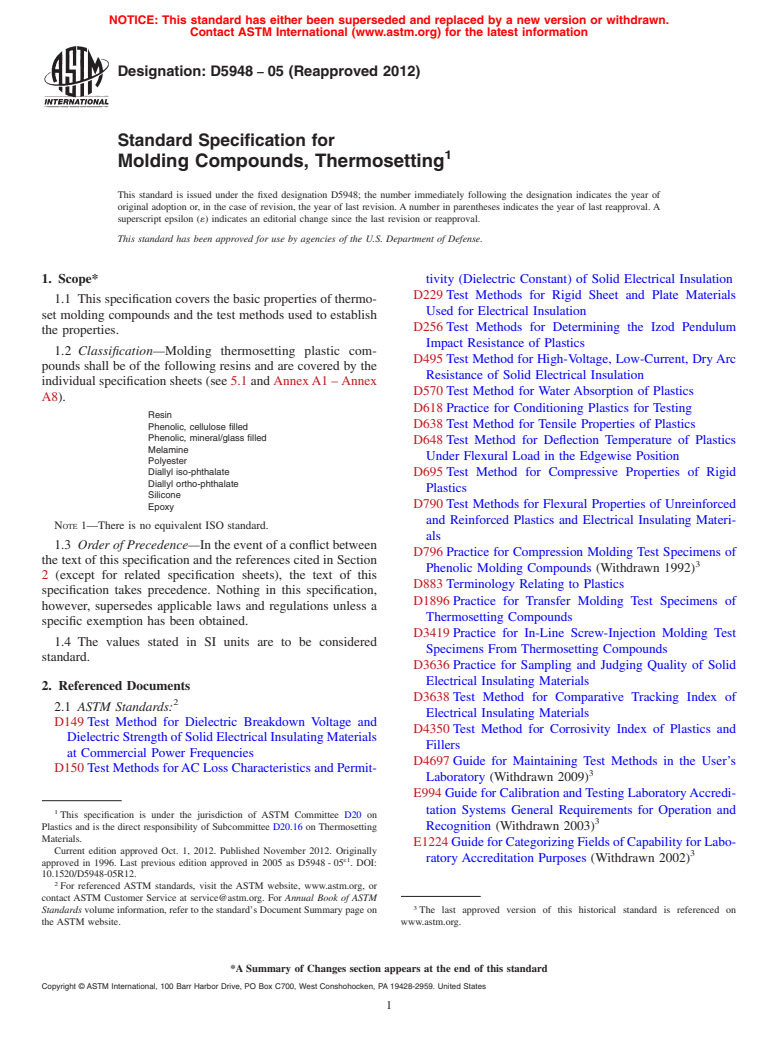
1.1 This specification covers the basic properties of thermoset molding compounds and the test methods used to establish the properties.
1.2 Classification—Molding thermosetting plastic compounds shall be of the following resins and are covered by the individual specification sheets (see 5.1 and Annex A1-Annex A8).
Resin
Phenolic, cellulose filled
Phenolic, mineral/glass filled
Melamine
Polyester
Diallyl iso-phthalate
Diallyl ortho-phthalate
Silicone
Epoxy
Note 1—There is no equivalent ISO standard.
1.3 Order of Precedence—In the event of a conflict between the text of this specification and the references cited in Section 2 (except for related specification sheets), the text of this specification takes precedence. Nothing in this specification, however, supersedes applicable laws and regulations unless a specific exemption has been obtained.
1.4 The values stated in SI units are to be considered standard.
General Information
Standards Content (Sample)
NOTICE: This standard has either been superseded and replaced by a new version or withdrawn.
Contact ASTM International (www.astm.org) for the latest information
Designation:D5948 −05 (Reapproved 2012)
Standard Specification for
Molding Compounds, Thermosetting
This standard is issued under the fixed designation D5948; the number immediately following the designation indicates the year of
original adoption or, in the case of revision, the year of last revision. A number in parentheses indicates the year of last reapproval. A
superscript epsilon (´) indicates an editorial change since the last revision or reapproval.
This standard has been approved for use by agencies of the U.S. Department of Defense.
1. Scope* tivity (Dielectric Constant) of Solid Electrical Insulation
D229 Test Methods for Rigid Sheet and Plate Materials
1.1 This specification covers the basic properties of thermo-
Used for Electrical Insulation
set molding compounds and the test methods used to establish
D256 Test Methods for Determining the Izod Pendulum
the properties.
Impact Resistance of Plastics
1.2 Classification—Molding thermosetting plastic com-
D495 Test Method for High-Voltage, Low-Current, Dry Arc
pounds shall be of the following resins and are covered by the
Resistance of Solid Electrical Insulation
individual specification sheets (see 5.1 and AnnexA1 – Annex
D570 Test Method for Water Absorption of Plastics
A8).
D618 Practice for Conditioning Plastics for Testing
Resin
D638 Test Method for Tensile Properties of Plastics
Phenolic, cellulose filled
Phenolic, mineral/glass filled
D648 Test Method for Deflection Temperature of Plastics
Melamine
Under Flexural Load in the Edgewise Position
Polyester
Diallyl iso-phthalate D695 Test Method for Compressive Properties of Rigid
Diallyl ortho-phthalate
Plastics
Silicone
D790 Test Methods for Flexural Properties of Unreinforced
Epoxy
and Reinforced Plastics and Electrical Insulating Materi-
NOTE 1—There is no equivalent ISO standard.
als
1.3 Order of Precedence—In the event of a conflict between
D796 Practice for Compression Molding Test Specimens of
the text of this specification and the references cited in Section
Phenolic Molding Compounds (Withdrawn 1992)
2 (except for related specification sheets), the text of this
D883 Terminology Relating to Plastics
specification takes precedence. Nothing in this specification,
D1896 Practice for Transfer Molding Test Specimens of
however, supersedes applicable laws and regulations unless a
Thermosetting Compounds
specific exemption has been obtained.
D3419 Practice for In-Line Screw-Injection Molding Test
1.4 The values stated in SI units are to be considered
Specimens From Thermosetting Compounds
standard.
D3636 Practice for Sampling and Judging Quality of Solid
Electrical Insulating Materials
2. Referenced Documents
D3638 Test Method for Comparative Tracking Index of
2.1 ASTM Standards:
Electrical Insulating Materials
D149 Test Method for Dielectric Breakdown Voltage and
D4350 Test Method for Corrosivity Index of Plastics and
DielectricStrengthofSolidElectricalInsulatingMaterials
Fillers
at Commercial Power Frequencies
D4697 Guide for Maintaining Test Methods in the User’s
D150 Test Methods forAC Loss Characteristics and Permit-
Laboratory (Withdrawn 2009)
E994 Guide for Calibration and Testing LaboratoryAccredi-
tation Systems General Requirements for Operation and
This specification is under the jurisdiction of ASTM Committee D20 on
Plastics and is the direct responsibility of Subcommittee D20.16 on Thermosetting Recognition (Withdrawn 2003)
Materials.
E1224 GuideforCategorizingFieldsofCapabilityforLabo-
Current edition approved Oct. 1, 2012. Published November 2012. Originally
ε1 ratory Accreditation Purposes (Withdrawn 2002)
approved in 1996. Last previous edition approved in 2005 as D5948 - 05 . DOI:
10.1520/D5948-05R12.
For referenced ASTM standards, visit the ASTM website, www.astm.org, or
contact ASTM Customer Service at service@astm.org. For Annual Book of ASTM
Standards volume information, refer to the standard’s Document Summary page on The last approved version of this historical standard is referenced on
the ASTM website. www.astm.org.
*A Summary of Changes section appears at the end of this standard
Copyright © ASTM International, 100 Barr Harbor Drive, PO Box C700, West Conshohocken, PA 19428-2959. United States
D5948−05 (2012)
TABLE 1 Sampling and Conditioning for Mechanical/Physical Qualification Tests
NOTE 1—A50 % retention of initial flexural strength is required.
NOTE 2—The side of a test specimen is that area formed by the chase of the mold.
NOTE 3—The face of the test specimen is that area formed by the top or bottom force plug.
NOTE 4—When specified.
Property to Be Tested- ASTM Test Modified Specimens, Form, and Number Conditioning Procedure
Unit of Value
Mechanical/Physical Method by Dimension Tested (see Section 6)
Compressive strength, end- D695 . 25.4 by 12.7 by 12.7 mm 5 E-48/50 + C-96 ⁄23 ⁄50 MPa (minimum average)
wise
Dimensional stability . 7.2.1 127 bar, 12.7 by 12.7 mm 5 C-96/23/50 Percent (maximum average)
Flexural strength D790 7.2.2 127 bar, 6.4 by 12.7 mm 5 E-48/50 + C-96 ⁄23 ⁄50 MPa (minimum average)
Heat deflection temperature D648 7.2.3 127 bar, 12.7 by 12.7 mm 3 A Degrees Celsius (minimum
average)
Heat resistance (1) D790 7.2.4 127 bar, 6.4 by 12.7 mm 5 E-1/at designated tempera- Degrees Celsius (minimum
ture test. Test at tempera- average) at temperature
ture
Impact strength
Side (2) D256 . As per Test Method D256 5 E-48/50 + C96 ⁄23 ⁄50 J/m notch (minimum average)
Face (3), (4) D256 . As per Test Method D256 5 E-48/50 + C96 ⁄23 ⁄50 J/m notch (minimum average)
Tensile strength D638 . As per Test Method D638 5 E-48/50 + C-96 ⁄23 ⁄50 MPa (minimum average)
Water absorption D570 7.2.5 51-mm disk, 3.2 mm thick 3 E-24/100 + des + D-48 ⁄50 Percent (maximum average)
2.2 Underwriters Laboratory Standard: the event of any conflict between the requirements of this
UL 94 Tests for Flammability of Plastic Materials for Parts specification and the material specification, the latter shall
in Devices and Appliances govern.
2.3 Other Standard:
5.2 Qualification—Molding compounds furnished under
DDC AD 297457 Procedure for Determining Toxicity of
this specification shall be products which conform to the
Synthetic Compounds
applicable material specification and quality assurance provi-
sions in this specification.
3. Terminology
5.3 Material Safety Data Sheet (MSDS)— The user shall be
3.1 For definitions of technical terms pertaining to plastics
provided with a material safety data sheet.
used in this specification, refer to Terminology D883.
5.4 Uniformity—All molding compound of the same brand
3.2 Definitions of Terms Specific to This Standard:
from one manufacturer shall be uniform in texture, in color,
3.2.1 batch—a homogeneous unit of finished molding com-
and in the specified properties as determined by the batch-
pound manufactured at one time.
acceptance inspection specified in 8.3.
3.2.2 heat resistance—the elevated temperature at which a
5.5 PropertyValues—Standardspecimensofthecompounds
particular material retains a minimum of 50 % of its original
shall conform to the property values shown in the individual
flexural strength measured at 23°C.
specification sheets for qualification (see 8.2) and batch accep-
tance (see 8.3).
4. Significance and Use
6. Conditioning
4.1 This specification is a revision of STD MIL-M-14H,
Specification for Molding Compound, Thermosetting, retain-
6.1 Standard test specimens shall be conditioned before
ing the MIL-M-14H material designations and property re-
testing, as specified in Tables 1-4.
quirements while conforming to ASTM form and style. It is
6.1.1 Nomenclature—The following letters shall be used to
intended for qualification and batch acceptance for materials
indicate the respective general conditioning procedures:
used by government and industry, and is intended as a direct
6.1.1.1 Condition A—As received; no special conditioning.
replacement for MIL-M-14H.
6.1.1.2 Condition C—Humidity conditioning in accordance
with Practice D618.
5. Requirements
6.1.1.3 Condition D—Immersion conditioning in distilled
5.1 Specification Sheets—The individual item requirements water in accordance with Practice D618.
6.1.1.4 Condition E—Temperature conditioning in accor-
shall be as specified herein and in accordance with the
applicable specification sheet (see Annex A1 – Annex A8). In dancewithPracticeD618;ConditionDesiccation–coolingover
silica gel or calcium chloride in a desiccator at 23°C for 16 to
20haftertemperatureconditioninginaccordancewithPractice
Available from Underwriters Laboratories (UL), Corporate Progress, 333 D618.
Pfingsten Rd., Northbrook, IL 60062.
6.2 Designation—Conditioning procedures shall be desig-
Available from National Technical Information Service (NTIS), U.S. Depart-
ment of Commerce, 5285 Port Royal Rd., Springfield, VA 22161. nated as follows:
D5948−05 (2012)
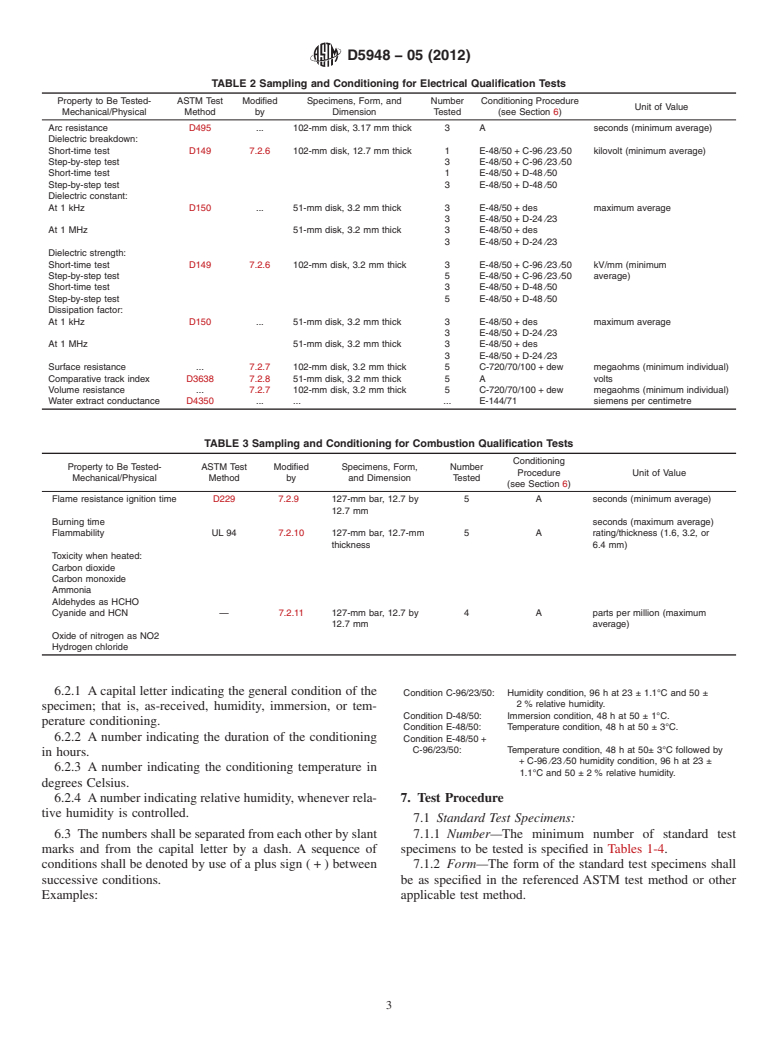
TABLE 2 Sampling and Conditioning for Electrical Qualification Tests
Property to Be Tested- ASTM Test Modified Specimens, Form, and Number Conditioning Procedure
Unit of Value
Mechanical/Physical Method by Dimension Tested (see Section 6)
Arc resistance D495 . 102-mm disk, 3.17 mm thick 3 A seconds (minimum average)
Dielectric breakdown:
Short-time test D149 7.2.6 102-mm disk, 12.7 mm thick 1 E-48/50 + C-96 ⁄23 ⁄50 kilovolt (minimum average)
Step-by-step test 3 E-48/50 + C-96 ⁄23 ⁄50
Short-time test 1 E-48/50 + D-48 ⁄50
Step-by-step test 3 E-48/50 + D-48 ⁄50
Dielectric constant:
At 1 kHz D150 . 51-mm disk, 3.2 mm thick 3 E-48/50 + des maximum average
3 E-48/50 + D-24 ⁄23
At 1 MHz 51-mm disk, 3.2 mm thick 3 E-48/50 + des
3 E-48/50 + D-24 ⁄23
Dielectric strength:
Short-time test D149 7.2.6 102-mm disk, 3.2 mm thick 3 E-48/50 + C-96 ⁄23 ⁄50 kV/mm (minimum
Step-by-step test 5 E-48/50 + C-96 ⁄23 ⁄50 average)
Short-time test 3 E-48/50 + D-48 ⁄50
Step-by-step test 5 E-48/50 + D-48 ⁄50
Dissipation factor:
At 1 kHz D150 . 51-mm disk, 3.2 mm thick 3 E-48/50 + des maximum average
3 E-48/50 + D-24 ⁄23
At 1 MHz 51-mm disk, 3.2 mm thick 3 E-48/50 + des
3 E-48/50 + D-24 ⁄23
Surface resistance . 7.2.7 102-mm disk, 3.2 mm thick 5 C-720/70/100 + dew megaohms (minimum individual)
Comparative track index D3638 7.2.8 51-mm disk, 3.2 mm thick 5 A volts
Volume resistance . 7.2.7 102-mm disk, 3.2 mm thick 5 C-720/70/100 + dew megaohms (minimum individual)
Water extract conductance D4350 . . . E-144/71 siemens per centimetre
TABLE 3 Sampling and Conditioning for Combustion Qualification Tests
Conditioning
Property to Be Tested- ASTM Test Modified Specimens, Form, Number
Procedure Unit of Value
Mechanical/Physical Method by and Dimension Tested
(see Section 6)
Flame resistance ignition time D229 7.2.9 127-mm bar, 12.7 by 5 A seconds (minimum average)
12.7 mm
Burning time seconds (maximum average)
Flammability UL 94 7.2.10 127-mm bar, 12.7-mm 5 A rating/thickness (1.6, 3.2, or
thickness 6.4 mm)
Toxicity when heated:
Carbon dioxide
Carbon monoxide
Ammonia
Aldehydes as HCHO
Cyanide and HCN — 7.2.11 127-mm bar, 12.7 by 4 A parts per million (maximum
12.7 mm average)
Oxide of nitrogen as NO2
Hydrogen chloride
6.2.1 A capital letter indicating the general condition of the
Condition C-96/23/50: Humidity condition, 96 h at 23 ± 1.1°C and 50 ±
2 % relative humidity.
specimen; that is, as-received, humidity, immersion, or tem-
Condition D-48/50: Immersion condition, 48 h at 50 ± 1°C.
perature conditioning.
Condition E-48/50: Temperature condition, 48 h at 50 ± 3°C.
6.2.2 A number indicating the duration of the conditioning Condition E-48/50 +
C-96/23/50: Temperature condition, 48 h at 50± 3°C followed by
in hours.
+ C-96 ⁄23 ⁄50 humidity condition, 96 h at 23 ±
6.2.3 A number indicating the conditioning temperature in
1.1°C and 50 ± 2 % relative humidity.
degrees Celsius.
7. Test Procedure
6.2.4 Anumber indicating relative humidity, whenever rela-
tive humidity is controlled.
7.1 Standard Test Specimens:
6.3 The numbers shall be separated from each other by slant 7.1.1 Number—The minimum number of standard test
marks and from the capital letter by a dash. A sequence of specimens to be tested is specified in Tables 1-4.
conditions shall be denoted by use of a plus sign ( + ) between 7.1.2 Form—The form of the standard test specimens shall
successive conditions. be as specified in the referenced ASTM test method or other
Examples: applicable test method.
D5948−05 (2012)
TABLE 4 Sampling and Conditioning for Batch Acceptance Tests
NOTE 1—The side of a test specimen is that area formed by the chase of the mold.
Property to Be Tested- ASTM Test Modified Specimens, Form, Number Conditioning Procedure
Unit of Value
Mechanical/Physical Method by and Dimension Tested (see Section 6)
Arc resistance D495 . 102-mm disk, 3.2 mm 3 A seconds (minimum aver-
thick age)
Comparative track index D3638 7.2.8 51-mm disk, 3.17 mm 5 A volts
thick
Dielectric constant at 1 MHz D150 . 51-mm disk, 3.2 mm thick 3 E-48/50 + D-24 ⁄23 maximum average
Dissipation factor at 1 MHz D150 . 51-mm disk, 3.2 mm thick 3 E-48/50 + D-24 ⁄23 maximum average
maximum average
Dielectric strength, step-by-step D149 7.2.6 102-mm disk, 3.2 mm 5 E-48/50 + D-48 ⁄50 kV/mm (minimum average)
thick
Flexural strength D790 7.2.2 127-mm bar, 6.4 by 12.7 5 E-48/50 + C-96 ⁄23 ⁄50 mPa (minimum average)
mm
Impact strength, side (1) D256 . in accordance with Test 5 E-48/50 + C-96 ⁄23 ⁄50 J/m notch (minimum
Methods D256 average)
Water absorption D570 7.2.5 51-mm disk, 3.2 mm thick 3 E-24/100 + des + D-48 ⁄50 percent (maximum aver-
age)
Water extract conductance D4350 7.2.12. . E-144/71 siemens per centimetre
7.1.3 Molding of Test Specimens—Mold test specimens by 7.2.4 Heat Resistance—Condition the specimen for1hat
methods that could include post-cure. No special treatment the designated temperature. After conditioning, the flexural
shall be used to improve the properties of the specimens when strength (see 7.2.2) shall be tested at the same temperature in
comparedwithpartsmoldedincommercialproductions.(Prac- accordance with Test Method D790. When measured at the
tices D796, D1896, and D3419 represent the best molding elevated test temperature, the molding compound shall meet
practices for thermosets.) the heat resistance requirement of retaining 50 % of the
7.1.4 Tolerance—Test specimens shall conform to the di- flexural strength value as determined at 23°C. The average of
mensionaltolerancesoftheappropriatetestmethod,aslistedin five determinations divided by the average flexural strength as
Tables 1-4. When not otherwise stated, tolerance on dimen- determined at 23°C shall be multiplied by 100 and recorded as
sions shall be 65%. percent flexural strength retained at the specified conditioning
and testing temperature. For
...
Questions, Comments and Discussion
Ask us and Technical Secretary will try to provide an answer. You can facilitate discussion about the standard in here.