


ASTM E1453-14
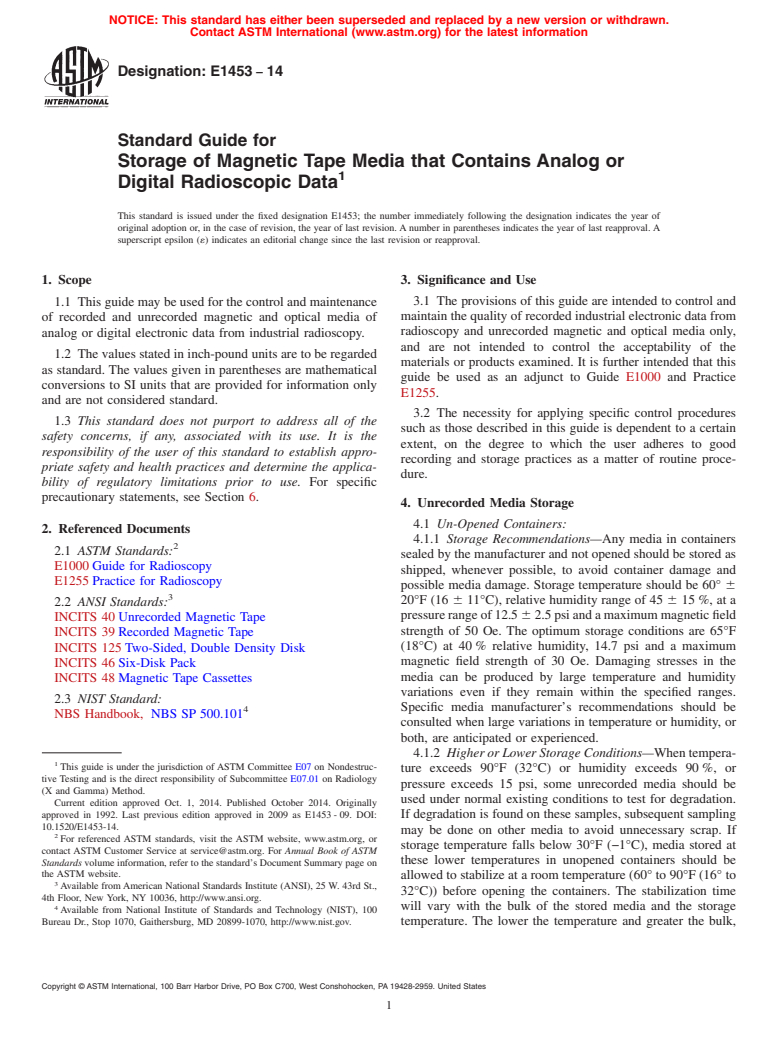
(Guide)Standard Guide for Storage of Magnetic Tape Media that Contains Analog or Digital Radioscopic Data
Standard Guide for Storage of Magnetic Tape Media that Contains Analog or Digital Radioscopic Data
SIGNIFICANCE AND USE
3.1 The provisions of this guide are intended to control and maintain the quality of recorded industrial electronic data from radioscopy and unrecorded magnetic and optical media only, and are not intended to control the acceptability of the materials or products examined. It is further intended that this guide be used as an adjunct to Guide E1000 and Practice E1255.
3.2 The necessity for applying specific control procedures such as those described in this guide is dependent to a certain extent, on the degree to which the user adheres to good recording and storage practices as a matter of routine procedure.
SCOPE
1.1 This guide may be used for the control and maintenance of recorded and unrecorded magnetic and optical media of analog or digital electronic data from industrial radioscopy.
1.2 The values stated in inch-pound units are to be regarded as standard. The values given in parentheses are mathematical conversions to SI units that are provided for information only and are not considered standard.
1.3 This standard does not purport to address all of the safety concerns, if any, associated with its use. It is the responsibility of the user of this standard to establish appropriate safety and health practices and determine the applicability of regulatory limitations prior to use. For specific precautionary statements, see Section 6.
General Information
Buy Standard

Standards Content (Sample)
NOTICE: This standard has either been superseded and replaced by a new version or withdrawn.
Contact ASTM International (www.astm.org) for the latest information
Designation: E1453 − 14
Standard Guide for
Storage of Magnetic Tape Media that Contains Analog or
1
Digital Radioscopic Data
This standard is issued under the fixed designation E1453; the number immediately following the designation indicates the year of
original adoption or, in the case of revision, the year of last revision.Anumber in parentheses indicates the year of last reapproval.A
superscript epsilon (´) indicates an editorial change since the last revision or reapproval.
1. Scope 3. Significance and Use
3.1 The provisions of this guide are intended to control and
1.1 Thisguidemaybeusedforthecontrolandmaintenance
maintainthequalityofrecordedindustrialelectronicdatafrom
of recorded and unrecorded magnetic and optical media of
radioscopy and unrecorded magnetic and optical media only,
analog or digital electronic data from industrial radioscopy.
and are not intended to control the acceptability of the
1.2 The values stated in inch-pound units are to be regarded
materials or products examined. It is further intended that this
as standard. The values given in parentheses are mathematical
guide be used as an adjunct to Guide E1000 and Practice
conversions to SI units that are provided for information only
E1255.
and are not considered standard.
3.2 The necessity for applying specific control procedures
1.3 This standard does not purport to address all of the
such as those described in this guide is dependent to a certain
safety concerns, if any, associated with its use. It is the
extent, on the degree to which the user adheres to good
responsibility of the user of this standard to establish appro-
recording and storage practices as a matter of routine proce-
priate safety and health practices and determine the applica-
dure.
bility of regulatory limitations prior to use. For specific
precautionary statements, see Section 6.
4. Unrecorded Media Storage
4.1 Un-Opened Containers:
2. Referenced Documents
4.1.1 Storage Recommendations—Any media in containers
2
2.1 ASTM Standards:
sealed by the manufacturer and not opened should be stored as
E1000Guide for Radioscopy
shipped, whenever possible, to avoid container damage and
E1255Practice for Radioscopy
possible media damage. Storage temperature should be 60° 6
3
20°F (16 6 11°C), relative humidity range of 45 6 15%, at a
2.2 ANSI Standards:
pressurerangeof12.5 62.5psiandamaximummagneticfield
INCITS 40Unrecorded Magnetic Tape
strength of 50 Oe. The optimum storage conditions are 65°F
INCITS 39Recorded Magnetic Tape
(18°C) at 40% relative humidity, 14.7 psi and a maximum
INCITS 125Two-Sided, Double Density Disk
magnetic field strength of 30 Oe. Damaging stresses in the
INCITS 46Six-Disk Pack
media can be produced by large temperature and humidity
INCITS 48Magnetic Tape Cassettes
variations even if they remain within the specified ranges.
2.3 NIST Standard:
Specific media manufacturer’s recommendations should be
4
NBS Handbook, NBS SP 500.101
consulted when large variations in temperature or humidity, or
both, are anticipated or experienced.
4.1.2 HigherorLowerStorageConditions—Whentempera-
1
This guide is under the jurisdiction of ASTM Committee E07 on Nondestruc-
ture exceeds 90°F (32°C) or humidity exceeds 90%, or
tive Testing and is the direct responsibility of Subcommittee E07.01 on Radiology
pressure exceeds 15 psi, some unrecorded media should be
(X and Gamma) Method.
used under normal existing conditions to test for degradation.
Current edition approved Oct. 1, 2014. Published October 2014. Originally
approved in 1992. Last previous edition approved in 2009 as E1453-09. DOI:
If degradation is found on these samples, subsequent sampling
10.1520/E1453-14.
may be done on other media to avoid unnecessary scrap. If
2
For referenced ASTM standards, visit the ASTM website, www.astm.org, or
storage temperature falls below 30°F (−1°C), media stored at
contact ASTM Customer Service at service@astm.org. For Annual Book of ASTM
these lower temperatures in unopened containers should be
Standards volume information, refer to the standard’s Document Summary page on
the ASTM website.
allowed to stabilize at a room temperature (60° to 90°F (16° to
3
Available fromAmerican National Standards Institute (ANSI), 25 W. 43rd St.,
32°C)) before opening the containers. The stabilization time
4th Floor, New York, NY 10036, http://www.ansi.org.
4
will vary with the bulk of the stored media and the storage
Available from National Institute of Standards and Technology (NIST), 100
Bureau Dr., Stop 1070, Gaithersburg, MD 20899-1070, http://www.nist.gov. temperature. The lower the temperature and greater the bulk,
Copyright © ASTM International, 100 Barr Harbor Drive, PO Box C700, West Conshohocken, PA 19428-2959. United States
1
---------------------- Page: 1 ----------------------
E1453 − 14
the longer the time required to reach
...
This document is not an ASTM standard and is intended only to provide the user of an ASTM standard an indication of what changes have been made to the previous version. Because
it may not be technically possible to adequately depict all changes accurately, ASTM recommends that users consult prior editions as appropriate. In all cases only the current version
of the standard as published by ASTM is to be considered the official document.
Designation: E1453 − 09 E1453 − 14
Standard Guide for
Storage of Magnetic Tape Media that Contains Analog or
1
Digital Radioscopic Data
This standard is issued under the fixed designation E1453; the number immediately following the designation indicates the year of
original adoption or, in the case of revision, the year of last revision. A number in parentheses indicates the year of last reapproval. A
superscript epsilon (´) indicates an editorial change since the last revision or reapproval.
1. Scope
1.1 This guide may be used for the control and maintenance of recorded and unrecorded magnetic and optical media of analog
or digital electronic data from industrial radioscopy.
1.2 The values stated in inch-pound units are to be regarded as standard. The values given in parentheses are mathematical
conversions to SI units that are provided for information only and are not considered standard.
1.3 This standard does not purport to address all of the safety concerns, if any, associated with its use. It is the responsibility
of the user of this standard to establish appropriate safety and health practices and determine the applicability of regulatory
limitations prior to use. For specific precautionary statements, see Section 6.
2. Referenced Documents
2
2.1 ASTM Standards:
E1000 Guide for Radioscopy
E1255 Practice for Radioscopy
3
2.2 ANSI Standards:
INCITS 40 Unrecorded Magnetic Tape
INCITS 39 Recorded Magnetic Tape
INCITS 125 Two-Sided, Double Density Disk
INCITS 46 Six-Disk Pack
INCITS 48 Magnetic Tape Cassettes
2.3 NIST Standard:
4
NBS Handbook, NBS SP 500.101
3. Significance and Use
3.1 The provisions of this guide are intended to control and maintain the quality of recorded industrial electronic data from
radioscopy and unrecorded magnetic and optical media only, and are not intended to control the acceptability of the materials or
products examined. It is further intended that this guide be used as an adjunct to Guide E1000 and Practice E1255.
3.2 The necessity for applying specific control procedures such as those described in this guide is dependent to a certain extent,
on the degree to which the user adheres to good recording and storage practices as a matter of routine procedure.
4. Unrecorded Media Storage
4.1 Un-Opened Containers:
4.1.1 Storage Recommendations—Any media in containers sealed by the manufacturer and not opened should be stored as
shipped, whenever possible, to avoid container damage and possible media damage. Storage temperature should be 60° 6 20°F
(16 6 11°C), relative humidity range of 45 6 15 %, at a pressure range of 12.5 6 2.5 psi and a maximum magnetic field strength
1
This guide is under the jurisdiction of ASTM Committee E07 on Nondestructive Testing and is the direct responsibility of Subcommittee E07.01 on Radiology (X and
Gamma) Method.
Current edition approved July 1, 2009Oct. 1, 2014. Published July 2009October 2014. Originally approved in 1992. Last previous edition approved in 20022009 as
E1453 - 93E1453 - 09.(2002). DOI: 10.1520/E1453-09.10.1520/E1453-14.
2
For referenced ASTM standards, visit the ASTM website, www.astm.org, or contact ASTM Customer Service at service@astm.org. For Annual Book of ASTM Standards
volume information, refer to the standard’s Document Summary page on the ASTM website.
3
Available from American National Standards Institute (ANSI), 25 W. 43rd St., 4th Floor, New York, NY 10036, http://www.ansi.org.
4
Available from National Institute of Standards and Technology (NIST), 100 Bureau Dr., Stop 1070, Gaithersburg, MD 20899-1070, http://www.nist.gov.
Copyright © ASTM International, 100 Barr Harbor Drive, PO Box C700, West Conshohocken, PA 19428-2959. United States
1
---------------------- Page: 1 ----------------------
E1453 − 14
of 50 Oe. The optimum storage conditions are 65°F (18°C) at 40 % relative humidity, 14.7 psi and a maximum magnetic field
strength of 30 Oe. Damaging stresses in the media can be produced by large temperature and humidity variations even if they
remain within the specified ranges. Specific media manufacturer’s recommendations should be consulted when large variations in
temperature or humidity, or both, are anticipated or experienced.
4.1.2 Higher or Lower Storage Conditions—When temperature exceeds 90°F (32°C) or humidity exceeds 90 %, or pressure
exceeds 15 psi, some unrecorded media should be used under normal existing conditions to test for degradation. If degradation
is found on these samples, subsequent sampling may be done on other media to avoid unnecessary scrap. If storage temperat
...
Questions, Comments and Discussion
Ask us and Technical Secretary will try to provide an answer. You can facilitate discussion about the standard in here.