

ASTM B611-21
(Test Method)Standard Test Method for Determining the High Stress Abrasion Resistance of Hard Materials
General Information
- Abstract
SIGNIFICANCE AND USE
5.1 The extraction of minerals from the Earth’s crust usually requires fracturing rock with tools made from metals, which have been clad, overlaid, or coated in some fashion with high hardness or wear-resistant materials, or both. Drilling, crushing, and moving rock involves high-stress abrasion on the surfaces that contact the rock. The stresses are high enough to crush or fracture the rock. This test method simulates this condition, and it is used to screen new materials for these types of applications. It can also be used as a quality control tool for materials destined for high-stress abrasion applications: slurry pumps, comminution equipment, recycling choppers, demolition equipment, etc.
5.2 Most abrasion tests use low-stress abrasion. The abrasive stays relatively intact during testing. High-stress abrasion simulates applications where the force between an abrasive substance and a tool/component will be high enough to crush the abrasive. If this describes an application under study, then this may be an appropriate test method to use.
SCOPE
1.1 This test method was developed for ranking the high-stress abrasion resistance of cemented carbides, but it has been successfully used on ceramics, cermets, and metal matrix hardfacings with a hardness over 55 Rockwell hardness, C scale (HRC). The feature of this test method that discriminates it from other abrasion tests is that the abrasive is forced against the test specimen with a steel wheel with sufficient force to cause fracture of the abrasive particles. Some abrasion tests use rubber wheels to force abrasive against test surfaces (Test Methods G65 and G105). A rubber wheel produces low-stress abrasion while a steel wheel produces high-stress abrasion.
1.2 In summary, this is a high-stress laboratory abrasion test for hard materials using a water slurry of aluminum oxide particles as the abrasive medium and a rotating steel wheel to force the abrasive across a flat test specimen in line contact with the rotating wheel immersed in the slurry.
1.3 The values stated in SI units are to be regarded as standard.
1.3.1 Exceptions—Subsection 4.4 and Table 1 use abrasive grit designations for particle size. The value given in parentheses is nominal dimension in micrometers based on sieve designation (Specification E11) and provided for information only. Subsection 6.2 uses the Rockwell hardness, B scale (HRB) as the standard unit of measure for hardness. In 6.4, 7.6, 7.7, and Table 1, rpm is the standard unit of measure for rotational speed.
1.4 This standard does not purport to address all of the safety concerns, if any, associated with its use. It is the responsibility of the user of this standard to establish appropriate safety, health, and environmental practices and determine the applicability of regulatory limitations prior to use.
1.5 This international standard was developed in accordance with internationally recognized principles on standardization established in the Decision on Principles for the Development of International Standards, Guides and Recommendations issued by the World Trade Organization Technical Barriers to Trade (TBT) Committee.
- Status
- Published
- Publication Date
- 31-Oct-2021
- Technical Committee
- G02 - Wear and Erosion
- Drafting Committee
- G02.30 - Abrasive Wear
Buy Documents
ASTM B611-21 - Standard Test Method for Determining the High Stress Abrasion Resistance of Hard Materials
REDLINE ASTM B611-21 - Standard Test Method for Determining the High Stress Abrasion Resistance of Hard Materials
Overview
ASTM B611-21: Standard Test Method for Determining the High Stress Abrasion Resistance of Hard Materials is an internationally recognized test method developed by ASTM International. This standard provides a reliable laboratory procedure to rank and compare the high-stress abrasion resistance of hard materials such as cemented carbides, ceramics, cermets, and metal matrix hardfacings. High-stress abrasion occurs in demanding environments where materials are exposed to forces strong enough to crush abrasive particles, closely simulating real-world applications such as mineral extraction, drilling, and heavy industrial operations.
By employing a rotating steel wheel and a water slurry of aluminum oxide abrasive, this method distinguishes itself from low-stress abrasion tests, which typically use rubber wheels. The ASTM B611-21 test is integral for both research and quality control, offering a controlled means to screen and evaluate materials subjected to intense abrasive conditions.
Key Topics
- High-stress abrasion simulation: The method simulates harsh industrial conditions where surfaces contact fractured rock or similar materials, helping assess practical wear resistance.
- Material range: Initially developed for cemented carbides, but broadly applicable to ceramics, cermets, and hardfacing alloys with hardness over 55 HRC.
- Steel wheel method: The use of a steel wheel under high normal force is key to creating the particle fracture and wear typical of many industrial processes.
- Standardized conditions: The test specifies parameters such as grit size, wheel speed, force, and specimen dimensions to ensure repeatability and comparability of results.
- Result quantification: Wear volume is determined by measuring specimen mass loss and calculating volume loss using material density.
Applications
The ASTM B611-21 standard is widely adopted in industries where abrasion resistance is critical to productivity and equipment lifespan. Typical applications include:
- Mining and mineral processing: Screening new materials or coatings for use in rock drilling, comminution, slurry pumps, chutes, and other abrasive equipment.
- Construction and demolition: Evaluating wear-resistant components in crushing, recycling, and demolition tools subjected to aggressive high-stress environments.
- Manufacturing of hard coatings: Quality control tool for hardfacing materials and overlays, ensuring surfaces maintain integrity against severe abrasion.
- Research and development: Compares relative resistance of candidate materials for harsh service conditions, supporting innovation and material selection.
- Heavy equipment maintenance: Assists in predicting performance and replacement intervals for wear parts in continuous-use machinery.
Selecting the appropriate test for the intended industrial context is crucial. ASTM B611-21 is most applicable where abrasive interactions provoke substantial mechanical stresses capable of fracturing abrasive particles, a criterion distinguishing it from lower-stress wear evaluations.
Related Standards
Several standards work alongside ASTM B611-21 to provide a comprehensive approach to abrasion and wear testing:
- ASTM G65: Standard Test Method for Measuring Abrasion Using the Dry Sand/Rubber Wheel Apparatus (low-stress abrasion).
- ASTM G105: Standard Test Method for Conducting Wet Sand/Rubber Wheel Abrasion Tests.
- ASTM E11: Specification for Woven Wire Test Sieve Cloth and Test Sieves (used for particle size classification).
- ANSI B74.12: Specification for the Size of Abrasive Grain for Grinding Wheels, Polishing, and General Industrial Uses.
- ASTM G40: Terminology Relating to Wear and Erosion.
By referencing and aligning with these standards, ASTM B611-21 supports an integrated strategy for material characterization, establishing a benchmark for abrasion resistance in high-stress environments.
Keywords: high stress abrasion, abrasion resistance, wear testing, cemented carbides, ceramics, ASTM B611-21, high-hardness materials, steel wheel test, mining equipment, industrial wear, abrasive testing.
Relations
- Refers
ASTM G65-16 - Standard Test Method for Measuring Abrasion Using the Dry Sand/Rubber Wheel Apparatus - Effective Date
- 01-Mar-2016
- Effective Date
- 01-Nov-2015
- Refers
ASTM G65-15 - Standard Test Method for Measuring Abrasion Using the Dry Sand/Rubber Wheel Apparatus - Effective Date
- 01-Nov-2015
- Effective Date
- 01-Oct-2013
- Effective Date
- 01-Jun-2013
- Effective Date
- 01-May-2012
- Effective Date
- 01-Dec-2010
- Effective Date
- 01-Dec-2010
- Effective Date
- 01-Jul-2010
- Effective Date
- 01-Jan-2010
- Effective Date
- 15-Nov-2009
- Effective Date
- 01-May-2009
- Effective Date
- 01-Jul-2007
- Effective Date
- 01-May-2005
- Effective Date
- 01-Dec-2004
Buy Documents
ASTM B611-21 - Standard Test Method for Determining the High Stress Abrasion Resistance of Hard Materials
REDLINE ASTM B611-21 - Standard Test Method for Determining the High Stress Abrasion Resistance of Hard Materials
Get Certified
Connect with accredited certification bodies for this standard

Element Materials Technology
Materials testing and product certification.

Inštitut za kovinske materiale in tehnologije
Institute of Metals and Technology. Materials testing, metallurgical analysis, NDT.
Sponsored listings
Frequently Asked Questions
ASTM B611-21 is a standard published by ASTM International. Its full title is "Standard Test Method for Determining the High Stress Abrasion Resistance of Hard Materials". This standard covers: SIGNIFICANCE AND USE 5.1 The extraction of minerals from the Earth’s crust usually requires fracturing rock with tools made from metals, which have been clad, overlaid, or coated in some fashion with high hardness or wear-resistant materials, or both. Drilling, crushing, and moving rock involves high-stress abrasion on the surfaces that contact the rock. The stresses are high enough to crush or fracture the rock. This test method simulates this condition, and it is used to screen new materials for these types of applications. It can also be used as a quality control tool for materials destined for high-stress abrasion applications: slurry pumps, comminution equipment, recycling choppers, demolition equipment, etc. 5.2 Most abrasion tests use low-stress abrasion. The abrasive stays relatively intact during testing. High-stress abrasion simulates applications where the force between an abrasive substance and a tool/component will be high enough to crush the abrasive. If this describes an application under study, then this may be an appropriate test method to use. SCOPE 1.1 This test method was developed for ranking the high-stress abrasion resistance of cemented carbides, but it has been successfully used on ceramics, cermets, and metal matrix hardfacings with a hardness over 55 Rockwell hardness, C scale (HRC). The feature of this test method that discriminates it from other abrasion tests is that the abrasive is forced against the test specimen with a steel wheel with sufficient force to cause fracture of the abrasive particles. Some abrasion tests use rubber wheels to force abrasive against test surfaces (Test Methods G65 and G105). A rubber wheel produces low-stress abrasion while a steel wheel produces high-stress abrasion. 1.2 In summary, this is a high-stress laboratory abrasion test for hard materials using a water slurry of aluminum oxide particles as the abrasive medium and a rotating steel wheel to force the abrasive across a flat test specimen in line contact with the rotating wheel immersed in the slurry. 1.3 The values stated in SI units are to be regarded as standard. 1.3.1 Exceptions—Subsection 4.4 and Table 1 use abrasive grit designations for particle size. The value given in parentheses is nominal dimension in micrometers based on sieve designation (Specification E11) and provided for information only. Subsection 6.2 uses the Rockwell hardness, B scale (HRB) as the standard unit of measure for hardness. In 6.4, 7.6, 7.7, and Table 1, rpm is the standard unit of measure for rotational speed. 1.4 This standard does not purport to address all of the safety concerns, if any, associated with its use. It is the responsibility of the user of this standard to establish appropriate safety, health, and environmental practices and determine the applicability of regulatory limitations prior to use. 1.5 This international standard was developed in accordance with internationally recognized principles on standardization established in the Decision on Principles for the Development of International Standards, Guides and Recommendations issued by the World Trade Organization Technical Barriers to Trade (TBT) Committee.
SIGNIFICANCE AND USE 5.1 The extraction of minerals from the Earth’s crust usually requires fracturing rock with tools made from metals, which have been clad, overlaid, or coated in some fashion with high hardness or wear-resistant materials, or both. Drilling, crushing, and moving rock involves high-stress abrasion on the surfaces that contact the rock. The stresses are high enough to crush or fracture the rock. This test method simulates this condition, and it is used to screen new materials for these types of applications. It can also be used as a quality control tool for materials destined for high-stress abrasion applications: slurry pumps, comminution equipment, recycling choppers, demolition equipment, etc. 5.2 Most abrasion tests use low-stress abrasion. The abrasive stays relatively intact during testing. High-stress abrasion simulates applications where the force between an abrasive substance and a tool/component will be high enough to crush the abrasive. If this describes an application under study, then this may be an appropriate test method to use. SCOPE 1.1 This test method was developed for ranking the high-stress abrasion resistance of cemented carbides, but it has been successfully used on ceramics, cermets, and metal matrix hardfacings with a hardness over 55 Rockwell hardness, C scale (HRC). The feature of this test method that discriminates it from other abrasion tests is that the abrasive is forced against the test specimen with a steel wheel with sufficient force to cause fracture of the abrasive particles. Some abrasion tests use rubber wheels to force abrasive against test surfaces (Test Methods G65 and G105). A rubber wheel produces low-stress abrasion while a steel wheel produces high-stress abrasion. 1.2 In summary, this is a high-stress laboratory abrasion test for hard materials using a water slurry of aluminum oxide particles as the abrasive medium and a rotating steel wheel to force the abrasive across a flat test specimen in line contact with the rotating wheel immersed in the slurry. 1.3 The values stated in SI units are to be regarded as standard. 1.3.1 Exceptions—Subsection 4.4 and Table 1 use abrasive grit designations for particle size. The value given in parentheses is nominal dimension in micrometers based on sieve designation (Specification E11) and provided for information only. Subsection 6.2 uses the Rockwell hardness, B scale (HRB) as the standard unit of measure for hardness. In 6.4, 7.6, 7.7, and Table 1, rpm is the standard unit of measure for rotational speed. 1.4 This standard does not purport to address all of the safety concerns, if any, associated with its use. It is the responsibility of the user of this standard to establish appropriate safety, health, and environmental practices and determine the applicability of regulatory limitations prior to use. 1.5 This international standard was developed in accordance with internationally recognized principles on standardization established in the Decision on Principles for the Development of International Standards, Guides and Recommendations issued by the World Trade Organization Technical Barriers to Trade (TBT) Committee.
ASTM B611-21 is classified under the following ICS (International Classification for Standards) categories: 77.160 - Powder metallurgy. The ICS classification helps identify the subject area and facilitates finding related standards.
ASTM B611-21 has the following relationships with other standards: It is inter standard links to ASTM G65-16, ASTM G40-15, ASTM G65-15, ASTM E11-13, ASTM G40-13, ASTM G40-12, ASTM G40-10b, ASTM G65-04(2010), ASTM G40-10a, ASTM G40-10, ASTM G40-09, ASTM E11-09e1, ASTM G105-02(2007), ASTM G40-05, ASTM G40-04. Understanding these relationships helps ensure you are using the most current and applicable version of the standard.
ASTM B611-21 is available in PDF format for immediate download after purchase. The document can be added to your cart and obtained through the secure checkout process. Digital delivery ensures instant access to the complete standard document.
Standards Content (Sample)
This international standard was developed in accordance with internationally recognized principles on standardization established in the Decision on Principles for the
Development of International Standards, Guides and Recommendations issued by the World Trade Organization Technical Barriers to Trade (TBT) Committee.
Designation: B611 − 21
Standard Test Method for
Determining the High Stress Abrasion Resistance of Hard
Materials
This standard is issued under the fixed designation B611; the number immediately following the designation indicates the year of
original adoption or, in the case of revision, the year of last revision.Anumber in parentheses indicates the year of last reapproval.A
superscript epsilon (´) indicates an editorial change since the last revision or reapproval.
1. Scope* Development of International Standards, Guides and Recom-
mendations issued by the World Trade Organization Technical
1.1 This test method was developed for ranking the high-
Barriers to Trade (TBT) Committee.
stress abrasion resistance of cemented carbides, but it has been
successfully used on ceramics, cermets, and metal matrix
2. Referenced Documents
hardfacings with a hardness over 55 Rockwell hardness, C
2.1 ASTM Standards:
scale (HRC).The feature of this test method that discriminates
E11Specification forWovenWireTest Sieve Cloth andTest
itfromotherabrasiontestsisthattheabrasiveisforcedagainst
Sieves
the test specimen with a steel wheel with sufficient force to
G40Terminology Relating to Wear and Erosion
causefractureoftheabrasiveparticles.Someabrasiontestsuse
G65Test Method for Measuring Abrasion Using the Dry
rubber wheels to force abrasive against test surfaces (Test
Sand/Rubber Wheel Apparatus
Methods G65 and G105).Arubber wheel produces low-stress
G105Test Method for Conducting Wet Sand/Rubber Wheel
abrasion while a steel wheel produces high-stress abrasion.
Abrasion Tests
1.2 Insummary,thisisahigh-stresslaboratoryabrasiontest
2.2 American National Standard:
for hard materials using a water slurry of aluminum oxide
ANSI B74.12Specification for the Size ofAbrasive Grain -
particles as the abrasive medium and a rotating steel wheel to
Grinding Wheels, Polishing and General Industrial Uses
force the abrasive across a flat test specimen in line contact
with the rotating wheel immersed in the slurry.
3. Terminology
1.3 The values stated in SI units are to be regarded as
3.1 Definitions: For definitions of terms found in this test
standard.
method, please refer to Terminology Standard G40.
1.3.1 Exceptions—Subsection 4.4 and Table 1 use abrasive
3.2 Definitions of Terms Specific to This Standard:
grit designations for particle size. The value given in paren-
3.2.1 abrasive wear, n—wear due to hard particles or hard
theses is nominal dimension in micrometers based on sieve
protuberancesforcedagainstandmovingalongasolidsurface.
designation (Specification E11) and provided for information
3.2.2 high-stress abrasion, n—progressive material removal
only. Subsection 6.2 uses the Rockwell hardness, B scale
from a hard solid surface by the action of hard particles rolling
(HRB)asthestandardunitofmeasureforhardness.In6.4,7.6,
or sliding on that surface with sufficient force to cause fracture
7.7, and Table 1, rpm is the standard unit of measure for
of the particles.
rotational speed.
3.2.3 slurry, n—a suspension of solid material in liquid.
1.4 This standard does not purport to address all of the
safety concerns, if any, associated with its use. It is the
4. Summary of Test Method
responsibility of the user of this standard to establish appro-
4.1 The test specimen is a flat that is held in a vertical
priate safety, health, and environmental practices and deter-
position tangent to a rotating steel wheel immersed in water
mine the applicability of regulatory limitations prior to use.
slurry of aluminum oxide particles.
1.5 This international standard was developed in accor-
dance with internationally recognized principles on standard-
4.2 The normal force holding the test specimen against the
ization established in the Decision on Principles for the
wheelishighenoughtocausefractureofabrasiveparticlesthat
1 2
This test method is under the jurisdiction of ASTM Committee G02 on Wear For referenced ASTM standards, visit the ASTM website, www.astm.org, or
and Erosion and is the direct responsibility of Subcommittee G02.30 on Abrasive contact ASTM Customer Service at service@astm.org. For Annual Book of ASTM
Wear. Standards volume information, refer to the standard’s Document Summary page on
Current edition approved Nov. 1, 2021. Published January 2022. Originally the ASTM website.
approved in 1976. Last previous edition approved in 2018 as B611–13 (2018). Available fromAmerican National Standards Institute (ANSI), 25 W. 43rd St.,
DOI: 10.1520/B0611-21. 4th Floor, New York, NY 10036, http://www.ansi.org.
*A Summary of Changes section appears at the end of this standard
Copyright © ASTM International, 100 Barr Harbor Drive, PO Box C700, West Conshohocken, PA 19428-2959. United States
B611 − 21
travel through the wheel/test specimen contact.The test metric 6. Apparatus
is the volume of material worn from the test specimen in
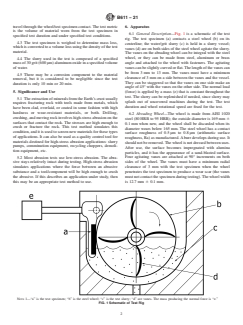
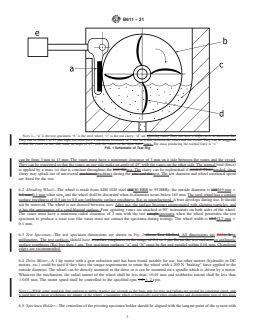
6.1 General Description—Fig. 1 is a schematic of the test
specified test duration and under specified test conditions.
rig. The test specimen (a) contacts a steel wheel (b) on its
4.3 The test specimen is weighed to determine mass loss,
centerline; the water/grit slurry (c) is held in a slurry vessel;
whichisconvertedtoavolumelossusingthedensityofthetest
vanes(d)areonbothsidesofthesteelwheelagitatetheslurry.
material.
The vanes on the abrading wheel can be integral with the steel
wheel, or they can be made from steel, aluminum or brass
4.4 The slurry used in the test is composed of a specified
angle and attached to the wheel with fasteners. The agitating
massof30grit(600µm)aluminumoxideinaspecifiedvolume
of water. vanescanbeslightlycurvedorflat.Thelengthofthevanescan
be from 3mm to 13 mm. The vanes must have a minimum
4.5 There may be a corrosion component to the material
clearance of 3 mm on a side between the vanes and the vessel.
removal, but it is considered to be negligible since the test
They can be staggered so that the vanes on one side make an
duration is only 10 min or 20 min.
angle of 45° with the vanes on the other side.The normal load
5. Significance and Use (force) is applied by a mass (e) that is constant throughout the
test. The slurry can be replenished if needed, since slurry may
5.1 TheextractionofmineralsfromtheEarth’scrustusually
splash out of uncovered machines during the test. The test
requires fracturing rock with tools made from metals, which
duration and wheel rotational speed are fixed for the test.
have been clad, overlaid, or coated in some fashion with high
hardness or wear-resistant materials, or both. Drilling,
6.2 Abrading Wheel—The wheel is made from AISI 1020
crushing,andmovingrockinvolveshigh-stressabrasiononthe
steel (80HRB to 95 HRB); the outside diameter is 169mm 6
surfaces that contact the rock. The stresses are high enough to
0.1mm when new, and the wheel shall be discarded when its
crush or fracture the rock. This test method simulates this
diameter wears below 165 mm. The steel wheel has a contact
condition,anditisusedtoscreennewmaterialsforthesetypes
surface roughness of 0.5µm to 0.8µm (arithmetic surface
of applications. It can also be used as a quality control tool for
roughness,Ra)asmanufactured.Aburrdevelopsduringuse.It
materials destined for high-stress abrasion applications: slurry
shouldnotberemoved.Thewheelisnotdressedbetweenuses.
pumps, comminution equipment, recycling choppers, demoli-
After use, the surface becomes impregnated with alumina
tion equipment, etc.
particles, and it has the appearance of a sand-blasted surface.
5.2 Most abrasion tests use low-stress abrasion. The abra- Four agitating vanes are attached at 90° increments on both
sides of the wheel. The vanes must have a minimum radial
sive stays relatively intact during testing. High-stress abrasion
simulates applications where the force between an abrasive clearance of 3 mm with the test specimen when the wheel
penetrates the test specimen to produce a wear scar (the vanes
substance and a tool/component will be high enough to crush
the abrasive. If this describes an application under study, then mustnotcontactthespecimenduringtesting).Thewheelwidth
this may be an appropriate test method to use. is 12.7mm 6 0.1 mm.
NOTE 1—“a” is the test specimen; “b” is the steel wheel; “c” is the test slurry; “d” are vanes. The mass producing the normal force is “e.”
FIG. 1 Schematic of Test Rig
B611 − 21
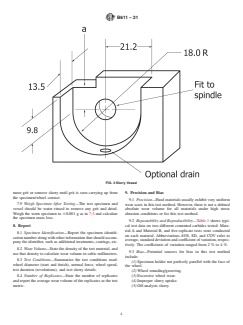
6.6 Slurry Vessel—The internal dimensions of the vessel
that contains the slurry are shown inFig. 3.All dimensions are
in millimeters. The vessel can be made from metals or plastic
andcorrosion-resistantmaterialsarepreferred.Inthisdesign,a
flat panel is fastened and sealed to the chamber shown to
complete the vessel. Cutout “a” is an option clearance for the
specimen pivot. Some test rigs do not need the spindle hole
because the vessel clamps to a faceplate containing the wheel
spindle.Theslurrymustbereplacedforeverytestsoadrainor
other way of removing the slurry is advisable.
7. Procedure
7.1 Specimen Preparation—The test surface of the test
specimen should be flat and not contain errors of form (ridges,
waves, bumps, etc.) greater than 2.0 µm. A test specimen can
be tested on the front and backside as long as the holder
references the specimen from the unworn surface.
7.2 Specimen Cleaning—Test specimens should be
degreasedwithasolventthatdoesnotattackthetestsurfaceor
leave a film. Ultrasonic cleaning for a duration from 30s to
90s in acetone has been found to be adequate for most metals
and cermets.
7.3 Specimen Weighing—Weigh the test specimen to
60.001 g three times and take the average weight as the
starting weight. Ferrous materials should be demagnetized
FIG. 2 Test Specimen Dimensions
before testing.
7.4 Specimen Mounting—Affix the specimen in the loading
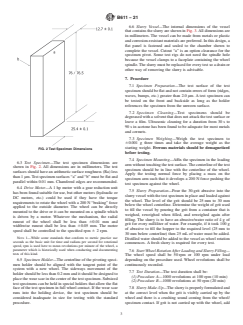
6.3 Test Specimen—The test specimen dimensions are
armwithouttouchingthetestsurface.Thecenterlineofthetest
shown in Fig. 2. All dimensions are in millimeters. The test
specimen should be in line with the centerline of the wheel.
surfaces should have an arithmetic surface roughness (Ra) less
Apply the testing normal force by placing a mass on the
than1µm.Testspecimensurfaces“a”and“b”mustbeflatand
specimen arm such that it develops a 200 N force pushing the
parallel within 0.01 mm. Chamfered edges are recommended.
test specimen against the wheel.
6.4 Drive Motor—A 1 hp motor with a gear reduction unit
7.5 Slurry Preparation—Pour the 30-grit abrasive into the
has been found suitable for use, but other motors (hydraulic or
slurryvesselwiththetestspecimeninplaceandloadedagainst
DC motors, etc.) could be used if they have the torque
the wheel. The level of the grit should be 25mm to 30 mm
requirements to rotate the wheel with a 200 N “braking” force
below the wheel centerline. Determine the weight of grit used
applied to the outside diameter. The wheel can be directly
to fill the vessel by pouring the grit from a container that is
mounted to the drive or it can be mounted on a spindle which
weighed, reweighed when filled, and reweighed again after
is driven by a motor. Whatever the mechanism, the radial
filling. The slurry is to have an abrasive/water ratio of4gof
runout of the wheel shall be less than 60.01 mm and
grit for every milliliter of water. For example, if it took 100 g
widthwise runout shall be less than 60.05 mm. The motor
of abrasive to fill the hopper to the required level (25mm to
speed shall be controlled to the specified rpm 6 2 rpm.
30mm below centerline) then 25 mL of water must be added.
NOTE 1—While some standards that conform to metric practice use
Distilled water should be added to the vessel as wheel rotation
seconds as the basic unit for time and radians per second for rotational
commences. A fresh slurry is required for every test.
speed, rpm is used here to mean revolutions per minute of the wheel, a
parameter which is historically used when conducting and documenting
7.6 Start Wheel Rotation After Loading and Slurry Filling—
tests of this kind.
The wheel speed shall be 50rpm or 100 rpm under load
6.5 Specimen Holder—The centerline of the pivoting speci- depending on the procedure used. Wheel revolutions shall be
men holder should be aligned with the tangent point of the
continuously recorded.
system with a new wheel. The sideways movement of the
7.7 Test Duration—The test duration shall be:
holdershouldbelessthan0.2mmanditshouldbedesignedto
(1) Procedure A—1000 revolutions at 100 rpm (10 min)
placethewearscarinthecenterofthetestspecimen.Subsized
(2) Procedure B—1000 revolutions at 50 rpm (20 min)
test specimens can be held in special holders that allow the flat
face of the test specimen in full wheel contact. If the wear scar 7.8 Slurry Make-Up—Theslurryisproperlyformula
...
This document is not an ASTM standard and is intended only to provide the user of an ASTM standard an indication of what changes have been made to the previous version. Because
it may not be technically possible to adequately depict all changes accurately, ASTM recommends that users consult prior editions as appropriate. In all cases only the current version
of the standard as published by ASTM is to be considered the official document.
Designation: B611 − 13 (Reapproved 2018) B611 − 21
Standard Test Method for
Determining the High Stress Abrasion Resistance of Hard
Materials
This standard is issued under the fixed designation B611; the number immediately following the designation indicates the year of
original adoption or, in the case of revision, the year of last revision. A number in parentheses indicates the year of last reapproval. A
superscript epsilon (´) indicates an editorial change since the last revision or reapproval.
1. Scope Scope*
1.1 This test method was developed for ranking the high-stress abrasion resistance of cemented carbides, but it has been
successfully used on ceramics, cermets, and metal matrix hardfacings with a hardness over 55 HRC. Rockwell hardness, C scale
(HRC). The feature of this test method that discriminates it from other abrasion tests is that the abrasive is forced against the test
specimen with a steel wheel with sufficient force to cause fracture of the abrasive particles. Some abrasion tests use rubber wheels
to force abrasive against test surfaces (Test Methods G65, G105,and G75G105). A rubber wheel produces low-stress abrasion while
a steel wheel produces high-stress abrasion.
1.2 In summary, this is a high-stress laboratory abrasion test for hard materials using a water slurry of aluminum oxide particles
as the abrasive medium and a rotating steel wheel to force the abrasive across a flat test specimen in line contact with the rotating
wheel immersed in the slurry.
1.3 The values stated in SI units are to be regarded as standard. No other units of measurement are included in this standard.
1.3.1 Exceptions—Subsection 4.4 and Table 1 use abrasive grit designations for particle size. The value given in parentheses is
nominal dimension in micrometers based on sieve designation (Specification E11) and provided for information only. Subsection
6.2 uses the Rockwell hardness, B scale (HRB) as the standard unit of measure for hardness. In 6.4, 7.6, 7.7, and Table 1, rpm
is the standard unit of measure for rotational speed.
1.4 This standard does not purport to address all of the safety concerns, if any, associated with its use. It is the responsibility
of the user of this standard to establish appropriate safety, health, and environmental practices and determine the applicability of
regulatory limitations prior to use.
1.5 This international standard was developed in accordance with internationally recognized principles on standardization
established in the Decision on Principles for the Development of International Standards, Guides and Recommendations issued
by the World Trade Organization Technical Barriers to Trade (TBT) Committee.
2. Referenced Documents
2.1 ASTM Standards:
B311E11 Test Method for Density of Powder Metallurgy (PM) Materials Containing Less Than Two Percent PorositySpecifi-
cation for Woven Wire Test Sieve Cloth and Test Sieves
G40 Terminology Relating to Wear and Erosion
This test method is under the jurisdiction of ASTM Committee G02 on Wear and Erosion and is the direct responsibility of Subcommittee G02.30 on Abrasive Wear.
Current edition approved Dec. 1, 2018Nov. 1, 2021. Published December 2018January 2022. Originally approved in 1976. Last previous edition approved in 20132018
as B611 – 13.B611 – 13 (2018). DOI: 10.1520/B0611-13R18.10.1520/B0611-21.
For referenced ASTM standards, visit the ASTM website, www.astm.org, or contact ASTM Customer Service at service@astm.org. For Annual Book of ASTM Standards
volume information, refer to the standard’sstandard’s Document Summary page on the ASTM website.
*A Summary of Changes section appears at the end of this standard
Copyright © ASTM International, 100 Barr Harbor Drive, PO Box C700, West Conshohocken, PA 19428-2959. United States
B611 − 21
G65 Test Method for Measuring Abrasion Using the Dry Sand/Rubber Wheel Apparatus
G75 Test Method for Determination of Slurry Abrasivity (Miller Number) and Slurry Abrasion Response of Materials (SAR
Number)
G105 Test Method for Conducting Wet Sand/Rubber Wheel Abrasion Tests
2.2 American National Standard:
ANSI B74.12 Specification for the Size of Abrasive Grain - Grinding Wheels, Polishing and General Industrial Uses
3. Terminology
3.1 Definitions: For definitions of terms found in this test method, please refer to Terminology Standard G40.
3.2 Definitions of Terms Specific to This Standard:
3.2.1 abrasive wear, n—wear due to hard particles or hard protuberances forced against and moving along a solid surface.
3.2.2 high-stress abrasion, n—progressive material removal from a hard solid surface by the action of hard particles rolling or
sliding on that surface with sufficient force to cause fracture of the particles.
3.2.3 slurry, n—a suspension of solid material in liquid.
4. Summary of Test Method
4.1 The test specimen is a flat that is held in a vertical position tangent to a rotating steel wheel immersed in water slurry of
aluminum oxide particles.
4.2 The normal force holding the test specimen against the wheel is high enough to cause fracture of abrasive particles that travel
through the wheel/test specimen contact. The test metric is the volume of material worn from the test specimen in specified test
duration and under specified test conditions.
4.3 The test specimen is weighed to determine mass loss, which is converted to a volume loss using the density of the test material.
4.4 The slurry used in the test is composed of a specified mass of 30-mesh 30 grit (600 μm) aluminum oxide in a specified volume
of water.
4.5 There may be a corrosion component to the material removal, but it is considered to be negligible since the test timeduration
is only ten or twenty minutes (600 or 1200 seconds).10 min or 20 min.
5. Significance and Use
5.1 The extraction of minerals from the Earth’s mantlecrust usually requires fracturing rock with tools made from metals, but
which have been clad, overlaid, or coveredcoated in some fashion with hard materials. high hardness or wear-resistant materials,
or both. Drilling, crushing, and moving rock involves high-stress abrasion on the surfaces that make contact with the rock. The
stresses are high enough to crush/fracture crush or fracture the rock. This test method simulates this condition, and it is used to
screen new materials for these types of applications. It can also be used as a quality control tool for materials destined for
high-stress abrasion applications: slurry pumps, comminution equipment, recycling choppers, demolition equipment, etc.
5.2 Most abrasion tests use low-stress abrasion. The abrasive stays relatively intact during testing. High-stress abrasion simulates
applications where the force between an abrasive substance and a tool/component will be high enough to crush the abrasive. If this
describes an application under study, then this may be an appropriate test method to use.
6. Apparatus
6.1 General Description—Fig. 1 is a schematic of the test rig. The test specimen (a) contacts a steel wheel (b) on its centerline;
the water/grit slurry (c) is held in a slurry vessel; vanes, made from aluminum or steel vanes (d) are on both sides of the steel wheel
agitate the slurry. The vanes on the abrading wheel can be integral with the steel wheel, or they can be made from steel, aluminum
or brass angle and attached to the wheel with fasteners. The agitating vanes can be slightly curved or flat. The length of the vanes
Available from American National Standards Institute (ANSI), 25 W. 43rd St., 4th Floor, New York, NY 10036, http://www.ansi.org.
B611 − 21
NOTE 1—“a” is the test specimen; “b” is the steel wheel; “c” is the test slurry; “d” are agitating vanes. They can have a slight curve as shown or flat.
They can be from 3 to 13 mm high, but must have a minimum clearance of 3 mm on a side between the vanes and the vessel. They can be staggered
so that the vanes on one side make an angle of 45° with the vanes on the other side. vanes. The mass producing the normal force is “e.”
FIG. 1 Schematic of Test Rig
can be from 3 mm to 13 mm. The vanes must have a minimum clearance of 3 mm on a side between the vanes and the vessel.
They can be staggered so that the vanes on one side make an angle of 45° with the vanes on the other side. The normal load (force)
is applied by a mass (e) that is constant throughout the test; thetest. The slurry can be replenished if needed (Note:needed, since
slurry may splash out of uncovered machines)machines during the test, and the test. The test duration and wheel rotational speed
are fixed for the test.
6.2 Abrading Wheel—The wheel is made from AISI 1020 steel (80(80 HRB to 95 HRB); the outside diameter is 169169 mm 6
0.1 mm 0.1 mm when new, and the wheel shall be discarded when its diameter wears below 165 mm. The steel wheel has a contact
surface roughness of 0.5 μm to 0.8 μm (arithmetic surface roughness, Ra) as manufactured. A burr develops during use. It should
not be removed. The wheel is not dressed between uses. After use, the surface becomes impregnated with alumina particles, and
it has the appearance of a sand-blasted surface. Four agitating vanes are attached at 90° increments on both sides of the wheel.
The vanes must have a minimum radial clearance of 3 mm with the test samplespecimen when the wheel penetrates the test
specimen to produce a wear scar (the vanes must not contact the specimen during testing). The wheel width is 12.712.7 mm 6
0.1 mm.
6.3 Test Specimen—The test specimen dimensions are shown in Fig. 2 (from Test Method. All dimensions are G65). It in
millimeters. The test surfaces should have a surface roughness in the range of 0.1 to 1 μm Ra on the test surfaces.an arithmetic
surface roughness (Ra) less than 1 μm. Test specimen surfaces “a” and “b” must be flat and parallel within 0.01 mm. Chamfered
edges are recommended.
6.4 Drive Motor—A 1 hp motor with a gear reduction unit has been found suitable for use, but other motors (hydraulic or DC
motors, etc.) could be used if they have the torque requirements to rotate the wheel with a 200 N “braking” force applied to the
outside diameter. The wheel can be directly mounted to the drive or it can be mounted on a spindle which is driven by a motor.
Whatever the mechanism, the radial runout of the wheel shall be less than 60.01 mm and widthwise runout shall be less than
60.05 mm. The motor speed shall be controlled to the specified rpm 62 6 2 rpm.
NOTE 1—While some standards that conform to metric practice use seconds as the basic unit for time and radians per second for rotational speed, rpm
is used here to mean revolutions per minute of the wheel, a parameter which is historically used when conducting and documenting tests of this kind.
6.5 Specimen Holder—The centerline of the pivoting specimen holder should be aligned with the tangent point of the system with
B611 − 21
FIG. 2 Test Specimen Dimensions
a new wheel. The sideways movement of the holder should be less than 0.2 mm and it should be designed to place the wear scar
in the center of the test specimen. Subsized test specimens can be held in special holders that allow the flat face of the test specimen
in full wheel contact. If the wear scar runs into the holding device, the test specimen should be considered inadequate in size for
testing with the standard procedure.
6.6 Slurry Vessel—The internal dimensions of the vessel that contains the slurry are shown in Fig. 3. All dimensions are in
millimeters. The vessel can be made from metals or plastic and corrosion-resistant materials are preferred. In this design, a flat
panel is fastened and sealed to the chamber shown to complete the vessel. Cutout “a” is an option clearance for the specimen pivot.
Some test rigs do not need the spindle hole because the vessel clamps to a faceplate containing the wheel spindle. The slurry must
be replaced for every test so a drain or other way of removing the slurry is advisable.
7. Procedure
7.1 Specimen Preparation—The test surface of the test specimen should be flat and not contain errors of form (ridges, waves,
bumps, etc.) greater than 2.0 μm. A test specimen can be tested on the front and backside as long as the holder references the
specimen from the unworn surface.
7.2 Specimen Cleaning—Test specimens should be degreased with a solvent that does not attack the test surface or leave a film.
Ultrasonic cleaning for a timeduration from 3030 s to 90 s 90 s in acetone has been found to be adequate for most metals and
cermets.
7.3 Specimen Weighing—Weigh the test specimen to 60.001 g three times and take the average weight as the starting weight.
Ferrous materials should be demagnetized before testing.
7.4 Specimen Mounting—Affix the specimen in the loading arm without touching the test surface. The centerline of the test
specimen should be in line with the centerline of the wheel. Apply the testing normal force by placing a mass on the specimen
arm such that it develops a 200 N force pushing the test specimen against the wheel.
7.5 Slurry Preparation—Pour the 30-grit abrasive into the slurry vessel with the test specimen in place and loaded against the
B611 − 21
FIG. 3 Slurry Vessel
wheel. The level of the grit should be 2525 mm to 30 mm below the wheel centerline. Determine the weight of grit used to fill
the vessel by pouring the grit from a container that is weighed, reweighed when filled, and reweighed again after filling. The slurry
is to have an abrasive/water ratio of 4 g of grit for every millilitremilliliter of water. For example, if it took 100 g of abrasive to
fill the hopper to the required level (25/30 mm (25 mm to 30 mm below centerline) then 25 mL of water must be added. Distilled
water should be added to the vessel as wheel rotation commences. A fresh slurry is required for every test.
7.6 Start Wheel Rotation After Loading and Slurry Filling—The wheel speed shall be 5050 rpm or 100 rpm under load depending
on the procedure used. Wheel revolutions shall be continuously recorded
...