

ASTM D1709-22
(Test Method)Standard Test Methods for Impact Resistance of Plastic Film by the Free-Falling Dart Method
General Information
- Abstract
SIGNIFICANCE AND USE
4.1 Test Methods A and B are used to establish the weight of the dart when 50 % of the specimens fail under the conditions specified. Data obtained by one test method cannot be compared directly with the other test method nor with those obtained from tests employing different conditions of missile velocity, impinging surface diameter, effective specimen diameter, material construction and finish of the dart head, and film thickness. The values obtained by these test variables are highly dependent on the method of film fabrication.
4.2 The results obtained by Test Methods A and B are greatly influenced by the quality of film under test. The confidence limits of data obtained by this procedure can, therefore, vary significantly, depending on the sample quality, uniformity of film gage, die marks, contaminants, etc.
4.3 Test Methods A and B have been found useful for specification purposes.
Note 4: With sufficient data, correlation between test results and field performance can usually be established.
4.4 The impact resistance of plastic film, while partly dependent on thickness, has no simple correlation with sample thickness. Hence, impact values cannot be normalized over a range of thickness without producing misleading data as to the actual impact resistance of the material. Data from these test methods are comparable only for specimens that vary by no more than ±25 % from the nominal or average thickness of the specimens tested.
4.5 Several impact test methods are used for film. It is sometimes desirable to know the relationships among test results derived by different test methods. A study was conducted in which four films made from two resins (polypropylene and linear low-density polyethylene), with two film thicknesses for each resin, were impacted using Test Methods D1709 (Method A), D3420 (Procedures A and B), and D4272. The test results are shown in the Appendix. Differences in results between Test Methods D1709 and D4272 are not unusual since...
SCOPE
1.1 These test methods cover the determination of the energy that causes plastic film to fail under specified conditions of impact of a free-falling dart. This energy is expressed in terms of the weight (mass) of the missile falling from a specified height which would result in 50 % failure of specimens tested.
1.2 Two test methods are described:
1.2.1 Test Method A employs a dart with a 38.10 ± 0.13-mm (1.500 ± 0.005-in.) diameter hemispherical head dropped from a height of 0.66 ± 0.01 m (26.0 ± 0.4 in.). This test method can be used for films whose impact resistances require masses of about 50 g to about 6 kg to fracture them.
1.2.2 Test Method B employs a dart with a 50.80 ± 0.13-mm (2.000 ± 0.005-in.) diameter hemispherical head dropped from a height of 1.52 ± 0.03 m (60.0 + 0.25, −1.70 in.). Its range of applicability is from about 0.3 kg to about 6 kg.
1.3 Two testing techniques are described:
1.3.1 The standard technique is the staircase method. By this technique, the missile weight employed during the test is decreased or increased by uniform increments after the testing of each specimen, depending upon the result (fail or not fail) observed for the specimen.
1.3.2 The alternative technique provides for testing specimens in successive groups of ten. One missile weight is employed for each group and the missile weight is varied in uniform increments from group to group.
1.3.3 The staircase technique and the alternative technique give equivalent results both as to the values of impact failure weight which are obtained and as to the precisions with which they are determined.
1.4 The values stated in SI units are to be regarded as standard. The values stated in parentheses are for information only.
Note 1: Tests on materials that do not break, for any reason, are not considered to be valid. It has been noted that certain materials may stretch so far as to bottom out at the base of certain ...
- Status
- Published
- Publication Date
- 30-Jun-2022
- Technical Committee
- D20 - Plastics
- Drafting Committee
- D20.19 - Film, Sheeting, and Molded Products
Buy Documents
ASTM D1709-22 - Standard Test Methods for Impact Resistance of Plastic Film by the Free-Falling Dart Method
REDLINE ASTM D1709-22 - Standard Test Methods for Impact Resistance of Plastic Film by the Free-Falling Dart Method
Overview
ASTM D1709-22: Standard Test Methods for Impact Resistance of Plastic Film by the Free-Falling Dart Method establishes laboratory procedures for determining the impact resistance of plastic films using a free-falling dart. Developed by ASTM International, this standard outlines two primary test methods-Method A and Method B-to measure the energy (expressed as dart weight) required to cause failure in 50% of the tested film specimens under distinct and clearly specified conditions. ASTM D1709 is widely used for quality control, product specification, and comparative material assessment in the plastics and packaging industries.
Key Topics
- Test Methods A and B
- Method A uses a dart with a 38.10 mm hemispherical head, dropped from 0.66 m, suitable for films fractured by 50 g to 6 kg weights.
- Method B uses a larger 50.80 mm dart, dropped from 1.52 m, covering a similar upper mass limit but with a higher starting impact force.
- Testing Techniques
- Staircase method: Adjusts the dart weight incrementally based on failure or non-failure outcomes as individual specimens are tested.
- Alternative group method: Tests films in groups of ten, changing the dart weight between groups for efficiency.
- Precision and Variables
- Test results are sensitive to film thickness, uniformity, and imperfections but impact resistance does not correlate simply with thickness.
- Data are comparable only for films that do not vary by more than ±25% from average thickness within the testing batch.
- Specification Utility
- Methods A and B support product specification and performance comparison but are not interchangeable due to differences in apparatus and conditions.
Applications
ASTM D1709 is critical in industries where the impact resistance of plastic film is a key performance attribute, including:
- Packaging films: Food, pharmaceutical, and consumer goods packaging require films with defined resistance to mechanical damage.
- Agricultural films: Greenhouse covers and silage wraps must withstand impact from tools or environmental factors.
- Industrial sheeting: Construction and protective films need qualification for resilience against puncturing or tearing.
- Quality Assurance: Manufacturers use the standard to validate batch consistency and to ensure product meets contractual or regulatory requirements.
- Material comparison: Enables objective comparison of different plastics and production methods for performance optimization.
The standard facilitates reliable, repeatable, and industry-accepted physical property testing for a wide range of plastic materials.
Related Standards
ASTM D1709 references and is related to several other standards governing plastics testing and terminology, including:
- ASTM D618: Conditioning Plastics for Testing
- ASTM D883: Terminology Relating to Plastics
- ASTM D3420: Pendulum Impact Resistance of Plastic Film
- ASTM D4272: Total Energy Impact of Plastic Films by Dart Drop
- ASTM D6988: Determination of Thickness of Plastic Film Test Specimens
- ISO 7765-1: International equivalent for free-falling dart impact, with some minor procedural and tolerance differences
These standards together create a robust framework for plastics testing, ensuring consistency in terminology, specimen preparation, and test execution.
Keywords: ASTM D1709, impact resistance, plastic film, free-falling dart method, packaging film testing, quality control, plastics standards, dart drop test, film impact performance, ASTM plastics test methods
Relations
- Effective Date
- 01-Feb-2024
- Effective Date
- 01-Nov-2023
- Effective Date
- 01-Apr-2022
- Effective Date
- 01-Jan-2020
- Effective Date
- 01-Aug-2019
- Effective Date
- 15-Apr-2019
- Effective Date
- 01-Feb-2019
- Effective Date
- 01-Dec-2018
- Effective Date
- 01-Nov-2018
- Effective Date
- 01-Oct-2017
- Refers
ASTM E2935-17 - Standard Practice for Conducting Equivalence Testing in Laboratory Applications - Effective Date
- 01-Oct-2017
- Effective Date
- 01-Oct-2017
- Effective Date
- 15-Aug-2017
- Refers
ASTM E2935-16 - Standard Practice for Conducting Equivalence Testing in Laboratory Applications - Effective Date
- 15-Nov-2016
- Effective Date
- 15-Nov-2016
Buy Documents
ASTM D1709-22 - Standard Test Methods for Impact Resistance of Plastic Film by the Free-Falling Dart Method
REDLINE ASTM D1709-22 - Standard Test Methods for Impact Resistance of Plastic Film by the Free-Falling Dart Method
Get Certified
Connect with accredited certification bodies for this standard

DIN CERTCO
DIN Group product certification.

Smithers Quality Assessments
US management systems and product certification.
Sponsored listings
Frequently Asked Questions
ASTM D1709-22 is a standard published by ASTM International. Its full title is "Standard Test Methods for Impact Resistance of Plastic Film by the Free-Falling Dart Method". This standard covers: SIGNIFICANCE AND USE 4.1 Test Methods A and B are used to establish the weight of the dart when 50 % of the specimens fail under the conditions specified. Data obtained by one test method cannot be compared directly with the other test method nor with those obtained from tests employing different conditions of missile velocity, impinging surface diameter, effective specimen diameter, material construction and finish of the dart head, and film thickness. The values obtained by these test variables are highly dependent on the method of film fabrication. 4.2 The results obtained by Test Methods A and B are greatly influenced by the quality of film under test. The confidence limits of data obtained by this procedure can, therefore, vary significantly, depending on the sample quality, uniformity of film gage, die marks, contaminants, etc. 4.3 Test Methods A and B have been found useful for specification purposes. Note 4: With sufficient data, correlation between test results and field performance can usually be established. 4.4 The impact resistance of plastic film, while partly dependent on thickness, has no simple correlation with sample thickness. Hence, impact values cannot be normalized over a range of thickness without producing misleading data as to the actual impact resistance of the material. Data from these test methods are comparable only for specimens that vary by no more than ±25 % from the nominal or average thickness of the specimens tested. 4.5 Several impact test methods are used for film. It is sometimes desirable to know the relationships among test results derived by different test methods. A study was conducted in which four films made from two resins (polypropylene and linear low-density polyethylene), with two film thicknesses for each resin, were impacted using Test Methods D1709 (Method A), D3420 (Procedures A and B), and D4272. The test results are shown in the Appendix. Differences in results between Test Methods D1709 and D4272 are not unusual since... SCOPE 1.1 These test methods cover the determination of the energy that causes plastic film to fail under specified conditions of impact of a free-falling dart. This energy is expressed in terms of the weight (mass) of the missile falling from a specified height which would result in 50 % failure of specimens tested. 1.2 Two test methods are described: 1.2.1 Test Method A employs a dart with a 38.10 ± 0.13-mm (1.500 ± 0.005-in.) diameter hemispherical head dropped from a height of 0.66 ± 0.01 m (26.0 ± 0.4 in.). This test method can be used for films whose impact resistances require masses of about 50 g to about 6 kg to fracture them. 1.2.2 Test Method B employs a dart with a 50.80 ± 0.13-mm (2.000 ± 0.005-in.) diameter hemispherical head dropped from a height of 1.52 ± 0.03 m (60.0 + 0.25, −1.70 in.). Its range of applicability is from about 0.3 kg to about 6 kg. 1.3 Two testing techniques are described: 1.3.1 The standard technique is the staircase method. By this technique, the missile weight employed during the test is decreased or increased by uniform increments after the testing of each specimen, depending upon the result (fail or not fail) observed for the specimen. 1.3.2 The alternative technique provides for testing specimens in successive groups of ten. One missile weight is employed for each group and the missile weight is varied in uniform increments from group to group. 1.3.3 The staircase technique and the alternative technique give equivalent results both as to the values of impact failure weight which are obtained and as to the precisions with which they are determined. 1.4 The values stated in SI units are to be regarded as standard. The values stated in parentheses are for information only. Note 1: Tests on materials that do not break, for any reason, are not considered to be valid. It has been noted that certain materials may stretch so far as to bottom out at the base of certain ...
SIGNIFICANCE AND USE 4.1 Test Methods A and B are used to establish the weight of the dart when 50 % of the specimens fail under the conditions specified. Data obtained by one test method cannot be compared directly with the other test method nor with those obtained from tests employing different conditions of missile velocity, impinging surface diameter, effective specimen diameter, material construction and finish of the dart head, and film thickness. The values obtained by these test variables are highly dependent on the method of film fabrication. 4.2 The results obtained by Test Methods A and B are greatly influenced by the quality of film under test. The confidence limits of data obtained by this procedure can, therefore, vary significantly, depending on the sample quality, uniformity of film gage, die marks, contaminants, etc. 4.3 Test Methods A and B have been found useful for specification purposes. Note 4: With sufficient data, correlation between test results and field performance can usually be established. 4.4 The impact resistance of plastic film, while partly dependent on thickness, has no simple correlation with sample thickness. Hence, impact values cannot be normalized over a range of thickness without producing misleading data as to the actual impact resistance of the material. Data from these test methods are comparable only for specimens that vary by no more than ±25 % from the nominal or average thickness of the specimens tested. 4.5 Several impact test methods are used for film. It is sometimes desirable to know the relationships among test results derived by different test methods. A study was conducted in which four films made from two resins (polypropylene and linear low-density polyethylene), with two film thicknesses for each resin, were impacted using Test Methods D1709 (Method A), D3420 (Procedures A and B), and D4272. The test results are shown in the Appendix. Differences in results between Test Methods D1709 and D4272 are not unusual since... SCOPE 1.1 These test methods cover the determination of the energy that causes plastic film to fail under specified conditions of impact of a free-falling dart. This energy is expressed in terms of the weight (mass) of the missile falling from a specified height which would result in 50 % failure of specimens tested. 1.2 Two test methods are described: 1.2.1 Test Method A employs a dart with a 38.10 ± 0.13-mm (1.500 ± 0.005-in.) diameter hemispherical head dropped from a height of 0.66 ± 0.01 m (26.0 ± 0.4 in.). This test method can be used for films whose impact resistances require masses of about 50 g to about 6 kg to fracture them. 1.2.2 Test Method B employs a dart with a 50.80 ± 0.13-mm (2.000 ± 0.005-in.) diameter hemispherical head dropped from a height of 1.52 ± 0.03 m (60.0 + 0.25, −1.70 in.). Its range of applicability is from about 0.3 kg to about 6 kg. 1.3 Two testing techniques are described: 1.3.1 The standard technique is the staircase method. By this technique, the missile weight employed during the test is decreased or increased by uniform increments after the testing of each specimen, depending upon the result (fail or not fail) observed for the specimen. 1.3.2 The alternative technique provides for testing specimens in successive groups of ten. One missile weight is employed for each group and the missile weight is varied in uniform increments from group to group. 1.3.3 The staircase technique and the alternative technique give equivalent results both as to the values of impact failure weight which are obtained and as to the precisions with which they are determined. 1.4 The values stated in SI units are to be regarded as standard. The values stated in parentheses are for information only. Note 1: Tests on materials that do not break, for any reason, are not considered to be valid. It has been noted that certain materials may stretch so far as to bottom out at the base of certain ...
ASTM D1709-22 is classified under the following ICS (International Classification for Standards) categories: 83.140.10 - Films and sheets. The ICS classification helps identify the subject area and facilitates finding related standards.
ASTM D1709-22 has the following relationships with other standards: It is inter standard links to ASTM D883-24, ASTM D883-23, ASTM E456-13a(2022)e1, ASTM D883-20, ASTM D883-19c, ASTM D883-19a, ASTM D883-19, ASTM D883-18a, ASTM D883-18, ASTM E456-13A(2017)e3, ASTM E2935-17, ASTM E456-13A(2017)e1, ASTM D883-17, ASTM E2935-16, ASTM D1248-16. Understanding these relationships helps ensure you are using the most current and applicable version of the standard.
ASTM D1709-22 is available in PDF format for immediate download after purchase. The document can be added to your cart and obtained through the secure checkout process. Digital delivery ensures instant access to the complete standard document.
Standards Content (Sample)
This international standard was developed in accordance with internationally recognized principles on standardization established in the Decision on Principles for the
Development of International Standards, Guides and Recommendations issued by the World Trade Organization Technical Barriers to Trade (TBT) Committee.
Designation: D1709 − 22
Standard Test Methods for
Impact Resistance of Plastic Film by the Free-Falling Dart
Method
This standard is issued under the fixed designation D1709; the number immediately following the designation indicates the year of
original adoption or, in the case of revision, the year of last revision.Anumber in parentheses indicates the year of last reapproval.A
superscript epsilon (´) indicates an editorial change since the last revision or reapproval.
This standard has been approved for use by agencies of the U.S. Department of Defense.
1. Scope* 1.4 The values stated in SI units are to be regarded as
standard. The values stated in parentheses are for information
1.1 These test methods cover the determination of the
only.
energythatcausesplasticfilmtofailunderspecifiedconditions
of impact of a free-falling dart. This energy is expressed in NOTE 1—Tests on materials that do not break, for any reason, are not
consideredtobevalid.Ithasbeennotedthatcertainmaterialsmaystretch
terms of the weight (mass) of the missile falling from a
so far as to bottom out at the base of certain test instruments without
specified height which would result in 50% failure of speci-
actually rupturing. Subcommittee D20.19 is currently considering meth-
mens tested.
odsfortestingthesematerials.AnyoneinterestedinparticipatinginaTask
Group should contact the Chairman of Subcommittee D20.19 through
1.2 Two test methods are described:
ASTM International Headquarters.
1.2.1 Test Method A employs a dart with a
1.5 This standard does not purport to address all of the
38.10 60.13-mm (1.500 60.005-in.) diameter hemispherical
safety concerns, if any, associated with its use. It is the
head dropped from a height of 0.66 60.01 m (26.0 60.4 in.).
responsibility of the user of this standard to establish appro-
This test method can be used for films whose impact resis-
priate safety, health, and environmental practices and deter-
tances require masses of about 50 g to about 6 kg to fracture
mine the applicability of regulatory limitations prior to use.
them.
1.2.2 Test Method B employs a dart with a
NOTE 2—Film has been arbitrarily defined as sheeting having nominal
50.80 60.13-mm (2.000 60.005-in.) diameter hemispherical thickness not greater than 0.25 mm (0.010 in.).
NOTE 3—This test method is technically equivalent to ISO7765-
head dropped from a height of 1.52 60.03 m (60.0+0.25,
1:1988, with the exception of a larger tolerance on the drop height inTest
−1.70 in.). Its range of applicability is from about 0.3 kg to
Method B, smaller tolerances on the dart diameters for Test Methods A
about 6 kg.
and B, and the requirement for a vented dart well in 5.1.1.Also, the ISO
method does not allow the alternative testing technique described in
1.3 Two testing techniques are described:
Section 11 of this test method.
1.3.1 The standard technique is the staircase method. By
1.6 This international standard was developed in accor-
this technique, the missile weight employed during the test is
dance with internationally recognized principles on standard-
decreased or increased by uniform increments after the testing
ization established in the Decision on Principles for the
of each specimen, depending upon the result (fail or not fail)
Development of International Standards, Guides and Recom-
observed for the specimen.
mendations issued by the World Trade Organization Technical
1.3.2 The alternative technique provides for testing speci-
Barriers to Trade (TBT) Committee.
mens in successive groups of ten. One missile weight is
employed for each group and the missile weight is varied in
2. Referenced Documents
uniform increments from group to group.
2.1 ASTM Standards:
1.3.3 The staircase technique and the alternative technique
D618Practice for Conditioning Plastics for Testing
give equivalent results both as to the values of impact failure
D883Terminology Relating to Plastics
weight which are obtained and as to the precisions with which
D1248Specification for Polyethylene Plastics Extrusion
they are determined.
Materials for Wire and Cable
D3420Test Method for Pendulum Impact Resistance of
Plastic Film
These test methods are under the jurisdiction of ASTM Committee D20 on
PlasticsandarethedirectresponsibilityofSubcommitteeD20.19onFilm,Sheeting,
and Molded Products. For referenced ASTM standards, visit the ASTM website, www.astm.org, or
CurrenteditionapprovedJuly1,2022.PublishedJuly2022.Originallyapproved contact ASTM Customer Service at service@astm.org. For Annual Book of ASTM
ɛ1
in 1959. Last previous edition approved in 2016 as D1709–16a . DOI: 10.1520/ Standards volume information, refer to the standard’s Document Summary page on
D1709-22. the ASTM website.
*A Summary of Changes section appears at the end of this standard
Copyright © ASTM International, 100 Barr Harbor Drive, PO Box C700, West Conshohocken, PA 19428-2959. United States
D1709 − 22
D4272TestMethodforTotalEnergyImpactofPlasticFilms 4.4 The impact resistance of plastic film, while partly
by Dart Drop dependent on thickness, has no simple correlation with sample
D6988GuideforDeterminationofThicknessofPlasticFilm thickness. Hence, impact values cannot be normalized over a
Test Specimens range of thickness without producing misleading data as to the
E177Practice for Use of the Terms Precision and Bias in actual impact resistance of the material. Data from these test
ASTM Test Methods methods are comparable only for specimens that vary by no
E456Terminology Relating to Quality and Statistics morethan 625%fromthenominaloraveragethicknessofthe
E691Practice for Conducting an Interlaboratory Study to specimens tested.
Determine the Precision of a Test Method
4.5 Several impact test methods are used for film. It is
E2935Practice for Evaluating Equivalence of Two Testing
sometimes desirable to know the relationships among test
Processes
results derived by different test methods. A study was con-
2.2 ISO Standard:
ducted in which four films made from two resins (polypropyl-
ISO7765:1988Plastic Film and Sheeting—Determination
ene and linear low-density polyethylene), with two film thick-
of Impact Resistance by the Free Falling Dart Method—
nesses for each resin, were impacted using Test Methods
Part 1: Staircase Method
D1709 (MethodA), D3420 (ProceduresAand B), and D4272.
The test results are shown in the Appendix. Differences in
3. Terminology
results between Test Methods D1709 and D4272 are not
unusual since Test Methods D1709 represents failure initiated
3.1 Terms used in this standard are defined in accordance
energy, whileTest Method D4272 is initiation plus completion
with Terminology D883, unless otherwise specified. For terms
energy. Some films exhibit consistency when the initiation
relating to precision and bias and associated issues, the terms
energy is the same as the total energy. This statement and the
used in this standard are defined in accordance with Terminol-
test data also appear in the significance sections and appen-
ogy E456.
dixes of Test Methods D3420 and D4272.
3.2 Definitions of Terms Specific to This Standard:
3.2.1 failure, n—any break through the film that can be
5. Apparatus
observed readily by feeling or by viewing the specimen under
5.1 The apparatus shall be constructed essentially as shown
backlighted condition.
inFig.1,usingthefollowingcomponentscommontobothtest
3.2.2 impact failure weight, n—that missile weight, esti-
methods:
mated statistically, at which 50% of the specimens would fail
5.1.1 Dart Well—If the dart impact machine utilizes an
in the specified test.
enclosed dart well, it must contain a single unobstructed vent
2 2
withaminimumareaof625mm (~1in. )toprovideadequate
3.2.3 missile weight, n—the weight (mass) of the dart plus
venting.
thetotalvalueofincrementalweightsattached plusthelocking
collar.
NOTE 5—Some dart impact machine designs utilize enclosed dart wells
thatdonotpermitadequateventingtotheatmosphereduringimpact.Data
4. Significance and Use haveshownthatthishasasignificanteffectontheobservedimpactvalue,
especially with films that exhibit high elongation during testing, resulting
4.1 TestMethodsAandBareusedtoestablishtheweightof
in atypically high impact values.
the dart when 50% of the specimens fail under the conditions
NOTE 6—The use of smaller, multiple vents is permitted if it can be
demonstrated that the venting efficiency is comparable and has no
specified. Data obtained by one test method cannot be com-
statistically significant effect on the values obtained.
pared directly with the other test method nor with those
obtained from tests employing different conditions of missile 5.1.2 Specimen Clamp—A two-piece annular specimen
velocity, impinging surface diameter, effective specimen clamp having an inside diameter of 125 62.0 mm (5.0+0.0,
diameter, material construction and finish of the dart head, and −0.15 in.) and conforming to the following requirements:
film thickness. The values obtained by these test variables are 5.1.2.1 The lower or stationary half of the clamp shall be
highly dependent on the method of film fabrication.
mountedrigidlysothattheplaneofthespecimenishorizontal.
5.1.2.2 The upper or movable part of the clamp shall be
4.2 The results obtained by Test Methods A and B are
designed to maintain positive and plane contact with the lower
greatly influenced by the quality of film under test. The
part of the clamp when in position. The clamps shall be
confidence limits of data obtained by this procedure can,
provided with suitable means of maintaining sufficient contact
therefore, vary significantly, depending on the sample quality,
to hold the film sample firmly in place during the test.
uniformity of film gage, die marks, contaminants, etc.
Pneumatically operated clamps have been successfully em-
4.3 Test Methods A and B have been found useful for
ployed.
specification purposes.
5.1.2.3 Rubber-like gaskets can be affixed to the specimen
contact surfaces of both clamps to provide a cushion which
NOTE 4—With sufficient data, correlation between test results and field
performance can usually be established. minimizes thickness variation effects. Rubber gasketing 3.18
61 mm (0.125+0.025, −0.04 in.) thick, of 50 to 60 ShoreA
durometer hardness, 125 62.0 mm (5.00+0.00, −0.15 in.) in
inside diameter and 152 63.0 mm (6.0+0.02, −0.2 in.) in
Available fromAmerican National Standards Institute (ANSI), 25 W. 43rd St.,
4th Floor, New York, NY 10036, http://www.ansi.org. outside diameter has been found satisfactory for this purpose.
D1709 − 22
NOTE 1—Values for tolerances in SI units are to be regarded as standard. The numbers in parentheses reflect the allowable tolerance range of older
equipment and are only provided for information and, in many cases, do not correspond directly to the tolerances in SI units. The differences are not
expected to have a significant effect on the results but the dimensions in SI units shall be used in cases of dispute.
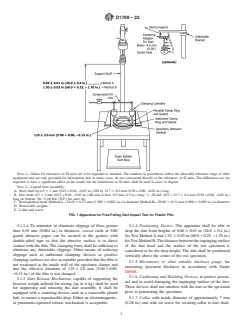
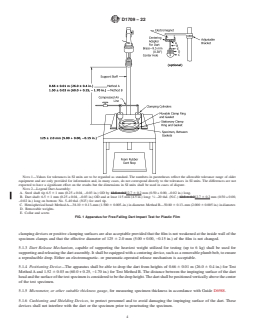
NOTE 2—Legend Dart Assembly:
A. Steel shaft tip 6.5 61 mm (0.25+0.04, −0.03 in.) OD by 12.7 60.2 mm (0.50+0.00, −0.02 in.) long.
B. Dart shaft: 6.5 61 mm (0.25+0.04, −0.03 in.) OD and at least 115 mm (4.5 in.) long: ⁄4 –20 thd. (N.C.) 12.7 60.2 mm (0.50+0.00, −0.02 in.)
long on bottom: No. 5–40 thd. (N.F.) for steel tip.
C. Hemisphericalhead:MethodA—38.10 60.13–mm(1.500 60.005–in.)indiameter.MethodB—50.80 60.13–mm(2.000 60.005in.)indiameter.
D. Removable weights.
E. Collar and screw.
FIG. 1 Apparatus for Free-Falling Dart Impact Test for Plastic Film
5.1.2.4 To minimize or eliminate slippage of films greater 5.1.4 Positioning Device—The apparatus shall be able to
than 0.10 mm (0.004 in.) in thickness, crocus cloth or 50D drop the dart from heights of 0.66 60.01 m (26.0 60.4 in.)
garnet abrasive paper can be secured to the gaskets with
for Test MethodAand 1.52 60.03 m (60.0+0.25, −1.70 in.)
double-sided tape so that the abrasive surface is in direct
forTestMethodB.Thedistancebetweentheimpingingsurface
contact with the film. The clamping force shall be sufficient to
of the dart head and the surface of the test specimen is
eliminate any detectable slippage. Other means of reducing
considered to be the drop height. The dart shall be positioned
slippage such as additional clamping devices or positive
vertically above the center of the test specimen.
clamping surfaces are also acceptable provided that the film is
5.1.5 Micrometer, or other suitable thickness gauge, for
not weakened at the inside wall of the specimen clamps and
measuring specimen thickness in accordance with Guide
that the effective diameter of 125 62.0 mm (5.00+0.00,
D6988.
−0.15 in.) of the film is not changed.
5.1.6 Cushioning and Shielding Devices, to protect person-
5.1.3 Dart Release Mechanism, capable of supporting the
nel and to avoid damaging the impinging surface of the dart.
heaviest weight utilized for testing (up to 6 kg) shall be used
These devices shall not interfere with the dart or the specimen
for supporting and releasing the dart assembly. It shall be
prior to penetrating the specimen.
equipped with a centering device, such as a removable plumb
5.1.7 Collar with inside diameter of approximately 7 mm
bob, to ensure a reproducible drop. Either an electromagnetic-
or pneumatic-operated release mechanism is acceptable. (0.28 in.) and with set screw for securing collar to dart shaft.
D1709 − 22
5.2 Darts for Test MethodsAand B shall have hemispheri- 5.3.3 Optionally, additional weights, each 120 g 60.5%
cal heads, each fitted with a 6.4 61-mm (0.25+0.04, −0.03- for Test Method A or 180 g 60.5% for Test Method B, are
in.) diameter shaft at least 114.3 mm (4.5 in.) long to acceptableforuseifitisnecessarytoextendthemissileweight
accommodate removable incremental weights. Each dart beyond that attainable when using all weights in the standard
weight shall be known to 60.5% relative. Dart head surfaces set.
shall be free of nicks, scratches, or other irregularities. The
6. Test Specimen
shaft shall be attached to the center of the flat surface of the
head with its longitudinal axis perpendicular to the surface. If 6.1 Test specimens shall be large enough to extend outside
an electromagnet is used, the shaft shall be made of material
the specimen clamp gaskets at all points. The specimens shall
that is not magnetic and shall have a steel tip 12.7 60.2 mm be representative of the film under study and shall be taken
(0.50+0.00,−0.02in.)longattheendheldbytheelectromag-
from the sheet or tube in a manner representative of sound
net. sampling practice. This is to ensure that the whole of the sheet
5.2.1 For Test Method A, the dart head shall be
be represented in the test unless such sampling constitutes a
38.10 60.13–mm (1.500 60.005–in.) in diameter. variable under study.
5.2.2 For Test Method B, the dart head shall be
6.2 Thespecimensshallbefreeofpinholes,wrinkles,folds,
50.80 60.13–mm (2.000 60.005 in.) in diameter.
or other obvious imperfections, unless such imperfections
5.2.3 Acceptable materials of construction include smooth,
constitute variables under study.
polished stainless steel, phenolic, composite, or other material
ofsimilarhardnessanddurability.Thematerialofconstruction
7. Conditioning
of the dart head shall be referenced in the report using the
7.1 Conditioning—Condition the test specimens at 23 6
following designations:
2°C (73.4 6 3.6°F) and 50 6 10% relative humidity for not
Material Construction Designation
less than 40 h prior to test in accordance with Procedure A of
Stainless Steel A
Practice D618 unless otherwise specified by agreement or the
Aluminum B
Phenolic C relevant ASTM material specification. In cases of
Composite D
disagreement, the tolerances shall be 61°C (61.8°F) and
Other E
65% relative humidity.
NOTE 7—Data have shown a sensitivity of impact results related to the
7.2 Test Conditions—Conductthetestsat23 62°C(73.4 6
material of construction and finish of the dart head used. The differences
3.6°F) and 50 6 10% relative humidity unless otherwise
havebeenespeciallysignificantwhentestingfilmsexhibitinghighimpact,
orhighelongationcharacteristics,orboth.Thisissue,togetherwithrelated
specified by agreement or the relevant ASTM material speci-
concerns, is currently under study in Subcommittee D20.19.
fication.Incasesofdisagreement,thetolerancesshallbe 61°C
5.3 Incremental Weights for Test MethodsAand B shall be
(61.8°F) and 65% relative humidity.
of stainless steel or brass and cylindrical in shape. Each shall
8. Preparation of Apparatus
haveacenterhole6.6+1.0,−0.00mm(0.26+0.03,−0.00in.)
in diameter. The thickness of each shall be adjusted to obtain
8.1 Set up the apparatus for testing by Test MethodAor by
the specified weight within 60.5%. The diameter of the
Test Method B.
weights shall not exceed the diameter of the dart head.
8.1.1 For Test Method A select a dart with a
Suggested combination of weights for the specified diameters
38.10 60.13-mm (1.500 60.005-in.) diameter hemispherical
are as follows:
head.ForTestMethodB,selectadartwitha50.80 60.13-mm
5.3.1 For Test Method A, 31.75 6 1-mm (1.25 + 0.03,
(2.000 60.005-in.) diameter hemispherical head.
−0.05-in.) diameter weights.
8.1.2 Inspect the dart head for any visually obvious
scratchesorotherimperfections.Ifpresent,rejecttheuseofthe
dart head.
8.1.3 Activate the dart release mechanism and insert the
Number We
...
This document is not an ASTM standard and is intended only to provide the user of an ASTM standard an indication of what changes have been made to the previous version. Because
it may not be technically possible to adequately depict all changes accurately, ASTM recommends that users consult prior editions as appropriate. In all cases only the current version
of the standard as published by ASTM is to be considered the official document.
´1
Designation: D1709 − 16a D1709 − 22
Standard Test Methods for
Impact Resistance of Plastic Film by the Free-Falling Dart
Method
This standard is issued under the fixed designation D1709; the number immediately following the designation indicates the year of
original adoption or, in the case of revision, the year of last revision. A number in parentheses indicates the year of last reapproval. A
superscript epsilon (´) indicates an editorial change since the last revision or reapproval.
This standard has been approved for use by agencies of the U.S. Department of Defense.
ε NOTE—Editorially corrected Fig. 1 in April 2017.
1. Scope*
1.1 These test methods cover the determination of the energy that causes plastic film to fail under specified conditions of impact
of a free-falling dart. This energy is expressed in terms of the weight (mass) of the missile falling from a specified height which
would result in 50 % failure of specimens tested.
1.2 Two test methods are described:
1.2.1 Test Method A employs a dart with a 38.10 6 0.13-mm (1.500 6 0.005-in.) diameter hemispherical head dropped from a
height of 0.66 6 0.01 m (26.0 6 0.4 in.). This test method can be used for films whose impact resistances require masses of about
50 g or less to about 6 kg to fracture them.
1.2.2 Test Method B employs a dart with a 50.80 6 0.13-mm (2.000 6 0.005-in.) diameter hemispherical head dropped from a
height of 1.52 6 0.03 m (60.0 + 0.25, −1.70 in.). Its range of applicability is from about 0.3 kg to about 6 kg.
1.3 Two testing techniques are described:
1.3.1 The standard technique is the staircase method. By this technique, the missile weight employed during the test is decreased
or increased by uniform increments after the testing of each specimen, depending upon the result (fail or not fail) observed for the
specimen.
1.3.2 The alternative technique provides for testing specimens in successive groups of ten. One missile weight is employed for
each group and the missile weight is varied in uniform increments from group to group.
1.3.3 The staircase technique and the alternative technique give equivalent results both as to the values of impact failure weight
which are obtained and as to the precisions with which they are determined.
1.4 The values stated in SI units are to be regarded as standard. The values stated in parentheses are for information only.
NOTE 1—Tests on materials that do not break, for any reason, are not considered to be valid. It has been noted that certain materials may stretch so far
These test methods are under the jurisdiction of ASTM Committee D20 on Plastics and are the direct responsibility of Subcommittee D20.19 on Film, Sheeting, and
Molded Products.
Current edition approved May 1, 2016July 1, 2022. Published May 2016July 2022. Originally approved in 1959. Last previous edition approved in 2016 as
ɛ1
D1709 – 16.D1709 – 16a . DOI: 10.1520/D1709-16AE01.10.1520/D1709-22.
*A Summary of Changes section appears at the end of this standard
Copyright © ASTM International, 100 Barr Harbor Drive, PO Box C700, West Conshohocken, PA 19428-2959. United States
D1709 − 22
as to bottom out at the base of certain test instruments without actually rupturing. Subcommittee D20.19 is currently considering methods for testing these
materials. Anyone interested in participating in a Task Group should contact the Chairman of Subcommittee D20.19 through ASTM International
Headquarters.
1.5 This standard does not purport to address all of the safety concerns, if any, associated with its use. It is the responsibility
of the user of this standard to establish appropriate safety safety, health, and healthenvironmental practices and determine the
applicability of regulatory limitations prior to use.
NOTE 2—Film has been arbitrarily defined as sheeting having nominal thickness not greater than 0.25 mm (0.010 in.).
NOTE 3—This test method is technically equivalent to ISO 7765-1: 1988, ISO 7765-1:1988, with the exception of a larger tolerance on the drop height
in Test Method B, smaller tolerances on the dart diameters for Test Methods A and B, and the requirement for a vented dart well in 5.1.1. Also, the ISO
method does not allow the alternative testing technique described in Section 11 of this test method.
1.6 This international standard was developed in accordance with internationally recognized principles on standardization
established in the Decision on Principles for the Development of International Standards, Guides and Recommendations issued
by the World Trade Organization Technical Barriers to Trade (TBT) Committee.
2. Referenced Documents
2.1 ASTM Standards:
D618 Practice for Conditioning Plastics for Testing
D883 Terminology Relating to Plastics
D1248 Specification for Polyethylene Plastics Extrusion Materials for Wire and Cable
D3420 Test Method for Pendulum Impact Resistance of Plastic Film
D4272 Test Method for Total Energy Impact of Plastic Films by Dart Drop
D6988 Guide for Determination of Thickness of Plastic Film Test Specimens
E177 Practice for Use of the Terms Precision and Bias in ASTM Test Methods
E456 Terminology Relating to Quality and Statistics
E691 Practice for Conducting an Interlaboratory Study to Determine the Precision of a Test Method
E2935 Practice for Evaluating Equivalence of Two Testing Processes
2.2 ISO Standard:
ISO 7765:1988ISO 7765:1988 Plastic Film and Sheeting—Determination of Impact Resistance by the Free Falling Dart
Method—Part 1: Staircase Method
3. Terminology
3.1 Definitions—For definitions related to plastics, see Terms used in this standard are defined in accordance with Terminology
D883. , unless otherwise specified. For terms relating to precision and bias and associated issues, the terms used in this standard
are defined in accordance with Terminology E456.
3.2 Definitions of Terms Specific to This Standard:
3.2.1 failure—failure, n—any break through the film that can be observed readily by feeling or by viewing the specimen under
backlighted condition.
3.2.2 impact failure weight—weight, n—that missile weight, estimated statistically, at which 50 % of the specimens would fail in
the specified test.
3.2.3 missile weight—weight, n—the weight (mass) of the dart plus the total value of incremental weights attached plus the locking
collar.
4. Significance and Use
4.1 Test Methods A and B are used to establish the weight of the dart when 50 % of the specimens fail under the conditions
specified. Data obtained by one test method cannot be compared directly with the other test method nor with those obtained from
For referenced ASTM standards, visit the ASTM website, www.astm.org, or contact ASTM Customer Service at service@astm.org. For Annual Book of ASTM Standards
volume information, refer to the standard’s Document Summary page on the ASTM website.
Available from American National Standards Institute (ANSI), 25 W. 43rd St., 4th Floor, New York, NY 10036, http://www.ansi.org.
D1709 − 22
tests employing different conditions of missile velocity, impinging surface diameter, effective specimen diameter, material
construction and finish of the dart head, and film thickness. The values obtained by these test variables are highly dependent on
the method of film fabrication.
4.2 The results obtained by Test Methods A and B are greatly influenced by the quality of film under test. The confidence limits
of data obtained by this procedure can, therefore, vary significantly, depending on the sample quality, uniformity of film gage, die
marks, contaminants, etc. (see Section 15).
4.3 Test Methods A and B have been found useful for specification purposes.
NOTE 4—With sufficient data, correlation between test results and field performance can usually be established.
4.4 The impact resistance of plastic film, while partly dependent on thickness, has no simple correlation with sample thickness.
Hence, impact values cannot be normalized over a range of thickness without producing misleading data as to the actual impact
resistance of the material. Data from these test methods are comparable only for specimens that vary by no more than 625 % from
the nominal or average thickness of the specimens tested.
4.5 Several impact test methods are used for film. It is sometimes desirable to know the relationships among test results derived
by different test methods. A study was conducted in which four films made from two resins (polypropylene and linear low-density
polyethylene), with two film thicknesses for each resin, were impacted using Test Methods D1709 (Method A), D3420 (Procedures
A and B), and D4272. The test results are shown in the Appendix. Differences in results between Test Methods D1709 and D4272
are not unusual since Test Methods D1709 represents failure initiated energy, while Test Method D4272 is initiation plus
completion energy. Some films exhibit consistency when the initiation energy is the same as the total energy. This statement and
the test data also appear in the significance sections and appendixes of Test Methods D3420 and D4272.
5. Apparatus
5.1 The apparatus shall be constructed essentially as shown in Fig. 1, using the following components common to both test
methods:
5.1.1 Dart Well—If the dart impact machine utilizes an enclosed dart well, it must contain a single unobstructed vent with a
2 2
minimum area of 625 mm (~1 in. ) to provide adequate venting.
NOTE 5—Some dart impact machine designs utilize enclosed dart wells that do not permit adequate venting to the atmosphere during impact. Data have
shown that this has a significant effect on the observed impact value, especially with films that exhibit high elongation during testing, resulting in
atypically high impact values.
NOTE 6—The use of smaller, multiple vents is permitted if it can be demonstrated that the venting efficiency is comparable and has no statistically
significant effect on the values obtained.
5.1.2 Specimen Clamp—A two-piece annular specimen clamp having an inside diameter of 125 6 2.0 mm (5.0 + 0.0, −0.15 in.)
and conforming to the following requirements:
5.1.2.1 The lower or stationary half of the clamp shall be mounted rigidly so that the plane of the specimen is horizontal.
5.1.2.2 The upper or movable part of the clamp shall be designed to maintain positive and plane contact with the lower part of
the clamp when in position. The clamps shall be provided with suitable means of maintaining sufficient contact to hold the film
sample firmly in place during the test. Pneumatically operated clamps have been successfully employed.
5.1.2.3 Rubber-like gaskets can be affixed to the specimen contact surfaces of both clamps to provide a cushion which minimizes
thickness variation effects. Rubber gasketing 3.18 6 1 mm (0.125 + 0.025, −0.04 in.) thick, of 50 to 60 Shore A durometer
hardness, 125 6 2.0 mm (5.00 + 0.00, −0.15 in.) in inside diameter and 152 6 3.0 mm (6.0 + 0.02, −0.2 in.) in outside diameter
has been found satisfactory for this purpose.
5.1.2.4 To minimize or eliminate slippage of films greater than 0.10 mm (0.004 in.) in thickness, crocus cloth or 50D garnet
abrasive paper can be secured to the gaskets with double-sided tape so that the abrasive surface is in direct contact with the film.
The clamping force shall be sufficient to eliminate any detectable slippage. Other means of reducing slippage such as additional
D1709 − 22
NOTE 1—Values for tolerances in SI units are to be regarded as standard. The numbers in parentheses reflect the allowable tolerance range of older
equipment and are only provided for information and, in many cases, do not correspond directly to the tolerances in SI units. The differences are not
expected to have a significant effect on the results but the dimensions in SI units shall be used in cases of dispute.
NOTE 2—Legend Dart Assembly:
A. Steel shaft tip 6.5 6 1 mm (0.25 + 0.04, −0.03 in.) OD by 12.5 6 0.212.7 6 0.2 mm (0.50 + 0.00, −0.02 in.) long.
B. Dart shaft: 6.5 6 1 mm (0.25 + 0.04, −0.03 in.) OD and at least 115 mm (4.5 in.) long: ⁄4 –20 thd. (N.C.) 12.5 6 0.212.7 6 0.2 mm (0.50 + 0.00,
−0.02 in.) long on bottom: No. 5–40 thd. (N.F.) for steel tip.
C. Hemispherical head: Method A—38.10 6 0.13–mm (1.500 6 0.005–in.) in diameter. Method B—50.80 6 0.13–mm (2.000 6 0.005 in.) in diameter.
D. Removable weights.
E. Collar and screw.
FIG. 1 Apparatus for Free-Falling Dart Impact Test for Plastic Film
clamping devices or positive clamping surfaces are also acceptable provided that the film is not weakened at the inside wall of the
specimen clamps and that the effective diameter of 125 6 2.0 mm (5.00 + 0.00, −0.15 in.) of the film is not changed.
5.1.3 Dart Release Mechanism, capable of supporting the heaviest weight utilized for testing (up to 6 kg) shall be used for
supporting and releasing the dart assembly. It shall be equipped with a centering device, such as a removable plumb bob, to ensure
a reproducible drop. Either an electromagnetic- or pneumatic-operated release mechanism is acceptable.
5.1.4 Positioning Device—The apparatus shall be able to drop the dart from heights of 0.66 6 0.01 m (26.0 6 0.4 in.) for Test
Method A and 1.52 6 0.03 m (60.0 + 0.25, −1.70 in.) for Test Method B. The distance between the impinging surface of the dart
head and the surface of the test specimen is considered to be the drop height. The dart shall be positioned vertically above the center
of the test specimen.
5.1.5 Micrometer, or other suitable thickness gauge, for measuring specimen thickness in accordance with Guide D6988.
5.1.6 Cushioning and Shielding Devices, to protect personnel and to avoid damaging the impinging surface of the dart. These
devices shall not interfere with the dart or the specimen prior to penetrating the specimen.
D1709 − 22
5.1.7 Collar with inside diameter of approximately 7 mm (0.28 in.) and with set screw for securing collar to dart shaft.
5.2 Darts for Test Methods A and B shall have hemispherical heads, each fitted with a 6.4 6 1-mm (0.25 + 0.04, −0.03-in.)
diameter shaft at least 114.3 mm (4.5 in.) long to accommodate removable incremental weights. Each dart weight shall be known
to 60.5 % relative. Dart head surfaces shall be free of nicks, scratches, or other irregularities. The shaft shall be attached to the
center of the flat surface of the head with its longitudinal axis perpendicular to the surface. If an electromagnet is used, the shaft
shall be made of material that is not magnetic and shall have a steel tip 12.7 6 0.2 mm (0.50 + 0.00, −0.02 in.) long at the end
held by the electromagnet.
5.2.1 For Test Method A, the dart head shall be 38.10 6 0.13–mm (1.500 6 0.005–in.) in diameter.
5.2.2 For Test Method B, the dart head shall be 50.80 6 0.13–mm (2.000 6 0.005 in.) in diameter.
5.2.3 Acceptable materials of construction include smooth, polished stainless steel, phenolic, composite, or other material of
similar hardness and durability. The material of construction of the dart head shall be referenced in the report using the following
designations:
Material Construction Designation
Stainless Steel A
Aluminum B
Phenolic C
Composite D
Other E
NOTE 7—Data have shown a sensitivity of impact results related to the material of construction and finish of the dart head used. The differences have
been especially significant when testing films exhibiting high impact, or high elongation characteristics, or both. This issue, together with related concerns,
is currently under study in Subcommittee D20.19.
5.3 Incremental Weights for Test Methods A and B shall be of stainless steel or brass and cylindrical in shape. Each shall have
a center hole 6.6 + 1.0, −0.00 mm (0.26 + 0.03, −0.00 in.) in diameter. The thickness of each shall be adjusted to obtain the
specified weight within 60.5 %. The diameter of the weights shall not exceed the diameter of the dart head. Suggested combination
of weights for the specified diameters are as follows:
5.3.1 For Test Method A, 31.75 6 1-mm (1.25 + 0.03, −0.05-in.) diameter weights.
Number Weight, g
2 or more 5
8 15
8 30
8 60
5.3.2 For Test Method B, 44.5 6 1-mm (1.75 + 0.06, −0.02-in.) diameter weights.
Number Weight, g
2 or more 15
8 45
8 90
5.3.3 Optionally, additional weights, each 120 g 6 0.5 % for Test Method A or 180 g 6 0.5 % for Test Method B, are acceptable
for use if it is necessary to extend the missile weight beyond that attainable when using all weights in the standard set.
D1709 − 22
6. Test Specimen
6.1 Test specimens shall be large enough to extend outside the specimen clamp gaskets at all points. The specimens shall be
representative of the film under study and shall be taken from the sheet or tube in a manner representative of sound sampling
practice. This is to ensure that the whole of the sheet be represented in the test unless such sampling constitutes a variable under
study.
6.2 The specimens shall be free of pinholes, wrinkles, folds, or other obvious imperfections, unless such imperfections constitute
variables under study.
7. Conditioning
7.1 Conditioning—Condition the test specimens at 23 6 2°C (73.4 6 3.6°F) and 50 6 10 % relative humidity for not less than
40 h prior to test in accordance with Procedure A of Practice D618 unless otherwise specified by agreement or the relevant ASTM
material specification. In cases of disagreement, the tolerances shall be 61°C (61.8°F) and 65 % relative humidity.
7.2 Test Conditions—Conduct the tests at 23 6 2°C (73.4 6 3.6°F) and 50 6 10 % relative humidity unless otherwise specified
by agreement or the relevant ASTM material specification. In cases of disagreement, the tolerances shall be 61°C (61.8°F) and
65 % relative humidity.
8. Preparation of Apparatus
8.1 Set up the apparatus for testing by Test Method A or by Test Method B.
8.1.1 For Test Method A select a dart with a 38.10 6 0.13-mm (1.500 6 0.005-in.) diameter hemispherical head. For Test Method
B, select a dart with a 50.80 6 0.13-mm (2.000 6 0.005-in.) diameter hemispherical head.
8.1.2 Inspect the diedart head for any visually obvious scratches or other imperfections. If present, reject the use of the diedart
head.
8.1.3 Activate the dart release mechanism and insert the steel shaft tip into the mechanism. Ensure the dart is securely held in place
by the dart release mechanism. Adjust the drop height (the vertical distance from the plane of a clamped specimen to the bottom
surface of the dart head) to 0.66 6 0.01 m (26.0 6 0.4 in.) for Test Method A or to 1.52 6 0.03 m (60.0 + 0.25, −1.70 in.) for Test
Method B. (Warning—For safety reasons, remove the dart while making position adjustments.)
8.1.4 With a trial film specimen clamped between the specimen clamps and with no added weights on the dart, release the dart
and observe the point at which the dart impacts the specimen, catching the dart after it bounces off the film surface. If necessary,
adjust the dart release mechanism so that, in repeated trials, the dart reproducibly impacts the center of the clamped portion of the
film.
8.2 Check the apparatus periodically to make sure specimen slippage during testing is not occurring (see 5.1.2.4). If slippage
occurs, this is reason to reject the results.
NOTE 8—The likelihood of occurrence of slippage increases with increasing dart weight and with increasing drop height and is greater with some materials
than with others.
Two methods to determine if slippage has occurred are described in the following notes.
NOTE 9—One method of conveniently checking slippage during the course of testing of a routine sample at a missile weight wherein both failures and
non-failures are being observed consists of drawing a circle on the film using a ball-point pen or equivalent before dropping the missile on a clamped
specimen, applying only the pressu
...