

ASTM C1248-22
(Test Method)Standard Test Method for Staining of Porous Substrate by Joint Sealants
General Information
- Abstract
SIGNIFICANCE AND USE
5.1 Staining of building materials is an aesthetically undesirable occurrence. This test method evaluates the likelihood of a sealant causing an early stain on a porous substrate due to exudation of materials from the sealant. Since this is an accelerated test, it does not necessarily predict that the tested sealants will not stain or discolor porous substrates over longer periods of time.
SCOPE
1.1 This test method covers four types of laboratory tests to determine if a joint sealant has a probability of staining a porous substrate (such as marble, limestone, sandstone, granite, or other similar material). The tests are on compressed samples and include (1) storage under standard laboratory conditions, (2) storage in an oven, and (3) exposure in a fluorescent UV/condensation device, and (4) exposure in a xenon arc device.
1.2 The values stated in SI units are to be regarded as standard. The values given in parentheses after SI units are provided for information only and are not considered standard.
1.3 This standard does not purport to address all of the safety concerns, if any, associated with its use. It is the responsibility of the user of this standard to establish appropriate safety, health, and environmental practices and determine the applicability of regulatory limitations prior to use.
1.4 This standard is similar, but not identical, to ISO 16938-1.
1.5 This international standard was developed in accordance with internationally recognized principles on standardization established in the Decision on Principles for the Development of International Standards, Guides and Recommendations issued by the World Trade Organization Technical Barriers to Trade (TBT) Committee.
- Status
- Published
- Publication Date
- 30-Jun-2022
- Technical Committee
- C24 - Building Seals and Sealants
- Drafting Committee
- C24.40 - Weathering
Overview
ASTM C1248-22: Standard Test Method for Staining of Porous Substrate by Joint Sealants is a widely recognized standard developed by ASTM International. This method provides a reliable laboratory protocol for evaluating the potential of joint sealants to stain porous building substrates, an issue which can negatively affect both aesthetics and long-term value of construction projects.
The standard focuses on the early-stage staining risk by testing compressed samples of sealants on common porous substrates such as marble, limestone, sandstone, and granite. Multiple accelerated exposure techniques are used to simulate real-world conditions and quickly assess staining behavior.
Key Topics
- Staining Potential Assessment: Evaluates the likelihood of joint sealants exuding staining substances that may be absorbed by porous substrates.
- Types of Tests: Includes four principal laboratory tests:
- Storage under standard laboratory conditions
- Storage in an oven
- Exposure in a fluorescent UV/condensation apparatus
- Exposure in a xenon arc device
- Versatility: Applicable to all types of elastomeric joint sealants and a range of porous substrates.
- Sample Preparation: Guidance on preparing test specimens, including use of primers and substrate dimensions.
- Result Evaluation: Visual inspection for changes in surface appearance, as well as precise measurement of both stain width and depth.
- Repeatability and Reproducibility: Provides data on the precision and consistency of test results within and between laboratories.
Applications
ASTM C1248-22 is essential for manufacturers, specifiers, and contractors working with building sealants and porous natural stones. Practical applications include:
- Construction and Renovation: Assists architects, engineers, and contractors in selecting compatible sealants for stone and masonry surfaces, minimizing risk of staining in visible areas.
- Material Qualification: Enables sealant manufacturers to qualify products for use on high-value substrates by demonstrating low staining potential.
- Quality Control: Allows builders and QA/QC professionals to verify sealant performance before use, reducing liability and the need for costly remediation.
- Specification Compliance: Provides a benchmark for project specifications where aesthetics and substrate integrity are critical, especially in commercial, historical, and luxury developments.
- Product Development: Helps R&D teams evaluate new formulations for compatibility with a variety of porous materials.
Related Standards
ASTM C1248-22 references and aligns with several other key standards, offering a comprehensive approach to building sealant selection and performance:
- ASTM C717: Terminology of Building Seals and Sealants
- ASTM C920: Specification for Elastomeric Joint Sealants
- ASTM C1442: Practice for Conducting Tests on Sealants Using Artificial Weathering Apparatus
- ASTM G113: Terminology Relating to Natural and Artificial Weathering Tests of Nonmetallic Materials
- ASTM G151: Practice for Exposing Nonmetallic Materials in Accelerated Test Devices That Use Laboratory Light Sources
- ASTM G154: Practice for Operating Fluorescent UV Lamp Apparatus for Exposure of Nonmetallic Materials
- ASTM G155: Practice for Operating Xenon Arc Lamp Apparatus for Exposure of Materials
- ISO 16938-1: Buildings and civil engineering works - Determination of staining of porous substrates by sealants used in joints - Part 1: Test with compression
ASTM C1248-22 is an indispensable resource for ensuring the aesthetic and long-term durability of joint sealant installations on natural stone and other porous substrates. Meeting this standard maintains building quality and protects investments in both new construction and restoration projects.
Relations
- Effective Date
- 01-Mar-2019
- Effective Date
- 01-Mar-2018
- Effective Date
- 01-Jan-2018
- Effective Date
- 01-Nov-2017
- Effective Date
- 01-Jan-2017
- Effective Date
- 15-Nov-2016
- Effective Date
- 01-Sep-2016
- Effective Date
- 01-Jun-2014
- Effective Date
- 01-May-2014
- Effective Date
- 01-Mar-2014
- Effective Date
- 01-Feb-2014
- Effective Date
- 01-Jan-2014
- Effective Date
- 01-Nov-2013
- Effective Date
- 01-Dec-2012
- Effective Date
- 01-Dec-2012
Get Certified
Connect with accredited certification bodies for this standard

DIBt (Deutsches Institut für Bautechnik)
German Institute for Building Technology.
DIN CERTCO
DIN Group product certification.

Aboma Certification B.V.
Specialized in construction, metal, and transport sectors.
Sponsored listings
Frequently Asked Questions
ASTM C1248-22 is a standard published by ASTM International. Its full title is "Standard Test Method for Staining of Porous Substrate by Joint Sealants". This standard covers: SIGNIFICANCE AND USE 5.1 Staining of building materials is an aesthetically undesirable occurrence. This test method evaluates the likelihood of a sealant causing an early stain on a porous substrate due to exudation of materials from the sealant. Since this is an accelerated test, it does not necessarily predict that the tested sealants will not stain or discolor porous substrates over longer periods of time. SCOPE 1.1 This test method covers four types of laboratory tests to determine if a joint sealant has a probability of staining a porous substrate (such as marble, limestone, sandstone, granite, or other similar material). The tests are on compressed samples and include (1) storage under standard laboratory conditions, (2) storage in an oven, and (3) exposure in a fluorescent UV/condensation device, and (4) exposure in a xenon arc device. 1.2 The values stated in SI units are to be regarded as standard. The values given in parentheses after SI units are provided for information only and are not considered standard. 1.3 This standard does not purport to address all of the safety concerns, if any, associated with its use. It is the responsibility of the user of this standard to establish appropriate safety, health, and environmental practices and determine the applicability of regulatory limitations prior to use. 1.4 This standard is similar, but not identical, to ISO 16938-1. 1.5 This international standard was developed in accordance with internationally recognized principles on standardization established in the Decision on Principles for the Development of International Standards, Guides and Recommendations issued by the World Trade Organization Technical Barriers to Trade (TBT) Committee.
SIGNIFICANCE AND USE 5.1 Staining of building materials is an aesthetically undesirable occurrence. This test method evaluates the likelihood of a sealant causing an early stain on a porous substrate due to exudation of materials from the sealant. Since this is an accelerated test, it does not necessarily predict that the tested sealants will not stain or discolor porous substrates over longer periods of time. SCOPE 1.1 This test method covers four types of laboratory tests to determine if a joint sealant has a probability of staining a porous substrate (such as marble, limestone, sandstone, granite, or other similar material). The tests are on compressed samples and include (1) storage under standard laboratory conditions, (2) storage in an oven, and (3) exposure in a fluorescent UV/condensation device, and (4) exposure in a xenon arc device. 1.2 The values stated in SI units are to be regarded as standard. The values given in parentheses after SI units are provided for information only and are not considered standard. 1.3 This standard does not purport to address all of the safety concerns, if any, associated with its use. It is the responsibility of the user of this standard to establish appropriate safety, health, and environmental practices and determine the applicability of regulatory limitations prior to use. 1.4 This standard is similar, but not identical, to ISO 16938-1. 1.5 This international standard was developed in accordance with internationally recognized principles on standardization established in the Decision on Principles for the Development of International Standards, Guides and Recommendations issued by the World Trade Organization Technical Barriers to Trade (TBT) Committee.
ASTM C1248-22 is classified under the following ICS (International Classification for Standards) categories: 91.100.50 - Binders. Sealing materials. The ICS classification helps identify the subject area and facilitates finding related standards.
ASTM C1248-22 has the following relationships with other standards: It is inter standard links to ASTM C717-19, ASTM C717-18, ASTM C920-18, ASTM C717-17a, ASTM C717-17, ASTM C717-16a, ASTM C717-16, ASTM C920-14a, ASTM C717-14a, ASTM G113-14, ASTM C717-14, ASTM C920-14, ASTM C717-13, ASTM G154-12, ASTM C717-12b. Understanding these relationships helps ensure you are using the most current and applicable version of the standard.
ASTM C1248-22 is available in PDF format for immediate download after purchase. The document can be added to your cart and obtained through the secure checkout process. Digital delivery ensures instant access to the complete standard document.
Standards Content (Sample)
This international standard was developed in accordance with internationally recognized principles on standardization established in the Decision on Principles for the
Development of International Standards, Guides and Recommendations issued by the World Trade Organization Technical Barriers to Trade (TBT) Committee.
Designation: C1248 − 22
Standard Test Method for
Staining of Porous Substrate by Joint Sealants
This standard is issued under the fixed designation C1248; the number immediately following the designation indicates the year of
original adoption or, in the case of revision, the year of last revision. A number in parentheses indicates the year of last reapproval. A
superscript epsilon (´) indicates an editorial change since the last revision or reapproval.
1. Scope ering Tests of Nonmetallic Materials
G151 Practice for Exposing Nonmetallic Materials inAccel-
1.1 This test method covers four types of laboratory tests to
erated Test Devices that Use Laboratory Light Sources
determine if a joint sealant has a probability of staining a
G154 Practice for Operating Fluorescent Ultraviolet (UV)
poroussubstrate(suchasmarble,limestone,sandstone,granite,
Lamp Apparatus for Exposure of Nonmetallic Materials
or other similar material).The tests are on compressed samples
G155 Practice for Operating XenonArc LampApparatus for
and include (1) storage under standard laboratory conditions,
Exposure of Materials
(2) storage in an oven, and (3) exposure in a fluorescent
2.2 ISO Standard:
UV/condensation device, and (4) exposure in a xenon arc
ISO 16938-1 Buildings and civil engineering works —
device.
Determination of the staining of porous substrates by
1.2 The values stated in SI units are to be regarded as
sealants used in joints — Part 1: Test with compression
standard. The values given in parentheses after SI units are
provided for information only and are not considered standard.
3. Terminology
1.3 This standard does not purport to address all of the
3.1 Definitions:
safety concerns, if any, associated with its use. It is the
3.1.1 Refer to Terminology C717 and G113 for definitions
responsibility of the user of this standard to establish appro-
of terms used in this test method.
priate safety, health, and environmental practices and deter-
mine the applicability of regulatory limitations prior to use.
4. Summary of Test Method
1.4 This standard is similar, but not identical, to ISO
4.1 In this test method standard joint specimens are com-
16938-1.
pressed and clamped at the manufacturer’s rated movement
1.5 This international standard was developed in accor-
capabilityandsubjectedtothefollowingtreatments;(a)fourof
dance with internationally recognized principles on standard-
the specimens are stored at standard conditions while under
ization established in the Decision on Principles for the
compression for up to 28 days; (b) four of the specimens are
Development of International Standards, Guides and Recom-
exposed in an oven while under compression for up to 28 days;
mendations issued by the World Trade Organization Technical
(c) four of the specimens are exposed either in a fluorescent
Barriers to Trade (TBT) Committee.
UV/condensation device or in a xenon arc device while under
compression for up to 28 days.
2. Referenced Documents
4.1.1 This test method allows for additional exposure be-
2.1 ASTM Standards: yond the minimum 28 day exposure period as described in 4.1.
If it is desired to extend the exposure period beyond 28 days,
C717 Terminology of Building Seals and Sealants
C920 Specification for Elastomeric Joint Sealants prepare an additional six specimens for each extended expo-
sure period. Of these six specimens prepared, two specimens
C1442 Practice for Conducting Tests on Sealants Using
Artificial Weathering Apparatus each should be stored as described in the three conditions
named in 4.1.
G113 Terminology Relating to Natural andArtificial Weath-
4.2 The effects of the test are evaluated by visual inspection
for changes in surface appearance and average measurements
ThistestmethodisunderthejurisdictionofASTMCommitteeC24onBuilding
of any stain depth and stain width.
Seals and Sealants and is the direct responsibility of Subcommittee C24.40 on
Weathering.
4.3 This test method is applicable to any type of elastomeric
Current edition approved July 1, 2022. Published August 2022. Originally
joint sealant and any type of porous substrate.
approved in 1993. Last previous edition approved in 2018 as C1248-18. DOI:
10.1520/C1248-22.
For referenced ASTM standards, visit the ASTM website, www.astm.org, or
contact ASTM Customer Service at service@astm.org. For Annual Book of ASTM Available from International Organization for Standardization (ISO), ISO
Standards volume information, refer to the standard’s Document Summary page on Central Secretariat, Chemin de Blandonnet 8, CP 401, 1214 Vernier, Geneva,
the ASTM website. Switzerland, https://www.iso.org.
Copyright © ASTM International, 100 Barr Harbor Drive, PO Box C700, West Conshohocken, PA 19428-2959. United States
C1248 − 22
5. Significance and Use 8. Conditioning
8.1 Cure specimens for 21 days at standard conditions.
5.1 Staining of building materials is an aesthetically unde-
Separate the casting spacers from the sealant as soon as
sirable occurrence.This test method evaluates the likelihood of
practical during the curing period without damaging the
a sealant causing an early stain on a porous substrate due to
sealant. If the sealant is damaged, re-assemble fresh specimens
exudation of materials from the sealant. Since this is an
and repeat, allowing for a longer curing duration prior to
accelerated test, it does not necessarily predict that the tested
re-attempting casting spacer removal. Sealant should not be-
sealants will not stain or discolor porous substrates over longer
come damaged upon removal of casting spacers.
periods of time.
NOTE 2—The producer may request conditions other than standard
6. Apparatus
conditions for the curing of single-component sealants provided they meet
thefollowingrequirements:thecuringperiodshallextendfor21days;and
6.1 Forced-Draft Oven.
the temperature during the curing period shall not exceed 50 °C (122 °F).
6.2 Exposure Apparatus:
9. Procedure
6.2.1 Fluorescent UV/condensation apparatus that conforms
9.1 Compress all test specimens and clamp them at the
totherequirementsinPracticesG151andG154withUVA-340
manufacturer’s rated movement class in accordance with
type lamps.
Specification C920 for the sealant being tested.
6.2.2 Xenon-Arc apparatus that conforms to the require-
ments in Practices G151 and G155 with daylight type filters.
9.2 Store four compressed specimens at standard condi-
tions. Remove two after 14 days and two after 28 days.
6.3 Casting Spacers.
9.2.1 If testing beyond the minimum 28 day exposure
6.4 Masking Tape. period, prepare an additional two compressed specimens at
standard conditions for each extended period, and remove
7. Test Specimens those two compressed specimens at the end of each extended
period.
7.1 Substratesshallbe25mmby25mmby75mm(0.98in.
9.3 Place four compressed specimens in an oven at 70 °C 6
by 0.98 in. by 2.95 in.). A total of 24 substrate pieces are
2 °C (158 °F 6 3.6 °F). Remove two after 14 days and two
required to make the twelve test specimens.
after 28 days.
7.1.1 If testing beyond the minimum 28 day exposure
9.3.1 If testing beyond the minimum 28 day exposure
period, prepare an additional twelve substrates to make the six
period, place an additional two compressed specimens in an
additional test specimens as required in 4.1.1.
oven at 70 6 2 °C (158 6 3.6 °F) for each extended period,
NOTE 1—The precision and bias statement is based on Vermont white
andremovethosetwocompressedspecimensattheendofeach
marble and Bethel white granite substrates.
extended period.
7.2 Primers—Whenaprimerisrecommendedbythesealant
9.4 Expose four compressed samples in one of the labora-
manufacturer, apply the primer to one substrate block of each
tory accelerate
...
This document is not an ASTM standard and is intended only to provide the user of an ASTM standard an indication of what changes have been made to the previous version. Because
it may not be technically possible to adequately depict all changes accurately, ASTM recommends that users consult prior editions as appropriate. In all cases only the current version
of the standard as published by ASTM is to be considered the official document.
Designation: C1248 − 18 C1248 − 22
Standard Test Method for
Staining of Porous Substrate by Joint Sealants
This standard is issued under the fixed designation C1248; the number immediately following the designation indicates the year of
original adoption or, in the case of revision, the year of last revision. A number in parentheses indicates the year of last reapproval. A
superscript epsilon (´) indicates an editorial change since the last revision or reapproval.
1. Scope
1.1 This test method covers four types of laboratory tests to determine if a joint sealant has a probability of staining a porous
substrate (such as marble, limestone, sandstone, and granite). granite, or other similar material). The tests are on compressed
samples and include (1) storage under standard laboratory conditions, (2) storage in an oven, and (3) exposure in a fluorescent
UV/condensation device, and (4) exposure in a xenon arc device.
1.2 The values stated in SI units are to be regarded as the standard. The values given in parentheses are for information only. after
SI units are provided for information only and are not considered standard.
1.3 This standard does not purport to address all of the safety concerns, if any, associated with its use. It is the responsibility
of the user of this standard to establish appropriate safety, health, and environmental practices and determine the applicability of
regulatory limitations prior to use.
1.4 The committee with jurisdiction over this standard is not aware of any comparable standards published by other organizations.
This standard is similar, but not identical, to ISO 16938-1.
1.5 This international standard was developed in accordance with internationally recognized principles on standardization
established in the Decision on Principles for the Development of International Standards, Guides and Recommendations issued
by the World Trade Organization Technical Barriers to Trade (TBT) Committee.
2. Referenced Documents
2.1 ASTM Standards:
C717 Terminology of Building Seals and Sealants
C920 Specification for Elastomeric Joint Sealants
C1442 Practice for Conducting Tests on Sealants Using Artificial Weathering Apparatus
G113 Terminology Relating to Natural and Artificial Weathering Tests of Nonmetallic Materials
G151 Practice for Exposing Nonmetallic Materials in Accelerated Test Devices that Use Laboratory Light Sources
G154 Practice for Operating Fluorescent Ultraviolet (UV) Lamp Apparatus for Exposure of Nonmetallic Materials
G155 Practice for Operating Xenon Arc Lamp Apparatus for Exposure of Materials
2.2 ISO Standard:
ISO 16938-1 Buildings and civil engineering works — Determination of the staining of porous substrates by sealants used in
joints — Part 1: Test with compression
This test method is under the jurisdiction of ASTM Committee C24 on Building Seals and Sealants and is the direct responsibility of Subcommittee C24.40 on
Weathering.
Current edition approved June 1, 2018July 1, 2022. Published June 2018August 2022. Originally approved in 1993. Last previous edition approved in 20122018 as
C1248-08(2012).C1248-18. DOI: 10.1520/C1248-18.10.1520/C1248-22.
For referenced ASTM standards, visit the ASTM website, www.astm.org, or contact ASTM Customer Service at service@astm.org. For Annual Book of ASTM Standards
volume information, refer to the standard’s Document Summary page on the ASTM website.
Available from International Organization for Standardization (ISO), ISO Central Secretariat, Chemin de Blandonnet 8, CP 401, 1214 Vernier, Geneva, Switzerland,
https://www.iso.org.
Copyright © ASTM International, 100 Barr Harbor Drive, PO Box C700, West Conshohocken, PA 19428-2959. United States
C1248 − 22
3. Terminology
3.1 Definitions:
3.1.1 Refer to Terminology C717 and G113 for definitions of terms used in this test method.
4. Summary of Test Method
4.1 In this test method standard joint specimens are compressed and clamped at the manufacturer’s rated movement capability and
subjected to the following treatments; (a) four of the specimens are stored at standard conditions while under compression for up
to 28 days; (b) four of the specimens are exposed in an oven while under compression for up to 28 days; (c) four of the specimens
are exposed either in a fluorescent UV/condensation device or in a xenon arc device while under compression for up to 28 days.
4.1.1 This test method allows for additional exposure beyond the minimum 28 day exposure period as described in 4.1. If it is
desired to extend the exposure period beyond 28 days, prepare an additional six specimens for each extended exposure period. Of
these six specimens prepared, two specimens each should be stored as described in the three conditions named in 4.1.
4.2 The effects of the test are evaluated by visual inspection for changes in surface appearance and average measurements of any
stain depth and stain width.
4.3 This test method is applicable to any type of elastomeric joint sealant and any type of porous substrate.
5. Significance and Use
5.1 Staining of building materials is an aesthetically undesirable occurrence. This test method evaluates the likelihood of a sealant
causing an early stain on a porous substrate due to exudation of materials from the sealant. Since this is an accelerated test, it does
not necessarily predict that the tested sealants will not stain or discolor porous substrates over longer periods of time.
6. Apparatus
6.1 Forced-Draft Oven.
6.2 Exposure Apparatus:
6.2.1 Fluorescent UV/condensation apparatus that conforms to the requirements in Practices G151 and G154 with UVA-340 type
lamps.
6.2.2 Xenon-Arc apparatus that conforms to the requirements in Practices G151 and G155 with daylight type filters.
6.3 TFE-FluorocarbonCasting Spacers.
6.4 Masking Tape.
7. Test Specimens
7.1 Substrates shall be 25 mm by 25 mm by 75 mm (1 by 1 by 3(0.98 in. by 0.98 in. by 2.95 in.). A total of 24 substrates substrate
pieces are required to make the twelve test specimens.
7.1.1 If testing beyond the minimum 28 day exposure period, prepare an additional twelve substrates to make the six additional
test specimens as required in 4.1.1.
NOTE 1—The precision and bias statement is based on Vermont white marble and Bethel white granite substrates.
7.2 Primers—When a primer is recommended by the sealant manufacturer, apply the primer to one substrate block of each test
specimen. Apply the primer where the sealant will be in contact with the substrate.
7.3 Preparation of Test Specimens:
C1248 − 22
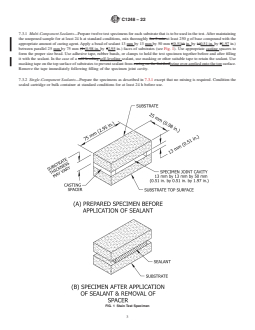
7.3.1 Multi-Component Sealants—Prepare twelve test specimens for each substrate that is to be used in the test. After maintaining
the unopened sample for at least 24 h at standard conditions, mix thoroughly for 5 min at least 250 g of base compound with the
1 1
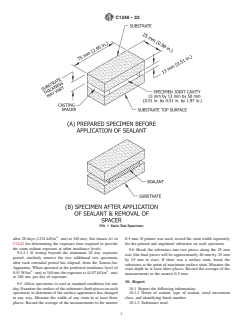
appropriate amount of curing agent. Apply a bead of sealant 13 mm by 13 mm by 50 mm ((0.51 ⁄2 in. by ⁄20.51 in. by 21.97 in.)
between parallel 25 mm by 75 mm (1 (0.98 in. by 32.95 in.) faces of substrates (see Fig. 1). Use appropriate casting spacers to
form the proper size bead. Use adhesive tape, rubber bands, or clamps to hold the test specimen together before and after filling
it with the sealant. In the case of a self leveling self-leveling sealant, use masking or other suitable tape to retain the sealant. Use
masking tape on the top surface of substrates to prevent sealant from curing on the finishedbeing over-applied onto the top surface.
Remove the tape immediately following filling of the specimen joint cavity.
7.3.2 Single-Component Sealants—Prepare the specimens as described in 7.3.1 except that no mixing is required. Condition the
sealed cartridge or bulk container at standard conditions for at least 24 h before use.
FIG. 1 Stain Test Specimen
C1248 − 22
8. Conditioning
8.1 Cure specimens for 21 days at standard conditions.
...