


ASTM D5272-08(2013)
(Practice)Standard Practice for Outdoor Exposure Testing of Photodegradable Plastics
Standard Practice for Outdoor Exposure Testing of Photodegradable Plastics
SIGNIFICANCE AND USE
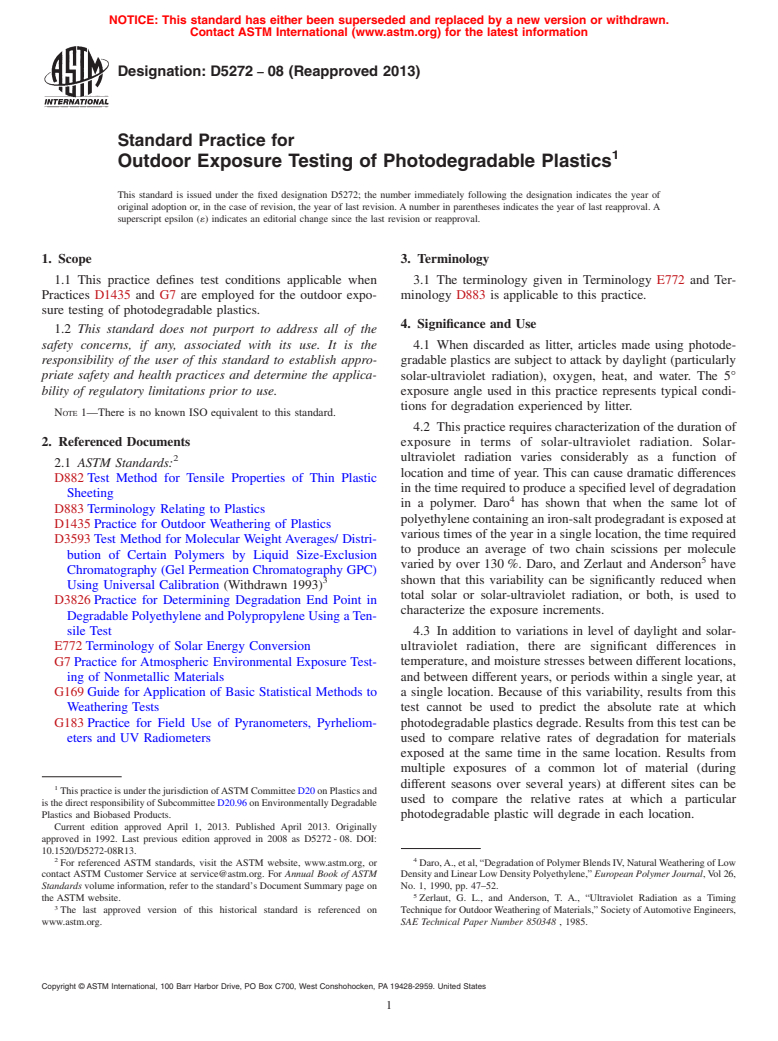
4.1 When discarded as litter, articles made using photodegradable plastics are subject to attack by daylight (particularly solar-ultraviolet radiation), oxygen, heat, and water. The 5° exposure angle used in this practice represents typical conditions for degradation experienced by litter.
4.2 This practice requires characterization of the duration of exposure in terms of solar-ultraviolet radiation. Solar-ultraviolet radiation varies considerably as a function of location and time of year. This can cause dramatic differences in the time required to produce a specified level of degradation in a polymer. Daro4 has shown that when the same lot of polyethylene containing an iron-salt prodegradant is exposed at various times of the year in a single location, the time required to produce an average of two chain scissions per molecule varied by over 130 %. Daro, and Zerlaut and Anderson5 have shown that this variability can be significantly reduced when total solar or solar-ultraviolet radiation, or both, is used to characterize the exposure increments.
4.3 In addition to variations in level of daylight and solar-ultraviolet radiation, there are significant differences in temperature, and moisture stresses between different locations, and between different years, or periods within a single year, at a single location. Because of this variability, results from this test cannot be used to predict the absolute rate at which photodegradable plastics degrade. Results from this test can be used to compare relative rates of degradation for materials exposed at the same time in the same location. Results from multiple exposures of a common lot of material (during different seasons over several years) at different sites can be used to compare the relative rates at which a particular photodegradable plastic will degrade in each location.Note 2—An inherent limitation in solar-radiation measurements is that they do not reflect the effects of variations in temperature and moistu...
SCOPE
1.1 This practice defines test conditions applicable when Practices D1435 and G7 are employed for the outdoor exposure testing of photodegradable plastics.
1.2 This standard does not purport to address all of the safety concerns, if any, associated with its use. It is the responsibility of the user of this standard to establish appropriate safety and health practices and determine the applicability of regulatory limitations prior to use. Note 1—There is no known ISO equivalent to this standard.
General Information
Standards Content (Sample)
NOTICE: This standard has either been superseded and replaced by a new version or withdrawn.
Contact ASTM International (www.astm.org) for the latest information
Designation: D5272 − 08 (Reapproved 2013)
Standard Practice for
Outdoor Exposure Testing of Photodegradable Plastics
This standard is issued under the fixed designation D5272; the number immediately following the designation indicates the year of
original adoption or, in the case of revision, the year of last revision.Anumber in parentheses indicates the year of last reapproval.A
superscript epsilon (´) indicates an editorial change since the last revision or reapproval.
1. Scope 3. Terminology
1.1 This practice defines test conditions applicable when 3.1 The terminology given in Terminology E772 and Ter-
Practices D1435 and G7 are employed for the outdoor expo- minology D883 is applicable to this practice.
sure testing of photodegradable plastics.
4. Significance and Use
1.2 This standard does not purport to address all of the
safety concerns, if any, associated with its use. It is the
4.1 When discarded as litter, articles made using photode-
responsibility of the user of this standard to establish appro- gradable plastics are subject to attack by daylight (particularly
priate safety and health practices and determine the applica-
solar-ultraviolet radiation), oxygen, heat, and water. The 5°
bility of regulatory limitations prior to use. exposure angle used in this practice represents typical condi-
tions for degradation experienced by litter.
NOTE 1—There is no known ISO equivalent to this standard.
4.2 Thispracticerequirescharacterizationofthedurationof
2. Referenced Documents exposure in terms of solar-ultraviolet radiation. Solar-
2 ultraviolet radiation varies considerably as a function of
2.1 ASTM Standards:
location and time of year. This can cause dramatic differences
D882Test Method for Tensile Properties of Thin Plastic
inthetimerequiredtoproduceaspecifiedlevelofdegradation
Sheeting
in a polymer. Daro has shown that when the same lot of
D883Terminology Relating to Plastics
polyethylenecontaininganiron-saltprodegradantisexposedat
D1435Practice for Outdoor Weathering of Plastics
various times of the year in a single location, the time required
D3593Test Method for Molecular WeightAverages/ Distri-
to produce an average of two chain scissions per molecule
bution of Certain Polymers by Liquid Size-Exclusion
varied by over 130%. Daro, and Zerlaut and Anderson have
Chromatography (Gel Permeation Chromatography GPC)
3 shown that this variability can be significantly reduced when
Using Universal Calibration (Withdrawn 1993)
total solar or solar-ultraviolet radiation, or both, is used to
D3826Practice for Determining Degradation End Point in
characterize the exposure increments.
DegradablePolyethyleneandPolypropyleneUsingaTen-
sile Test 4.3 In addition to variations in level of daylight and solar-
E772Terminology of Solar Energy Conversion ultraviolet radiation, there are significant differences in
G7Practice for Atmospheric Environmental Exposure Test- temperature, and moisture stresses between different locations,
ing of Nonmetallic Materials and between different years, or periods within a single year, at
G169Guide for Application of Basic Statistical Methods to a single location. Because of this variability, results from this
Weathering Tests test cannot be used to predict the absolute rate at which
G183Practice for Field Use of Pyranometers, Pyrheliom- photodegradableplasticsdegrade.Resultsfromthistestcanbe
eters and UV Radiometers used to compare relative rates of degradation for materials
exposed at the same time in the same location. Results from
multiple exposures of a common lot of material (during
different seasons over several years) at different sites can be
ThispracticeisunderthejurisdictionofASTMCommitteeD20onPlasticsand
used to compare the relative rates at which a particular
isthedirectresponsibilityofSubcommitteeD20.96onEnvironmentallyDegradable
Plastics and Biobased Products.
photodegradable plastic will degrade in each location.
Current edition approved April 1, 2013. Published April 2013. Originally
approved in 1992. Last previous edition approved in 2008 as D5272-08. DOI:
10.1520/D5272-08R13.
2 4
For referenced ASTM standards, visit the ASTM website, www.astm.org, or Daro,A.,etal,“DegradationofPolymerBlendsIV,NaturalWeatheringofLow
contact ASTM Customer Service at service@astm.org. For Annual Book of ASTM DensityandLinearLowDensityPolyethylene,”EuropeanPolymerJournal,Vol26,
Standards volume information, refer to the standard’s Document Summary page on No. 1, 1990, pp. 47–52.
the ASTM website. Zerlaut, G. L., and Anderson, T. A., “Ultraviolet Radiation as a Timing
The last approved version of this historical standard is referenced on TechniqueforOutdoorWeatheringofMaterials,”SocietyofAutomotiveEngineers,
www.astm.org. SAE Technical Paper Number 850348 , 1985.
Copyright © ASTM International, 100 Barr Harbor Drive, PO Box C700, West Conshohocken, PA 19428-2959. United States
D5272 − 08 (2013)
NOTE 2—An inherent limitation in solar-radiation measurements is that
60to70%open.Useanoncorrodingmaterialforthemounting
they do not reflect the effects of variations in temperature and moisture
bars. 6061T6 aluminum or untreated wood are typical materi-
exposure, which often can be as important as solar radiation. The same
als used for the mounting bars. Fig. 1 is a top view showing
solar-ultraviolet radiation increment will not necessarily give the same
typical rack construction.
changes in properties of the test specimen in different exposure sites.
Results from this practice must be regarded as giving only a general
5.2.2 Exposure Rack B—Unpainted exterior-grade plywood
indication of the degree of degradability and should always be considered
forms the rack surface to which specimens are directly at-
in terms of characteristics of the exposure site as well.
tached. Replace the plywood when there is any evidence of
4.4 Where measurement of total solar-ultraviolet radiation
delamination or fiber separation which could produce sharp
is not possible, exposure duration can be determined by the
edges and damage exposed specimens. Medium-density over-
numberofdays,weeks,ormonthsexposed.Whenthispractice
lay (MDO) or high-density overlay (HDO) plywood are
isused,areferencematerialwhosedegradationpropertieshave
satisfactory substrates and will require less frequent replace-
been well established must be exposed at the same time as the
ment than plywood with no overlay.
other materials being tested. The reference material used must
be agreed upon by all interested parties.The time to produce a
NOTE 4—There is less air circulation around the specimens when Rack
specified level of degradation for each material in this simul- Bexposuresareused.DegradationratesfromexposuresusingRackBwill
be somewhat faster than those using Rack A because specimen tempera-
taneousexposureisthencompared.Itisalsoagoodpracticeto
tures will be higher. Comparisons between materials should only be made
usereferencematerialswhenexposurelengthisdeterminedby
with exposures conducted at the same time and using the same rack type.
total solar or solar UV radiant exposure.
5.3 Solar Radiometers:
NOTE 3—Areference material can be a single lot of material which has
5.3.1 Ultraviolet Radiometer—Unless otherwise specified,
shown consistent results after a number of exposures. It is not necessary
that the composition or properties of the reference material be character-
use a total UV radiometer that measures ultraviolet radiation
ized and certified by a recognized standards agency or group.
from 295 to 385 mm. Operate the radiometer in accordance
with Practice G183. Narrow band radiometers (for example,
5. Apparatus
with 20 nm bandpass) can also be used if agreed upon by all
5.1 Use exposure racks constructed in accordance with the
interested parties. Operate narrow band radiometers in accor-
requirements of Practice G7. Unless otherwise specified, posi-
dance with Practice G183.
tion the exposure racks so that specimens face the equator and
NOTE5—TheuseofnarrowbandfilterUVradiometershavingselective
sothattheexposedsurfacesare5°fromthehorizontal.Ifother
spectral sensitivity may not be sensitive to all variations of solar-
exposure rack orientations ar
...
Questions, Comments and Discussion
Ask us and Technical Secretary will try to provide an answer. You can facilitate discussion about the standard in here.