

ASTM F3346-24
(Specification)Standard Specification for Polyethylene of Raised Temperature/Aluminum/Polyethylene of Raised Temperature (PE-RT/AL/PE-RT) Composite Pressure Pipe
General Information
- Abstract
SCOPE
1.1 This specification covers a coextruded polyethylene composite pressure pipe with a butt welded aluminum tube reinforcement between the inner and outer layers. The inner and outer polyethylene layers are bonded to the aluminum tube by a melt adhesive. Included is a system of nomenclature for the polyethylene-aluminum-polyethylene of raised temperature (PE-RT/AL/PE-RT) pipes, the requirements and test methods for materials, the dimensions and strengths of the component tubes and finished pipe, adhesion tests, and the burst and sustained pressure performance. Also given are the requirements and methods of marking. The pipe covered by this specification is intended for use in air conditioning and refrigeration (ACR), underground irrigation systems, radiant panel heating systems, baseboard, snow- and ice-melt systems, and gases that are compatible with composite pipe.
1.2 This specification relates only to composite pipes incorporating a butt welded aluminum tube having both internal and external polyethylene layers. The welded aluminum tube is capable of sustaining internal pressures. Pipes consisting of metallic layers not butt welded together and plastic layers other than polyethylene are outside the scope of this specification.
1.3 Specifications for fittings for use with pipe meeting the requirements of this specification are given in Annex A1.
1.4 This specification excludes crosslinked polyethylene-aluminum-crosslinked polyethylene pipes (see Specification F1281).
1.5 Units—The values stated in SI units are to be regarded as standard. The values given in parentheses after SI units are provided for information only and are not considered standard.
1.6 This standard does not purport to address all of the safety concerns, if any, associated with its use. It is the responsibility of the user of this standard to establish appropriate safety, health, and environmental practices and determine the applicability of regulatory limitations prior to use.
1.7 This international standard was developed in accordance with internationally recognized principles on standardization established in the Decision on Principles for the Development of International Standards, Guides and Recommendations issued by the World Trade Organization Technical Barriers to Trade (TBT) Committee.
- Status
- Published
- Publication Date
- 31-Jan-2024
- Technical Committee
- F17 - Plastic Piping Systems
- Drafting Committee
- F17.11 - Composite
Buy Documents
ASTM F3346-24 - Standard Specification for Polyethylene of Raised Temperature/Aluminum/Polyethylene of Raised Temperature (PE-RT/AL/PE-RT) Composite Pressure Pipe
REDLINE ASTM F3346-24 - Standard Specification for Polyethylene of Raised Temperature/Aluminum/Polyethylene of Raised Temperature (PE-RT/AL/PE-RT) Composite Pressure Pipe
Overview
ASTM F3346-24 is the international standard specification for Polyethylene of Raised Temperature/Aluminum/Polyethylene of Raised Temperature (PE-RT/AL/PE-RT) Composite Pressure Pipe. Issued by ASTM International, this standard establishes the requirements for a coextruded pipe featuring a butt welded aluminum tube reinforced between inner and outer PE-RT layers, joined by a melt adhesive.
The standard outlines material specifications, dimensional criteria, performance qualifications such as burst and sustained pressure, as well as test methods and marking requirements. ASTM F3346-24 is widely referenced in air conditioning and refrigeration (ACR), underground irrigation, radiant heating systems, baseboard, snow- and ice-melt installations, and for compatible gases. This standard supports product consistency, performance reliability, and safe installation across these crucial piping applications.
Key Topics
- Material Requirements: The composite pipe must use virgin or reworked polyethylene resin with established long-term hydrostatic strength (HDB) at both room and elevated temperatures, matched with a minimum strength aluminum layer.
- Pipe Construction: A critical feature is the butt welded aluminum tube sandwiched between two layers of PE-RT, providing robust pressure resistance and durability. Melt adhesive ensures the integrity of bonds between layers.
- Dimensional Standards: Pipes are classified by outside diameter, with fixed tolerances for out-of-roundness and layer thickness, ensuring compatibility and uniform installation quality.
- Performance Testing:
- Adhesion and delamination tests assess the reliability of laminate bonds for long-term use.
- Pipe rings and complete pipes undergo tensile, burst, and sustained pressure testing at specified temperatures, ensuring safe hydraulic performance.
- Additional testing validates chemical resistance to refrigerants and mechanical strength when subjected to conditions like vibration and pressure cycling.
- Marking and Identification: Pipes are mandatorily marked with key data such as size, material type, pressure ratings, ASTM designation, refrigerant compatibility, and manufacturer’s information, supporting traceability and compliance.
Applications
PE-RT/AL/PE-RT composite pressure pipes offer several practical advantages across a variety of industries and settings:
- HVAC Systems: Widely used in air conditioning and refrigeration (ACR) owing to their pressure stability, corrosion resistance, and compatibility with common refrigerants.
- Plumbing and Hydronic Systems: Suited for radiant panel heating, baseboard and snow-melt piping, offering flexibility, heat tolerance, and reliability-especially in under-slab and underground installations.
- Irrigation: Preferred for underground irrigation systems due to their strength, resistance to pipe deformation, and ease of handling compared to traditional metal pipes.
- Gas Applications: Suitable for transporting gases compatible with composite piping, with the aluminum layer serving as a gas barrier.
- Infrastructure and Commercial Use: Marking and quality requirements support safe deployment in commercial and government installations, including specific packaging and labeling needs for federal procurement.
Related Standards
ASTM F3346-24 references several related standards to ensure comprehensive performance and safety:
- ASTM D3350: Specifications for polyethylene plastics pipe and fitting materials.
- ASTM D1598/D1599: Test methods for hydraulic pressure resistance and time-to-failure analysis for plastic pipes.
- ASTM D2837: Test method for hydrostatic design basis (HDB) establishment.
- ASHRAE 15: Safety standards for refrigeration systems, ensuring safe interaction with refrigerants.
- UL 207/1963: Underwriters Laboratory standards for refrigerant-containing components and recovery equipment.
- ASTM F1281: Standard for crosslinked PEX-AL-PEX pressure pipes, which is excluded from the scope of ASTM F3346-24.
- Plastics Pipe Institute (PPI) TR-3 and TR-4: Guidelines for pressure design basis and hydrostatic strength ratings.
Organizations implementing ASTM F3346-24 benefit from harmonized safety, performance, and product identification in thermoplastic-aluminum composite piping, supporting both domestic and international best practices.
Keywords: PE-RT/AL/PE-RT pipe, composite pressure pipe, polyethylene-aluminum, ASTM F3346, hydronic piping, ACR line sets, radiant heating, underground irrigation, composite pipe standard, HVAC piping solutions
Relations
- Effective Date
- 01-Feb-2024
- Effective Date
- 01-Jan-2024
- Effective Date
- 01-May-2022
Buy Documents
ASTM F3346-24 - Standard Specification for Polyethylene of Raised Temperature/Aluminum/Polyethylene of Raised Temperature (PE-RT/AL/PE-RT) Composite Pressure Pipe
REDLINE ASTM F3346-24 - Standard Specification for Polyethylene of Raised Temperature/Aluminum/Polyethylene of Raised Temperature (PE-RT/AL/PE-RT) Composite Pressure Pipe
Get Certified
Connect with accredited certification bodies for this standard

Institut za varilstvo d.o.o. (Welding Institute)
Slovenia's leading welding institute since 1952. ISO 3834, EN 1090, pressure equipment certification, NDT personnel, welder qualification. Only IIW Au
Sponsored listings
Frequently Asked Questions
ASTM F3346-24 is a technical specification published by ASTM International. Its full title is "Standard Specification for Polyethylene of Raised Temperature/Aluminum/Polyethylene of Raised Temperature (PE-RT/AL/PE-RT) Composite Pressure Pipe". This standard covers: SCOPE 1.1 This specification covers a coextruded polyethylene composite pressure pipe with a butt welded aluminum tube reinforcement between the inner and outer layers. The inner and outer polyethylene layers are bonded to the aluminum tube by a melt adhesive. Included is a system of nomenclature for the polyethylene-aluminum-polyethylene of raised temperature (PE-RT/AL/PE-RT) pipes, the requirements and test methods for materials, the dimensions and strengths of the component tubes and finished pipe, adhesion tests, and the burst and sustained pressure performance. Also given are the requirements and methods of marking. The pipe covered by this specification is intended for use in air conditioning and refrigeration (ACR), underground irrigation systems, radiant panel heating systems, baseboard, snow- and ice-melt systems, and gases that are compatible with composite pipe. 1.2 This specification relates only to composite pipes incorporating a butt welded aluminum tube having both internal and external polyethylene layers. The welded aluminum tube is capable of sustaining internal pressures. Pipes consisting of metallic layers not butt welded together and plastic layers other than polyethylene are outside the scope of this specification. 1.3 Specifications for fittings for use with pipe meeting the requirements of this specification are given in Annex A1. 1.4 This specification excludes crosslinked polyethylene-aluminum-crosslinked polyethylene pipes (see Specification F1281). 1.5 Units—The values stated in SI units are to be regarded as standard. The values given in parentheses after SI units are provided for information only and are not considered standard. 1.6 This standard does not purport to address all of the safety concerns, if any, associated with its use. It is the responsibility of the user of this standard to establish appropriate safety, health, and environmental practices and determine the applicability of regulatory limitations prior to use. 1.7 This international standard was developed in accordance with internationally recognized principles on standardization established in the Decision on Principles for the Development of International Standards, Guides and Recommendations issued by the World Trade Organization Technical Barriers to Trade (TBT) Committee.
SCOPE 1.1 This specification covers a coextruded polyethylene composite pressure pipe with a butt welded aluminum tube reinforcement between the inner and outer layers. The inner and outer polyethylene layers are bonded to the aluminum tube by a melt adhesive. Included is a system of nomenclature for the polyethylene-aluminum-polyethylene of raised temperature (PE-RT/AL/PE-RT) pipes, the requirements and test methods for materials, the dimensions and strengths of the component tubes and finished pipe, adhesion tests, and the burst and sustained pressure performance. Also given are the requirements and methods of marking. The pipe covered by this specification is intended for use in air conditioning and refrigeration (ACR), underground irrigation systems, radiant panel heating systems, baseboard, snow- and ice-melt systems, and gases that are compatible with composite pipe. 1.2 This specification relates only to composite pipes incorporating a butt welded aluminum tube having both internal and external polyethylene layers. The welded aluminum tube is capable of sustaining internal pressures. Pipes consisting of metallic layers not butt welded together and plastic layers other than polyethylene are outside the scope of this specification. 1.3 Specifications for fittings for use with pipe meeting the requirements of this specification are given in Annex A1. 1.4 This specification excludes crosslinked polyethylene-aluminum-crosslinked polyethylene pipes (see Specification F1281). 1.5 Units—The values stated in SI units are to be regarded as standard. The values given in parentheses after SI units are provided for information only and are not considered standard. 1.6 This standard does not purport to address all of the safety concerns, if any, associated with its use. It is the responsibility of the user of this standard to establish appropriate safety, health, and environmental practices and determine the applicability of regulatory limitations prior to use. 1.7 This international standard was developed in accordance with internationally recognized principles on standardization established in the Decision on Principles for the Development of International Standards, Guides and Recommendations issued by the World Trade Organization Technical Barriers to Trade (TBT) Committee.
ASTM F3346-24 is classified under the following ICS (International Classification for Standards) categories: 23.040.20 - Plastics pipes. The ICS classification helps identify the subject area and facilitates finding related standards.
ASTM F3346-24 has the following relationships with other standards: It is inter standard links to ASTM F3346-19, ASTM E8/E8M-24, ASTM E8/E8M-22. Understanding these relationships helps ensure you are using the most current and applicable version of the standard.
ASTM F3346-24 is available in PDF format for immediate download after purchase. The document can be added to your cart and obtained through the secure checkout process. Digital delivery ensures instant access to the complete standard document.
Standards Content (Sample)
This international standard was developed in accordance with internationally recognized principles on standardization established in the Decision on Principles for the
Development of International Standards, Guides and Recommendations issued by the World Trade Organization Technical Barriers to Trade (TBT) Committee.
Designation: F3346 − 24 An American National Standard
Standard Specification for
Polyethylene of Raised Temperature/Aluminum/Polyethylene
of Raised Temperature (PE-RT/AL/PE-RT) Composite
Pressure Pipe
This standard is issued under the fixed designation F3346; the number immediately following the designation indicates the year of
original adoption or, in the case of revision, the year of last revision. A number in parentheses indicates the year of last reapproval. A
superscript epsilon (´) indicates an editorial change since the last revision or reapproval.
1. Scope* priate safety, health, and environmental practices and deter-
mine the applicability of regulatory limitations prior to use.
1.1 This specification covers a coextruded polyethylene
1.7 This international standard was developed in accor-
composite pressure pipe with a butt welded aluminum tube
dance with internationally recognized principles on standard-
reinforcement between the inner and outer layers. The inner
ization established in the Decision on Principles for the
and outer polyethylene layers are bonded to the aluminum tube
by a melt adhesive. Included is a system of nomenclature for Development of International Standards, Guides and Recom-
the polyethylene-aluminum-polyethylene of raised temperature mendations issued by the World Trade Organization Technical
(PE-RT/AL/PE-RT) pipes, the requirements and test methods Barriers to Trade (TBT) Committee.
for materials, the dimensions and strengths of the component
tubes and finished pipe, adhesion tests, and the burst and
2. Referenced Documents
sustained pressure performance. Also given are the require-
2.1 ASTM Standards:
ments and methods of marking. The pipe covered by this
D618 Practice for Conditioning Plastics for Testing
specification is intended for use in air conditioning and
D1598 Test Method for Time-to-Failure of Plastic Pipe
refrigeration (ACR), underground irrigation systems, radiant
Under Constant Internal Pressure
panel heating systems, baseboard, snow- and ice-melt systems,
D1599 Test Method for Resistance to Short-Time Hydraulic
and gases that are compatible with composite pipe.
Pressure of Plastic Pipe, Tubing, and Fittings
1.2 This specification relates only to composite pipes incor-
D1600 Terminology for Abbreviated Terms Relating to Plas-
porating a butt welded aluminum tube having both internal and 3
tics (Withdrawn 2024)
external polyethylene layers. The welded aluminum tube is
D2122 Test Method for Determining Dimensions of Ther-
capable of sustaining internal pressures. Pipes consisting of
moplastic Pipe and Fittings
metallic layers not butt welded together and plastic layers other
D2837 Test Method for Obtaining Hydrostatic Design Basis
than polyethylene are outside the scope of this specification.
for Thermoplastic Pipe Materials or Pressure Design Basis
1.3 Specifications for fittings for use with pipe meeting the
for Thermoplastic Pipe Products
requirements of this specification are given in Annex A1.
D3350 Specification for Polyethylene Plastics Pipe and Fit-
tings Materials
1.4 This specification excludes crosslinked polyethylene-
D3895 Test Method for Oxidative-Induction Time of Poly-
aluminum-crosslinked polyethylene pipes (see Specification
olefins by Differential Scanning Calorimetry
F1281).
E8/E8M Test Methods for Tension Testing of Metallic Ma-
1.5 Units—The values stated in SI units are to be regarded
terials
as standard. The values given in parentheses after SI units are
F412 Terminology Relating to Plastic Piping Systems
provided for information only and are not considered standard.
F1281 Specification for Crosslinked Polyethylene/
1.6 This standard does not purport to address all of the
Aluminum/Crosslinked Polyethylene (PEX-AL-PEX)
safety concerns, if any, associated with its use. It is the
Pressure Pipe
responsibility of the user of this standard to establish appro-
1 2
This specification is under the jurisdiction of ASTM Committee F17 on Plastic For referenced ASTM standards, visit the ASTM website, www.astm.org, or
Piping Systems and is the direct responsibility of Subcommittee F17.11 on contact ASTM Customer Service at service@astm.org. For Annual Book of ASTM
Composite. Standards volume information, refer to the standard’s Document Summary page on
Current edition approved Feb. 1, 2024. Published February 2024. Originally the ASTM website.
approved in 2019. Last previous edition approved in 2019 as F3346–19. DOI: The last approved version of this historical standard is referenced on
10.1520/F3346–24 www.astm.org.
*A Summary of Changes section appears at the end of this standard
Copyright © ASTM International, 100 Barr Harbor Drive, PO Box C700, West Conshohocken, PA 19428-2959. United States
F3346 − 24
2.2 ASHRAE Standard: 4. Pipe Classification
ASHRAE Standard 15 Safety Standard for Refrigeration
4.1 Pipe Diameter—The PE-RT/AL/PE-RT composite pipes
Systems
are classified by outside diameter.
2.3 Uniform Classification Committee:
NOTE 1—Pipe Dimension Ratio—The concept of dimension ratio is not
Uniform Freight Classification
relevant to PE-RT/AL/PE-RT laminated pipes, and cannot be used to
2.4 National Motor Freight Association Standard:
relate pressure rating with total wall thickness.
National Motor Freight Classification
6 5. Materials
2.5 Federal Standard:
Fed. Std. No. 123 Marking for Shipments (Civil Agencies)
5.1 General—The PE-RT/AL/PE-RT pipe is composed of
one metallic layer, two layers of the same polyethylene melt
2.6 Underwriters Laboratory Standards:
adhesive and two layers of the same polyethylene. For pipe
UL 207 Refrigerant-Containing Components and Accesso-
made to this specification the constituent materials must meet
ries
the following requirements:
UL 1963 Refrigerant Recovery/Recycling Equipment
2.7 Military Standard:
5.2 Aluminum—The aluminum shall have a thickness as
MIL-STD-129 Marking for Shipment and Storage
specified in Table 1. The material shall have minimum elon-
2.8 PPI Standard: gations and ultimate tensile strengths of 20 % and 100 MPa
PPI TR-3 Policies and Procedures for Developing Hydro- (14 600 psi), respectively when tested in accordance with 9.5.
static Design Basis (HDB), Hydrostatic Design Stresses
5.3 Polyethylene:
(HDS), Pressure Design Basis (PDB), Strength Design
5.3.1 Polyethylene resin used to make pipe meeting the
Basis (SDB), Minimum Required Strength (MRS)
requirements of this specification shall be virgin resin, re-
Ratings, and Categorized Required Strength (CRS) for
worked plastic, or both, and shall have a Plastic Pipe Institute
Thermoplastic Piping Materials or Pipe
(PPI) HDB established at 23 °C (73 °F) and 82 °C (180 °F).
PPI TR-4 PPI Listing of Hydrostatic Design Basis (HDB),
5.3.1.1 Only polyethylene plastics having an HDB at 82 °C
Hydrostatic Design Stress (HDS), Strength Design Basis
(180 °F) shall be used to manufacture pipe rated at 82 °C
(SDB), Pressure Design Basis (PDB) and Minimum Re-
(180 °F).
quired Strength (MRS) Ratings For Thermoplastic Piping
5.3.1.2 The inner PE compound shall meet the color and UV
Materials or Pipe
stabilizer code of A, B, C, D or E in accordance with
Specification D3350. The outer layer PE compound shall meet
3. Terminology
the color and UV stabilizer code of E in accordance with
3.1 Definitions—Definitions are in accordance with Termi-
Specification D3350.
nology F412, and abbreviations are in accordance with Termi-
5.4 Polyethylene Melt Adhesive—The polyethylene melt
nology D1600, unless otherwise specified.
adhesive shall have a density cell of 1, 2, or 3; a melt index cell
3.2 Definitions of Terms Specific to This Standard:
of 1, 2, or 3; and a color code of A or B, in accordance with
3.2.1 assembly, n—a system made up of pipe, fittings,
Specification D3350.
flanges, valves, or other piping components.
6. Requirements
6.1 General—The requirements and test methods in this
specification cover PE-RT/AL/PE-RT pipes. Tests on the indi-
Available from American Society of Heating, Refrigerating, and Air-
vidual layers that comprise this composite pipe are outside the
Conditioning Engineers, Inc. (ASHRAE), 1791 Tullie Circle, NE, Atlanta, GA
30329, http://www.ashrae.org.
scope of this specification. The raw materials used, however,
Available from National Motor Freight Traffic Association, Inc. (NMFTA),
must conform to the requirements in Section 5.
1001 N. Fairfax St., Suite 600, Alexandria, VA 22314-1798, http://www.nmfta.org.
Available from DLA Document Services, Building 4/D, 700 Robbins Ave.,
6.2 Dimensions and Tolerances of Pipe:
Philadelphia, PA 19111-5094, http://quicksearch.dla.mil.
6.2.1 Pipe Diameter—The minimum outside diameter and
Available from Underwriters Laboratories (UL), 2600 N.W. Lake Rd., Camas,
tolerances of the pipe shall meet the requirements given in
WA 98607-8542, http://www.ul.com.
Available from Plastics Pipe Institute (PPI), 105 Decker Court, Suite 825, Table 1, when measured in accordance with 9.1 and 9.1.2.
Irving, TX 75062, http://www.plasticpipe.org.
TABLE 1 Outside Diameters, Aluminum Thickness, and Tolerances for PE-RT/AL/PE-RT
Diameter Nominal (DN) Minimum Outside Tolerance on Minimum, Maximum Out-of Minimum Aluminum Tolerance on Thickness,
A
Diameter, mm (in.) mm (in.) Roundness, mm (in.) Thickness, mm (in.) mm (in.)
12 12.00 (0.472) +0.30 (0.012) 0.4 (0.016) 0.16 (0.006) +0.09 (+0.0035)
14 14.00 (0.552) +0.30 (0.012) 0.4 (0.016) 0.16 (0.006) +0.09 (+0.0035)
16 16.00 (0.630) +0.30 (0.012) 0.5 (0.020) 0.23 (0.009) +0.09 (+0.0035)
18 18.00 (0.709) +0.30 (0.012) 0.5 (0.020) 0.23 (0.009) +0.09 (+0.0035)
20 20.00 (0.787) +0.30 (0.012) 0.5 (0.020) 0.28 (0.011) +0.09 (+0.0035)
25 25.00 (0.984) +0.30 (0.012) 0.5 (0.020) 0.36 (0.014) +0.09 (+0.0035)
32 32.00 (1.260) +0.30 (0.012) 0.5 (0.020) 0.46 (0.018) +0.09 (+0.0035)
A
The out-of-roundness specification applies only to pipe prior to coiling.
F3346 − 24
Maximum and minimum (out-of-roundness) tolerances apply 7. Workmanship
only to measurements made on pipe prior to coiling.
7.1 The pipe shall be free of visible cracks, holes, foreign
6.2.2 Pipe Wall Thickness—The total pipe wall thickness
inclusions, blisters, and other known injurious defects. The
shall meet the requirements given in Table 2, when measured
pipe shall be as uniform as commercially practicable in color,
in accordance with 9.1 and 9.1.3. The minimum wall thickness
opacity, and regularity of the distribution of the polyethylene
at any point of measurement of the pipe shall not be less than
inside and outside.
the minimum wall thickness specified in Table 2.
6.2.3 Polyethylene Layer Thickness—The thickness of the
8. Sampling and Conditioning
inner and outer layers of PE-RT in the PE-RT/AL/PE-RT pipe
8.1 Sampling—Take a sample of the PE-RT/AL/PE-RT pipe
shall have a minimum value and tolerance as specified in Table
sufficient to determine conformance with this specification.
2. The PE-RT thickness is measured in accordance with 9.2.
The number of specimens designated for each test shall be
6.2.4 Pipe Length—The pipe shall be supplied coiled or in
taken from pipe selected at random.
straight lengths as agreed upon with the purchaser with an
NOTE 2—Sample size and testing frequency of lots for quality control
allowable tolerance of –0 mm.
must be established by the manufacturer to ensure conformance to the
6.3 Adhesion Test:
specification. Sampling and frequency will vary with the specific circum-
stances.
6.3.1 There shall be no delamination of the PE-RT and AL,
either on the bore side or the outside (see Fig. 1). The test shall
8.2 Test Specimens—Not less than 50 % of the test speci-
be conducted in accordance with 9.3.1.
mens required for any pressure test shall have at least part of
the marking in their central sections. The central section is that
6.4 Apparent Tensile Strength of Pipe—The pipe rings,
portion of the pipe that is at least one pipe diameter away from
when tested in accordance with 9.4, shall meet the minimum
an end closure.
strength as specified in Table 3.
8.3 Conditioning—Condition the specimens at 23 °C 6
6.5 Minimum Burst Pressure—The minimum burst pressure
2 °C (73 °F 6 3 °F) and 50 % 6 10 % relative humidity for not
for PE-RT/AL/PE-RT pipe shall be as given in Table 3, when
less than 40 h prior to test in accordance with Procedure A of
determined in accordance with 9.6.
Practice D618, for those tests where conditioning is required.
6.6 Sustained Pressure:
In cases of disagreement, the tolerances shall be 61 °C
6.6.1 The PE-RT/AL/PE-RT pipe rated at 60 °C (140 °F)
(62 °F) and 62 % relative humidity.
shall not fail, balloon, burst, or weep, as defined in Test Method
8.4 Test Conditions—Conduct the test in the standard labo-
D1598, when tested for 10 h at the test pressure given in Table
ratory atmosphere of 23 °C 6 2 °C (73 °F 6 3 °F) and 50 % 6
4 at a temperature of 60 °C (140 °F) in accordance with 9.7.
10 % relative humidity, unless otherwise specified in the test
6.6.2 PE-RT/AL/PE-RT pipe rated at 82 °C ( 180 °F) shall
methods or in this specification. In cases of disagreement, the
not fail, balloon, burst, or weep as defined in Test Method
tolerances shall be 61 °C (2 °F) and 62 % relative humidity.
D1598 when tested in accordance with 9.7 for 10 h at the test
pressure given in Table 4 at a temperature of 82 °C (180 °F).
9. Test Methods
6.7 Pressure design basis (PDB)—All pipe meeting the
9.1 Dimensions and Tolerances:
requirements of this specification shall have a PDB of 400 psi
9.1.1 Pipe—Any length of the PE-RT/AL/PE-RT composite
at 23 °C (73 °F) and 200 psi at 82 °C (180 °F) obtained by
pipe may be used to determine dimensions.
categorizing the long-term hydrostatic pressure strength deter-
9.1.2 Outside Diameter—Measure the outside diameter of
mined in accordance with Test Method D2837 and PPI TR-3.
the PE-RT/AL/PE-RT pipe in accordance with Test Method
PDB is specific to the particular wall construction and pipe
D2122.
diameter.
9.1.3 Wall Thickness—Make micrometer measurements of
6.8 Refrigerant Exposure—All pipe designed to be used the wall thickness in accordance with Test Method D2122 to
with refrigerant shall be tested in accordance with 9.8 for determine the maximum and minimum values. Measure the
compatibility with each refrigerant as specified by the manu- wall thickness at both ends of the pipe to the nearest 0.01 mm
facturer (0.0004 in.).
TABLE 2 Wall Thickness for PE-RT/AL/PE-RT Composite Pipe
Diameter Nominal (DN) Total Wall Thickness, min, Wall Tolerance (+) mm Outer PE-RT Layer Inner PE-RT Layer Thickness,
mm (in.) Thickness, min, mm (in.) min, mm (in.)
12 2.45 (0.965) 0.40 (0.016) 0.40 (0.016) 1.00 (0.039)
14 2.50 (0.984) 0.40 (0.016) 0.40 (0.016) 1.20 (0.047)
16 2.45 (0.965) 0.40 (0.016) 0.40 (0.016) 1.20 (0.047)
18 2.75 (0.108) 0.40 (0.016) 0.40 (0.016) 1.30 (0.051)
20 2.70 (0.106) 0.40 (0.016) 0.40 (0.016) 1.40 (0.055)
25 3.25 (0.128) 0.40 (0.016) 0.40 (0.016) 1.40 (0.055)
32 3.75 (0.148) 0.40 (0.016) 0.40 (0.016) 1.40 (0.055)
F3346 − 24
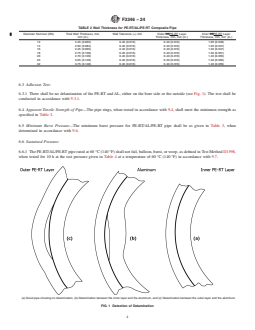
(a) Good pipe showing no delamination, (b) Delamination between the inner layer and the aluminum, and (c) Delamination between the outer layer and the aluminum.
FIG. 1 Detection of Delamination
TABLE 3 Minimum Pipe Ring Strengths and 23 °C (73 °F) Burst Pressure of PE-RT/AL/PE-RT Composite Pipe
Diameter Nominal (DN) Minimum Pipe Ring Strength N (lb) Minimum 23 °C (73.4 °F)
Burst Pressure, kPa (psi)
12 2100 (470) 6000 (880)
14 2200 (495) 5500 (800)
16 2400 (540) 5000 (730)
18 2400 (540) 5000 (730)
20 2400 (540) 4000 (580)
25 2650 (595) 4000 (580)
32 3200 (720) 4000 (580)
TABLE 4 Minimum Sustained Pressure for PE-RT/AL/PE-RT
9.2.2 Thickness Determination—Use a hand held magnify-
Composite Pipe
ing glass equipped with graduated reticule, or a laboratory
Diameter Nominal Minimum Sustained Minimum Sustained
microscope with graduated reticule. The reticule should mea-
(DN) Pressure Pressure
sure to the nearest 0.1 mm (0.004 in.). Determine the thickness
PE-RT/AL/PE-RT, kPa PE-RT/AL/PE-RT, kPa
of the outer coating of polyethylene at six points around the
(psi) (psi)
at 60 °C (140 °F) at 82 °C (180 °F)
circumference. Only one of the points should be at the
12 2480 (360) 2340 (340)
aluminum weld.
14 2480 (360) 2340 (340)
16 2480 (360) 2340 (340)
9.3 Adhesion Test:
18 2480 (360) 2340 (340)
9.3.1 Visual Test:
20 2480 (360) 2340 (340)
25 2480 (360) 2340 (340)
9.3.1.1 Cutting the Spiral—Mount a Stanley 1991 or simi-
32 2100 (305) 1960 (285)
larly sharp but rigid razor-like blade within a protective
housing and angle to cut a 45 6 5° spiral in the pipe (Fig. 2).
9.2 Polyethylene Layer Thickness: Choose a PE-RT/AL/PE-RT pipe at random and insert into the
9.2.1 Sample Preparation—Select the sample of pipe at housing and rotate to form the spiral cut. The cut goes through
random. Cut the pipe with a sharp knife or other suitable cutter, the complete wall on one side of the pipe only. Run the spiral
ensuring that the pipe after cutting is not more than 10 % along the pipe for a minimum distance along the pipe axis
out-of-round. equal to five times the outside diameter.
F3346 − 24
FIG. 2 Spiral Cutter for the Delamination Test
9.3.1.2 Examining for Delamination—Firmly hold the pipe 9.3.2.3 Test Procedure—Remove the outer layers from the
with the spiral cut at the uncut end and create a ribbon of pipe pipe at 23 °C 6 2 °C (73 °F 6 3 °F) with a linear speed of 50
material by opening out the spiral-cut pipe. Pliers can be used mm/min (≈2 in./min). Record the force diagram.
to grip the spiral-cut pipe. Examine the wall of the pipe
9.4 Ring Test:
visually side-on for evidence of delamination between the
9.4.1 Sample Size and Shape—Cut rings of the PE-RT/AL/
metal and plastic layers (see Fig. 1).
PE-RT pipe so that the two sides are parallel and at 90 6 2° to
9.3.2 Separation Test:
the pipe axis. The length of each ring shall be 25 mm 6 1 mm
9.3.2.1 Specimen—Five pipe sections of 10 mm (0.394 in.)
(1 in. 6 0.04 in.). Cut a minimum of 15 samples co
...
This document is not an ASTM standard and is intended only to provide the user of an ASTM standard an indication of what changes have been made to the previous version. Because
it may not be technically possible to adequately depict all changes accurately, ASTM recommends that users consult prior editions as appropriate. In all cases only the current version
of the standard as published by ASTM is to be considered the official document.
Designation: F3346 − 19 F3346 − 24 An American National Standard
Standard Specification for
Polyethylene of Raised Temperature/Aluminum/Polyethylene
of Raised Temperature (PERT/AL/PE-RT)(PE-RT/AL/PE-RT)
Composite Pressure Pipe
This standard is issued under the fixed designation F3346; the number immediately following the designation indicates the year of
original adoption or, in the case of revision, the year of last revision. A number in parentheses indicates the year of last reapproval. A
superscript epsilon (´) indicates an editorial change since the last revision or reapproval.
1. Scope Scope*
1.1 This specification covers a coextruded polyethylene composite pressure pipe with a butt welded aluminum tube reinforcement
between the inner and outer layers. The inner and outer polyethylene layers are bonded to the aluminum tube by a melt adhesive.
Included is a system of nomenclature for the polyethylene-aluminum-polyethylene of raised temperature (PERT/AL/PE-RT)(PE-
RT/AL/PE-RT) pipes, the requirements and test methods for materials, the dimensions and strengths of the component tubes and
finished pipe, adhesion tests, and the burst and sustained pressure performance. Also given are the requirements and methods of
marking. The pipe covered by this specification is intended for use in air conditioning and refrigeration (ACR), underground
irrigation systems, radiant panel heating systems, baseboard, snow- and ice-melt systems, and gases that are compatible with
composite pipe.
1.2 This specification relates only to composite pipes incorporating a butt welded aluminum tube having both internal and external
polyethylene layers. The welded aluminum tube is capable of sustaining internal pressures. Pipes consisting of metallic layers not
butt welded together and plastic layers other than polyethylene are outside the scope of this specification.
1.3 Specifications for fittings for use with pipe meeting the requirements of this specification are given in Annex A1.
1.4 This specification excludes crosslinked polyethylene-aluminum-crosslinked polyethylene pipes (see Specification F1281).
1.5 Units—The values stated in SI units are to be regarded as standard. The values given in parentheses after SI units are provided
for information only and are not considered standard.
1.6 This standard does not purport to address all of the safety concerns, if any, associated with its use. It is the responsibility
of the user of this standard to establish appropriate safety, health, and environmental practices and determine the applicability of
regulatory limitations prior to use.
1.7 This international standard was developed in accordance with internationally recognized principles on standardization
established in the Decision on Principles for the Development of International Standards, Guides and Recommendations issued
by the World Trade Organization Technical Barriers to Trade (TBT) Committee.
This specification is under the jurisdiction of ASTM Committee F17 on Plastic Piping Systems and is the direct responsibility of Subcommittee F17.11 on Composite.
Current edition approved June 1, 2019Feb. 1, 2024. Published June 2019February 2024. Originally approved in 2019. Last previous edition approved in 2019 as F3346–19.
DOI: 10.1520/F3346–1910.1520/F3346–24
*A Summary of Changes section appears at the end of this standard
Copyright © ASTM International, 100 Barr Harbor Drive, PO Box C700, West Conshohocken, PA 19428-2959. United States
F3346 − 24
2. Referenced Documents
2.1 ASTM Standards:
D618 Practice for Conditioning Plastics for Testing
D1598 Test Method for Time-to-Failure of Plastic Pipe Under Constant Internal Pressure
D1599 Test Method for Resistance to Short-Time Hydraulic Pressure of Plastic Pipe, Tubing, and Fittings
D1600 Terminology for Abbreviated Terms Relating to Plastics (Withdrawn 2024)
D2122 Test Method for Determining Dimensions of Thermoplastic Pipe and Fittings
D2837 Test Method for Obtaining Hydrostatic Design Basis for Thermoplastic Pipe Materials or Pressure Design Basis for
Thermoplastic Pipe Products
D3350 Specification for Polyethylene Plastics Pipe and Fittings Materials
D3895 Test Method for Oxidative-Induction Time of Polyolefins by Differential Scanning Calorimetry
E8/E8M Test Methods for Tension Testing of Metallic Materials
F412 Terminology Relating to Plastic Piping Systems
F1281 Specification for Crosslinked Polyethylene/Aluminum/Crosslinked Polyethylene (PEX-AL-PEX) Pressure Pipe
2.2 ASHRAE Standard:
ASHRAE Standard 15 Safety Standard for Refrigeration Systems
2.3 Uniform Classification Committee:
Uniform Freight Classification
2.4 National Motor Freight Association Standard:
National Motor Freight Classification
2.5 Federal Standard:
Fed. Std. No. 123 Marking for Shipments (Civil Agencies)
2.6 Underwriters Laboratory Standards:
UL 207 Refrigerant-Containing Components and Accessories
UL 1963 Refrigerant Recovery/Recycling Equipment
2.7 Military Standard:
MIL-STD-129 Marking for Shipment and Storage
2.8 PPI Standard:
PPI TR-3 Policies and Procedures for Developing Hydrostatic Design Basis (HDB), Hydrostatic Design Stresses (HDS),
Pressure Design Basis (PDB), Strength Design Basis (SDB), Minimum Required Strength (MRS) Ratings, and Categorized
Required Strength (CRS) for Thermoplastic Piping Materials or Pipe
PPI TR-4 PPI Listing of Hydrostatic Design Basis (HDB), Hydrostatic Design Stress (HDS), Strength Design Basis (SDB),
Pressure Design Basis (PDB) and Minimum Required Strength (MRS) Ratings For Thermoplastic Piping Materials or Pipe
3. Terminology
3.1 Definitions—Definitions are in accordance with Terminology F412, and abbreviations are in accordance with Terminology
D1600, unless otherwise specified.
3.2 Definitions of Terms Specific to This Standard:
3.2.1 assembly, n—a system made up of pipe, fittings, flanges, valves, or other piping components.
4. Pipe Classification
4.1 Pipe Diameter—The PE-RT/AL/PE-RT composite pipes are classified by outside diameter.
NOTE 1—Pipe Dimension Ratio—The concept of dimension ratio is not relevant to PE-RT/AL/PE-RT laminated pipes, and cannot be used to relate
pressure rating with total wall thickness.
For referenced ASTM standards, visit the ASTM website, www.astm.org, or contact ASTM Customer Service at service@astm.org. For Annual Book of ASTM Standards
volume information, refer to the standard’s Document Summary page on the ASTM website.
The last approved version of this historical standard is referenced on www.astm.org.
Available from American Society of Heating, Refrigerating, and Air-Conditioning Engineers, Inc. (ASHRAE), 1791 Tullie Circle, NE, Atlanta, GA 30329,
http://www.ashrae.org.
Available from National Motor Freight Traffic Association, Inc. (NMFTA), 1001 N. Fairfax St., Suite 600, Alexandria, VA 22314-1798, http://www.nmfta.org.
Available from DLA Document Services, Building 4/D, 700 Robbins Ave., Philadelphia, PA 19111-5094, http://quicksearch.dla.mil.
Available from Underwriters Laboratories (UL), 2600 N.W. Lake Rd., Camas, WA 98607-8542, http://www.ul.com.
Available from Plastics Pipe Institute (PPI), 105 Decker Court, Suite 825, Irving, TX 75062, http://www.plasticpipe.org.
F3346 − 24
5. Materials
5.1 General—The PE-RT/AL/PE-RT pipe is composed of one metallic layer, two layers of the same polyethylene melt adhesive
and two layers of the same polyethylene. For pipe made to this specification the constituent materials must meet the following
requirements:
5.2 Aluminum—The aluminum shall have a thickness as specified in Table 1. The material shall have minimum elongations and
ultimate tensile strengths of 20 % and 100 MPa (14 600 psi), respectively when tested in accordance with 9.5.
5.3 Polyethylene:
5.3.1 Polyethylene resin used to make pipe meeting the requirements of this specification shall be virgin resin, reworked plastic,
or both, and shall have a Plastic Pipe Institute (PPI) HDB established at 23 °C (73 °F) and 82 °C (180 °F).
5.3.1.1 Only polyethylene plastics having an HDB at 82 °C (180 °F) shall be used to manufacture pipe rated at 82 °C (180 °F).
5.3.1.2 The inner PE compound shall meet the color and UV stabilizer code of A, B, C, D or E in accordance with Specification
D3350. The outer layer PE compound shall meet the color and UV stabilizer code of E in accordance with Specification D3350.
5.4 Polyethylene Melt Adhesive—The polyethylene melt adhesive shall have a density cell of 1, 2, or 3; a melt index cell of 1, 2,
or 3; and a color code of A or B, in accordance with Specification D3350.
6. Requirements
6.1 General—The requirements and test methods in this specification cover PE-RT/AL/PE-RT pipes. Tests on the individual layers
that comprise this composite pipe are outside the scope of this specification. The raw materials used, however, must conform to
the requirements in Section 5.
6.2 Dimensions and Tolerances of Pipe:
6.2.1 Pipe Diameter—The minimum outside diameter and tolerances of the pipe shall meet the requirements given in Table 1,
when measured in accordance with 9.1 and 9.1.2. Maximum and minimum (out-of-roundness) tolerances apply only to
measurements made on pipe prior to coiling.
6.2.2 Pipe Wall Thickness—The total pipe wall thickness shall meet the requirements given in Table 2, when measured in
accordance with 9.1 and 9.1.3. The minimum wall thickness at any point of measurement of the pipe shall not be less than the
minimum wall thickness specified in Table 2.
6.2.3 Polyethylene Layer Thickness—The thickness of the inner and outer layers of polyethylenePE-RT in the PE-RT/AL/PE-RT
pipe shall have a minimum value and tolerance as specified in Table 2. The polyethylenePE-RT thickness is measured in
accordance with 9.2.
6.2.4 Pipe Length—The pipe shall be supplied coiled or in straight lengths as agreed upon with the purchaser with an allowable
tolerance of –0 mm.
TABLE 1 Outside Diameters, Aluminum Thickness, and Tolerances for PE-RT/AL/PE-RT
Diameter Nominal (DN) Minimum Outside Tolerance on Minimum, Maximum Out-of Minimum Aluminum Tolerance on Thickness,
A
Diameter, mm (in.) mm (in.) Roundness, mm (in.) Thickness, mm (in.) mm (in.)
12 12.00 (0.472) +0.30 (0.012) 0.4 (0.016) 0.16 (0.006) +0.09 (+0.0035)
14 14.00 (0.552) +0.30 (0.012) 0.4 (0.016) 0.16 (0.006) +0.09 (+0.0035)
16 16.00 (0.630) +0.30 (0.012) 0.5 (0.020) 0.23 (0.009) +0.09 (+0.0035)
18 18.00 (0.709) +0.30 (0.012) 0.5 (0.020) 0.23 (0.009) +0.09 (+0.0035)
20 20.00 (0.787) +0.30 (0.012) 0.5 (0.020) 0.28 (0.011) +0.09 (+0.0035)
25 25.00 (0.984) +0.30 (0.012) 0.5 (0.020) 0.36 (0.014) +0.09 (+0.0035)
32 32.00 (1.260) +0.30 (0.012) 0.5 (0.020) 0.46 (0.018) +0.09 (+0.0035)
A
The out-of-roundness specification applies only to pipe prior to coiling.
F3346 − 24
TABLE 2 Wall Thickness for PE-RT/AL/PE-RT Composite Pipe
Diameter Nominal (DN) Total Wall Thickness, min, Wall Tolerance (+) mm Outer PEPE-RT Layer Inner PEPE-RT Layer
mm (in.) Thickness, min, mm (in.) Thickness, min, mm (in.)
12 2.45 (0.965) 0.40 (0.016) 0.40 (0.016) 1.00 (0.039)
14 2.50 (0.984) 0.40 (0.016) 0.40 (0.016) 1.20 (0.047)
16 2.45 (0.965) 0.40 (0.016) 0.40 (0.016) 1.20 (0.047)
18 2.75 (0.108) 0.40 (0.016) 0.40 (0.016) 1.30 (0.051)
20 2.70 (0.106) 0.40 (0.016) 0.40 (0.016) 1.40 (0.055)
25 3.25 (0.128) 0.40 (0.016) 0.40 (0.016) 1.40 (0.055)
32 3.75 (0.148) 0.40 (0.016) 0.40 (0.016) 1.40 (0.055)
6.3 Adhesion Test:
6.3.1 There shall be no delamination of the PE-RT and AL, either on the bore side or the outside (see Fig. 1). The test shall be
conducted in accordance with 9.3.1.
6.4 Apparent Tensile Strength of Pipe—The pipe rings, when tested in accordance with 9.4, shall meet the minimum strength as
specified in Table 3.
6.5 Minimum Burst Pressure—The minimum burst pressure for PE-RT/AL/PE-RT pipe shall be as given in Table 3, when
determined in accordance with 9.6.
6.6 Sustained Pressure:
6.6.1 The PE-RT/AL/PE-RT pipe rated at 60 °C (140 °F) shall not fail, balloon, burst, or weep, as defined in Test Method D1598,
when tested for 10 h at the test pressure given in Table 4 at a temperature of 60 °C (140 °F) in accordance with 9.7.
(a) Good pipe showing no delamination, (b) Delamination between the inner layer and the aluminum, and (c) Delamination between the outer layer and the aluminum.
FIG. 1 Detection of Delamination
F3346 − 24
TABLE 3 Minimum Pipe Ring Strengths and 23 °C (73 °F) Burst Pressure of PE-RT/AL/PE-RT Composite Pipe
Diameter Nominal (DN) Minimum Pipe Ring Strength N (lb) Minimum 23 °C (73.4 °F)
Burst Pressure, kPa (psi)
12 2100 (470) 6000 (880)
14 2200 (495) 5500 (800)
16 2400 (540) 5000 (730)
18 2400 (540) 5000 (730)
20 2400 (540) 4000 (580)
25 2650 (595) 4000 (580)
32 3200 (720) 4000 (580)
TABLE 4 Minimum Sustained Pressure for PE-RT/AL/PE-RT
Composite Pipe
Diameter Nominal Minimum Sustained Minimum Sustained
(DN) Pressure Pressure
PE-RT/AL/PE-RT, kPa PE-RT/AL/PE-RT, kPa
(psi) (psi)
at 60 °C (140 °F) at 82 °C (180 °F)
12 2480 (360) 2340 (340)
14 2480 (360) 2340 (340)
16 2480 (360) 2340 (340)
18 2480 (360) 2340 (340)
20 2480 (360) 2340 (340)
25 2480 (360) 2340 (340)
32 2100 (305) 1960 (285)
6.6.2 PE-RT/AL/PE-RT pipe rated at 82 °C ( 180 °F) shall not fail, balloon, burst, or weep as defined in Test Method D1598 when
tested in accordance with 9.7 for 10 h at the test pressure given in Table 4 at a temperature of 82 °C (180 °F).
6.7 Pressure design basis (PDB)—All pipe meeting the requirements of this specification shall have a PDB of 400 psi at 23 °C
(73 °F) and 200 psi at 82 °C (180 °F) obtained by categorizing the long-term hydrostatic pressure strength determined in
accordance with Test Method D2837 and PPI TR-3. PDB is specific to the particular wall construction and pipe diameter.
6.8 Refrigerant Exposure—All pipe designed to be used with refrigerant shall be tested in accordance with 9.8 for compatibility
with each refrigerant as specified by the manufacturer
7. Workmanship
7.1 The pipe shall be free of visible cracks, holes, foreign inclusions, blisters, and other known injurious defects. The pipe shall
be as uniform as commercially practicable in color, opacity, and regularity of the distribution of the polyethylene inside and
outside.
8. Sampling and Conditioning
8.1 Sampling—Take a sample of the PE-RT/AL/PE-RT pipe sufficient to determine conformance with this specification. The
number of specimens designated for each test shall be taken from pipe selected at random.
NOTE 2—Sample size and testing frequency of lots for quality control must be established by the manufacturer to ensure conformance to the specification.
Sampling and frequency will vary with the specific circumstances.
8.2 Test Specimens—Not less than 50 % of the test specimens required for any pressure test shall have at least part of the marking
in their central sections. The central section is that portion of the pipe that is at least one pipe diameter away from an end closure.
8.3 Conditioning—Condition the specimens at 2323 °C 6 2 °C (73(73 °F 6 3 °F) and 5050 % 6 10 % relative humidity for not
less than 40 h prior to test in accordance with Procedure A of Practice D618, for those tests where conditioning is required. In cases
of disagreement, the tolerances shall be 61 °C (61.8 °F)(62 °F) and 62 % relative humidity.
8.4 Test Conditions—Conduct the test in the standard laboratory atmosphere of 2323 °C 6 2 °C (73(73 °F 6 3 °F) and 5050 %
F3346 − 24
6 10 % relative humidity, unless otherwise specified in the test methods or in this specification. In cases of disagreement, the
tolerances shall be 61 °C (2 °F) and 62 % relative humidity.
9. Test Methods
9.1 Dimensions and Tolerances:
9.1.1 Pipe—Any length of the PE-RT/AL/PE-RT composite pipe may be used to determine dimensions.
9.1.2 Outside Diameter—Measure the outside diameter of the PE-RT/AL/PE-RT pipe in accordance with Test Method D2122.
9.1.3 Wall Thickness—Make micrometer measurements of the wall thickness in accordance with Test Method D2122 to determine
the maximum and minimum values. Measure the wall thickness at both ends of the pipe to the nearest 0.01 mm (0.0004 in.).
9.2 Polyethylene Layer Thickness:
9.2.1 Sample Preparation—Select the sample of pipe at random. Cut the pipe with a sharp knife or other suitable cutter, ensuring
that the pipe after cutting is not more than 10 % out-of-round.
9.2.2 Thickness Determination—Use a hand held magnifying glass equipped with graduated reticule, or a laboratory microscope
with graduated reticule. The reticule should measure to the nearest 0.1 mm (0.004 in.). Determine the thickness of the outer coating
of polyethylene at six points around the circumference. Only one of the points should be at the aluminum weld.
9.3 Adhesion Test:
9.3.1 Visual Test:
9.3.1.1 Cutting the Spiral—Mount a Stanley 1991 or similarly sharp but rigid razor-like blade within a protective housing and
angle to cut a 45 6 5° spiral in the pipe (Fig. 2). Choose a PE-RT/AL/PE-RT pipe at random and insert into the housing and rotate
to form the spiral cut. The cut goes through the complete wall on one side of the pipe only. Run the spiral along the pipe for a
minimum distance along the pipe axis equal to five times the outside diameter.
9.3.1.2 Examining for Delamination—Firmly hold the pipe with the spiral cut at the uncut end and create a ribbon of pipe material
by opening out the spiral-cut pipe. Pliers can be used to grip the spiral-cut pipe. Examine the wall of the pipe visually side-on for
evidence of delamination between the metal and plastic layers (see Fig. 1).
9.3.2 Separation Test:
FIG. 2 Spiral Cutter for the Delamination Test
F3346 − 24
9.3.2.1 Specimen—Five pipe sections of 10-mm (0.394-in.)10 mm (0.394 in.) length are cut at random intervals. The outer layers
of the pipe (outer PE-RT layer together with the aluminum) are separated mechanically from the inner PE-RT layer with an
appropriate device on the opposite side to the welding seam. The outer layers are separated on one side to about 5 mm from the
pipe in order to allow clamping.
...