

ASTM E1-14(2020)
(Specification)Standard Specification for ASTM Liquid-in-Glass Thermometers
General Information
- Abstract
ABSTRACT
This specification covers the construction requirements for various liquid-in-glass thermometers graduated in degrees Celsius or degrees Fahrenheit that are frequently identified and used in methods under the jurisdiction of the various technical committees within ASTM. This specification also covers adjustable-range enclosed-scale thermometers (commonly called Beckmann thermometers), graduated in degrees Celsius, which are used in ASTM methods. The ASTM thermometers covered here are listed in a manner that helps facilitate selection according to temperature range, immersion, and scale-error requirements.
SCOPE
1.1 This specification covers liquid-in-glass thermometers graduated in degrees Celsius or degrees Fahrenheit that are frequently identified and used in methods under the jurisdiction of the various technical committees within ASTM. The various thermometers specified are listed in Table 1. The inclusion of an IP number in Table 1 indicates, where appearing, that the thermometer specification has been jointly agreed upon by the British Institute of Petroleum (IP) and ASTM.
1.2 This specification also covers adjustable-range enclosed-scale thermometers, graduated in degrees Celsius, which are used in ASTM methods.
1.3 The enclosed-scale thermometers are commonly called Beckmann thermometers. They are suitable for measuring small temperature differences not exceeding 6 °C within a larger range of temperature. The thermometers are unsuitable for measuring Celsius- or kelvin-scale temperatures unless they have been compared with standard instruments immediately before use.
1.4 An alphabetic list of the ASTM Thermometers included in this standard is given in Table 2.
1.5 A list of ASTM Thermometers is given in Table 3 to facilitate selection according to temperature range, immersion, and scale-error requirements.
Note 1: For a listing of thermometers recommended for general laboratory use, the Scientific Apparatus Makers Association Specifications for General Purpose Glass Laboratory Thermometers may be consulted.2
Note 2: It has been found by experience that these ASTM Thermometers, although developed in general for specific tests, may also be found suitable for other applications, thus precluding the need for new thermometer specifications differing in only minor features. However, it is suggested that technical committees contact Subcommittee E20.05 before choosing a currently specified thermometer for a new method to be sure the thermometer will be suitable for the intended application.
1.6 The thermometers found in Table 1 contain mercury, mercury thallium eutectic alloy, or toluene or other suitable liquid colored with a permanent red dye. For low-hazard precision non-mercury alternatives to E1 thermometers, see Specification E2251.
1.7 WARNING—Mercury has been designated by EPA and many state agencies as a hazardous material that can cause central nervous system, kidney and liver damage. Mercury, or its vapor, may be hazardous to health and corrosive to materials. Caution should be taken when handling mercury and mercury containing products. See the applicable product Material Safety Data Sheet (MSDS) for details and EPA’s website- http://www.epa.gov/mercury/faq.htm - for additional information. Users should be aware that selling mercury and/or mercury containing products into your state may be prohibited by state law.
1.8 This standard does not purport to address all of the safety concerns, if any, associated with its use. It is the responsibility of the user of this standard to establish appropriate safety and health practices and determine the applicability of regulatory limitations prior to use.
1.9 This international standard was developed in accordance with internationally recognized principles on standardization established in the Decision on Principles for the Development of International Standards, Guides and Recommendations issued by the World Trade Organiz...
- Status
- Published
- Publication Date
- 30-Apr-2020
- Technical Committee
- E20 - Temperature Measurement
- Drafting Committee
- E20.05 - Liquid-in-Glass Thermometers and Hydrometers
Overview
ASTM E1-14(2020): Standard Specification for ASTM Liquid-in-Glass Thermometers defines the construction, calibration, and application requirements for liquid-in-glass thermometers used in laboratory and industrial processes. Developed by ASTM, this standard addresses both Celsius and Fahrenheit scale thermometers, including adjustable-range enclosed-scale types (Beckmann thermometers).
ASTM E1-14(2020) ensures the reliability, usability, and interchangeability of glass thermometers across a variety of temperature measurement methods commonly referenced by ASTM technical committees. It details specifications for temperature range, immersion depth, scale error tolerances, and materials used, supporting both mercury and non-mercury alternatives.
Key Topics
- Scope and Purpose:
- Applies to liquid-in-glass thermometers graduated in Celsius or Fahrenheit.
- Encompasses standard and adjustable-range (Beckmann) thermometers.
- Suitable for specific ASTM test methods and interchangeable for similar applications.
- Construction Requirements:
- Materials include mercury, mercury-thallium eutectic alloy, or suitable dyed organic liquids.
- Defines stem and bulb dimensions, capillary design, and marking methods for clarity and permanence.
- Calibration and Performance:
- Outlines scale error tolerances and verification procedures.
- Specifies methods for inspecting bulb stability and pigment permanence.
- Safety and Environmental Considerations:
- Addresses hazards associated with mercury-containing thermometers.
- Cautions regarding the handling, use, and legislative compliance for hazardous materials.
- Recommends low-hazard, non-mercury alternatives in accordance with Specification ASTM E2251.
- Selection and Identification:
- Provides detailed listings to select thermometers by temperature range, immersion depth, and performance.
- Advises users to consult relevant ASTM committees for suitability in new applications.
Applications
- Industrial and Laboratory Use:
- Used extensively in petroleum, chemical, food, and environmental testing industries.
- Specified for precise temperature measurements in quality control, research, and routine analytical procedures.
- Reference Instruments:
- Serve as standards for verifying the performance of other temperature measurement devices.
- Specialized Fields:
- Adjustable-range Beckmann thermometers are ideal for measuring minute temperature differences, such as freezing point depression and boiling point elevation in analytical chemistry.
- Global Compliance:
- Widely referenced by international organizations and compatible with collaborative standards (e.g., British Institute of Petroleum specifications).
Related Standards
- ASTM E77 - Test Method for Inspection and Verification of Thermometers
- ASTM E344 - Terminology Relating to Thermometry and Hydrometry
- ASTM E563 - Practice for Preparation and Use of an Ice-Point Bath
- ASTM E2251 - Specification for Liquid-in-Glass ASTM Thermometers with Low-Hazard Precision Liquids
Practical Value
Implementing ASTM E1-14(2020) guarantees:
- Consistency: Uniform thermometer construction ensures consistent results across laboratories and industries.
- Accuracy: Tight control over scale error and calibration boosts measurement accuracy.
- Safety and Compliance: Alignment with environmental regulations and hazard prevention, particularly concerning mercury use.
- Ease of Selection: Comprehensive tables and performance criteria facilitate the right thermometer choice for each application.
- International Recognition: Compliance with WTO and global standardization principles supports worldwide acceptance.
Overall, ASTM E1-14(2020) is essential for ensuring the quality and safety of temperature measurements using liquid-in-glass thermometers in scientific, industrial, and regulatory environments.
Relations
- Effective Date
- 01-Dec-2023
- Effective Date
- 01-Sep-2019
- Effective Date
- 01-Apr-2018
- Effective Date
- 01-Nov-2016
- Effective Date
- 01-May-2014
- Effective Date
- 01-May-2013
- Effective Date
- 01-May-2012
- Effective Date
- 01-May-2011
- Effective Date
- 01-May-2011
- Effective Date
- 01-Nov-2010
- Effective Date
- 01-Nov-2010
- Effective Date
- 15-Nov-2008
- Effective Date
- 01-Nov-2008
- Effective Date
- 01-Dec-2007
- Effective Date
- 01-Nov-2007
Get Certified
Connect with accredited certification bodies for this standard

BSMI (Bureau of Standards, Metrology and Inspection)
Taiwan's standards and inspection authority.
Sponsored listings
Frequently Asked Questions
ASTM E1-14(2020) is a technical specification published by ASTM International. Its full title is "Standard Specification for ASTM Liquid-in-Glass Thermometers". This standard covers: ABSTRACT This specification covers the construction requirements for various liquid-in-glass thermometers graduated in degrees Celsius or degrees Fahrenheit that are frequently identified and used in methods under the jurisdiction of the various technical committees within ASTM. This specification also covers adjustable-range enclosed-scale thermometers (commonly called Beckmann thermometers), graduated in degrees Celsius, which are used in ASTM methods. The ASTM thermometers covered here are listed in a manner that helps facilitate selection according to temperature range, immersion, and scale-error requirements. SCOPE 1.1 This specification covers liquid-in-glass thermometers graduated in degrees Celsius or degrees Fahrenheit that are frequently identified and used in methods under the jurisdiction of the various technical committees within ASTM. The various thermometers specified are listed in Table 1. The inclusion of an IP number in Table 1 indicates, where appearing, that the thermometer specification has been jointly agreed upon by the British Institute of Petroleum (IP) and ASTM. 1.2 This specification also covers adjustable-range enclosed-scale thermometers, graduated in degrees Celsius, which are used in ASTM methods. 1.3 The enclosed-scale thermometers are commonly called Beckmann thermometers. They are suitable for measuring small temperature differences not exceeding 6 °C within a larger range of temperature. The thermometers are unsuitable for measuring Celsius- or kelvin-scale temperatures unless they have been compared with standard instruments immediately before use. 1.4 An alphabetic list of the ASTM Thermometers included in this standard is given in Table 2. 1.5 A list of ASTM Thermometers is given in Table 3 to facilitate selection according to temperature range, immersion, and scale-error requirements. Note 1: For a listing of thermometers recommended for general laboratory use, the Scientific Apparatus Makers Association Specifications for General Purpose Glass Laboratory Thermometers may be consulted.2 Note 2: It has been found by experience that these ASTM Thermometers, although developed in general for specific tests, may also be found suitable for other applications, thus precluding the need for new thermometer specifications differing in only minor features. However, it is suggested that technical committees contact Subcommittee E20.05 before choosing a currently specified thermometer for a new method to be sure the thermometer will be suitable for the intended application. 1.6 The thermometers found in Table 1 contain mercury, mercury thallium eutectic alloy, or toluene or other suitable liquid colored with a permanent red dye. For low-hazard precision non-mercury alternatives to E1 thermometers, see Specification E2251. 1.7 WARNING—Mercury has been designated by EPA and many state agencies as a hazardous material that can cause central nervous system, kidney and liver damage. Mercury, or its vapor, may be hazardous to health and corrosive to materials. Caution should be taken when handling mercury and mercury containing products. See the applicable product Material Safety Data Sheet (MSDS) for details and EPA’s website- http://www.epa.gov/mercury/faq.htm - for additional information. Users should be aware that selling mercury and/or mercury containing products into your state may be prohibited by state law. 1.8 This standard does not purport to address all of the safety concerns, if any, associated with its use. It is the responsibility of the user of this standard to establish appropriate safety and health practices and determine the applicability of regulatory limitations prior to use. 1.9 This international standard was developed in accordance with internationally recognized principles on standardization established in the Decision on Principles for the Development of International Standards, Guides and Recommendations issued by the World Trade Organiz...
ABSTRACT This specification covers the construction requirements for various liquid-in-glass thermometers graduated in degrees Celsius or degrees Fahrenheit that are frequently identified and used in methods under the jurisdiction of the various technical committees within ASTM. This specification also covers adjustable-range enclosed-scale thermometers (commonly called Beckmann thermometers), graduated in degrees Celsius, which are used in ASTM methods. The ASTM thermometers covered here are listed in a manner that helps facilitate selection according to temperature range, immersion, and scale-error requirements. SCOPE 1.1 This specification covers liquid-in-glass thermometers graduated in degrees Celsius or degrees Fahrenheit that are frequently identified and used in methods under the jurisdiction of the various technical committees within ASTM. The various thermometers specified are listed in Table 1. The inclusion of an IP number in Table 1 indicates, where appearing, that the thermometer specification has been jointly agreed upon by the British Institute of Petroleum (IP) and ASTM. 1.2 This specification also covers adjustable-range enclosed-scale thermometers, graduated in degrees Celsius, which are used in ASTM methods. 1.3 The enclosed-scale thermometers are commonly called Beckmann thermometers. They are suitable for measuring small temperature differences not exceeding 6 °C within a larger range of temperature. The thermometers are unsuitable for measuring Celsius- or kelvin-scale temperatures unless they have been compared with standard instruments immediately before use. 1.4 An alphabetic list of the ASTM Thermometers included in this standard is given in Table 2. 1.5 A list of ASTM Thermometers is given in Table 3 to facilitate selection according to temperature range, immersion, and scale-error requirements. Note 1: For a listing of thermometers recommended for general laboratory use, the Scientific Apparatus Makers Association Specifications for General Purpose Glass Laboratory Thermometers may be consulted.2 Note 2: It has been found by experience that these ASTM Thermometers, although developed in general for specific tests, may also be found suitable for other applications, thus precluding the need for new thermometer specifications differing in only minor features. However, it is suggested that technical committees contact Subcommittee E20.05 before choosing a currently specified thermometer for a new method to be sure the thermometer will be suitable for the intended application. 1.6 The thermometers found in Table 1 contain mercury, mercury thallium eutectic alloy, or toluene or other suitable liquid colored with a permanent red dye. For low-hazard precision non-mercury alternatives to E1 thermometers, see Specification E2251. 1.7 WARNING—Mercury has been designated by EPA and many state agencies as a hazardous material that can cause central nervous system, kidney and liver damage. Mercury, or its vapor, may be hazardous to health and corrosive to materials. Caution should be taken when handling mercury and mercury containing products. See the applicable product Material Safety Data Sheet (MSDS) for details and EPA’s website- http://www.epa.gov/mercury/faq.htm - for additional information. Users should be aware that selling mercury and/or mercury containing products into your state may be prohibited by state law. 1.8 This standard does not purport to address all of the safety concerns, if any, associated with its use. It is the responsibility of the user of this standard to establish appropriate safety and health practices and determine the applicability of regulatory limitations prior to use. 1.9 This international standard was developed in accordance with internationally recognized principles on standardization established in the Decision on Principles for the Development of International Standards, Guides and Recommendations issued by the World Trade Organiz...
ASTM E1-14(2020) is classified under the following ICS (International Classification for Standards) categories: 17.200.20 - Temperature-measuring instruments. The ICS classification helps identify the subject area and facilitates finding related standards.
ASTM E1-14(2020) has the following relationships with other standards: It is inter standard links to ASTM E344-23, ASTM E344-19, ASTM E344-18, ASTM E344-16, ASTM E77-14, ASTM E344-13, ASTM E344-12, ASTM E2251-11, ASTM E563-11, ASTM E2251-10, ASTM E344-10, ASTM E344-08, ASTM E563-08, ASTM E77-07, ASTM E2251-07. Understanding these relationships helps ensure you are using the most current and applicable version of the standard.
ASTM E1-14(2020) is available in PDF format for immediate download after purchase. The document can be added to your cart and obtained through the secure checkout process. Digital delivery ensures instant access to the complete standard document.
Standards Content (Sample)
This international standard was developed in accordance with internationally recognized principles on standardization established in the Decision on Principles for the
Development of International Standards, Guides and Recommendations issued by the World Trade Organization Technical Barriers to Trade (TBT) Committee.
Designation: E1 − 14 (Reapproved 2020) Method 9501—Federal Test
Method Standard No. 791b
Standard Specification for
ASTM Liquid-in-Glass Thermometers
This standard is issued under the fixed designation E1; the number immediately following the designation indicates the year of original
adoption or, in the case of revision, the year of last revision. A number in parentheses indicates the year of last reapproval. A superscript
epsilon (´) indicates an editorial change since the last revision or reapproval.
This standard has been approved for use by agencies of the U.S. Department of Defense.
the thermometer will be suitable for the intended application.
1. Scope
1.6 The thermometers found in Table 1 contain mercury,
1.1 This specification covers liquid-in-glass thermometers
mercury thallium eutectic alloy, or toluene or other suitable
graduated in degrees Celsius or degrees Fahrenheit that are
liquid colored with a permanent red dye. For low-hazard
frequently identified and used in methods under the jurisdiction
precision non-mercury alternatives to E1 thermometers, see
of the various technical committees within ASTM. The various
Specification E2251.
thermometers specified are listed in Table 1. The inclusion of
an IP number in Table 1 indicates, where appearing, that the
1.7 WARNING—Mercury has been designated by EPA and
thermometer specification has been jointly agreed upon by the
many state agencies as a hazardous material that can cause
British Institute of Petroleum (IP) and ASTM.
central nervous system, kidney and liver damage. Mercury, or
its vapor, may be hazardous to health and corrosive to
1.2 This specification also covers adjustable-range
materials. Caution should be taken when handling mercury and
enclosed-scale thermometers, graduated in degrees Celsius,
mercury containing products. See the applicable product Ma-
which are used in ASTM methods.
terial Safety Data Sheet (MSDS) for details and EPA’s website-
1.3 The enclosed-scale thermometers are commonly called
http://www.epa.gov/mercury/faq.htm - for additional informa-
Beckmann thermometers. They are suitable for measuring
tion. Users should be aware that selling mercury and/or
small temperature differences not exceeding 6 °C within a
mercury containing products into your state may be prohibited
larger range of temperature. The thermometers are unsuitable
by state law.
for measuring Celsius- or kelvin-scale temperatures unless they
1.8 This standard does not purport to address all of the
have been compared with standard instruments immediately
safety concerns, if any, associated with its use. It is the
before use.
responsibility of the user of this standard to establish appro-
1.4 An alphabetic list of the ASTM Thermometers included
priate safety, health, and environmental practices and deter-
in this standard is given in Table 2.
mine the applicability of regulatory limitations prior to use.
1.5 A list of ASTM Thermometers is given in Table 3 to 1.9 This international standard was developed in accor-
facilitate selection according to temperature range, immersion,
dance with internationally recognized principles on standard-
and scale-error requirements. ization established in the Decision on Principles for the
Development of International Standards, Guides and Recom-
NOTE 1—For a listing of thermometers recommended for general
mendations issued by the World Trade Organization Technical
laboratory use, the Scientific Apparatus Makers Association Specifications
for General Purpose Glass Laboratory Thermometers may be consulted. Barriers to Trade (TBT) Committee.
NOTE 2—It has been found by experience that these ASTM
Thermometers, although developed in general for specific tests, may also
2. Referenced Documents
be found suitable for other applications, thus precluding the need for new
2.1 ASTM Standards:
thermometer specifications differing in only minor features. However, it is
suggested that technical committees contact Subcommittee E20.05 before
E77 Test Method for Inspection and Verification of Ther-
choosing a currently specified thermometer for a new method to be sure
mometers
E344 Terminology Relating to Thermometry and Hydrom-
etry
This specification is under the jurisdiction of ASTM Committee E20 on
E563 Practice for Preparation and Use of an Ice-Point Bath
Temperature Measurement and is the direct responsibility of Subcommittee E20.05
on Liquid-in-Glass Thermometers and Hydrometers.
Current edition approved May 1, 2020. Published May 2020. Originally
approved in 1939. Last previous edition approved in 2014 as E1 – 14. DOI: For referenced ASTM standards, visit the ASTM website, www.astm.org, or
10.1520/E0001-14R20. contact ASTM Customer Service at service@astm.org. For Annual Book of ASTM
Available from SAMA Group of Assocs., 225 Reinekers, Ste. 625, Alexandria, Standards volume information, refer to the standard’s Document Summary page on
VA 23314. the ASTM website.
Copyright © ASTM International, 100 Barr Harbor Drive, PO Box C700, West Conshohocken, PA 19428-2959. United States
E1 − 14 (2020)
as a Reference Temperature should an encapsulated or otherwise modified ASTM ther-
E2251 Specification for Liquid-in-Glass ASTM Thermom- mometer be used in performing tests that specify the use of an
eters with Low-Hazard Precision Liquids ASTM thermometer.
5. Type
3. Terminology
5.1 The thermometers, as specified in Table 1, shall be filled
3.1 Definitions:
with one of the following liquids:
3.1.1 The definitions given in Terminology E344 apply.
5.1.1 Mercury,
3.2 Definitions of Terms Specific to This Standard:
5.1.2 Mercury thallium eutectic alloy, or
3.2.1 adjusting device, n—a section of the instrument used
5.1.3 Toluene or other suitable liquid colored with a perma-
to adjust the amount of mercury in the bulb and main capillary
nent red dye.
to that needed for the intended temperature interval.
5.2 The filling above the liquid shall be nitrogen or other
3.2.2 bulb length, n—the distance from the bottom of the
suitable inert gas.
bulb to the junction of the bulb and the stem tubing.
6. Stem
3.2.3 contraction chamber, n—an enlargement of the
capillary, that will appear below the main scale or between the
6.1 Stem—The stem shall be made of suitable thermometer
main scale and the auxiliary scale, which serves to reduce its
tubing and shall have a plain front and enamel back, unless
length or to prevent contraction of the liquid column into the
otherwise specified in Table 1.
bulb.
6.2 Top Finish—The top of all thermometers specified in
3.2.4 diameter, n—the largest outside dimension of the glass
Table 1 shall have a plain rounded finish, except the following
as measured with a ring gage.
which shall have the top finish indicated below (unless
indicated as optional). Any special top finish shall be included
3.2.5 expansion chamber, n—an enlargement at the top of
in the total length of the thermometer.
the capillary to provide protection against breakage caused by
6.2.1 Glass Button Finish:
excessive gas pressure.
Thermometers 23C, 24C, and 25C
3.2.6 interval error, n—the deviation of the nominal value of
6.2.2 Special Finish:
a temperature interval from its true value; either for the total
6.2.2.1 Suitable for assembly in a standard 304.8-mm (12-
range (total interval) or for a part of the range (partial interval).
in.) non-sparking metal armor with open face; in a cup case
3.2.7 saddle, n—the bottom support of the enclosed scale.
assembly; or in a flushing case assembly:
3.2.8 setting temperature, n—the temperature that yields a
Thermometers 58C, 58F, 59C, 59F, 60C, 60F, 97C, 97F, 98C, 98F,
reading of zero on the main scale for a given adjustment of the 130C, and 130F
amount of mercury in the bulb and main capillary.
6.2.2.2 Suitable for assembly in a 12-in. non-sparking metal
armor with open face:
3.2.9 thermometric liquid, n—the liquid in a liquid-in-glass
thermometer that indicates the value of temperature.
Thermometer 99C, 99F
6.2.3 Ring Top (optional only)—Thermometers 11C and
3.2.10 top of the thermometer, n—the top of the finished
11F.
instrument.
3.2.11 total length, n—overall length of the finished instru-
7. Bulb
ment.
7.1 The bulb shall be made of glass having a viscosity of at
14.6 13.4
3.2.12 Other descriptions of terms shall be in accordance
least 10 poises at 490 °C (914 °F) and at least 10 poises
with the Terminology section of Test Method E77.
at 520 °C (968 °F).
7.2 Thermometers made with bulb glasses not meeting the
Part A—Solid-Stem Thermometers
minimum properties in 7.1 shall not be subjected to tempera-
tures above 405 °C (760 °F) or be continuously exposed to
4. Specifications
temperatures above 370 °C (700 °F).
4.1 The individual thermometers shall conform to the de-
tailed specifications given in Table 1 and to the general 8. Capillary Clearances
requirements specified in Sections 5 – 15.
8.1 The following distances between graduations and the
bulb, and between graduations and enlargements in the
4.2 Thermometers manufactured to previous revisions of
capillary, shall be minimum limits for thermometers in this
this specification shall retain the same ASTM status as those
specification.
meeting current specifications.
NOTE 3—In order for a thermometer to be usable over its entire
4.3 The encapsulation (jacketing) of the glass of liquid-in-
graduated range, graduation marks should not be placed too close to any
glass thermometers with polyfluorinated hydrocarbons will
enlargement in the capillary. Insufficient immersion of the thermometric
change their performance and physical characteristics,
liquid in the main bulb or capillary enlargement, graduation marks placed
including, but not limited to, response time, accuracy, and
over parts of the capillary that have been changed by manufacturing
physical dimensions. Therefore, under no circumstances operations, or graduations so close to the top of the thermometer that
E1 − 14 (2020)
excessive gas pressure results when the thermometric liquid is raised to
Thermometers 1C, 1F, 2C, 2F, 3C, 3F, 5C, 5F, 6C, 6F, 7C, 7F, 8C,
this level, may lead to appreciable errors.
8F, 9C, 9F, 10C, 10F, 11C, 11F, 12C, 12F, 13C, 15C, 15F, 16C, 16F,
17C, 17F, 18C, 18F, 19C, 19F, 20C, 20F, 21C, 21F, 22C, 22F, 23C,
8.1.1 A 13-mm length of unchanged capillary between the
24C, 25C, 36C, 37C, 38C, 39C, 40C, 41C, 42C, 43C, 43F, 49C,
bulb and the immersion line or lowest graduation, if the
54C, 54F, 61C, 61F, 71C, 71F, 82C, 82F, 83C, 83F, 84C, 84F, 85C,
85F, 86C, 86F, 87C, 87F, 99C, 99F, 102C, 103C, 104C, 105C,
graduation is not above 100 °C (212 °F); a 30-mm length if the
106C, 107C, 108F, 109F, 114C, 122C, 123C, 124C, 125C, 134C,
graduation is above 100 °C (212 °F).
135C, 135F, 136C, and 136F.
8.1.2 A 5-mm length of unchanged capillary between an
9.2.3 Group 3—Maximum line width 0.20 mm; for ther-
enlargement and the graduation next below, except at the top of
mometers with more open scales, usually read to the nearest
the thermometer.
division, often times under adverse conditions where a bold
8.1.3 A 10-mm length of unchanged capillary between an
graduation is therefore desired:
enlargement, other than the bulb, and the immersion line or the
Thermometers 27C, 57C, 57F, 58C, 58F, 59C, 59F, 60C, 60F,
graduation next above, if the graduation is not above 100 °C
75F, 76F, 77F, 78F, 79F, 80F, 81F, 88C, 88F, 97C, 97F, 98C, 98F,
(212 °F); a 30-mm length if the graduation is above 100 °C
130C, and 130F.
(212 °F).
9.3 Immersion Line—On partial immersion thermometers
8.1.4 A 10-mm length of unchanged capillary above the
an immersion line shall be permanently marked on the front of
highest graduation, if there is an expansion chamber at the top
the thermometer at the distance above the bottom of the bulb as
of the thermometer; a 30-mm length if there is no expansion
specified in Table 1 within a tolerance of 60.5 mm, except for
chamber. For the purposes of this requirement, “an expansion
Thermometers 82F to 87F, which shall have no immersion line.
chamber” is interpreted as an enlargement at the top end of the
The immersion inscription shall be written in capital letters and
capillary bore which shall have a capacity equivalent to not less
abbreviated (for example, 76 mm immersion shall be written
than 20 mm of unchanged capillary.
76 MM IMM).
8.2 It is possible to manufacture thermometers that comply
9.4 Terminal Numbers—The terminal number shall be in
with the specifications given in Table 1, but do not meet the
full when there are one or more numbered graduations between
requirements for capillary clearances given above. In any case,
it and the last full number, before the terminal number. This
the distances given in this section shall be the governing factor.
rule need not necessarily be followed for:
Under no circumstances shall the scales on thermometers be
9.4.1 Saybolt Viscosity Thermometers :
placed closer than these minimum distances.
17C, 17F, 19C, 19F, 20C, 20F, 21C, 21F, 77F, 78F, 79F, 80F, and
81F
9. Graduations and Inscriptions
9.4.2 Kinematic Viscosity Thermometers:
9.1 All graduation lines, immersion lines, figures, and
letters shall be clearly defined, suitably colored, and perma- 28F, 29F, 30F, 44F, 45F, 46F, 47F, 48F, 72F, 73F, 74F, 110F, 118F,
126F, 128F, and 129F
nent. The width and the sharpness of the graduation lines shall
9.4.3 Engler Viscosity Thermometers :
be in accordance with 9.2. The middle of the graduation line
shall be determinable.
23C, 24C, and 25C
9.1.1 A suitably etched thermometer with the etched lines
9.4.4 Precision Thermometers:
and figures filled with a pigment shall be considered perma-
65F, 66F, 67C, 67F, and 68C
nently marked provided it passes the test for permanency of
9.4.5 Tank Thermometer:
pigment in Section 11.
97F
9.1.2 A thermometer marked by other means shall also be
considered permanently marked, provided it passes the test for
9.4.6 Solidification Point Thermometers:
permanency of pigment in Section 11.
100C and 101C
9.2 Graduation Lines—All graduation lines shall be
9.4.7 Reid Vapor Pressure:
straight, of uniform width, and perpendicular to the axis of the
18C and 18F
thermometer. The width of the graduation lines shall be as
9.4.8 Oxidation Stability:
follows:
22C and 22F
9.2.1 Group 1—Maximum line width 0.10 mm; for ther-
mometers that may read to fractions of a division, often with 9.5 Scale Below Zero—When a scale extends both above
magnifying aids: and below 0 °C or 0 °F, the two parts of the scale shall be
differentiated by some means. Examples of suitable means are:
Thermometers 14C, 14F, 26C, 28C, 28F, 29C, 29F, 30F, 33C,
33F, 34C, 34F, 35C, 35F, 44C, 44F, 45C, 45F, 46C, 46F, 47C, 47F,
9.5.1 Different pigment colors for the two parts of the scale,
48C, 48F, 50F, 51F, 52C, 56C, 56F, 62C, 62F, 63C, 63F, 64C, 64F,
9.5.2 Different style of numerical characters for the two
65C, 65F, 66C, 66F, 67C, 67F, 68C, 68F, 69C, 69F, 70C, 70F, 72C,
parts of the scale, and
72F, 73C, 73F, 74C, 74F, 89C, 90C, 91C, 92C, 93C, 94C, 95C, 96C,
100C, 101C, 110C, 110F, 111C, 112C, 113C, 113F, 116C, 117C,
9.5.3 Use of minus signs before appropriate numbers below
118C, 118F, 119C, 119F, 120C, 121C, 126C, 126F, 127C, 128C,
0 °C or 0 °F.
128F, 129C, 129F, 132C, 133C, and 137C.
9.2.2 Group 2—Maximum line width 0.15 mm; for ther-
10. Special Inscription
mometers that may be read to the nearest half division or where
the congestion of scale dictates the use of a scale with moderate 10.1 The special inscription specified in Table 1 shall be
fineness: marked on the thermometer in capital letters and Arabic
E1 − 14 (2020)
numbers without the use of periods. In addition to the special 12. Bulb Stability
inscription prescribed in Table 1, each thermometer shall be
12.1 The test for bulb stability shall be made for the
permanently marked with a unique serial number and the
following thermometers in the temperature range specified
manufacturer’s tradename or mark.
below for 24 h. The scale indications after the test shall be
10.2 Engraving Revision Date on ASTM Thermometers— within the maximum scale error specified in Table 1. Obser-
vations of a reference point before and after the test to give a
Include year of current revision in ASTM designation (for
example, ASTM 1C-99). measure of the degree of bulb stability achieved in manufac-
ture. The bulb is considered stable if the change in indications
11. Permanency of Pigment of the thermometer in the test is no more than 0.7 ( ⁄10 ) of the
maximum scale error found in Table 1.
11.1 The test for permanency of pigment is designed to
ASTM Test Temperature
determine the ability of the pigment material to withstand the
Thermometer Number Range
exposure conditions encountered in use without being obliter-
ated. 3C, 8C, 10C, 11C, 70C 360 to 370°C
3F, 8F, 10F, 11F, 70F 680 to 700°F
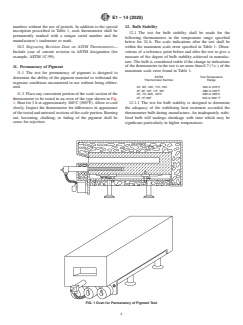
11.2 Place any convenient portion of the scale section of the
2C, 7C, 69C, 107C 280 to 290°C
2F, 7F, 69F 540 to 560 °F
thermometer to be tested in an oven of the type shown in Fig.
1. Heat for 3 h at approximately 260°C (500°F). Allow to cool 12.1.1 The test for bulb stability is designed to determine
slowly. Inspect the thermometer for differences in appearance the adequacy of the stabilizing heat treatment accorded the
of the tested and untested sections of the scale portion. Burning thermometer bulb during manufacture. An inadequately stabi-
out, loosening, chalking, or fading of the pigment shall be lized bulb will undergo shrinkage with time which may be
cause for rejection. significant particularly in higher temperatures.
FIG. 1 Oven for Permanency of Pigment Test
E1 − 14 (2020)
12.1.1.1 Heat the thermometer for 5 min at the temperature then repeat the procedures described in 12.1.2.1 and 12.1.2.2.
specified above in a preheated bath which may be of the type It must be emphasized that to obtain meaningful results, the
shown in Fig. 2. Immersion must be sufficient that all of the procedure adopted after the 168-h period of heating must be
thermometer bulb is at the specified temperature. Allow the identical to that used in the original calibration.
thermometer to cool, either naturally in still air, or slowly in the
13. Scale Error
test bath at a specified rate, to a span of 20° on the Celsius scale
13.1 Thermometers shall be verified and calibrated at the
(36° on the Fahrenheit scale) above ambient temperature or to
temperatures specified in Table 4. Partial immersion thermom-
50°C (122°F), whichever is the lower, and then determine the
eters shall be calibrated for the emergent stem temperatures
reading at some reference point, such as the ice point. If natural
specified in Table 4.
cooling in still air is used, determine the reference reading
13.1.1 At the time of purchase, the scale errors shall be
within 1 h. Return the thermometer to the bath, preheated to the
within the maximum scale error found in Table 1. The
temperature of test, and heat for 24 h. Allow the thermometer
indications of many high temperature and fractionally gradu-
to cool, at the same rate as at the start of the test, to the
ated thermometers may change with time and continued use
temperature referred to above, and redetermine the reference
due to minute changes in bulb volume. Periodic verification of
reading under the same conditions as before. The magnitude of
these thermometers, either over the entire scale or reverifica-
any change in this reference reading as a result of the 24-h
tion at a reference temperature (ice point or steam point), in
heating period is a measure of the quality of the bulb glass and
accordance with procedures set forth in Test Method E77, is
the adequacy of the previous heat treatment accorded the
recommended. For additional information on preparing ice-
thermometer in manufacture.
point baths see Practice E563.
12.1.2 For kinematic viscosity thermometers used for mea-
suring temperatures at and above 50°C (122°F), the following
13.2 Due to the application requirements for range and
bulb stability test is used.
construction of the following thermometers, it is not practical
12.1.2.1 Heat the thermometer to the selected reference
to include reference points such as the ice and steam points.
point on the main scale, maintain the temperature for at least 15
13C, 14C, 14F, 17C, 17F, 18C, 18F, 19C, 19F, 20C, 20F, 21C, 21F,
min, and determine the scale correction at this point.
23C, 24C, 26C, 27C, 38C, 49C, 50F, 51F, 56C, 56F, 76F, 77F, 78F,
79F, 80F, 81F, 83C, 83F, 84C, 84F, 87C, 87F, 91C, 92C, 93C, 96C,
12.1.2.2 Allow the thermometer to cool slowly in the test
98C, 98F, 100C, 101C, 102C, 103C, 104C, 105C, 106C, 107C,
bath (or naturally in still air) to at least a span of 20° on the
108F, 109F, 111C, 116C, 117C, 122C, 123C, and 124C
Celsius scale (36° on the Fahrenheit scale) above ambient or to
14. Case
50°C (122°F), whichever is the lower, and then determine the
correction after at least 15 min at the ice point. If natural
14.1 Each thermometer shall be supplied in a suitable case
cooling is used, the correction should be determined within 1 h. on which shall appear the following marking (except when a
12.1.2.3 Heat the thermometer again to the selected refer-
transparent case is used): the letters “ASTM,” the thermometer
ence point on the main scale, keep it at this temperature for 168 number (33C, 33F, etc.), and the temperature range.
h. Allow the thermometer to cool as described in 12.1.2.2 and
15. Methods of Verification and Calibration
15.1 Thermometers shall be verified and calibrated at the
specified immersion in accordance with Test Method E77.
15.2 For partial immersion thermometers, careful consider-
ation of emergent stem temperatures shall be observed.
15.2.1 During the manufacture of partial immersion
thermometers, the manufacturer shall calibrate the thermom-
eters so the indicated temperatures are within the maximum
permissible errors found in Table 1 when the emergent stem
temperatures found in Table 4 are applied to the readings.
NOTE 4—To achieve the requirements in 15.2.1, the manufacturer may
have to measure emergent stem temperatures above its bath, calculate
correction factors, and offset its calibrations accordingly. See Test Method
FIG. 2 Air Bath for Bulb Stability Test E77 for the procedure to correct for emergent stem temperatures.
E1 − 14 (2020)
TABLE 1 Specification for ASTM Thermometers
All dimensions are in millimeters.
See Table 4 for Verification and Calibration Temperatures.
Explanatory Notes:
A
An expansion chamber is provided for relief of gas pressure to avoid distortion of the bulb at higher temperatures. It is not for the purpose of joining mercury
separations and under no circumstances should the thermometer be heated above the highest temperature reading.
B
Toluene or other suitable liquid colored red with a permanent dye shall be used as the actuating liquid.
C
Under certain test conditions, the bulb of the thermometer may be 28 °C (50 °F) above the temperature indicated by the thermometer, and at an indicated
temperature of 371 °C (700 °F) the temperature of the bulb is approaching a critical range in the glass. It is therefore not desirable to use this thermometer under
such conditions at indicated temperatures above 371 °C (700 °F) without checking the ice point.
D
Longest graduation lines at 155 °C, 160 °C, 162 °C, 164 °C, 165 °C, and 170 °C, with arrows at 162 °C and 164 °C.
E
The length of the enlargement, and the distance from the bottom of the enlargement to the bottom of the bulb shall be measured with the test gage shown in
Fig. 1.
F
Long, narrow shape.
G
The test temperature shall be indicated by an arrow whether the graduation corresponding to that point is numbered or not.
H
Long, narrow shape; mercury shall be in the chamber at 0 °C (32 °F).
I
The thermometer shall be made to be mounted in a brass ferrule consisting of a tubular bushing 8.0 mm in outside diameter with a flanged head approximately
12 mm in diameter so that the upper extremity of the 8.0 mm diameter is located 90 mm from the bottom of the bulb.
J
To be marked on the glass stem at least 90 mm from the bottom of the bulb.
K
Glass button finish, see 6.2.1.
L
Long, narrow shape; mercury shall be near bottom of the chamber at 0 °C.
M
For kinematic viscosity thermometers, the ice-point reading shall be taken within 1 h after being at the test temperature for not less than 3 minutes. The ice-
point reading shall be expressed to the nearest 0.01 °C or 0.02 °F and applied as explained in Test Method E77, Section 13.
N
Thermometers made to these specifications conform also with the requirements for the titer test thermometer of the American Oil Chemists Society and the
Association of Official Agricultural Chemists, except for the special inscription.
O
Capillary clearances must conform to Section 8.
P
Mercury shall be near middle of chamber at 0 °C.
Q
The stem may be either the plain front or lens front type. If the thermometer is of the lens front type, the cross section of the stem shall be such that it will
pass through an 8-mm ring gage but will not enter a 5-mm slot gage.
R
A suitable mercury-thallium alloy shall be used as the actuating liquid.
S
The expansion chamber shall be of the long narrow type 10 to 20 mm in length. The length of unchanged capillary between the nearest graduation mark and
the expansion chamber shall be not less than 10 mm.
T
Mercury shall be near the bottom of the chamber at 0 °C.
U
The length of unchanged capillary between the nearest graduation mark and contraction chamber shall be not less than 10 mm.
V
Change in correction over any 5 °F interval shall not exceed 0.10 °F.
W
Expansion chamber shall be of the long narrow type and there shall be not less than 10 mm of unchanged capillary between the base of the chamber and the
top graduation.
X
Mercury shall be in the chamber at 32 °F.
Y
Over any interval of 2 °C the change in correction shall not exceed 0.02 °C.
Z
Over any interval of 4 °F the change in correction shall not exceed 0.05 °F.
AA
Special finish, see 6.2.2.
BB
The bulb diameter shall not be more than 0.5 mm greater than the stem.
CC
The stem shall be of the lens front type. The cross section of the stem shall be such that it will pass through a 8.0-mm ring gage but will not enter a 5.0-mm
slot gage. A minor diameter of 4 mm is permissible provided that the major diameter is not less than 7 mm.
DD
Bulb bottom shall be essentially hemispherical.
EE
Immersion line shall be omitted.
E1 − 14 (2020)
FF
For Fahrenheit thermometers, dimension G (length of graduated portion) shall be measured as the length of graduated portion corresponding to the nominal
Celsius range.
GG
The immersion line shall be visible in the case opening after assembly. The immersion shall be measured from the bottom of the bulb rather than from the
bottom of the armor. See 6.2.2.
HH
The stem shall be either the round or lens-front type.
II
Contraction chamber to be long narrow type.
JJ
Over any interval of 1 °C the change in correction shall not exceed 0.01 °C. The correction at the lowest temperature of the nominal range shall not change
by more than 0.02 °C immediately after the thermometer has been heated for 15 min at a temperature 30 °C higher, and allowed to cool naturally in air.
KK
The capillary bore shall be large enough in relation to the bulb to ensure that (without tapping) jumping of the meniscus does not exceed one half of the
smallest scale division, when the temperature is rising at a uniform rate not exceeding 0.05 °C/min.
LL
The thermometer is to be calibrated for 100-mm immersion for the main scale, the ice point is to be calibrated for total immersion.
MM
Bulb shape ellipsoidal (see Fig. 2).
NN
This thermometer may be furnished with an optional ring top. See 6.2.3. Addition of a ring top will increase the total length by an amount equal to the outside
diameter of the ring.
OO
The stem shall be of the lens front type. The cross section of the stem shall be such that it will pass through a 7.0 mm ring gage.
FF FF FF
ASTM No. 1C-99 1F-99 2C-99 2F-99 3C-99 3F-99
IP No. 62C 73C
Name Partial Immersion Partial Immersion Partial Immersion
Reference Fig. No. 3 3 3
C C
Range −20 to + 150°C 0 to 302°F −5 to + 300°C 20 to 580°F −5 to + 400°C 20 to 760°F
For test at
A Immersion, mm 76 76 76
Graduations:
Subdivisions 1°C 2°F 1°C 2°F 1°C 2°F
Long lines at each 5°C 10°F 5°C 10°F 5°C 10°F
Numbers at each 10°C 20°F 10°C 20°F 10°C 20°F
Scale error, max 0.5°C 1°F 1°C 2°F 1°C to 301°C 2°F to 574°F
1.5°C above 3°F above
301°C 574°F
Special inscription ASTM ASTM ASTM
1C-99 or 1F-99 2C-99 or 2F-99 3C-99 or 3F–99
76 MM IMM 76 MM IMM 76 MM IMM
Expansion chamber:
A A
Permit heating to 200°C 392°F
B Total length, mm 317 to 327 385 to 395 410 to 420
C Stem OD, mm 6.0 to 7.0 6.0 to 7.0 6.0 to 7.5
D Bulb length, mm 19 to 25 10 to 15 10 to 15
E Bulb OD, mm 5.0 to 6.0 5.0 to 6.0 5.0 to 6.0
Scale location:
Bottom of bulb to line at 0°C 32°F 0°C 32°F 0°C 32°F
F Distance, mm 111 to 118 100 to 110 100 to 110
O O O
G Length of graduated portion, mm 170 to 200 225 to 265 250 to 290
Ice-point scale:
Range
H Bottom of bulb to ice-point, mm
Contraction chamber:
I Distance to bottom, min, mm
J Distance to top, max, mm
Stem enlargement:
K OD, mm
L Length, mm
M Distance to bottom, mm
A
An expansion chamber is provided for relief of gas pressure to avoid distortion of the bulb at higher temperatures. It is not for the purpose of joining mercury separations and under no circumstances should
the thermometer be heated above the highest temperature reading.
B
Under certain test conditions, the bulb of the thermometer may be 28°C (50°F) above the temperature indicated by the thermometer, and at an indicated temperature of 371°C (700°F) the temperature of the
bulb is approaching a critical range in the glass. It is therefore not desirable to use this thermometer under such conditions at indicated temperatures above 371°C (700°F) without checking the ice point.
O
Capillary clearances shall conform to Section 8.
FF
For Fahrenheit thermometers, dimension G (length of graduated portion) shall be measured as the length of graduated portion corresponding to the nominal Celsius range.
E1 − 14 (2020)
TABLE 1 Continued
FF FF FF
ASTM No. 5C-86 5F-86 6C-86 6F-86 7C-86 7F-86
IP No. 1C 2C 5C
B
Name Cloud and Pour Low Cloud and Pour Low Distillation
Reference Fig. No. 3 3 4
Range −38 to + 50°C −36 to + 120°F −80 to + 20°C −112 to + 70°F −2 to + 300°C 30 to 580°F
For test at
A Immersion, mm 108 76 total
Graduations:
Subdivisions 1°C 2°F 1°C 2°F 1°C 2°F
Long lines at each 5°C 10°F 5°C 10°F 5°C 10°F
Numbers at each 10°C 20°F 10°C 20°F 10°C 20°F
Scale error, max 0.5°C 1°F 1°C to − 33°C 2°F to − 28°F 0.5°C to 150°C 1°F to 300°F
2°C below − 33°C 4°F below − 28°F 1°C above 150°C 2°F above 300°F
Special inscription ASTM ASTM ASTM
5C-86 or 5F–86 6C-86 or 6F-86 7C-86 or 7F–86
108 MM IMM 76 MM IMM
Expansion chamber:
A
Permit heating to 100°C 212°F 60°C 140°F
B Total length, mm 225 to 235 225 to 235 380 to 390
C Stem OD, mm 6.0 to 8.0 6.0 to 8.0 6.0 to 8.0
D Bulb length, mm 7 to 10 7 to 10 10 to 15
E Bulb OD, mm ≤5.5 and ≥stem ≤5.0 and ≥stem ≤5.0 and ≥stem
Scale location:
Bottom of bulb to line at −38°C −36°F −70°C −94°F 0°C 32°F
F Distance, mm 120 to 130 100 to 120 100 to 110
O O O
G Length of graduated portion, mm 65 to 85 70 to 100 225 to 255
Ice-point scale:
Range
H Bottom of bulb to ice-point, mm
Contraction chamber:
I Distance to bottom, min, mm
J Distance to top, max, mm
Stem enlargement:
K OD, mm
L Length, mm
M Distance to bottom, mm
A
An expansion chamber is provided for relief of gas pressure to avoid distortion of the bulb at higher temperatures. It is not for the purpose of joining mercury separations and under no circumstances should
the thermometer be heated above the highest temperature reading.
B
Toluene or other suitable liquid colored red with a permanent dye shall be used as the actuating liquid.
O
Capillary clearances shall conform to Section 8.
FF
For Fahrenheit thermometers, dimension G (length of graduated portion) shall be measured as the length of graduated portion corresponding to the nominal Celsius range.
FF FF FF
ASTM No. 8C-86 8F-86 9C-86 9F-86 10C-86 10F-86
IP No. 6C 15C 16C
Name High Distillation Low-Pensky-Martens High-Pensky-Martens
Reference Fig. No. 4 5 5
C C
Range −2 to + 400°C 30 to 760°F −5 to + 110°C 20 to 230°F 90 to 370°C 200 to 700°F
For test at
A Immersion, mm total 57 57
Graduations:
Subdivisions 1°C 2°F 0.5°C 1°F 2°C 5°F
Long lines at each 5°C 10°F 1°C and 5°C 5°F 10°C 25°F
Numbers at each 10°C 20°F 5°C 10°F 20°C 50°F
Scale error, max 1°C to 300°C 2°F to 570°F 0.5°C 1°F 1°C to 260°C 2.5°F to 500°F
1.5°C above 300°C 3°F above 570°F 2°C above 260°C 3.5°F above 500°F
E1 − 14 (2020)
TABLE 1 Continued
Special inscription ASTM ASTM ASTM
8C-86 or 8F-86 9C-86 or 9F–86 10C-86 or 10F–86
57 MM IMM 57 MM IMM
Expansion chamber:
A A
Permit heating to 160°C 320°F
B Total length, mm 380 to 390 285 to 295 285 to 295
C Stem OD, mm 6.0 to 8.0 6.0 to 7.0 6.0 to 7.0
D Bulb length, mm 10 to 15 9 to 13 7 to 10
E Bulb OD, mm ≤5.0 and ≥stem ≤5.5 and ≥stem ≤4.5 and ≥stem
Scale location:
Bottom of bulb to line at 0°C 32°F 0°C 32°F 90°C 200°F
F Distance, mm 30 to 40 85 to 95 80 to 90
O O O
G Length of graduated portion, mm 290 to 330 140 to 175 145 to 180
Ice-point scale:
Range
H Bottom of bulb to ice-point, mm
Contraction chamber:
I Distance to bottom, min, mm
J Distance to top, max, mm
Stem enlargement
K OD, mm 7.5 to 8.5 7.5 to 8.5
E E
L Length, mm 2.5 to 5.0 2.5 to 5.0
M Distance to bottom, mm 64 to 66 64 to 66
A
An expansion chamber is provided for relief of gas pressure to avoid distortion of the bulb at higher temperatures. It is not for the purpose of joining mercury separations and under no circumstances should
the thermometer be heated above the highest temperature reading.
C
Under certain test conditions, the bulb of the thermometer may be 28°C (50°F) above the temperature indicated by the thermometer, and at an indicated temperature of 371°C (700°F) the temperature of the
bulb is approaching a critical range in the glass. It is therefore not desirable to use this thermometer under such conditions at indicated temperatures above 371°C (700°F) without checking the ice point.
E
The length of the enlargement, and the distance from the bottom of the enlargement to the bottom of the bulb shall be measured with the test gage shown in Fig. 1.
O
Capillary clearances shall conform to Section 8.
FF
For Fahrenheit thermometers, dimension G (length of graduated portion) shall be measured as the length of graduated portion corresponding to the nominal Celsius range.
FF FF
ASTM No. 11C-86 11F-86 12C-98 12F-98 13C-86
IP No. 28C 64C 64F 47C
Name Cleveland Open Flash Density-Wide Range Loss on Heat
Reference Fig. No. 3 4 9
C C
Range −6 to + 400°C 20 to 760°F −20 to + 102°C −5 to + 215°F 155 to 170°C
For test at
A Immersion, mm 25 total total
Graduations:
Subdivisions 2°C 5°F 0.2°C 0.5°F 0.5°C
D
Long lines at each 10°C 10°F 1°C 1°F 1°C
Numbers at each 20°C 20°F 2°C 5°F 155°C, 160°C, 165°C,
170°C
Scale error, max 2°C to 260°C 5°F to 500°F 0.15°C 0.25°F 0.5°C
4°C above 260°C 7°F above 500°F
Special inscription ASTM ASTM ASTM
11C-86 or 11F–86 12C-98 or 12F–98 13C-86
25 MM IMM
Expansion chamber:
A
Permit heating to 150°C 300°F 200°C
NN
B Total length, mm 305 to 315 415 to 425 150 to 160
C Stem OD, mm 6.0 to 8.0 6.0 to 8.0 5.5 to 7.0
D Bulb length, mm 7 to 10 15 to 20 10 to 15
E Bulb OD, mm ≤4.5 and ≥stem bulb size ≥stem size ≤5.0 and ≥stem
Scale location:
Bottom of bulb to line at 0°C 32°F −20°C −4°F 155°C
F Distance, mm 45 to 55 35 to 50 50 to 60
O O O
G Length of graduated portion, 210 to 240 305 to 350 40 to 60
mm
E1 − 14 (2020)
TABLE 1 Continued
Ice-point scale:
Range
H Bottom of bulb to ice-point,
mm
Contraction chamber:
I Distance to bottom, min, mm
F
J Distance to top, max, mm 30
Stem enlargement:
K OD, mm
L Length, mm
M Distance to bottom, mm
A
An expansion chamber is provided for relief of gas pressure to avoid distortion of the bulb at higher temperatures. It is not for the purpose of joining mercury separations, and under no circum-
stances should the thermometer be heated above the highest temperature reading.
C
Under certain test conditions, the bulb of the thermometer may be 28°C (50°F) above the temperature indicated by the thermometer, and at an indicated temperature of 371°C (700°F) the tempera-
ture of the bulb is approaching a critical range in the glass. It is therefore not desirable to use this thermometer under such conditions at indicated temperatures above 371°C (700°F) without checking
the ice point.
D
Longest graduation lines at 155°C, 160°C, 162°C, 164°C, 165°C, and 170°C, with arrows at 162°C and 164°C.
F
Long, narrow shape.
O
Capillary clearances shall conform to Section 8.
FF
For Fahrenheit thermometers, dimension G (length of graduated portion) shall be measured as the length of graduated portion corresponding to the nominal Celsius range.
NN
This thermometer may be furnished with an optional ring top. See 6.2.3. Addition of a ring top will increase the total length by an amount equal to the outside diameter of the ring.
FF FF FF
ASTM No. 14C-86 14F-86 15C-86 15F-86 16C-86 16F-86
IP No. 17C 60C 61C
Name Wax Melting Point Low Softening Point High Softening Point
Reference Fig. No. 7 4 4
Range 38 to 82°C 100 to 180°F −2 to + 80°C 30 to 180°F 30 to 200°C 85 to 392°F
For test at
A Immersion, mm 79 total total
Graduations:
Subdivisions 0.1°C 0.2°F 0.2°C 0.5°F 0.5°C 1°F
Long lines at each 0.5°C 1°F 1°C 1°F 1°C 5°F
Numbers at each 1°C 2°F 2°C 5°F 5°C 10°F
Scale error, max 0.1°C 0.2°F 0.2°C 0.4°F 0.3°C 0.5°F
Special inscription ASTM ASTM ASTM
14C-86 or 14F–86 15C-86 or 15F–86 16C-86 or 16F–86
79 MM IMM
Expansion chamber:
Permit heating to 100°C 212°F 130°C 270°F 250°C 482°F
B Total length, mm 370 to 380 390 to 400 390 to 400
C Stem OD, mm 6.0 to 8.0 6.0 to 8.0 6.0 to 8.0
D Bulb length, mm 18 to 28 9 to 14 9 to 14
E Bulb OD, mm 5.0 to 6.0 4.5 to 5.5 4.5 to 5.5
Scale location:
Bottom of bulb to line at 40°C 104°F 0°C 32°F 30°C 86°F
F Distance, mm 115 to 125 75 to 90 75 to 90
O O O
G Length of graduated portion, mm 210 to 240 245 to 285 245 to 280
Ice-point scale:
Range
H Bottom of bulb to ice-point, mm
Contraction chamber:
I Distance to bottom, min, mm
J Distance to top, max, mm 41
Stem enlargement:
K OD, mm
L Length, mm
M Distance to bottom, mm
O
Capillary clearances shall conform to Section 8.
FF
For Fahrenheit thermometers, dimension G (length of graduated portion) shall be measured as the length of graduated portion corresponding to the nominal Celsius range.
E1 − 14 (2020)
TABLE 1 Continued
FF FF FF
ASTM No. 17C-86 17F-86 18C-86 18F-86 19C-86 19F-86
IP No. 23C
Name Saybolt Viscosity Reid Vapor Pressure Saybolt Viscosity
Reference Fig. No. 8 8 8
Range 19 to 27°C 66 to 80°F 34 to 42°C 94 to 108°F 49 to 57°C 120 to 134°F
G G G G G G
For test at 21.1 and 25°C 70 and 77°F 37.8°C 100°F 50 and 54.4°C 122 and 130°F
A Immersion, mm total total total
Graduations:
Subdivisions 0.1°C 0.2°F 0.1°C 0.2°F 0.1°C 0.2°F
Long lines at each 0.5°C 1°F 0.5°C 1°F 0.5°C 1°F
Numbers at each 1°C, except 21 2°F 1°C 2°F 1°C, except 54 2°F
Scale error, max 0.1°C 0.2°F 0.1°C 0.2°F 0.1°C 0.2°F
Special inscription ASTM ASTM ASTM
17C-86 or 17F-86 18C-86 or 18F-86 19C-86 or 19F-86
Expansion chamber:
Permit heating to 100°C 212°F 100°C 212°F 115°C 240°F
B Total length, mm 270 to 280 270 to 280 270 to 280
C Stem OD, mm 6.0 to 7.0 6.0 to 7.0 6.0 to 7.0
D Bulb length, mm 25 to 35 25 to 35 25 to 35
E Bulb OD, mm ≤5.0 and ≥stem ≥stem ≤5.0 and ≥stem
Scale location:
Bottom of bulb to line at 19°C 66°F 34°C 94°F 49°C 120°F
F Distance, mm 135 to 150 130 to 150 135 to 150
O O O
G Length of graduated portion, mm 67 to 101 60 to 90 67 to 101
Ice-point scale:
Range
H Bottom of bulb to ice-point, mm
Contraction chamber:
I Distance to bottom, min, mm
H H H
J Distance to top, max, mm 60 60 60
Stem enlargement:
K OD, mm 8.0 to 10.0 8.0 to 10.0 8.0 to 10.0
L Length, mm 4.0 to 7.0 4.0 to 7.0 4.0 to 7.0
M Distance to bottom, mm 112 to 116 112 to 116 112 to 116
G
The test temperatures shall be indicated by an arrow whether the graduation corresponding to that point is numbered or not.
H
Long, narrow shape; mercury shall be in the chamber at 0°C (32°F).
O
Capillary clearances shall conform to Section 8.
FF
For Fahrenheit thermometers, dimension G (length of graduated portion) shall be measured as the length of graduated portion corresponding to the nominal Celsius range.
FF FF FF
ASTM No. 20C-86 20F-86 21C-86 21F-86 22C-86 22F-86
IP No. 24C
Name Saybolt Viscosity Saybolt Viscosity Oxidation Stability
Reference Fig. No. 8 8 8
Range 57 to 65°C 134 to 148°F 79 to 87°C 174 to 188°F 95 to 103°C 204 to 218°F
G G G G G G
For test at 60°C 140°F 82.2°C 180°F 98.9 and 100°C 210°F
A Immersion, mm total total total
Graduations:
Subdivisions 0.1°C 0.2°F 0.1°C 0.2°F 0.1°C 0.2°F
Long lines at each 0.5°C 1°F 0.5°C 1°F 0.5°C 1°F
Numbers at each 1°C 2°F 1°C, except 82 2°F 1°C 2°F
Scale error, max 0.1°C 0.2°F 0.1°C 0.2°F 0.1°C 0.2°F
Special inscription ASTM ASTM ASTM
20C-86 or 20F-86 21C-86 or 21F–86 22C-86 or 22F–86
Expansion chamber:
Permit heating to 115°C 240°F 140°C 285°F 155°C 310°F
B Total length, mm 270 to 280 270 to 280 270 to 280
C Stem OD, mm 6.0 to 7.0 6.0 to 7.0 6.0 to 8.0
E1 − 14 (2020)
TABLE 1 Continued
D Bulb length, mm 25 to 35 25 to 35 25 to 35
E Bulb OD, mm ≤5.0 and ≥stem ≤5.0 and ≥stem ≤5.0 and ≥stem
Scale location:
Bottom of bulb to line at 57°C 134°F 79°C 174°F 95°C 204°F
F Distance, mm 135 to 150 135 to 150 135 to 150
O O O
G Length of graduated portion, mm 67 to 101 67 to 101 70 to 100
Ice-point scale:
Range
H Bottom of bulb to ice-point,
mm
Contraction chamber:
I Distance to bottom, min, mm
H H H
J Distance to top, max, mm 60 60 60
Stem enlargement:
K OD, mm 8.0 to 10.0 8.0 to 10.0 8.0 to 10.0
L Length, mm 4.0 to 7.0 4.0 to 7.0 4.0 to 7.0
M Distance to bottom, mm 112 to 116 112 to 116 112 to 116
G
The test temperatures shall be indicated by an arrow whether the graduation corresponding to that point is numbered or not.
H
Long, narrow shape; mercury shall be in the chamber at 0°C (32°F).
O
Capillary clearances shall conform to Section 8.
FF
For Fahrenheit thermometers, dimension G (length of graduated portion) shall be measured as the length of graduated portion corresponding to the nominal Celsius range.
ASTM No. 23C-86 24C-86 25C-86
IP No.
I I I
Name Engler Viscosity Engler Viscosity Engler Viscosity
K K K
Reference Fig. No. 7 7 7
Range 18 to 28°C 39 to 54°C 95 to 105°C
For test at 25°C 40 and 50°C 100°C
A Immersion, mm 90 90 90
Graduations:
Subdivisions 0.2°C 0.2°C 0.2°C
Long lines at each 1°C 1°C 1°C
Numbers at each 2°C full figures at 25 2°C full figures at 40 and 50 2°C full figures at 100
Scale error, max 0.1°C at 25°C 0.1°C at 40 and 50°C 0.1°C at 100°C
Special inscription ASTM ASTM ASTM
23C-86 24C-86 25C-86
J J J
90 MM IMM 90 MM IMM 90 MM IMM
Expansion chamber:
Permit heating to 100°C 105°C 155°C
B Total length, mm 207 to 217 232 to 242 207 to 217
C Stem OD, mm 5.5 to 6.5 5.5 to 6.5 5.5 to 6.5
D Bulb length, mm 13 to 19 13 to 19 13 to 19
E Bulb OD, mm 5.5 to 6.5 5.5 to 6.5 5.5 to 6.5
Scale location:
Bottom of bulb to line at 18°C 39°C 95°C
F Distance, mm 108 to 118 108 to 118 108 to 118
O O O
G Length of graduated portion, mm 42 to 69 67 to 94 42 to 69
Ice-point scale:
Range
H Bottom of bulb to ice-point, mm
Contraction chamber:
I Distance to bottom, min, mm
I I I
J Distance to top, max, mm 60 60 60
Stem enlargement:
K OD, mm
L Length, mm
M Distance to bottom, mm
E1 − 14 (2020)
TABLE 1 Continued
I
The thermometer shall be made to be mounted in a brass ferrule consisting of a tubular bushing 8.0 mm in outside diameter with a flanged head approximately 12 mm in diameter so that the upper extrem-
ity of the 8.0 mm diameter is located 90 mm from the bottom of the bulb.
J
To be marked on the glass stem at least 90 mm from the bottom of the bulb.
K
Glass button finish, see 6.2.1.
L
Long, narrow shape; mercury shall be near bottom of the chamber at 0°C.
O
Capilla
...