

ASTM F3165-16(2022)
(Specification)Standard Specification for Throat Protective Equipment for Hockey Goaltenders
General Information
- Abstract
ABSTRACT
This specification covers performance requirements and corresponding test methods for throat protectors marketed, sold, and intended for use by ice hockey goalkeepers. It aims to reduce the risk of injury to the throat without compromising the form or appeal of the game. To this end, the protector shall be used as intended within the rules of the game and in accordance with the manufacturer's instructions.
This specification includes a protocol for testing throat protectors, which covers: construction, coverage, marking, and information relevant to users as well as sampling, low-temperature conditioning, determination of Head-Positioning Index (HPI) and puck impact resistance, and information that must be contained in the test report.
SCOPE
1.1 This specification covers performance requirements and test methods for throat protectors marketed, sold, and intended for ice hockey goalkeepers.
1.2 The intent of this specification is to reduce the risk of injury to the throat without compromising the form or appeal of the game. To do so, the protector shall be used:
1.2.1 As intended within the rules of the game and
1.2.2 In accordance with the manufacturer’s instructions.
1.3 Ice hockey is a sport with intrinsic hazards associated with the normal conduct of the game. Participation in ice hockey implies the acceptance of some risk of injury. Use of a throat protector certified to this specification will not prevent all injuries.
1.4 This specification has been prepared after careful consideration of the frequency and mechanisms associated with throat injuries that can potentially occur within the rules of the game of ice hockey.
1.5 Requirements and the corresponding test methods, where appropriate, are given for the following:
1.5.1 Construction,
1.5.2 Puck impact resistance,
1.5.3 Coverage,
1.5.4 Marking and information.
1.6 Throat protection is intended for use by goalkeepers.
1.7 Use of the singular does not exclude the plural (and vice versa) when the sense allows.
1.8 Although the intended primary application of this specification is stated in this scope, note that it remains the responsibility of the users of this specification to judge its suitability for their particular purpose.
1.9 The values stated in SI units are to be regarded as standard. No other units of measurement are included in this standard.
1.10 This standard does not purport to address all of the safety concerns, if any, associated with its use. It is the responsibility of the user of this standard to establish appropriate safety, health, and environmental practices and determine the applicability of regulatory limitations prior to use.
1.11 This international standard was developed in accordance with internationally recognized principles on standardization established in the Decision on Principles for the Development of International Standards, Guides and Recommendations issued by the World Trade Organization Technical Barriers to Trade (TBT) Committee.
- Status
- Published
- Publication Date
- 30-Apr-2022
- Technical Committee
- F08 - Sports Equipment, Playing Surfaces, and Facilities
- Drafting Committee
- F08.15 - Ice Hockey
Overview
ASTM F3165-16(2022): Standard Specification for Throat Protective Equipment for Hockey Goaltenders is an internationally recognized standard developed by ASTM International. This specification establishes the essential performance requirements and test methods for throat protectors designed specifically for ice hockey goalkeepers. By prescribing requirements for construction, coverage, puck impact resistance, marking, and information provided to users, the standard aims to help reduce the risk of throat injuries without impacting the play or enjoyment of the game. Throat protectors certified to this specification are intended for use during ice hockey games, as outlined within the sport’s official rules and guidelines.
Key Topics
- Performance Requirements: The standard defines criteria for the construction, durability, and protective qualities of throat protectors, ensuring they can withstand common on-ice impacts.
- Testing Methods: Protocols are outlined for sample selection, conditioning (including low temperature exposure), puck impact resistance, positioning (including Head-Positioning Index, HPI), and test reporting.
- Coverage and Design: The specification states that throat protectors must overlap with goaltender masks to minimize unprotected areas, while not interfering with other protective equipment.
- Marking and Instructions: Every certified protector must be permanently marked with key product and manufacturing details. User-facing information must include correct assembly, fitting, care instructions, and warnings about potential product damage.
Applications
ASTM F3165-16(2022) is applicable to:
- Manufacturers of ice hockey protective equipment: Ensuring products meet minimum safety and performance requirements before being marketed or sold for use by goaltenders.
- Hockey associations and governing bodies: Setting equipment standards in leagues and competitions to improve player safety.
- Testing laboratories: Certifying throat protectors by conducting performance evaluations under defined test conditions, including puck impacts at regulated velocities and temperatures.
- Coaches, players, and equipment managers: Selecting and maintaining throat protectors that comply with recognized standards, optimizing both safety and comfort during play.
By adhering to this specification, manufacturers and organizations help minimize the risk of throat injuries from puck strikes and other game-related hazards, while users gain assurance that products are tested for both efficacy and compatibility with other protective gear.
Related Standards
- ASTM D2240: Test Method for Rubber Property-Durometer Hardness, used for assessing puck hardness in related protective equipment tests.
- CSA Z262.6: Specifications for facially featured headforms, relevant to equipment testing and fit assessment.
- ISO/IEC Sports Equipment Standards: For additional guidance on general sports equipment safety and performance.
- Other ASTM F08 Series Standards: Covering sports equipment, playing surfaces, and safety specifications for various athletic activities.
Practical Value
Compliance with ASTM F3165-16(2022) ensures that throat protectors for hockey goaltenders meet industry best practices for ice hockey safety, are constructed from materials resistant to sweat, UV, and moderate heat, and do not irritate skin or interfere with other standard equipment. Proper marking, assembly instructions, and care guidelines support both user safety and product longevity. Adopting this global standard helps manufacturers demonstrate a commitment to player welfare and can aid in regulatory acceptance across international markets.
Keywords: ASTM F3165-16(2022), throat protector, ice hockey goaltender, puck impact resistance, hockey safety equipment, testing methods, player safety, protective equipment standard, equipment marking, goaltender mask, equipment compliance
Get Certified
Connect with accredited certification bodies for this standard

CIS Institut d.o.o.
Personal Protective Equipment (PPE) certification body. Notified Body NB-2890 for EU Regulation 2016/425 PPE.

Kiwa BDA Testing
Building and construction product certification.
Kmetijski inštitut Slovenije
Agricultural Institute of Slovenia. Soil testing, plant health, agricultural product analysis.
Sponsored listings
Frequently Asked Questions
ASTM F3165-16(2022) is a technical specification published by ASTM International. Its full title is "Standard Specification for Throat Protective Equipment for Hockey Goaltenders". This standard covers: ABSTRACT This specification covers performance requirements and corresponding test methods for throat protectors marketed, sold, and intended for use by ice hockey goalkeepers. It aims to reduce the risk of injury to the throat without compromising the form or appeal of the game. To this end, the protector shall be used as intended within the rules of the game and in accordance with the manufacturer's instructions. This specification includes a protocol for testing throat protectors, which covers: construction, coverage, marking, and information relevant to users as well as sampling, low-temperature conditioning, determination of Head-Positioning Index (HPI) and puck impact resistance, and information that must be contained in the test report. SCOPE 1.1 This specification covers performance requirements and test methods for throat protectors marketed, sold, and intended for ice hockey goalkeepers. 1.2 The intent of this specification is to reduce the risk of injury to the throat without compromising the form or appeal of the game. To do so, the protector shall be used: 1.2.1 As intended within the rules of the game and 1.2.2 In accordance with the manufacturer’s instructions. 1.3 Ice hockey is a sport with intrinsic hazards associated with the normal conduct of the game. Participation in ice hockey implies the acceptance of some risk of injury. Use of a throat protector certified to this specification will not prevent all injuries. 1.4 This specification has been prepared after careful consideration of the frequency and mechanisms associated with throat injuries that can potentially occur within the rules of the game of ice hockey. 1.5 Requirements and the corresponding test methods, where appropriate, are given for the following: 1.5.1 Construction, 1.5.2 Puck impact resistance, 1.5.3 Coverage, 1.5.4 Marking and information. 1.6 Throat protection is intended for use by goalkeepers. 1.7 Use of the singular does not exclude the plural (and vice versa) when the sense allows. 1.8 Although the intended primary application of this specification is stated in this scope, note that it remains the responsibility of the users of this specification to judge its suitability for their particular purpose. 1.9 The values stated in SI units are to be regarded as standard. No other units of measurement are included in this standard. 1.10 This standard does not purport to address all of the safety concerns, if any, associated with its use. It is the responsibility of the user of this standard to establish appropriate safety, health, and environmental practices and determine the applicability of regulatory limitations prior to use. 1.11 This international standard was developed in accordance with internationally recognized principles on standardization established in the Decision on Principles for the Development of International Standards, Guides and Recommendations issued by the World Trade Organization Technical Barriers to Trade (TBT) Committee.
ABSTRACT This specification covers performance requirements and corresponding test methods for throat protectors marketed, sold, and intended for use by ice hockey goalkeepers. It aims to reduce the risk of injury to the throat without compromising the form or appeal of the game. To this end, the protector shall be used as intended within the rules of the game and in accordance with the manufacturer's instructions. This specification includes a protocol for testing throat protectors, which covers: construction, coverage, marking, and information relevant to users as well as sampling, low-temperature conditioning, determination of Head-Positioning Index (HPI) and puck impact resistance, and information that must be contained in the test report. SCOPE 1.1 This specification covers performance requirements and test methods for throat protectors marketed, sold, and intended for ice hockey goalkeepers. 1.2 The intent of this specification is to reduce the risk of injury to the throat without compromising the form or appeal of the game. To do so, the protector shall be used: 1.2.1 As intended within the rules of the game and 1.2.2 In accordance with the manufacturer’s instructions. 1.3 Ice hockey is a sport with intrinsic hazards associated with the normal conduct of the game. Participation in ice hockey implies the acceptance of some risk of injury. Use of a throat protector certified to this specification will not prevent all injuries. 1.4 This specification has been prepared after careful consideration of the frequency and mechanisms associated with throat injuries that can potentially occur within the rules of the game of ice hockey. 1.5 Requirements and the corresponding test methods, where appropriate, are given for the following: 1.5.1 Construction, 1.5.2 Puck impact resistance, 1.5.3 Coverage, 1.5.4 Marking and information. 1.6 Throat protection is intended for use by goalkeepers. 1.7 Use of the singular does not exclude the plural (and vice versa) when the sense allows. 1.8 Although the intended primary application of this specification is stated in this scope, note that it remains the responsibility of the users of this specification to judge its suitability for their particular purpose. 1.9 The values stated in SI units are to be regarded as standard. No other units of measurement are included in this standard. 1.10 This standard does not purport to address all of the safety concerns, if any, associated with its use. It is the responsibility of the user of this standard to establish appropriate safety, health, and environmental practices and determine the applicability of regulatory limitations prior to use. 1.11 This international standard was developed in accordance with internationally recognized principles on standardization established in the Decision on Principles for the Development of International Standards, Guides and Recommendations issued by the World Trade Organization Technical Barriers to Trade (TBT) Committee.
ASTM F3165-16(2022) is classified under the following ICS (International Classification for Standards) categories: 13.340.20 - Head protective equipment. The ICS classification helps identify the subject area and facilitates finding related standards.
ASTM F3165-16(2022) is available in PDF format for immediate download after purchase. The document can be added to your cart and obtained through the secure checkout process. Digital delivery ensures instant access to the complete standard document.
Standards Content (Sample)
This international standard was developed in accordance with internationally recognized principles on standardization established in the Decision on Principles for the
Development of International Standards, Guides and Recommendations issued by the World Trade Organization Technical Barriers to Trade (TBT) Committee.
Designation: F3165 −16 (Reapproved 2022) An American National Standard
Standard Specification for
Throat Protective Equipment for Hockey Goaltenders
This standard is issued under the fixed designation F3165; the number immediately following the designation indicates the year of
original adoption or, in the case of revision, the year of last revision. A number in parentheses indicates the year of last reapproval. A
superscript epsilon (´) indicates an editorial change since the last revision or reapproval.
1. Scope 1.10 This standard does not purport to address all of the
safety concerns, if any, associated with its use. It is the
1.1 This specification covers performance requirements and
responsibility of the user of this standard to establish appro-
test methods for throat protectors marketed, sold, and intended
priate safety, health, and environmental practices and deter-
for ice hockey goalkeepers.
mine the applicability of regulatory limitations prior to use.
1.2 The intent of this specification is to reduce the risk of
1.11 This international standard was developed in accor-
injurytothethroatwithoutcompromisingtheformorappealof
dance with internationally recognized principles on standard-
the game. To do so, the protector shall be used:
ization established in the Decision on Principles for the
1.2.1 As intended within the rules of the game and
Development of International Standards, Guides and Recom-
1.2.2 In accordance with the manufacturer’s instructions.
mendations issued by the World Trade Organization Technical
1.3 Ice hockey is a sport with intrinsic hazards associated Barriers to Trade (TBT) Committee.
with the normal conduct of the game. Participation in ice
2. Referenced Documents
hockey implies the acceptance of some risk of injury. Use of a
throat protector certified to this specification will not prevent 2.1 ASTM Standards:
all injuries. D2240 Test Method for Rubber Property—Durometer Hard-
ness
1.4 This specification has been prepared after careful con-
2.2 CSA Standards:
sideration of the frequency and mechanisms associated with
CSA Z262.6 Specifications for facially featured headforms
throat injuries that can potentially occur within the rules of the
game of ice hockey.
3. Terminology
1.5 Requirements and the corresponding test methods,
3.1 Definitions:
where appropriate, are given for the following:
3.1.1 chip, n—readily visible particle missing from the
1.5.1 Construction,
protector with an area bigger than 9mm .
1.5.2 Puck impact resistance,
3.1.2 combination, n—combined unit of a throat protector
1.5.3 Coverage,
placed or attached on a hockey goaltender mask with which it
1.5.4 Marking and information.
is designed to be used.
1.6 Throat protection is intended for use by goalkeepers.
3.1.3 helmet positioning index, HPI, n—vertical distance
1.7 Use of the singular does not exclude the plural (and vice
measuredatthemedianplane,fromthefrontedgeofthegoalie
versa) when the sense allows.
mask shell to the basic plane, when the goalie mask is placed
on the reference headform.
1.8 Although the intended primary application of this speci-
fication is stated in this scope, note that it remains the
3.1.4 impact sites for testing throat protectors, n—
responsibility of the users of this specification to judge its
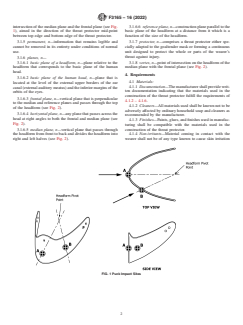
3.1.4.1 direct impact, n—point in the intersection between
suitability for their particular purpose.
the horizontal plane and the median plane in the direction of
the center of the throat protector mid-point between top edge
1.9 The values stated in SI units are to be regarded as
and bottom edge of the throat protector.
standard. No other units of measurement are included in this
standard. 3.1.4.2 25° impact, n—point in the horizontal plane, 25° to
the median plane, and in the direction of the axis formed by the
1 2
This specification is under the jurisdiction ofASTM Committee F08 on Sports For referenced ASTM standards, visit the ASTM website, www.astm.org, or
Equipment, Playing Surfaces, and Facilities and is the direct responsibility of contact ASTM Customer Service at service@astm.org. For Annual Book of ASTM
Subcommittee F08.15 on Ice Hockey. Standards volume information, refer to the standard’s Document Summary page on
Current edition approved May 1, 2022. Published June 2022. Originally the ASTM website.
approved in 2016. Last previous edition approved in 2016 as F3165 – 16. DOI: Available from Canadian Standards Association (CSA), 178 Rexdale Blvd.,
10.1520/F3165-16R22. Toronto, ON M9W 1R3, Canada, http://www.csagroup.org.
Copyright © ASTM International, 100 Barr Harbor Drive, PO Box C700, West Conshohocken, PA 19428-2959. United States
F3165 − 16 (2022)
intersection of the median plane and the frontal plane (see Fig. 3.1.6.6 referenceplane,n—constructionplaneparalleltothe
1), aimed in the direction of the throat protector mid-point basic plane of the headform at a distance from it which is a
between top edge and bottom edge of the throat protector. function of the size of the headform.
3.1.5 permanent, n—information that remains legible and 3.1.7 protector, n—comprises a throat protector either spe-
cannot be removed in its entirety under conditions of normal cially adapted to the goaltender mask or forming a continuous
use. unit designed to protect the whole or parts of the wearer’s
throat against injury.
3.1.6 planes, n—
3.1.6.1 basic plane of a headform, n—plane relative to the 3.1.8 vertex, n—point of intersection on the headform of the
headform that corresponds to the basic plane of the human median plane with the frontal plane (see Fig. 2).
head.
4. Requirements
3.1.6.2 basic plane of the human head, n—plane that is
4.1 Materials:
located at the level of the external upper borders of the ear
4.1.1 Documentation—Themanufacturershallprovidewrit-
canal (external auditory meatus) and the inferior margins of the
ten documentation indicating that the materials used in the
orbits of the eyes.
construction of the throat protector fulfill the requirements of
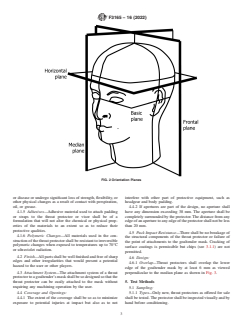
3.1.6.3 frontal plane, n—vertical plane that is perpendicular
4.1.2 – 4.1.6.
to the median and reference planes and passes through the top
4.1.2 Cleaners—All materials used shall be known not to be
of the headform (see Fig. 2).
adversely affected by ordinary household soap and cleaners as
3.1.6.4 horizontal plane, n—any plane that passes across the
recommended by the manufacturer.
head at right angles to both the frontal and median plane (see
4.1.3 Finishes—Paints, glues, and finishes used in manufac-
Fig. 2).
turing shall be compatible with the materials used in the
3.1.6.5 median plane, n—vertical plane that passes through construction of the throat protector.
the headform from front to back and divides the headform into 4.1.4 Non-irritants—Material coming in contact with the
right and left halves (see Fig. 2). wearer shall not be of any type known to cause skin irritation
FIG. 1 Puck Impact Sites
F3165 − 16 (2022)
FIG. 2 Orientation Planes
or disease or undergo significant loss of strength, flexibility, or interfere with other part of protective equipment, such as
other physical changes as a result of contact with perspiration, headgear and body padding.
oil, or grease. 4.4.2 If apertures are part of the design, no aperture shall
4.1.5 Adhesives—Adhesive material used to attach padding have any dimension exceeding 38 mm. The aperture shall be
or straps to the throat protector or visor shall be of a completely surrounded by the protector. The distance from any
formulation that will not alter the chemical or physical prop- edgeofanaperturetoanyedgeoftheprotectorshallnotbeless
erties of the materials to an extent so as to reduce their than 20 mm.
protective qualities.
4.5 Puck Impact Resistance—There shall be no breakage of
4.1.6 Polymeric Changes—All materials used in the con-
the structural components of the throat protector or failure of
struction of the throat protector shall be resistant to irreversible
the point of attachments to the goaltender mask. Cracking of
polymeric changes when exposed to temperatures up to 70°C
surface coatings is permissible but chips (see 3.1.1) are not
or ultraviolet radiation.
permitted.
4.2 Finish—All parts shall be well finished and free of sharp
4.6 Design:
edges and other irregularities that would present a potential
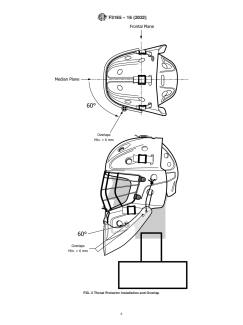
4.6.1 Overlap—Throat protectors shall overlap the lower
hazard to the user or other players.
edge of the goaltender mask by at least 6 mm as viewed
4.3 Attachment System—The attachment system of a throat perpendicular to the median plane as shown in Fig. 3.
protectortoagoaltender’smaskshallbesodesignedsothatthe
throat protector can be easily attached to the mask without 5. Test Methods
requiring any machining operation by the user.
5.1 Sampling:
4.4 Coverage and Openings: 5.1.1 Types—Only new, throat protectors as offered for sale
4.4.1 The extent of the coverage shall be so as to minimize shall be tested.The protector shall be inspected visually and by
exposure to potential injuries at impact but also as to not hand before conditioning.
F3165 − 16 (2022)
FIG. 3 Throat Protector Installation and Overlap
...