

ASTM E2352-19
(Practice)Standard Practice for Aerospace Cleanrooms and Associated Controlled Environments—Cleanroom Operations
General Information
- Abstract
ABSTRACT
This practice specifies the basic requirements, procedures, and practices for operating aerospace cleanrooms and controlled environments and the precautions associated with the facility and equipment used. This practice covers the requirements for operational systems, appropriate cleanroom clothing, authorized work personnel, stationary equipments, materials and mobile equipments, proper cleanroom operations, correct cleaning methods, and critical surfaces.
SCOPE
1.1 This practice specifies basic requirements, procedures, and practices for operating aerospace cleanrooms and controlled environments and precautions associated with the facility and equipment used.
1.2 This standard does not purport to address all of the safety concerns, if any, associated with its use. It is the responsibility of the user of this standard to establish appropriate safety, health, and environmental practices and determine the applicability of regulatory limitations prior to use.
1.3 This international standard was developed in accordance with internationally recognized principles on standardization established in the Decision on Principles for the Development of International Standards, Guides and Recommendations issued by the World Trade Organization Technical Barriers to Trade (TBT) Committee.
- Status
- Published
- Publication Date
- 30-Apr-2019
- Technical Committee
- E21 - Space Simulation and Applications of Space Technology
- Drafting Committee
- E21.05 - Contamination
Buy Documents
ASTM E2352-19 - Standard Practice for Aerospace Cleanrooms and Associated Controlled Environments—Cleanroom Operations
REDLINE ASTM E2352-19 - Standard Practice for Aerospace Cleanrooms and Associated Controlled Environments—Cleanroom Operations
Overview
ASTM E2352-19: Standard Practice for Aerospace Cleanrooms and Associated Controlled Environments – Cleanroom Operations defines the fundamental requirements, procedures, and best practices for operating cleanrooms and controlled environments associated with the aerospace industry. Developed by ASTM, this international standard ensures safe, efficient, and contamination-controlled conditions necessary for high-reliability aerospace manufacturing, assembly, and testing. The standard addresses operational systems, cleanroom clothing protocols, personnel practices, equipment handling, cleaning methods, and management of critical surfaces. The goal is to minimize particulate contamination and maintain product integrity throughout sensitive aerospace processes.
Key Topics
- Operational Systems: Guidance on establishing operational criteria including air cleanliness classes, risk assessment, monitoring, and maintenance plans tailored to the aerospace context.
- Personnel Training and Certification: Specifies the need for comprehensive training, periodic recertification, and strict documentation for all types of cleanroom users-operators, technicians, engineers, contractors, and visitors.
- Cleanroom Clothing: Defines appropriate garment types, material selection, frequency of changing, and storage requirements to avoid introducing contaminants.
- Controlled Equipment and Materials Handling: Covers correct procedures for installing, cleaning, entering, and removing both stationary and mobile equipment. Emphasizes pre-cleaning and verification before introduction into critical environments.
- Behavior in the Cleanroom: Details the disciplines expected of personnel, including hygiene, movement, prohibited items (such as cosmetics and jewelry), and emergency safety protocols.
- Environmental Monitoring and Documentation: Calls for regular testing and validation of parameters like particle counts, temperature, humidity, and pressure differentials to ensure compliance and rapid response when out-of-control conditions are detected.
- Safety and Compliance: Requires the establishment of safety data documentation, hazard response procedures, proper storage and disposal of hazardous materials, and adherence to health and environmental regulations.
Applications
ASTM E2352-19 is essential for organizations involved in:
- Aerospace manufacturing and assembly
- Spacecraft and satellite integration
- Precision component and instrumentation fabrication
- Maintenance and operation of cleanrooms for research or testing
- Contract service providers managing aerospace cleanroom facilities
Implementing this standard helps organizations systematically control contamination risks, extend the operational life of sensitive components, and ensure product compliance with stringent aerospace quality requirements. Adhering to these cleanroom practices not only reduces defects but also supports compliance with customer and regulatory audits.
Related Standards
ASTM E2352-19 aligns with and references several key standards and best practices relevant to cleanroom and contamination control:
- ISO 14644 Series: International standards for cleanroom classification, design, monitoring, and testing
- ASTM E2217: Practice for design and construction of aerospace cleanrooms
- ASTM E1549: Specification for ESD controlled garments used in cleanrooms
- IEST-RP-CC003/CC027: Guidelines for garments and personnel procedures in cleanrooms
- Federal Standard 209E: Airborne particulate cleanliness classes (historical reference)
- NASA-STD-6001: Flammability, odor, and offgassing requirements for aerospace materials
These related standards contribute to a comprehensive contamination control framework ensuring that aerospace cleanroom facilities remain compliant with both international and sector-specific expectations.
Keywords: ASTM E2352-19, aerospace cleanrooms, controlled environments, contamination control, cleanroom operations, cleanroom standards, personnel training, cleanroom clothing, aerospace manufacturing, ISO 14644, cleanroom safety, cleanroom monitoring
Relations
- Effective Date
- 01-May-2019
- Effective Date
- 01-Apr-2020
- Effective Date
- 01-Apr-2020
- Effective Date
- 01-Apr-2020
- Effective Date
- 01-Dec-2019
- Effective Date
- 01-Nov-2018
- Effective Date
- 01-Nov-2018
- Effective Date
- 01-Jul-2016
- Effective Date
- 01-Nov-2012
- Effective Date
- 01-Nov-2012
- Effective Date
- 01-Jul-2012
- Effective Date
- 01-Apr-2012
- Effective Date
- 01-Apr-2012
- Effective Date
- 01-Dec-2011
- Effective Date
- 01-Dec-2011
Buy Documents
ASTM E2352-19 - Standard Practice for Aerospace Cleanrooms and Associated Controlled Environments—Cleanroom Operations
REDLINE ASTM E2352-19 - Standard Practice for Aerospace Cleanrooms and Associated Controlled Environments—Cleanroom Operations
Get Certified
Connect with accredited certification bodies for this standard

CIS Institut d.o.o.
Personal Protective Equipment (PPE) certification body. Notified Body NB-2890 for EU Regulation 2016/425 PPE.

Kiwa BDA Testing
Building and construction product certification.
Kmetijski inštitut Slovenije
Agricultural Institute of Slovenia. Soil testing, plant health, agricultural product analysis.
Sponsored listings
Frequently Asked Questions
ASTM E2352-19 is a standard published by ASTM International. Its full title is "Standard Practice for Aerospace Cleanrooms and Associated Controlled Environments—Cleanroom Operations". This standard covers: ABSTRACT This practice specifies the basic requirements, procedures, and practices for operating aerospace cleanrooms and controlled environments and the precautions associated with the facility and equipment used. This practice covers the requirements for operational systems, appropriate cleanroom clothing, authorized work personnel, stationary equipments, materials and mobile equipments, proper cleanroom operations, correct cleaning methods, and critical surfaces. SCOPE 1.1 This practice specifies basic requirements, procedures, and practices for operating aerospace cleanrooms and controlled environments and precautions associated with the facility and equipment used. 1.2 This standard does not purport to address all of the safety concerns, if any, associated with its use. It is the responsibility of the user of this standard to establish appropriate safety, health, and environmental practices and determine the applicability of regulatory limitations prior to use. 1.3 This international standard was developed in accordance with internationally recognized principles on standardization established in the Decision on Principles for the Development of International Standards, Guides and Recommendations issued by the World Trade Organization Technical Barriers to Trade (TBT) Committee.
ABSTRACT This practice specifies the basic requirements, procedures, and practices for operating aerospace cleanrooms and controlled environments and the precautions associated with the facility and equipment used. This practice covers the requirements for operational systems, appropriate cleanroom clothing, authorized work personnel, stationary equipments, materials and mobile equipments, proper cleanroom operations, correct cleaning methods, and critical surfaces. SCOPE 1.1 This practice specifies basic requirements, procedures, and practices for operating aerospace cleanrooms and controlled environments and precautions associated with the facility and equipment used. 1.2 This standard does not purport to address all of the safety concerns, if any, associated with its use. It is the responsibility of the user of this standard to establish appropriate safety, health, and environmental practices and determine the applicability of regulatory limitations prior to use. 1.3 This international standard was developed in accordance with internationally recognized principles on standardization established in the Decision on Principles for the Development of International Standards, Guides and Recommendations issued by the World Trade Organization Technical Barriers to Trade (TBT) Committee.
ASTM E2352-19 is classified under the following ICS (International Classification for Standards) categories: 13.040.35 - Cleanrooms and associated controlled environments. The ICS classification helps identify the subject area and facilitates finding related standards.
ASTM E2352-19 has the following relationships with other standards: It is inter standard links to ASTM E2352-04(2010), ASTM E1235-12(2020)e1, ASTM E1234-12(2020), ASTM E1235-12(2020), ASTM E2217-12(2019), ASTM E1560-18, ASTM E1731-11(2018), ASTM D737-04(2016), ASTM E1235-12, ASTM E1234-12, ASTM D737-04(2012), ASTM E2217-12, ASTM F50-12, ASTM E1560-11e1, ASTM E1560-11. Understanding these relationships helps ensure you are using the most current and applicable version of the standard.
ASTM E2352-19 is available in PDF format for immediate download after purchase. The document can be added to your cart and obtained through the secure checkout process. Digital delivery ensures instant access to the complete standard document.
Standards Content (Sample)
This international standard was developed in accordance with internationally recognized principles on standardization established in the Decision on Principles for the
Development of International Standards, Guides and Recommendations issued by the World Trade Organization Technical Barriers to Trade (TBT) Committee.
Designation: E2352 − 19
Standard Practice for
Aerospace Cleanrooms and Associated Controlled
Environments—Cleanroom Operations
This standard is issued under the fixed designation E2352; the number immediately following the designation indicates the year of
original adoption or, in the case of revision, the year of last revision. A number in parentheses indicates the year of last reapproval. A
superscript epsilon (´) indicates an editorial change since the last revision or reapproval.
1. Scope E1549 Specification for ESD Controlled Garments Required
in Cleanrooms and Controlled Environments for Space-
1.1 This practice specifies basic requirements, procedures,
craft for Non-Hazardous and Hazardous Operations
and practices for operating aerospace cleanrooms and con-
E1559 Test Method for Contamination Outgassing Charac-
trolled environments and precautions associated with the
teristics of Spacecraft Materials
facility and equipment used.
E1560 Test Method for Gravimetric Determination of Non-
1.2 This standard does not purport to address all of the
volatile Residue From Cleanroom Wipers
safety concerns, if any, associated with its use. It is the
E1731 Test Method for Gravimetric Determination of Non-
responsibility of the user of this standard to establish appro-
volatile Residue from Cleanroom Gloves
priate safety, health, and environmental practices and deter-
E2042 Practice for Cleaning and Maintaining Controlled
mine the applicability of regulatory limitations prior to use.
Areas and Clean Rooms
1.3 This international standard was developed in accor-
E2088 Practice for Selecting, Preparing, Exposing, andAna-
dance with internationally recognized principles on standard-
lyzing Witness Surfaces for Measuring Particle Deposi-
ization established in the Decision on Principles for the
tion in Cleanrooms and Associated Controlled Environ-
Development of International Standards, Guides and Recom-
ments
mendations issued by the World Trade Organization Technical
E2217 Practice for Design and Construction of Aerospace
Barriers to Trade (TBT) Committee.
Cleanrooms and Contamination Controlled Areas
F25 Test Method for Sizing and CountingAirborne Particu-
2. Referenced Documents
late Contamination in Cleanrooms and Other Dust-
2.1 ASTM Standards:
Controlled Areas
D737 Test Method for Air Permeability of Textile Fabrics
F50 Practice for Continuous Sizing and Counting of Air-
E595 Test Method for Total Mass Loss and Collected Vola-
borne Particles in Dust-Controlled Areas and Clean
tile Condensable Materials from Outgassing in a Vacuum
Rooms Using Instruments Capable of Detecting Single
Environment
Sub-Micrometre and Larger Particles
E1216 Practice for Sampling for Particulate Contamination
F51 Test Method for Sizing and Counting Particulate Con-
by Tape Lift
taminant In and On Clean Room Garments
E1234 Practice for Handling, Transporting, and Installing
F318 Practice for Sampling Airborne Particulate Contami-
Nonvolatile Residue (NVR) Sample Plates Used in Envi-
nation in Cleanrooms for Handling Aerospace Fluids
ronmentally Controlled Areas for Spacecraft 3
(Withdrawn 2013)
E1235 Test Method for Gravimetric Determination of Non- 4
2.2 Government Standards:
volatile Residue (NVR) in Environmentally Controlled
Federal Standard 209E Airborne Particulate Cleanliness
Areas for Spacecraft
Classes in Cleanroom and Clean Zones (cancelled Nov.
29, 2001)
This practice is under the jurisdiction of ASTM Committee E21 on Space
NASA-STD-6001, Test #7 Flammability, Odor, Offgassing
Simulation andApplications of Space Technology and is the direct responsibility of
and Compatibility Requirements and Test Procedures for
Subcommittee E21.05 on Contamination.
Materials in Environments That Support Combustion
CurrenteditionapprovedMay1,2019.PublishedJuly2019.Originallyapproved
in 2004. Last previous edition approved in 2010 as E2352 – 04(2010). DOI:
10.1520/E2352-19.
2 3
For referenced ASTM standards, visit the ASTM website, www.astm.org, or The last approved version of this historical standard is referenced on
contact ASTM Customer Service at service@astm.org. For Annual Book of ASTM www.astm.org.
Standards volume information, refer to the standard’s Document Summary page on AvailablefromU.S.GovernmentPrintingOfficeSuperintendentofDocuments,
the ASTM website. 732 N. Capitol St., NW, Mail Stop: SDE, Washington, DC 20401.
Copyright © ASTM International, 100 Barr Harbor Drive, PO Box C700, West Conshohocken, PA 19428-2959. United States
E2352 − 19
2.3 Other Technical Society Standards: 3.1.3 cross-over bench—bench that is used as an aid to
IEST-RP-CC003 Garments Required in Cleanrooms and changingofcleanroomclothingandwhichprovidesabarrierto
Controlled Environments
the tracking of floor contamination.
IEST-RP-CC004 Evaluating Wiping Materials Used in
3.1.4 fiber—particlehavinganaspect(length-to-width)ratio
Cleanrooms and Other Controlled Environments
of 10 or more.
IEST-RP-CC005 Cleanroom Gloves and Finger Cots
IEST-RP-CC018 Cleanroom Housekeeping—Operating and 3.1.5 non-unidirectional airflow—air distribution where the
Monitoring Procedures supply air entering the room mixes with the internal air by
IEST-RP-CC027 Personnel Practices and Procedures in
means of induction.
Cleanrooms and Controlled Environments
3.1.5.1 Discussion—This type of air distribution results in
IEST-RP-CC0016 Recommended Practice for the Rate of
dilution of the particle concentration.
Deposition of Nonvolatile Residue in Cleanrooms
3.1.6 operational—condition where the installation is func-
IEST-STD-CC1246 Product Cleanliness Levels –
tioning in the specified manner, with the personnel present and
Applications, Requirements, and Determination
working in the manner agreed upon.
JIS B9923 Methods for Sizing and Counting Particle Con-
taminants in and on Clean Room Garments
3.1.7 operator—person working in the cleanroom perform-
JIS B9926 Test Methods for Dust Generation from Moving
ing production work or carrying out process procedures.
Mechanisms
3.1.8 particle—small piece of matter with defined physical
2.4 International Standards:
boundaries.
ISO 14644-1 Cleanrooms and Associated Controlled
Environments—Part 1: Classification of Air Cleanliness
3.1.9 personnel—persons entering the cleanroom for any
ISO 14644-2 Cleanrooms and Associated Controlled
purpose, but typically operators.
Environments—Part 2: Specifications for Testing and
3.1.10 stationary equipment—large equipment that cannot
Monitoring to Prove Continued Compliance with ISO
be easily moved.
14644-1
ISO 14644-3 Cleanrooms and Associated Controlled
3.1.11 unidirectional airflow—air flow which has a singular
Environments—Part 3: Metrology and Test Methods
direction of flow and may or may not contain uniform
ISO 14644-4 Cleanrooms and Associated Controlled
velocities of air flow along parallel lines; formerly known as
Environments—Part 4: Design, Construction, and Start-
laminar airflow.
up
ISO 14644-7 Cleanrooms and Controlled Environments—
4. Requirements
Part 7: Separative Devices
4.1 Operational Systems:
ISO 9237 Textiles—Determination of Permeability of Fab-
rics to Air 4.1.1 General—The air cleanliness class required shall be
EN 1149-1 (1994) Protective Clothing—Electrostatic
determined before the facility is certified or used initially.
Properties—Part 1 Surface Resistivity (Test Methods and Operations may be performed in a controlled area if the
Requirements)
products are not sensitive to contamination, or if they will be
CEI IIEC 1025:1990 Fault Tree Analysis (FTA)
cleanedadequatelyduringlatersteps.Normallyoperationswill
be performed in a cleanroom of at least class 8 or cleaner per
3. Terminology
ISO 14644-1 (class 100 000 or cleaner per FED-STD-209E).
3.1 Definitions:
4.1.2 A set of risk factors, appropriate for the use of the
3.1.1 airlock—intermediate room or area that is normally
specificcleanroom,shallidentifytheareaswherethereisarisk
ventilated and used to minimize the transfer of airborne
ofcontaminationtotheprocess.Impropercontrolofthecritical
contamination from one area to another; the airlock is main-
elements of an operational cleanroom can pose a risk to the
tained at a lower air pressure than the cleanroom and a higher
cleanliness of the cleanroom and the quality of the product. A
pressure than the outside area.
risk assessment must be done and plans formulated to remedy
3.1.2 changing room—room where people using a clean-
out-of-control situations. A method for monitoring these risks
room may change into or out of cleanroom clothing. shall be instituted so that action can be taken when conditions
are outside of specifications. The following list identifies some
of the risks that may prove important. Cleanroom parameters
Available from Institute of Environmental Sciences and Technology (IEST),
including heating, ventilation and air conditioning, pressure
1827 Walden Office Square Suite #400, Schaumburg, IL 60173, info@iest.org.
AvailablefromJapanIndustrialStandards(JIS),1-3-1Kasumigaseki,Chiyoda- differential, temperature, humidity, air change rates, and filters,
ku, Tokyo, 100-8901, Japan.
are discussed in ISO 14644-2, ISO 14644-3, and ISO 14644-4.
Available from International Organization for Standardization (ISO), ISO
4.1.2.1 Table1givestherecommendedaircleanlinessclass,
Central Secretariat, BIBC II, Chemin de Blandonnet 8, CP 401, 1214 Vernier,
Geneva, Switzerland, http://www.iso.org.
personnelpractices,andoperationalcontrolsfordifferenttypes
Available from European Committee for Standardization (CEN), Rue de la
of cleanroom and controlled area operations. Examples of
Science 23, B-1040, Brussels, Belgium.
9 methods used for determining and managing these factors
International Electrotechnical Commission, Case postale 131, 1211 Geneva 20,
Switzerland. include:
E2352 − 19
TABLE 1 Minimum Requirements for Air Cleanliness Classes and Operations Constraints
Operation or Controls Class 4 Class 5 Class 6 Class 7 Class 8 Class 8.5
Wear garments including hair and beard covers Required Required Required Required Required No beard or hair covers
Enter via ante room with air shower or air lock Required Required Required Optional Optional No
No cosmetics or similar products worn Required Required Required Required Required No
Sanding, grinding, machining prohibited Required Required Required Controlled Controlled Controlled
Particle counts taken continuously Required Required Required Required Optional Weekly
Temperature and humidity recorded continuously Required Required Required Required Optional Daily
Wear gloves even when not handling products Required Required Required Required Optional Optional
Pre-clean all equipment before entry, verify clean Required Required Required Required Required Optional
Clean working surfaces twice daily Required Required Required Required Daily No
Remove trash and waste daily Required Required Required Required Preferred No
Personnel trained and certified for cleanliness level Required Required Required Required Required Required
(1) HAZOP (HACCP Principles and Applications, per (12) Corrective actions if there are operational failures
HACCP Principles and Applications), such as exceeding allowed particle counts or temperature.
(2) HACCP (Hazard Analysis Critical Control Point), 4.1.3.2 Different types of personnel require training in
(3) FMEA (Failure Mode Effects Analysis) per CEI IIEC different areas. For example, visitors need not be trained in
1025,FMEA:FailureModesandEffectAnalysis, andFailure maintenance, testing, monitoring, or corrective actions. Failure
12,13
Mode Effect Analysis: FMEA from Theory to Execution, to properly train anyone entering, using, or maintaining the
(4) FTA (Fault Tree Analysis) per EN 1149-1, and facility will compromise the effectiveness of the cleanroom.
(5) Evaluation of sensitivity of the products and equipment 4.1.4 Courses taken and passed for certification must be
in the cleanroom or controlled area to the effects of identified. A concise, comprehensive system that documents
contamination,andtheeaseandcostofcleaningthoseproducts the training progression and level of each individual should be
and removing contamination products. used. Each job and set of jobs or responsibilities should be
4.1.3 A system for training and certifying personnel in identified by the management team. This system should be
cleanroom procedures is required. Provide a method for easily accessible to management and periodically reviewed.
monitoring compliance to procedures. All personnel must be Basicdocumentationshouldincludecoursecontents,personnel
trained and certified with regard to their responsibilities and identification information, training and certification dates, and
how those responsibilities affect the clean environment. Per- schedules for retraining at future intervals.
sonnel shall be recertified every two years.The training should 4.1.5 A set of procedures shall be documented to describe
ensure that each of the following groups of personnel is how the cleanroom systems are to be operated, maintained,
educated and trained appropriately: operators, technicians, repaired, and monitored. See ISO 14644-4. Factors that may
engineers and scientists, supervisors and managers, facilities influence the operation or environmental quality of the clean-
personnel, contractors, field service personnel, and visitors. room may include the following:
4.1.3.1 Recordsshallbemaintainedtoprovideevidencethat 4.1.5.1 Entry,exit,andmovementproceduresforequipment
all personnel have received proper training in the following and personnel,
areas: 4.1.5.2 Installation of equipment,
(1) How the cleanroom works (design, airflow, equipment 4.1.5.3 Cleaning techniques and methodology,
used, and air filtration), 4.1.5.4 Contamination generation from personnel or equip-
(2) Cleanroom standards, ment operation,
(3) Sources of contamination and how to avoid or control 4.1.5.5 Generation of heat, humidity, and electrostatic
them, charge,
(4) Hygiene and permitted and prohibited personal care 4.1.5.6 Service, maintenance, and repair of equipment and
products, facilities,
(5) Cleaning operations and handling of products, 4.1.5.7 Cleanliness of process materials and utilities deliv-
(6) Cleanroom clothing and changing procedures, ery systems,
(7) Maintenance procedures, 4.1.5.8 Testing and monitoring the facility,
(8) Cleanroom testing and monitoring, 4.1.5.9 Routine environmental contaminating factors
(9) Proper behavior in a cleanroom, (airflows, airborne particles, outgassing, hazardous gas,
(10) Work processes and technologies employed, vibration, electrostatic charges, and molecular contamination),
(11) Safety and emergency responses, and 4.1.5.10 Personnel and material flow,
4.1.5.11 Emergency and planned shutdowns,
4.1.5.12 Facility expansion and modification,
HACCP Principles and Applications, edited by Merle D. Pierson and Donald
4.1.5.13 Frequency of monitoring the results,
A. Corlett, Jr., Chapman & Hall, New York, NY, 1992.
4.1.5.14 Compatibility and selection of fabrication and en-
Palady, P., FMEA: Failure Modes and Effect Analysis, PT Publications, Inc.,
West Palm Beach, FL, 1995.
vironmental control equipment,
Stamatis, D. H., Failure Mode Effect Analysis: FMEA from Theory to
4.1.5.15 Waste and trash disposal,
Execution, American Society for Quality, Milwaukee, WI, 1995.
4.1.5.16 Storage of equipment and supporting supplies in
Kletz, T.A., Hazop and Hazan: Identifying and Assessing Process Industry
Hazards, Hemisphere Pub, Washington, DC, 1992. the cleanroom,
E2352 − 19
TABLE 2 Minimum Requirements for Frequency of Garment Changes
Class 4 Class 5 Class 6 Class 7 Class 8 Class 8.5
Garments, Gowns Each entry Each entry Daily Every 3 days Weekly Weekly
Gloves, hand covers Each entry Each entry Each entry Each entry Daily Daily
Hair, beard covers Each entry Each entry Each entry Each entry Daily N.A.
4.1.5.17 Contamination factors during use, 4.1.8.9 Safe storage for hazardous materials in or near the
4.1.5.18 Fluid and gas purity supplied by delivery systems, cleanroom.
and
4.2 Cleanroom Clothing:
4.1.5.19 Packaging materials and methods of packaging
4.2.1 Cleanroom clothing shall protect the environment and
products.
products from contamination generated by the personnel and
4.1.6 Cleanroom mats and sticky flooring are used as a
their clothing. To maximize this containment, the choice of
barrier to help control foot-borne contamination from entering
barrier fabric, the clothing style, and extent of coverage of
the cleanroom. The size (particularly the length) and location
personnel by the garment shall be controlled. The fabric used
of the mats/flooring are major factors governing the effective-
to manufacture cleanroom clothing should not create signifi-
ness for the removal of foot-borne contamination. Two major
cant amounts of contamination and shall be made of fabrics
varieties of mats/flooring available include:
and materials that have minimal linting and do not shed.
4.1.6.1 Disposable—Multiple layers of adhesive, plastic
Cleanroom clothing should be resistant to break-down and
film with the sticky surface facing up. Layers are removed and
tearing. Garments should disperse the minimum of particles.
discarded periodically as they get dirty.
Informationontestsusedtoassessthesepropertiesisavailable.
4.1.6.2 Reusable—Resilient polymeric mat with a naturally
Garments should comply with Test Method F51 or IEST-RP-
sticky surface, to be cleaned when it becomes dirty. These
CC003. Specification E1549 describes garment requirements
polymeric mats reportedly have higher particle capture effi-
for ESD controlled areas. Clothes worn under the cleanroom
ciency than disposable mats.
gowns should cover most of the body. Shorts or short skirts
4.1.7 All activities that modify the cleanroom or that result
which expose bare legs are inappropriate under cleanroom
in any change in contamination controls shall be planned to
garments. The cleanroom clothing worn will vary according to
include all relevant personnel, including facility,
the product cleanliness and process requirements. It includes
manufacturing, and equipment engineers, contamination con-
hoods, caps, coveralls, overboots, facemasks, and goggles or
trol engineers, process engineers, quality assurance engineers,
safety glasses. In controlled areas, class 8.5 (FED-STD-209E
manufacturing managers, and contractors. Any significant
300 000) or less stringent, wearing facemasks, goggles, and
changes of facility operation or use may require requalification
safety glasses is optional.
of the facility in compliance with Practice E2217, Practice
4.2.2 People disperse fragments from their skin and par-
E2042, ISO 14644-2, and ISO 14644-4. Modifications of
ticles from their normal indoor clothing. This dispersion varies
concern include adding equipment or work benches, relocating
fromperson-to-personandfromtimetotimebutcanbeseveral
equipment, adding or removing operations or functions,
million particles and several hundred bacteria-carrying par-
changes to mechanical equipment such as blowers or HEPA
ticles per minute. The prime function of cleanroom clothing is
filters, relocating environmental monitors for particle counts,
to act as a body filter. It should be made from a fabric that
temperature, humidity, particle deposition, or NVR deposition
filters the contamination, and be designed to enclose a person
may require retesting and recertification of the facility.
and prevent significant amounts of unfiltered body emissions
4.1.8 Establish and document a system that enforces safety
from being dispersed into the cleanroom.
and complies with all applicable regulatory requirements for
4.2.2.1 Personnel emit, through sneezing, coughing and
operations and personnel in the cleanroom. Proper personnel
talking, inert and microbe-carrying particles from the mouth,
training in safety requirements and procedures are essential.
nose, and face. Touching transmits contamination from the
Management must implement and monitor effective systems to
hands to surfaces in the cleanroom. It normally is necessary to
protect the health and safety of personnel. Good programs
wear facemasks and gloves to minimize transmission of this
should include the following:
contamination. Face masks are required to cover beards or
4.1.8.1 Readily available safety data sheets (MSDS) that
facial hair. They are a barrier against saliva and contamination
describe hazardous materials,
and are commonly used in cleanrooms. The masks can be
4.1.8.2 Evacuation plans and practice evacuations,
surgical-style masks with elasticized straps and loops and the
4.1.8.3 An accident reporting system,
veilsaresnappedintohoodsorpermanentlysewnintothehood
4.1.8.4 Suggestion feedback systems for personnel,
at manufacture. Materials used are washable or disposable
4.1.8.5 Appropriate monitoring of potentially hazardous
fabrics. Care should be taken to select the proper material and
conditions or materials,
style that is appropriate to the risk from emissions from the
4.1.8.6 Rapidresponsetoemergenciesbytrainedpersonnel,
mouth.
4.1.8.7 Supporting documentation for all safety improve-
ments and corrections and emergency responses, 4.2.3 The best design of cleanroom clothing completely
4.1.8.8 Standard operating guidelines and plans for different envelops the person and has good closures at the wrist, neck,
types of incidents, and and ankle. The choice depends on operations being performed,
E2352 − 19
the requirements of the hardware, and the class of cleanroom. 4.2.9.1 Remove contamination from shoes by use of a shoe
In class 7 (FED-STD-209E class 10 000) or better cleanrooms, cleaner, cleanroom mat, or cleanroom flooring.
typical clothing includes a one-piece coverall, overboots, and a
4.2.9.2 Remove unnecessary street clothing and store or
hood with yoke or skirt that tucks under the neck of the hang it in provided lockers or on hangers.
garment. In class 8 (FED-STD-209E class 100 000), cleanli- 4.2.9.3 Remove jewelry and so forth, if required (always in
ness requirements permit clothing of lesser coverage. The
class 8 or cleaner).
minimumrequirementsforclothingworninvariouscleanroom
4.2.9.4 Remove cosmetics and put on moisturizer, if re-
classes are shown in Table 1.
quired (always in class 8 or cleaner).
4.2.9.5 Put on hair cover.
4.2.4 The frequency of changing into fresh clothing before
entering the cleanroom shall be determined in accordance with 4.2.9.6 Wash hands and put on suitable moisturizer, if
the product and process cleanliness requirements. Table 2 applicable.
provides the minimum requirements for the frequency of 4.2.9.7 Select cleanroom clothing.
garment changes.
4.2.9.8 If required, put on gloves for handling cleanroom
clothing.
4.2.5 The necessary cleaning, processing, and packaging of
4.2.9.9 Put on beard covering, if the operator has a notice-
clothing shall be defined so that the clothing and packaging are
able beard or facial hair.
appropriate for the product or process. Personnel must wear
hair and beard covers and garments that have acceptable ESD 4.2.9.10 Put on coverall or gown.
behavior, stability, and low levels of particulate generation, 4.2.9.11 Put on shoe coverings or special cleanroom shoes.
acceptable permeability, and low NVR when tested per Test
4.2.9.12 Gloves used for putting on cleanroom clothing can
Method D737, Specification E1549, IEST-RP-CC003.2, JIS
now be removed. Process gloves then can be put on.
B9923, and JIS B9926.
4.2.9.13 Enter the cleanroom.
4.2.6 Reusable cleanroom clothing shall be cleaned at 4.2.10 Cleanroom clothing will become contaminated dur-
regular intervals, but not less than weekly, to remove contami- ing use. If clothing is to be reused, it shall be removed and
nation.
stored in an anteroom or in a closet or closed cabinet to ensure
that contamination is minimized. Package clothing to be
4.2.7 Cleanroom clothing shall be stored in closed cabinets
laundered to minimize any additional contamination during
or closets, or on racks in the changing room to minimize
transport to the cleaning facility. Laundering and operations
contamination. An area large enough to contain the spare
must be carried out in a cleanroom with equal or better
clothing must be set aside for storage purposes. Lockers can be
standards of cleanliness as where the clothing is worn. An
obtained for this purpose. These lockers should be placed on
effectivecleaningprocessshouldbeused.Cleaningprocedures
the cleaning schedule to ensure that they do not contribute to
should be followed by sample testing at the laundry, for the
contamination. Several methods are effective for storing cloth-
appropriate type and level of contamination.
ing. These may include the following:
4.2.11 Cleanroom clothing shall be checked at regular
4.2.7.1 Clothing racks inside lockers or closets,
intervals to ensure that it retains acceptable contamination
4.2.7.2 Fixed and portable racks utilizing hangers,
control characteristics. See IEST-RP-CC027.1 and ISO 9237.
4.2.7.3 Hooks mounted to walls or frames in the changing
4.2.12 The design and construction of cleanroom clothing
area or room; these can be in a locker or in the room, and
should minimize contamination in the cleanroom. Methods
4.2.7.4 Bins or storage slots. Clothing elements may require
used include: all raw edges of the fabric should be interlocked,
physical separation when stored together in bins or slots.
heat seared, or laser cut to prevent fraying. Seams are double
Launderable or disposable bags can be used to help avoid
needle stitched, bound, or taped to provide a good barrier and
cross-contamination.
not produce fibers. Threads should be continuous monofila-
4.2.8 Cleanroomclothing(cleanpackagedordirty)shallnot
ment. Zippers, clips and fasteners, and shoe soles should not
be removed beyond the confines of the storage area and
shed, chip, or corrode, and should be able to tolerate multiple
cleanroom or changing room except for laundering purposes.
laundering.
Cleanroom garments shall not be worn in uncontrolled areas or
4.2.13 The fabric used acts as a filter to prevent personnel-
outside of the cleanroom and changing room.
generated contamination from being dispersed into the clean-
room. Fabric effectiveness is related to the tightness of the
4.2.9 Cleanroom clothing shall be put on and removed so
that the spread of contamination is avoided or minimized. fabric’s weave or the effectiveness of the membrane barrier.
The effectiveness of the weave can be tested by measuring the
Dress from the top down, and do not drag cleanroom garments
on the floor. Cleanroom personnel will change into cleanroom pore size and the efficiency of fabrics in removing particles,
and by measuring air permeability. As air permeability
clothinginthechangingareaorairlock,beforeproceedinginto
a cleanroom. Minimize contamination of the cleanroom cloth- decreases, pressure within the garment increases as personnel
move about. This can result in pumping of unfiltered air out
ing while putting it on and removing it to ensure that
contamination is not spread from the changing area. Several through the closures of the cleanroom clothing.
methods are acceptable depending on the design of the 4.2.14 The design of clothing should consider the type of
changing area and the cleanliness levels of the cleanroom. A cleanroom. There are two broad categories of clothing used in
preferred procedure is outlined below, but many variations cleanrooms,thatis,disposable(orlimiteduse)andreusable.In
exist. general, disposable or limited use clothing usually is made
E2352 − 19
from a non-woven materials and is used either once or a few sidered depending upon the type of cleanroom in which they
times and then discarded. Reusable clothing is processed and will be used are as follows: surface contamination, outgassing
laundered at regular intervals and is usually made from tightly or offgassing, sterility, tactility, strength, comfort, and fit, as
wovensyntheticfabrics.Morecriticalapplicationsmayrequire well as the method of packaging. Various tests can be per-
formedtohelpinselectingthepropergloves.SeeTestMethods
the use of membrane barrier technology. Natural fabrics made
from fibers such as cotton or blends with high percentages of E595, E1559, and E1731, NASA STD-6001, Test #7, and
IEST-RP-CC005.
cotton or wool would not normally be used in cleanrooms, as
they easily break up and disperse contamination. 4.2.17.1 Gloves can be constructed of latex, vinyl, or nitrile
rubber and must be powder-free. Nitrile gloves are preferable
4.2.14.1 Cleanroom clothing should incorporate a large
for cleanrooms’ use. Some glove materials cause rashes or
selection of sizes, to provide comfort and fit. To minimize the
discomfort for susceptible personnel and must be avoided.
retention of contamination, no pockets, pleats, darts, or action
Under gloves, made from non-linting materials, may also be
backs should be used. Elasticized or knitted cuffs should not
needed by some employees to provide comfort or isolation
trap or shed contaminants and should not build up electrostatic
from glove surfaces that can cause, or aggravate, dermatitis.
charges. Pockets are either not provided or are limited in
number. Garment closures should provide a tight yet comfort-
4.3 Personnel:
able closure. Other design parameters that should be consid-
4.3.1 Personal and other items not intended for cleanroom
ered are:
useshallnotbeallowedinsidethecleanroom,unlessapproved.
(1) Zipper material (for example, covered plastic zip-
Jewelry normally is not allowed, but watches and rings usually
fasteners), type, and location,
are permitted. In general, items taken into the cleanroom
(2) Placementandeffectivenessofsnapadjustersandstays,
should be limited to those needed to perform operations and
(3) Sleeve construction (set-in or raglan),
functions and not be mainly decorative.
(4) Collar style,
4.3.2 Personnel shall be instructed in hygiene-related issues
(5) Ability to don over various shoe or boot styles,
that will prepare them for properly working in the cleanroom
(6) Hood style (open or closed face, snap or pull-over),
environment. Cleanroom personnel are expected to have good
(7) Passive or active adjustment and fit of hoods, and
personal hygiene. They should minimize dandruff and use
(8) Type and placement of straps on boots.
specially formulated skin lotion to replace skin oils after
4.2.15 The comfort of people working in the cleanroom
washing and showering, if necessary. Personnel should report
must be considered whenever possible when choosing clean-
problems associated with unusual skin shedding, coughing,
room clothing materials. Air and moisture permeability speci-
allergic conditions which cause sneezing, itching or scratching
fications of the fabrics under consideration can help in this
or other problems such as flaking skin, dermatitis, sunburn or
determination. A simple but effective approach is to obtain a
bad dandruff, a cold, flu, or chronic coughing. Depending on
selection of suitable clothing of different fabrics and try them
the seriousness of the condition with respect to the process or
in the cleanroom. Feedback, solicited from personnel who will
product being produced, it may be necessary to relocate such
be expected to wear the clothing, may provide valuable
personnel to work outside the cleanroom. Personnel who are
information that will aid in the selection process. See Test
coughing or sneezing should be excluded from cleanrooms
Method D737 and ISO 9237 (1995).
until their health problems are resolved.
4.2.16 Consideration shall be given to special (for example, 4.3.3 Smoking and tobacco products are prohibited.
Jewelry, cosmetics, hair spray, and similar materials that can
chemical,physical,orESD)propertiesoftheclothingthatmay
be necessary for specific applications. In some types of cause contamination problems shall be prohibited from clean-
rooms but may be allowed in controlled areas. Cosmetics,
cleanrooms, for example, microelectronics, or rooms with
flammable ordnance or explosive chemicals, the electrostatic talcum powder, hair sprays, nail polish, or similar materials are
undesirable in a cleanroom. Cosmetics can generate particles
charges that build up on the surface of clothing will be harmful
to the components being manufactured or hazardous to opera- or contaminate cleanroom clothing and are prohibited in
tors. Fabrics are available that have static-dissipative threads, cleanrooms, but may be worn in controlled areas.
wovenintothefabric,toconductawaytheelectrostaticcharge. 4.3.4 Personnel shall be protected against hazards such as
The effectiveness of a fabric to dissipate an electrostatic charge
microbes,radioactivity,andchemicals.Thiscanbedonebythe
can be indirectly measured by checking the fabric’s surface provision of containment cabinets, cupboards, or isolators. See
resistivity. In a more effective test, a static charge of known
ISO 14644-4 and ISO 14644-7. Suitable protective clothing
voltage level is applied to the fabric. Static dissipative perfor- suchaseyesplashshields,gloves,andapronsmayberequired.
mance can then be determined by the time it takes for the
4.3.5 Personnel shall receive safety training for all known
voltage to decrease by a given percentage of the original
health and safety risks associated with their work. Normal
voltage. Static dissipation effectiveness can degrade over time,
operation of cleanrooms often includes the use of hazardous or
orafterrepeatedwashings,soitisimportanttoverifyadequacy
toxic materials. Personnel should be protected from exposure
of static dissipation of garments periodically.
to those agents. MSDS information shall be provided in each
cleanroom and controlled area.
4.2.17 Cleanroom gloves are required for anyone who
handles any items in a cleanroom. They cover that part of the 4.3.6 Cleanroom personnel shall be trained to conduct
human body that is often closest to the product and critical themselves in a manner that minimizes the possibility of
surfaces. Properties of cleanroom gloves that should be con- contamination being generated or stirred up and transferred or
E2352 − 19
deposited on or into the product. Personnel who are motivated provisions should be made for the orderly return to the
can have a positive influence on the effectiveness of the cleanroom once the situation is cleared. An emergency proce-
cleanroom. Helpful coaching of one to another can improve dure for supplying fresh cleanroom clothing should be imple-
conformance to personnel procedures. Also, empowering all mented. Retesting or recertification should be considered as
personnel to report observed deficiencies in the cleanroom to necessary.
authorized personnel may help identify unnoticed contamina-
4.3.9 The number of personnel in a cleanroom should be
tion sources for correction or repair.
limited. Normally only those personnel actively working or
4.3.6.1 Even though properly trained, personnel may fall directly supporting the operations should be in the cleanroom.
into poor cleanroom habits. The actions of personnel should If there is a cleaner area within a cleanroom, such as a laminar
therefore be monitored to ensure that they adhere to correct flow bench operating at class 5 in a class 8 facility, personnel
cleanroom disciplines. Monitoring programs can be formal or at the clean bench should be minimized.
informaldependingonthelevelofempowermentgiventoeach
4.3.10 Exit procedures for portable objects should be con-
person on the cleanroom staff and the sensitivity of the
sidered. Many items used by personnel are routinely removed
products. Internal auditors can monitor the actions of those in
when they leave the cleanroom. These items may include
the cleanroom based upon the written procedures. Reports
notebooks, pens, hand-tools, and other types of small portable
would be issued to management on a regular basis detailing
equipment. These items should be protected from becoming
deficiencies and can be used for determining corrective actions
contaminated through the use of approved plastic bags or other
that can be initiated. An effective program should positively
suitable means if they will be regularly reintroduced into the
influence all personnel to follow proper cleanroom procedures.
cleanroom. In addition, items may require cleaning before
4.3.7 Cleanroom personnel should conduct themselves in a being reintroduced into the cleanroom. This will facilitate
cleanroom in such a way as to minimize the possibility of reentry to the cleanroom at a future time. The method for the
contaminationgettingtotheproduct.Minimumdisciplinesthat removal of cleanroom clothing on leaving the cleanroom will
should be considered are given below. depend on whether fresh clothing is used on each entry or
whether they are to be reused. Cleanroom clothing that will be
4.3.7.1 Doors should not be opened and closed quickly, not
reused should be stored on hangers or inside cabinets in the
left open. When entering an airlock, the first door should be
anteroom and should not be worn in uncontrolled areas or
allowed to close before next one is opened. Personnel should
outsideoftheanteroomorcleanroom.Iffreshclothingisworn,
be positioned correctly with respect to the product so that
discard the used clothing in a designated bin.
contamination dispersed from them neither falls onto the
product nor is blown towards the product. In general, the
4.4 Stationary Equipment:
correct air flow sequence should be: air supply to exposed
4.4.1 All equipment that is large enough to be relatively
product to personnel and then onwards to the general clean-
immovable is called stationary. Usually, extensive efforts are
room area and hence to the air return or exhaust. Devise
required to remove or relocate this equipment once installation
methodsformovingormanipulatingtheproductthatminimize
is completed.
opportunities for product contamination. ‘No-touch’ tech-
4.4.2 This equipment and its associated moving and rigging
niques should be used where appropriate. Personnel should not
equipment shall be thoroughly cleaned before being trans-
support material against their body, or contamination may be
ported into the cleanroom. When possible equipment to be
transferred. Personnel should not talk when working close to
used in the cleanroom should be manufactured under clean
the product. Do not allow anything to trail over the product.
conditions and packaged for the requirements of the intended
Facial or other personal wiping must be done outside the
cleanroom.
cleanroom.Itmaybepermissibletodosointhechangingarea.
Glove and garment surfaces can easily become contaminated. 4.4.3 All equipment should be checked for damage in
transport and suspected or damaged goods should be isolated
Personnelshouldnottouchsurfacesandtransfercontamination
to critical areas. A cleanroom wiper should be used as or protected outside the cleanroom pending appropriate ac-
specified, and then discarded.All personnel movements should tions. Shipping crates and packaging should be removed in the
be deliberate and methodical. Overexuberant behavior should uncontrolled environment adjacent to the cleanroom.All card-
not be allowed. Contamination generation is proportional to boardandsheddingmaterialsshouldberemovedoutsideofthe
personnel activity. The room should be kept neat and tidy. controlledenvironment.Whennotpre-packaged,allequipment
Products stored or left standing in a cleanroom should be surfaces should be pre-cleaned prior to its entry into a
protectedfromcontaminationandkeptinanidentifiableclosed cleanroom area. This is best done within the airlock or entry
cabinet, container or unidirectional cabinet. Waste material chamber.
should be collected frequently into easily identified containers
4.4.4 Bringing equipment into the cleanroom should not
and removed.
cause contamination of the environment. Equipment entering a
4.3.8 Emergency situations may arise and emergency re- cleanroom that is operating “as built” or “at rest” should be
sponse personnel, trained in all aspects of potential properly unpackaged and cleaned before entry. Failure to do so
emergencies, can minimize the effects of mishaps that may will require extensive clean-up afterwards. Special consider-
occur. Procedures for the most common types of incidents ations must be made before bringing equipment into an
should be documented and practiced.All employees should be “operational” cleanroom. Failure to do so will expose not only
trainedforanorderlyevacuation.Ifanevacuationisnecessary, the cleanroom to contamination risks but may affect products
E2352 − 19
in process. This will necessitate additional cleaning and may 4.4.7.2 A completely sealed isolation area should not be
require the cleanroom to be requalified under ISO 14644-2. pressurized from within or the surrounding cleanroom can be
contaminated. Clean-air supplies inside the isolated area must
4.4.5 If the equipment is so large that special installation
be deactivated. When entry to the isolated area is only
procedures are required, then the area should be isolated from
accessible through an adjacent cleanroom, sticky mats should
surrounding portions of the cleanroom or other controlled
be installed to remove shoe-borne contamination. Once inside,
environments with temporary walls. Unpack the equipment in
disposable boots or shoe covers and coveralls may be required
steps to control contamination entering the cleanroom. The
to avoid contaminating cleanroom clothing. These disposables
airlock,oratemporaryroombuiltforthispurposeandattached
must be taken off before leaving the isolated area.
to the cleanroom, can be used for the removal of exterior film
packaging materials and surface cleaning before cleanroom 4.4.7.3 Monitor the areas surrounding the isolated area to
ensure that any contamination that may leak into the adjacent
entry. Preparation should be performed in the order listed
cleanroom areas is detected and removed.
below:
4.4.7.4 Attach facility services such as electricity, water,
4.4.5.1 The outer protective covering should be vacuumed,
gas, vacuum, compressed air, and waste piping. Care should be
beginning at the top surface and then proceeding to the sides.
taken to ensure that fumes and debris generated are controlled
4.4.5.2 The protective cover should be wiped, using the
and contained as completely as possible to avoid release to the
appropriate cleaning agent.
surrounding cleanroom and to facilitate effective cleaning
4.4.5.3 The outer layer of packaging film should be slit at
before removal of the isolation barriers.
the top and peeled from the top to the bottom.
4.4.7.5 Use accepted cleaning procedures to decontaminate
4.4.5.4 The bottom edge of the packaging film should then
the entire isolation area. All surfaces should be vacuumed,
be lifted and joined to the sides of the packaging film.
wiped, and mopped. This includes all walls, both fixed and
4.4.5.5 These unpacking procedures, except for vacuuming,
portable, equipment, and floors, taking special care to clean
should be repeated for each additional layer.
areas behind equipment panels and under equipment.
4.4.5.6 All exterior surfaces of the equipment should be
4.4.7.6 Some internal preparation and preliminary perfor-
thoroughly cleaned.
mance testing of the equipment is now possible, but final
4.4.5.7 All personnel should be properly gowned prior to
acceptance may require full cleanroom conditions before final
entering the airlock.
testing can be completed.
4.4.5.8 All moving and handling equipment should be
4.4.7.7 The isolation walls can now carefully be removed
cleaned as described above.
and filtered air sources returned to service if deactivated. This
4.4.5.9 The airlock should be cleaned before opening the should be scheduled to minimize interruptions in the regular
doors to the cleanroom for transferring the equipment inside. operation of the cleanroom. Particle measuring or testing also
may be required.
4.4.6 Large equipment should be dismantled (if possible) to
4.4.7.8 Clean equipment interiors and critical processing
a size that will enable safe entry via the anteroom, minimizing
risk to personnel and the existing cleanroom. Physical damage chambers for use under normal cleanroom conditions. All
surfaces involv
...
This document is not an ASTM standard and is intended only to provide the user of an ASTM standard an indication of what changes have been made to the previous version. Because
it may not be technically possible to adequately depict all changes accurately, ASTM recommends that users consult prior editions as appropriate. In all cases only the current version
of the standard as published by ASTM is to be considered the official document.
Designation: E2352 − 04 (Reapproved 2010) E2352 − 19
Standard Practice for
Aerospace Cleanrooms and Associated Controlled
Environments—Cleanroom Operations
This standard is issued under the fixed designation E2352; the number immediately following the designation indicates the year of
original adoption or, in the case of revision, the year of last revision. A number in parentheses indicates the year of last reapproval. A
superscript epsilon (´) indicates an editorial change since the last revision or reapproval.
1. Scope
1.1 This practice specifies basic requirements, procedures, and practices for operating aerospace cleanrooms and controlled
environments and precautions associated with the facility and equipment used.
1.2 This standard does not purport to address all of the safety concerns, if any, associated with its use. It is the responsibility
of the user of this standard to establish appropriate safety safety, health, and healthenvironmental practices and determine the
applicability of regulatory limitations prior to use.
1.3 This international standard was developed in accordance with internationally recognized principles on standardization
established in the Decision on Principles for the Development of International Standards, Guides and Recommendations issued
by the World Trade Organization Technical Barriers to Trade (TBT) Committee.
2. Referenced Documents
2.1 ASTM Standards:
D737 Test Method for Air Permeability of Textile Fabrics
E595 Test Method for Total Mass Loss and Collected Volatile Condensable Materials from Outgassing in a Vacuum
Environment
E1216 Practice for Sampling for Particulate Contamination by Tape Lift
E1234 Practice for Handling, Transporting, and Installing Nonvolatile Residue (NVR) Sample Plates Used in Environmentally
Controlled Areas for Spacecraft
E1235 Test Method for Gravimetric Determination of Nonvolatile Residue (NVR) in Environmentally Controlled Areas for
Spacecraft
E1549 Specification for ESD Controlled Garments Required in Cleanrooms and Controlled Environments for Spacecraft for
Non-Hazardous and Hazardous Operations
E1559 Test Method for Contamination Outgassing Characteristics of Spacecraft Materials
E1560 Test Method for Gravimetric Determination of Nonvolatile Residue From Cleanroom Wipers
E1731 Test Method for Gravimetric Determination of Nonvolatile Residue from Cleanroom Gloves
E2042 Practice for Cleaning and Maintaining Controlled Areas and Clean Rooms
E2088 Practice for Selecting, Preparing, Exposing, and Analyzing Witness Surfaces for Measuring Particle Deposition in
Cleanrooms and Associated Controlled Environments
E2217 Practice for Design and Construction of Aerospace Cleanrooms and Contamination Controlled Areas
F25 Test Method for Sizing and Counting Airborne Particulate Contamination in Cleanrooms and Other Dust-Controlled Areas
F50 Practice for Continuous Sizing and Counting of Airborne Particles in Dust-Controlled Areas and Clean Rooms Using
Instruments Capable of Detecting Single Sub-Micrometre and Larger Particles
F51 Test Method for Sizing and Counting Particulate Contaminant In and On Clean Room Garments
F318 Practice for Sampling Airborne Particulate Contamination in Cleanrooms for Handling Aerospace Fluids (Withdrawn
2013)
This practice is under the jurisdiction of ASTM Committee E21 on Space Simulation and Applications of Space Technology and is the direct responsibility of
Subcommittee E21.05 on Contamination.
Current edition approved April 1, 2010May 1, 2019. Published May 2010July 2019. Originally approved in 2004. Last previous edition approved in 20042010 as E2352
– 04.04(2010). DOI: 10.1520/E2352-04R10.10.1520/E2352-19.
For referenced ASTM standards, visit the ASTM website, www.astm.org, or contact ASTM Customer Service at service@astm.org. For Annual Book of ASTM Standards
volume information, refer to the standard’s Document Summary page on the ASTM website.
The last approved version of this historical standard is referenced on www.astm.org.
Copyright © ASTM International, 100 Barr Harbor Drive, PO Box C700, West Conshohocken, PA 19428-2959. United States
E2352 − 19
2.2 Government Standards:
Federal Standard 209E Airborne Particulate Cleanliness Classes in Cleanroom and Clean Zones (cancelled Nov. 29, 2001)
NASA-STD-6001, Test #7 Flammability, Odor, Offgassing and Compatibility Requirements and Test Procedures for Materials
in Environments That Support Combustion
2.3 Other Technical Society Standards:
IEST-RP-CC003 Garments Required in Cleanrooms and Controlled Environments
IEST-RP-CC004 Evaluating Wiping Materials Used in Cleanrooms and Other Controlled Environments
IEST-RP-CC005 Cleanroom Gloves and Finger Cots
IEST-RP-CC018 Cleanroom Housekeeping—Operating and Monitoring Procedures
IEST-RP-CC020 Substrates and Forms for Documentation in Cleanrooms
IEST-RP-CC022 Electrostatic Charge in Cleanrooms and Other Controlled Environments
IEST-RP-CC026 Cleanroom Operations
IEST-RP-CC027 Personnel Practices and Procedures in Cleanrooms and Controlled Environments
IEST-RP-CC0016 Recommended Practice for the Rate of Deposition of Nonvolatile Residue in Cleanrooms
IEST-STD-CC1246 Product Cleanliness Levels – Applications, Requirements, and Determination
JIS B9923 Methods for Sizing and Counting Particle Contaminants in and on Clean Room Garments
JIS B9926 Test Methods for Dust Generation from Moving Mechanisms
JACA Number 14C Guidance for Operation of Clean Rooms
2.4 International Standards:
ISO 14644-1 Cleanrooms and Associated Controlled Environments—Part 1: Classification of Air Cleanliness
ISO 14644-2 Cleanrooms and Associated Controlled Environments—Part 2: Specifications for Testing and Monitoring to Prove
Continued Compliance with ISO 14644-1
ISO 14644-3 Cleanrooms and Associated Controlled Environments—Part 3: Metrology and Test Methods
ISO 14644-4 Cleanrooms and Associated Controlled Environments—Part 4: Design, Construction, and Start-up
ISO/AWI 14644-6 Cleanrooms and Associated Controlled Environments—Part 6: Terms and Definitions
ISO 14644-7 Cleanrooms and Controlled Environments—Part 7: Separative Devices
ISO 7730 Moderate Thermal Environments—Determination of the PMV and PPD Indices and Specification of the Conditions
for Thermal Comfort
ISO 9237 Textiles—Determination of Permeability of Fabrics to Air
ISO 11092 Textiles—Physiological Effects—Measurement of Thermal and Water-Vapour Resistance Under Steady-State
Conditions (Sweating Guarded-Hotplate Test)
EN 1149-1 (1994) Protective Clothing—Electrostatic Properties—Part 1 Surface Resistivity (Test Methods and Requirements)
CEI IIEC 1025:1990 Fault Tree Analysis (FTA)
CEI IIEC 812:1985 Analysis Techniques for System Reliability—Procedure for Failure Mode and Effective Analysis (FMEA)
3. Terminology
3.1 Definitions:
3.1.1 airlock—intermediate room or area that is normally ventilated and used to minimize the transfer of airborne contamination
from one area to another. Theanother; the airlock is maintained at a lower air pressure than the cleanroom and a higher pressure
than the outside area.
3.1.2 changing room—room where people using a cleanroom may change into or out of cleanroom clothing.
3.1.3 cross-over bench—bench that is used as an aid to changing of cleanroom clothing and which provides a barrier to the
tracking of floor contamination.
3.1.4 fiber—particle having an aspect (length-to-width) ratio of 10 or more.
3.1.5 non-unidirectional airflow—air distribution where the supply air entering the room mixes with the internal air by means
of induction.
3.1.5.1 Discussion—
Available from U.S. Government Printing Office Superintendent of Documents, 732 N. Capitol St., NW, Mail Stop: SDE, Washington, DC 20401.
Available from Institute of Environmental Sciences and Technology (IEST), Arlington Place One, 2340 S. Arlington Heights Rd., Suite 100, Arlington Heights, IL
60005-4516, http://www.iest.org.1827 Walden Office Square Suite #400, Schaumburg, IL 60173, info@iest.org.
Available from Japan Industrial Standards (JIS), 1-3-1 Kasumigaseki, Chiyoda-ku, Tokyo, 100-8901, Japan.
Available from Japan Air Cleaning Association (JACA), Tomoe-Ya Building No. 2-14, 1-Chome, Uchi-Kanda, Chiyoda-ku, Tokyo, 101, Japan.
Available from International Organization for Standardization (ISO), 1, ch. de la Voie-Creuse, Case postale 56, CH-1211, Geneva 20, Switzerland, http://www.iso.ch.ISO
Central Secretariat, BIBC II, Chemin de Blandonnet 8, CP 401, 1214 Vernier, Geneva, Switzerland, http://www.iso.org.
Available from European Committee for Standardization (CEN), 36 rue de Stassart, B-1050, Brussels, Belgium, http://www.cenorm.be.Rue de la Science 23, B-1040,
Brussels, Belgium.
International Electrotechnical Commission, Case postale 131, 1211 Geneva 20, Switzerland.
E2352 − 19
This type of air distribution results in dilution of the particle concentration.
3.1.6 operational—condition where the installation is functioning in the specified manner, with the personnel present and
working in the manner agreed upon.
3.1.7 operator—person working in the cleanroom performing production work or carrying out process procedures.
3.1.8 particle—small piece of matter with defined physical boundaries.
3.1.9 personnel—persons entering the cleanroom for any purpose, but typically operators.
3.1.10 stationary equipment—large equipment that cannot be easily moved.
3.1.11 unidirectional airflow—air flow which has a singular direction of flow and may or may not contain uniform velocities
of air flow along parallel lines. Formerlylines; formerly known as laminar airflow.
4. Requirements
4.1 Operational Systems:
4.1.1 General—The air cleanliness class required shall be determined before the facility is certified or used initially. Operations
may be performed in a controlled area if the products are not sensitive to contamination, or if they will be cleaned adequately
during later steps. Normally operations will be performed in a cleanroom of at least class 8 or cleaner per ISO 14644-1 (class 100
000 or cleaner per FED-STD-209E).
4.1.2 A set of risk factors, appropriate for the use of the specific cleanroom, shall identify the areas where there is a risk of
contamination to the process. Improper control of the critical elements of an operational cleanroom can pose a risk to the
cleanliness of the cleanroom and the quality of the product. A risk assessment must be done and plans formulated to remedy
out-of-control situations. A method for monitoring these risks shall be instituted so that action can be taken when conditions are
outside of specifications. The following list identifies some of the risks that may prove important. Cleanroom parameters including
heating, ventilation and air conditioning, pressure differential, temperature, humidity, air change rates, and filters, are discussed in
ISO 14644-2, ISO 14644-3, and ISO 14644-4.
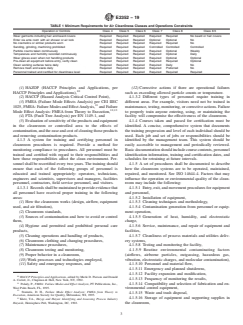
4.1.2.1 Table 1 gives the recommended air cleanliness class, personnel practices, and operational controls for different types of
cleanroom and controlled area operations. Examples of methods used for determining and managing these factors include:
(1) HAZOP (HACCP Principles and Applications, per HACCP Principles and Applications),
(2) HACCP (Hazard Analysis Critical Control Point),
(3) FMEA (Failure Mode Effects Analysis) per CEI IIEC 1025, FMEA: Failure Modes and Effect Analysis, and Failure Mode
12,13
Effect Analysis: FMEA from Theory to Execution,
(4) FTA (Fault Tree Analysis) per EN 1149-1, and
(5) Evaluation of sensitivity of the products and equipment in the cleanroom or controlled area to the effects of contamination,
and the ease and cost of cleaning those products and removing contamination products.
4.1.3 A system for training and certifying personnel in cleanroom procedures is required. Provide a method for monitoring
compliance to procedures. All personnel must be trained and certified with regard to their responsibilities and how those
responsibilities affect the clean environment. Personnel shall be recertified every two years. The training should ensure that each
of the following groups of personnel is educated and trained appropriately: operators, technicians, engineers and scientists,
supervisors and managers, facilities personnel, contractors, field service personnel, and visitors.
TABLE 1 Minimum Requirements for Air Cleanliness Classes and Operations Constraints
Operation or Controls Class 4 Class 5 Class 6 Class 7 Class 8 Class 8.5
Wear garments including hair and beard covers Required Required Required Required Required No beard or hair covers
Enter via ante room with air shower or air lock Required Required Required Optional Optional No
No cosmetics or similar products worn Required Required Required Required Required No
Sanding, grinding, machining prohibited Required Required Required Controlled Controlled Controlled
Particle counts taken continuously Required Required Required Required Opt. Weekly
Particle counts taken continuously Required Required Required Required Optional Weekly
Temperature and humidity recorded continuously Required Required Required Required Opt. Daily
Temperature and humidity recorded continuously Required Required Required Required Optional Daily
Wear gloves even when not handling products Required Required Required Required Opt. Opt.
Wear gloves even when not handling products Required Required Required Required Optional Optional
Pre-clean all equipment before entry, verify clean Required Required Required Required Req. Opt.
Pre-clean all equipment before entry, verify clean Required Required Required Required Required Optional
Clean working surfaces twice daily Required Required Required Required Daily No
Remove trash and waste daily Required Required Required Required Preferred No
Personnel trained and certified for cleanliness level Required Required Required Required Required Required
HACCP Principles and Applications, edited by Merle D. Pierson and Donald A. Corlett, Jr., Chapman & Hall, New York, NY, 1992.
Palady, P., FMEA: Failure Modes and Effect Analysis, PT Publications, Inc., West Palm Beach, FL, 1995.
Stamatis, D. H., Failure Mode Effect Analysis: FMEA from Theory to Execution, American Society for Quality, Milwaukee, WI, 1995.
Kletz, T.A., Hazop and Hazan: Identifying and Assessing Process Industry Hazards, Hemisphere Pub, Washington, DC, 1992.
E2352 − 19
4.1.3.1 Records shall be maintained to provide evidence that all personnel have received proper training in the following areas:
(1) How the cleanroom works (design, airflow, equipment used, and air filtration),
(2) Cleanroom standards,
(3) Sources of contamination and how to avoid or control them,
(4) Hygiene and permitted and prohibited personal care products,
(5) Cleaning operations and handling of products,
(6) Cleanroom clothing and changing procedures,
(7) Maintenance procedures,
(8) Cleanroom testing and monitoring,
(9) Proper behavior in a cleanroom,
(10) Work processes and technologies employed,
(11) Safety and emergency responses, and
(12) Corrective actions if there are operational failures such as exceeding allowed particle counts or temperature.
4.1.3.2 Different types of personnel require training in different areas. For example, visitors need not be trained in maintenance,
testing, monitoring, or corrective actions. Failure to properly train anyone entering, using, or maintaining the facility will
compromise the effectiveness of the cleanroom.
4.1.4 Courses taken and passed for certification must be identified. A concise, comprehensive system that documents the training
progression and level of each individual should be used. Each job and set of jobs or responsibilities should be identified by the
management team. This system should be easily accessible to management and periodically reviewed. Basic documentation should
include course contents, personnel identification information, training and certification dates, and schedules for retraining at future
intervals.
4.1.5 A set of procedures shall be documented to describe how the cleanroom systems are to be operated, maintained, repaired,
and monitored. See ISO 14644—Part 4. 14644-4. Factors that may influence the operation or environmental quality of the
cleanroom may include the following:
4.1.5.1 Entry, exit, and movement procedures for equipment and personnel,
4.1.5.2 Installation of equipment,
4.1.5.3 Cleaning techniques and methodology,
4.1.5.4 Contamination generation from personnel or equipment operation,
4.1.5.5 Generation of heat, humidity, and electrostatic charge,
4.1.5.6 Service, maintenance, and repair of equipment and facilities,
4.1.5.7 Cleanliness of process materials and utilities delivery systems,
4.1.5.8 Testing and monitoring the facility,
4.1.5.9 Routine environmental contaminating factors (airflows, airborne particles, outgassing, hazardous gas, vibration,
electrostatic charges, and molecular contamination),
4.1.5.10 Personnel and material flow,
4.1.5.11 Emergency and planned shutdowns,
4.1.5.12 Facility expansion and modification,
4.1.5.13 Frequency of monitoring the results,
4.1.5.14 Compatibility and selection of fabrication and environmental control equipment,
4.1.5.15 Waste and trash disposal,
4.1.5.16 Storage of equipment and supporting supplies in the cleanroom,
4.1.5.17 Contamination factors during use,
4.1.5.18 Fluid and gas purity supplied by delivery systems, and
4.1.5.19 Packaging materials and methods of packaging products.
4.1.6 Cleanroom mats and sticky flooring are used as a barrier to help control foot-borne contamination from entering the
cleanroom. The size (particularly the length) and location of the mats/flooring are major factors governing the effectiveness for the
removal of foot-borne contamination. Two major varieties of mats/flooring available include:
4.1.6.1 Disposable—Multiple layers of adhesive, plastic film with the sticky surface facing up. Layers are removed and
discarded periodically as they get dirty.
4.1.6.2 Reusable—Resilient polymeric mat with a naturally sticky surface, to be cleaned when it becomes dirty. These polymeric
mats reportedly have higher particle capture efficiency than disposable mats.
TABLE 2 Minimum Requirements for Frequency of Garment Changes
Class 4 Class 5 Class 6 Class 7 Class 8 Class 8.5
Garments, Gowns Each entry Each entry Daily Every 3 days Weekly Weekly
Gloves, hand covers Each entry Each entry Each entry Each entry Daily Daily
Hair, beard covers Each entry Each entry Each entry Each entry Daily N.A.
E2352 − 19
4.1.7 All activities that modify the cleanroom or that result in any change in contamination controls shall be planned to include
all relevant personnel, including facility, manufacturing, and equipment engineers, contamination control engineers, process
engineers, quality assurance engineers, manufacturing managers, and contractors. Any significant changes of facility operation or
use may require requalification of the facility in compliance with Practice E2217, Practice E2042, ISO 14644-2, and ISO 14644-4.
Modifications of concern include adding equipment or work benches, relocating equipment, adding or removing operations or
functions, changes to mechanical equipment such as blowers or HEPA filters, relocating environmental monitors for particle
counts, temperature, humidity, particle deposition, or NVR deposition may require retesting and recertification of the facility.
4.1.8 Establish and document a system that enforces safety and complies with all applicable regulatory requirements for
operations and personnel in the cleanroom. Proper personnel training in safety requirements and procedures are essential.
Management must implement and monitor effective systems to protect the health and safety of personnel. Good programs should
include the following:
4.1.8.1 Readily available safety data sheets (MSDS) that describe hazardous materials,
4.1.8.2 Evacuation plans and practice evacuations,
4.1.8.3 An accident reporting system,
4.1.8.4 Suggestion feedback systems for personnel,
4.1.8.5 Appropriate monitoring of potentially hazardous conditions or materials,
4.1.8.6 Rapid response to emergencies by trained personnel,
4.1.8.7 Supporting documentation for all safety improvements and corrections and emergency responses,
4.1.8.8 Standard operating guidelines and plans for different types of incidents, and
4.1.8.9 Safe storage for hazardous materials in or near the cleanroom.
4.2 Cleanroom Clothing:
4.2.1 Cleanroom clothing shall protect the environment and products from contamination generated by the personnel and their
clothing. To maximize this containment, the choice of barrier fabric, the clothing style, and extent of coverage of personnel by the
garment shall be controlled. The fabric used to manufacture cleanroom clothing should not create significant amounts of
contamination and shall be made of fabrics and materials that hashave minimal linting and doesdo not shed. Cleanroom clothing
should be resistant to break-down and tearing. Garments should disperse the minimum of particles. Information on tests used to
assess these properties is availableavailable. Garments should comply with Test Method F51 or IEST-RP-CC003. Specification
E1549 describes garment requirements for ESD controlled areas. Clothes worn under the cleanroom gowns should cover most of
the body. Shorts or short skirts which expose bare legs are inappropriate under cleanroom garments. The cleanroom clothing worn
will vary according to the product cleanliness and process requirements. It includes hoods, caps, coveralls, overboots, facemasks,
and goggles or safety glasses. In controlled areas, class 8.5 (FED-STD-209E 300 000) or less stringent, wearing facemasks,
goggles, and safety glasses is optional.
4.2.2 People disperse fragments from their skin and particles from their normal indoor clothing. This dispersion varies from
person-to-person and from time to time but can be several million particles and several hundred bacteria-carrying particles per
minute. The prime function of cleanroom clothing is to act as a body filter. It should be made from a fabric that filters the
contamination, and be designed to enclose a person and prevent significant amounts of unfiltered body emissions from being
dispersed into the cleanroom.
4.2.2.1 Personnel emit, through sneezing, coughing and talking, inert and microbe-carrying particles from the mouth, nose, and
face. Touching transmits contamination from the hands to surfaces in the cleanroom. It normally is necessary to wear facemasks
and gloves to minimize transmission of this contamination. Face masks are required to cover beards or facial hair. They are a
barrier against saliva and contamination and are commonly used in cleanrooms. The masks can be surgical-style masks with
elasticized straps and loops and the veils are snapped into hoods or permanently sewn into the hood at manufacture. Materials used
are washable or disposable fabrics. Care should be taken to select the proper material and style that is appropriate to the risk from
emissions from the mouth.
4.2.3 The best design of cleanroom clothing completely envelops the person and has good closures at the wrist, neck, and ankle.
The choice depends on operations being performed, the requirements of the hardward,hardware, and the class of cleanroom.In
cleanroom. In class 7 (FED-STD-209E class 10 000) 10 000) or better cleanrooms, typical clothing includes a one-piece coverall,
overboots, and a hood with yoke or skirt that tucks under the neck of the garment. In class 8 (FED-STD-209E class 100 000),
100 000), cleanliness requirements permit clothing of lesser coverage. The minimum requirements for clothing worn in various
cleanroom classes are shown in Table 1.
4.2.4 The frequency of changing into fresh clothing before entering the cleanroom shall be determined in accordance with the
product and process cleanliness requirements. Table 2 provides the minimum requirements for the frequency of garment changes.
4.2.5 The necessary cleaning, processing, and packaging of clothing shall be defined so that the clothing and packaging are
appropriate for the product or process. Personnel must wear hair and beard covers and garments that have acceptable ESD
behavior, stability, and low levels of particulate generation, acceptable permeability, and low NVR when tested per Test Method
D737, Specification E1549, IEST-RP-CC003.2, and JIS.JIS B9923, and JIS B9926.
4.2.6 Reusable cleanroom clothing shall be cleaned at regular intervals, but not less than weekly, to remove contamination.
E2352 − 19
4.2.7 Cleanroom clothing shall be stored in closed cabinets or closets, or on racks in the changing room to minimize
contamination. An area large enough to contain the spare clothing must be set aside for storage purposes. Lockers can be obtained
for this purpose. These lockers should be placed on the cleaning schedule to ensure that they do not contribute to contamination.
Several methods are effective for storing clothing. These may include the following:
4.2.7.1 Clothing racks inside lockers or closets,
4.2.7.2 Fixed and portable racks utilizing hangers,
4.2.7.3 Hooks mounted to walls or frames in the changing area or room; these can be in a locker or in the room, and
4.2.7.4 Bins or storage slots. Clothing elements may require physical separation when stored together in bins or slots.
Launderable or disposable bags can be used to help avoid cross-contamination.
4.2.8 Cleanroom clothing (clean packaged or dirty) shall not be removed beyond the confines of the storage area and cleanroom
or changing room except for laundering purposes. Cleanroom garments shall not be worn in uncontrolled areas or outside of the
cleanroom and changing room.
4.2.9 Cleanroom clothing shall be put on and removed so that the spread of contamination is avoided or minimized. Dress from
the top down, and do not drag cleanroom garments on the floor. Cleanroom personnel will change into cleanroom clothing in the
changing area or airlock, before proceeding into a cleanroom. Minimize contamination of the cleanroom clothing while putting
it on and removing it to ensure that contamination is not spread from the changing area. Several methods are acceptable depending
on the design of the changing area and the cleanliness levels of the cleanroom. A preferred procedure is outlined below, but many
variations exist.
4.2.9.1 Remove contamination from shoes by use of a shoe cleaner, cleanroom mat, or cleanroom flooring.
4.2.9.2 Remove unnecessary street clothing and store or hang it in provided lockers or on hangers.
4.2.9.3 Remove jewelry and so forth, if required (always in class 8 or cleaner).
4.2.9.4 Remove cosmetics and put on moisturizer, if required (always in class 8 or cleaner).
4.2.9.5 Put on hair cover.
4.2.9.6 Wash hands and put on suitable moisturizer, if applicable.
4.2.9.7 Select cleanroom clothing.
4.2.9.8 If required, put on gloves for handling cleanroom clothing.
4.2.9.9 Put on beard covering, if the operator has a noticeable beard or facial hair.
4.2.9.10 Put on coverall or gown.
4.2.9.11 Put on shoe coverings or special cleanroom shoes.
4.2.9.12 Gloves used for putting on cleanroom clothing can now be removed. Process gloves then can be put on.
4.2.9.13 Enter the cleanroom.
4.2.10 Cleanroom clothing will become contaminated during use. If clothing is to be reused, it shall be removed and stored in
an anteroom or in a closet or closed cabinet to ensure that contamination is minimized. Package clothing to be laundered to
minimize any additional contamination during transport to the cleaning facility. Laundering and operations must be carried out in
a cleanroom with equal or better standards of cleanliness as where the clothing is worn. An effective cleaning process should be
used. Cleaning procedures should be followed by sample testing at the laundry, for the appropriate type and level of contamination.
4.2.11 Cleanroom clothing shall be checked at regular intervals to ensure that it retains acceptable contamination control
characteristics. See IEST-RP-CC027.1 and ISO 9237.
4.2.12 The design and construction of cleanroom clothing should minimize contamination in the cleanroom. Methods used
include: all raw edges of the fabric should be interlocked, heat seared, or laser cut to prevent fraying. Seams are double needle
stitched, bound, or taped to provide a good barrier and not produce fibers. Threads should be continuous monofilament. Zippers,
clips and fasteners, and shoe soles should not shed, chip, or corrode, and should be able to tolerate multiple laundering.
4.2.13 The fabric used acts as a filter to prevent personnel-generated contamination from being dispersed into the cleanroom.
Fabric effectiveness is related to the tightness of the fabric’s weave or the effectiveness of the membrane barrier. The effectiveness
of the weave can be tested by measuring the pore size and the efficiency of fabrics in removing particles, and by measuring air
permeability. As air permeability decreases, pressure within the garment increases as personnel move about. This can result in
pumping of unfiltered air out through the closures of the cleanroom clothing.
4.2.14 The design of clothing should consider the type of cleanroom. There are two broad categories of clothing used in
cleanrooms, that is, disposable (or limited use) and reusable. In general, disposable or limited use clothing usually is made from
a non-woven materials and is used either once or a few times and then discarded. Reusable clothing is processed and laundered
at regular intervals and is usually made from tightly woven synthetic fabrics. More critical applications may require the use of
membrane barrier technology. Natural fabrics made from fibers such as cotton or blends with high percentages of cotton or wool
would not normally be used in cleanrooms, as they easily break up and disperse contamination.
4.2.14.1 Cleanroom clothing should incorporate a large selection of sizes, to provide comfort and fit. To minimize the retention
of contamination, no pockets, pleats, darts, or action backs should be used. Elasticized or knitted cuffs should not trap or shed
contaminants and should not build up electrostatic charges. Pockets are either not provided or are limited in number. Garment
closures should provide a tight yet comfortable closure. Other design parameters that should be considered are:
(1) Zipper material (for example, covered plastic zip-fasteners), type, and location,
E2352 − 19
(2) Placement and effectiveness of snap adjusters and stays,
(3) Sleeve construction (set-in or raglan),
(4) Collar style,
(5) Ability to don over various shoe or boot styles,
(6) Hood style (open or closed face, snap or pull-over),
(7) Passive or active adjustment and fit of hoods, and
(8) Type and placement of straps on boots.
4.2.15 The comfort of people working in the cleanroom must be considered whenever possible when choosing cleanroom
clothing materials. Air and moisture permeability specifications of the fabrics under consideration can help in this determination.
A simple but effective approach is to obtain a selection of suitable clothing of different fabrics and try them in the cleanroom.
Feedback, solicited from personnel who will be expected to wear the clothing, may provide valuable information that will aid in
the selection process. See Test Method D737 and ISO 9237 (1995).
4.2.16 Consideration shall be given to special (for example, chemical, physical, or ESD) properties of the clothing that may be
necessary for specific applications. In some types of cleanrooms, for example, microelectronics, or rooms with flammable ordnance
or explosive chemicals, the electrostatic charges that build up on the surface of clothing will be harmful to the components being
manufactured or hazardous to operators. Fabrics are available that have static-dissipative threads, woven into the fabric, to conduct
away the electrostatic charge. The effectiveness of a fabric to dissipate an electrostatic charge can be indirectly measured by
checking the fabric’s surface resistivity. In a more effective test, a static charge of known voltage level is applied to the fabric.
Static dissipative performance can then be determined by the time it takes for the voltage to decrease by a given percentage of the
original voltage. Static dissipation effectiveness can degrade over time, or after repeated washings, so it is important to verify
adequacy of static dissipation of garments periodically.
4.2.17 Cleanroom gloves are required for anyone who handles any items in a cleanroom. They cover that part of the human body
that is often closest to the product and critical surfaces. Properties of cleanroom gloves that should be considered depending upon
the type of cleanroom in which they will be used are as follows: surface contamination, outgassing or offgassing, sterility, tactility,
strength, comfort, fit and fit, as well as the method of packaging. Various tests can be performed to help in selecting the proper
gloves. See Test Methods E595, E1559, and E1731, NASA STD-6001, Test #7, and IEST-RP-CC005.
4.2.17.1 Gloves can be constructed of latex, vinyl, or nitrile rubber and must be powder-free. Nitrile gloves are preferable for
cleanrooms’ use. Some glove materials cause rashes or discomfort for susceptible personnel and must be avoided. Undergloves,
Under gloves, made from non-linting materials, may also be needed by some employees to provide comfort or isolation from glove
surfaces that can cause, or aggravate, dermatitis.
4.3 Personnel:
4.3.1 Personal and other items not intended for cleanroom use shall not be allowed inside the cleanroom, unless approved.
Jewelry normally is not allowed, but watches and rings usually are permitted. In general, items taken into the cleanroom should
be limited to those needed to perform operations and functions and not be mainly decorative.
4.3.2 Personnel shall be instructed in hygiene-related issues that will prepare them for properly working in the cleanroom
environment. Cleanroom personnel are expected to have good personal hygiene. They should minimize dandruff and use specially
formulated skin lotion to replace skin oils after washing and showering, if necessary. Personnel should report problems associated
with unusual skin shedding, coughing, allergic conditions which cause sneezing, itching or scratching or other problems such as
flaking skin, dermatitis, sunburn or bad dandruff, a cold, flu, or chronic coughing. Depending on the seriousness of the condition
with respect to the process or product being produced, it may be necessary to relocate such personnel to work outside the
cleanroom. Personnel who are coughing or sneezing should be excluded from cleanrooms until their health problems are resolved.
4.3.3 Smoking and tobacco products are prohibited. Jewelry, cosmetics, hair spray, and similar materials that can cause
contamination problems shall be prohibited from cleanrooms but may be allowed in controlled areas. Cosmetics, talcum powder,
hair sprays, nail polish, or similar materials are undesirable in a cleanroom. Cosmetics can generate particles or contaminate
cleanroom clothing and are prohibited in cleanrooms, but may be worn in controlled areas.
4.3.4 Personnel shall be protected against hazards such as microbes, radioactivity, and chemicals. This can be done by the
provision of containment cabinets, cupboards, or isolators. See ISO 14644-4 and ISO 14644-7. Suitable protective clothing such
as eye splash shields, gloves, and aprons may be required.
4.3.5 Personnel shall receive safety training for all known health and safety risks associated with their work. Normal operation
of cleanrooms often includes the use of hazardous or toxic materials. Personnel should be protected from exposure to those agents.
MSDS information shall be provided in each cleanroom and controlled area.
4.3.6 Cleanroom personnel shall be trained to conduct themselves in a manner that minimizes the possibility of contamination
being generated or stirred up and transferred or deposited on or into the product. Personnel who are motivated can have a positive
influence on the effectiveness of the cleanroom. Helpful coaching of one to another can improve conformance to personnel
procedures. Also, empowering all personnel to report observed deficiencies in the cleanroom to authorized personnel may help
identify unnoticed contamination sources for correction or repair.
4.3.6.1 Even though properly trained, personnel may fall into poor cleanroom habits. The actions of personnel should therefore
be monitored to ensure that they adhere to correct cleanroom disciplines. Monitoring programs can be formal or informal
E2352 − 19
depending on the level of empowerment given to each person on the cleanroom staff and the sensitivity of the products. Internal
auditors can monitor the actions of those in the cleanroom based upon the written procedures. Reports would be issued to
management on a regular basis detailing deficiencies and can be used for determining corrective actions that can be initiated. An
effective program should positively influence all personnel to follow proper cleanroom procedures.
4.3.7 Cleanroom personnel should conduct themselves in a cleanroom in such a way as to minimize the possibility of
contamination getting to the product. Minimum disciplines that should be considered are given below.
4.3.7.1 Doors should not be opened and closed quickly, not left open. When entering an airlock, the first door should be allowed
to close before next one is opened. Personnel should be positioned correctly with respect to the product so that contamination
dispersed from them neither falls onto the product nor is blown towards the product. In general, the correct air flow sequence
should be: air supply to exposed product to personnel and then onwards to the general cleanroom area and hence to the air return
or exhaust. Devise methods for moving or manipulating the product that minimize opportunities for product contamination.
‘No-touch’ techniques should be used where appropriate. Personnel should not support material against their body, or
contamination may be transferred. Personnel should not talk when working close to the product. Do not allow anything to trail over
the product. Facial or other personal wiping must be done outside the cleanroom. It may be permissible to do so in the changing
area. Glove and garment surfaces can easily become contaminated. Personnel should not touch surfaces and transfer contamination
to critical areas. A cleanroom wiper should be used as specified, and then discarded. All personnel movements should be deliberate
and methodical. Overexuberant behavior should not be allowed. Contamination generation is proportional to personnel activity.
The room should be kept neat and tidy. Products stored or left standing in a cleanroom should be protected from contamination
and kept in an identifiable closed cabinet, container or unidirectional cabinet. Waste material should be collected frequently into
easily identified containers and removed.
4.3.8 Emergency situations may arise and emergency response personnel, trained in all aspects of potential emergencies, can
minimize the effects of mishaps that may occur. Procedures for the most common types of incidents should be documented and
practiced. All employees should be trained for an orderly evacuation. If an evacuation is necessary, provisions should be made for
the orderly return to the cleanroom once the situation is cleared. An emergency procedure for supplying fresh cleanroom clothing
should be implemented. Retesting or recertification should be considered as necessary.
4.3.9 The number of personnel in a cleanroom should be limited. Normally only those personnel actively working or directly
supporting the operations should be in the cleanroom. If there is a cleaner area within a cleanroom, such as a laminar flow bench
operating at class 5 in a class 8 facility, personnel at the clean bench should be minimized.
4.3.10 Exit procedures for portable objects should be considered. Many items used by personnel are routinely removed when
they leave the cleanroom. These items may include notebooks, pens, hand-tools, and other types of small portable equipment.
These items should be protected from becoming contaminated through the use of approved plastic bags or other suitable means
if they will be regularly reintroduced into the cleanroom. In addition, items may require cleaning before being reintroduced into
the cleanroom. This will facilitate reentry to the cleanroom at a future time. The method for the removal of cleanroom clothing
on leaving the cleanroom will depend on whether fresh clothing is used on each entry or whether they are to be reused. Cleanroom
clothing that will be reused should be stored on hangers or inside cabinets in the anteroom and should not be worn in uncontrolled
areas or outside of the anteroom or cleanroom. If fresh clothing is worn, discard the used clothing in a designated bin.
4.4 Stationary Equipment:
4.4.1 All equipment that is large enough to be relatively immovable is called stationary. Usually, extensive efforts are required
to remove or relocate this equipment once installation is completed.
4.4.2 This equipment and its associated moving and rigging equipment shall be thoroughly cleaned before being transported into
the cleanroom. When possible equipment to be used in the cleanroom should be manufactured under clean conditions and packaged
for the requirements of the intended cleanroom.
4.4.3 All equipment should be checked for damage in transport and suspected or damaged goods should be isolated or protected
outside the cleanroom pending appropriate actions. Shipping crates and packaging should be removed in the uncontrolled
environment adjacent to the cleanroom. All cardboard and shedding materials should be removed outside of the controlled
environment. When not pre-packaged, all equipment surfaces should be pre-cleaned prior to its entry into a cleanroom area. This
is best done within the airlock or entry chamber.
4.4.4 Bringing equipment into the cleanroom should not cause contamination of the environment. Equipment entering a
cleanroom that is operating “as built” or “at rest” should be properly unpackaged and cleaned before entry. Failure to do so will
require extensive clean-up afterwards. Special considerations must be made before bringing equipment into an “operational”
cleanroom. Failure to do so will expose not only the cleanroom to contamination risks but may affect products in process. This
will necessitate additional cleaning and may require the cleanroom to be requalified under ISO 14644-2.
4.4.5 If the equipment is so large that special installation procedures are required, then the area should be isolated from
surrounding portions of the cleanroom or other controlled environments with temporary walls. Unpack the equipment in steps to
control contamination entering the cleanroom. The airlock, or a temporary room built for this purpose and attached to the
cleanroom, can be used for the removal of exterior film packaging materials and surface cleaning before cleanroom entry.
Preparation should be performed in the order listed below:
4.4.5.1 The outer protective covering should be vacuumed, beginning at the top surface and then proceeding to the sides.
E2352 − 19
4.4.5.2 The protective cover should be wiped, using the appropriate cleaning agent.
4.4.5.3 The outer layer of packaging film should be slit at the top and peeled from the top to the bottom.
4.4.5.4 The bottom edge of the packaging film should then be lifted and joined to the sides of the packaging film.
4.4.5.5 These unpacking procedures, except for vacuuming, should be repeated for each additional layer.
4.4.5.6 All exterior surfaces of the equipment should be thoroughly cleaned.
4.4.5.7 All personnel should be properly gowned prior to entering the airlock.
4.4.5.8 All moving and handling equipment should be cleaned as described above.
4.4.5.9 The airlock should be cleaned before opening the doors
...