

ASTM E2090-12(2020)
(Test Method)Standard Test Method for Size-Differentiated Counting of Particles and Fibers Released from Cleanroom Wipers Using Optical and Scanning Electron Microscopy
General Information
- Abstract
SIGNIFICANCE AND USE
5.1 This test method provides for accurate and reproducible enumeration of particles and fibers released from a wiper immersed in a cleaning solution with moderate mechanical stress applied. When performed correctly, this counting test method is sensitive enough to quantify very low levels of total particle and fiber burden. The results are accurate and not influenced by artifact or particle size limitations. A further advantage to this technique is that it allows for morphological as well as X-ray analysis of individual particles.
SCOPE
1.1 This test method covers testing all wipers used in cleanrooms and other controlled environments for characteristics related to particulate cleanliness.
1.2 This test method includes the use of computer-based image analysis and counting hardware and software for the counting of densely particle-laden filters (see 7.7 – 7.9). While the use of this equipment is not absolutely necessary, it is strongly recommended to enhance the accuracy, speed, and consistency of counting.
1.3 The values stated in SI units are to be regarded as the standard.
1.4 This standard does not purport to address all of the safety concerns, if any, associated with its use. It is the responsibility of the user of this standard to establish appropriate safety, health, and environmental practices and determine the applicability of regulatory limitations prior to use.
1.5 This international standard was developed in accordance with internationally recognized principles on standardization established in the Decision on Principles for the Development of International Standards, Guides and Recommendations issued by the World Trade Organization Technical Barriers to Trade (TBT) Committee.
- Status
- Published
- Publication Date
- 31-Mar-2020
- Technical Committee
- E21 - Space Simulation and Applications of Space Technology
- Drafting Committee
- E21.05 - Contamination
Overview
ASTM E2090-12(2020) is an established international standard that outlines a test method for the size-differentiated counting of particles and fibers released from cleanroom wipers. Utilizing both optical microscopy and scanning electron microscopy (SEM), this method provides a sensitive and reproducible approach for enumerating very low levels of particulate and fiber contamination. The standard's procedures enable precise morphological analysis and support applications in industries dependent on contaminant-free environments, such as semiconductor, pharmaceutical, biotechnology, aerospace, data storage, and automotive sectors.
Key Topics
- Cleanroom Wipers: The document defines wipers as absorbent materials (knit, woven, nonwoven, or foam) used in controlled environments for cleaning, spill pickup, or liquid application where minimal particulate contamination is essential.
- Particle and Fiber Release Testing: The method simulates typical usage of wipers by immersing them in a low-surface-tension cleaning solution and applying moderate mechanical agitation to remove particles and fibers.
- Microscopy-based Enumeration:
- Optical Microscopy: Used for manual counting of large fibers and particles greater than 100 µm.
- Scanning Electron Microscopy (SEM): Enables accurate enumeration and morphological analysis of particles in the 0.5 µm to 100 µm size range.
- Image Analysis Software: Computer-aided image analysis is strongly recommended for counting areas with high particle density, ensuring accuracy and consistency in results.
- Background Correction: Involves preparing blanks to assess and correct for background contamination from sample handling and filtration apparatus.
- Calibration and Validation: Requires calibration of microscopes and validation of sizing algorithms with reference standards, ensuring the reliability of particulate cleanliness assessments.
Applications
- Quality Control in Cleanroom Consumables: Enables manufacturers and users to assess and verify the performance of wipers with respect to particle and fiber release, ensuring conformance to cleanroom standards.
- Process Validation and Compliance: Used by regulated industries for demonstrating that wipers meet the stringent particulate cleanliness levels required in applications such as microelectronics fabrication, pharmaceutical production, and biotechnology processing.
- Research and Development: Facilitates comparative analysis of various wiper materials and cleaning solutions, supporting the selection and optimization of low-shedding consumables.
- Contamination Control: Supports cleanroom managers and quality assurance teams in ongoing efforts to minimize sources of particle and fiber contamination, thereby safeguarding sensitive processes and products.
Related Standards
- ASTM D1193: Specification for Reagent Water, referenced for ensuring appropriate purity during testing.
- ASTM F25 & F312: Methods for sizing and counting airborne particulates and particles on membrane filters.
- ISO 14644-1 & ISO 14644-2: International standards for cleanroom classification and compliance, critical for cleanroom particle control.
- FED-STD-209E: U.S. federal standard (now replaced by ISO 14644) for airborne particulate cleanliness in cleanrooms.
Practical Value
Implementing ASTM E2090-12(2020) helps organizations:
- Trust in the traceable, repeatable assessment of cleanroom wiper cleanliness
- Reduce sources of contamination risk in sensitive environments
- Meet regulatory and customer-driven requirements for process cleanliness
- Benchmark and improve cleanroom consumable quality using industry-accepted methodologies
By following this standard, laboratories and manufacturing operations can reliably quantify particulate and fiber contamination from critical cleaning materials, ensuring the highest quality standards in controlled environments.
Relations
- Effective Date
- 01-Apr-2020
- Effective Date
- 01-Nov-2008
- Effective Date
- 01-Mar-2006
- Effective Date
- 01-Sep-2004
- Effective Date
- 10-Aug-1999
- Effective Date
- 10-Feb-1999
- Effective Date
- 10-Feb-1999
- Effective Date
- 10-Apr-1997
- Effective Date
- 01-Jan-1997
- Effective Date
- 01-Apr-2020
Get Certified
Connect with accredited certification bodies for this standard

CIS Institut d.o.o.
Personal Protective Equipment (PPE) certification body. Notified Body NB-2890 for EU Regulation 2016/425 PPE.

Kiwa BDA Testing
Building and construction product certification.
Kmetijski inštitut Slovenije
Agricultural Institute of Slovenia. Soil testing, plant health, agricultural product analysis.
Sponsored listings
Frequently Asked Questions
ASTM E2090-12(2020) is a standard published by ASTM International. Its full title is "Standard Test Method for Size-Differentiated Counting of Particles and Fibers Released from Cleanroom Wipers Using Optical and Scanning Electron Microscopy". This standard covers: SIGNIFICANCE AND USE 5.1 This test method provides for accurate and reproducible enumeration of particles and fibers released from a wiper immersed in a cleaning solution with moderate mechanical stress applied. When performed correctly, this counting test method is sensitive enough to quantify very low levels of total particle and fiber burden. The results are accurate and not influenced by artifact or particle size limitations. A further advantage to this technique is that it allows for morphological as well as X-ray analysis of individual particles. SCOPE 1.1 This test method covers testing all wipers used in cleanrooms and other controlled environments for characteristics related to particulate cleanliness. 1.2 This test method includes the use of computer-based image analysis and counting hardware and software for the counting of densely particle-laden filters (see 7.7 – 7.9). While the use of this equipment is not absolutely necessary, it is strongly recommended to enhance the accuracy, speed, and consistency of counting. 1.3 The values stated in SI units are to be regarded as the standard. 1.4 This standard does not purport to address all of the safety concerns, if any, associated with its use. It is the responsibility of the user of this standard to establish appropriate safety, health, and environmental practices and determine the applicability of regulatory limitations prior to use. 1.5 This international standard was developed in accordance with internationally recognized principles on standardization established in the Decision on Principles for the Development of International Standards, Guides and Recommendations issued by the World Trade Organization Technical Barriers to Trade (TBT) Committee.
SIGNIFICANCE AND USE 5.1 This test method provides for accurate and reproducible enumeration of particles and fibers released from a wiper immersed in a cleaning solution with moderate mechanical stress applied. When performed correctly, this counting test method is sensitive enough to quantify very low levels of total particle and fiber burden. The results are accurate and not influenced by artifact or particle size limitations. A further advantage to this technique is that it allows for morphological as well as X-ray analysis of individual particles. SCOPE 1.1 This test method covers testing all wipers used in cleanrooms and other controlled environments for characteristics related to particulate cleanliness. 1.2 This test method includes the use of computer-based image analysis and counting hardware and software for the counting of densely particle-laden filters (see 7.7 – 7.9). While the use of this equipment is not absolutely necessary, it is strongly recommended to enhance the accuracy, speed, and consistency of counting. 1.3 The values stated in SI units are to be regarded as the standard. 1.4 This standard does not purport to address all of the safety concerns, if any, associated with its use. It is the responsibility of the user of this standard to establish appropriate safety, health, and environmental practices and determine the applicability of regulatory limitations prior to use. 1.5 This international standard was developed in accordance with internationally recognized principles on standardization established in the Decision on Principles for the Development of International Standards, Guides and Recommendations issued by the World Trade Organization Technical Barriers to Trade (TBT) Committee.
ASTM E2090-12(2020) is classified under the following ICS (International Classification for Standards) categories: 13.040.35 - Cleanrooms and associated controlled environments. The ICS classification helps identify the subject area and facilitates finding related standards.
ASTM E2090-12(2020) has the following relationships with other standards: It is inter standard links to ASTM E2090-12, ASTM F312-08, ASTM D1193-06, ASTM F25-04, ASTM F25-68(1999), ASTM D1193-99, ASTM D1193-99e1, ASTM F312-97(2003), ASTM F312-97, ASTM E2312-11(2019). Understanding these relationships helps ensure you are using the most current and applicable version of the standard.
ASTM E2090-12(2020) is available in PDF format for immediate download after purchase. The document can be added to your cart and obtained through the secure checkout process. Digital delivery ensures instant access to the complete standard document.
Standards Content (Sample)
This international standard was developed in accordance with internationally recognized principles on standardization established in the Decision on Principles for the
Development of International Standards, Guides and Recommendations issued by the World Trade Organization Technical Barriers to Trade (TBT) Committee.
Designation: E2090 − 12 (Reapproved 2020)
Standard Test Method for
Size-Differentiated Counting of Particles and Fibers
Released from Cleanroom Wipers Using Optical and
Scanning Electron Microscopy
This standard is issued under the fixed designation E2090; the number immediately following the designation indicates the year of
original adoption or, in the case of revision, the year of last revision.Anumber in parentheses indicates the year of last reapproval.A
superscript epsilon (´) indicates an editorial change since the last revision or reapproval.
INTRODUCTION
Techniques for determining the number of particles and fibers that can potentially be released from
wiping materials consist of two steps. The first step is to separate the particles and fibers from the
wiper and capture them in a suitable medium for counting, and the second step is to quantify the
number and size of the released particles and fibers.
The procedure used in this test method to separate particles and fibers from the body of the wiper
is designed to simulate conditions that the wiper would experience during typical use. Therefore, the
wiper is immersed in a standard low-surface-tension cleaning liquid (such as a surfactant/water
solutionorisopropylalcohol/watersolution)andthensubjectedtomechanicalagitationinthatliquid.
Theapplicationofmoderatemechanicalenergytoawiperimmersedinacleaningsolutioniseffective
in removing most of the particles that would be released from a wiper during typical cleanroom
wiping.Thistestmethodassumesthewiperisnotdamagedbychemicalormechanicalactivityduring
the test.
Once the particles have been released from the wiper into the cleaning solution, they can be
collected and counted. The collection of the particles is accomplished through filtration of the
particle-laden test liquid onto a microporous membrane filter. The filter is then examined using both
optical and scanning electron microscopy where particles are analyzed and counted. Microscopy was
chosen over automated liquid particle counters for greater accuracy in counting as well as for
morphological identification of the particles.
The comprehensive nature of this technique involves the use of a scanning electron microscope
(SEM) to count particles distributed on a microporous membrane filter and a stereo-binocular optical
microscopetocountlargefibers.Computer-basedimageanalysisandcountingisusedforfieldswhere
the particle density is too great to be accurately determined by manual counting.
Instead of sampling aliquots, the entire amount of liquid containing the particles and fibers in
suspension is filtered through a microporous membrane filter. The filtering technique is crucial to the
procedure for counting particles. Because only a small portion of the filter will actually be counted,
the filtration must produce a random and uniform distribution of particles on the filter.After filtration,
the filter is mounted on an SEM stub and examined using the optical microscope for uniformity of
distribution. Large fibers are also counted during this step. Once uniformity is determined and large
fibersarecounted,thesamplestubistransferredtotheSEMandexaminedforparticles.Astatistically
valid procedure for counting is described in this test method. The accuracy and precision of the
resultant count can likewise be measured.
This test method offers the advantage of a single sample preparation for the counting of both
particles and fibers. It also adds the capability of computerized image analysis, which provides
accurate recognition and sizing of particles and fibers. Using different magnifications, particles from
0.5to1000µmorlargercanbecountedandclassifiedbysize.Thisprocedurecategorizesthreeclasses
of particles and fibers: small particles between 0.5 and 5 µm; large particles greater than 5 µm but
smaller than 100 µm; and large particles and fibers equal to or greater than 100 µm. The technique as
described in this test method uses optical microscopy to count large particles and fibers greater than
100 µm and SEM to count the other two classes of particles. However, optical microscopy can be
employed as a substitute for SEM to count the large particles between 5 and 100 µm .
Copyright © ASTM International, 100 Barr Harbor Drive, PO Box C700, West Conshohocken, PA 19428-2959. United States
E2090 − 12 (2020)
1. Scope 3. Terminology
1.1 This test method covers testing all wipers used in 3.1 Definitions of Terms Specific to This Standard:
cleanrooms and other controlled environments for characteris- 3.1.1 automaticcounting,n—countingandsizingperformed
tics related to particulate cleanliness. using computerized image analysis software.
3.1.2 cleanroomwiper,n—apieceofabsorbentknit,woven,
1.2 This test method includes the use of computer-based
nonwoven, or foam material used in a cleanroom for wiping,
image analysis and counting hardware and software for the
spill pickup, or applying a liquid to a surface.
counting of densely particle-laden filters (see 7.7 – 7.9).While
3.1.2.1 Discussion—Characteristically,thesewiperspossess
the use of this equipment is not absolutely necessary, it is
very small amounts of particulate and ionic contaminants and
strongly recommended to enhance the accuracy, speed, and
are primarily used in cleanrooms in the semiconductor, data
consistency of counting.
storage, pharmaceutical, biotechnology, aerospace, and auto-
1.3 The values stated in SI units are to be regarded as the
motive industries.
standard.
3.1.3 effective filter area, n—the area of the membrane
1.4 This standard does not purport to address all of the
which entraps the particles to be counted.
safety concerns, if any, associated with its use. It is the
3.1.4 fiber, n—aparticlehavingalengthtodiameterratioof
responsibility of the user of this standard to establish appro-
10 or greater.
priate safety, health, and environmental practices and deter-
mine the applicability of regulatory limitations prior to use.
3.1.5 illuminance, n—luminous flux incident per unit of
1.5 This international standard was developed in accor-
area.
dance with internationally recognized principles on standard-
3.1.6 particle, n—a unit of matter with observable length,
ization established in the Decision on Principles for the
width, and thickness.
Development of International Standards, Guides and Recom-
3.1.7 particle size, n—the size of a particle as defined by its
mendations issued by the World Trade Organization Technical
longest dimension on any axis.
Barriers to Trade (TBT) Committee.
4. Summary of Test Method
2. Referenced Documents
4.1 Summary of Counting Methods—See the following:
2.1 ASTM Standards:
Counting Technique Particle Size Range
D1193Specification for Reagent Water
>100 µm 5–100 µm 0.5–5 µm
F25Test Method for Sizing and CountingAirborne Particu-
A B
Stereobinocular optical microscope 20× NA
late Contamination in Cleanrooms and Other Dust- manual
Scanning electron microscope NA 200× auto 3000× manual or
Controlled Areas
B
automatic
F312Test Methods for Microscopical Sizing and Counting
A
See Footnote 2.
Particles from Aerospace Fluids on Membrane Filters
B
NA = not applicable.
2.2 Other Documents:
5. Significance and Use
ISO 14644-1Cleanrooms and Associated Controlled Envi-
ronments – Classification of Air Cleanliness
5.1 This test method provides for accurate and reproducible
ISO 14644-2Cleanrooms and Associated Controlled Envi-
enumeration of particles and fibers released from a wiper
ronments – Part 2: Specifications for testing and monitor-
immersed in a cleaning solution with moderate mechanical
ing to prove continued compliance with ISO 14644-1
stress applied. When performed correctly, this counting test
Fed. Std. 209EAirborne Particulate Cleanliness Classes in
method is sensitive enough to quantify very low levels of total
Cleanrooms and Clean Zones
particle and fiber burden. The results are accurate and not
influenced by artifact or particle size limitations. A further
1 advantage to this technique is that it allows for morphological
This test method is under the jurisdiction of ASTM Committee E21 on Space
Simulation andApplications of SpaceTechnology and is the direct responsibility of as well as X-ray analysis of individual particles.
Subcommittee E21.05 on Contamination.
Current edition approved April 1, 2020. Published May 2020. Originally
6. Apparatus
approved in 2000. Last previous edition approved in 2012 as E2090–12. DOI:
6.1 Scanning Electron Microscope, with high-quality imag-
10.1520/E2090-12R20.
The counting of particles 5 to 100 µm by optical microscopy is not described
ing and computerized stage/specimen mapping capability.
inthistestmethod.However,proceduresforcountingparticlesinthissizerangeare
6.2 Stereo-BinocularOpticalMicroscope,withatleast40×-
described in the Test Methods F25 and F312.
For referenced ASTM standards, visit the ASTM website, www.astm.org, or
magnification capability equipped with a two-arm, adjustable-
contact ASTM Customer Service at service@astm.org. For Annual Book of ASTM
angle variable-intensity light source and a specimen holding
Standards volume information, refer to the standard’s Document Summary page on
plate.
the ASTM website.
Available fromAmerican National Standards Institute (ANSI), 25 W. 43rd St.,
6.3 Orbital Shaker, that provides 20-mm ( ⁄4-in.) diameter
4th Floor, New York, NY 10036, http://www.ansi.org.
circular motion in a horizontal plane at 150 r/min.
Cancelled Nov. 29, 2001 and replaced with ISO 14644-1 and ISO 14644-2,
FED-STD-209E may be used by mutual agreement between buyer and seller.
6.4 Microanalytical Stainless Steel Screen-Supported Mem-
AvailablefromU.S.GovernmentPrintingOfficeSuperintendentofDocuments,732
brane Filtration Apparatus, with stainless steel funnel, TFE-
N. Capitol St., NW, Mail Stop: SDE, Washington, DC 20401, http://
www.access.gpo.gov. fluorocarbon gasket and spring clamp.
E2090 − 12 (2020)
6.5 Vacuum Pump, capable of providing a pressure of industries.However,thistestmethodisnotlimitedtoaspecific
6.5kPa (65mb) (49torr) or lower. cleaning solution and only requires that the cleaning liquid
used be relatively free of particles and fibers. It is recom-
6.6 Cold Sputter/Etch Unit, with gold or gold/palladium
mended that the cleaning liquid most relevant to the product
foils.
end use be considered for this test method.
6.7 Video Camera (3-CCD preferable), that can be attached
to the stereo-binocular microscope and a monitor to provide
8. Preparation of Apparatus
video microscopy capability.
8.1 Setting Up Stereo-Binocular Optical Microscope—See
6.8 Personal Computer (486-Type Processor or Better) and
Section 10.
Monitor.
8.2 FiberCountingbyOpticalMicroscopy—SeeSection10.
6.9 Frame-Grabbing Hardware and Image Analysis
6 8.3 Setting Up Scanning Electron Microscope (SEM)—See
Software, compatible with the personal computer.
Section 10.
6.10 Hand-Operated Tally Counter.
8.4 Particle Counting by SEM—See Section 10.
6.11 Stage Micrometer, with 0.1- and 0.01-mm subdivi-
sions.
9. Calibration and Standardization
6.12 Horizontal, Unidirectional Flow Workstation, with
9.1 For the fiber counting by optical microscopy, the size
ISO Class 5 (Fed. Std. 209 Class 100) or cleaner air.
calibration at 20× magnification can be done by comparing the
fiber sizes, as visualized in the video monitor, with the rulings
7. Materials
onthestagemicrometer(with0.1-and0.01-mmsubdivisions).
7.1 Deionized Water, in accordance with Specification
For the equipment described above, a linear dimension of
–6 –1
D1193, Type III, 4.0 × 10 (Ω-cm) or better.
8mm in the video screen equaled 100 µm. The conversion
factors are equipment-dependent and users of this test method
7.2 Cleanroom Gloves (for example, unpowdered latex
shall establish the relation between screen size and object size.
gloves).
9.2 In the SEM study, to determine the values of the start
7.3 Fine-Point, Duckbill Tweezers.
and the end areas for the computer-assisted automatic particle
7.4 Forceps, two pairs, with flat gripping surface tips.
counting, it is necessary to perform the size calibration study
7.5 GlassBeakers,1.5L,cleanedinaccordancewith10.2.1.
by experimenting with standard-sized particles such as poly-
styrene microspheres or actual particles of known dimensions
7.6 Polyethylene Photographic Tray, approximately 250 by
which can be ascertained by using the micrometre bar mea-
340 by 45 mm cleaned in accordance with 10.2.1.
surement tool available on most SEMs.
7.7 Polycarbonate Membrane Filters (typically 0.1- to
9.3 Toprepareastubwith0.5-and5-µmspheres,add10µL
0.4-µm pore size), white, and 25-mm diameter.
of each of the 0.5- and 5-µm sphere suspensions to a beaker
7.8 Petri Slide, 47 mm.
containing 500 mL of deionized water.
7.9 SEMAluminumSpecimenStubs,typically32-mmdiam-
9.4 Filter the solution using a new membrane filter.
eter by 10-mm height.
9.5 PreparetheSEMstub.Savethestubinacleancontainer
7.10 Polystyrene Latex Microspheres (sizes 0.5 and 5 µm)
as a standard size reference for the automatic particle counting
for use in calibration (see Section 9).
at 200 and at 3000×.
7.11 Carbon Paint, for SEM stub preparation.
9.6 For the manual procedure at 3000×, avoid counting
7.12 Low-Surface-Tension Cleaning Liquid—Any 8- to 10-
particles having approximate linear lengths of 25 mm and up,
mole ethoxylated-octyl- or nonyl-phenol-type surfactant pre-
as those will have sizes larger than 5 µm as determined from
pared as a 0.1% stock solution in deionized water. This
measurements done against the micrometre bars at various
solution will facilitate the release of both nonpolar and polar
magnifications in the SEM.
contaminants and can serve as a general test standard across
10. Procedure
“Image-Pro Plus,” Version 7, available from Media Cybernetics, has been
10.1 The procedure consists of two parts: preparing the
found to be satisfactory for this test method.
sample and counting the fibers and particles. Fibers and
The sole source of supply of the apparatus known to the committee at this time
particles greater than 100 µm are counted using an optical
is Media Cybernetics. If you are aware of alternative suppliers, please provide this
information to ASTM International Headquarters. Your comments will receive
microscope at 20× magnification; large (between 5
careful consideration at a meeting of the responsible technical committee, which
and100µm) and small (between 0.5 and 5 µm) particles are
you may attend.
7 counted using an SEM at 200 and 3000× magnifications
Triton® X-100 manufactured by Rohm and Haas Co. has been found to be
respectively. Both manual and computer-aided automatic
satisfactory for this test method.
The sole source of supply of the apparatus known to the committee at this time
counting methods are used in this procedure.
is Rohm and Haas Co. If you are aware of alternative suppliers, please provide this
10.1.1 SamplePreparation—Samplepreparationconsistsof
information to ASTM International Headquarters. Your comments will receive
two steps:
careful consideration at a meeting of the responsible technical committee, which
you may attend. 10.1.1.1 Preparation of a background filter stub and
E2090 − 12 (2020)
10.1.1.2 Preparation of the sample filter stub containing
particles released from a cleanroom wiper.
10.2 Preparation of a Background Filter Stub—To measure
the background level of particles from the glassware, polyeth-
ylene tray, and filtration system, it is necessary to prepare an
experimental blank.
10.2.1 Thecleaningofthephotographictray,glassware,and
the filtration apparatus should be accomplished in the follow-
ing manner:
10.2.1.1 Clean the photographic tray thoroughly by rinsing
the inner surface at least five times with deionized water.
10.2.1.2 Ultrasonically clean the glassware, storage
FIG. 1 Orbital Shaker
containers, and filtration assembly then thoroughly rinse using
deionized water.
10.2.5 Insert the base of the filtration assembly into the
10.2.1.3 Allow all containers and assemblies to drain dry in
stopper. Place theTFE-fluorocarbon gasket onto the base, then
the unidirectional flow workstation.
place the stainless steel screen on top of the gasket. Insert the
10.2.1.4 Store all containers and assemblies, including the
stopper holding the base, gasket and screen into the filtration
photographic tray, in the clean workstation to prevent environ-
flask.
mental contamination.
10.2.6 Connect the filtration flask to the vacuum pump but
10.2.2 Thechoiceofthecleaningsolutionshouldreflectthe
do not turn the pump on at this point.
liquid that the wiper will come in contact with during actual
10.2.7 Transfera25-mmdiameterpolycarbonatemembrane
use. A typical example of a cleaning solution would be a
filtertoapetrislidewiththefiltershiny(coated)sidefacingup
low-concentration surfactant/deionized water mixture (see
using a fine-point duckbill tweezer.
7.12). This mixture serves well as a standard for general
10.2.8 Rinsethefiltergentlyunderrunningdeionizedwater.
comparative purposes since it facilitates the release of both
10.2.9 Usingthetweezers,slidethefilterfromthepetrislide
nonpolar and polar contaminants. However, this test method is
onto the stainless steel screen of the filtration apparatus with
notlimitedtoaspecificcleaningsolutionandonlyrequiresthat
the shiny (coated) side of the filter facing up.
the solution be relatively free of particles and fibers. The
10.2.10 Place the stainless steel funnel on top of the filter
specific cleaning solution used must be reported in accordance
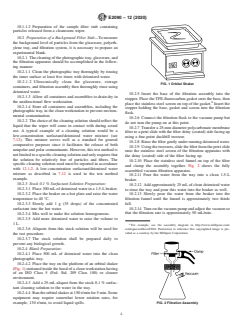
and clamp the assembly together. Fig. 2 shows the fully
with 12.1.2. A low-concentration surfactant/deionized water
assembled vacuum filtration apparatus.
mixture as described in 7.12 is used in the test method
10.2.11 Pour the water from the tray into a clean 1.5-L
example.
beaker.
10.2.3 Stock 0.1% Surfactant Solution Preparation:
10.2.12 Add approximately 25 mLof clean deionized water
10.2.3.1 Place300mLofdeionizedwaterina1.5-Lbeaker.
to rinse the tray and pour this water into the beaker as well.
10.2.3.2 Place the beaker on a hot plate and raise the water 10.2.13 Slowly pour the water from the beaker into the
temperature to 40°C.
filtration funnel until the funnel is approximately two thirds
full.
10.2.3.3 Slowly add 1 g (35 drops) of the concentrated
surfactant into the hot water. 10.2.14 Turnonthevacuumpumpandadjustthevacuumso
that the filtration rate is approximately 50 mL/min.
10.2.3.4 Mix well to make the solution homogeneous.
10.2.3.5 Add more deionized water to raise the volume to
1L.
For example, see the assembly diagram in http://www.millipore.com/
catalogue.nsf/docs/C804. Permission to reference this copyrighted image is pro-
10.2.3.6 Aliquots from this stock solution will be used for
vided as a courtesy by the Millipore Corporation.
the test procedure.
10.2.3.7 The stock solution shall be prepared daily to
prevent any biological growth.
10.2.4 Blank Preparation:
10.2.4.1 Place 500 mL of deionized water into the clean
photographic tray.
10.2.4.2 Place the tray on the platform of an orbital shaker
(Fig.1)stationedinsidethehoodofacleanworkstationhaving
of an ISO Class 5 (Fed. Std. 209 Class 100) or cleaner
environment.
10.2.4.3 Add a 25-mL aliquot from the stock 0.1% surfac-
tant cleaning solution to the water in the tray.
10.2.4.4 Runtheorbitalshakerat150r/minfor5min.Some
equipment may require somewhat lower rotation rates, for
example, 130 r/min, to avoid liquid spills. FIG. 2 Filtration Assembly
E2090 − 12 (2020)
10.2.15 Continuetotransferthewaterfromthebeakertothe 10.3.8 Using the forceps, lift the wiper from the tray slowly
funneluntiltheentirecontentsofthebakerareemptiedintothe by holding two adjacent corners, allowing the excess water to
filter funnel. drip into the tray.
10.2.16 Add approximately 25 mLof clean deionized water 10.3.9 Measure the dimensions of the wiper to two signifi-
to rinse the beaker and pour this water into the filter funnel as cant figures and set the wiper aside.
well. Ensure that the filter funnel remains filled with solution 10.3.10 Pour the water from the tray into the beaker
from the beaker until the filtration is complete. previously used for the background sample preparation.
10.2.17 Remove the funnel and carefully transfer the filter 10.3.11 Add approximately 25 mLof clean deionized water
onto a clean SEM specimen stub, using fine-point duckbill to rinse the tray and pour this water into the beaker as well.
tweezers. 10.3.12 Complete the sample preparation for the test speci-
10.2.18 Allow the filter to air dry in an ISO Class 5 (Fed. men by repeating 10.2.7 – 10.2.21, using a new membrane
Std. 209 Class 100) or cleaner environment. filterfromthesamepackage.Somewipersmayhaveexcessive
10.2.19 Affixtheperimeterofthefiltertothespecimenstub numbers of particles that can overload the filter, making it
by applying several (at least four) spots of conductive carbon impossible to obtain accurate counts. In these cases, one
paint. samplesarepresentativeportionofthewaterofthebeakerand
10.2.20 Transfer the stub to the vacuum sputtering unit and filters only that portion. As an example, if 25 mL of the total
apply a gold coating to the filter. Typically, 20s–40s sputter 550 mL were sampled for filtration, this would represent only
time will provide adequate gold coverage, depending on the 25/550thoftheavailableparticles.Theactualparticlecounton
equipment used. the wiper would be calculated by multiplying the particles
10.2.21 Label the sample as the background count for this counted in the representative portion by 550/25, then subtract-
particularexperimentandplaceitinaclean,coveredcontainer. ing the blank value.
Set it aside for subsequent particle enumeration. The counting 10.3.13 Label the sample as the test specimen for the
procedures are described in 10.4 and 10.5. If there is concern particular experiment.
thatthebackgroundmayexhibitexcessivecontamination,then
10.4 Manual counting of >100-µm fibers and particles.
the operator may wish to reverse the order of counting
10.4.1 Place the wiper sample stub in the specimen-holding
described in 10.5.14, that is, count the background first and
mount plate and then place the mount plate on the x-y stage of
delay preparation of the sample stub (10.3) until there is
the optical microscope (see Fig. 3).
confidence that there are no contamination issues in the set up.
10.4.2 Set the microscope at the lowest magnification and
10.2.22 After preparing the blank, the wiper sample is
its circular iris dial in the middle of its range.
prepared using the same glassware and filtration system.
10.4.3 Turn on the illuminator and adjust the knobs to have
10.2.23 Accurate counts in the test wiper sample require
adequate and uniform illumination on the stub.
subtracting background counts from the sample counts. The
10.4.3.1 To obtain the uniformity, set one of the arms of the
value of the background count should be less than 15% of the
light guide so the light grazes the surface of the membrane
sample count. If this is not the case, reclean the apparatus and
filter (approximately 15 to 30° angle between the light beam
perform the experiment again. For very clean wipers which
and the surface of the filter).
may exhibit very low counts in the >100 µm range, this
10.4.3.2 Set the other arm from the other side of the filter,
requirement may be lifted.
again with the light grazing the filter surface.
10.3 Preparation of Sample Stub: 10.4.3.3 The illuminance can be varied by adjusting the iris
10.3.1 Place 500 mL of deionized water into the same dialandbyslightlyadjustingtheknobsoftheilluminatorback
photographic tray that was used in preparation of the back- and forth.
ground sample. 10.4.4 Bringtheparticles/fibersonthefiltersurfacetofocus
10.3.2 Place the tray on the platform of the orbital shaker by adjusting the focus knob while observing the field through
(Fig. 1). the microscope eyepieces.
10.3.3 Add a 25-mL aliquot from the stock surfactant
10.5 Viewing Fields From the Optical Microscope:
cleaning solution (see 10.2.2 and 10.2.3) to the water in the
tray.
10.3.4 Shake the tray for 1 min to facilitate the mixing of
surfactant and water.
10.3.5 Using cleanroom gloves, open the bag of wipers to
be tested.
10.3.6 Using two pairs of clean forceps, carefully lift a
wiperfromthebagandgentlydrapethewiperontothesurface
of the water in the tray.
10.3.7 Run the shaker at 150 r/min for 5 min.
The application of a vacuum in the sput
...