

ASTM D6226-21
(Test Method)Standard Test Method for Open Cell Content of Rigid Cellular Plastics
General Information
- Abstract
SIGNIFICANCE AND USE
5.1 This test method is intended to be used in specifications where porosity of cellular plastics has a direct bearing on their end use. For example, for thermal insulation applications, a high percentage of closed cells is necessary to prevent escape of gases and to promote low thermal conductivity. In flotation applications, high closed-cell content generally reduces water absorption.
5.2 Before proceeding with this test method, reference shall be made to the specification of the material being tested. Any test specimen preparation, conditioning, or dimensions, or both, and testing parameters covered in the materials specification shall take precedence over those mentioned in this test method. If there are no material specifications, then the default conditions apply.
SCOPE
1.1 This test method covers cellular plastics, which are composed of membranes or walls of polymer separating small cavities or cells. These cells may be interconnecting (open cell), non-connecting (closed cell), or any combination of these types. This test method determines numerical values for open cells. It is a porosity determination, measuring the accessible cellular volume of a material. The remaining volume is that occupied by closed cells and cell walls. Since any conveniently sized specimen is typically obtained by some cutting operation, a fraction of the closed cells will be opened by specimen preparation and will be included as open cells, (see Note 2).
1.2 This test method provides good accuracy on predominantly highly open-celled materials. By not accounting for closed cells that were opened during specimen preparation, the accuracy decreases as the closed cell content increases and as the cell size increases.
1.3 The values as stated in SI units are to be regarded as the standard. The values in parentheses are given for reference only.
1.4 This standard does not purport to address all of the safety concerns, if any, associated with its use. It is the responsibility of the user of this standard to establish appropriate safety, health, and environmental practices and determine the applicability of regulatory limitations prior to use.
Note 1: This test method and ISO 4590 use the same basic principles but are significantly different in experimental detail.
Note 2: Two procedures for correcting for cells opened during specimen preparation are described in Appendix X1.1.
1.5 This international standard was developed in accordance with internationally recognized principles on standardization established in the Decision on Principles for the Development of International Standards, Guides and Recommendations issued by the World Trade Organization Technical Barriers to Trade (TBT) Committee.
- Status
- Published
- Publication Date
- 14-Feb-2021
- Technical Committee
- D20 - Plastics
- Drafting Committee
- D20.22 - Cellular Materials - Plastics and Elastomers
Overview
ASTM D6226-21 is the Standard Test Method for Open Cell Content of Rigid Cellular Plastics, developed by ASTM International. This standard provides a reliable and standardized procedure for determining the open cell content in rigid cellular plastics-materials that play a critical role in insulation, flotation, and other applications where the internal structure influences performance characteristics such as thermal conductivity and water absorption.
The procedure outlined in ASTM D6226-21 allows manufacturers, researchers, and quality control professionals to assess porosity, offering valuable data for product development, regulatory compliance, and quality assurance. By quantifying the accessible volume within cellular plastics, this test method provides essential insight for industries that depend on cellular plastic materials.
Key Topics
Cellular Plastics: This standard applies to cellular plastics composed of interconnected (open cell) and non-interconnected (closed cell) cavities or cells. Determining the ratio of open to closed cells is central to evaluating structural and performance properties.
Open vs. Closed Cell Measurement: The method determines the percentage of open cells (interconnected and accessible) as a measure of porosity, which influences insulation efficiency and moisture resistance.
Testing Accuracy: D6226-21 is particularly accurate for materials with a high percentage of open cells. The test method recognizes reduced accuracy for materials with higher closed cell content or larger cell sizes due to the potential for closed cells to be unintentionally opened during specimen preparation.
Testing Methodology: The standard utilizes a gas pycnometer to apply Boyle’s Law, measuring specimen volume via displacement and pressure changes. The difference between the geometric volume and displaced volume quantifies open cell content.
Specimen Preparation and Conditioning: The method provides guidelines for cutting and conditioning specimens to ensure consistency and reliability in results. Material specifications may dictate preparation, conditioning, and specimen dimensions.
Applications
ASTM D6226-21 is widely applicable across sectors that use rigid cellular plastics, including:
- Thermal Insulation: Ensures high closed cell content to trap insulation gases and minimize thermal conductivity. Materials tested under this standard are vital for energy-efficient building panels, refrigeration, and industrial insulation.
- Flotation Devices: Evaluates cellular materials for closed cell content, which reduces water absorption, crucial for buoys, marine flotation, and life-saving equipment.
- Product Quality Control: Supports manufacturers in consistently monitoring the porosity of their plastic foams, helping meet both internal quality benchmarks and external regulatory requirements.
- Research and Development: Offers a standardized approach for comparing new formulations and optimizing the open/closed cell ratio to enhance end-use performance.
- Regulatory and Specification Compliance: Provides a recognized basis for demonstrating that products align with industry and customer specifications related to open or closed cell content.
Related Standards
- ASTM D883: Terminology Relating to Plastics-provides definitions foundational to understanding this and related standards.
- ASTM D2842: Test Method for Water Absorption of Rigid Cellular Plastics-often used in conjunction with D6226-21 to assess resistance to water uptake.
- ASTM D3576: Test Method for Cell Size of Rigid Cellular Plastics-offers additional detail on cell size measurement, enhancing open/closed cell ratio assessments.
- ASTM E691: Practice for Conducting an Interlaboratory Study to Determine the Precision of a Test Method-relevant for validating and benchmarking D6226-21 results.
- ISO 4590: International standard for the determination of open and closed cells in rigid materials, based on similar principles as ASTM D6226-21 but with key procedural differences.
By following ASTM D6226-21, stakeholders in the plastics, construction, and marine industries can ensure accurate and consistent measurement of open cell content, supporting the development and quality assurance of high-performance rigid cellular plastics.
Relations
- Effective Date
- 01-Feb-2024
- Effective Date
- 01-Nov-2023
- Effective Date
- 01-Apr-2022
- Effective Date
- 01-Jan-2020
- Effective Date
- 01-Aug-2019
- Effective Date
- 01-May-2019
- Effective Date
- 15-Apr-2019
- Effective Date
- 01-Feb-2019
- Effective Date
- 01-Dec-2018
- Effective Date
- 01-Nov-2018
- Effective Date
- 01-Oct-2017
- Effective Date
- 01-Oct-2017
- Effective Date
- 15-Aug-2017
- Effective Date
- 15-Nov-2013
- Effective Date
- 15-Nov-2013
Get Certified
Connect with accredited certification bodies for this standard

DIN CERTCO
DIN Group product certification.

Smithers Quality Assessments
US management systems and product certification.
Sponsored listings
Frequently Asked Questions
ASTM D6226-21 is a standard published by ASTM International. Its full title is "Standard Test Method for Open Cell Content of Rigid Cellular Plastics". This standard covers: SIGNIFICANCE AND USE 5.1 This test method is intended to be used in specifications where porosity of cellular plastics has a direct bearing on their end use. For example, for thermal insulation applications, a high percentage of closed cells is necessary to prevent escape of gases and to promote low thermal conductivity. In flotation applications, high closed-cell content generally reduces water absorption. 5.2 Before proceeding with this test method, reference shall be made to the specification of the material being tested. Any test specimen preparation, conditioning, or dimensions, or both, and testing parameters covered in the materials specification shall take precedence over those mentioned in this test method. If there are no material specifications, then the default conditions apply. SCOPE 1.1 This test method covers cellular plastics, which are composed of membranes or walls of polymer separating small cavities or cells. These cells may be interconnecting (open cell), non-connecting (closed cell), or any combination of these types. This test method determines numerical values for open cells. It is a porosity determination, measuring the accessible cellular volume of a material. The remaining volume is that occupied by closed cells and cell walls. Since any conveniently sized specimen is typically obtained by some cutting operation, a fraction of the closed cells will be opened by specimen preparation and will be included as open cells, (see Note 2). 1.2 This test method provides good accuracy on predominantly highly open-celled materials. By not accounting for closed cells that were opened during specimen preparation, the accuracy decreases as the closed cell content increases and as the cell size increases. 1.3 The values as stated in SI units are to be regarded as the standard. The values in parentheses are given for reference only. 1.4 This standard does not purport to address all of the safety concerns, if any, associated with its use. It is the responsibility of the user of this standard to establish appropriate safety, health, and environmental practices and determine the applicability of regulatory limitations prior to use. Note 1: This test method and ISO 4590 use the same basic principles but are significantly different in experimental detail. Note 2: Two procedures for correcting for cells opened during specimen preparation are described in Appendix X1.1. 1.5 This international standard was developed in accordance with internationally recognized principles on standardization established in the Decision on Principles for the Development of International Standards, Guides and Recommendations issued by the World Trade Organization Technical Barriers to Trade (TBT) Committee.
SIGNIFICANCE AND USE 5.1 This test method is intended to be used in specifications where porosity of cellular plastics has a direct bearing on their end use. For example, for thermal insulation applications, a high percentage of closed cells is necessary to prevent escape of gases and to promote low thermal conductivity. In flotation applications, high closed-cell content generally reduces water absorption. 5.2 Before proceeding with this test method, reference shall be made to the specification of the material being tested. Any test specimen preparation, conditioning, or dimensions, or both, and testing parameters covered in the materials specification shall take precedence over those mentioned in this test method. If there are no material specifications, then the default conditions apply. SCOPE 1.1 This test method covers cellular plastics, which are composed of membranes or walls of polymer separating small cavities or cells. These cells may be interconnecting (open cell), non-connecting (closed cell), or any combination of these types. This test method determines numerical values for open cells. It is a porosity determination, measuring the accessible cellular volume of a material. The remaining volume is that occupied by closed cells and cell walls. Since any conveniently sized specimen is typically obtained by some cutting operation, a fraction of the closed cells will be opened by specimen preparation and will be included as open cells, (see Note 2). 1.2 This test method provides good accuracy on predominantly highly open-celled materials. By not accounting for closed cells that were opened during specimen preparation, the accuracy decreases as the closed cell content increases and as the cell size increases. 1.3 The values as stated in SI units are to be regarded as the standard. The values in parentheses are given for reference only. 1.4 This standard does not purport to address all of the safety concerns, if any, associated with its use. It is the responsibility of the user of this standard to establish appropriate safety, health, and environmental practices and determine the applicability of regulatory limitations prior to use. Note 1: This test method and ISO 4590 use the same basic principles but are significantly different in experimental detail. Note 2: Two procedures for correcting for cells opened during specimen preparation are described in Appendix X1.1. 1.5 This international standard was developed in accordance with internationally recognized principles on standardization established in the Decision on Principles for the Development of International Standards, Guides and Recommendations issued by the World Trade Organization Technical Barriers to Trade (TBT) Committee.
ASTM D6226-21 is classified under the following ICS (International Classification for Standards) categories: 83.080.01 - Plastics in general. The ICS classification helps identify the subject area and facilitates finding related standards.
ASTM D6226-21 has the following relationships with other standards: It is inter standard links to ASTM D883-24, ASTM D883-23, ASTM E456-13a(2022)e1, ASTM D883-20, ASTM D883-19c, ASTM D2842-19, ASTM D883-19a, ASTM D883-19, ASTM D883-18a, ASTM D883-18, ASTM E456-13A(2017)e1, ASTM E456-13A(2017)e3, ASTM D883-17, ASTM E456-13a, ASTM E456-13ae3. Understanding these relationships helps ensure you are using the most current and applicable version of the standard.
ASTM D6226-21 is available in PDF format for immediate download after purchase. The document can be added to your cart and obtained through the secure checkout process. Digital delivery ensures instant access to the complete standard document.
Standards Content (Sample)
This international standard was developed in accordance with internationally recognized principles on standardization established in the Decision on Principles for the
Development of International Standards, Guides and Recommendations issued by the World Trade Organization Technical Barriers to Trade (TBT) Committee.
Designation: D6226 − 21
Standard Test Method for
Open Cell Content of Rigid Cellular Plastics
This standard is issued under the fixed designation D6226; the number immediately following the designation indicates the year of
original adoption or, in the case of revision, the year of last revision. A number in parentheses indicates the year of last reapproval. A
superscript epsilon (´) indicates an editorial change since the last revision or reapproval.
1. Scope* 2. Referenced Documents
2.1 ASTM Standards:
1.1 This test method covers cellular plastics, which are
D883 Terminology Relating to Plastics
composed of membranes or walls of polymer separating small
D2842 Test Method for Water Absorption of Rigid Cellular
cavities or cells. These cells may be interconnecting (open
Plastics
cell),non-connecting(closedcell),oranycombinationofthese
D3576 Test Method for Cell Size of Rigid Cellular Plastics
types. This test method determines numerical values for open
E456 Terminology Relating to Quality and Statistics
cells. It is a porosity determination, measuring the accessible
E691 Practice for Conducting an Interlaboratory Study to
cellular volume of a material. The remaining volume is that
Determine the Precision of a Test Method
occupiedbyclosedcellsandcellwalls.Sinceanyconveniently
sizedspecimenistypicallyobtainedbysomecuttingoperation, 2.2 ISO Standard:
a fraction of the closed cells will be opened by specimen ISO 4590 Cellular Plastics—Determination of Volume Per-
preparation and will be included as open cells, (see Note 2). centage of Open and Closed Cells of Rigid Materials
1.2 This test method provides good accuracy on predomi-
3. Terminology
nantly highly open-celled materials. By not accounting for
3.1 Definitions:
closed cells that were opened during specimen preparation, the
3.1.1 Terms used in this standard are defined in accordance
accuracy decreases as the closed cell content increases and as
with Terminology D883, unless otherwise specified. For terms
the cell size increases.
relating to precision and bias and associated issues, the terms
1.3 The values as stated in SI units are to be regarded as the
used in this standard are defined in accordance with Terminol-
standard. The values in parentheses are given for reference
ogy E456.
only.
3.2 Definitions of Terms Specific to This Standard:
1.4 This standard does not purport to address all of the
3.2.1 closed cell—a cell totally enclosed by its walls and
safety concerns, if any, associated with its use. It is the
hence not interconnecting with other cells.
responsibility of the user of this standard to establish appro-
3.2.2 open cell—a cell not totally enclosed by its walls and
priate safety, health, and environmental practices and deter-
open to the surface either directly or by interconnecting with
mine the applicability of regulatory limitations prior to use.
other cells.
NOTE 1—This test method and ISO 4590 use the same basic principles
3.2.3 volume of closed cells and cell walls—inaccessible
but are significantly different in experimental detail.
internal volume, consisting of an aggregate of solid polymer
NOTE 2—Two procedures for correcting for cells opened during
volume (cell walls, struts), filler volume, when applicable
specimen preparation are described in Appendix X1.1.
(solidparticlesorfibers),thevolumeofindividualclosedcells,
1.5 This international standard was developed in accor-
andthevolumeofsmallcellgroupsinterconnectedbyruptured
dance with internationally recognized principles on standard-
cell walls but otherwise inaccessible.
ization established in the Decision on Principles for the
3.2.4 uncorrected volume of open cells—the aggregate mea-
Development of International Standards, Guides and Recom-
surement of both the internal porous volume of the material
mendations issued by the World Trade Organization Technical
and the various irregular volumes accessible at the cut-cell
Barriers to Trade (TBT) Committee.
surface of the test specimen.
1 2
This test method is under the jurisdiction ofASTM Committee D20 on Plastics For referenced ASTM standards, visit the ASTM website, www.astm.org, or
and is the direct responsibility of Subcommittee D20.22 on Cellular Materials - contact ASTM Customer Service at service@astm.org. For Annual Book of ASTM
Plastics and Elastomers. Standards volume information, refer to the standard’s Document Summary page on
Current edition approved Feb. 15, 2021. Published February 2021. Originally the ASTM website.
approved in 1998. Last previous edition approved in 2015 as D6226 - 15. DOI: Available fromAmerican National Standards Institute (ANSI), 25 W. 43rd St.,
10.1520/D6226-21. 4th Floor, New York, NY 10036.
*A Summary of Changes section appears at the end of this standard
Copyright © ASTM International, 100 Barr Harbor Drive, PO Box C700, West Conshohocken, PA 19428-2959. United States
D6226 − 21
3.3 Symbols:
3.3.1 d—specimen diameter, cm.
3.3.2 h—specimen height, cm.
3.3.3 l—specimen length, cm.
3.3.4 O —volume, percent open cells.
v
3.3.5 V—geometric volume of specimen, cm .
3.3.6 V —volume of the calibration standard, cm .
CALIB
3.3.7 V —volume of the sample chamber, cm .
CHAMBER
3.3.8 V —expansion reference volume, cm .
EXP
FIG. 1 Schematic Diagram of Gas Pycnometer
3.3.9 V —specimen displacement volume, cm , and,
SPEC
3.3.10 w—specimen width, cm.
6.1.1 Sample Chamber (V ), having a volume ap-
CHAMBER
3 3
proximately between 30 and 150 cm (1.8 and 9.2 in. ),
4. Summary of Test Method
3 3
calibrated to the nearest 0.1 cm (0.006 in. ).
4.1 This test method is based on a determination of porosity
6.1.2 Expansion Reference Volume (V ), a precisely cali-
EXP
in which the accessible cellular volume of a cellular plastic is
3 3
brated volume known to the nearest 0.1 cm (0.006 in. ).
determined by application of Boyle’s Law, which states that
6.1.3 GaugePressureTransducer,capableofmeasuring0to
the increase in volume of a confined gas results in a propor-
175kPa(0to25psig)withminimumvolumedisplacementand
tionate decrease in pressure. The apparatus consists of two
linear within 0.1%.
chambers of known volume connected by a valve. One of the
6.1.4 Pressure Relief Valve, to avoid over pressurization of
chambers, the calibrated sample chamber, is accessible for
the transducer.
insertion of the test specimen and is connected to a source of
6.1.5 Filter, to prevent powder from contaminating the
high purity (at least 99.99 %) dry gas, such as nitrogen or
transducer and selector valves.
helium. The pressure in the sample chamber is increased to a
6.1.6 Input Flow Control Toggle and Needle Valves, or
predetermined pressure and this value, P , is noted. The valve
alternative means to control pressurization.
between the two chambers is then opened and the second,
6.1.7 Output Flow Control Toggle and Needle Valves, or
lower Pressure, P , is again noted. The ratio of the pressure
alternative means to vent the gas.
change P /P , is directly related to the volume of the sample
1 2
6.1.8 Two-Way Selector Valve, to connect the reference
chamber displaced by the specimen. The difference between
volume to the sample chamber.
this volume and the geometric volume of the specimen is a
6.1.9 Nonporous Calibration Standard, (for example, a
measure of the open-cell volume.
stainless steel sphere) of known volume which fills from ⁄3 to
NOTE 3—The criteria for selecting a dry gas are that the gas shall not ⁄3 of the sample chamber.
exhibit significant non-ideal behavior, dissolve the matrix, or readily
6.1.10 Digital Meter, for reading the pressure from the
diffuse into the matrix.
transducer to 0.007 kPa (0.001 psig).
6.1.11 Sample Chamber Closure, with O-ring seal.
5. Significance and Use
6.1.12 Calibration Procedure, for the gas pycnometer is
5.1 This test method is intended to be used in specifications outlined in A2.2
where porosity of cellular plastics has a direct bearing on their
6.2 Cutting Device, for specimen preparation, such as a
end use. For example, for thermal insulation applications, a
bandsaw or hobby jigsaw, the blade of which must be capable
high percentage of closed cells is necessary to prevent escape
of producing a smooth cut. This will require a blade with at
of gases and to promote low thermal conductivity. In flotation
least 4 teeth/cm (10 teeth/in.). A cellular hole cutter is also
applications, high closed-cell content generally reduces water
acceptable.
absorption.
6.3 Vernier Calipers, or micrometer measuring device, ca-
5.2 Before proceeding with this test method, reference shall
pable of measuring specimens to the nearest 0.003 cm (0.001
be made to the specification of the material being tested. Any
in.).
test specimen preparation, conditioning, or dimensions, or
both, and testing parameters covered in the materials specifi-
7. Sampling and Test Specimen Preparation
cation shall take precedence over those mentioned in this test
7.1 The standard test specimen is two cubes having a
method. If there are no material specifications, then the default
nominal dimension of 2.5 by 2.5 by 2.5 cm (1.0 by 1.0 by 1.0
conditions apply.
in.), (see Note 4).An alternative configuration is two cylinders
withnominalcrosssectionalareasof6.25cm (0.97in.)by2.5
6. Apparatus
cm (1.0 in.) in height, (see Note 5). It is possible that it will be
6.1 Gas Pycnometer—Aschematic diagram of the pycnom- practical in some instances (for example, when using smaller-
eter apparatus is shown in Fig. 1. It shall have the following sized sample chambers or when there is a limited amount of
features: material) to use only one cube or one cylinder. However, the
D6226 − 21
specimen displacement volume (V ) shall be at least 15 % must remain open at the completion of the purge process.
SPEC
of the sample chamber volume. Report the number of purge cycles used.
NOTE 4—The analyst shall not substitute a single 5 by 2.5 by 2.5 cm
9.9 Operate the two-way selector valve so that it connects
rectangular prism for the two cubes because the surface areas are not
the expansion volume (reference) chamber with the rest of the
equal.
system.Allow the pressure to fall to a steady value, correcting
NOTE 5—The cylindrical configuration is not recommended for aniso-
the pressure display with the zero control as necessary.
tropic materials.
9.10 Operate the two-way selector valve so that it again
7.2 Unless otherwise agreed upon, at least three sets of two
isolates the expansion volume (reference) chamber from the
cubes or two cylinders, selected at random, shall be tested.All
rest of the system, ensuring that the pressure display does not
specimens having obvious defects shall be omitted.
shift from zero. If a shift occurs, repeat 9.9.
7.3 Sample selection on commercially available materials
shall be by agreement between the supplier and the user. 9.11 Closetheventvalveneglectinganychangeinpressure.
7.4 Test specimens shall be machined or sawed from the
9.12 Opentheflowvalveandfillthechamberto20kPa(2.9
sample so as to have smooth surfaces. It is permissible for
psig) as shown on the pressure indicator.
machined or sawed surfaces to be further smoothed by slicing
NOTE6—Itwillbedesirableinsomeinstancestousepressureslessthan
techniques or sanding with a number 400 or finer sandpaper.
20 kPa for the purging and testing steps. The applied pressure shall not
Resulting dust shall be blown from the specimens.
distortthespecimen.Ifotherpressuresareused,theyshallbenotedonthe
test report.
8. Conditioning
9.13 Close the flow valve and allow the pressure to stabilize
8.1 Condition specimens at standard laboratory atmosphere
or wait a fixed period of time (10 to 15 s give best results for
23 6 2°C (73.4 6 3.6°F) and 50 6 10 % relative humidity for
most samples) and record the final pressure as P . Report the
a minimum of 24 h.
time used if the pressure did not stabilize.
8.2 Since this test method depends on very accurate mea-
9.14 Immediatelyoperatethetwo-wayselectorvalvesothat
surement of gas pressures, the temperature of the environment,
it again connects the expansion volume (reference) chamber
the apparatus, the specimen, and the sample cup must be kept
with the rest of the system and allow the pressure to stabilize
constant within 62°C.
or wait the same fixed period of time as in 9.13. Record the
final pressure as P .
8.3 The temperature at which the calibration is performed
shall be within 62°C of the temperature at which the analysis
NOTE 7—If the pressure reading drifts continuously to lower pressures,
is performed.
the cells may be rupturing or the test gas may be diffusing through the cell
walls. Under these conditions, an accurate open-cell content cannot be
determined.
9. Procedure
9.15 Open the vent valve and allow the pressure to fall to 0
9.1 Measure and record the length, l, height, h, and width,
kPa (0 psig).
w,ofthespecimenstothenearest0.003cm(0.001in.).Ifusing
cylindrical specimens measure the height, h, and diameter, d.
9.16 Return to 9.9 if multiple determinations are to be made
on this specimen.
9.2 Close the flow valve if not already closed.
9.3 Operate the two-way selector valve so that it isolates the 9.17 Remove the specimen from the sample chamber.
expansion volume (reference) chamber from the rest of the
9.18 If the instrument is to remain idle for an extended
system.
period (days), close the sample chamber and shut off the gas
9.4 Open the vent valve if not already open.
supply.
9.5 Removethesamplechambercapifnotalreadyopenand
9.19 Calculate the specimen volume from the general equa-
remove any previous specimen.
tion:
9.6 Insertthenewspecimenandsecurelyreplacethesample
V 5 V 2 V /@~P /P ! 2 1#. (1)
SPEC CHAMBER EXP 1 2
chamber cap.
NOTE 8—Several companies produce both manually operated and
automatically operated gas pycnometers which meet the specifications
9.7 Air,andvaporstrappedwithinpores,crevices,oramong
described herein. Please refer to the specific operating manuals for
the pieces of the specimen will be removed from the specimen
additional details on operation and calibration.
by a prolonged purge when all valves are opened. Report the
time used. However, these impurity gases are much more
10. Calculation
rapidly removed by alternately increasing and decreasing the
10.1 Calculate the geometric volume, V, in cubic centime-
gas pressure in the sample chamber.
tres of the specimen by adding together the volumes of its
9.8 Close the vent valve and open the flow valve.Allow the
component specimens determined from their measurements of
pressure to rise to 20 kPa (2.9 psig), then close the flow valve
length, width, and height as follows:
and open the vent valve. When the pressure has fallen to less
If two cubes:V 5 l 3w 3h 1 l 3w 3h (2)
~ ! ~ !
1 1 1 2 2 2
than 3 kPa (0.4 psig), cl
...
This document is not an ASTM standard and is intended only to provide the user of an ASTM standard an indication of what changes have been made to the previous version. Because
it may not be technically possible to adequately depict all changes accurately, ASTM recommends that users consult prior editions as appropriate. In all cases only the current version
of the standard as published by ASTM is to be considered the official document.
Designation: D6226 − 15 D6226 − 21
Standard Test Method for
Open Cell Content of Rigid Cellular Plastics
This standard is issued under the fixed designation D6226; the number immediately following the designation indicates the year of
original adoption or, in the case of revision, the year of last revision. A number in parentheses indicates the year of last reapproval. A
superscript epsilon (´) indicates an editorial change since the last revision or reapproval.
1. Scope Scope*
1.1 This test method covers cellular plastics, which are composed of membranes or walls of polymer separating small cavities or
cells. These cells may be interconnecting (open cell), non-connecting (closed cell), or any combination of these types. This test
method determines numerical values for open cells. It is a porosity determination, measuring the accessible cellular volume of a
material. The remaining volume is that occupied by closed cells and cell walls. Since any conveniently sized specimen is typically
obtained by some cutting operation, a fraction of the closed cells will be opened by specimen preparation and will be included as
open cells, (see Note 2).
1.2 This test method provides good accuracy on predominantly highly open-celled materials. By not accounting for closed cells
that were opened during specimen preparation, the accuracy decreases as the closed cell content increases and as the cell size
increases.
1.3 The values as stated in SI units are to be regarded as the standard. The values in parentheses are given for reference only.
1.4 This standard does not purport to address all of the safety concerns, if any, associated with its use. It is the responsibility
of the user of this standard to establish appropriate safety safety, health, and healthenvironmental practices and determine the
applicability of regulatory limitations prior to use.
NOTE 1—This test method and ISO 4590 use the same basic principles but are significantly different in experimental detail.
NOTE 2—Two procedures for correcting for cells opened during specimen preparation are described in Appendix X1.1.
1.5 This international standard was developed in accordance with internationally recognized principles on standardization
established in the Decision on Principles for the Development of International Standards, Guides and Recommendations issued
by the World Trade Organization Technical Barriers to Trade (TBT) Committee.
2. Referenced Documents
2.1 ASTM Standards:
D883 Terminology Relating to Plastics
D2842 Test Method for Water Absorption of Rigid Cellular Plastics
D3576 Test Method for Cell Size of Rigid Cellular Plastics
E456 Terminology Relating to Quality and Statistics
This test method is under the jurisdiction of ASTM Committee D20 on Plastics and is the direct responsibility of Subcommittee D20.22 on Cellular Materials - Plastics
and Elastomers.
Current edition approved Sept. 1, 2015Feb. 15, 2021. Published September 2015February 2021. Originally approved in 1998. Last previous edition approved in 20102015
as D6226 - 10.D6226 - 15. DOI: 10.1520/D6226-15.10.1520/D6226-21.
For referenced ASTM standards, visit the ASTM website, www.astm.org, or contact ASTM Customer Service at service@astm.org. For Annual Book of ASTM Standards
volume information, refer to the standard’s Document Summary page on the ASTM website.
*A Summary of Changes section appears at the end of this standard
Copyright © ASTM International, 100 Barr Harbor Drive, PO Box C700, West Conshohocken, PA 19428-2959. United States
D6226 − 21
E691 Practice for Conducting an Interlaboratory Study to Determine the Precision of a Test Method
2.2 ISO Standard:
ISO 4590 Cellular Plastics—Determination of Volume Percentage of Open and Closed Cells of Rigid Materials
3. Terminology
3.1 Definitions:
3.1.1 Terms relating to plastics as given in used in this standard are defined in accordance with Terminology D883 shall be used
where applicable., unless otherwise specified. For terms relating to precision and bias and associated issues, the terms used in this
standard are defined in accordance with Terminology E456.
3.2 Definitions of Terms Specific to This Standard:
3.2.1 closed cell—a cell totally enclosed by its walls and hence not interconnecting with other cells.
3.2.2 open cell—a cell not totally enclosed by its walls and open to the surface either directly or by interconnecting with other
cells.
3.2.3 volume of closed cells and cell walls—inaccessible internal volume, consisting of an aggregate of solid polymer volume (cell
walls, struts), filler volume, when applicable (solid particles or fibers), the volume of individual closed cells, and the volume of
small cell groups interconnected by ruptured cell walls but otherwise inaccessible.
3.2.4 uncorrected volume of open cells—the aggregate measurement of both the internal porous volume of the material and the
various irregular volumes accessible at the cut-cell surface of the test specimen.
3.3 Symbols:
3.3.1 d—specimen diameter, cm.
3.3.2 h—specimen height, cm.
3.3.3 l—specimen length, cm.
3.3.4 O —volume, percent open cells.
v
3.3.5 V—geometric volume of specimen, cm .
3.3.6 V —volume of the calibration standard, cm .
CALIB
3.3.7 V —volume of the sample chamber, cm .
CHAMBER
3.3.8 V —expansion reference volume, cm .
EXP
3.3.9 V —specimen displacement volume, cm , and,
SPEC
3.3.10 w—specimen width, cm.
4. Summary of Test Method
4.1 This test method is based on a determination of porosity in which the accessible cellular volume of a cellular plastic is
determined by application of Boyle’s Law, which states that the increase in volume of a confined gas results in a proportionate
decrease in pressure. The apparatus consists of two chambers of known volume connected by a valve. One of the chambers, the
calibrated sample chamber, is accessible for insertion of the test specimen and is connected to a source of high purity (at least
Available from American National Standards Institute (ANSI), 25 W. 43rd St., 4th Floor, New York, NY 10036.
D6226 − 21
99.99 %) dry gas, such as nitrogen or helium. The pressure in the sample chamber is increased to a predetermined pressure and
this value, P , is noted. The valve between the two chambers is then opened and the second, lower Pressure, P , is again noted.
1 2
The ratio of the pressure change P /P , is directly related to the volume of the sample chamber displaced by the specimen. The
1 2
difference between this volume and the geometric volume of the specimen is a measure of the open-cell volume.
NOTE 3—The criteria for selecting a dry gas are that the gas shall not exhibit significant non-ideal behavior, dissolve the matrix, or readily diffuse into
the matrix.
5. Significance and Use
5.1 This test method is intended to be used in specifications where porosity of cellular plastics has a direct bearing on their end
use. For example, for thermal insulation applications, a high percentage of closed cells is necessary to prevent escape of gases and
to promote low thermal conductivity. In flotation applications, high closed-cell content generally reduces water absorption.
5.2 Before proceeding with this test method, reference shall be made to the specification of the material being tested. Any test
specimen preparation, conditioning, or dimensions, or both, and testing parameters covered in the materials specification shall take
precedence over those mentioned in this test method. If there are no material specifications, then the default conditions apply.
6. Apparatus
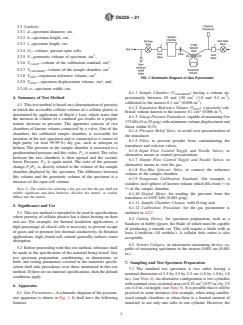
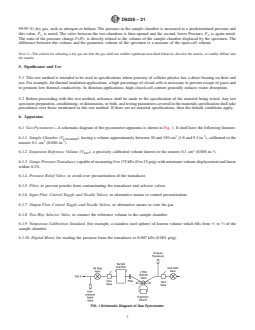
6.1 Gas Pycnometer—A schematic diagram of the pycnometer apparatus is shown in Fig. 1. It shall have the following features:
3 3
6.1.1 Sample Chamber (V ), having a volume approximately between 30 and 150 cm (1.8 and 9.2 in. ), calibrated to the
CHAMBER
3 3
nearest 0.1 cm (0.006 in. ).
3 3
6.1.2 Expansion Reference Volume (V ), a precisely calibrated volume known to the nearest 0.1 cm (0.006 in. ).
EXP
6.1.3 Gauge Pressure Transducer, capable of measuring 0 to 175 kPa (0 to 25 psig) with minimum volume displacement and linear
within 0.1%.
6.1.4 Pressure Relief Valve, to avoid over pressurization of the transducer.
6.1.5 Filter, to prevent powder from contaminating the transducer and selector valves.
6.1.6 Input Flow Control Toggle and Needle Valves, or alternative means to control pressurization.
6.1.7 Output Flow Control Toggle and Needle Valves, or alternative means to vent the gas.
6.1.8 Two-Way Selector Valve, to connect the reference volume to the sample chamber.
1 2
6.1.9 Nonporous Calibration Standard, (for example, a stainless steel sphere) of known volume which fills from ⁄3 to ⁄3 of the
sample chamber.
6.1.10 Digital Meter, for reading the pressure from the transducer to 0.007 kPa (0.001 psig).
FIG. 1 Schematic Diagram of Gas Pycnometer
D6226 − 21
6.1.11 Sample Chamber Closure, with O-ring seal.
6.1.12 Calibration Procedure, for the gas pycnometer is outlined in A2.2
6.2 Cutting Device, for specimen preparation, such as a bandsaw or hobby jigsaw, the blade of which must be capable of producing
a smooth cut. This will require a blade with at least 4 teeth/cm (10 teeth/in.). A cellular hole cutter is also acceptable.
6.3 Vernier Calipers, or micrometer measuring device, capable of measuring specimens to the nearest 0.003 cm (0.001 in.).
7. Sampling and Test Specimen Preparation
7.1 The standard test specimen is two cubes having a nominal dimension of 2.5 by 2.5 by 2.5 cm (1.0 by 1.0 by 1.0 in.), (see Note
4). An alternative configuration is two cylinders with nominal cross sectional areas of 6.25 cm (0.97 in.) by 2.5 cm (1.0 in.) in
height, (see Note 5). It is possible that it will be practical in some instances (for example, when using smaller-sized sample
chambers or when there is a limited amount of material) to use only one cube or one cylinder. However, the specimen displacement
volume (V ) shall be at least 15 % of the sample chamber volume.
SPEC
NOTE 4—The analyst shall not substitute a single 5 by 2.5 by 2.5 cm rectangular prism for the two cubes because the surface areas are not equal.
NOTE 5—The cylindrical configuration is not recommended for anisotropic materials.
7.2 Unless otherwise agreed upon, at least three sets of two cubes or two cylinders, selected at random, shall be tested. All
specimens having obvious defects shall be omitted.
7.3 Sample selection on commercially available materials shall be by agreement between the supplier and the user.
7.4 Test specimens shall be machined or sawed from the sample so as to have smooth surfaces. It is permissible for machined or
sawed surfaces to be further smoothed by slicing techniques or sanding with a number 400 or finer sandpaper. Resulting dust shall
be blown from the specimens.
8. Conditioning
8.1 Condition specimens at standard laboratory atmosphere 23 6 2°C (73.4 6 3.6°F) and 50 6 10 % relative humidity for a
minimum of 24 h.
8.2 Since this test method depends on very accurate measurement of gas pressures, the temperature of the environment, the
apparatus, the specimen, and the sample cup must be kept constant within 62°C.
8.3 The temperature at which the calibration is performed shall be within 62°C of the temperature at which the analysis is
performed.
9. Procedure
9.1 Measure and record the length, l, height, h, and width, w, of the specimens to the nearest 0.003 cm (0.001 in.). If using
cylindrical specimens measure the height, h, and diameter, d.
9.2 Close the flow valve if not already closed.
9.3 Operate the two-way selector valve so that it isolates the expansion volume (reference) chamber from the rest of the system.
9.4 Open the vent valve if not already open.
9.5 Remove the sample chamber cap if not already open and remove any previous specimen.
D6226 − 21
9.6 Insert the new specimen and securely replace the sample chamber cap.
9.7 Air, and vapors trapped within pores, crevices, or among the pieces of the specimen will be removed from the specimen by
a prolonged purge when all valves are opened. Report the time used. However, these impurity gases are much more rapidly
removed by alternately increasing and decreasing the gas pressure in the sample chamber.
9.8 Close the vent valve and open the flow valve. Allow the pressure to rise to 20 kPa (2.9 psig), then close the flow valve and
open the vent valve. When the pressure has fallen to less than 3 kPa (0.4 psig), close the vent valve. This purging process shall
be repeated at least twice more. The vent valve must remain open at the completion of the purge process. Report the number of
purge cycles used.
9.9 Operate the two-way selector valve so that it connects the expansion volume (reference) chamber with the rest of the system.
Allow the pressure to fall to a steady value, correcting the pressure display with the zero control as necessary.
9.10 Operate the two-way selector valve so that it again isolates the expansion volume (reference) chamber from the rest of the
system, ensuring that the pressure display does not shift from zero. If a shift occurs, repeat 9.9.
9.11 Close the vent valve neglecting any change in pressure.
9.12 Open the flow valve and fill the chamber to 20 kPa (2.9 psig) as shown on the pressure indicator.
NOTE 6—It will be desirable in some instances to use pressures less than 20 kPa for the purging and testing steps. The applied pressure shall not distort
the specimen. If other pressures are used, they shall be noted on the test report.
9.13 Close the flow valve and allow the pressure to stabilize or wait a fixed period of time (10 to 15 s give best results for most
samples) and record the final pressure as P . Report the time used if the pressure did not stabilize.
9.14 Immediately operate the two-way selector valve so that it again connects the expansion volume (reference) chamber with the
rest of the system and allow the pressure to stabilize or wait the same fixed period of time as in 9.13. Record the final pressure
as P .
NOTE 7—If the pressure reading drifts continuously to lower pressures, the cells may be rupturing or the test gas may be diffusing through the cell walls.
Under these conditions, an accurate open-cell content cannot be determined.
9.15 Open the vent valve and allow the pressure to fall to 0 kPa (0 psig).
9.16 Return to 9.9 if multiple determinations are to be made on this specimen.
9.17 Remove the specimen from the sample chamber.
9.18 If the instrument is to remain idle for an extended period (days), close the sample chamber and shut off the gas supply.
9.19 Calculate the specimen volume from the general equation:
V 5 V 2 V /@~P /P ! 2 1#. (1)
SPEC CHAMBER EXP 1 2
NOTE 8—Several companies produce both manually operated and automatically operated gas pycnometers which meet the specifications described herein.
Please refer to the specific operating manuals for additional details on operation and calibration.
10. Calculation
10.1 Calculate the geometric volume, V, in cubic centimetres of the specimen by adding together the volumes of its component
specimens determined from their measurements of length, width, and height as follows:
D6226 − 21
If two cubes:V 5 l 3w 3h 1 l 3w 3h (2)
~ ! ~ !
...