

ASTM C732-17(2022)
(Test Method)Standard Test Method for Aging Effects of Artificial Weathering on Latex Sealants
General Information
- Abstract
SIGNIFICANCE AND USE
5.1 Accelerated weathering exposure serves to indicate long-term exterior durability of the sealant. In this test method, durability is tested when the sealant is used with wood or aluminum.
SCOPE
1.1 This test method covers a laboratory procedure for the determination of aging effects of artificial weathering on latex sealants.
1.2 The values stated in SI units are to be regarded as standard. The values given in parentheses after SI units are provided for information only and are not considered standard.
1.3 This standard does not purport to address all of the safety concerns, if any, associated with its use. It is the responsibility of the user of this standard to establish appropriate safety, health, and environmental practices and determine the applicability of regulatory limitations prior to use.
Note 1: Currently there is no ISO standard similar to this test method.
1.4 This international standard was developed in accordance with internationally recognized principles on standardization established in the Decision on Principles for the Development of International Standards, Guides and Recommendations issued by the World Trade Organization Technical Barriers to Trade (TBT) Committee.
- Status
- Published
- Publication Date
- 31-Dec-2021
- Technical Committee
- C24 - Building Seals and Sealants
- Drafting Committee
- C24.40 - Weathering


Overview
ASTM C732-17(2022), Standard Test Method for Aging Effects of Artificial Weathering on Latex Sealants, establishes a laboratory procedure to evaluate how latex sealants age under artificial weathering conditions. Developed by ASTM International, this standard helps indicate the long-term exterior durability of latex sealants, especially when used with wood and aluminum substrates. By simulating extended exposure to outdoor elements in a controlled laboratory setting, stakeholders gain valuable data on the expected performance and resilience of building sealants.
Key Topics
- Artificial Weathering Exposure: The test exposes latex sealants to alternating wet and dry cycles using specialized weathering equipment, simulating years of outdoor wear in a condensed period.
- Durability Assessment: Focuses on identifying changes such as wash-out, slump, cracking, loss of adhesion, and discoloration, which are critical to evaluating sealant longevity.
- Sample Preparation: Specifies the use of wood-and-aluminum fixtures called channel panels, with strict requirements for materials and assembly to ensure consistency and reliability.
- Unit Standards: Mandates the use of SI units throughout the testing process. Reference values in other units are provided for information only.
- Laboratory Safety: Users are responsible for adhering to appropriate safety, health, and environmental practices, and for ensuring regulatory compliance.
- No Equivalent ISO Standard: Currently, there is no ISO standard mirroring this test, making ASTM C732 particularly relevant for international projects requiring such testing.
Applications
This test method is integral in many practical scenarios, including:
- Product Development: Manufacturers utilize this standard to benchmark new latex sealant formulations for improved weather resistance.
- Quality Assurance: Producers and testers use these procedures for quality control, ensuring that batches conform to performance expectations before reaching the market.
- Construction Specification: Architects and engineers employ results from this artificial weathering test to select appropriate sealant materials for high-performance building envelopes, particularly in diverse climates.
- Regulatory Compliance: Certification bodies and governmental agencies reference ASTM C732 to verify product claims and ensure materials used in public and private construction projects meet durability requirements.
Industries benefiting from this standard include construction, building materials manufacturing, and regulatory testing laboratories. Typical applications cover joint sealing in exterior facades, window and door installation, and any context where latex sealants protect against environmental exposure.
Related Standards
For comprehensive evaluation and complementary testing, consider the following ASTM standards:
- ASTM C717: Terminology of Building Seals and Sealants - Provides foundational definitions such as adhesive failure, latex sealant, and more.
- ASTM C1442: Practice for Conducting Tests on Sealants Using Artificial Weathering Apparatus - Offers guidance on the use and operation of artificial weathering devices referenced in ASTM C732.
- Other Relevant Methods: While no ISO equivalent currently exists for this artificial weathering test, ASTM C732 aligns with international best practices under WTO TBT Committee guidelines.
By following ASTM C732-17(2022), stakeholders can ensure they are using a robust, standardized method for assessing the aging and weathering resistance of latex sealants, critical for the longevity and effectiveness of building envelopes exposed to adverse environmental conditions.
Relations
- Effective Date
- 01-Mar-2019
- Effective Date
- 01-Mar-2018
- Effective Date
- 01-Nov-2017
- Effective Date
- 01-Jan-2017
- Effective Date
- 15-Nov-2016
- Effective Date
- 01-Sep-2016
- Effective Date
- 01-May-2014
- Effective Date
- 01-Feb-2014
- Effective Date
- 01-Nov-2013
- Effective Date
- 01-Dec-2012
- Effective Date
- 01-May-2012
- Effective Date
- 15-Jan-2012
- Effective Date
- 01-Apr-2011
- Effective Date
- 01-Mar-2011
- Effective Date
- 15-Jan-2011
Get Certified
Connect with accredited certification bodies for this standard

DIBt (Deutsches Institut für Bautechnik)
German Institute for Building Technology.
DIN CERTCO
DIN Group product certification.

Aboma Certification B.V.
Specialized in construction, metal, and transport sectors.
Sponsored listings
Frequently Asked Questions
ASTM C732-17(2022) is a standard published by ASTM International. Its full title is "Standard Test Method for Aging Effects of Artificial Weathering on Latex Sealants". This standard covers: SIGNIFICANCE AND USE 5.1 Accelerated weathering exposure serves to indicate long-term exterior durability of the sealant. In this test method, durability is tested when the sealant is used with wood or aluminum. SCOPE 1.1 This test method covers a laboratory procedure for the determination of aging effects of artificial weathering on latex sealants. 1.2 The values stated in SI units are to be regarded as standard. The values given in parentheses after SI units are provided for information only and are not considered standard. 1.3 This standard does not purport to address all of the safety concerns, if any, associated with its use. It is the responsibility of the user of this standard to establish appropriate safety, health, and environmental practices and determine the applicability of regulatory limitations prior to use. Note 1: Currently there is no ISO standard similar to this test method. 1.4 This international standard was developed in accordance with internationally recognized principles on standardization established in the Decision on Principles for the Development of International Standards, Guides and Recommendations issued by the World Trade Organization Technical Barriers to Trade (TBT) Committee.
SIGNIFICANCE AND USE 5.1 Accelerated weathering exposure serves to indicate long-term exterior durability of the sealant. In this test method, durability is tested when the sealant is used with wood or aluminum. SCOPE 1.1 This test method covers a laboratory procedure for the determination of aging effects of artificial weathering on latex sealants. 1.2 The values stated in SI units are to be regarded as standard. The values given in parentheses after SI units are provided for information only and are not considered standard. 1.3 This standard does not purport to address all of the safety concerns, if any, associated with its use. It is the responsibility of the user of this standard to establish appropriate safety, health, and environmental practices and determine the applicability of regulatory limitations prior to use. Note 1: Currently there is no ISO standard similar to this test method. 1.4 This international standard was developed in accordance with internationally recognized principles on standardization established in the Decision on Principles for the Development of International Standards, Guides and Recommendations issued by the World Trade Organization Technical Barriers to Trade (TBT) Committee.
ASTM C732-17(2022) is classified under the following ICS (International Classification for Standards) categories: 91.100.50 - Binders. Sealing materials. The ICS classification helps identify the subject area and facilitates finding related standards.
ASTM C732-17(2022) has the following relationships with other standards: It is inter standard links to ASTM C717-19, ASTM C717-18, ASTM C717-17a, ASTM C717-17, ASTM C717-16a, ASTM C717-16, ASTM C717-14a, ASTM C717-14, ASTM C717-13, ASTM C717-12b, ASTM C717-12a, ASTM C717-12, ASTM C1442-11, ASTM C717-11a, ASTM C717-11. Understanding these relationships helps ensure you are using the most current and applicable version of the standard.
ASTM C732-17(2022) is available in PDF format for immediate download after purchase. The document can be added to your cart and obtained through the secure checkout process. Digital delivery ensures instant access to the complete standard document.
Standards Content (Sample)
This international standard was developed in accordance with internationally recognized principles on standardization established in the Decision on Principles for the
Development of International Standards, Guides and Recommendations issued by the World Trade Organization Technical Barriers to Trade (TBT) Committee.
Designation:C732 −17 (Reapproved 2022)
Standard Test Method for
Aging Effects of Artificial Weathering on Latex Sealants
This standard is issued under the fixed designation C732; the number immediately following the designation indicates the year of
original adoption or, in the case of revision, the year of last revision. A number in parentheses indicates the year of last reapproval. A
superscript epsilon (´) indicates an editorial change since the last revision or reapproval.
This standard has been approved for use by agencies of the U.S. Department of Defense.
1. Scope 4. Summary of Test Method
1.1 This test method covers a laboratory procedure for the 4.1 The sealant is placed in a specially constructed wood-
determination of aging effects of artificial weathering on latex and-aluminum fixture (referred to as a “channel panel”) and
sealants. exposedforintervalsof500 htospecifiedalternatewetanddry
cycles in an accelerated weathering unit, then periodically
1.2 The values stated in SI units are to be regarded as
examined for evidences of deterioration.
standard. The values given in parentheses after SI units are
provided for information only and are not considered standard.
5. Significance and Use
1.3 This standard does not purport to address all of the
5.1 Accelerated weathering exposure serves to indicate
safety concerns, if any, associated with its use. It is the
long-term exterior durability of the sealant. In this test method,
responsibility of the user of this standard to establish appro-
durability is tested when the sealant is used with wood or
priate safety, health, and environmental practices and deter-
aluminum.
mine the applicability of regulatory limitations prior to use.
NOTE 1—Currently there is no ISO standard similar to this test method.
6. Apparatus
1.4 This international standard was developed in accor-
6.1 Accelerated Weathering Device—One of the units as
dance with internationally recognized principles on standard-
described in Practice C1442. Because of differences in spectral
ization established in the Decision on Principles for the
power distributions of the exposure sources and exposure
Development of International Standards, Guides and Recom-
parameters used in the different types of devices described in
mendations issued by the World Trade Organization Technical
Practice C1442, test results may differ with the type of
Barriers to Trade (TBT) Committee.
accelerated weathering device. Choice of type of device shall
be by mutual agreement among the interested parties.
2. Referenced Documents
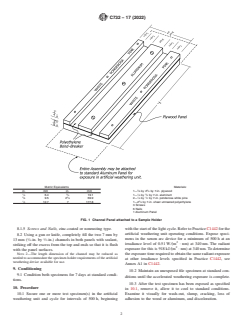
6.2 Channel Panel attached to a Sample Holder, as shown
2.1 ASTM Standards:
in Fig. 1.
C717 Terminology of Building Seals and Sealants
6.3 Knife, for tooling.
C1442 Practice for Conducting Tests on Sealants Using
Artificial Weathering Apparatus
7. Sampling
3. Terminology
7.1 Use the sealant to be tested directly from the container
as commercially supplied by the manufacturer.
3.1 Definitions:
3.1.1 Definitions of the following terms are found in Ter-
8. Test Specimens
minology C717: adhesive failure (loss of adhesion); latex
8.1 Prepare two 25 mm by 70 mm by 175 mm (1-in. by
sealant; sealant, standard conditions.
2 ⁄4-in. by 7-in.) wood-and-aluminum channel panels as shown
in Fig. 1, using the following materials:
ThistestmethodisunderthejurisdictionofASTMCommitteeC24onBuilding
8.1.1 ExteriorFirPlywood,withawater-resistantthermoset
Seals and Sealantsand is the direct responsibility of Subcommittee C24.40 on
glue such as urea or melamine-formaldehyde type.
Weathering.
8.1.2 Ponderosa Pine Sapwood, white kiln dried and free of
Current edition approved Jan. 1, 2022. Published January 2022. Originally
knots or imperfections.
approved in 1972. Last previous edition approved in 2017 as C732 – 17. DOI:
10.1520/C0732-17R22.
8.1.3 Aluminum Alloy 6063-T5 or 6061-T6, clear, anodized
For referenced ASTM standards, visit the ASTM website, www.astm.org, or
a minimum of 30 min over a scale-free finish.
contact ASTM Customer Service at service@astm.org. For Annual Book of ASTM
8.1.4 Polyethylene Bond-Breaker of low-density film ap-
Standards
...