


ASTM B699-86(2015)
(Specification)Standard Specification for Coatings of Cadmium Vacuum-Deposited on Iron and Steel
Standard Specification for Coatings of Cadmium Vacuum-Deposited on Iron and Steel
ABSTRACT
This specification covers the standard requirements for cadmium coatings vacuum deposited with or without supplementary chromate treatment on iron and steel basis metals. The cadmium metal for the production of the coating and the resultant coating shall conform to the chemical composition requirements as shall be determined by chemical, electrochemical, spectrochemical, or X-ray fluorescence analysis. Steel parts that have been machined, ground, cold-formed, or cold-straightened shall be heat treated for stress relief before cleaning and coating. The basis metal shall undergo surface cleaning, abrasive dry blasting, and outgassing by electron bombardment with high-energy positive ions to ensure satisfactory adhesion, abrasion resistance, and corrosion resistance performance. Chromate treatment shall be done in or with special aqueous acid solutions composed of hexavalent chromium along with certain anions that act as a catalyst or film forming compound to produce continuous, smooth, protective film. Coating adhesion shall be determined either by scraping or shearing with a sharp edge, knife, or razor blade through the coating down to the basis metal; plastically deforming by clamping and bending; or any suitable procedure such as burnishing, draw, or scribe tests. Salt spray corrosion test and visual examination shall also be performed on the coatings.
SCOPE
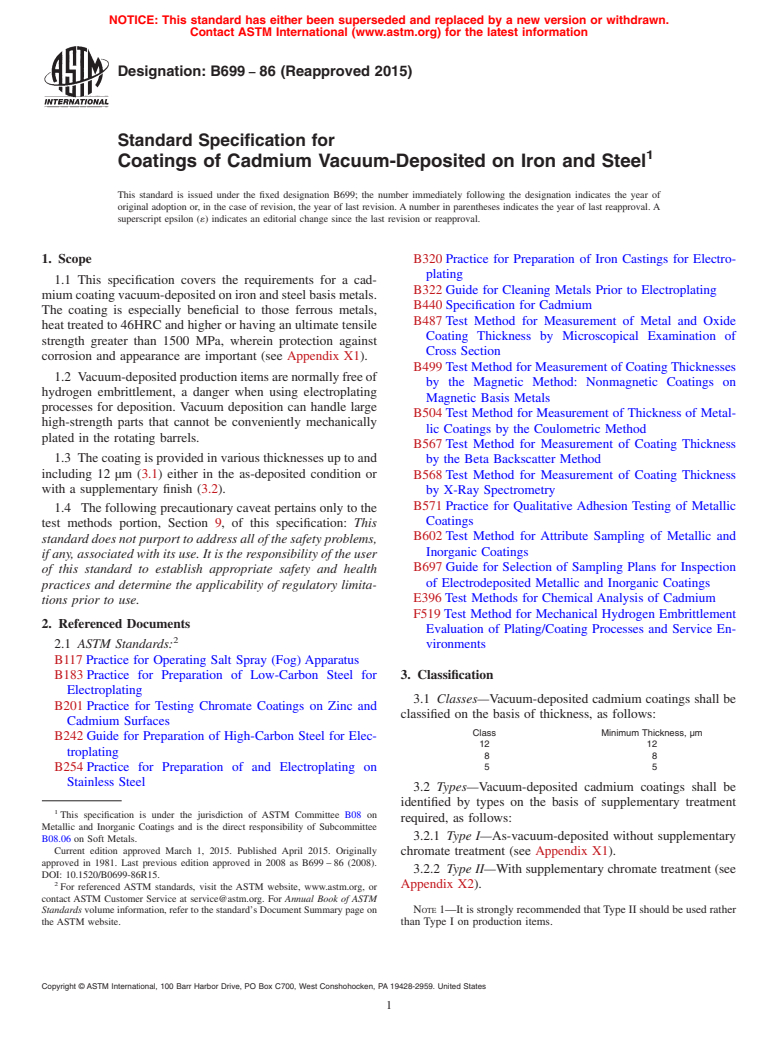
1.1 This specification covers the requirements for a cadmium coating vacuum-deposited on iron and steel basis metals. The coating is especially beneficial to those ferrous metals, heat treated to 46HRC and higher or having an ultimate tensile strength greater than 1500 MPa, wherein protection against corrosion and appearance are important (see Appendix X1).
1.2 Vacuum-deposited production items are normally free of hydrogen embrittlement, a danger when using electroplating processes for deposition. Vacuum deposition can handle large high-strength parts that cannot be conveniently mechanically plated in the rotating barrels.
1.3 The coating is provided in various thicknesses up to and including 12 μm (3.1) either in the as-deposited condition or with a supplementary finish (3.2).
1.4 The following precautionary caveat pertains only to the test methods portion, Section 9, of this specification: This standard does not purport to address all of the safety problems, if any, associated with its use. It is the responsibility of the user of this standard to establish appropriate safety and health practices and determine the applicability of regulatory limitations prior to use.
General Information
Buy Standard
Standards Content (Sample)
NOTICE: This standard has either been superseded and replaced by a new version or withdrawn.
Contact ASTM International (www.astm.org) for the latest information
Designation:B699 −86 (Reapproved 2015)
Standard Specification for
Coatings of Cadmium Vacuum-Deposited on Iron and Steel
This standard is issued under the fixed designation B699; the number immediately following the designation indicates the year of
original adoption or, in the case of revision, the year of last revision.Anumber in parentheses indicates the year of last reapproval.A
superscript epsilon (´) indicates an editorial change since the last revision or reapproval.
1. Scope B320Practice for Preparation of Iron Castings for Electro-
plating
1.1 This specification covers the requirements for a cad-
B322Guide for Cleaning Metals Prior to Electroplating
miumcoatingvacuum-depositedonironandsteelbasismetals.
B440Specification for Cadmium
The coating is especially beneficial to those ferrous metals,
B487Test Method for Measurement of Metal and Oxide
heattreatedto46HRCandhigherorhavinganultimatetensile
Coating Thickness by Microscopical Examination of
strength greater than 1500 MPa, wherein protection against
Cross Section
corrosion and appearance are important (see Appendix X1).
B499Test Method for Measurement of CoatingThicknesses
1.2 Vacuum-depositedproductionitemsarenormallyfreeof
by the Magnetic Method: Nonmagnetic Coatings on
hydrogen embrittlement, a danger when using electroplating
Magnetic Basis Metals
processes for deposition. Vacuum deposition can handle large
B504Test Method for Measurement of Thickness of Metal-
high-strength parts that cannot be conveniently mechanically
lic Coatings by the Coulometric Method
plated in the rotating barrels.
B567Test Method for Measurement of Coating Thickness
1.3 Thecoatingisprovidedinvariousthicknessesuptoand
by the Beta Backscatter Method
including 12 µm (3.1) either in the as-deposited condition or
B568Test Method for Measurement of Coating Thickness
with a supplementary finish (3.2).
by X-Ray Spectrometry
B571Practice for Qualitative Adhesion Testing of Metallic
1.4 Thefollowingprecautionarycaveatpertainsonlytothe
Coatings
test methods portion, Section 9, of this specification: This
B602Test Method for Attribute Sampling of Metallic and
standarddoesnotpurporttoaddressallofthesafetyproblems,
Inorganic Coatings
ifany,associatedwithitsuse.Itistheresponsibilityoftheuser
B697Guide for Selection of Sampling Plans for Inspection
of this standard to establish appropriate safety and health
of Electrodeposited Metallic and Inorganic Coatings
practices and determine the applicability of regulatory limita-
E396Test Methods for Chemical Analysis of Cadmium
tions prior to use.
F519Test Method for Mechanical Hydrogen Embrittlement
2. Referenced Documents
Evaluation of Plating/Coating Processes and Service En-
2.1 ASTM Standards: vironments
B117Practice for Operating Salt Spray (Fog) Apparatus
B183Practice for Preparation of Low-Carbon Steel for
3. Classification
Electroplating
3.1 Classes—Vacuum-deposited cadmium coatings shall be
B201Practice for Testing Chromate Coatings on Zinc and
classified on the basis of thickness, as follows:
Cadmium Surfaces
Class Minimum Thickness, µm
B242Guide for Preparation of High-Carbon Steel for Elec-
12 12
troplating
B254Practice for Preparation of and Electroplating on 55
Stainless Steel
3.2 Types—Vacuum-deposited cadmium coatings shall be
identified by types on the basis of supplementary treatment
This specification is under the jurisdiction of ASTM Committee B08 on
required, as follows:
Metallic and Inorganic Coatings and is the direct responsibility of Subcommittee
3.2.1 Type I—As-vacuum-deposited without supplementary
B08.06 on Soft Metals.
Current edition approved March 1, 2015. Published April 2015. Originally
chromate treatment (see Appendix X1).
approved in 1981. Last previous edition approved in 2008 as B699–86 (2008).
3.2.2 Type II—With supplementary chromate treatment (see
DOI: 10.1520/B0699-86R15.
Appendix X2).
For referenced ASTM standards, visit the ASTM website, www.astm.org, or
contact ASTM Customer Service at service@astm.org. For Annual Book of ASTM
Standards volume information, refer to the standard’s Document Summary page on NOTE1—ItisstronglyrecommendedthatTypeIIshouldbeusedrather
the ASTM website. than Type I on production items.
Copyright © ASTM International, 100 Barr Harbor Drive, PO Box C700, West Conshohocken, PA 19428-2959. United States
B699−86 (2015)
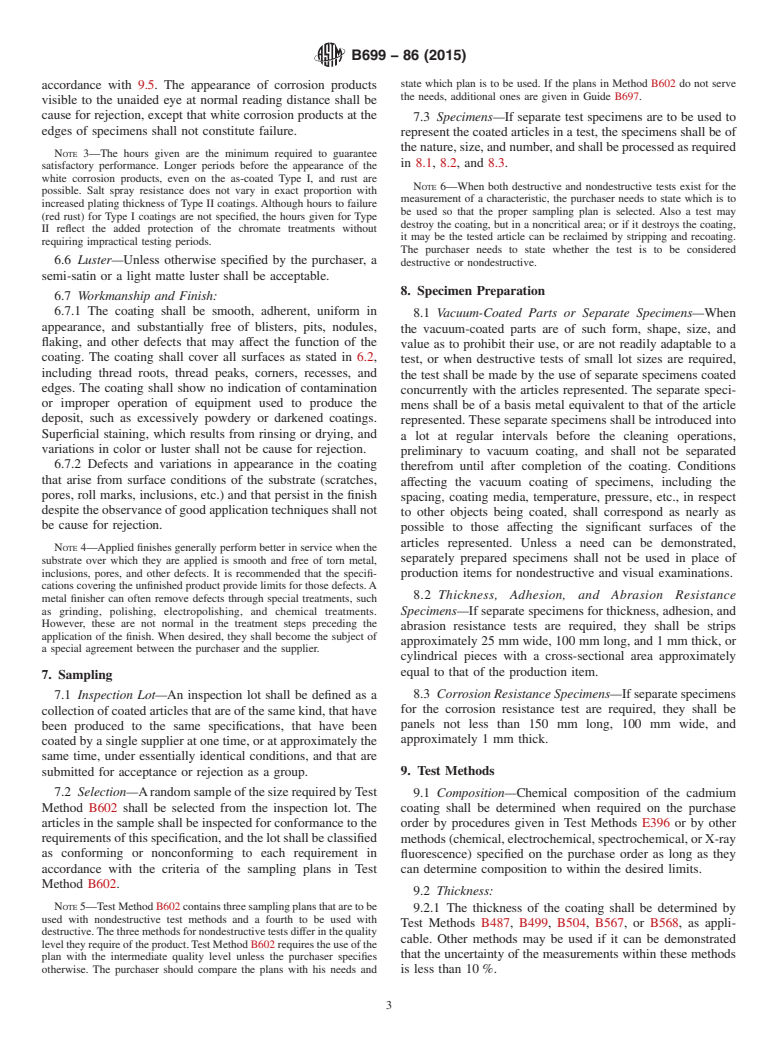
4. Ordering Information 5.5 Substrate—Unless otherwise specified, cadmium shall
be deposited directly on the basis metal without a preliminary
4.1 To make the application of this specification complete,
undercoating of another metal. A preliminary undercoating of
the purchaser needs to supply the following information to the
nickel is permissible with parts made of stainless steel.
supplier in the purchase order or other governing document:
4.1.1 The designation number and year of issue of this 5.6 Chromate Treatment (Type II):
document. 5.6.1 Chromate treatment for Type II shall be done in or
4.1.2 Class and type (3.1 and 3.2), with special aqueous acid solutions composed of hexavalent
4.1.3 Hardness or tensile strength of the steel parts (5.2), chromium along with certain anions that act as a catalyst or
4.1.4 Heat treatment for stress relief, whether it has been film forming compound to produce a continuous, smooth,
performed or is required, protective film.
4.1.5 Undercoating, if required (5.5), 5.6.2 TheTypeIIfilmshallrangeincolorfromaniridescent
4.1.6 Test of coating composition, if required (6.1), yelloworathickermoreprotectiveiridescentbronzeorbrown
4.1.7 Significant surfaces (6.2.2), to the heavier olive drab. It may be dyed to a desired color.
When necessary, a desired color shall be indicated by the
4.1.8 Luster (6.6),
4.1.9 Sampling, if other than specified (Section 7), purchaser and specified by the provision of a suitable colored
4.1.10 Certification (11.1), and sample or indicated on the drawing for the part.
4.1.11 Supplementary requirements, if applicable. 5.6.3 Waxes,lacquers,orotherorganiccoatingsshallnotbe
permitted as a substitute, nor shall they be used in conjunction
5. Materials and Manufacture withTypeIIcoatings,inordertoensuretheconformancetothe
saltsprayorabrasionresistancetestrequirements.Waxes,etc.,
5.1 Nature of Finish—The cadmium metal for the produc-
may be used to improve lubricity.
tion of the coating and the resultant coating shall conform to
the composition requirements of Specification B440 and shall
6. Coating Requirements
contain not less than 99.95 mass% cadmium.
6.1 Coating Composition—When specified, the chemical
5.2 Stress Relief—Steel parts that have an ultimate tensile
composition of the coating shall be determined (see X1.3).
strengthof1000MPaandaboveandthathavebeenmachined,
6.2 Thickness:
ground, cold-formed, or cold-straightened shall be heat-treated
6.2.1 The thickness of the coating everywhere on the
at a minimum of 190°C for3hor more for stress relief before
significant surfaces shall be at least that of the specified class
cleaning and coating.
as defined in 3.1.
5.3 Cleaning of Basis Metal—Proper preparatory proce-
6.2.2 Significant surfaces defined as those normally visible
dures and thorough cleaning of the basis metal are essential to
(directly or by reflection) are essential to the appearance or
ensure satisfactory adhesion and corrosion resistance perfor-
serviceabilityofthearticlewhenassembledinnormalposition;
mance of the coating. The basis metal shall not be exposed to
or can be the source of corrosion products that deface visible
treatments such as cathodic cleaning, and acid treatments
surfaces on the assembled article. When necessary, the signifi-
involvingreleaseofhydrogenonthesurfaceofparts;norshall
cant surfaces shall be indicated by the purchaser on the
materials be used for cleaning that will have damaging effects
applicable drawing of the article, or by the provision of
on the metal, such as pits, intergranular attack, and hydrogen
suitably marked samples.
embrittlement. If necessary, cleaning materials for surface
6.2.3 On nonsignificant visible surfaces, the minimum al-
preparation should be evaluated in accordance with Method
lowable thickness for Class 12 shall be Class 8 (8 µm), for
F519.The basis metal shall be abrasive dry-blasted, using new
Class 8 it shall be Class 5 (5 µm), and for Class 5 it shall be 4
materials or materials that have not been used on other metals.
µm.
All loose particles shall be removed by air blasting the parts
6.3 Adhesion—The cadmium coating shall be sufficiently
thoroughly, using clean dry oil-free compressed air. Following
adherent to the basis metal to pass the tests in 9.3. When
air blasting, the basis metal may be outgassed by subjecting it
examined at a magnification of approximately 4 diameters, the
to an electron bombardment with high-energy positive ions in
coating shall not show separation from the basis metal. The
a glow discharge unit. The following practices, where appro-
formation of cracks in the coating caused by rupture of the
priate for precleaning to remove oil, grease, and other foreign
basismetalthatdoesnotresultinflaking,peeling,orblistering
materialsshouldbeused:B183,B242,B254,B320,andB322.
of the cadmium coating shall not be considered as nonconfor-
NOTE 2—Parts may be cleaned by blasting with 120-mesh aluminum
mance to this requirement.
oxide or 100-mesh garnet grit with a nozzle pressure of 410 to 620 kPa to
remove scale, oxides, or other contamination. Blasted surfaces should not
6.4 AbrasionResistance—Thesupplementarychromatefilm
be rougher than the specified finish for the part. When necessary to
(Type II) on the cadmium coating shall be adherent, non-
achieve the proper surface roughness, finer grit may be used, but
powdery, and shall resist abrasion when tested as detailed in
aluminum oxide coarser than 120-mesh or garnet grit coarser than
9.4.
100-mesh should not be used. Following air blasting, stainless steel parts
should be passivated.
6.5 Corrosion Resistance—Cadmium coatings with Type II
5.4 DepositionProcess—Cadmiumvacuumdepositionshall treatment shall show neither white corrosion products of
−4
be conducted in a vacuum of 1.33×10 to 3.3 Pa with an cadmium nor basis metal corrosion products at the end of 96 h
evaporation rate of 0.8 to 1.7 mg/s. testperiod,whentestedbycontinuousexposuretosaltsprayin
B699−86 (2015)
state which plan is to be used. If the plans in Method B602 do not serve
accordance with 9.5. The appearance of corrosion products
the needs, additional ones are given in Guide B697.
visible to the unaided eye at normal reading distance shall be
cause for rejection, except that white corrosion products at the
7.3 Specimens—If separate test specimens are to be used to
edges of specimens shall not constitute failure.
representthecoatedarticlesinatest,thespecimensshallbeof
thenature,size,andnumber,andshallbeprocessedasrequired
NOTE 3—The hours given are the minimum required to guarantee
in 8.1, 8.2, and 8.3.
satisfactory performance. Longer periods before the appearance of the
white corrosion products, even on the as-coated Type I, and rust are
NOTE 6—When both destructive and nondestructive tests exist for the
possible. Salt spray resistance does not vary in exact proportion with
measurement of a characteristic, the purchaser needs to state which is to
increased plating thickness of Type II coatings.Although hours to failure
be used so that the proper sampling plan is selected. Also a test may
(red rust) for Type I coatings are not specified, the hours given for Type
destroy the coating, but in a noncritical area; or if it destroys the coating,
II reflect the added protection of the chromate treatments without
it may be the tested article can be reclaimed by stripping and recoating.
requiring impractical testing periods.
The purchaser needs to state whether the test is to be considered
6.6 Luster—Unless otherwise specified by the purchaser, a
destructive or nondestructive.
semi-satin or a light matte luster shall be acceptable.
8. Specimen Preparation
6.7 Workmanship and Finish:
6.7.1 The coating shall be smooth, adherent, uniform in
8.1 Vacuum-Coated Parts or Separate Specimens—When
appearance, and substantially free of blisters, pits, nodules,
the vacuum-coated parts are of such form, shape, size, and
flaking, and other defects that may affect the function of the
value as to prohibit their use, or are not readily adaptable to a
coating. The coating shall cover all surfaces as stated in 6.2,
test, or when destructive tests of small lot sizes are required,
including thread roots, thread peaks, corners, recesses, and
the test shall be made by the use of separate specimens coated
edges. The coating shall show no indication of contamination
concurrently with the articles represented. The separate speci-
or improper operation of equipment used to produce the
mens shall be of a basis metal equivalent to that of the article
deposit, such as excessively powdery or darkened coatings.
represented.These separate specimens shall be introduced into
Superficial staining, which results from rinsing or drying, and
a lot at regular intervals before the cleaning operations,
variations in color or luster shall not be cause for rejection.
preliminary to vacuum coating, and shall not be separated
6.7.2 Defects and variations in appearance in the coating
therefrom until after completion of the coating. Conditions
that arise from surface conditions of the substrate (scratches,
affecting the vacuum coating of specimens, including the
pores, roll marks, inclusions, etc.) and that persist in the finish
spacing, coating media, temperature, pressure, etc., in respect
despitetheobservanceofgoodapplicationtechniquesshallnot
to other objects being coated, shall correspond as nearly as
be cause for rejection.
possible to those affecting the significant surfaces of the
articles represented. Unless a need can be demonstrated,
NOTE 4—Applied finishes generally perform better in service when the
separately prepared specimens shall not be used in place of
substrate over which they are applied is smooth and free of torn metal,
inclusions, pores, and other defects. It is recommended that the specifi- production items for nondestructive and visual examinations.
cationscoveringtheunfinishedproductprovidelimitsforthosedefects.A
8.2 Thickness, Adhesion, and Abrasion Resistance
metal finisher can often remove defects through special treatments, such
as grinding, polishing, electropolishing, and chemical treatments. Specimens—If separate specimens for thickness, adhesion, and
However, these are not normal in the treatment steps preceding the
abrasion resistance tests are required, they shall be strips
application of the finish. When desired, they shall become the subject of
approximately 25 mm wide, 100 mm long, and 1 m
...
This document is not an ASTM standard and is intended only to provide the user of an ASTM standard an indication of what changes have been made to the previous version. Because
it may not be technically possible to adequately depict all changes accurately, ASTM recommends that users consult prior editions as appropriate. In all cases only the current version
of the standard as published by ASTM is to be considered the official document.
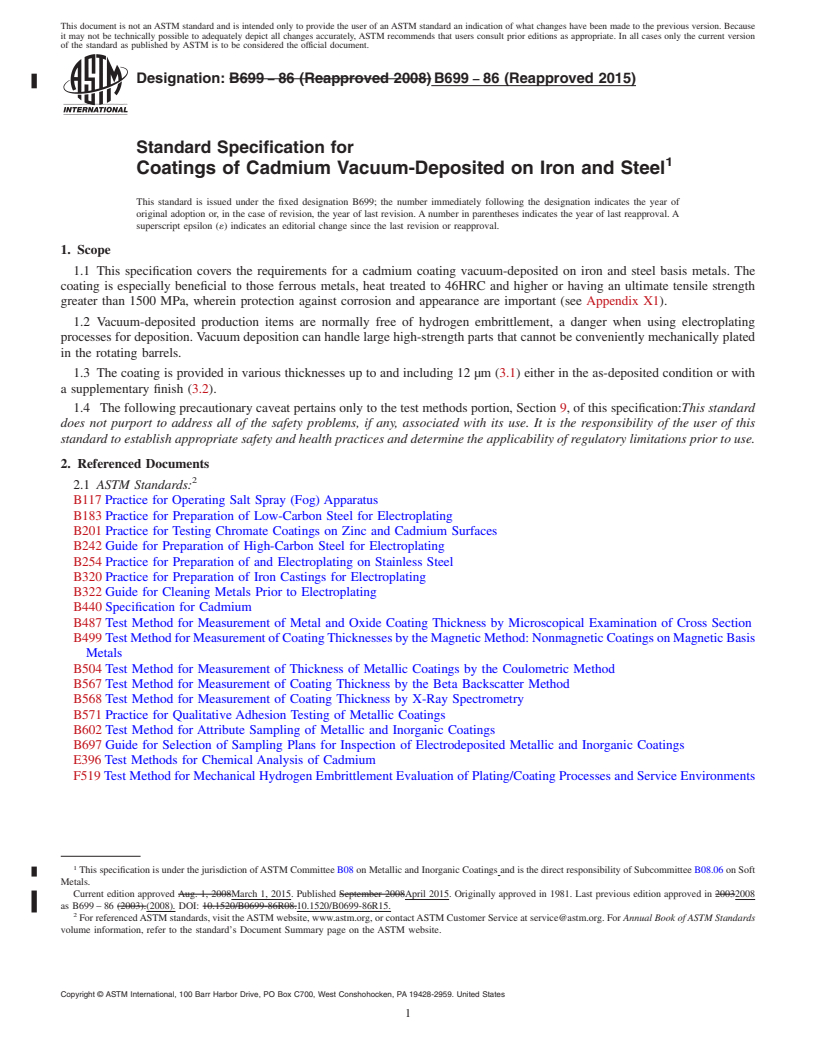
Designation: B699 − 86 (Reapproved 2008) B699 − 86 (Reapproved 2015)
Standard Specification for
Coatings of Cadmium Vacuum-Deposited on Iron and Steel
This standard is issued under the fixed designation B699; the number immediately following the designation indicates the year of
original adoption or, in the case of revision, the year of last revision. A number in parentheses indicates the year of last reapproval. A
superscript epsilon (´) indicates an editorial change since the last revision or reapproval.
1. Scope
1.1 This specification covers the requirements for a cadmium coating vacuum-deposited on iron and steel basis metals. The
coating is especially beneficial to those ferrous metals, heat treated to 46HRC and higher or having an ultimate tensile strength
greater than 1500 MPa, wherein protection against corrosion and appearance are important (see Appendix X1).
1.2 Vacuum-deposited production items are normally free of hydrogen embrittlement, a danger when using electroplating
processes for deposition. Vacuum deposition can handle large high-strength parts that cannot be conveniently mechanically plated
in the rotating barrels.
1.3 The coating is provided in various thicknesses up to and including 12 μm (3.1) either in the as-deposited condition or with
a supplementary finish (3.2).
1.4 The following precautionary caveat pertains only to the test methods portion, Section 9, of this specification:This standard
does not purport to address all of the safety problems, if any, associated with its use. It is the responsibility of the user of this
standard to establish appropriate safety and health practices and determine the applicability of regulatory limitations prior to use.
2. Referenced Documents
2.1 ASTM Standards:
B117 Practice for Operating Salt Spray (Fog) Apparatus
B183 Practice for Preparation of Low-Carbon Steel for Electroplating
B201 Practice for Testing Chromate Coatings on Zinc and Cadmium Surfaces
B242 Guide for Preparation of High-Carbon Steel for Electroplating
B254 Practice for Preparation of and Electroplating on Stainless Steel
B320 Practice for Preparation of Iron Castings for Electroplating
B322 Guide for Cleaning Metals Prior to Electroplating
B440 Specification for Cadmium
B487 Test Method for Measurement of Metal and Oxide Coating Thickness by Microscopical Examination of Cross Section
B499 Test Method for Measurement of Coating Thicknesses by the Magnetic Method: Nonmagnetic Coatings on Magnetic Basis
Metals
B504 Test Method for Measurement of Thickness of Metallic Coatings by the Coulometric Method
B567 Test Method for Measurement of Coating Thickness by the Beta Backscatter Method
B568 Test Method for Measurement of Coating Thickness by X-Ray Spectrometry
B571 Practice for Qualitative Adhesion Testing of Metallic Coatings
B602 Test Method for Attribute Sampling of Metallic and Inorganic Coatings
B697 Guide for Selection of Sampling Plans for Inspection of Electrodeposited Metallic and Inorganic Coatings
E396 Test Methods for Chemical Analysis of Cadmium
F519 Test Method for Mechanical Hydrogen Embrittlement Evaluation of Plating/Coating Processes and Service Environments
This specification is under the jurisdiction of ASTM Committee B08 on Metallic and Inorganic Coatings and is the direct responsibility of Subcommittee B08.06 on Soft
Metals.
Current edition approved Aug. 1, 2008March 1, 2015. Published September 2008April 2015. Originally approved in 1981. Last previous edition approved in 20032008
as B699 – 86 (2003).(2008). DOI: 10.1520/B0699-86R08.10.1520/B0699-86R15.
For referenced ASTM standards, visit the ASTM website, www.astm.org, or contact ASTM Customer Service at service@astm.org. For Annual Book of ASTM Standards
volume information, refer to the standard’s Document Summary page on the ASTM website.
Copyright © ASTM International, 100 Barr Harbor Drive, PO Box C700, West Conshohocken, PA 19428-2959. United States
B699 − 86 (2015)
3. Classification
3.1 Classes—Vacuum-deposited cadmium coatings shall be classified on the basis of thickness, as follows:
Class Minimum Thickness, μm
12 12
8 8
5 5
3.2 Types—Vacuum-deposited cadmium coatings shall be identified by types on the basis of supplementary treatment required,
as follows:
3.2.1 Type I—As-vacuum-deposited without supplementary chromate treatment (see Appendix X1).
3.2.2 Type II—With supplementary chromate treatment (see Appendix X2).
NOTE 1—It is strongly recommended that Type II should be used rather than Type I on production items.
4. Ordering Information
4.1 To make the application of this specification complete, the purchaser needs to supply the following information to the
supplier in the purchase order or other governing document:
4.1.1 The designation number and year of issue of this document.
4.1.2 Class and type (3.1 and 3.2),
4.1.3 Hardness or tensile strength of the steel parts (5.2),
4.1.4 Heat treatment for stress relief, whether it has been performed or is required,
4.1.5 Undercoating, if required (5.5),
4.1.6 Test of coating composition, if required (6.1),
4.1.7 Significant surfaces (6.2.2),
4.1.8 Luster (6.6),
4.1.9 Sampling, if other than specified (Section 7),
4.1.10 Certification (11.1), and
4.1.11 Supplementary requirements, if applicable.
5. Materials and Manufacture
5.1 Nature of Finish—The cadmium metal for the production of the coating and the resultant coating shall conform to the
composition requirements of Specification B440 and shall contain not less than 99.95 mass % cadmium.
5.2 Stress Relief—Steel parts that have an ultimate tensile strength of 1000 MPa and above and that have been machined,
ground, cold-formed, or cold-straightened shall be heat-treated at a minimum of 190°C for 3 h or more for stress relief before
cleaning and coating.
5.3 Cleaning of Basis Metal—Proper preparatory procedures and thorough cleaning of the basis metal are essential to ensure
satisfactory adhesion and corrosion resistance performance of the coating. The basis metal shall not be exposed to treatments such
as cathodic cleaning, and acid treatments involving release of hydrogen on the surface of parts; nor shall materials be used for
cleaning that will have damaging effects on the metal, such as pits, intergranular attack, and hydrogen embrittlement. If necessary,
cleaning materials for surface preparation should be evaluated in accordance with Method F519. The basis metal shall be abrasive
dry-blasted, using new materials or materials that have not been used on other metals. All loose particles shall be removed by air
blasting the parts thoroughly, using clean dry oil-free compressed air. Following air blasting, the basis metal may be outgassed by
subjecting it to an electron bombardment with high-energy positive ions in a glow discharge unit. The following practices, where
appropriate for precleaning to remove oil, grease, and other foreign materials should be used: B183, B242, B254, B320, and B322.
NOTE 2—Parts may be cleaned by blasting with 120-mesh aluminum oxide or 100-mesh garnet grit with a nozzle pressure of 410 to 620 kPa to remove
scale, oxides, or other contamination. Blasted surfaces should not be rougher than the specified finish for the part. When necessary to achieve the proper
surface roughness, finer grit may be used, but aluminum oxide coarser than 120-mesh or garnet grit coarser than 100-mesh should not be used. Following
air blasting, stainless steel parts should be passivated.
−4
5.4 Deposition Process—Cadmium vacuum deposition shall be conducted in a vacuum of 1.33 × 10 to 3.3 Pa with an
evaporation rate of 0.8 to 1.7 mg/s.
5.5 Substrate—Unless otherwise specified, cadmium shall be deposited directly on the basis metal without a preliminary
undercoating of another metal. A preliminary undercoating of nickel is permissible with parts made of stainless steel.
5.6 Chromate Treatment (Type II):
5.6.1 Chromate treatment for Type II shall be done in or with special aqueous acid solutions composed of hexavalent chromium
along with certain anions that act as a catalyst or film forming compound to produce a continuous, smooth, protective film.
5.6.2 The Type II film shall range in color from an iridescent yellow or a thicker more protective iridescent bronze or brown
to the heavier olive drab. It may be dyed to a desired color. When necessary, a desired color shall be indicated by the purchaser
and specified by the provision of a suitable colored sample or indicated on the drawing for the part.
B699 − 86 (2015)
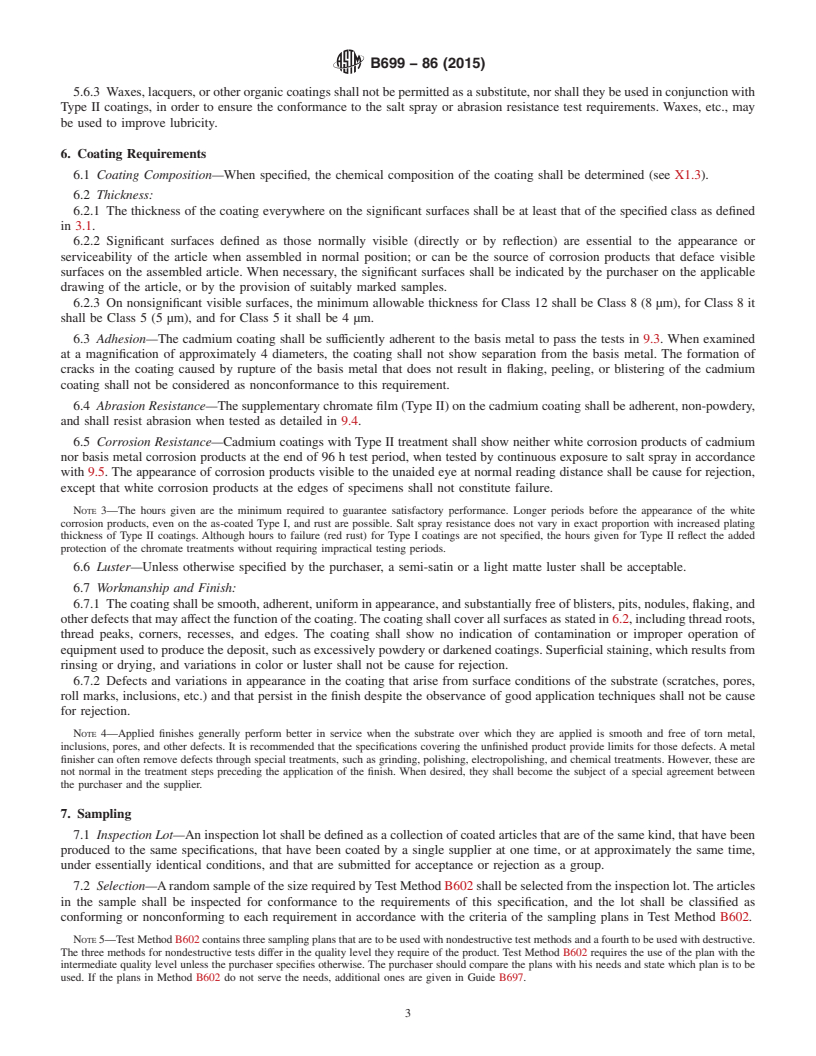
5.6.3 Waxes, lacquers, or other organic coatings shall not be permitted as a substitute, nor shall they be used in conjunction with
Type II coatings, in order to ensure the conformance to the salt spray or abrasion resistance test requirements. Waxes, etc., may
be used to improve lubricity.
6. Coating Requirements
6.1 Coating Composition—When specified, the chemical composition of the coating shall be determined (see X1.3).
6.2 Thickness:
6.2.1 The thickness of the coating everywhere on the significant surfaces shall be at least that of the specified class as defined
in 3.1.
6.2.2 Significant surfaces defined as those normally visible (directly or by reflection) are essential to the appearance or
serviceability of the article when assembled in normal position; or can be the source of corrosion products that deface visible
surfaces on the assembled article. When necessary, the significant surfaces shall be indicated by the purchaser on the applicable
drawing of the article, or by the provision of suitably marked samples.
6.2.3 On nonsignificant visible surfaces, the minimum allowable thickness for Class 12 shall be Class 8 (8 μm), for Class 8 it
shall be Class 5 (5 μm), and for Class 5 it shall be 4 μm.
6.3 Adhesion—The cadmium coating shall be sufficiently adherent to the basis metal to pass the tests in 9.3. When examined
at a magnification of approximately 4 diameters, the coating shall not show separation from the basis metal. The formation of
cracks in the coating caused by rupture of the basis metal that does not result in flaking, peeling, or blistering of the cadmium
coating shall not be considered as nonconformance to this requirement.
6.4 Abrasion Resistance—The supplementary chromate film (Type II) on the cadmium coating shall be adherent, non-powdery,
and shall resist abrasion when tested as detailed in 9.4.
6.5 Corrosion Resistance—Cadmium coatings with Type II treatment shall show neither white corrosion products of cadmium
nor basis metal corrosion products at the end of 96 h test period, when tested by continuous exposure to salt spray in accordance
with 9.5. The appearance of corrosion products visible to the unaided eye at normal reading distance shall be cause for rejection,
except that white corrosion products at the edges of specimens shall not constitute failure.
NOTE 3—The hours given are the minimum required to guarantee satisfactory performance. Longer periods before the appearance of the white
corrosion products, even on the as-coated Type I, and rust are possible. Salt spray resistance does not vary in exact proportion with increased plating
thickness of Type II coatings. Although hours to failure (red rust) for Type I coatings are not specified, the hours given for Type II reflect the added
protection of the chromate treatments without requiring impractical testing periods.
6.6 Luster—Unless otherwise specified by the purchaser, a semi-satin or a light matte luster shall be acceptable.
6.7 Workmanship and Finish:
6.7.1 The coating shall be smooth, adherent, uniform in appearance, and substantially free of blisters, pits, nodules, flaking, and
other defects that may affect the function of the coating. The coating shall cover all surfaces as stated in 6.2, including thread roots,
thread peaks, corners, recesses, and edges. The coating shall show no indication of contamination or improper operation of
equipment used to produce the deposit, such as excessively powdery or darkened coatings. Superficial staining, which results from
rinsing or drying, and variations in color or luster shall not be cause for rejection.
6.7.2 Defects and variations in appearance in the coating that arise from surface conditions of the substrate (scratches, pores,
roll marks, inclusions, etc.) and that persist in the finish despite the observance of good application techniques shall not be cause
for rejection.
NOTE 4—Applied finishes generally perform better in service when the substrate over which they are applied is smooth and free of torn metal,
inclusions, pores, and other defects. It is recommended that the specifications covering the unfinished product provide limits for those defects. A metal
finisher can often remove defects through special treatments, such as grinding, polishing, electropolishing, and chemical treatments. However, these are
not normal in the treatment steps preceding the application of the finish. When desired, they shall become the subject of a special agreement between
the purchaser and the supplier.
7. Sampling
7.1 Inspection Lot—An inspection lot shall be defined as a collection of coated articles that are of the same kind, that have been
produced to the same specifications, that have been coated by a single supplier at one time, or at approximately the same time,
under essentially identical conditions, and that are submitted for acceptance or rejection as a group.
7.2 Selection—A random sample of the size required by Test Method B602 shall be selected from the inspection lot. The articles
in the sample shall be inspected for conformance to the requirements of this specification, and the lot shall be classified as
conforming or nonconforming to each requirement in accordance with the criteria of the sampling plans in Test Method B602.
NOTE 5—Test Method B602 contains three sampling plans that are to be used with nondestructive test methods and a fourth to be used with destructive.
The three methods for nondestructive tests differ in the quality level they require of the product. Test Method B602 requires the use of the plan with the
intermediate quality level unless the purchaser specifies otherwise. The purchaser should compare the plans with his needs and state which plan is to be
used. If the plans in Method B602 do not serve the needs, additional ones are given in Guide B697.
B699 − 86 (2015)
7.3 Specimens—If separate test specimens are to be used to represent the coated articles in a te
...
Questions, Comments and Discussion
Ask us and Technical Secretary will try to provide an answer. You can facilitate discussion about the standard in here.