


ASTM D2442-75(2016)
(Specification)Standard Specification for Alumina Ceramics for Electrical and Electronic Applications
Standard Specification for Alumina Ceramics for Electrical and Electronic Applications
SCOPE
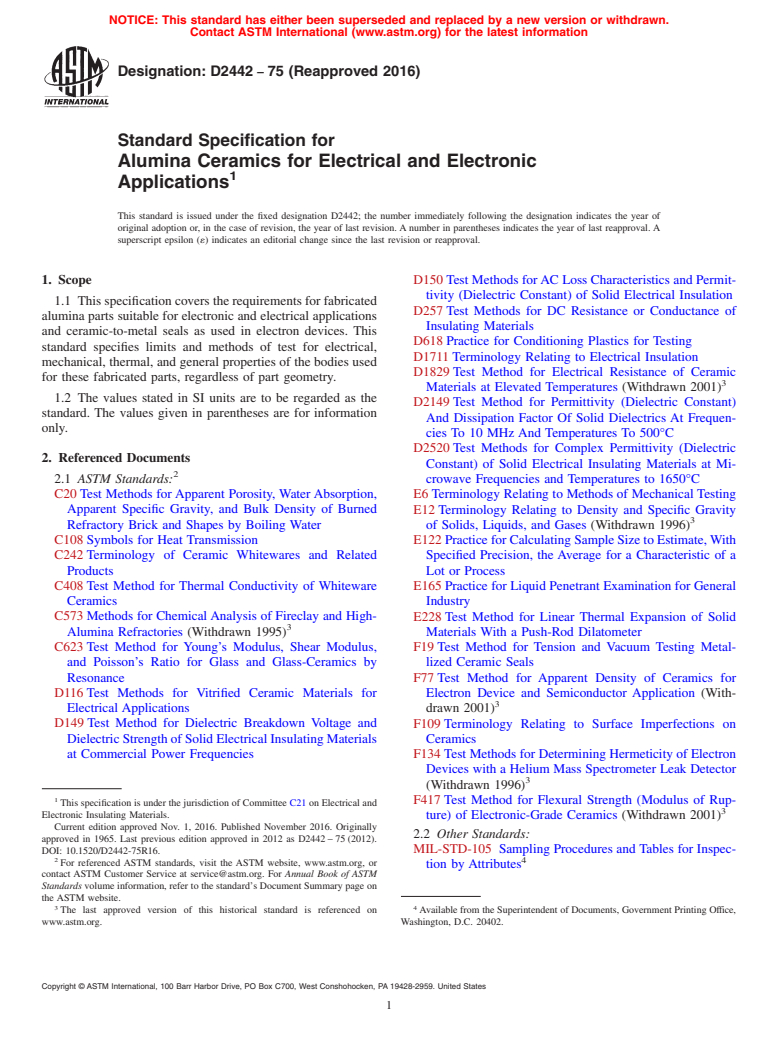
1.1 This specification covers the requirements for fabricated alumina parts suitable for electronic and electrical applications and ceramic-to-metal seals as used in electron devices. This standard specifies limits and methods of test for electrical, mechanical, thermal, and general properties of the bodies used for these fabricated parts, regardless of part geometry.
1.2 The values stated in SI units are to be regarded as the standard. The values given in parentheses are for information only.
General Information
Buy Standard
Standards Content (Sample)
NOTICE: This standard has either been superseded and replaced by a new version or withdrawn.
Contact ASTM International (www.astm.org) for the latest information
Designation:D2442 −75 (Reapproved 2016)
Standard Specification for
Alumina Ceramics for Electrical and Electronic
Applications
This standard is issued under the fixed designation D2442; the number immediately following the designation indicates the year of
original adoption or, in the case of revision, the year of last revision.Anumber in parentheses indicates the year of last reapproval.A
superscript epsilon (´) indicates an editorial change since the last revision or reapproval.
1. Scope D150Test Methods forAC Loss Characteristics and Permit-
tivity (Dielectric Constant) of Solid Electrical Insulation
1.1 Thisspecificationcoverstherequirementsforfabricated
D257Test Methods for DC Resistance or Conductance of
alumina parts suitable for electronic and electrical applications
Insulating Materials
and ceramic-to-metal seals as used in electron devices. This
D618Practice for Conditioning Plastics for Testing
standard specifies limits and methods of test for electrical,
D1711Terminology Relating to Electrical Insulation
mechanical, thermal, and general properties of the bodies used
D1829Test Method for Electrical Resistance of Ceramic
for these fabricated parts, regardless of part geometry.
Materials at Elevated Temperatures (Withdrawn 2001)
1.2 The values stated in SI units are to be regarded as the
D2149Test Method for Permittivity (Dielectric Constant)
standard. The values given in parentheses are for information
And Dissipation Factor Of Solid Dielectrics At Frequen-
only.
cies To 10 MHz And Temperatures To 500°C
D2520Test Methods for Complex Permittivity (Dielectric
2. Referenced Documents
Constant) of Solid Electrical Insulating Materials at Mi-
2.1 ASTM Standards: crowave Frequencies and Temperatures to 1650°C
C20Test Methods forApparent Porosity, WaterAbsorption, E6Terminology Relating to Methods of Mechanical Testing
Apparent Specific Gravity, and Bulk Density of Burned E12Terminology Relating to Density and Specific Gravity
Refractory Brick and Shapes by Boiling Water
of Solids, Liquids, and Gases (Withdrawn 1996)
C108Symbols for Heat Transmission E122PracticeforCalculatingSampleSizetoEstimate,With
C242Terminology of Ceramic Whitewares and Related
Specified Precision, the Average for a Characteristic of a
Products Lot or Process
C408Test Method for Thermal Conductivity of Whiteware
E165Practice for Liquid Penetrant Examination for General
Ceramics Industry
C573Methods for ChemicalAnalysis of Fireclay and High- E228Test Method for Linear Thermal Expansion of Solid
Alumina Refractories (Withdrawn 1995) Materials With a Push-Rod Dilatometer
C623Test Method for Young’s Modulus, Shear Modulus, F19Test Method for Tension and Vacuum Testing Metal-
and Poisson’s Ratio for Glass and Glass-Ceramics by lized Ceramic Seals
Resonance F77Test Method for Apparent Density of Ceramics for
D116Test Methods for Vitrified Ceramic Materials for Electron Device and Semiconductor Application (With-
Electrical Applications drawn 2001)
D149Test Method for Dielectric Breakdown Voltage and F109Terminology Relating to Surface Imperfections on
DielectricStrengthofSolidElectricalInsulatingMaterials Ceramics
at Commercial Power Frequencies F134Test Methods for Determining Hermeticity of Electron
Devices with a Helium Mass Spectrometer Leak Detector
(Withdrawn 1996)
F417Test Method for Flexural Strength (Modulus of Rup-
This specification is under the jurisdiction of Committee C21 on Electrical and
Electronic Insulating Materials.
ture) of Electronic-Grade Ceramics (Withdrawn 2001)
Current edition approved Nov. 1, 2016. Published November 2016. Originally
2.2 Other Standards:
approved in 1965. Last previous edition approved in 2012 as D2442–75(2012).
DOI: 10.1520/D2442-75R16. MIL-STD-105 Sampling Procedures and Tables for Inspec-
2 4
For referenced ASTM standards, visit the ASTM website, www.astm.org, or
tion by Attributes
contact ASTM Customer Service at service@astm.org. For Annual Book of ASTM
Standards volume information, refer to the standard’s Document Summary page on
the ASTM website.
3 4
The last approved version of this historical standard is referenced on Available from the Superintendent of Documents, Government Printing Office,
www.astm.org. Washington, D.C. 20402.
Copyright © ASTM International, 100 Barr Harbor Drive, PO Box C700, West Conshohocken, PA 19428-2959. United States
D2442−75 (2016)
TABLE 2 Mechanical Requirements
MIL-STD-883Test Methods and Procedures for Microelec-
tronics Property Type I Type II Type III Type IV
ANSIB46.1Surface Texture Flexural strength, 240 275 275 275
A
min avg, (35 000) (40 000) (40 000) (40 000)
MPa (psi)
3. Terminology
Modulus of 215 275 310 345
6 6 6 6
elasticity, min, (31×10 ) (40×10 ) (45×10 ) (50×10 )
3.1 Definitions:
GPa (psi)
3.1.1 The applicable definitions of terms in the following
Poisson’s ratio, 0.20 to 0.25 0.20 to 0.25 0.20 to 0.25 0.20 to 0.25
documentsshallapplytothisspecification:SymbolsC108,and average
A
Definitions C242, D1711, E6, E12, and F109.
Maximum permissible coefficient of variation is 10 percent.
4. Classification
4.1 Ceramics covered by this specification shall be classi-
6.2 Dimensionalandsurfacefinishrequirementsoftheparts
fied by alumina content as follows:
shall be as agreed between the supplier and the purchaser;
Alumina Content
however, guidance for establishing such an agreement is
Type Weight percent, min
provided in Appendix X1.
I82
II 93
6.3 Visual Requirements:
III 97
6.3.1 Parts shall be uniform in color and texture. Cracks,
IV 99
blisters, holes, porous areas, inclusions, and adherent foreign
5. Basis of Purchase
particles shall not be permitted. The limits of surface imper-
fections such as pits, pocks, chips (open or closed), surface
5.1 Purchase orders for ceramic parts furnished to this
marks, fins, ridges, and flow lines shall be set by mutual
specification shall include the following information:
agreement between the supplier and the purchaser. Limiting
5.1.1 Type designation (see 3.1),
dimensions for these defects, when required for clarification,
5.1.2 Surface finish and allowable defect limits (if required)
will be listed in the parts drawing or purchase description. For
(Definitions F109, ANSI B46.1, and Appendix X1),
definitions of the surface imperfections enumerated above, see
5.1.3 Part drawing with dimensional tolerances (Appendix
Definitions F109.
X1),
6.3.2 For hermetic seal applications at least ⁄4 of the width
5.1.4 Specific tests (if required),
5.1.5 Certification (if required), and of the seal surface shall remain intact at the location of any
defect.
5.1.6 Packing and marking.
6.3.3 On other surfaces the limits for defects are such that
6. Requirements
the dimensional tolerances of the part are not affected at the
location of the defect.
6.1 This material shall conform to the electrical,
mechanical, thermal, and general property requirements speci-
7. Test Specimens
fied in Table 1, Table 2, Table 3, and Table 4.
7.1 Thepreferredspecimensfortestare,wherepossible,the
actual part. When necessary, however, specific test specimens
AvailablefromStandardizationDocumentsOrderDesk,Bldg.4SectionD,700
shall be prepared from the same batch of material and by the
Robbins Ave., Philadelphia, PA 19111-5094, Attn: NPODS.
same processes as those employed in fabricating the ceramic
Available fromAmerican National Standards Institute (ANSI), 25 W. 43rd St.,
4th Floor, New York, NY 10036, http://www.ansi.org.
part insofar as possible.
8. Specimen Preparation
TABLE 1 Electrical Requirements
Property Type I Type II Type III Type IV
8.1 The specimens for tests described in 9.1 – 9.3 shall be
Dielectric constant,
preconditioned in accordance with Procedure A of Test Meth-
max 25°C:
ods D618.
at 1 MHz 8.8 9.6 9.8 10.1
at 10 GHz 8.7 9.6 9.8 10.1
9. Test Methods
Dissipation factor,
max 25°C:
9.1 Dielectric Constant and Dissipation Factor—Determine
at 1 MHz 0.002 0.001 0.0005 0.0002
at 10 GHz 0.002 0.001 0.0005 0.0002 in accordance with Test Methods D150. Determine values at
Volume resistivity,
higher frequencies in accordance with Test Methods D2520.
minΩ·cm:
14 14 14 14 Determine values at higher temperatures in accordance with
at 25°C 10 10 10 10
10 10 10 10
at 300°C 1 × 10 1×10 1×10 7×10 Test Method D2149.
7 7 7 8
at 500°C 4 × 10 2×10 8×10 1×10
6 6 6 7
9.2 Volume Resistivity—Determine in accordance with Test
at 700°C 4 × 10 2×10 6×10 1×10
5 5 5 6
at 900°C 4 × 10 2×10 8×10 1×10
Methods D257. For elevated temperature measurements use
Dielectric
Procedure A of Test Method D1829.
strength:
3.175 mm 9.85 9.85 9.85 9.85
(0.125 in.) (250 V/mil) (250 V/mil) (250 V/mil) (250 V/mil)
min kV/mm For another suitable method see Dielectric Materials and Applications, edited
by Von Hippel, A., John Wiley and Sons, Inc., New York, N.Y., 1954.
D2442−75 (2016)
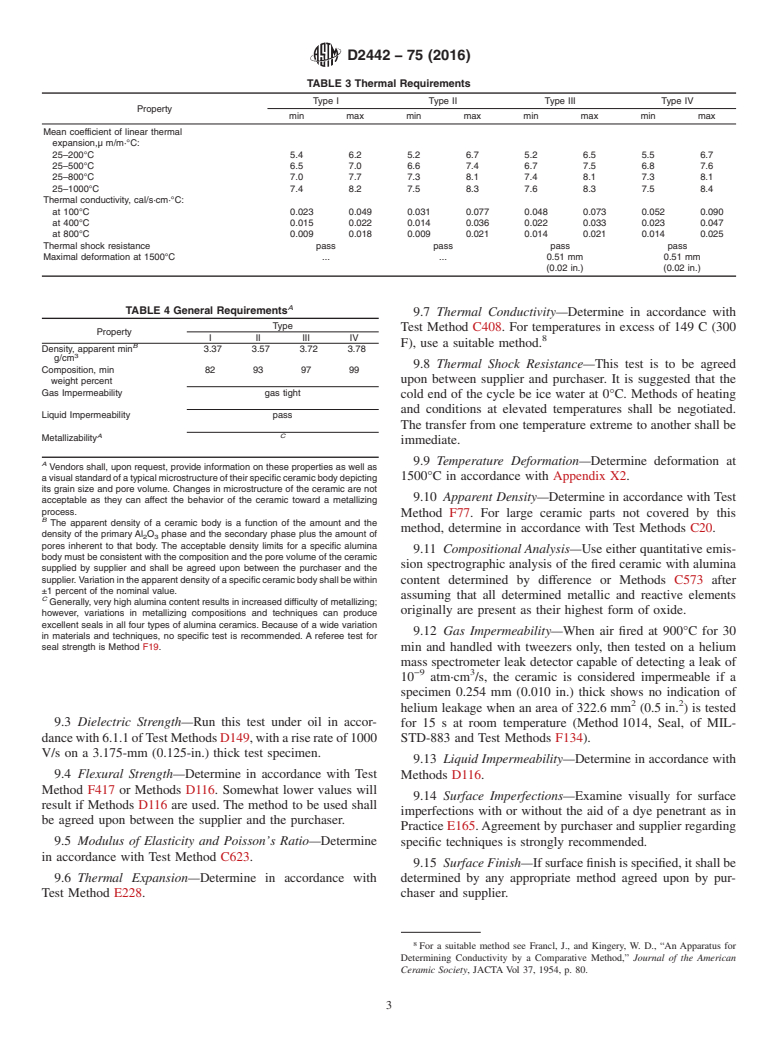
TABLE 3 Thermal Requirements
Type I Type II Type III Type IV
Property
min max min max min max min max
Mean coefficient of linear thermal
expansion,µ m/m·°C:
25–200°C 5.4 6.2 5.2 6.7 5.2 6.5 5.5 6.7
25–500°C 6.5 7.0 6.6 7.4 6.7 7.5 6.8 7.6
25–800°C 7.0 7.7 7.3 8.1 7.4 8.1 7.3 8.1
25–1000°C 7.4 8.2 7.5 8.3 7.6 8.3 7.5 8.4
Thermal conductivity, cal/s·cm·°C:
at 100°C 0.023 0.049 0.031 0.077 0.048 0.073 0.052 0.090
at 400°C 0.015 0.022 0.014 0.036 0.022 0.033 0.023 0.047
at 800°C 0.009 0.018 0.009 0.021 0.014 0.021 0.014 0.025
Thermal shock resistance pass pass pass pass
Maximal deformation at 1500°C . . 0.51 mm 0.51 mm
(0.02 in.) (0.02 in.)
A
TABLE 4 General Requirements
9.7 Thermal Conductivity—Determine in accordance with
Type
Test Method C408. For temperatures in excess of 149 C (300
Property
I II III IV
F), use a suitable method.
B
Density, apparent min 3.37 3.57 3.72 3.78
g/cm
9.8 Thermal Shock Resistance—This test is to be agreed
Composition, min 82 93 97 99
upon between supplier and purchaser. It is suggested that the
weight percent
Gas Impermeability gas tight
cold end of the cycle be ice water at 0°C. Methods of heating
and conditions at elevated temperatures shall be negotiated.
Liquid Impermeability pass
The transfer from one temperature extreme to another shall be
AC
Metallizability
immediate.
A 9.9 Temperature Deformation—Determine deformation at
Vendors shall, upon request, provide information on these properties as well as
1500°C in accordance with Appendix X2.
a visual standard of a typical microstructure of their specific ceramic body depicting
its grain size and pore volume. Changes in microstructure of the ceramic are not
9.10 Apparent Density—Determine in accordance with Test
acceptable as they can affect the behavior of the ceramic toward a metallizing
process.
Method F77. For large ceramic parts not covered by this
B
The apparent density of a ceramic body is a function of the amount and the
method, determine in accordance with Test Methods C20.
density of the primary Al O phase and the secondary phase plus the amount of
2 3
pores inherent to that body. The acceptable density limits for a specific alumina
9.11 Compositional Analysis—Use either quantitative emis-
body must be consistent with the composition and the pore volume of the ceramic
sion spectrographic analysis of the fired ceramic with alumina
supplied by supplier and shall be agreed upon between the purchaser and the
supplier. Variation in the apparent density of a specific ceramic body shall be within
content determined by difference or Methods C573 after
±1 percent of the nominal value.
assuming that all determined metallic and reactive elements
C
Generally, very high alumina content results in increased difficulty of metallizing;
originally are present as their highest form of oxide.
however, variations in metallizing compositions and techniques can produce
excellent seals in all four types of alumina ceramics. Because of a wide variation
9.12 Gas Impermeability—When air fired at 900°C for 30
in materials and techniques, no specific test is recommended. A referee test for
seal strength is Method F19. min and handled with tweezers only, then tested on a helium
mass spectrometer leak detector capable of detecting a leak of
−9 3
10 atm·cm /s, the ceramic is considered impermeable if a
specimen 0.254 mm (0.010 in.) thick shows no indication of
2 2
helium leakage when an area of 322.6 mm (0.5 in. ) is tested
9.3 Dielectric Strength—Run this test under oil in accor- for 15 s at room temperature (Method1014, Seal, of MIL-
dancewith6.1.1ofTestMethodsD149,withariserateof1000
STD-883 and Test Methods F134).
V/s on a 3.175-mm (0.125-in.) thick test specimen.
9.13 Liquid Impermeability—Determine in accordance with
9.4 Flexural Strength—Determine in accordance with Test Methods D116.
Method F417 or Methods D116. Somewhat lower values will
9.14 Surface Imperfections—Examine visually for surface
result if Methods D116 are used. The method to be used shall
imperfections with or without the aid of a dye penetrant as in
be agreed upon between the supplier and the purchaser.
Practice E165.Agreement by purchaser and supplier regarding
9.5 Modulus of Elasticity and Poisson’s Ratio—Determine specific techniques is strongly recommended.
in accordance with Test Method C623.
9.15 Surface Finish—Ifsurfacefinishisspecified,itshallbe
9.6 Thermal Expansion—Determine in accordance with determined by any appropriate method agreed upon by pur-
Test Method E228. chaser and supplier.
For a suitable method see Francl, J., and Kingery, W. D., “An Apparatus for
Determining Conductivity by a Comparative Method,” Journal of the American
Ceramic Society, JACTA Vol 37, 1954, p. 80.
D2442−75 (2016)
10. Inspection 12. Certification
10.1 When agreed upon between the manufacturer and the
12.1 Any test results requiring certification shall be explic-
purchaser, the purchaser may inspect the ceramic parts and
itly agreed upon, in writing, between the purchaser and the
verify the test results at the manufacturer’s facility. Otherwise
manufacturer.
thepurchasershallinspectandtesttheceramicpartswithinone
month of the date of receipt by the purchaser or at such other
13. Packing and Marking
times as may be agreed upon between the purchaser and the
13.1 Special packing techniques shall be subject to agree-
manufacturer.
ment between the purchaser and the manufacturer. Otherwise
10.2 When agreed upon between the manufacturer and the
all parts shall be handled, inspected, and packed in such a
purchaser, the manufacturer shall supply, prior to fabrication,
mannerastoavoidchipping,scratches,andcontamination,and
duplicate test specimens to the purchaser for his testing
in accordance with the best practices to provide ample protec-
purposes. These specimens shall be identical with those tested
tion against damage during shipment.
by the manufacture
...
This document is not an ASTM standard and is intended only to provide the user of an ASTM standard an indication of what changes have been made to the previous version. Because
it may not be technically possible to adequately depict all changes accurately, ASTM recommends that users consult prior editions as appropriate. In all cases only the current version
of the standard as published by ASTM is to be considered the official document.
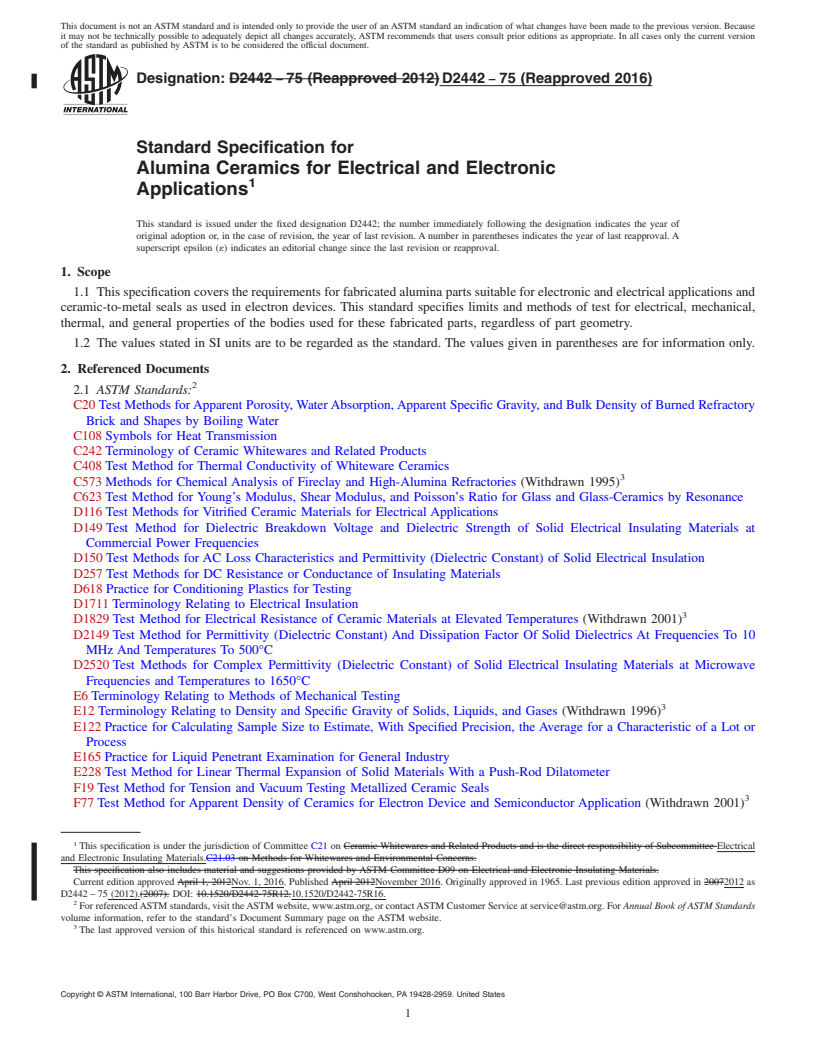
Designation: D2442 − 75 (Reapproved 2012) D2442 − 75 (Reapproved 2016)
Standard Specification for
Alumina Ceramics for Electrical and Electronic
Applications
This standard is issued under the fixed designation D2442; the number immediately following the designation indicates the year of
original adoption or, in the case of revision, the year of last revision. A number in parentheses indicates the year of last reapproval. A
superscript epsilon (´) indicates an editorial change since the last revision or reapproval.
1. Scope
1.1 This specification covers the requirements for fabricated alumina parts suitable for electronic and electrical applications and
ceramic-to-metal seals as used in electron devices. This standard specifies limits and methods of test for electrical, mechanical,
thermal, and general properties of the bodies used for these fabricated parts, regardless of part geometry.
1.2 The values stated in SI units are to be regarded as the standard. The values given in parentheses are for information only.
2. Referenced Documents
2.1 ASTM Standards:
C20 Test Methods for Apparent Porosity, Water Absorption, Apparent Specific Gravity, and Bulk Density of Burned Refractory
Brick and Shapes by Boiling Water
C108 Symbols for Heat Transmission
C242 Terminology of Ceramic Whitewares and Related Products
C408 Test Method for Thermal Conductivity of Whiteware Ceramics
C573 Methods for Chemical Analysis of Fireclay and High-Alumina Refractories (Withdrawn 1995)
C623 Test Method for Young’s Modulus, Shear Modulus, and Poisson’s Ratio for Glass and Glass-Ceramics by Resonance
D116 Test Methods for Vitrified Ceramic Materials for Electrical Applications
D149 Test Method for Dielectric Breakdown Voltage and Dielectric Strength of Solid Electrical Insulating Materials at
Commercial Power Frequencies
D150 Test Methods for AC Loss Characteristics and Permittivity (Dielectric Constant) of Solid Electrical Insulation
D257 Test Methods for DC Resistance or Conductance of Insulating Materials
D618 Practice for Conditioning Plastics for Testing
D1711 Terminology Relating to Electrical Insulation
D1829 Test Method for Electrical Resistance of Ceramic Materials at Elevated Temperatures (Withdrawn 2001)
D2149 Test Method for Permittivity (Dielectric Constant) And Dissipation Factor Of Solid Dielectrics At Frequencies To 10
MHz And Temperatures To 500°C
D2520 Test Methods for Complex Permittivity (Dielectric Constant) of Solid Electrical Insulating Materials at Microwave
Frequencies and Temperatures to 1650°C
E6 Terminology Relating to Methods of Mechanical Testing
E12 Terminology Relating to Density and Specific Gravity of Solids, Liquids, and Gases (Withdrawn 1996)
E122 Practice for Calculating Sample Size to Estimate, With Specified Precision, the Average for a Characteristic of a Lot or
Process
E165 Practice for Liquid Penetrant Examination for General Industry
E228 Test Method for Linear Thermal Expansion of Solid Materials With a Push-Rod Dilatometer
F19 Test Method for Tension and Vacuum Testing Metallized Ceramic Seals
F77 Test Method for Apparent Density of Ceramics for Electron Device and Semiconductor Application (Withdrawn 2001)
This specification is under the jurisdiction of Committee C21 on Ceramic Whitewares and Related Products and is the direct responsibility of Subcommittee Electrical
and Electronic Insulating Materials.C21.03 on Methods for Whitewares and Environmental Concerns.
This specification also includes material and suggestions provided by ASTM Committee D09 on Electrical and Electronic Insulating Materials.
Current edition approved April 1, 2012Nov. 1, 2016. Published April 2012November 2016. Originally approved in 1965. Last previous edition approved in 20072012 as
D2442 – 75 (2012).(2007). DOI: 10.1520/D2442-75R12.10.1520/D2442-75R16.
For referenced ASTM standards, visit the ASTM website, www.astm.org, or contact ASTM Customer Service at service@astm.org. For Annual Book of ASTM Standards
volume information, refer to the standard’s Document Summary page on the ASTM website.
The last approved version of this historical standard is referenced on www.astm.org.
Copyright © ASTM International, 100 Barr Harbor Drive, PO Box C700, West Conshohocken, PA 19428-2959. United States
D2442 − 75 (2016)
F109 Terminology Relating to Surface Imperfections on Ceramics
F134 Test Methods for Determining Hermeticity of Electron Devices with a Helium Mass Spectrometer Leak Detector
(Withdrawn 1996)
F417 Test Method for Flexural Strength (Modulus of Rupture) of Electronic-Grade Ceramics (Withdrawn 2001)
2.2 Other Standards:
MIL-STD-105 Sampling Procedures and Tables for Inspection by Attributes
MIL-STD-883 Test Methods and Procedures for Microelectronics
ANSI B46.1 Surface Texture
3. Terminology
3.1 Definitions:
3.1.1 The applicable definitions of terms in the following documents shall apply to this specification: Symbols C108, and
Definitions C242, D1711, E6, E12, and F109.
4. Classification
4.1 Ceramics covered by this specification shall be classified by alumina content as follows:
Alumina Content
Type Weight percent, min
I 82
II 93
III 97
IV 99
5. Basis of Purchase
5.1 Purchase orders for ceramic parts furnished to this specification shall include the following information:
5.1.1 Type designation (see 3.1),
5.1.2 Surface finish and allowable defect limits (if required) (Definitions F109, ANSI B46.1, and Appendix X1),
5.1.3 Part drawing with dimensional tolerances (Appendix X1),
5.1.4 Specific tests (if required),
5.1.5 Certification (if required), and
5.1.6 Packing and marking.
6. Requirements
6.1 This material shall conform to the electrical, mechanical, thermal, and general property requirements specified in Table 1,
Table 2, Table 3, and Table 4.
Available from the Superintendent of Documents, Government Printing Office, Washington, D.C. 20402.
Available from Standardization Documents Order Desk, Bldg. 4 Section D, 700 Robbins Ave., Philadelphia, PA 19111-5094, Attn: NPODS.
Available from American National Standards Institute (ANSI), 25 W. 43rd St., 4th Floor, New York, NY 10036, http://www.ansi.org.
TABLE 1 Electrical Requirements
Property Type I Type II Type III Type IV
Dielectric constant,
max 25°C:
at 1 MHz 8.8 9.6 9.8 10.1
at 10 GHz 8.7 9.6 9.8 10.1
Dissipation factor,
max 25°C:
at 1 MHz 0.002 0.001 0.0005 0.0002
at 10 GHz 0.002 0.001 0.0005 0.0002
Volume resistivity,
min Ω·cm:
14 14 14 14
at 25°C 10 10 10 10
1 0 1 0 1 0 1 0
at 300°C 1 × 10 1 × 10 1 × 10 7 × 10
7 7 7 8
at 500°C 4 × 10 2 × 10 8 × 10 1 × 10
6 6 6 7
at 700°C 4 × 10 2 × 10 6 × 10 1 × 10
5 5 5 6
at 900°C 4 × 10 2 × 10 8 × 10 1 × 10
Dielectric
strength:
3.175 mm 9.85 9.85 9.85 9.85
(0.125 in.) (250 V/mil) (250 V/mil) (250 V/mil) (250 V/mil)
min kV/mm
D2442 − 75 (2016)
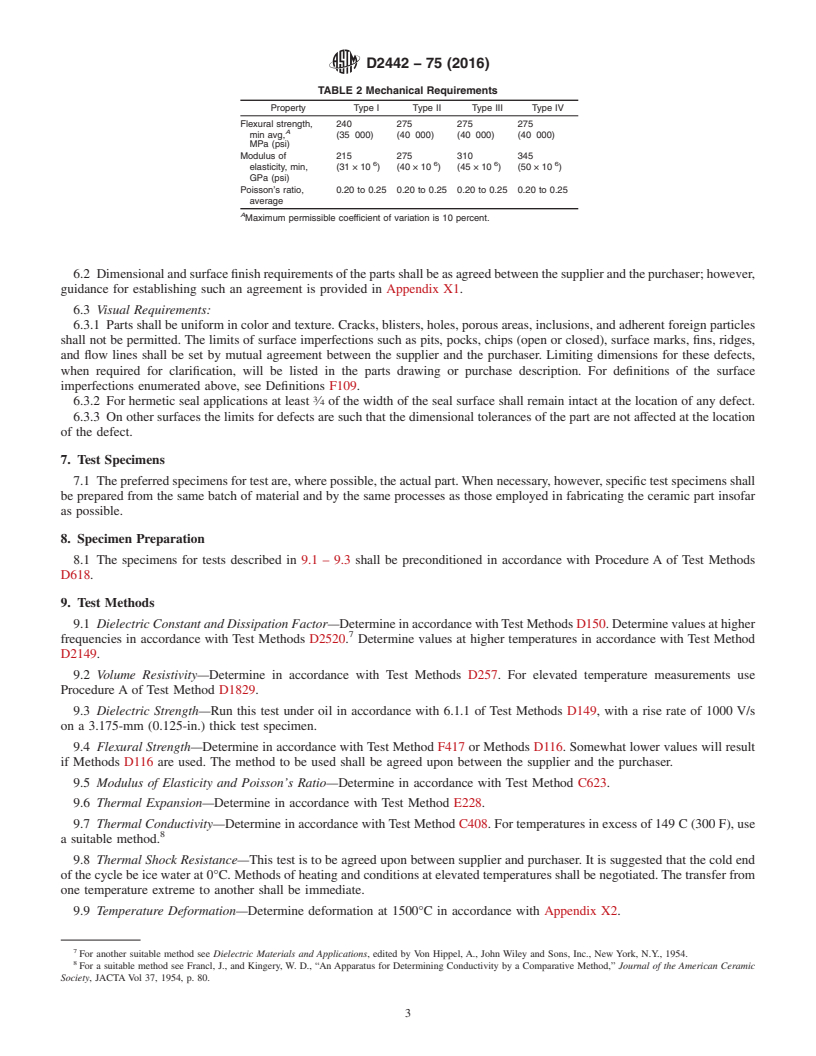
TABLE 2 Mechanical Requirements
Property Type I Type II Type III Type IV
Flexural strength, 240 275 275 275
A
min avg, (35 000) (40 000) (40 000) (40 000)
MPa (psi)
Modulus of 215 275 310 345
6 6 6 6
elasticity, min, (31 × 10 ) (40 × 10 ) (45 × 10 ) (50 × 10 )
GPa (psi)
Poisson’s ratio, 0.20 to 0.25 0.20 to 0.25 0.20 to 0.25 0.20 to 0.25
average
A
Maximum permissible coefficient of variation is 10 percent.
6.2 Dimensional and surface finish requirements of the parts shall be as agreed between the supplier and the purchaser; however,
guidance for establishing such an agreement is provided in Appendix X1.
6.3 Visual Requirements:
6.3.1 Parts shall be uniform in color and texture. Cracks, blisters, holes, porous areas, inclusions, and adherent foreign particles
shall not be permitted. The limits of surface imperfections such as pits, pocks, chips (open or closed), surface marks, fins, ridges,
and flow lines shall be set by mutual agreement between the supplier and the purchaser. Limiting dimensions for these defects,
when required for clarification, will be listed in the parts drawing or purchase description. For definitions of the surface
imperfections enumerated above, see Definitions F109.
6.3.2 For hermetic seal applications at least ⁄4 of the width of the seal surface shall remain intact at the location of any defect.
6.3.3 On other surfaces the limits for defects are such that the dimensional tolerances of the part are not affected at the location
of the defect.
7. Test Specimens
7.1 The preferred specimens for test are, where possible, the actual part. When necessary, however, specific test specimens shall
be prepared from the same batch of material and by the same processes as those employed in fabricating the ceramic part insofar
as possible.
8. Specimen Preparation
8.1 The specimens for tests described in 9.1 – 9.3 shall be preconditioned in accordance with Procedure A of Test Methods
D618.
9. Test Methods
9.1 Dielectric Constant and Dissipation Factor—Determine in accordance with Test Methods D150. Determine values at higher
frequencies in accordance with Test Methods D2520. Determine values at higher temperatures in accordance with Test Method
D2149.
9.2 Volume Resistivity—Determine in accordance with Test Methods D257. For elevated temperature measurements use
Procedure A of Test Method D1829.
9.3 Dielectric Strength—Run this test under oil in accordance with 6.1.1 of Test Methods D149, with a rise rate of 1000 V/s
on a 3.175-mm (0.125-in.) thick test specimen.
9.4 Flexural Strength—Determine in accordance with Test Method F417 or Methods D116. Somewhat lower values will result
if Methods D116 are used. The method to be used shall be agreed upon between the supplier and the purchaser.
9.5 Modulus of Elasticity and Poisson’s Ratio—Determine in accordance with Test Method C623.
9.6 Thermal Expansion—Determine in accordance with Test Method E228.
9.7 Thermal Conductivity—Determine in accordance with Test Method C408. For temperatures in excess of 149 C (300 F), use
a suitable method.
9.8 Thermal Shock Resistance—This test is to be agreed upon between supplier and purchaser. It is suggested that the cold end
of the cycle be ice water at 0°C. Methods of heating and conditions at elevated temperatures shall be negotiated. The transfer from
one temperature extreme to another shall be immediate.
9.9 Temperature Deformation—Determine deformation at 1500°C in accordance with Appendix X2.
For another suitable method see Dielectric Materials and Applications, edited by Von Hippel, A., John Wiley and Sons, Inc., New York, N.Y., 1954.
For a suitable method see Francl, J., and Kingery, W. D., “An Apparatus for Determining Conductivity by a Comparative Method,” Journal of the American Ceramic
Society, JACTA Vol 37, 1954, p. 80.
D2442 − 75 (2016)
TABLE 3 Thermal Requirements
Type I Type II Type III Type IV
Property
min max min max min max min max
Mean coefficient of linear thermal
expansion,μ m/m·°C:
25–200°C 5.4 6.2 5.2 6.7 5.2 6.5 5.5 6.7
25–500°C 6.5 7.0 6.6 7.4 6.7 7.5 6.8 7.6
25–800°C 7.0 7.7 7.3 8.1 7.4 8.1 7.3 8.1
25–1000°C 7.4 8.2 7.5 8.3 7.6 8.3 7.5 8.4
Thermal conductivity, cal/s·cm·°C:
at 100°C 0.023 0.049 0.031 0.077 0.048 0.073 0.052 0.090
at 400°C 0.015 0.022 0.014 0.036 0.022 0.033 0.023 0.047
at 800°C 0.009 0.018 0.009 0.021 0.014 0.021 0.014 0.025
Thermal shock resistance pass pass pass pass
Maximal deformation at 1500°C . . 0.51 mm 0.51 mm
(0.02 in.) (0.02 in.)
A
TABLE 4 General Requirements
Type
Property
I II III IV
B
Density, apparent min 3.37 3.57 3.72 3.78
g/cm
Composition, min 82 93 97 99
weight percent
Gas Impermeability gas tight
Liquid Impermeability pass
A C
Metallizability
A
Vendors shall, upon request, provide information on these properties as well as
a visual standard of a typical microstructure of their specific ceramic body depicting
its grain size and pore volume. Changes in microstructure of the ceramic are not
acceptable as they can affect the behavior of the ceramic toward a metallizing
process.
B
The apparent density of a ceramic body is a function of the amount and the
density of the primary Al O phase and the secondary phase plus the amount of
2 3
pores inherent to that body. The acceptable density limits for a specific alumina
body must be consistent with the composition and the pore volume of the ceramic
supplied by supplier and shall be agreed upon between the purchaser and the
supplier. Variation in the apparent density of a specific ceramic body shall be within
±1 percent of the nominal value.
C
Generally, very high alumina content results in increased difficulty of metallizing;
however, variations in metallizing compositions and techniques can produce
excellent seals in all four types of alumina ceramics. Because of a wide variation
in materials and techniques, no specific test is recommended. A referee test for
seal strength is Method F19.
9.10 Apparent Density—Determine in accordance with Test Method F77. For large ceramic parts not covered by this method,
determine in accordance with Test Methods C20.
9.11 Compositional Analysis—Use either quantitative emission spectrographic analysis of the fired ceramic with alumina
content determined by difference or Methods C573 after assuming that all determined metallic and reactive elements originally are
present as their highest form of oxide.
9.12 Gas Impermeability—When air fired at 900°C for 30 min and handled with tweezers only, then tested on a helium mass
−9 3
spectrometer leak detector capable of detecting a leak of 10 atm·cm /s, the ceramic is considered impermeable if a specimen
2 2
0.254 mm (0.010 in.) thick shows no indication of helium leakage when an area of 322.6 mm (0.5 in. ) is tested for 15 s at room
temperature (Method 1014, Seal, of MIL-STD-883 and Test Methods F134).
9.13 Liquid Impermeability—Determine in accordance with Methods D116.
9.14 Surface Imperfections—Examine visually for surface imperfections with or without the aid of a dye penetrant as in Practice
E165. Agreement by purchaser and supplier regarding specific techniques is strongly recommended.
9.15 Surface Finish—If surface finish is specified, it shall be determined by any appropriate method agreed upon by purchaser
and supplier.
D2442 − 75 (2016)
10. Inspection
10.1 When agreed upon between the manufacturer and the purchaser, the purchaser may inspect the ceramic parts and verify
the test results at the manufacturer’s facility. Otherwise the purchaser shall inspect and test the ceramic parts within one month
of the date of receipt by the pu
...
Questions, Comments and Discussion
Ask us and Technical Secretary will try to provide an answer. You can facilitate discussion about the standard in here.