

ASTM D6737-12(2017)
(Test Method)Standard Test Method for Bulk Density of Tapered Paintbrush Filaments
General Information
- Abstract
SIGNIFICANCE AND USE
3.1 Filaments are available in a variety of cross-sections and materials. A measure of bulk density permits the brushmaker to estimate the weight of filament required to prepare a given number of brushes.
SCOPE
1.1 This test method covers a procedure for measuring the weight of filaments per unit volume.
1.2 This method is applicable only to monofilament with tapered longitudinal profiles.
1.3 The values given in SI units are to be regarded as the standard. The values given in parentheses are for information only.
1.4 This standard does not purport to address all of the safety concerns, if any, associated with its use. It is the responsibility of the user of this standard to establish appropriate safety and health practices and determine the applicability of regulatory limitations prior to use.
1.5 This international standard was developed in accordance with internationally recognized principles on standardization established in the Decision on Principles for the Development of International Standards, Guides and Recommendations issued by the World Trade Organization Technical Barriers to Trade (TBT) Committee.
- Status
- Published
- Publication Date
- 31-May-2017
- Technical Committee
- D01 - Paint and Related Coatings, Materials, and Applications
- Drafting Committee
- D01.61 - Paint Application Tools


Overview
ASTM D6737-12(2017): Standard Test Method for Bulk Density of Tapered Paintbrush Filaments defines a standardized procedure for measuring the weight of monofilament paintbrush filaments per unit volume. This test method ensures brush manufacturers and material suppliers can consistently determine the bulk density of tapered filaments-crucial information for estimating the weight of filament required for brush production. Only monofilament filaments with tapered longitudinal profiles are covered by this method, with results reported in SI units in line with international measurement standards.
Key Topics
- Bulk Density Measurement: Establishes how to calculate the mass-per-unit volume of tapered monofilament filaments, aiding in material requirement estimations.
- Applicability: Designed for various filament cross-sections and materials specifically with tapered longitudinal profiles relevant to the paintbrush manufacturing industry.
- Standardized Procedure: Details the apparatus and equipment calibration, including miniature air cylinders, stainless steel machined parts, accurate weighing devices, and linear scales.
- Sampling and Testing:
- Select filament bundles within specified diameter ranges.
- Nest filaments for accurate measurement using a designated apparatus.
- Measure bundle length and diameters at both ends, and calculate average values.
- Calculations: Based on the measurements, the volume is calculated using formulas for a frustum of a cone. The bulk density is then computed as weight divided by volume, resulting in values expressed in g/cm³ or g/in³.
- Safety and Compliance: Users must establish appropriate safety procedures and consider relevant regulatory requirements for their specific context.
Applications
This ASTM test method delivers practical benefits in the following areas:
- Brush Manufacturing: Enables brushmakers to determine the precise mass of filament material needed to assemble a set number of paintbrushes, optimizing cost estimation and resource planning.
- Quality Control: Ensures consistency in filament supply by providing a repeatable method for measuring bulk density across different filament types and batches.
- Material Specification: Assists suppliers and manufacturers in specifying filament products accurately according to density, supporting efficient procurement and communications.
- Research and Development: Offers a reliable approach for evaluating and comparing the bulk density of new filament materials and designs, promoting innovation in paintbrush technology.
- International Trade Compliance: Developed following World Trade Organization principles, this standard supports interoperability and conformity in global material exchanges.
Related Standards
Brushmakers, coating manufacturers, and material suppliers may also find value in referencing these related standards:
- ASTM D5335 - Test Method for Determination of Bulk Density of Fibrous Materials
- ASTM D5793 - Standard Test Method for Binding Strength of Brush Filaments
- ASTM D6687 - Standard Test Method for Measurement of Paintbrush Bristle Stiffness
- ISO 862 - Vocabulary of paintbrushes and art brushes
Summary
ASTM D6737-12(2017) offers a robust and internationally recognized methodology for measuring the bulk density of tapered paintbrush filaments. Applying this standard facilitates precise formulation, quality assurance, and communication throughout the paintbrush and filament supply chain, supporting efficient, high-quality manufacturing operations. For modern brush production and supply specification, adopting ASTM D6737 is a best practice in ensuring consistency, compliance, and performance.
Relations
- Effective Date
- 01-Jun-2017
Frequently Asked Questions
ASTM D6737-12(2017) is a standard published by ASTM International. Its full title is "Standard Test Method for Bulk Density of Tapered Paintbrush Filaments". This standard covers: SIGNIFICANCE AND USE 3.1 Filaments are available in a variety of cross-sections and materials. A measure of bulk density permits the brushmaker to estimate the weight of filament required to prepare a given number of brushes. SCOPE 1.1 This test method covers a procedure for measuring the weight of filaments per unit volume. 1.2 This method is applicable only to monofilament with tapered longitudinal profiles. 1.3 The values given in SI units are to be regarded as the standard. The values given in parentheses are for information only. 1.4 This standard does not purport to address all of the safety concerns, if any, associated with its use. It is the responsibility of the user of this standard to establish appropriate safety and health practices and determine the applicability of regulatory limitations prior to use. 1.5 This international standard was developed in accordance with internationally recognized principles on standardization established in the Decision on Principles for the Development of International Standards, Guides and Recommendations issued by the World Trade Organization Technical Barriers to Trade (TBT) Committee.
SIGNIFICANCE AND USE 3.1 Filaments are available in a variety of cross-sections and materials. A measure of bulk density permits the brushmaker to estimate the weight of filament required to prepare a given number of brushes. SCOPE 1.1 This test method covers a procedure for measuring the weight of filaments per unit volume. 1.2 This method is applicable only to monofilament with tapered longitudinal profiles. 1.3 The values given in SI units are to be regarded as the standard. The values given in parentheses are for information only. 1.4 This standard does not purport to address all of the safety concerns, if any, associated with its use. It is the responsibility of the user of this standard to establish appropriate safety and health practices and determine the applicability of regulatory limitations prior to use. 1.5 This international standard was developed in accordance with internationally recognized principles on standardization established in the Decision on Principles for the Development of International Standards, Guides and Recommendations issued by the World Trade Organization Technical Barriers to Trade (TBT) Committee.
ASTM D6737-12(2017) is classified under the following ICS (International Classification for Standards) categories: 87.100 - Paint coating equipment. The ICS classification helps identify the subject area and facilitates finding related standards.
ASTM D6737-12(2017) has the following relationships with other standards: It is inter standard links to ASTM D6737-12. Understanding these relationships helps ensure you are using the most current and applicable version of the standard.
ASTM D6737-12(2017) is available in PDF format for immediate download after purchase. The document can be added to your cart and obtained through the secure checkout process. Digital delivery ensures instant access to the complete standard document.
Standards Content (Sample)
This international standard was developed in accordance with internationally recognized principles on standardization established in the Decision on Principles for the
Development of International Standards, Guides and Recommendations issued by the World Trade Organization Technical Barriers to Trade (TBT) Committee.
Designation: D6737 − 12 (Reapproved 2017)
Standard Test Method for
Bulk Density of Tapered Paintbrush Filaments
This standard is issued under the fixed designation D6737; the number immediately following the designation indicates the year of
original adoption or, in the case of revision, the year of last revision. A number in parentheses indicates the year of last reapproval. A
superscript epsilon (´) indicates an editorial change since the last revision or reapproval.
1. Scope 4.1.2 Miniature Air Cylinder, dual acting, heavy duty.
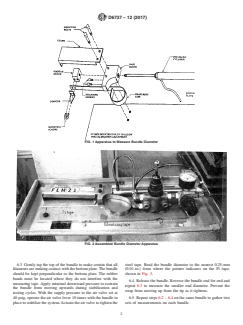
4.1.3 AssortedpartsshowninFig.1aremachinedfrom304
1.1 This test method covers a procedure for measuring the
stainlesssteelandassembledasshownalongwiththeairvalve
weight of filaments per unit volume.
and cylinder just described.The Pi tape must be fixed in place
1.2 This method is applicable only to monofilament with
so that it reads accurately the diameter of a metal calibration
tapered longitudinal profiles.
standard that is 50.8-mm (2.00-in.) diameter. The Pi tape is
1.3 The values given in SI units are to be regarded as the mounted on an adjustable plate for calibration.
standard. The values given in parentheses are for information
4.2 Weighing Device, accurate to 0.1 g to weigh the bundle.
only.
4.3 Graduated, Linear Scale, accurate to 0.5-mm (0.02-in.)
1.4 This standard does not purport to address all of the
to measure the bundle length.
safety concerns, if any, associated with its use. It is the
4.4 Air Supply, with pressure regulator set for 40 psig.
responsibility of the user of this standard to establish appro-
priate safety and health practices and determine the applica-
4.5 Calibration Standard, 50.8-mm (2.00-in.) in diameter.
bility of regulatory limitations prior to use.
5. Sampling, Test Specimens and Test Units
1.5 This international standard was developed in accor-
dance with internationally recognized principles on standard-
5.1 The test result depends on the cross-sectional shape, the
ization established in the Decision on Principles for the
polymer, and the length of the bundle selected for the test. To
Development of International Standards, Guides and Recom-
a lesser extent, it also depends on the filament diameter, since
mendations issued by the World Trade Organization Technical
thin filaments pack more efficiently than large ones.
Barriers to Trade (TBT) Committee.
5.2 The device, as pictured in Fig. 1, is designed to measure
diameters ranging from 30.5 to 52.3 mm (1.20 to 2.06 in.).
2. Summary of Test Method
Make sure that both ends to be measured are within this range.
2.1 The weight, length and diameter of a bundle of tapered
5.3 Calculations are based on conical bundle shape.
filaments are measured, and the bundle density is calculated.
6. Procedure
3. Significance and Use
6.1 Select a sample bundle of approximately 50-mm (2.0-
3.1 Filamentsareavailableinavarietyofcross-sectionsand
in.) diameter. Filament may be removed from a sample so the
materials.Ameasureofbulkdensitypermitsthebrushmakerto
bundle diameter falls within the scale range 30.5 to 52.3-mm
estimate the weight of filament required to prepare a given
(1.20 to 2.06-in.). One convenient method to adjust the sample
number of brushes.
diameter to the desired range is to fill a 50-mm (2.0-in.) inside
diameter tube. If the sample is too small, like samples may be
4. Apparatus
combined to adjust the bundle diameter to the desired range.
4.1 The apparatus requires some machining, and is as-
6.2 With rubber bands holding the bundle together, roll it
sembled as shown in Fig. 1 from the following equipment:
between the palms of the hands four times to allow the
4.1.1 Air Valve.
filaments to nest. Place the larger end of the bundle inside the
loop of measuring tape in the device shown in Fig. 2.
This test method is under the jurisdiction of ASTM Committee D01 on Paint
3 3
and Related Coatings, Materials, andApplications and is the direct responsibility of MiniatureaircylindersuchasModel047DXP, ⁄4in.(19.0mm)bore7in.(178
Subcommittee D01.61 on Paint Application Tools. mm)stroke,dualacting,heavydutyavailablefromBimbaManufacturingCompany,
Current edition approved June 1, 2017. Published June 2017. Originally Monee, IL 60449-0068, or equivalent, has been found suitable for this purpose.
4 1
approved in 2001. Last previous edition approved in 2012 as D6737–12. DOI: Pi tape ⁄4in.(6mm)×6ft (1.8 m) with 0.01 in. graduations. Lufkin model
10.1520/D6737-12R17. W606P, or equivalent, has been found suitable for this purpose.
Air valve such as Model 6676 available from Hunt Valve Co., 1913
...