


ASTM C1466-00(2016)
(Test Method)Standard Test Method for Graphite Furnace Atomic Absorption Spectrometric Determination of Lead and Cadmium Extracted from Ceramic Foodware
Standard Test Method for Graphite Furnace Atomic Absorption Spectrometric Determination of Lead and Cadmium Extracted from Ceramic Foodware
SIGNIFICANCE AND USE
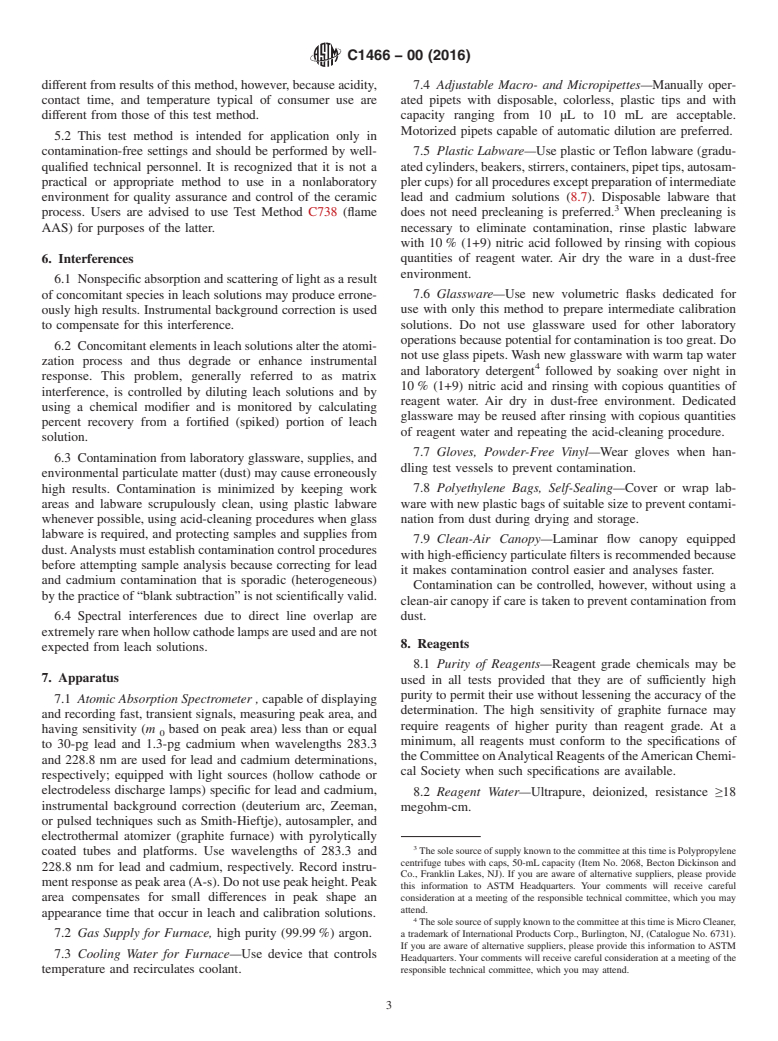
5.1 Toxic effects of lead and cadmium are well known and release of these elements from foodware is regulated by many countries. Regulatory decisions are based on results of 24-h leaching with acetic acid because results of this test method are precise and accurate and this test method is easy to use. Concentrations of lead and cadmium extracted by food may be different from results of this method, however, because acidity, contact time, and temperature typical of consumer use are different from those of this test method.
5.2 This test method is intended for application only in contamination-free settings and should be performed by well-qualified technical personnel. It is recognized that it is not a practical or appropriate method to use in a nonlaboratory environment for quality assurance and control of the ceramic process. Users are advised to use Test Method C738 (flame AAS) for purposes of the latter.
SCOPE
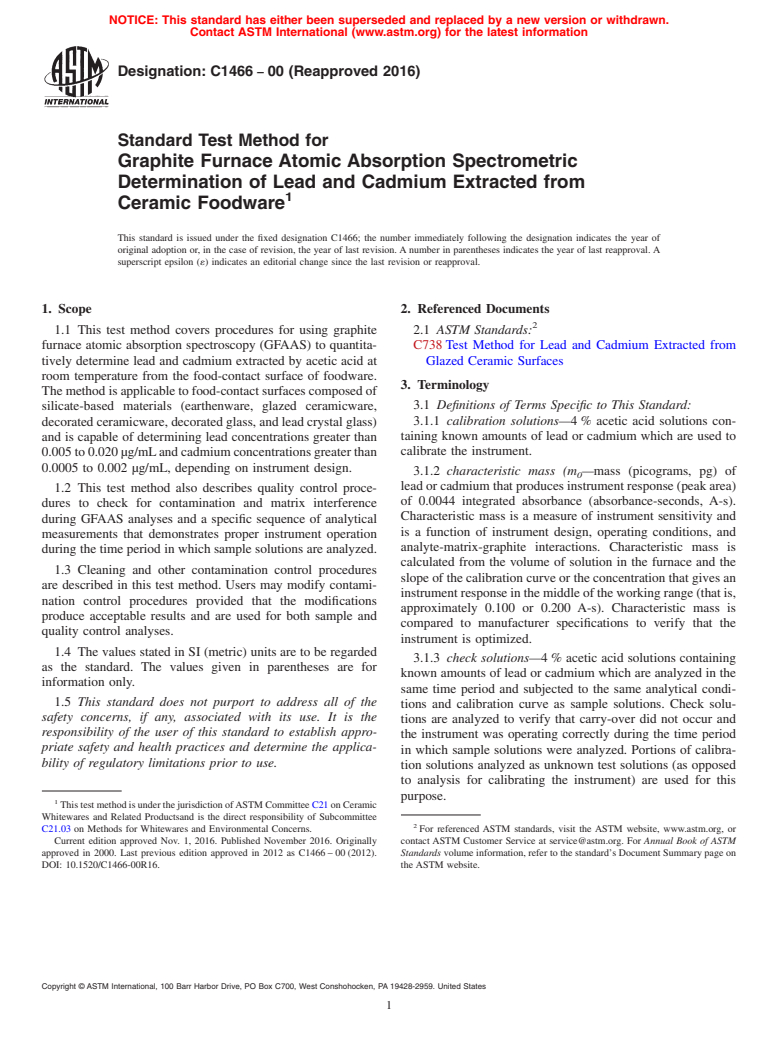
1.1 This test method covers procedures for using graphite furnace atomic absorption spectroscopy (GFAAS) to quantitatively determine lead and cadmium extracted by acetic acid at room temperature from the food-contact surface of foodware. The method is applicable to food-contact surfaces composed of silicate-based materials (earthenware, glazed ceramicware, decorated ceramicware, decorated glass, and lead crystal glass) and is capable of determining lead concentrations greater than 0.005 to 0.020 μg/mL and cadmium concentrations greater than 0.0005 to 0.002 μg/mL, depending on instrument design.
1.2 This test method also describes quality control procedures to check for contamination and matrix interference during GFAAS analyses and a specific sequence of analytical measurements that demonstrates proper instrument operation during the time period in which sample solutions are analyzed.
1.3 Cleaning and other contamination control procedures are described in this test method. Users may modify contamination control procedures provided that the modifications produce acceptable results and are used for both sample and quality control analyses.
1.4 The values stated in SI (metric) units are to be regarded as the standard. The values given in parentheses are for information only.
1.5 This standard does not purport to address all of the safety concerns, if any, associated with its use. It is the responsibility of the user of this standard to establish appropriate safety and health practices and determine the applicability of regulatory limitations prior to use.
General Information
Buy Standard
Standards Content (Sample)
NOTICE: This standard has either been superseded and replaced by a new version or withdrawn.
Contact ASTM International (www.astm.org) for the latest information
Designation: C1466 − 00 (Reapproved 2016)
Standard Test Method for
Graphite Furnace Atomic Absorption Spectrometric
Determination of Lead and Cadmium Extracted from
Ceramic Foodware
This standard is issued under the fixed designation C1466; the number immediately following the designation indicates the year of
original adoption or, in the case of revision, the year of last revision.Anumber in parentheses indicates the year of last reapproval.A
superscript epsilon (´) indicates an editorial change since the last revision or reapproval.
1. Scope 2. Referenced Documents
1.1 This test method covers procedures for using graphite 2.1 ASTM Standards:
furnace atomic absorption spectroscopy (GFAAS) to quantita- C738Test Method for Lead and Cadmium Extracted from
tively determine lead and cadmium extracted by acetic acid at Glazed Ceramic Surfaces
room temperature from the food-contact surface of foodware.
3. Terminology
Themethodisapplicabletofood-contactsurfacescomposedof
3.1 Definitions of Terms Specific to This Standard:
silicate-based materials (earthenware, glazed ceramicware,
3.1.1 calibration solutions—4% acetic acid solutions con-
decoratedceramicware,decoratedglass,andleadcrystalglass)
taining known amounts of lead or cadmium which are used to
and is capable of determining lead concentrations greater than
calibrate the instrument.
0.005to0.020µg/mLandcadmiumconcentrationsgreaterthan
0.0005 to 0.002 µg/mL, depending on instrument design.
3.1.2 characteristic mass (m —mass (picograms, pg) of
leadorcadmiumthatproducesinstrumentresponse(peakarea)
1.2 This test method also describes quality control proce-
of 0.0044 integrated absorbance (absorbance-seconds, A-s).
dures to check for contamination and matrix interference
Characteristic mass is a measure of instrument sensitivity and
during GFAAS analyses and a specific sequence of analytical
is a function of instrument design, operating conditions, and
measurements that demonstrates proper instrument operation
analyte-matrix-graphite interactions. Characteristic mass is
during the time period in which sample solutions are analyzed.
calculated from the volume of solution in the furnace and the
1.3 Cleaning and other contamination control procedures
slopeofthecalibrationcurveortheconcentrationthatgivesan
are described in this test method. Users may modify contami-
instrumentresponseinthemiddleoftheworkingrange(thatis,
nation control procedures provided that the modifications
approximately 0.100 or 0.200 A-s). Characteristic mass is
produce acceptable results and are used for both sample and
compared to manufacturer specifications to verify that the
quality control analyses.
instrument is optimized.
1.4 The values stated in SI (metric) units are to be regarded
3.1.3 check solutions—4% acetic acid solutions containing
as the standard. The values given in parentheses are for
known amounts of lead or cadmium which are analyzed in the
information only.
same time period and subjected to the same analytical condi-
1.5 This standard does not purport to address all of the
tions and calibration curve as sample solutions. Check solu-
safety concerns, if any, associated with its use. It is the
tions are analyzed to verify that carry-over did not occur and
responsibility of the user of this standard to establish appro-
the instrument was operating correctly during the time period
priate safety and health practices and determine the applica-
in which sample solutions were analyzed. Portions of calibra-
bility of regulatory limitations prior to use.
tion solutions analyzed as unknown test solutions (as opposed
to analysis for calibrating the instrument) are used for this
purpose.
ThistestmethodisunderthejurisdictionofASTMCommitteeC21onCeramic
Whitewares and Related Productsand is the direct responsibility of Subcommittee
C21.03 on Methods for Whitewares and Environmental Concerns. For referenced ASTM standards, visit the ASTM website, www.astm.org, or
Current edition approved Nov. 1, 2016. Published November 2016. Originally contact ASTM Customer Service at service@astm.org. For Annual Book of ASTM
approved in 2000. Last previous edition approved in 2012 as C1466–00(2012). Standards volume information, refer to the standard’s Document Summary page on
DOI: 10.1520/C1466-00R16. the ASTM website.
Copyright © ASTM International, 100 Barr Harbor Drive, PO Box C700, West Conshohocken, PA 19428-2959. United States
C1466 − 00 (2016)
3.1.4 dilutionfactor(DF)—factorbywhichconcentrationin 3.1.11 sample concentration limit (SCL)—a low concentra-
test solution is multiplied to obtain concentration in original tion (µg/mL) that can be reliably measured in leach solutions.
leach solution. For test solutions prepared by mixing pipet- In this test method, the sample concentration limit is the
measured portions of leach solution and diluent, DF=(V + concentrationofleadorcadmiumthatproduces0.050A-s.The
V )/V where V and V are volumes of leach solution and value 0.050 A-s is chosen to establish the limit of this test
2 1 1 2
diluentintestsolution,respectively.Fortestsolutionsprepared method for two reasons; 0.050A-s is ten times greater than the
by mixing weighed portions of leach solution (gravimetric maximum response (0.005 A-s) typically expected from
dilution). DF = W /W where: W is the weight of leach periodic, repeated analysis of a contamination-free, 0 ng/mL
T 1 1
solution in test solution and W is the total weight of leach solution and thus guarantees that concentrations in sample
T
solution and diluent in the test solution. solutions are significantly (ten times) greater than those in a
true blank; and percent relative standard deviation of instru-
3.1.5 fortified leach solution—a portion of leach solution to
ment response (relative variability as a result of instrument
which a known amount of lead or cadmium is added. A
precision) is better for 0.050 A-s than for lower values. The
fortified leach solution is analyzed to calculate percent recov-
sample concentration limit depends on the characteristic mass
ery and monitor matrix interference. Stock, intermediate, and
of the instrument and volume of solution deposited in the
calibration solutions are used to fortify leach solutions.
furnace; the numerical value of the limit increases as charac-
3.1.6 gravimetric dilution—practice of quantitatively pre-
teristic mass increases and as the volume of solution deposited
paring dilute solutions from more concentrated ones by com-
in the furnace decreases.
bining known weights of diluent and solution of known
3.1.12 sample mass limit (SML)—a low mass (µg) of
concentration. Gravimetric dilution using contamination-free,
extractable lead or cadmium that can be reliably measured by
disposable plasticware is recommended whenever possible
this method. The sample limit is the product of the concentra-
because glass volumetric flasks require time-consuming, acid-
tion limit times the volume of leach solutions.
cleaning procedures to eliminate contamination. Gravimetric
3.1.13 subsample—each of the six individual vessels which
dilution may be used when densities and major components of
make up the sample.
thediluentandconcentratedsolutionarethesame(thatis,both
solutions contain 4% acetic acid). Volumetric flasks must be
3.1.14 test solution—solution deposited in the graphite fur-
used when the densities are different (that is, as when diluent
nace for analysis. Test solutions are prepared by diluting leach
contains 4% acetic acid and stock standards contain 2% nitric
solutions with known amounts of 4% acetic acid. Test solu-
acid). Gravimetric dilution is accomplished as follows: weigh
tions also include portions of undiluted leach, check, and
necessary amount (≥1.0000 g) of solution with known concen-
independent check solutions deposited in the furnace.
trationtonearest0.0001ginatared,plasticcontainer.Add4%
3.1.15 working range—range of instrument response that
acetic acid so that weight of final solution provides required
may be described as a linear function of the mass of analyte.
concentration. Calculate concentration in final solution as:
Thelinearrangeofgraphitefurnacepeakareameasurementsis
C 5 C 3W /W (1)
approximately 0.050 to 0.3500-0.400 A-s. The range of linear
2 1 1 2
response depends on the element and operating conditions and
where:
must be verified by analyzing calibration solutions each time
C = concentration in diluted (final) solution, ng/mL;
theinstrumentisused.Thelinearrangeofinstrumentresponse
C = concentration in initial solution, ng/mL;
was chosen as the working range of this method because
W = weight of initial solution, g; and
responses in the linear range are well below those at which
W = weight of final solution, g.
roll-over adversely affects lead and cadmium instrument re-
3.1.7 independent check solution—4% acetic acid solution
sponses obtained using Zeeman background correction.
containing a known amount of lead or cadmium which is from
4. Summary of Test Method
a starting material that is different from the starting material
used to prepare calibration solutions. Starting materials with
4.1 Lead and cadmium are extracted from the food-contact
different lot numbers are acceptable, but starting materials
surface of test vessels by filling them with 4% acetic acid to
from different manufacturers are preferable. The independent
within6to7mm( ⁄4in.)ofoverflowingandleachingthemfor
check solution is analyzed to verify that calibration solutions
24 h at 20 to 24°C (68 to 75°F). Lead and cadmium are
have been prepared correctly. An independent check solution
determined by GFAAS using a chemical modifier and instru-
must be used to verify calibration until such time that a
mental background correction. Concentrations in leach solu-
reference material certified for lead and cadmium leaching
tions are calculated using a calibration curve and linear least
becomes available.
squares regression.
3.1.8 leach solution—solution obtained by leaching a test
5. Significance and Use
vessel or method blank with 4% acetic acid for 24 h.
5.1 Toxic effects of lead and cadmium are well known and
3.1.9 method blank—a contamination-free laboratory bea-
release of these elements from foodware is regulated by many
ker or dish that is analyzed by the entire method including
countries. Regulatory decisions are based on results of 24-h
preparation, leaching, and solution analysis.
leachingwithaceticacidbecauseresultsofthistestmethodare
3.1.10 sample—six test vessels of identical size, shape, precise and accurate and this test method is easy to use.
color, and decorative pattern. Concentrationsofleadandcadmiumextractedbyfoodmaybe
C1466 − 00 (2016)
differentfromresultsofthismethod,however,becauseacidity, 7.4 Adjustable Macro- and Micropipettes—Manually oper-
contact time, and temperature typical of consumer use are ated pipets with disposable, colorless, plastic tips and with
different from those of this test method. capacity ranging from 10 µL to 10 mL are acceptable.
Motorized pipets capable of automatic dilution are preferred.
5.2 This test method is intended for application only in
contamination-free settings and should be performed by well- 7.5 Plastic Labware—Use plastic or Teflon labware (gradu-
qualified technical personnel. It is recognized that it is not a atedcylinders,beakers,stirrers,containers,pipettips,autosam-
practical or appropriate method to use in a nonlaboratory plercups)forallproceduresexceptpreparationofintermediate
environment for quality assurance and control of the ceramic lead and cadmium solutions (8.7). Disposable labware that
process. Users are advised to use Test Method C738 (flame does not need precleaning is preferred. When precleaning is
AAS) for purposes of the latter. necessary to eliminate contamination, rinse plastic labware
with 10% (1+9) nitric acid followed by rinsing with copious
6. Interferences quantities of reagent water. Air dry the ware in a dust-free
environment.
6.1 Nonspecificabsorptionandscatteringoflightasaresult
7.6 Glassware—Use new volumetric flasks dedicated for
of concomitant species in leach solutions may produce errone-
ously high results. Instrumental background correction is used use with only this method to prepare intermediate calibration
solutions. Do not use glassware used for other laboratory
to compensate for this interference.
operations because potential for contamination is too great. Do
6.2 Concomitantelementsinleachsolutionsaltertheatomi-
not use glass pipets.Wash new glassware with warm tap water
zation process and thus degrade or enhance instrumental
and laboratory detergent followed by soaking over night in
response. This problem, generally referred to as matrix
10% (1+9) nitric acid and rinsing with copious quantities of
interference, is controlled by diluting leach solutions and by
reagent water. Air dry in dust-free environment. Dedicated
using a chemical modifier and is monitored by calculating
glassware may be reused after rinsing with copious quantities
percent recovery from a fortified (spiked) portion of leach
of reagent water and repeating the acid-cleaning procedure.
solution.
7.7 Gloves, Powder-Free Vinyl—Wear gloves when han-
6.3 Contamination from laboratory glassware, supplies, and
dling test vessels to prevent contamination.
environmental particulate matter (dust) may cause erroneously
high results. Contamination is minimized by keeping work 7.8 Polyethylene Bags, Self-Sealing—Cover or wrap lab-
areas and labware scrupulously clean, using plastic labware warewithnewplasticbagsofsuitablesizetopreventcontami-
whenever possible, using acid-cleaning procedures when glass nation from dust during drying and storage.
labware is required, and protecting samples and supplies from
7.9 Clean-Air Canopy—Laminar flow canopy equipped
dust.Analystsmustestablishcontaminationcontrolprocedures
withhigh-efficiencyparticulatefiltersisrecommendedbecause
before attempting sample analysis because correcting for lead
it makes contamination control easier and analyses faster.
and cadmium contamination that is sporadic (heterogeneous)
Contamination can be controlled, however, without using a
bythepracticeof“blanksubtraction”isnotscientificallyvalid.
clean-aircanopyifcareistakentopreventcontaminationfrom
6.4 Spectral interferences due to direct line overlap are dust.
extremelyrarewhenhollowcathodelampsareusedandarenot
8. Reagents
expected from leach solutions.
8.1 Purity of Reagents—Reagent grade chemicals may be
7. Apparatus
used in all tests provided that they are of sufficiently high
purity to permit their use without lessening the accuracy of the
7.1 Atomic Absorption Spectrometer , capable of displaying
determination. The high sensitivity of graphite furnace may
and record
...
This document is not an ASTM standard and is intended only to provide the user of an ASTM standard an indication of what changes have been made to the previous version. Because
it may not be technically possible to adequately depict all changes accurately, ASTM recommends that users consult prior editions as appropriate. In all cases only the current version
of the standard as published by ASTM is to be considered the official document.
Designation: C1466 − 00 (Reapproved 2012) C1466 − 00 (Reapproved 2016)
Standard Test Method for
Graphite Furnace Atomic Absorption Spectrometric
Determination of Lead and Cadmium Extracted from
Ceramic Foodware
This standard is issued under the fixed designation C1466; the number immediately following the designation indicates the year of
original adoption or, in the case of revision, the year of last revision. A number in parentheses indicates the year of last reapproval. A
superscript epsilon (´) indicates an editorial change since the last revision or reapproval.
1. Scope
1.1 This test method covers procedures for using graphite furnace atomic absorption spectroscopy (GFAAS) to quantitatively
determine lead and cadmium extracted by acetic acid at room temperature from the food-contact surface of foodware. The method
is applicable to food-contact surfaces composed of silicate-based materials (earthenware, glazed ceramicware, decorated
ceramicware, decorated glass, and lead crystal glass) and is capable of determining lead concentrations greater than 0.005 to 0.020
μg/mL and cadmium concentrations greater than 0.0005 to 0.002 μg/mL, depending on instrument design.
1.2 This test method also describes quality control procedures to check for contamination and matrix interference during
GFAAS analyses and a specific sequence of analytical measurements that demonstrates proper instrument operation during the
time period in which sample solutions are analyzed.
1.3 Cleaning and other contamination control procedures are described in this test method. Users may modify contamination
control procedures provided that the modifications produce acceptable results and are used for both sample and quality control
analyses.
1.4 The values stated in SI (metric) units are to be regarded as the standard. The values given in parentheses are for information
only.
1.5 This standard does not purport to address all of the safety concerns, if any, associated with its use. It is the responsibility
of the user of this standard to establish appropriate safety and health practices and determine the applicability of regulatory
limitations prior to use.
2. Referenced Documents
2.1 ASTM Standards:
C738 Test Method for Lead and Cadmium Extracted from Glazed Ceramic Surfaces
3. Terminology
3.1 Definitions of Terms Specific to This Standard:
3.1.1 calibration solutions—4 % acetic acid solutions containing known amounts of lead or cadmium which are used to
calibrate the instrument.
3.1.2 characteristic mass (m —mass (picograms, pg) of lead or cadmium that produces instrument response (peak area) of
0.0044 integrated absorbance (absorbance-seconds, A-s). Characteristic mass is a measure of instrument sensitivity and is a
function of instrument design, operating conditions, and analyte-matrix-graphite interactions. Characteristic mass is calculated
from the volume of solution in the furnace and the slope of the calibration curve or the concentration that gives an instrument
response in the middle of the working range (that is, approximately 0.100 or 0.200 A-s). Characteristic mass is compared to
manufacturer specifications to verify that the instrument is optimized.
3.1.3 check solutions—4 % acetic acid solutions containing known amounts of lead or cadmium which are analyzed in the same
time period and subjected to the same analytical conditions and calibration curve as sample solutions. Check solutions are analyzed
This test method is under the jurisdiction of ASTM Committee C21 on Ceramic Whitewares and Related Productsand is the direct responsibility of Subcommittee C21.03
on Methods for Whitewares and Environmental Concerns.
Current edition approved April 1, 2012Nov. 1, 2016. Published April 2012November 2016. Originally approved in 2000. Last previous edition approved in 20072012 as
C1466–00(2007).C1466 – 00 (2012). DOI: 10.1520/C1466-00R12.10.1520/C1466-00R16.
For referenced ASTM standards, visit the ASTM website, www.astm.org, or contact ASTM Customer Service at service@astm.org. For Annual Book of ASTM Standards
volume information, refer to the standard’s Document Summary page on the ASTM website.
Copyright © ASTM International, 100 Barr Harbor Drive, PO Box C700, West Conshohocken, PA 19428-2959. United States
C1466 − 00 (2016)
to verify that carry-over did not occur and the instrument was operating correctly during the time period in which sample solutions
were analyzed. Portions of calibration solutions analyzed as unknown test solutions (as opposed to analysis for calibrating the
instrument) are used for this purpose.
3.1.4 dilution factor (DF)—factor by which concentration in test solution is multiplied to obtain concentration in original leach
solution. For test solutions prepared by mixing pipet-measured portions of leach solution and diluent, DF = (V + V )/V where
1 2 1
V and V are volumes of leach solution and diluent in test solution, respectively. For test solutions prepared by mixing weighed
1 2
portions of leach solution (gravimetric dilution). DF = W /W where: W is the weight of leach solution in test solution and W
T 1 1 T
is the total weight of leach solution and diluent in the test solution.
3.1.5 fortified leach solution—a portion of leach solution to which a known amount of lead or cadmium is added. A fortified
leach solution is analyzed to calculate percent recovery and monitor matrix interference. Stock, intermediate, and calibration
solutions are used to fortify leach solutions.
3.1.6 gravimetric dilution—practice of quantitatively preparing dilute solutions from more concentrated ones by combining
known weights of diluent and solution of known concentration. Gravimetric dilution using contamination-free, disposable
plasticware is recommended whenever possible because glass volumetric flasks require time-consuming, acid-cleaning procedures
to eliminate contamination. Gravimetric dilution may be used when densities and major components of the diluent and
concentrated solution are the same (that is, both solutions contain 4 % acetic acid). Volumetric flasks must be used when the
densities are different (that is, as when diluent contains 4 % acetic acid and stock standards contain 2 % nitric acid). Gravimetric
dilution is accomplished as follows: weigh necessary amount (≥1.0000 g) of solution with known concentration to nearest 0.0001
g in a tared, plastic container. Add 4 % acetic acid so that weight of final solution provides required concentration. Calculate
concentration in final solution as:
C 5 C 3W /W (1)
2 1 1 2
where:
C = concentration in diluted (final) solution, ng/mL;
C = concentration in initial solution, ng/mL;
W = weight of initial solution, g; and
W = weight of final solution, g.
3.1.7 independent check solution—4 % acetic acid solution containing a known amount of lead or cadmium which is from a
starting material that is different from the starting material used to prepare calibration solutions. Starting materials with different
lot numbers are acceptable, but starting materials from different manufacturers are preferable. The independent check solution is
analyzed to verify that calibration solutions have been prepared correctly. An independent check solution must be used to verify
calibration until such time that a reference material certified for lead and cadmium leaching becomes available.
3.1.8 leach solution—solution obtained by leaching a test vessel or method blank with 4 % acetic acid for 24 h.
3.1.9 method blank—a contamination-free laboratory beaker or dish that is analyzed by the entire method including preparation,
leaching, and solution analysis.
3.1.10 sample—six test vessels of identical size, shape, color, and decorative pattern.
3.1.11 sample concentration limit (SCL)—a low concentration (μg/mL) that can be reliably measured in leach solutions. In this
test method, the sample concentration limit is the concentration of lead or cadmium that produces 0.050 A-s. The value 0.050 A-s
is chosen to establish the limit of this test method for two reasons; 0.050 A-s is ten times greater than the maximum response (0.005
A-s) typically expected from periodic, repeated analysis of a contamination-free, 0 ng/mL solution and thus guarantees that
concentrations in sample solutions are significantly (ten times) greater than those in a true blank; and percent relative standard
deviation of instrument response (relative variability as a result of instrument precision) is better for 0.050 A-s than for lower
values. The sample concentration limit depends on the characteristic mass of the instrument and volume of solution deposited in
the furnace; the numerical value of the limit increases as characteristic mass increases and as the volume of solution deposited in
the furnace decreases.
3.1.12 sample mass limit (SML)—a low mass (μg) of extractable lead or cadmium that can be reliably measured by this method.
The sample limit is the product of the concentration limit times the volume of leach solutions.
3.1.13 subsample—each of the six individual vessels which make up the sample.
3.1.14 test solution—solution deposited in the graphite furnace for analysis. Test solutions are prepared by diluting leach
solutions with known amounts of 4 % acetic acid. Test solutions also include portions of undiluted leach, check, and independent
check solutions deposited in the furnace.
3.1.15 working range—range of instrument response that may be described as a linear function of the mass of analyte. The linear
range of graphite furnace peak area measurements is approximately 0.050 to 0.3500-0.400 A-s. The range of linear response
depends on the element and operating conditions and must be verified by analyzing calibration solutions each time the instrument
C1466 − 00 (2016)
is used. The linear range of instrument response was chosen as the working range of this method because responses in the linear
range are well below those at which roll-over adversely affects lead and cadmium instrument responses obtained using Zeeman
background correction.
4. Summary of Test Method
4.1 Lead and cadmium are extracted from the food-contact surface of test vessels by filling them with 4 % acetic acid to within
6 to 7 mm ( ⁄4 in.) of overflowing and leaching them for 24 h at 20 to 24°C (68 to 75°F). Lead and cadmium are determined by
GFAAS using a chemical modifier and instrumental background correction. Concentrations in leach solutions are calculated using
a calibration curve and linear least squares regression.
5. Significance and Use
5.1 Toxic effects of lead and cadmium are well known and release of these elements from foodware is regulated by many
countries. Regulatory decisions are based on results of 24-h leaching with acetic acid because results of this test method are precise
and accurate and this test method is easy to use. Concentrations of lead and cadmium extracted by food may be different from
results of this method, however, because acidity, contact time, and temperature typical of consumer use are different from those
of this test method.
5.2 This test method is intended for application only in contamination-free settings and should be performed by well-qualified
technical personnel. It is recognized that it is not a practical or appropriate method to use in a nonlaboratory environment for
quality assurance and control of the ceramic process. Users are advised to use Test Method C738 (flame AAS) for purposes of the
latter.
6. Interferences
6.1 Nonspecific absorption and scattering of light as a result of concomitant species in leach solutions may produce erroneously
high results. Instrumental background correction is used to compensate for this interference.
6.2 Concomitant elements in leach solutions alter the atomization process and thus degrade or enhance instrumental response.
This problem, generally referred to as matrix interference, is controlled by diluting leach solutions and by using a chemical
modifier and is monitored by calculating percent recovery from a fortified (spiked) portion of leach solution.
6.3 Contamination from laboratory glassware, supplies, and environmental particulate matter (dust) may cause erroneously high
results. Contamination is minimized by keeping work areas and labware scrupulously clean, using plastic labware whenever
possible, using acid-cleaning procedures when glass labware is required, and protecting samples and supplies from dust. Analysts
must establish contamination control procedures before attempting sample analysis because correcting for lead and cadmium
contamination that is sporadic (heterogeneous) by the practice of “blank subtraction” is not scientifically valid.
6.4 Spectral interferences due to direct line overlap are extremely rare when hollow cathode lamps are used and are not expected
from leach solutions.
7. Apparatus
7.1 Atomic Absorption Spectrometer , capable of displaying and recording fast, transient signals, measuring peak area, and
having sensitivity (m based on peak area) less than or equal to 30-pg lead and 1.3-pg cadmium when wavelengths 283.3 and 228.8
nm are used for lead and cadmium determinations, respectively; equipped with light sources (hollow cathode or electrodeless
discharge lamps) specific for lead and cadmium, instrumental background correction (deuterium arc, Zeeman, or pulsed techniques
such as Smith-Hieftje), autosampler, and electrothermal atomizer (graphite furnace) with pyrolytically coated tubes and platforms.
Use wavelengths of 283.3 and 228.8 nm for lead and cadmium, respectively. Record instrument response as peak area (A-s). Do
not use peak height. Peak area compensates for small differences in peak shape an appearance time that occur in leach and
calibration solutions.
7.2 Gas Supply for Furnace, high purity (99.99 %) argon.
7.3 Cooling Water for Furnace—Use device that controls temperature and recirculates coolant.
7.4 Adjustable Macro- and Micropipettes—Manually operated pipets with disposable, colorless, plastic tips and with capacity
ranging from 10 μL to 10 mL are acceptable. Motorized pipets capable of automatic dilution are preferred.
7.5 Plastic Labware—Use plastic or Teflon labware (graduated cylinders, beakers, stirrers, containers, pipet tips, autosampler
cups) for all procedures except preparation of intermediate lead and cadmium solutions (8.7). Disposable labware that does not
need precleaning is preferred. When precleaning is necessary to eliminate contamination, rinse pla
...
Questions, Comments and Discussion
Ask us and Technical Secretary will try to provide an answer. You can facilitate discussion about the standard in here.