

ASTM D7310-21
(Practice)Standard Practice for Defect Detection and Rating of Plastic Films Using Optical Sensors
General Information
- Abstract
SIGNIFICANCE AND USE
4.1 Defects in film are not acceptable to the end-user as there is a reduction in the fitness-for-use in many applications. This document is intended to be a practice to assist users in the inspection, quantification and observation of defects.
4.2 This practice is applicable in a laboratory environment, continuous inspection as a quality control or as a research tool. It is also appropriate for use in any commercial process used to produce film including extrusion, calendaring, etc.
4.3 This practice is also suitable for use as an evaluation or screening tool for materials intended to be used in other processes where defects of this nature are critical, such as fiber spinning non-woven, etc.
4.4 Results achieved by different equipment, even from the same vendor in the same laboratory, are often not directly comparable as a bias exists that cannot be fully addressed through consistent operating conditions. Results frequently shift when analyzer components are upgraded. Additionally, results are often not directly comparable between different product types. All results are to be considered as relative values rather than absolute.
4.4.1 Therefore, it is not recommended to provide absolute results as part of a sales contract between the buyer and seller. For sales contracts, it is recommended to establish product grade designations based on the historical relationship of the absolute results reported, and fitness-for-use or based on a reference material agreed by both parties. This is attained by the collection of data over a time-period to establish acceptable control limits.
4.4.2 The defect size range of interest is usually different between resin supplier and converters. Total defect counts are not one to one comparable between small laboratory extrusion lines and commercial extrusion lines. Therefore, an individual correlation is the aim to get accepted results for fitness-for-use.
Note 2: This was tested on Brabender, Collin, Goettfert, and OCS s...
SCOPE
1.1 This practice intends to provide standardized approaches and criteria for the observation and reporting of defects in various types of plastic film, by means of an optical scanning system. Scope includes the in situ inspection of defects in films fabricated for specific applications after preparation of a suitable film from plastic resin.
1.2 This standard does not purport to address all of the safety concerns, if any, associated with its use. It is the responsibility of the user of this standard to establish appropriate safety, health, and environmental practices and determine the applicability of regulatory limitations prior to use.
Note 1: There is no known ISO equivalent to this standard.
1.3 This international standard was developed in accordance with internationally recognized principles on standardization established in the Decision on Principles for the Development of International Standards, Guides and Recommendations issued by the World Trade Organization Technical Barriers to Trade (TBT) Committee.
- Status
- Published
- Publication Date
- 31-Aug-2021
- Technical Committee
- D20 - Plastics
- Drafting Committee
- D20.19 - Film, Sheeting, and Molded Products
Buy Documents
ASTM D7310-21 - Standard Practice for Defect Detection and Rating of Plastic Films Using Optical Sensors
REDLINE ASTM D7310-21 - Standard Practice for Defect Detection and Rating of Plastic Films Using Optical Sensors
Overview
ASTM D7310-21 - Standard Practice for Defect Detection and Rating of Plastic Films Using Optical Sensors provides a comprehensive framework for inspecting, quantifying, and reporting defects in plastic films using optical scanning systems. Developed by ASTM International, this standard ensures consistent and reliable evaluation of film quality, supporting quality control in both laboratory and commercial production environments. The practice is designed for in situ inspection of defects in films fabricated for specific applications, offering value in research, quality assurance, and process monitoring for plastic film manufacturing, extrusion, and other relevant processes.
Key Topics
- Defect Types: The standard classifies defects detectable by optical sensors in plastic films as gels, contamination (e.g., dirt, undispersed additives), and structural defects (e.g., air bubbles, pinholes, wrinkles).
- Detection Systems: Emphasizes the use of optical scanners equipped with appropriate light sources and cameras (transmission for clear films or reflection for opaque films) for accurate defect visualization and measurement.
- Measurement Accuracy: Guides users on system setup, calibration, and verification to ensure measurement consistency, including the definition of pixel size, resolution, and effective sensitivity settings.
- Reporting Requirements: Specifies detailed criteria for data recording, including defect counts, defect size classes, defect types, film dimensions, and processing settings.
- Data Interpretation: Results achieved using different equipment or laboratory setups are relative, not absolute, due to potential biases and variations in system configurations and upgrades.
- Fitness-for-Use: Recommends that film quality evaluation be based on historical data, control limits, and reference materials, rather than absolute defect numbers-especially in sales contracts.
Applications
The ASTM D7310-21 standard is essential for several key applications in the plastics industry:
- Laboratory Evaluation: Used as a research tool to assess the quality of plastic resins by producing films and analyzing them for defects.
- Process Quality Control: Integrates into continuous or batch inspection on both lab and production-scale extrusion lines, providing real-time defect monitoring to ensure consistent product quality.
- Product Screening: Serves as a screening method for materials destined for demanding downstream processes (e.g., fiber spinning, non-wovens) where defect levels are critical for performance.
- Manufacturer-Buyer Communication: Offers a best-practice approach for establishing product grade designations, supporting transparent communication and agreement on quality between suppliers and consumers.
- Calibration and Validation: Outlines systematic procedures for equipment calibration and periodic verification, enhancing confidence in reported defect measurements and supporting compliance with quality management systems.
Related Standards
For a comprehensive approach to plastic film quality and optical sensor performance, users should consider these related ASTM standards:
- ASTM D883: Terminology Relating to Plastics
- ASTM E456: Terminology Relating to Quality and Statistics
- ASTM E691: Practice for Conducting an Interlaboratory Study to Determine the Precision of a Test Method
- ASTM E2587: Practice for Use of Control Charts in Statistical Process Control
These standards provide essential terminology, statistical methods, and process control tools that complement the application of ASTM D7310-21 in plastic film defect detection.
By following ASTM D7310-21, manufacturers and laboratories can reliably detect, categorize, and rate defects in plastic films using optical sensors, ensuring higher product quality, improved process control, and better alignment with customer requirements in both research and industrial settings. For optimal results, ASTM D7310-21 should be integrated with a robust quality control system, tailored to the specific processes and materials involved.
Relations
- Effective Date
- 01-Feb-2024
- Effective Date
- 01-Nov-2023
- Effective Date
- 01-Apr-2022
- Effective Date
- 01-Jan-2020
- Effective Date
- 01-Aug-2019
- Effective Date
- 15-Apr-2019
- Effective Date
- 01-Feb-2019
- Effective Date
- 01-Dec-2018
- Effective Date
- 01-Nov-2018
- Effective Date
- 01-Oct-2017
- Effective Date
- 01-Oct-2017
- Effective Date
- 15-Aug-2017
- Effective Date
- 01-Apr-2015
- Effective Date
- 01-Oct-2014
- Effective Date
- 01-Oct-2014
Buy Documents
ASTM D7310-21 - Standard Practice for Defect Detection and Rating of Plastic Films Using Optical Sensors
REDLINE ASTM D7310-21 - Standard Practice for Defect Detection and Rating of Plastic Films Using Optical Sensors
Get Certified
Connect with accredited certification bodies for this standard

DIN CERTCO
DIN Group product certification.

Smithers Quality Assessments
US management systems and product certification.
Sponsored listings
Frequently Asked Questions
ASTM D7310-21 is a standard published by ASTM International. Its full title is "Standard Practice for Defect Detection and Rating of Plastic Films Using Optical Sensors". This standard covers: SIGNIFICANCE AND USE 4.1 Defects in film are not acceptable to the end-user as there is a reduction in the fitness-for-use in many applications. This document is intended to be a practice to assist users in the inspection, quantification and observation of defects. 4.2 This practice is applicable in a laboratory environment, continuous inspection as a quality control or as a research tool. It is also appropriate for use in any commercial process used to produce film including extrusion, calendaring, etc. 4.3 This practice is also suitable for use as an evaluation or screening tool for materials intended to be used in other processes where defects of this nature are critical, such as fiber spinning non-woven, etc. 4.4 Results achieved by different equipment, even from the same vendor in the same laboratory, are often not directly comparable as a bias exists that cannot be fully addressed through consistent operating conditions. Results frequently shift when analyzer components are upgraded. Additionally, results are often not directly comparable between different product types. All results are to be considered as relative values rather than absolute. 4.4.1 Therefore, it is not recommended to provide absolute results as part of a sales contract between the buyer and seller. For sales contracts, it is recommended to establish product grade designations based on the historical relationship of the absolute results reported, and fitness-for-use or based on a reference material agreed by both parties. This is attained by the collection of data over a time-period to establish acceptable control limits. 4.4.2 The defect size range of interest is usually different between resin supplier and converters. Total defect counts are not one to one comparable between small laboratory extrusion lines and commercial extrusion lines. Therefore, an individual correlation is the aim to get accepted results for fitness-for-use. Note 2: This was tested on Brabender, Collin, Goettfert, and OCS s... SCOPE 1.1 This practice intends to provide standardized approaches and criteria for the observation and reporting of defects in various types of plastic film, by means of an optical scanning system. Scope includes the in situ inspection of defects in films fabricated for specific applications after preparation of a suitable film from plastic resin. 1.2 This standard does not purport to address all of the safety concerns, if any, associated with its use. It is the responsibility of the user of this standard to establish appropriate safety, health, and environmental practices and determine the applicability of regulatory limitations prior to use. Note 1: There is no known ISO equivalent to this standard. 1.3 This international standard was developed in accordance with internationally recognized principles on standardization established in the Decision on Principles for the Development of International Standards, Guides and Recommendations issued by the World Trade Organization Technical Barriers to Trade (TBT) Committee.
SIGNIFICANCE AND USE 4.1 Defects in film are not acceptable to the end-user as there is a reduction in the fitness-for-use in many applications. This document is intended to be a practice to assist users in the inspection, quantification and observation of defects. 4.2 This practice is applicable in a laboratory environment, continuous inspection as a quality control or as a research tool. It is also appropriate for use in any commercial process used to produce film including extrusion, calendaring, etc. 4.3 This practice is also suitable for use as an evaluation or screening tool for materials intended to be used in other processes where defects of this nature are critical, such as fiber spinning non-woven, etc. 4.4 Results achieved by different equipment, even from the same vendor in the same laboratory, are often not directly comparable as a bias exists that cannot be fully addressed through consistent operating conditions. Results frequently shift when analyzer components are upgraded. Additionally, results are often not directly comparable between different product types. All results are to be considered as relative values rather than absolute. 4.4.1 Therefore, it is not recommended to provide absolute results as part of a sales contract between the buyer and seller. For sales contracts, it is recommended to establish product grade designations based on the historical relationship of the absolute results reported, and fitness-for-use or based on a reference material agreed by both parties. This is attained by the collection of data over a time-period to establish acceptable control limits. 4.4.2 The defect size range of interest is usually different between resin supplier and converters. Total defect counts are not one to one comparable between small laboratory extrusion lines and commercial extrusion lines. Therefore, an individual correlation is the aim to get accepted results for fitness-for-use. Note 2: This was tested on Brabender, Collin, Goettfert, and OCS s... SCOPE 1.1 This practice intends to provide standardized approaches and criteria for the observation and reporting of defects in various types of plastic film, by means of an optical scanning system. Scope includes the in situ inspection of defects in films fabricated for specific applications after preparation of a suitable film from plastic resin. 1.2 This standard does not purport to address all of the safety concerns, if any, associated with its use. It is the responsibility of the user of this standard to establish appropriate safety, health, and environmental practices and determine the applicability of regulatory limitations prior to use. Note 1: There is no known ISO equivalent to this standard. 1.3 This international standard was developed in accordance with internationally recognized principles on standardization established in the Decision on Principles for the Development of International Standards, Guides and Recommendations issued by the World Trade Organization Technical Barriers to Trade (TBT) Committee.
ASTM D7310-21 is classified under the following ICS (International Classification for Standards) categories: 83.140.10 - Films and sheets. The ICS classification helps identify the subject area and facilitates finding related standards.
ASTM D7310-21 has the following relationships with other standards: It is inter standard links to ASTM D883-24, ASTM D883-23, ASTM E456-13a(2022)e1, ASTM D883-20, ASTM D883-19c, ASTM D883-19a, ASTM D883-19, ASTM D883-18a, ASTM D883-18, ASTM E456-13A(2017)e1, ASTM E456-13A(2017)e3, ASTM D883-17, ASTM E2587-15, ASTM E2587-14, ASTM E2587-14e1. Understanding these relationships helps ensure you are using the most current and applicable version of the standard.
ASTM D7310-21 is available in PDF format for immediate download after purchase. The document can be added to your cart and obtained through the secure checkout process. Digital delivery ensures instant access to the complete standard document.
Standards Content (Sample)
This international standard was developed in accordance with internationally recognized principles on standardization established in the Decision on Principles for the
Development of International Standards, Guides and Recommendations issued by the World Trade Organization Technical Barriers to Trade (TBT) Committee.
Designation: D7310 − 21
Standard Practice for
Defect Detection and Rating of Plastic Films Using Optical
Sensors
This standard is issued under the fixed designation D7310; the number immediately following the designation indicates the year of
original adoption or, in the case of revision, the year of last revision.Anumber in parentheses indicates the year of last reapproval.A
superscript epsilon (´) indicates an editorial change since the last revision or reapproval.
1. Scope 3.2 Definitions of Terms Specific to This Standard:
3.2.1 defect—for the purpose of this practice any entity in
1.1 This practice intends to provide standardized ap-
thefilmthatislargeenoughtobedetectedbyanopticalsensor
proaches and criteria for the observation and reporting of
and is either polymeric in nature or caused by degradation,
defects in various types of plastic film, by means of an optical
external contamination, undispersed additives or pigments, or
scanning system. Scope includes the in situ inspection of
similar sources.
defects in films fabricated for specific applications after prepa-
3.2.1.1 Discussion—In Appendix X1, some types of defects
ration of a suitable film from plastic resin.
are shown (cross-linked material, un-molten polymer, pin-
1.2 This standard does not purport to address all of the
holes). The defects can be classified in three groups:
safety concerns, if any, associated with its use. It is the
3.2.1.1 gel—particle of plastic material in the film matrix
responsibility of the user of this standard to establish appro-
not blended with the matrix and often acting as a miniature
priate safety, health, and environmental practices and deter-
lens. Several types of gels exist.
mine the applicability of regulatory limitations prior to use.
3.2.1.2 contamination—anyparticleinoronthefilmmatrix
NOTE 1—There is no known ISO equivalent to this standard.
affecting irradiated light differently than the matrix (dirt,
1.3 This international standard was developed in accor-
insects, oxidized additives or material, catalyst residues, solid
dance with internationally recognized principles on standard-
particles,metallicparticles,undispersedpigmentsoradditives,
ization established in the Decision on Principles for the
etc.).
Development of International Standards, Guides and Recom-
3.2.1.3 structural defect—visual deviation not caused by
mendations issued by the World Trade Organization Technical
gels or contaminations, for example, air bubbles, wrinkles, die
Barriers to Trade (TBT) Committee.
lines, film holes, sharkskin, arrowheads.
2. Referenced Documents
3.2.2 pixel
2 3.2.2.1 in a picture—smallest element of an image that can
2.1 ASTM Standards:
be individually processed by a video display system or a
D883Terminology Relating to Plastics
physical point in a raster image.
E456Terminology Relating to Quality and Statistics
3.2.2.1 Discussion—The greater the number of pixels per
E691Practice for Conducting an Interlaboratory Study to
area, the higher the resolution.
Determine the Precision of a Test Method
3.2.2.2 in a camera—smallest single photo-electrical detec-
E2587Practice for Use of Control Charts in Statistical
tor element of the camera sensor.
Process Control
3.2.3 effective pixel size—actualsizeoftheindividualpixels
3. Terminology
in the analyzed image.
3.1 Definitions—For definitions of terms that appear in this
3.2.3.1 Discussion—The effective pixel size of the optical
practice relating to plastics, refer to Terminology D883. system is determined by the physical pixel size of the sensor
and a magnification factor caused by the lens of the camera.
1 3.2.4 resolution
ThispracticeisunderthejurisdictionofASTMCommitteeD20onPlasticsand
is the direct responsibility of Subcommittee D20.19 on Film, Sheeting, and Molded
3.2.4.1 image—the detail an image holds, also called pixel
Products.
density.
Current edition approved Sept. 1, 2021. Published September 2021. Originally
3.2.4.1 Discussion—Higher resolution means more image
approved in 2007. Last previous edition approved in 2020 as D7310-20.
detail, often expressed in pixels per inch or dots per inch.
DOI:10.1520/D7310-21.
For referenced ASTM standards, visit the ASTM website, www.astm.org, or
3.2.4.2 camera—resolution of the sensor: the sheer number
contact ASTM Customer Service at service@astm.org. For Annual Book of ASTM
of pixels on the sensor; the amount of detail that a camera can
Standards volume information, refer to the standard’s Document Summary page on
the ASTM website. capture, measured in pixels (for example, 4k-camera).
Copyright © ASTM International, 100 Barr Harbor Drive, PO Box C700, West Conshohocken, PA 19428-2959. United States
D7310 − 21
3.2.5 optical resolution—describestheabilityofanimaging 4. Significance and Use
system to resolve detail in the object that is being imaged.
4.1 Defects in film are not acceptable to the end-user as
3.2.5.1 Discussion—It is the sum of all system effects, such
there is a reduction in the fitness-for-use in many applications.
as lateral resolution, lens resolution, etc.
Thisdocumentisintendedtobeapracticetoassistusersinthe
3.2.6 minimum detectable object size—smallest number of inspection, quantification and observation of defects.
pixels of a defect such that the defect can be reliably detected,
4.2 This practice is applicable in a laboratory environment,
typically pixel size×3.
continuousinspectionasaqualitycontrolorasaresearchtool.
3.2.7 defect size—a length derived from the area of the
Itisalsoappropriateforuseinanycommercialprocessusedto
defect.
produce film including extrusion, calendaring, etc.
3.2.7.1 Discussion—Commonly equivalent circular
4.3 This practice is also suitable for use as an evaluation or
diameter, longest elongation or longest axis through center of
screening tool for materials intended to be used in other
mass are used and may not yield a same value.
processeswheredefectsofthisnaturearecritical,suchasfiber
Pixel size depicted in Appendix X6 is effective pixel as
spinning non-woven, etc.
defined in 3.2.3.
4.4 Results achieved by different equipment, even from the
3.2.7.2 equivalent circle diameter—this is the diameter of a
same vendor in the same laboratory, are often not directly
circlehavingthesameareaasthedigitizedimageofthedefect
comparable as a bias exists that cannot be fully addressed
as depicted in Appendix X6.
through consistent operating conditions. Results frequently
shift when analyzer components are upgraded. Additionally,
3.2.7.3 maximum extension—the diagonal of a box circum-
scribing the defect as depicted in Appendix X6. results are often not directly comparable between different
producttypes.Allresultsaretobeconsideredasrelativevalues
3.2.8 sensitivity levels—a threshold value (for example, %
rather than absolute.
of grey value, brightness) to distinguish the pixels associated
4.4.1 Therefore, it is not recommended to provide absolute
with the defect from the film matrix.
results as part of a sales contract between the buyer and seller.
3.2.8.1 Discussion—It is the threshold limit where the
For sales contracts, it is recommended to establish product
software detects/reports defects in the film. This may be
grade designations based on the historical relationship of the
defined by the vendor (factory setting) but this value can be
absolute results reported, and fitness-for-use or based on a
optimized for your test material. If the value is too low it will
reference material agreed by both parties. This is attained by
not properly detect the defects in the film. If the value is too
thecollectionofdataoveratime-periodtoestablishacceptable
high it will lead to false detection.
control limits.
3.2.9 grey level—value associated with a pixel representing
4.4.2 The defect size range of interest is usually different
the lightness from black to white. Usually defined as a value
between resin supplier and converters. Total defect counts are
from 0 to 255, with 0 being black and 255 being white.
not one to one comparable between small laboratory extrusion
3.2.9.1 Discussion—Other ranges are possible (vendor de-
lines and commercial extrusion lines. Therefore, an individual
pendent).
correlationistheaimtogetacceptedresultsforfitness-for-use.
NOTE 2—This was tested on Brabender, Collin, Goettfert, and OCS
3.2.10 parcel—a user-defined smallest area of inspected
systems.
film for statistical analysis to which a detected defect can be
attributed. 4.5 For support in a basic interpretation of the different
3.2.10.1 Discussion—The statistical evaluation is based on
results the following points may be helpful for comparison.
number of parcels. 4.5.1 Size classes (number and definition)
4.5.2 Reported defect types
3.2.11 total defect area—sum of areas of defects (vendor
4.5.3 Comparable units (gels/kg, gels/m , class system,
dependent).
index.)
3.2.12 inspected area—total area of the film, inspected for
4.5.4 Vendor(typeofequipment,forexample,castorblown
evaluation.
film.)
3.2.13 light source—consistent source of light that shines
4.5.5 Camera settings (sensitivity, grey level, resolution.)
through or on the film to provide a clear image for defect
4.5.6 Extrusion parameters
detection and measurement.
NOTE 3—For attribute data such as defect counts, C-type control charts
aremostappropriateperrecommendationswithinPracticeE2587,Section
3.2.13.1 Discussion—Different type of light sources can be
9.
used, for example, halogen, LED, fluorescent, laser.
3.2.14 mean filter—themeanfilterisaslidingwindowvalue 5. Apparatus
based on a defined number of film parcel areas inspected
5.1 Extruder—Adeviceformeltingpolymerthatproducesa
3.2.14.1 Discussion—During continuous measurement
castorblown(tubular)filmwithsizesvaryingfromlab-scaleto
scenarios, the test is not usually stopped; therefore, a mean
production-scale.
filter value should be used for reporting.Amean filter value is
5.1.1 Cast Film Extrusion—An extrusion system that pro-
reported every time a new parcel area is inspected.
duces a flat film that is quenched immediately after extrusion
3.2.15 neck-in—difference between the width of the film by means of one or more cooling devices such as an air knife,
compared to the width of the die. chill roll or water bath.
D7310 − 21
5.1.2 Blown or Tubular Extrusion—An extrusion system appearance. When an air knife is used, the mounted geometry
that produces a tubular “bubble” of film from a circular die, should be fixed and flow controlled as different angles or air
usually equipped with an air-ring to cool the polymer. quantity affect the film.
5.4.3 Guiding Rolls—These are various rolls used to guide
5.2 Screen Pack—Although commonly used in commercial
the film through the system to the winding roll.
or semi-commercial environments, screen packs are not gen-
5.4.4 Camera and Light Source:
erally used in laboratory units intended for research or quality
5.4.5 Winding Roll—Final collecting roll for the film.
functions. Screen packs will change the appearance of the film
5.4.6 Additional analysis equipment—Thickness
and will change/reduce the number of defects. Therefore,
measurement, haze, FTIR, etc.
screenpacksshouldnotbeusedwhenevaluatingdefectlevels.
5.5 Overview System—A typical setup is shown in Fig. 3.
5.3 Defect Detection System—An optical scanning system
with a light source, an analog or digital camera, and an image
6. Procedure
processor. The optical characteristics of the camera and light-
NOTE4—Thepracticeisdevelopedtobeusedfortheanalysisofdefects
ing unit are critical for detecting small defects and it is
on the film directly produced after the extrusion of polymer pellets. This
important that the instrument manufacturer be informed of the
scope does not include the direct defect detection on commercially
detection needs when choosing a system.
available films.
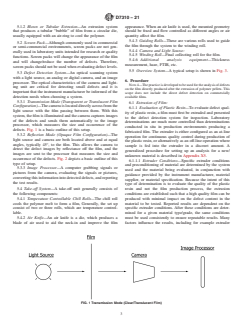
5.3.1 Transmission Mode (Transparent or Translucent Film
6.1 Extrusion of Film:
Configuration)—Thecameraislocateddirectlyacrossfromthe
6.1.1 Evaluation of Plastic Resin—To evaluate defect qual-
light source with the film passing between them. With this
ity of plastic resin, a film must first be extruded and presented
system, the film is illuminated and the camera captures images
to the defect detection system for inspection. Laboratory
of the defects and sends them automatically to the image
determinations are much more controlled than determinations
processor, which measures the size and occurrence of the
conducted in situ in production environments producing a
defects. Fig. 1 is a basic outline of this setup.
fabricated film. The extruder is either configured as an at-line
5.3.2 Reflection Mode (Opaque Film Configuration)—The
operation for continuous quality control during production of
light source and camera are both located above and at equal
the plastic resin, or alternatively as an off-line operation where
angles, typically 45°, to the film. This allows the camera to
sample is fed into the extruder in a discreet amount. A
detect the defect images by reflectance off the film, and the
generalized procedure for setting up an analysis for a new/
images are sent to the processor that measures the size and
unknown material is described in Appendix X5.
occurrence of the defects. Fig. 2 depicts a basic outline of this
6.1.1.1 Extruder Conditions—Specific extruder conditions
type of setup.
and preconditioning of material are determined by the system
5.3.3 Image Processor—A computer grabbing signals or
used and the material being evaluated, in conjunction with
pictures from the camera, evaluating the signals or pictures,
guidance provided by the instrument manufacturer, material
convertingthisinformationintodetecteddefects,andreporting
supplier, or material specification. Because the intent of this
the test results.
type of determination is to evaluate the quality of the plastic
5.4 Take-off System—A take-off unit generally consists of resin and not the film production process, the extrusion
the following components: conditions are established such that a high quality film can be
5.4.1 Temperature Controllable Chill Rolls—The chill roll produced with minimal impact on the defect content in the
cools the polymer melt to form a film, Generally, the set up material to be tested. Reported results are dependent on the
consist of two or three rolls, which are temperature control- specific extruder conditions. After these conditions are deter-
lable. mined for a given material type/grade, the same conditions
5.4.2 Air Knife—An air knife is a die, which produces a must be used consistently to ensure repeatable results. Many
blade of air used to aid the neck-in and improve the film factors influence the results, including for example extruder
FIG. 1 Transmission Mode (Clear/Translucent Film)
D7310 − 21
FIG. 2 Reflection Mode (Opaque Film)
FIG. 3 Typical Analyzer Setup
temperatures, speed, take-up speed, chill roll temperature, it to cause degradation of the material. Temperature set points
screw geometry, frost line height (for blown films), the use of should take into consideration the melting and degradation
an air knife. Specific guidance for key parameters are given
temperaturesofallcomponentsinaformulatedresin,including
below.
additives.
(1) Preconditioning—Sample with high levels of volatiles
(3) Speed—Extruder screw speed shall be set such that the
need to be devolatilized prior to introduction into the extruder
residence time of the polymer is adequate to entirely melt and
to avoid creation of voids in the film, which are possibly
mix the polymer, but not long enough to cause degradation.
detected as defects.
(4) Film Thickness—The relation of the screw speed (ex-
(2) Temperature—Appropriate temperatures, especially in
truderoutput)andtake-upspeedshallbesettoproducefilmof
the die zone, must have been reached to melt and mix the
suitable thickness to measure defects.Typical film thickness is
sample.Ingeneral,itisbestforthediesetpointtemperatureto
10 – 100 micron.
be above the melt point of the polymer, but not enough above
D7310 − 21
NOTE 7—It is critical that the surrounding area not be disturbed during
6.1.1.2 Extruder Cleanliness—The extruder shall be clean
the evaluation, as dust and other foreign particulate matter are prone to
prior to the introduction of the material to be evaluated.
causing erroneous measurements. Cover the extruder hopper during the
Cleaning procedures are required when the extruder is started
evaluation to prevent the inclusion of any foreign materials.
up, when the prior sample is dissimilar, or when there is
6.2.2 Monitor the film with the optical scanning system.
evidence of degradation/contamination in the extruder. This is
6.2.3 Observations:
accomplished by various means, depending on the prior
6.2.3.1 Record the results of the measurement of defects as
conditions (for example, material type, defect quality, etc.).
detected by the specific inspection system.
One or more of the following options are examples on how to
6.2.3.2 Categorize and count the defects according to size
proceed:
classes or other specifications as defined by internal standards
(1)Runaclean,highlystable,compatiblematerialthrough
or agreement between supplier and user.
the extruder until the film appears clear or when the defect
(a) Typical units for reporting include defects per square
count, as measured by the optical monitoring system, has
meter (or square foot), defect area in parts per million (PPM)
stabilized.
Defect area = total defect area/total area measured), or any
(2)Introduce some form of scrubbing compound, typically
other method as defined by internal standards or agreement
a concentrated additive mixture in a base resin.
between supplier and user.
(3)Open up the extruder and mechanically clean it.
6.1.1.3 After introducing the material to be evaluated into NOTE 8—Examples of data presentation for film defect detection and
monitoring are shown in Appendix X4. The examples of the reports are
the extruder, allow enough time for the preceding material to
from the same optical scanner and are provided as a means of demon-
completely purge. If studies of similar materials are being
strating the type of information available.
performed, the typical purge time is established prior to
subsequent evaluations. (See Appendix X2 for guidelines on
7. Establishing Optical Sensor Settings
the use of a control resin.)
7.1 Theuserdefinedmethodsetupisdeterminedbydefining
NOTE 5—The need for adequate equilibration cannot be overstressed.
the specific hardware and software settings of the defect
Not only must care be taken to provide adequate time for the system to
detectionsystem.Onceamethodsetuphasbeenestablishedfor
stabilizeafterpurging,butalsotoallowadequatemonitoringtimeincases
a given product type/grade, the settings should not be altered.
where intermittent defect flurries occur in a stable system due to
non-uniformity of the sample itself (see Appendix X2).
7.2 Camera Alignment—The camera must be geometrically
aligned to the film and lighting source, so that the intensity is
6.1.2 Evaluation of Film Produced for Specific Application:
homogeneously distributed across the sensor. The respective
6.1.2.1 The general purpose of optical sensors used in a
vendor sets this alignment.
production film fabrication environment is continuous, in-line
monitoringofthefilmasproducedforitsintendedapplication,
7.3 Light Source—Various light source options are
both for the consistency of the product and to detect any
available, as described in 3.1.12. Selection of light source type
disturbances in the systems or processes that introduce an
and the wavelength(s) of the light source influences the
unacceptable level of defects.
discrimination of defects in the matrix film and are chosen to
meet customer requirements. The selection of the light source
6.1.2.2 Extruder Conditions—When monitoring film pro-
duced on a commercial scale for a given application, the is very much setup dependent. Ideally, the selection should be
extruder conditions shall be determined by the constraints of done in close collaboration with the vendor.
theproductionandapplicationrequirements,thatis,conditions
7.4 Software—When establishing the method setup, opti-
are not changed from the normal operating conditions for the
mized settings are defined for grey levels, defect detection
purpose of defect detection. When the intent is to evaluate the
threshold level(s). Size classes must also be defined, as well as
film for defects, it is important to have processes in place to
groupings of size classes, if desired.
ensure that proper operating guidelines are followed.Variables
7.4.1 Grey Level—Greylevelisadjustedtoensurethatthere
such as temperature, film gauge, etc. must be taken into
is an adequate signal to distinguish defects from the surround-
account to achieve repeatable results.
ing background of the film.
6.1.2.3 Extruder cleaning —For commercial scale film ex-
7.4.2 Defect Detection Threshold Level(s)—Asuitablegrey-
trusion equipment it is normally not possible to interrupt
levelthresholdsettingisdeterminedtodefinethedefectedges.
production to routinely purge or clean. In this case, the system
Multiple levels may be established to distinguish different
mustbesetuptoproducecommerciallyacceptableproductand
types of defects, if desired. Selection of threshold levels will
the monitoring system essentially serves to track deviations
affect the measured size of the defects, and suitable thresholds
from the acceptable levels. In this case, the acceptable levels
should ensure that artifacts of the film quality are not counted
shall be determined by the accepted fitness-for-use set by the
as defects.
application or by agreement between supplier and user.
7.4.3 Sensitivity Optimization—Even if the vendor (factory)
settings initially work for the application, it is beneficial to
6.2 Evaluation of Defects:
optimize the sensitivity level for own product(s). Caution—
NOTE 6—General best practice guidelines and possible sources of test
Changes to sensitivity level settings influence the test values
error are found in Appendix X2.
and historical specifications.
6.2.1 For laboratory evaluations, produce a sufficient quan- 7.4.4 To determine the optimized level, testing of the
tity of film to ensure the defect frequency has stabilized. productatdifferentsensitivitylevelvaluesisrequired.Initially
D7310 − 21
a wide range is tested to determine the approximate optimal 8.5 The accurate diameter of these dots or disk is deter-
level. See Table 1, which uses the percent of the grey value. mined and certified by an accredited laboratory. The diameter
Thesmallgelsizecategories<≈250µmaremoreimpactedby canbeselectedinaccordancewiththetestwidthandresolution
the sensitivity level and are usually more consistent in a of the system. It must be ensured that the diameter is smaller
defined area of film inspected. than the width of the inspection so that during calibration the
7.4.5 For further improvement, a secondary sensitivity whole test shape is captured by the camera. (Rule of thumb:
study with more focused range of values must be performed. less than the half of the test width). For example a nominal
For example, a graph of the number of defects versus the diameter can be 15 mm.
sensitivity level can help to optimize a setting. In Fig. 4, the
8.6 Itisadvisabletocheckwiththeequipmentmanufacturer
mid-pointofthecurveforthesmallgelcategorywiththelarge
for appropriate calibration and recalibration procedures.
gel category is used to determine the final sensitivity level.
8.7 A verification is performed by either user or ven
...
This document is not an ASTM standard and is intended only to provide the user of an ASTM standard an indication of what changes have been made to the previous version. Because
it may not be technically possible to adequately depict all changes accurately, ASTM recommends that users consult prior editions as appropriate. In all cases only the current version
of the standard as published by ASTM is to be considered the official document.
Designation: D7310 − 20 D7310 − 21
Standard Practice for
Defect Detection and Rating of Plastic Films Using Optical
Sensors
This standard is issued under the fixed designation D7310; the number immediately following the designation indicates the year of
original adoption or, in the case of revision, the year of last revision. A number in parentheses indicates the year of last reapproval. A
superscript epsilon (´) indicates an editorial change since the last revision or reapproval.
1. Scope
1.1 This practice intends to provide standardized approaches and criteria for the observation and reporting of defects in various
types of plastic film, by means of an optical scanning system. Scope includes the in situ inspection of defects in films fabricated
for specific applications as well as after preparation of a suitable film sample to characterize defects within plastic granules
followed by inspection of the film sample.from plastic resin.
1.2 This standard does not purport to address all of the safety concerns, if any, associated with its use. It is the responsibility
of the user of this standard to establish appropriate safety, health, and environmental practices and determine the applicability of
regulatory limitations prior to use.
NOTE 1—There is no known ISO equivalent to this standard.
1.3 This international standard was developed in accordance with internationally recognized principles on standardization
established in the Decision on Principles for the Development of International Standards, Guides and Recommendations issued
by the World Trade Organization Technical Barriers to Trade (TBT) Committee.
2. Referenced Documents
2.1 ASTM Standards:
D883 Terminology Relating to Plastics
E456 Terminology Relating to Quality and Statistics
E691 Practice for Conducting an Interlaboratory Study to Determine the Precision of a Test Method
E2587 Practice for Use of Control Charts in Statistical Process Control
3. Terminology
3.1 Definitions—For definitions of terms that appear in this practice relating to plastics, refer to Terminology D883.
3.2 Definitions of Terms Specific to This Standard:
3.2.1 defect—for the purpose of this practice any entity in the film that is large enough to be detected by an optical sensor and
is either polymeric in nature or caused by degradation, external contamination, undispersed additives or pigments, or similar
sources.
This practice is under the jurisdiction of ASTM Committee D20 on Plastics and is the direct responsibility of Subcommittee D20.19 on Film, Sheeting, and Molded
Products.
Current edition approved May 15, 2020Sept. 1, 2021. Published August 2020September 2021. Originally approved in 2007. Last previous edition approved in 20112020
as D7310 - 11.D7310 - 20. DOI:10.1520/D7310-20.DOI:10.1520/D7310-21.
For referenced ASTM standards, visit the ASTM website, www.astm.org, or contact ASTM Customer Service at service@astm.org. For Annual Book of ASTM Standards
volume information, refer to the standard’s Document Summary page on the ASTM website.
Copyright © ASTM International, 100 Barr Harbor Drive, PO Box C700, West Conshohocken, PA 19428-2959. United States
D7310 − 21
3.2.1.1 Discussion—
In Appendix X1, some types of defects are shown (cross-linked material, un-molten polymer, pinholes). The defects can be
classified in three groups:
3.2.1.1 gel—particle of plastic material in the film matrix not blended with the matrix and often acting as a miniature lens.
Several types of gels exist.
3.2.1.2 contamination—any particle in or on the film matrix affecting irradiated light differently than the matrix (dirt, insects,
oxidized additives or material, catalyst residues, solid particles, metallic particles, undispersed pigments or additives, etc.).
3.2.1.3 structural defect—visual deviation not caused by gels or contaminations, for example, air bubbles, wrinkles, die lines,
film holes, sharkskin, arrowheads.
3.2.2 pixel
3.2.2.1 in a picture—smallest element of an image that can be individually processed by a video display system or a physical
point in a raster image.
3.2.2.1 Discussion—
The greater the number of pixels per area, the higher the resolution.
3.2.2.2 in a camera—smallest single photo-electrical detector element of the camera sensor.
3.2.3 effective pixel size—actual size of the individual pixels in the analyzed image.
3.2.3.1 Discussion—
The effective pixel size of the optical system is determined by the physical pixel size of the sensor and a magnification factor
caused by the lens of the camera.
3.2.4 resolution
3.2.4.1 image—the detail an image holds, also called pixel density.
3.2.4.1 Discussion—
Higher resolution means more image detail, often expressed in pixels per inch or dots per inch.
3.2.4.2 camera—resolution of the sensor: the sheer number of pixels on the sensor; the amount of detail that a camera can
capture, measured in pixels (for example, 4k-camera).
3.2.5 optical resolution—describes the ability of an imaging system to resolve detail in the object that is being imaged.
3.2.5.1 Discussion—
It is the sum of all system effects, such as lateral resolution, lens resolution, etc.
3.2.6 minimum detectable object size—smallest number of pixels of a defect such that the defect can be reliably detected, typically
pixel size × 3.
3.2.7 defect size—a length derived from the area of the defect.
3.2.7.1 Discussion—
Commonly equivalent circular diameter, longest elongation or longest axis through center of mass are used and may not yield a
same value.
Pixel size depicted in Appendix X6 is effective pixel as defined in 3.2.3.
3.2.7.2 equivalent circle diameter—this is the diameter of a circle having the same area as the digitized image of the defect as
depicted in Appendix X6.
3.2.7.3 maximum extension—the diagonal of a box circumscribing the defect as depicted in Appendix X6.
3.2.8 sensitivity levels—a threshold value (for example, % of grey value, brightness) to distinguish the pixels associated with the
defect from the film matrix.
3.2.8.1 Discussion—
It is the threshold limit where the software detects/reports defects in the film. This may be defined by the vendor (factory setting)
but this value can be optimized for your test material. If the value is too low it will not properly detect the defects in the film. If
the value is too high it will lead to false detection.
3.2.9 grey level—value associated with a pixel representing the lightness from black to white. Usually defined as a value from 0
to 255, with 0 being black and 255 being white.
D7310 − 21
3.2.9.1 Discussion—
Other ranges are possible (vendor dependent).
3.2.10 parcel—a user-defined smallest area of inspected film for statistical analysis to which a detected defect can be attributed.
3.2.10.1 Discussion—
The statistical evaluation is based on number of parcels.
3.2.11 total defect area—sum of areas of defects (vendor dependent).
3.2.12 inspected area—total area of the film, inspected for evaluation.
3.2.13 light source—consistent source of light that shines through or on the film to provide a clear image for defect detection and
measurement.
3.2.13.1 Discussion—
Different type of light sources can be used, for example, halogen, LED, fluorescent, laser.
3.2.14 mean filter—the mean filter is a sliding window value based on a defined number of film parcel areas inspected
3.2.14.1 Discussion—
During continuous measurement scenarios, the test is not usually stopped; therefore, a mean filter value should be used for
reporting. A mean filter value is reported every time a new parcel area is inspected.
3.2.15 neck-in—difference between the width of the film compared to the width of the die.
4. Significance and Use
4.1 Defects in film are not acceptable to the end-user as there is a reduction in the fitness-for-use in many applications. This
document is intended to be a practice to assist users in the inspection, quantification and observation of defects.
4.2 This practice is applicable in a laboratory environment, continuous inspection as a quality control or as a research tool. It is
also appropriate for use in any commercial process used to produce film including extrusion, calendaring, etc.
4.3 This practice is also suitable for use as an evaluation or screening tool for materials intended to be used in other processes
where defects of this nature are critical, such as fiber spinning non-woven, etc.
4.4 Results achieved by different equipment’sequipment, even from the same vendor in different laboratories are the same
laboratory, are often not directly comparable and may result in as a bias exists that cannot be fully addressed through consistent
operating conditions, and results may shift asconditions. Results frequently shift when analyzer components are upgraded for a
given analyzer. upgraded. Additionally, results may are often not be directly comparable between different product types. All results
should are to be considered as relative values rather than absolute.
4.4.1 Therefore, it is not recommended to provide absolute results as part of a sales contract between the buyer and seller. For sales
contracts, it is recommended to establish product grade designations based on the historical relationship of the absolute results
reported, and fitness-for-use or based on a reference material agreed by both parties. This is attained by the collection of data over
a time-period to establish acceptable control limits.
4.4.2 The defect size range of interest is usually different between resin supplier and converters. Total defect counts are not one
to one comparable between small laboratory extrusion lines and commercial extrusion lines. Therefore, an individual correlation
is the aim to get accepted results for fitness-for-use.
NOTE 2—This was tested on Brabender, Collin, Goettfert, and OCS systems.
4.5 For support in a basic interpretation of the different results the following points may be helpful for comparison.
4.5.1 Size classes (number and definition)
4.5.2 Reported defect types
D7310 − 21
4.5.3 Comparable units (gels/kg, gels/m , class system, index.)
4.5.4 Vendor (type of equipment, for example, cast or blown film.)
4.5.5 Camera settings (sensitivity, grey level, resolution.)
4.5.6 Extrusion parameters
NOTE 3—For attribute data such as defect counts, C-type control charts are most appropriate per recommendations within Practice E2587, Section 9.
5. Apparatus
5.1 Extruder—A device for melting polymer that produces a cast or blown (tubular) filmwith sizes varying from lab-scale to
production-scale.
5.1.1 Cast Film Extrusion—An extrusion system that produces a flat film that is quenched immediately after extrusion by means
of one or more cooling devices such as an air knife, chill roll or water bath.
5.1.2 Blown or Tubular Extrusion—An extrusion system that produces a tubular “bubble” of film from a circular die, usually
equipped with an air-ring to cool the polymer.
5.2 Screen Pack—Although commonly used in commercial or semi-commercial environments, screen packs are not generally used
in laboratory units intended for research or quality functions. Screen packs will change the appearance of the film and will
change/reduce the number of defects. Therefore, screen packs should not be used when evaluating defect levels.
5.3 Defect Detection System—An optical scanning system with a light source, an analog or digital camera, and an image processor.
The optical characteristics of the camera and lighting unit are critical for detecting small defects and it is important that the
instrument manufacturer be informed of the detection needs when choosing a system.
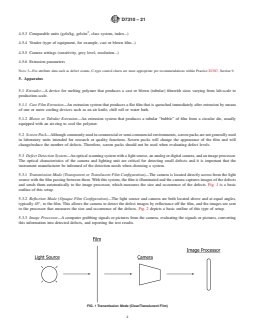
5.3.1 Transmission Mode (Transparent or Translucent Film Configuration)—The camera is located directly across from the light
source with the film passing between them. With this system, the film is illuminated and the camera captures images of the defects
and sends them automatically to the image processor, which measures the size and occurrence of the defects. Fig. 1 is a basic
outline of this setup.
5.3.2 Reflection Mode (Opaque Film Configuration)—The light source and camera are both located above and at equal angles,
typically 45°, to the film. This allows the camera to detect the defect images by reflectance off the film, and the images are sent
to the processor that measures the size and occurrence of the defects. Fig. 2 depicts a basic outline of this type of setup.
5.3.3 Image Processor—A computer grabbing signals or pictures from the camera, evaluating the signals or pictures, converting
this information into detected defects, and reporting the test results.
FIG. 1 Transmission Mode (Clear/Translucent Film)
D7310 − 21
FIG. 2 Reflection Mode (Opaque Film)
5.4 Take-off System—A take-off unit generally consists of the following components:
5.4.1 Temperature Controllable Chill Rolls—The chill roll cools the polymer melt to form a film, Generally, the set up consist of
two or three rolls, which are temperature controllable.
5.4.2 Air Knife—An air knife is a die, which produces a blade of air used to aid the neck-in and improve the film appearance. When
an air knife is used, the mounted geometry should be fixed and flow controlled as different angles or air quantity affect the film.
5.4.3 Guiding Rolls—These are various rolls used to guide the film through the system to the winding roll.
5.4.4 Camera and Light Source:
5.4.5 Winding Roll—Final collecting roll for the film.
5.4.6 Additional analysis equipment—Thickness measurement, haze, FTIR, etc.
5.5 Overview System—A typical setup is shown in Fig. 3.
6. Procedure
NOTE 4—The practice is developed to be used for the analysis of defects on the film directly produced after the extrusion of polymer pellets. This scope
does not include the direct defect detection on commercially available films.
6.1 Extrusion of Film:
6.1.1 Evaluation of Plastic Resin—To evaluate defect quality of plastic resin, a film must first be extruded and presented to the
defect detection system for inspection. Laboratory determinations are much more controlled than determinations conducted in situ
in production environments producing a fabricated film. The extruder may be configured in is either configured as an at-line
operation for continuous quality control during production of the plastic resin, or alternatively in as an off-line operation where
sample is fed into the extruder in a discreet amount. A generalized procedure for setting up an analysis for a new/ unknown material
is described in Appendix X5.
6.1.1.1 Extruder Conditions—Specific extruder conditions and preconditioning of material are determined by the system used and
the material being evaluated, in conjunction with guidance provided by the instrument manufacturer, material supplier, or material
specification. Because the intent of this type of determination is to evaluate the quality of the plastic resin and not the film
production process, the extrusion conditions are established such that a high quality film can be produced with minimal impact on
the defect content in the material to be tested. Reported results are dependent on the specific extruder conditions. After these
D7310 − 21
FIG. 3 Typical Analyzer Setup
conditions are determined for a given material type/grade, the same conditions must be used consistently to ensure repeatable
results. Many factors can influence the results, including for example extruder temperatures, speed, takeuptake-up speed, chill roll
temperature, screw geometry, frost line height (for blown films), the use of an air knife, etc. knife. Specific guidance for key
parameters are given below.
(1) Preconditioning—Sample with high levels of volatiles may need to be devolatilized prior to introduction into the extruder
to avoid creation of voids in the film, which can beare possibly detected as defects.
(2) Temperature—Appropriate temperatures, especially in the die zone, must have been reached to melt and mix the sample.
In general, it is best for the die set point temperature to be above the melt point of the polymer, but not enough above it to cause
degradation of the material. Temperature set points should take into consideration the melting and degradation temperatures of all
components in a formulated resin, including additives.
(3) Speed—Extruder screw speed shall be set such that the residence time of the polymer is adequate to entirely melt and mix
the polymer, but not long enough to cause degradation.
(4) Film Thickness—The relation of the screw speed (extruder output) and take-up speed shall be set to produce film of suitable
thickness to measure defects. Typical film thickness is 10 – 100 micron.
6.1.1.2 Extruder Cleanliness—The extruder shall be clean prior to the introduction of the material to be evaluated. Cleaning
procedures are required when the extruder is started up, when the prior sample is dissimilar, or when there is evidence of
degradation/contamination in the extruder. This is accomplished by various means, depending on the prior conditions (for example,
material type, defect quality, etc.). One or more of the following options may be used: are examples on how to proceed:
(1) RunningRun a clean, highly stable, compatible material through the extruder until the film appears clear or when the defect
count, as measured by the optical monitoring system, has stabilized.
(2) IntroducingIntroduce some form of scrubbing compound, typically a concentrated additive mixture in a base resin.
(3) Open up the extruder and mechanically clean it.
6.1.1.3 After introducing the material to be evaluated into the extruder, allow enough time for the preceding material to completely
purge. If studies of similar materials are being performed, the typical purge time is established prior to subsequent evaluations. (See
Appendix X2 for guidelines on the use of a control resin.)
NOTE 5—The need for adequate equilibration cannot be overstressed. Not only must care be taken to provide adequate time for the system to stabilize
after purging, but also to allow adequate monitoring time in cases where intermittent defect flurries occur in a stable system due to non-uniformity of
the sample itself (see Appendix X2).
6.1.2 Evaluation of Film Produced for Specific Application:
D7310 − 21
6.1.2.1 The general purpose of optical sensors used in a production film fabrication environment is continuous, in-line monitoring
of the film as produced for its intended application, both for the consistency of the product and to detect any disturbances in the
systems or processes that introduce an unacceptable level of defects.
6.1.2.2 Extruder Conditions—When monitoring film produced on a commercial scale for a given application, the extruder
conditions shall be determined by the constraints of the production and application requirements, that is, conditions are not changed
from the normal operating conditions for the purpose of defect detection. When the intent is to evaluate the film for defects, it is
important to have processes in place to ensure that proper operating guidelines are followed. Variables such as temperature, film
gauge, etc. must be taken into account to achieve repeatable results.
6.1.2.3 Extruder cleaning —For commercial scale film extrusion equipment it is normally not possible to interrupt production to
routinely purge or clean. In this case, the system must be set up to produce commercially acceptable product and the monitoring
system essentially serves to track deviations from the acceptable levels. In this case, the acceptable levels shall be determined by
the accepted fitness-for-use set by the application or by agreement between supplier and user.
6.2 Evaluation of Defects:
NOTE 6—General best practice guidelines and possible sources of test error are found in Appendix X2.
6.2.1 For laboratory evaluations, produce a sufficient quantity of film to ensure the defect frequency has stabilized.
NOTE 7—It is critical that the surrounding area not be disturbed during the evaluation, as dust and other foreign particulate matter are prone to causing
erroneous measurements. Cover the extruder hopper during the evaluation to prevent the inclusion of any foreign materials.
6.2.2 Monitor the film with the optical scanning system.
6.2.3 Observations:
6.2.3.1 Record the results of the measurement of defects as detected by the specific inspection system.
6.2.3.2 Categorize and count the defects according to size classes or other specifications as defined by internal standards or
agreement between supplier and user.
(a) Typical units for reporting include defects per square meter (or square foot), defect area in parts per million (PPM)
Defect area = total defect area/total area measured), or any other method as defined by internal standards or agreement between
supplier and user.
NOTE 8—Examples of data presentation for film defect detection and monitoring are shown in Appendix X4. The examples of the reports are from the
same optical scanner and are provided as a means of demonstrating the type of information available.
7. Establishing Optical Sensor Settings
7.1 The user defined method setup is determined by defining the specific hardware and software settings of the defect detection
system. Once a method setup has been established for a given product type/grade, the settings should not be altered.
7.2 Camera Alignment—The camera shouldmust be geometrically aligned to the film and lighting source, so that the intensity is
homogeneously distributed across the sensor. The respective vendor sets this alignment.
7.3 Light Source—Various light source options are available, as described in 3.1.12. Selection of light source type and the
wavelength(s) of the light source may influence influences the discrimination of defects in the matrix film and should be are chosen
to meet customer requirements. The selection of the light source is very much setup dependent. Ideally, the selection should be
done in close collaboration with the vendorvendor.
7.4 Software—When establishing the method setup, optimized settings are defined for grey levels, defect detection threshold
level(s). Size classes must also be defined, as well as groupings of size classes, if desired.
D7310 − 21
7.4.1 Grey Level—Grey level is adjusted to ensure that there is an adequate signal to distinguish defects from the surrounding
background of the film.
7.4.2 Defect Detection Threshold Level(s)—A suitable grey-level threshold setting is determined to define the defect edges.
Multiple levels may be established to distinguish different types of defects, if desired. Selection of threshold levels will affect the
measured size of the defects, and suitable thresholds should ensure that artifacts of the film quality are not counted as defects.
7.4.3 Sensitivity Optimization—Vendor (factory) setting may work for your application; however Even if the vendor (factory)
settings initially work for the application, it is beneficial to optimize the sensitivity level for youown product(s). Caution—Changes
to sensitivity level settings influence the test values and historical specifications.
7.4.4 To determine the optimized level, testing of the product at different sensitivity level values is required. Initially a wide range
is tested to determine the approximate optimal level. See Table 1, which uses the percent of the grey value. The small gel size
categories < ≈ 250 μm are more impacted by the sensitivity level and are usually more consistent in a defined area of film inspected.
7.4.5 For further improvement, a secondary sensitivity study with more focused range of values can be used. A must be performed.
For example, a graph of the number of defects versus the sensitivity level can help to optimize a setting. In Fig. 4, the mid-point
of the curve for the small gel category with the large gel category is used to determine the final sensitivity level. Once the
sensitivity level has been set, the instrument size validation is recommended using the reference black dots.
7.4.6 Defect Measurement:
7.4.6.1 The primary measurement is the projected area of each defect, expressed in number of pixels. The size of the defect can
be expressed as either the effective equivalent diameter or the longest dimension, expressed in microns. See Appendix X6. Other
morphometric parameters mayare also be determined availab
...