

ASTM D3270-13(2021)
(Test Method)Standard Test Methods for Analysis for Fluoride Content of the Atmosphere and Plant Tissues (Semiautomated Method)
General Information
- Abstract
SIGNIFICANCE AND USE
5.1 These test methods may be used for determining the fluoride content of particulate matter and gases collected from the atmosphere by passive and active means, including plant tissues. The user is warned that the fluoride content of passive collectors (including plants) give only qualitative or semiquantitative measurement of atmospheric fluoride content.
SCOPE
1.1 These test methods describe the semiautomated procedure for the analyses of various types of samples for the purpose of determining total fluoride. Since the test methods incorporate microdistillation of the sample, they may be applied to any fluoride-containing solution where standards of identical composition have been carried through the same sample preparation procedures and have proven to provide quantitative recovery when analyzed by the semiautomated system. Conversely, the methods shall not be applied for analyses until the applicability has been demonstrated.
1.2 In normal use, the procedure can detect 0.1 μg/mL of F. The normal range of analysis is from 0.1 to 1.6 μg/mL of F. Higher concentrations can be analyzed by careful dilution of samples with reagent water. If digested samples routinely exceed 1.6 μg/mL of F, the analytical portion of the pump manifold can be modified to reduce sensitivity. However, the best procedure is to analyze a smaller aliquot of the sample. Most accurate results are obtained when the fluoride concentration falls in the middle or upper part of the calibration curve.
1.3 The values stated in SI units are to be regarded as standard. The values given in parentheses after SI units are provided for information only and are not considered standard.
1.4 This standard does not purport to address all of the safety concerns, if any, associated with its use. It is the responsibility of the user of this standard to establish appropriate safety, health, and environmental practices and determine the applicability of regulatory limitations prior to use. See 8.3, 10.2.4, and 10.2.5 for additional precautions.
1.5 This international standard was developed in accordance with internationally recognized principles on standardization established in the Decision on Principles for the Development of International Standards, Guides and Recommendations issued by the World Trade Organization Technical Barriers to Trade (TBT) Committee.
- Status
- Published
- Publication Date
- 31-Aug-2021
- Technical Committee
- D22 - Air Quality
- Drafting Committee
- D22.03 - Ambient Atmospheres and Source Emissions
Overview
ASTM D3270-13(2021) is the international standard developed by ASTM for the analysis of fluoride content in the atmosphere and plant tissues using semiautomated methods. This standard provides guidance for determining total fluoride concentrations in various sample types, including particulate matter, gases, and plant materials collected from the environment. The test methods are built around microdistillation and can be applied to any fluoride-containing solution that has undergone similar sample preparation and for which proven quantitative recovery via the semiautomated system has been established.
Key Topics
- Analysis Scope: The methods are intended for samples of atmospheric particulate matter and gases, as well as plant tissues, to measure total fluoride. Passive collectors, including unmodified plant samples, yield only qualitative or semiquantitative results for atmospheric fluoride exposure.
- Detection Range: The standard analytical range is from 0.1 to 1.6 μg/mL fluoride, with higher concentrations measurable after suitable dilution of the samples.
- Sample Preparation: Microdistillation is a central step, ensuring the extraction of fluoride ions from sample matrices. Calibration standards must match the sample composition and preparation process to ensure accurate quantification.
- Instrumentation: The test employs semiautomated robot chemical analyzers equipped for colorimetric or potentiometric measurements. Supporting equipment includes proportioning pumps, microdistillation units, colorimeters, ion-selective electrode detectors, and more.
- Results and Calibration: For robust calibration, standards and samples must be processed in a comparable manner, and results are most accurate when sample concentrations are in the middle or upper regions of the calibration range.
- Units and Safety: All results are reported in SI units. The standard includes comprehensive safety guidance, reminding users to follow relevant laboratory, health, and environmental practices.
Applications
- Ambient Air Quality Monitoring: Laboratories and environmental monitoring agencies use this standard to quantify fluoride levels in the air and on atmospheric particulates. The methods help assess fluoride pollution and ensure compliance with environmental regulations.
- Plant Tissue Analysis: Researchers and agricultural bodies analyze plant tissues (washed or unwashed leaves) to gauge fluoride uptake from the environment. This data supports studies on plant health, environmental exposure, and the potential entry of fluoride into the food chain.
- Industrial Hygiene and Emissions: Facilities emitting fluoride compounds can apply these methods to measure workplace and surrounding area fluoride levels, ensuring worker safety and regulatory compliance.
- Research and Environmental Impact Assessments: The standard facilitates scientific studies and environmental impact reports focused on fluoride dispersion, accumulation, and effects on ecosystems.
Related Standards
- ASTM D1193 – Specification for Reagent Water: Specifies the purity of water used in fluoride analysis.
- ASTM D1356 – Terminology Relating to Sampling and Analysis of Atmospheres: Provides definitions for relevant terms.
- ASTM D3266, D3267, D3268 – Test methods for the separation and collection of fluoride species in atmospheric samples.
- ASTM D3614 – Guide for Laboratories Engaged in Sampling and Analysis of Atmospheres and Emissions: Offers broader laboratory protocols.
- Other Related Withdrawn and Historical Standards: ASTM D3269 and methods referenced for manual fluoride analyses can provide foundational or supplementary procedural insight.
Adhering to ASTM D3270 helps laboratories produce reliable, comparable, and defensible results for fluoride monitoring and regulatory reporting, supporting air quality programs and plant tissue analyses around the globe.
Keywords: ASTM D3270, fluoride analysis, atmospheric fluoride, plant tissue, environmental monitoring, semiautomated fluoride detection, air quality testing, microdistillation, laboratory standards, ASTM International.
Relations
- Effective Date
- 01-Sep-2020
- Effective Date
- 15-Mar-2020
- Effective Date
- 01-Jun-2018
- Effective Date
- 15-Apr-2018
- Effective Date
- 15-Oct-2015
- Effective Date
- 01-Jul-2015
- Effective Date
- 01-Dec-2014
- Effective Date
- 01-May-2014
- Effective Date
- 15-Jan-2014
- Effective Date
- 01-Oct-2011
- Effective Date
- 01-Oct-2011
- Effective Date
- 01-Apr-2010
- Effective Date
- 01-Jun-2007
- Effective Date
- 01-Mar-2006
- Effective Date
- 01-Oct-2005
Get Certified
Connect with accredited certification bodies for this standard

CIS Institut d.o.o.
Personal Protective Equipment (PPE) certification body. Notified Body NB-2890 for EU Regulation 2016/425 PPE.

Kiwa BDA Testing
Building and construction product certification.
Kmetijski inštitut Slovenije
Agricultural Institute of Slovenia. Soil testing, plant health, agricultural product analysis.
Sponsored listings
Frequently Asked Questions
ASTM D3270-13(2021) is a standard published by ASTM International. Its full title is "Standard Test Methods for Analysis for Fluoride Content of the Atmosphere and Plant Tissues (Semiautomated Method)". This standard covers: SIGNIFICANCE AND USE 5.1 These test methods may be used for determining the fluoride content of particulate matter and gases collected from the atmosphere by passive and active means, including plant tissues. The user is warned that the fluoride content of passive collectors (including plants) give only qualitative or semiquantitative measurement of atmospheric fluoride content. SCOPE 1.1 These test methods describe the semiautomated procedure for the analyses of various types of samples for the purpose of determining total fluoride. Since the test methods incorporate microdistillation of the sample, they may be applied to any fluoride-containing solution where standards of identical composition have been carried through the same sample preparation procedures and have proven to provide quantitative recovery when analyzed by the semiautomated system. Conversely, the methods shall not be applied for analyses until the applicability has been demonstrated. 1.2 In normal use, the procedure can detect 0.1 μg/mL of F. The normal range of analysis is from 0.1 to 1.6 μg/mL of F. Higher concentrations can be analyzed by careful dilution of samples with reagent water. If digested samples routinely exceed 1.6 μg/mL of F, the analytical portion of the pump manifold can be modified to reduce sensitivity. However, the best procedure is to analyze a smaller aliquot of the sample. Most accurate results are obtained when the fluoride concentration falls in the middle or upper part of the calibration curve. 1.3 The values stated in SI units are to be regarded as standard. The values given in parentheses after SI units are provided for information only and are not considered standard. 1.4 This standard does not purport to address all of the safety concerns, if any, associated with its use. It is the responsibility of the user of this standard to establish appropriate safety, health, and environmental practices and determine the applicability of regulatory limitations prior to use. See 8.3, 10.2.4, and 10.2.5 for additional precautions. 1.5 This international standard was developed in accordance with internationally recognized principles on standardization established in the Decision on Principles for the Development of International Standards, Guides and Recommendations issued by the World Trade Organization Technical Barriers to Trade (TBT) Committee.
SIGNIFICANCE AND USE 5.1 These test methods may be used for determining the fluoride content of particulate matter and gases collected from the atmosphere by passive and active means, including plant tissues. The user is warned that the fluoride content of passive collectors (including plants) give only qualitative or semiquantitative measurement of atmospheric fluoride content. SCOPE 1.1 These test methods describe the semiautomated procedure for the analyses of various types of samples for the purpose of determining total fluoride. Since the test methods incorporate microdistillation of the sample, they may be applied to any fluoride-containing solution where standards of identical composition have been carried through the same sample preparation procedures and have proven to provide quantitative recovery when analyzed by the semiautomated system. Conversely, the methods shall not be applied for analyses until the applicability has been demonstrated. 1.2 In normal use, the procedure can detect 0.1 μg/mL of F. The normal range of analysis is from 0.1 to 1.6 μg/mL of F. Higher concentrations can be analyzed by careful dilution of samples with reagent water. If digested samples routinely exceed 1.6 μg/mL of F, the analytical portion of the pump manifold can be modified to reduce sensitivity. However, the best procedure is to analyze a smaller aliquot of the sample. Most accurate results are obtained when the fluoride concentration falls in the middle or upper part of the calibration curve. 1.3 The values stated in SI units are to be regarded as standard. The values given in parentheses after SI units are provided for information only and are not considered standard. 1.4 This standard does not purport to address all of the safety concerns, if any, associated with its use. It is the responsibility of the user of this standard to establish appropriate safety, health, and environmental practices and determine the applicability of regulatory limitations prior to use. See 8.3, 10.2.4, and 10.2.5 for additional precautions. 1.5 This international standard was developed in accordance with internationally recognized principles on standardization established in the Decision on Principles for the Development of International Standards, Guides and Recommendations issued by the World Trade Organization Technical Barriers to Trade (TBT) Committee.
ASTM D3270-13(2021) is classified under the following ICS (International Classification for Standards) categories: 13.040.20 - Ambient atmospheres. The ICS classification helps identify the subject area and facilitates finding related standards.
ASTM D3270-13(2021) has the following relationships with other standards: It is inter standard links to ASTM D1356-20a, ASTM D1356-20, ASTM D3266-91(2018), ASTM D3268-91(2018), ASTM D1356-15a, ASTM D1356-15, ASTM D1356-14b, ASTM D1356-14a, ASTM D1356-14, ASTM D3268-91(2011), ASTM D3266-91(2011), ASTM D1356-05(2010), ASTM D3614-07, ASTM D1193-06, ASTM D3266-91(2005). Understanding these relationships helps ensure you are using the most current and applicable version of the standard.
ASTM D3270-13(2021) is available in PDF format for immediate download after purchase. The document can be added to your cart and obtained through the secure checkout process. Digital delivery ensures instant access to the complete standard document.
Standards Content (Sample)
This international standard was developed in accordance with internationally recognized principles on standardization established in the Decision on Principles for the
Development of International Standards, Guides and Recommendations issued by the World Trade Organization Technical Barriers to Trade (TBT) Committee.
Designation: D3270 − 13 (Reapproved 2021)
Standard Test Methods for
Analysis for Fluoride Content of the Atmosphere and Plant
Tissues (Semiautomated Method)
This standard is issued under the fixed designation D3270; the number immediately following the designation indicates the year of
original adoption or, in the case of revision, the year of last revision.Anumber in parentheses indicates the year of last reapproval.A
superscript epsilon (´) indicates an editorial change since the last revision or reapproval.
1. Scope 2. Referenced Documents
1.1 These test methods describe the semiautomated proce-
2.1 ASTM Standards:
dure for the analyses of various types of samples for the
D1193Specification for Reagent Water
purpose of determining total fluoride. Since the test methods
D1356Terminology Relating to Sampling and Analysis of
incorporate microdistillation of the sample, they may be
Atmospheres
applied to any fluoride-containing solution where standards of
D3266Test Method for Automated Separation and Collec-
identical composition have been carried through the same
tion of Particulate and Acidic Gaseous Fluoride in the
sample preparation procedures and have proven to provide
Atmosphere (Double Paper Tape Sampler Method)
quantitative recovery when analyzed by the semiautomated
D3267Test Method for Separation and Collection of Par-
system. Conversely, the methods shall not be applied for
ticulate and Water-Soluble Gaseous Fluorides in the At-
analyses until the applicability has been demonstrated.
mosphere (Filter and Impinger Method)
D3268Test Method for Separation and Collection of Par-
1.2 In normal use, the procedure can detect 0.1 µg/mLof F.
ticulate and Gaseous Fluorides in the Atmosphere (So-
The normal range of analysis is from 0.1 to 1.6 µg/mL of F.
Higher concentrations can be analyzed by careful dilution of dium Bicarbonate-Coated Glass Tube and Particulate
Filter Method)
samples with reagent water. If digested samples routinely
exceed 1.6 µg/mL of F, the analytical portion of the pump D3269Test Methods for Analysis for Fluoride Content of
the Atmosphere and Plant Tissues (Manual Procedures)
manifold can be modified to reduce sensitivity. However, the
best procedure is to analyze a smaller aliquot of the sample. (Withdrawn 2010)
D3614Guide for Laboratories Engaged in Sampling and
Most accurate results are obtained when the fluoride concen-
trationfallsinthemiddleorupperpartofthecalibrationcurve. Analysis of Atmospheres and Emissions
1.3 The values stated in SI units are to be regarded as
3. Terminology
standard. The values given in parentheses after SI units are
providedforinformationonlyandarenotconsideredstandard. 3.1 Definitions—For definitions of terms used in these
methods, see Terminology D1356.
1.4 This standard does not purport to address all of the
safety concerns, if any, associated with its use. It is the
4. Summary of Test Methods
responsibility of the user of this standard to establish appro-
priate safety, health, and environmental practices and deter-
4.1 These semiautomated methods are based on the distil-
mine the applicability of regulatory limitations prior to use.
lation of hydrogen fluoride (HF) from the sample and subse-
See 8.3, 10.2.4, and 10.2.5 for additional precautions.
quent reaction of the distillate with alizarin fluorine blue-
1.5 This international standard was developed in accor-
lanthanum nitrate reagent, to form a blue complex which is
dance with internationally recognized principles on standard-
measured colorimetrically at 624 nm (1), or the subsequent
ization established in the Decision on Principles for the
measurement with a specific ion probe.
Development of International Standards, Guides and Recom-
mendations issued by the World Trade Organization Technical
Barriers to Trade (TBT) Committee.
For referenced ASTM standards, visit the ASTM website, www.astm.org, or
contact ASTM Customer Service at service@astm.org. For Annual Book of ASTM
These test methods are under the jurisdiction ofASTM Committee D22 on Air Standards volume information, refer to the standard’s Document Summary page on
Quality and are the direct responsibility of Subcommittee D22.03 on Ambient the ASTM website.
Atmospheres and Source Emissions. The last approved version of this historical standard is referenced on
Current edition approved Sept. 1, 2021. Published October 2021. Originally www.astm.org.
approved in 1991. Last previous edition approved in 2013 as D3270–13. DOI: The boldface numbers in parentheses refer to the references at the end of this
10.1520/D3270-13R21. method.
Copyright © ASTM International, 100 Barr Harbor Drive, PO Box C700, West Conshohocken, PA 19428-2959. United States
D3270 − 13 (2021)
4.2 General, Plant Material: solid matter, particularly silicates, will also retard distillation.
Accordingly, the smallest sample of vegetation consistent with
4.2.1 The plant material including leaf samples, washed or
obtaining a suitable amount of fluoride should be analyzed.
unwashed, is dried, and ground, then dissolved with perchloric
The aforementioned conditions must be carefully controlled,
acid and diluted to 50 mL with water. In the case of leaf
since accurate results depend on obtaining the same degree of
samples, an appreciable amount of fluoride may be deposited
efficiency of distillation from samples as from the standard
on the external leaf surfaces. This fluoride behaves differently
fluoride solutions used for calibration.
physiologically from fluoride absorbed into the leaf and it is
4.5.4 Temperaturecontrolismaintainedwithin 62°Cbythe
oftendesirabletowashitfromthesurfaceasapreliminarystep
thermoregulator and by efficient stirring of the oil bath. Acid
in the analysis. Details of a leaf-washing process are described
concentration during distillation is regulated by taking plant
in 9.1.
samples in the range from 0.1 to 2.0 g and by using 100 6 10
4.3 General, Atmospheric Samples:
mg of CaO and 3.0 6 0.1 g of NaOH for ashing and fusion of
4.3.1 Test Methods D3269 contains acceptable procedures
each sample. Vacuum in the system is controlled with flow-
and also techniques for the proper preparation of atmospheric
meters and a vacuum gage. Any marked change in vacuum
samples. Test Methods D3266, D3267, and D3268 are sam-
(greater than 0.7 kPa or 0.2 in. Hg) over a short time period
pling procedures for ambient air and each method contains
indicates either a leak or a block in the system. Distillation
specificinstructionsforsamplepreparationpriortoanalysesby
should take place at the same vacuum each day unless some
the semiautomated method.
other change in the system has been made. It is also essential
4.4 General, System Operation: to maintain the proper ratio between air flow on the line
drawing liquid and solid wastes from the distillation coil and
4.4.1 The dissolved digest is pumped into the polytetrafluo-
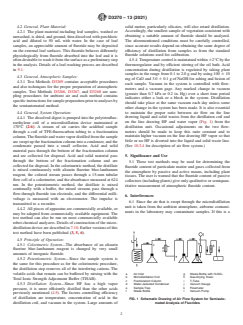
on the line drawing HF and water vapor (Fig. 1) from the
roethylene coil of a microdistillation device maintained at
distillation unit. Occasional adjustments on the two flow-
170°C (2-6). A stream of air carries the acidified sample
meters should be made to keep this ratio constant and to
through a coil of TFE-fluorocarbon tubing to a fractionation
maintain higher vacuum on the line drawing HF vapor so that
column.Thefluorideandwatervapordistilledfromthesample
little or no HF is diverted into the liquid and solid waste line.
aresweptupthefractionationcolumnintoacondenser,andthe
(See 10.3.4 for description of air flow system.)
condensate passed into a small collector. Acid and solid
material pass through the bottom of the fractionation column
and are collected for disposal. Acid and solid material pass 5. Significance and Use
through the bottom of the fractionation column and are
5.1 These test methods may be used for determining the
collectedfordisposal.Inthecolorimetricmethod,thedistillate
fluoride content of particulate matter and gases collected from
is mixed continuously with alizarin fluorine blue-lanthanum
the atmosphere by passive and active means, including plant
reagent, the colored stream passes through a 15-mm tubular
tissues. The user is warned that the fluoride content of passive
flow cell of a colorimeter, and the absorbance measured at 624
collectors(includingplants)giveonlyqualitativeorsemiquan-
nm. In the potentiometric method, the distillate is mixed
titative measurement of atmospheric fluoride content.
continually with a buffer, the mixed streams pass through a
flow-through fluoride ion electrode, and the differential milli-
6. Interferences
voltage is measured with an electrometer. The impulse is
6.1 Since the air that is swept through the microdistillation
transmitted to a recorder.
unit is taken from the ambient atmosphere, airborne contami-
4.4.2 All pieces of apparatus are commercially available, or
nants in the laboratory may contaminate samples. If this is a
may be adapted from commercially available equipment. The
test method can also be run on most commercially available
robot chemical analyzers. Details of construction of the micro-
distillationdevicearedescribedin7.10.Earlierversionsofthis
test method have been published (3, 5, 6).
4.5 Principle of Operation:
4.5.1 Colorimetric System—The absorbance of an alizarin
fluorine blue-lanthanum reagent is changed by very small
amounts of inorganic fluoride.
4.5.2 Potentiometric System—Since the sample system is
the same for this procedure as for the colorimetric procedure,
the distillation step removes all of the interfering cations. The
volatile acids that remain can be buffered by mixing with the a Air Inlet g Waste Bottle with H SO
2 4
b Microdistillation Coil h Gas-Drying Tower
Total Ionic Strength Adjustment Buffer (TISAB).
c Fractionation Column i T-Tube
4.5.3 Distillation System—Since HF has a high vapor
d Water-Jacketed Condenser j Vacuum Gauge
e Sample Trap k Flowmeter
pressure, it is more efficiently distilled than the other acids
f Waste Bottle l Vacuum Pump
previously mentioned (4.5). The factors controlling efficiency
of distillation are temperature, concentration of acid in the
FIG. 1 Schematic Drawing of Air Flow System for Semiauto-
distillation coil, and vacuum in the system. Large amounts of mated Analysis of Fluorides
D3270 − 13 (2021)
problem, a small drying bulb filled with calcium carbonate 7.3 Automatic Sampler, with 8.5 mL plastic sample cups.
granules can be attached to the air inlet tube of the microdis-
7.4 Voltage Stabilizer.
tillation unit.
7.5 Colorimeter (for colorimetric method), with 15-mm
6.2 If the polytetrafluoroethylene distillation coil is not
tubular flow cell and 624-nm interference filters.
cleaned periodically, particulate matter will accumulate and
7.6 Ion Selective Electrode Detector, (for potentiometric
will reduce sensitivity.
method) with flow-through electrodes.
6.3 Silicate, chloride, nitrate, and sulfate ions in high
7.7 Rotary Vacuum and Pressure Pump, with continuous
concentration can be distilled with fluoride ion and will
oiler.
interfere with the analysis by bleaching the alizarin fluorine
blue-lanthanum reagent. Phosphate ion is not distilled, and 7.8 Recorder.
therefore does not interfere. Metals such as iron and aluminum
7.9 Range Expander.
are not distilled and will not interfere with the analysis (most
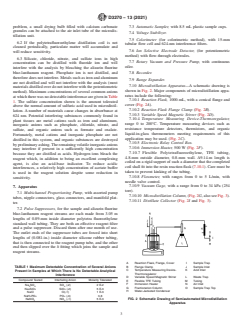
7.10 Microdistillation Apparatus—A schematic drawing is
materialsdistilledoverdonotinterferewiththepotentiometric
shown in Fig. 2. Major components of microdistillation appa-
method). Maximum concentrations of several common anions
ratus include the following:
atwhichtherewasnodetectableinterferencearegiveninTable
7.10.1 Reaction Flask, 1000-mL, with a conical flange and
1. The sulfate concentration shown is the amount tolerated
cover (Fig. 2A).
above the normal amount of sulfuric acid used in microdistil-
7.10.2 Reaction Flask Flange Clamp (Fig. 2B).
lation. A number of materials cause changes in absorbance at
7.10.3 Variable Speed Magnetic Stirrer (Fig. 2D).
624 nm. Potential interfering substances commonly found in
7.10.4 Temperature Measuring Device-Thermoregulator,
plant tissues are metal cations such as iron and aluminum,
range 0 to 200°C. Temperature measuring devices such as
inorganic anions such as phosphate, chloride, nitrate, and
resistance temperature detectors, thermistors, and organic
sulfate, and organic anions such as formate and oxalate.
liquid-in-glass thermometers meeting requirements of this
Fortunately, metal cations and inorganic phosphate are not
application may be used. (Fig. 2C).
distilled in this system, and organic substances are destroyed
7.10.5 Electronic Relay Control Box.
bypreliminaryashing.Theremainingvolatileinorganicanions
7.10.6 Immersion Heater,500W(Fig. 2F).
may interfere if present in a sufficiently high concentration
7.10.7 Flexible Polytetrafluoroethylene, TFE tubing,
because they are distilled as acids. Hydrogen ions bleach the
4.8-mm outside diameter, 0.8-mm wall. A9.14-m length is
reagent which, in addition to being an excellent complexing
coiled on a rigid support of such a diameter that the completed
agent, is also an acid-base indicator. To reduce acidic
coil shall fit into the resin reaction flask (7.10.1). Care must be
interferences, a relatively high concentration of acetate buffer
taken to prevent kinking of the tubing.
is used in the reagent solution despite some reduction in
7.10.8 Flowmeter, with ranges from 0 to 5 L/min, with
sensitivity.
needle valve control.
7.10.9 Vacuum Gage, with a range from 0 to 34 kPa (254
7. Apparatus
torr).
7.1 Multichannel Proportioning Pump, with assorted pump
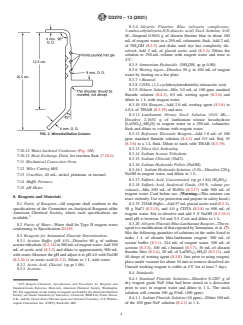
7.10.10 Microdistillation Column,(Fig.2G,alsoseeFig.3).
tubes, nipple connectors, glass connectors, and manifold plat-
7.10.11 Distillate Collector (Fig. 2I and Fig. 3).
ter.
7.2 Pulse Suppressors, for the sample and alizarin fluorine
blue-lanthanum reagent streams are each made from 3.05 m
lengths of 0.89-mm inside diameter polytetra fluoroethylene
standard wall tubing. They are both an effective reagent filter
and a pulse suppressor. Discard them after one month of use.
The outlet ends of the suppressor tubes are forced into short
lengths of (0.081-in.) inside diameter silicone rubber tubing,
that is then connected to the reagent pump tube, and the other
end then slipped over the h fitting which joins the sample and
reagent streams.
A Reaction Flask, Flange, Cover I Sample Trap
B Flange Clamp J Sample Inlet
TABLE 1 Maximum Detectable Concentration of Several Anions
C Temperature Measuring Device- K Acid Inlet
Present in Samples at Which There is No Detectable Analytical
Thermoregulator
Interference
D Variable Speed Magnetic Stirrer L Waste Trap
Compound Tested Interfering Anion Molarity Tolerated
E Flexible TFE Tubing M Tubing
F Immersion Heater N Air Inlet
Na SO SO (-2) 2 E-2
2 4 4
G Fractionation Column O Sample Trap Top
Na SiO SiO (-2) 5 E-3
2 3 3
H Water-Jacketed Condenser
NaCl Cl(-1) 1 E-3
NaH PO PO (-3) 3.8
2 4 4
NaNO NO (-1) 5 E-3 FIG. 2 Schematic Drawing of Semiautomated Microdistillation
3 3
Apparatus
D3270 − 13 (2021)
8.3.4 Alizarin Fluorine Blue (alizarin complexone,
3-amino-ethylalizarin-N,N-diacetic acid) Stock Solution, 0.01
M—Suspend 0.9634 g of alizarin fluorine blue in about 100
mL of reagent water in a 250-mL volumetric flask.Add 2 mL
of NH OH (8.3.5) and shake until dye has completely dis-
solved. Add 2 mL of glacial acetic acid (8.3.2). Dilute the
solution to 250-mL volume with reagent water and store at
4°C.
8.3.5 Ammonium Hydroxide, (NH OH, sp gr 0.80).
8.3.6 Wetting Agent—Dissolve 50 g in 100 mL of reagent
water by heating on a hot plate.
8.3.7 t-Butanol.
8.3.8 CDTA, (1,2-cyclohexylenedinitrilo)-tetraacetic acid.
8.3.9 Diluent Solution—Mix 3.0 mL of 100 ppm standard
fluoride solution (8.4.1), 0.5 mL wetting agent (8.3.6) and
dilute to 1 L with reagent water.
8.3.10 ISA Reagent—Add 2.0 mL wetting agent (8.3.6)to
4.0 L of TISAB (8.3.19) and mix.
8.3.11 Lanthanum Nitrate Stock Solution (0.01 M)—
Dissolve 2.1652 g of lanthanum nitrate hexahydrate
[La(NO ) ·6H O] in reagent water in a 250-mL volumetric
3 3 2
flask and dilute to volume with reagent water.
FIG. 3 Microdistillation Column
8.3.12 Reference Electrode Reagent—Add 1.0 mL of 100
ppm standard fluoride solution (8.4.1) and 0.5 mL Brij 35
(8.3.6) to a 1-L flask. Dilute to mark with TISAB (8.3.19).
8.3.13 Silica Gel, Indicating.
7.10.12 Water-Jacketed Condenser (Fig. 2H).
8.3.14 Sodium Acetate Trihydrate.
7.10.13 Heat Exchange Fluid, for reaction flask (7.10.1).
8.3.15 Sodium Chloride (NaCl).
7.11 Mechanical Convection Oven.
8.3.16 Sodium Hydroxide Pellets (NaOH).
7.12 Wiley Cutting Mill.
8.3.16.1 Sodium Hydroxide Solution,(5N)—Dissolve220g
NaOH in reagent water, and dilute to 1 L.
7.13 Crucibles, 40 mL, nickel, platinum, or inconel.
8.3.17 Sulfuric Acid, Concentrated, (sp gr 1.84) (H SO ).
2 4
7.14 Muffle Furnace.
8.3.18 Sulfuric Acid, Analytical Grade, (50 %, volume per
7.15 pH Meter.
volume)—Mix 500 mL of H SO (8.3.17) with 500 mL of
2 4
reagent water. Cool before use. (Warning—This mixture can
8. Reagents and Materials
reactviolently.Useeyeprotectionandprepareinsafetyhood.)
8.1 Purity of Reagents—All reagents shall conform to the
8.3.19 TISAB Buffer—Add57mLglacialaceticacid(8.3.2),
specifications of the Committee on Analytical Reagents ofthe 58 g NaCl (8.3.15), and 4.0 g CDTA (8.3.8) to 500 mL of
American Chemical Society, where such specifications are
reagent water. Stir to dissolve and add 5 N NaOH (8.3.16.1)
available. until pH is between 5.0 and 5.5. Cool and dilute to 1 L.
8.3.20 Alizarin Fluoride Blue-Lanthanum Reagent—There-
8.2 Purity of Water—Water shall be Type II reagent water
agentisamodificationofthatreportedbyYamamura,etal. (7).
conforming to Specification D1193.
Mix the following quantities of solutions in the order listed to
8.3 Reagents for Automated Fluoride Determination:
make 1 L of alizarin blue-lanthanum reagent: 300 mL of
8.3.1 Acetate Buffer (pH 4.0)—Dissolve 60 g of sodium
acetate buffer (8.3.1), 244 mL of reagent water, 300 mL of
acetatetrihydrate(8.3.14)in500mLofreagentwater.Add100
acetone (8.3.3), 100 mL t-butanol (8.3.7), 36 mL of alizarin
mL of acetic acid (8.3.2) and dilute to approximately 900 mL
fluorine blue (8.3.4), 20 mL of La(NO ) ·6HO(8.3.11), and
3 3 2
withwater.MeasurethepHandadjustittopH4.0withNaOH
40 drops of wetting agent (8.3.8). Just prior to using reagent,
(8.3.16.1) or acetic acid (8.3.2). Dilute to 1 L with water.
place under vacuum for about 10 min to remove dissolved air.
8.3.2 Acetic Acid, Glacial, (sp gr 1.06).
Unused working reagent is stable at 4°C for at least 7 days.
8.3.3 Acetone.
8.4 Standards.
8.4.1 Standard Fluoride Solutions—Dissolve 0.2207 g of
dry reagent grade NaF (that had been stored in a desiccator
ACS Reagent Chemicals, Specifications and Procedures for Reagents and
Standard-Grade Reference Materials, American Chemical Society, Washington,
prior to use) in reagent water and dilute to 1 L. The stock
DC. For suggestions on the testing of reagents not listed by theAmerican Chemical
solution will contain 100 µg F/mL (100 ppm).
Society, see Analar Standards for Laboratory Chemicals, BDH Ltd., Poole, Dorset,
8.4.1.1 Sodium Fluoride Solution(10ppm)—Dilute100mL
U.K., and the United States Pharmacopeia and National Formulary, U.S. Pharma-
copeial Convention, Inc. (USPC), Rockville, MD. of the 100 ppm NaF solution (8.4.1)to1L.
D3270 − 13 (2021)
8.4.2 Working Standards—Prepare working standards by described in 10.3. A calibration curve should precede and
takingsuitablealiquotstoeightfinalconcentrationsof0.2,0.4, follow each day’s set of samples.
0.8, 1.0, 1.6, 2.4, 3.2, and 4.0 µg F/mL. Plant analysis shall
9.2 After calibration solutions have been analyzed and the
contain 6 g NaOH (8.3.16) and 20 mLHClO (8.4.3) for each
peaks plotted by the chart recorder, draw a straight line
100 mL of solution in order to compensate for the amounts of
connecting the baseline before and after the analysis. Record
these substances used in alkali fusion of the ashed plant
theabsorbanceofeachpeakandsubtracttheabsorbanceofthe
samples. Standard solutions for fluoride analysis of water
baseline. Compute the regression of net absorbance versus
samples or of air samples absorbed in water are made up in
µg/mL of fluoride by the method of least squares.
reagent water. Store stock solutions in clean polyethylene
bottles in the cold. Since, as will be seen later, plant tissue
10. Procedure
samples are diluted to a 50-mL volume before analysis, the
10.1 Preparation of Plant Tissues for Analysis:
standard containing 0.20 µg/mL of fluoride is equivalent to a
10.1.1 This procedure is used to remove fluoride from
sample of plant material containing 10.0 µg of fluoride (0.20
surface tissues without altering the internal concentration of
µg/mL×50 mL).
fluoride. Whether vegetation samples are to be washed will
8.4.3 Perchloric Acid, concentrated, (70%) (HClO,spgr
1.66). depend on the intended use of the population of plants the
sample represents. For example, in foliage crops or other
8.4.3.1 Perchloric Acid,(1+1Solution)—Dilute250mLof
concentrated HClO (8.4.3) to 500 mL with reagent water. vegetationintendedforconsumptionbyherbivores,fluorideon
foliar surfaces as well as that within leaves is important and
8.5 Tetrasodium Ethylenediamine Tetraacetate (Na EDTA),
should be included in the analysis. For other kinds of
1%(weightpervolume)—Dissolve1gofNa EDTAin99mL
vegetation, fluoride deposited on the surface of leaves may be
of reagent water.
unimportant with respect to the plant, and it may be desirable
8.6 Plant Tissue Solution—Dissolve 0.5 g of detergent and
to wash it from the surface prior to analysis.
0.5gNa EDTA in reagent water to make 1 L.
10.1.2 Criteria—Astandardwashingprocedureshouldmeet
8.7 Reagents for Ashing and Alkali Fusion of Plant several washing criteria: it should be simple and gentle; it
should remove surface fluoride quantitatively with a minimum
Samples:
8.7.1 Calcium Oxide (CaO), with a known, low fluoride ofleachingofinternalfluoride;itshouldnotleaveresiduesthat
might interfere with subsequent analysis; and, in the event that
content.
8.7.2 Cheesecloth. thetissueistobeanalyzedalsofornutrientstatus,itshouldnot
leach other internal elements. These criteria and methods are
8.7.3 Ethanol or Propanol.
8.7.4 Hydrochloric Acid, (4 N)—Dilute 342 mL of concen- discussed thoroughly in the literature (6, 8-21).
trated hydrochloric acid (HCl, sp gr 1.19) to 1 L. 10.1.3 Procedure—Fresh tissues are placed in a cheesecloth
8.7.5 Kraft Paper Bags. square,theendsofthesquarefoldedup,andthewholewashed
8.7.6 PhenolphthaleinSolution(1%)—Dissolve1gphenol- in a polyethylene container filled with the plant tissue wash
phthalein in 50 mLof absolute ethanol or isopropanol.Add 50 solution (8.6) for 30 s with gentle agitation. The cheesecloth
mL of reagent water. containingthetissueisremovedandallowedtodrainforafew
8.7.7 Polypropylene Bags, with moisture seal. s,andthenrinsedfor10sineachofthreecontainersofreagent
8.7.8 Sodium Hydroxide Solution (10%)—Dissolve 10 g of water. Dry the tissue by blotting it with dry paper towels.
NaOH (8.3.16) in water, cool, and dilute to 100 mL.
10.1.3.1 Thewashedandpartiallydriedtissueisthenplaced
inalabeledKraftpaperbag(8.7.5)anddriedinthemechanical
8.8 Effect of Storage:
convection oven at 80°C for no less than 24 h.
8.8.1 The acetate buffer (8.3.1) and Brij 35 (8.3.6) solutions
10.1.3.2 Grind dried tissues in a semimicro Wiley mill to
are stable at room temperature. Stock solutions of alizarin
pass a 40-mesh sieve. The sieved material is collected and
fluorine blue (8.3.4) and lanthanum nitrate (8.3.11) are stable
placedinapolyethylenecontainerwithamoistureseal(8.7.7).
indefinitelyat4°C.Thealizarinfluorineblue-lanthanumwork-
ing reagent (8.3.11) is stable at 4°C for at least 7 days. Diluted
10.2 Procedure for Ashing and Alkali Fusion of Plant
NaF solutions (8.4.1 and 8.4.2) shall be stored in the cold in
Tissues:
polyethylene bo
...