

ASTM D229-19e1
(Test Method)Standard Test Methods for Rigid Sheet and Plate Materials Used for Electrical Insulation
General Information
- Abstract
SIGNIFICANCE AND USE
18.1 This test method provides useful engineering information for evaluating the mechanical behavior of rigid electrical insulation at elevated temperature. When the proper exposure and test temperatures are chosen, depending on the material and end-use operating temperature, use the test method as one means of indicating relative thermal degradation of rigid insulating materials.
SCOPE
1.1 These test methods cover procedures for testing rigid electrical insulation normally manufactured in flat sheet or plate form. They are generally used as terminal boards, spacers, voltage barriers, and circuit boards.
1.2 Use Test Methods D619 (withdrawn) or Specification D710 for tests applying to vulcanized fibre.
1.3 Some of the test methods contained in this standard are similar to those contained in IEC 60893-2, which applies to rigid industrial laminated sheets based on thermosetting resins for electrical purposes.
1.4 The test methods appear in the following sections:
Test
Sections
ASTM
Test
Method
Acetone extractable matter
82 to 83
D494
Arc resistance
47
D495
Ash
56 to 60
...
Bonding strength
49 to 54
...
Flammability methods I and II
61 to 74
...
Coefficient of linear thermal expansion
76
D696
Compressive strength
25
D695
Conditioning
4
D6054
Dissipation factor
34 to 40
D669
Dielectric strength
28 to 33
D149
Expansion (linear thermal)
75
D696
Flexural properties
12 to 24
D790
Hardness (Rockwell)
55
D785
Insulation resistance and resistivity
41 to 46
D257
Permittivity
34 to 40
D150
Resistance to impact
26
D256
Tensile properties
7 to 11
D638
Thickness
5 to 6
D374
Tracking resistance
48
D2132
Warp or twist
76 to 81
...
Water absorption
27
D570
1.5 The values stated in inch-pound units are to be regarded as standard. The values given in parentheses are mathematical conversions to SI units that are provided for information only and are not considered standard.
1.6 This is a fire-test-response standard. See Sections 61 through 74, which are the procedures for assessing ignitability and burning time under specific test conditions
1.7 This standard does not purport to address all of the safety concerns, if any, associated with its use. It is the responsibility of the user of this standard to establish appropriate safety, health, and environmental practices and determine the applicability of regulatory limitations prior to use. Specific precautionary statements are given in 31.1 and 1.8.
1.8 This standard measures and describes the response of materials, products, or assemblies to heat and flame under controlled conditions, but does not by itself incorporate all factors required for fire hazard or fire risk assessment of the materials, products, or assemblies under actual fire conditions.
1.9 Fire testing is inherently hazardous. Adequate safeguards for personnel and property shall be employed in conducting these tests.
1.10 This international standard was developed in accordance with internationally recognized principles on standardization established in the Decision on Principles for the Development of International Standards, Guides and Recommendations issued by the World Trade Organization Technical Barriers to Trade (TBT) Committee.
- Status
- Published
- Publication Date
- 28-Feb-2019
- Technical Committee
- D09 - Electrical and Electronic Insulating Materials
- Drafting Committee
- D09.07 - Electrical Insulating Materials
Overview
ASTM D229-19e1 is the internationally recognized standard for testing rigid sheet and plate materials used for electrical insulation. Developed by ASTM International, this standard outlines comprehensive test methods to evaluate the mechanical, electrical, and thermal properties of rigid electrical insulating materials typically produced in flat sheets or plates. These materials are widely used as terminal boards, spacers, voltage barriers, and circuit boards in various electrical and electronic applications. The standard is essential for material selection, quality control, and compliance in industries such as electrical manufacturing, power distribution, and electronics.
Key Topics
ASTM D229-19e1 covers a broad range of standardized test methods, including:
Mechanical Property Testing
- Tensile properties (D638)
- Flexural properties (D790)
- Compressive strength (D695)
- Resistance to impact (D256)
- Bonding strength
- Hardness (Rockwell, D785)
- Warp or twist
Electrical Property Testing
- Dielectric strength (D149)
- Insulation resistance and resistivity (D257)
- Permittivity (D150)
- Dissipation factor (D669)
- Arc and tracking resistance (D495, D2132)
Thermal Property Testing
- Coefficient of thermal expansion (D696)
- Water absorption (D570)
- Flammability (methods for assessing ignitability and burning time)
General Material Characterization
- Thickness (D374)
- Acetone extractable matter (D494)
- Ash content
The standard specifies test conditions, specimen preparation, and conditioning, ensuring repeatability and validity across laboratories and production batches.
Applications
Implementing ASTM D229-19e1 enables stakeholders to:
- Evaluate Material Suitability: Assess mechanical and electrical performance for use in electrical insulation, ensuring products meet operational demands.
- Quality Assurance and Control: Manufacturers and end-users can verify material consistency and detect defects or deviations before installation.
- Compliance and Certification: Demonstrate compliance with regulatory and safety requirements in domestic and international markets.
- Material Development and Comparison: R&D teams leverage standardized data to compare materials, study thermal degradation, and improve new insulation products.
- Risk Assessment for Fire Safety: Flammability tests within the standard provide valuable insights into fire-response characteristics under controlled conditions.
Industries relying on rigid electrical insulation-including power generation, electrical apparatus manufacturing, and electronics assembly-utilize this standard to improve reliability, safety, and lifespan of their products.
Related Standards
ASTM D229-19e1 references and aligns with several other important standards, helping ensure a comprehensive approach to material testing:
- ASTM D149: Dielectric Breakdown Voltage and Dielectric Strength
- ASTM D150: AC Loss Characteristics and Permittivity (Dielectric Constant)
- ASTM D257: DC Resistance or Conductance of Insulating Materials
- ASTM D638: Tensile Properties of Plastics
- ASTM D790: Flexural Properties of Plastics
- ASTM D695: Compressive Properties of Rigid Plastics
- ASTM D696: Coefficient of Linear Thermal Expansion
- IEC 60893-2: Rigid Industrial Laminated Sheets for Electrical Purposes
- ISO 13943: Fire Safety Vocabulary
Adhering to ASTM D229-19e1 ensures alignment with globally recognized testing practices and supports international trade by meeting the technical requirements set forth by the WTO Technical Barriers to Trade (TBT) Committee.
Use ASTM D229-19e1 to ensure your rigid sheet and plate insulating materials are tested, specified, and documented according to the latest industry consensus and international best practices. This standard is an integral tool for engineers, quality managers, and safety professionals committed to the highest standards in electrical insulation.
Relations
- Effective Date
- 01-Mar-2024
- Effective Date
- 01-Feb-2024
- Effective Date
- 01-Jan-2024
- Effective Date
- 01-Nov-2023
- Effective Date
- 30-Sep-2023
- Effective Date
- 01-Jan-2020
- Effective Date
- 01-Jan-2020
- Effective Date
- 01-Nov-2019
- Effective Date
- 01-Nov-2019
- Effective Date
- 01-Aug-2019
- Effective Date
- 15-Apr-2019
- Effective Date
- 01-Mar-2019
- Effective Date
- 01-Feb-2019
- Effective Date
- 15-Dec-2018
- Effective Date
- 01-Dec-2018
Get Certified
Connect with accredited certification bodies for this standard

IMQ S.p.A. (Certification)
Italian electrical product certification.

SLG Prüf- und Zertifizierungs GmbH
German testing and certification body.

UL Solutions
Global safety science company with testing, inspection and certification.
Sponsored listings
Frequently Asked Questions
ASTM D229-19e1 is a standard published by ASTM International. Its full title is "Standard Test Methods for Rigid Sheet and Plate Materials Used for Electrical Insulation". This standard covers: SIGNIFICANCE AND USE 18.1 This test method provides useful engineering information for evaluating the mechanical behavior of rigid electrical insulation at elevated temperature. When the proper exposure and test temperatures are chosen, depending on the material and end-use operating temperature, use the test method as one means of indicating relative thermal degradation of rigid insulating materials. SCOPE 1.1 These test methods cover procedures for testing rigid electrical insulation normally manufactured in flat sheet or plate form. They are generally used as terminal boards, spacers, voltage barriers, and circuit boards. 1.2 Use Test Methods D619 (withdrawn) or Specification D710 for tests applying to vulcanized fibre. 1.3 Some of the test methods contained in this standard are similar to those contained in IEC 60893-2, which applies to rigid industrial laminated sheets based on thermosetting resins for electrical purposes. 1.4 The test methods appear in the following sections: Test Sections ASTM Test Method Acetone extractable matter 82 to 83 D494 Arc resistance 47 D495 Ash 56 to 60 ... Bonding strength 49 to 54 ... Flammability methods I and II 61 to 74 ... Coefficient of linear thermal expansion 76 D696 Compressive strength 25 D695 Conditioning 4 D6054 Dissipation factor 34 to 40 D669 Dielectric strength 28 to 33 D149 Expansion (linear thermal) 75 D696 Flexural properties 12 to 24 D790 Hardness (Rockwell) 55 D785 Insulation resistance and resistivity 41 to 46 D257 Permittivity 34 to 40 D150 Resistance to impact 26 D256 Tensile properties 7 to 11 D638 Thickness 5 to 6 D374 Tracking resistance 48 D2132 Warp or twist 76 to 81 ... Water absorption 27 D570 1.5 The values stated in inch-pound units are to be regarded as standard. The values given in parentheses are mathematical conversions to SI units that are provided for information only and are not considered standard. 1.6 This is a fire-test-response standard. See Sections 61 through 74, which are the procedures for assessing ignitability and burning time under specific test conditions 1.7 This standard does not purport to address all of the safety concerns, if any, associated with its use. It is the responsibility of the user of this standard to establish appropriate safety, health, and environmental practices and determine the applicability of regulatory limitations prior to use. Specific precautionary statements are given in 31.1 and 1.8. 1.8 This standard measures and describes the response of materials, products, or assemblies to heat and flame under controlled conditions, but does not by itself incorporate all factors required for fire hazard or fire risk assessment of the materials, products, or assemblies under actual fire conditions. 1.9 Fire testing is inherently hazardous. Adequate safeguards for personnel and property shall be employed in conducting these tests. 1.10 This international standard was developed in accordance with internationally recognized principles on standardization established in the Decision on Principles for the Development of International Standards, Guides and Recommendations issued by the World Trade Organization Technical Barriers to Trade (TBT) Committee.
SIGNIFICANCE AND USE 18.1 This test method provides useful engineering information for evaluating the mechanical behavior of rigid electrical insulation at elevated temperature. When the proper exposure and test temperatures are chosen, depending on the material and end-use operating temperature, use the test method as one means of indicating relative thermal degradation of rigid insulating materials. SCOPE 1.1 These test methods cover procedures for testing rigid electrical insulation normally manufactured in flat sheet or plate form. They are generally used as terminal boards, spacers, voltage barriers, and circuit boards. 1.2 Use Test Methods D619 (withdrawn) or Specification D710 for tests applying to vulcanized fibre. 1.3 Some of the test methods contained in this standard are similar to those contained in IEC 60893-2, which applies to rigid industrial laminated sheets based on thermosetting resins for electrical purposes. 1.4 The test methods appear in the following sections: Test Sections ASTM Test Method Acetone extractable matter 82 to 83 D494 Arc resistance 47 D495 Ash 56 to 60 ... Bonding strength 49 to 54 ... Flammability methods I and II 61 to 74 ... Coefficient of linear thermal expansion 76 D696 Compressive strength 25 D695 Conditioning 4 D6054 Dissipation factor 34 to 40 D669 Dielectric strength 28 to 33 D149 Expansion (linear thermal) 75 D696 Flexural properties 12 to 24 D790 Hardness (Rockwell) 55 D785 Insulation resistance and resistivity 41 to 46 D257 Permittivity 34 to 40 D150 Resistance to impact 26 D256 Tensile properties 7 to 11 D638 Thickness 5 to 6 D374 Tracking resistance 48 D2132 Warp or twist 76 to 81 ... Water absorption 27 D570 1.5 The values stated in inch-pound units are to be regarded as standard. The values given in parentheses are mathematical conversions to SI units that are provided for information only and are not considered standard. 1.6 This is a fire-test-response standard. See Sections 61 through 74, which are the procedures for assessing ignitability and burning time under specific test conditions 1.7 This standard does not purport to address all of the safety concerns, if any, associated with its use. It is the responsibility of the user of this standard to establish appropriate safety, health, and environmental practices and determine the applicability of regulatory limitations prior to use. Specific precautionary statements are given in 31.1 and 1.8. 1.8 This standard measures and describes the response of materials, products, or assemblies to heat and flame under controlled conditions, but does not by itself incorporate all factors required for fire hazard or fire risk assessment of the materials, products, or assemblies under actual fire conditions. 1.9 Fire testing is inherently hazardous. Adequate safeguards for personnel and property shall be employed in conducting these tests. 1.10 This international standard was developed in accordance with internationally recognized principles on standardization established in the Decision on Principles for the Development of International Standards, Guides and Recommendations issued by the World Trade Organization Technical Barriers to Trade (TBT) Committee.
ASTM D229-19e1 is classified under the following ICS (International Classification for Standards) categories: 29.035.01 - Insulating materials in general. The ICS classification helps identify the subject area and facilitates finding related standards.
ASTM D229-19e1 has the following relationships with other standards: It is inter standard links to ASTM D1711-24, ASTM D883-24, ASTM E176-24, ASTM D883-23, ASTM D669-03, ASTM D149-20, ASTM D883-20, ASTM D710-19, ASTM D494-11(2019), ASTM D883-19c, ASTM D883-19a, ASTM D5032-19, ASTM D883-19, ASTM E176-18a, ASTM D883-18a. Understanding these relationships helps ensure you are using the most current and applicable version of the standard.
ASTM D229-19e1 is available in PDF format for immediate download after purchase. The document can be added to your cart and obtained through the secure checkout process. Digital delivery ensures instant access to the complete standard document.
Standards Content (Sample)
This international standard was developed in accordance with internationally recognized principles on standardization established in the Decision on Principles for the
Development of International Standards, Guides and Recommendations issued by the World Trade Organization Technical Barriers to Trade (TBT) Committee.
´1
Designation: D229 − 19
Standard Test Methods for
Rigid Sheet and Plate Materials Used for Electrical
Insulation
This standard is issued under the fixed designation D229; the number immediately following the designation indicates the year of
original adoption or, in the case of revision, the year of last revision. A number in parentheses indicates the year of last reapproval. A
superscript epsilon (´) indicates an editorial change since the last revision or reapproval.
This standard has been approved for use by agencies of the U.S. Department of Defense.
ε NOTE—The title of Table 1 was editorially corrected in August 2019.
1. Scope* conversions to SI units that are provided for information only
and are not considered standard.
1.1 These test methods cover procedures for testing rigid
electrical insulation normally manufactured in flat sheet or 1.6 This is a fire-test-response standard. See Sections 61
plate form. They are generally used as terminal boards, spacers, through 74, which are the procedures for assessing ignitability
voltage barriers, and circuit boards. and burning time under specific test conditions
1.7 This standard does not purport to address all of the
1.2 Use Test Methods D619 (withdrawn) or Specification
safety concerns, if any, associated with its use. It is the
D710 for tests applying to vulcanized fibre.
responsibility of the user of this standard to establish appro-
1.3 Some of the test methods contained in this standard are
priate safety, health, and environmental practices and deter-
similar to those contained in IEC 60893-2, which applies to
mine the applicability of regulatory limitations prior to use.
rigid industrial laminated sheets based on thermosetting resins
Specific precautionary statements are given in 31.1 and 1.8.
for electrical purposes.
1.8 This standard measures and describes the response of
1.4 The test methods appear in the following sections:
materials, products, or assemblies to heat and flame under
ASTM controlled conditions, but does not by itself incorporate all
Test
factors required for fire hazard or fire risk assessment of the
Test Sections Method
materials, products, or assemblies under actual fire conditions.
Acetone extractable matter 82 to 83 D494
Arc resistance 47 D495
1.9 Fire testing is inherently hazardous. Adequate safe-
Ash 56 to 60 .
guards for personnel and property shall be employed in
Bonding strength 49 to 54 .
Flammability methods I and II 61 to 74 .
conducting these tests.
Coefficient of linear thermal expansion 76 D696
Compressive strength 25 D695 1.10 This international standard was developed in accor-
Conditioning 4 D6054
dance with internationally recognized principles on standard-
Dissipation factor 34 to 40 D669
ization established in the Decision on Principles for the
Dielectric strength 28 to 33 D149
Development of International Standards, Guides and Recom-
Expansion (linear thermal) 75 D696
Flexural properties 12 to 24 D790
mendations issued by the World Trade Organization Technical
Hardness (Rockwell) 55 D785
Barriers to Trade (TBT) Committee.
Insulation resistance and resistivity 41 to 46 D257
Permittivity 34 to 40 D150
Resistance to impact 26 D256
2. Referenced Documents
Tensile properties 7 to 11 D638
Thickness 5 to 6 D374 2.1 ASTM Standards:
Tracking resistance 48 D2132
D149 Test Method for Dielectric Breakdown Voltage and
Warp or twist 76 to 81 .
Dielectric Strength of Solid Electrical Insulating Materials
Water absorption 27 D570
at Commercial Power Frequencies
1.5 The values stated in inch-pound units are to be regarded
D150 Test Methods for AC Loss Characteristics and Permit-
as standard. The values given in parentheses are mathematical
tivity (Dielectric Constant) of Solid Electrical Insulation
These test methods are under the jurisdiction of ASTM Committee D09 on
Electrical and Electronic Insulating Materials and are the direct responsibility of
Subcommittee D09.07 on Electrical Insulating Materials. For referenced ASTM standards, visit the ASTM website, www.astm.org, or
Current edition approved March 1, 2019. Published March 2019. Originally contact ASTM Customer Service at service@astm.org. For Annual Book of ASTM
approved in 1925. Last previous edition approved in 2013 as D229 – 13. DOI: Standards volume information, refer to the standard’s Document Summary page on
10.1520/D0229-19E01. the ASTM website.
*A Summary of Changes section appears at the end of this standard
Copyright © ASTM International, 100 Barr Harbor Drive, PO Box C700, West Conshohocken, PA 19428-2959. United States
´1
D229 − 19
D256 Test Methods for Determining the Izod Pendulum 2.2 IEC Standard:
Impact Resistance of Plastics IEC 60893–2 Specification for Rigid Industrial Laminated
D257 Test Methods for DC Resistance or Conductance of Sheets Based on Thermosetting Resins for Electrical
Insulating Materials Purpose, Methods of Tests
D374 Test Methods for Thickness of Solid Electrical Insu-
2.3 International Organization for Standardization (ISO)
lation (Metric) D0374_D0374M
Standard:
D494 Test Method for Acetone Extraction of Phenolic
ISO 13943 Fire Safety: Vocabulary
Molded or Laminated Products
D495 Test Method for High-Voltage, Low-Current, Dry Arc 3. Terminology
Resistance of Solid Electrical Insulation
3.1 Definitions—Rigid electrical insulating materials are
D570 Test Method for Water Absorption of Plastics
defined in these test methods in accordance with Terminology
D617 Test Method for Punching Quality of Phenolic Lami-
D883. The terminology applied to materials in these test
nated Sheets (Withdrawn 2003)
methods shall be in accordance with the terms appearing in
D619 Test Methods for Vulcanized Fibre Used for Electrical
Terminologies D883 and D1711. Use Terminology E176 and
Insulation
ISO 13943 for definitions of terms used in this test method and
D638 Test Method for Tensile Properties of Plastics
associated with fire issues. Where differences exist in
D669 Test Method for Dissipation Factor and Permittivity
definitions, those contained in Terminology E176 shall be used.
Parallel with Laminations of Laminated Sheet and Plate
3 3.2 Definitions of Terms Specific to This Standard:
Materials (Withdrawn 2012)
3.2.1 In referring to the cutting, application, and loading of
D695 Test Method for Compressive Properties of Rigid
the specimens, the following terms apply:
Plastics
3.2.1.1 crosswise (CW), adj—in the direction of the sheet at
D696 Test Method for Coefficient of Linear Thermal Expan-
90° to the lengthwise direction.
sion of Plastics Between −30°C and 30°C with a Vitreous
3.2.1.1.1 Discussion—This is normally the weakest direc-
Silica Dilatometer
tion in flexure. For some materials, including the raw materials
D710 Specification for Vulcanized Fibre Sheets, Rolls,
used for manufacture of materials considered herein, this
Rods, and Tubes Used for Electrical Insulation
direction may be designated as the cross-machine direction or
D785 Test Method for Rockwell Hardness of Plastics and
the weft direction.
Electrical Insulating Materials
3.2.1.2 edgewise loading, n—mechanical force applied in
D790 Test Methods for Flexural Properties of Unreinforced
the plane of the original sheet or plate.
and Reinforced Plastics and Electrical Insulating Materi-
3.2.1.3 flatwise loading, n—mechanical force applied nor-
als
mal to the surfaces of the original sheet or plate.
D792 Test Methods for Density and Specific Gravity (Rela-
3.2.1.4 lengthwise (LW), adj—in the direction of the sheet
tive Density) of Plastics by Displacement
which is strongest in flexure.
D883 Terminology Relating to Plastics
3.2.1.4.1 Discussion—For some materials, including the
D1674 Test Method for Testing Polymerizable Embedding
raw materials used for the manufacture of materials considered
Compounds Used for Electrical Insulation (Withdrawn
herein, this direction may be designated as the machine
1990)
direction or the warp direction.
D1711 Terminology Relating to Electrical Insulation
3.2.2 In referring to bonding strength, the following term
D1825 Practice for Etching and Cleaning Copper-Clad Elec-
applies:
trical Insulating Materials and Thermosetting Laminates
3.2.2.1 bonding strength, n—the force required to split a
for Electrical Testing (Withdrawn 2012)
prescribed specimen under the test conditions specified herein.
D2132 Test Method for Dust-and-Fog Tracking and Erosion
3.2.3 In reference to ignitability and burning time, the
Resistance of Electrical Insulating Materials
following terms apply:
D2303 Test Methods for Liquid-Contaminant, Inclined-
3.2.3.1 ignition time, n—the elapsed time in seconds re-
Plane Tracking and Erosion of Insulating Materials
quired to produce ignition under conditions of this test method.
D3487 Specification for Mineral Insulating Oil Used in
3.2.3.2 burning time, n—the elapsed time that the specimen
Electrical Apparatus
burns after removal of the ignition heat source under conditions
D5032 Practice for Maintaining Constant Relative Humidity
of this test method.
by Means of Aqueous Glycerin Solutions
D6054 Practice for Conditioning Electrical Insulating Mate-
4. Conditioning
rials for Testing (Withdrawn 2012)
4.1 The properties of the materials described in these test
E176 Terminology of Fire Standards
methods are affected by the temperature and moisture exposure
E197 Specification for Enclosures and Servicing Units for
Tests Above and Below Room Temperature (Withdrawn
1981)
Available from American National Standards Institute (ANSI), 25 W. 43rd St.,
4th Floor, New York, NY 10036, http://www.ansi.org.
Available from International Organization for Standardization, P.O. Box 56,
The last approved version of this historical standard is referenced on CH-1211, Geneva 20, Switzerland or from American National Standards Institute
www.astm.org. (ANSI), 25 W. 43rd St., 4th Floor, New York, NY 10036, http://www.ansi.org.
´1
D229 − 19
of the materials to a greater or lesser extent, depending on the devices, indicate that the trade is able to measure sheets ⁄32 and
particular material and the specific property. Control of tem- ⁄8 in. (1 and 3 mm) in thickness to accuracy of 0.0015 in.
perature and humidity exposure is undertaken to: (1) obtain (0.0381 mm). (In the tests, σ, of 0.0005 in. (0.0127 mm) was
satisfactory test precision, or (2) study the behavior of the obtained.)
material as influenced by specific temperature and humidity
6.2 This test method has no bias because the value for
conditions.
breaking strength is determined solely in terms of this test
4.2 Unless otherwise specified in these test methods or by a method itself.
specific ASTM material specification, or unless material be-
TENSILE PROPERTIES
havior at a specific exposure is desired, condition test speci-
mens in accordance with Procedure A of Practice D6054 and
7. Test Specimens
test in the Standard Laboratory Atmosphere (23 6 1.1°C, 50 6
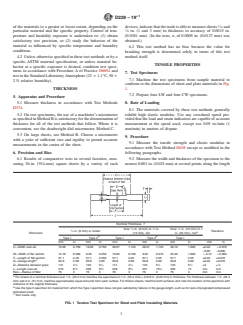
7.1 Machine the test specimens from sample material to
2 % relative humidity).
conform to the dimensions of sheet and plate materials in Fig.
THICKNESS 1.
7.2 Prepare four LW and four CW specimens.
5. Apparatus and Procedure
5.1 Measure thickness in accordance with Test Methods 8. Rate of Loading
D374.
8.1 The materials covered by these test methods generally
5.2 On test specimens, the use of a machinist’s micrometer exhibit high elastic modulus. Use any crosshead speed pro-
as specified in Method B is satisfactory for the determination of vided that the load and strain indicators are capable of accurate
thickness for all of the test methods that follow. Where it is measurement at the speed used, except use 0.05 in./min (1
convenient, use the deadweight dial micrometer, Method C. mm/min) in matters of dispute.
5.3 On large sheets, use Method B. Choose a micrometer
9. Procedure
with a yoke of sufficient size and rigidity to permit accurate
9.1 Measure the tensile strength and elastic modulus in
measurements in the center of the sheet.
accordance with Test Method D638 except as modified in the
6. Precision and Bias following paragraphs.
6.1 Results of comparative tests in several factories, mea- 9.2 Measure the width and thickness of the specimen to the
suring 36-in. (914-mm) square sheets by a variety of such nearest 0.001 in. (0.025 mm) at several points along the length
Nominal Thickness, T
1 1 1
Over ⁄4 in. (6 mm) to ⁄2 in. Over ⁄2 in. (13 mm) to 1
⁄4 in. (6 mm) or Under Tolerance
A
(13 mm), incl in. (25 mm), incl
Dimension
B B
Type I Type II Type I Type II Type I
mm in. mm in. mm in. mm in. mm in. mm in.
C—Width over-all 19.05 0.750 19.05 0.750 28.57 1.125 28.57 1.125 38.10 1.500 ±0.40 + 0.016
−0.00 −0.000
W—Width of flat section 12.70 0.500 6.35 0.250 19.05 0.750 9.52 0.375 25.40 1.000 + 0.12 + 0.005
F—Length of flat section 57.1 2.25 57.1 2.250 57.1 2.25 57.1 2.25 57.1 2.25 ±0.40 ±0.016
C
G—Gauge length 50.8 2.00 50.8 2.00 50.8 2.00 50.8 2.00 50.8 2.00 ±0.40 ±0.016
1 1 1 1 1 1
D—Distance between grips 114 4 ⁄2 133 5 ⁄4 114 4 ⁄2 133 5 ⁄4 133 5 ⁄4 ±3 ± ⁄8
1 3 3 1
L—Length over-all 216 8 ⁄2 238 9 ⁄8 248 9 ⁄4 257 10 ⁄8 305 12 min min
Rad.—Radius of fillet 76 3 76 3 76 3 76 3 76 3 min min
A
For sheets of a nominal thickness over 1 in. (25.4 mm) machine the specimens to 1 in. (25.4 mm) ± 0.010 in. (0.25 mm) in thickness. For thickness between 1 in. (25.4
mm) and 2 in. (51 mm), machine approximately equal amounts from each surface. For thicker sheets, machine both surfaces and note the location of the specimen with
reference to the original thickness.
B
Use the type II specimen for material from which the Type I specimen does not give satisfactory failures in the gauge length, such as for resin-impregnated compressed
laminated wood.
C
Test marks only.
FIG. 1 Tension Test Specimen for Sheet and Plate Insulating Materials
´1
D229 − 19
of the flat section, which is indicated as Dimension F in Fig. 1. 13. Rate of Loading
Record the minimum values of cross-sectional area so deter-
13.1 The materials covered by these test methods generally
mined.
rupture during flexural testing at small deflections. Therefore,
Procedure A (strain rate of 0.01/min) is specified whenever it is
9.3 Place the specimen in the grips of the testing machine,
desired to obtain the modulus of elasticity. Use any crosshead
taking care to align the long axis of the specimen and the grips
speed that produces failure in no less than 1 min when flexural
with an imaginary line joining the points of attachment of the
strength only is desired, provided that the load indicator is
grips to the machine. Allow 0.25 in. (6.3 mm) between the ends
capable of accurately indicating the load at the speed used, and
of the gripping surfaces and the shoulders of the fillet of the flat
except that in all matters of dispute, a crosshead speed that
test specimen; thus, it is important that the ends of the gripping
surfaces be the indicated distance apart, as shown in Fig. 1, at produces the strain rate specified in Procedure A shall be
considered to be the referee speed.
the start of the test. Tighten the grips evenly and firmly to the
degree necessary to prevent slippage of the specimen during
14. Procedure
the test, but not to the point where the specimen would be
crushed. 14.1 Measure the flexural strength and modulus of elasticity
in accordance with Procedure A of Test Methods D790, except
9.4 Tensile Strength—Set the rate of loading. Load the
that where modulus of elasticity is desired use a load-deflection
specimen at the indicated rate until the specimen ruptures.
recorder with appropriate deflection transmitter.
Record the maximum load (usually the load at rupture).
15. Report
9.5 Elastic Modulus—When elastic modulus is desired, use
a load-extension recorder with appropriate extension transmit-
15.1 Report the following information:
ter and proceed as in 9.3. Attach the extension transmitter, and
15.1.1 Complete identification of the material tested,
proceed as in 9.4.
15.1.2 Conditioning if other than specified,
15.1.3 Speed of testing if other than Procedure A speed,
10. Report
15.1.4 Calculated flexural strength, average, maximum, and
minimum in lb/in. (MPa), for LW and CW specimens,
10.1 Report the following information:
respectively,
10.1.1 Complete identification of the material tested,
15.1.5 Calculated tangent modulus of elasticity when
10.1.2 Type of test specimen (I or II),
applicable, average, maximum, and minimum, for LW and CW
10.1.3 Conditioning if other than specified,
specimens, respectively, and
10.1.4 Speed of testing,
15.1.6 Any other flexural property calculated from the
10.1.5 Calculated tensile strength, average, maximum, and
measurements obtained.
minimum in lb/in. (MPa), for LW and CW specimens,
respectively, 16. Precision and Bias
10.1.6 Calculated elastic modulus when applicable,
16.1 This test method has been in use for many years, but no
average, maximum, and minimum in lb/in. (MPa), for LW and
statement for precision has been made and no activity is
CW specimens, respectively, and
planned to develop such a statement.
10.1.7 Any other tensile property calculated from the mea-
16.2 This test method has no bias because the value for
surements obtained.
breaking strength is determined solely in terms of this test
method itself. See Test Methods D790 for a discussion of
11. Precision and Bias
precision and bias for testing of flexural properties of plastics.
11.1 This test method has been in use for many years, but no
FLEXURAL PROPERTIES AT ELEVATED
statement for precision has been made and no activity is
TEMPERATURE
planned to develop such a statement.
11.2 This test method has no bias because the value for 17. Scope
breaking strength is determined solely in terms of this test
17.1 This test method covers the determination of flexural
method itself. See Test Method D638 for a discussion of
properties at elevated temperature, and as a function of time of
precision and bias for tensile testing of plastics.
exposure to elevated temperature.
17.2 This international standard was developed in accor-
FLEXURAL PROPERTIES
dance with internationally recognized principles on standard-
ization established in the Decision on Principles for the
12. Test Specimens
Development of International Standards, Guides and Recom-
12.1 Test four LW and four CW specimens machined from
mendations issued by the World Trade Organization Technical
sample material in accordance with Test Methods D790.
Barriers to Trade (TBT) Committee.
12.2 Do not use conventional flexure tests in a flatwise
18. Significance and Use
direction for materials thinner than 1/32 in. (1 mm). Do not use
conventional flexure tests in an edgewise direction for materi- 18.1 This test method provides useful engineering informa-
als thinner than ¼ in. (6 mm). tion for evaluating the mechanical behavior of rigid electrical
´1
D229 − 19
insulation at elevated temperature. When the proper exposure 21. Conditioning
and test temperatures are chosen, depending on the material
21.1 No special conditioning is required for specimens that
and end-use operating temperature, use the test method as one
are to be tested after more than 1-h exposure at elevated
means of indicating relative thermal degradation of rigid
temperature.
insulating materials.
22. Procedure
19. Apparatus
22.1 Adjust the rate of loading in accordance with Section
19.1 Testing Machine—A universal testing machine and
13 and test the specimen in accordance with Section 14.
accessory equipment in accordance with Test Methods D790.
22.2 Age in the flexural test enclosure the specimens that
Apparatus that is exposed to elevated temperature during the
are to be tested 1 h or less after exposure to elevated
test shall be adjusted to function normally at the elevated
temperature.
temperature and, where necessary, accuracy shall be verified by
calibration at the test temperature. 22.3 Exposures at elevated temperature for 15 min or less
shall not include the time (previously determined from the
19.2 Test Enclosure—A test enclosure conforming to the
specimen with the thermocouple) that is required for the
Type I, Grade B, temperature requirements of Specification
specimen to reach the specified temperature. Rather, begin
E197. The test enclosure shall be permitted to rest on the
exposures for intervals of 15 min or less when the specimen
testing machine table, in which case the top shall have a hole
reaches the specified temperature and end when the specified
of sufficient size so that adequate clearance is provided for the
exposure period has expired.
loading nose, or the test enclosure shall be permitted to rest on
22.4 Age in the heat-aging oven the specimens that are
a dolly and contain a cradle which is supported by the loading
exposed to elevated temperature for more than 1 h. Do not
members of the machine.
allow the specimens to cool when removed from the heat-aging
19.3 Heat Aging Oven—A heat aging oven for conditioning
oven, but rather transfer them in the mobile-transfer oven or
specimens at the test temperature for periods of more than 1 h.
wrap them in previously heated thick pad of heat resistant
The oven shall conform to the requirements for Type I, Grade
material. Place them in the flexural test chamber which has
A, units of Specification E197, except with respect to the time
been previously heated to the specified temperature.
constant.
22.5 Consider the flexural test enclosure and accessory
19.4 Specimen Transfer Device—A means of transferring
equipment inside at equilibrium when a dummy specimen
the test specimens from the heat-aging oven to the test fitted with an internal thermocouple, and placed on the
enclosure when testing specimens exposed to elevated tem- supports, has reached the specified temperature, as determined
perature for periods of more than 1 h. Transfer the specimens by the thermocouple measurement. Place test specimens in the
without cooling either in a small mobile transfer oven or flexural test enclosure only after equilibrium has been estab-
lished.
wrapped in previously heated thick pad of heat resistant
material.
23. Report
19.5 Thermocouple—Thermocouple made with No. 30 or
23.1 Report all applicable information plus the following:
28 B & S gauge thermocouple calibration wires to determine
the temperature of the specimen. Any suitable indicating or 23.1.1 Temperature at which the specimens were exposed
recording device shall be used that provides an overall (junc- and tested,
tion and instrument) accuracy of 62°C. 23.1.2 Time of exposure, and
23.1.3 Where sufficient measurements are made, a plot of
20. Test Specimen
flexural strength as ordinate and time at elevated temperature
as abscissa, for each temperature chosen.
20.1 Test the specimen flatwise and lengthwise and machine
from sample material in accordance with Section 12.
24. Precision and Bias
20.2 Where it is desired to evaluate relative thermal
24.1 This test method has been in use for many years, but no
degradation, specimens shall be ⁄8 in. (3 mm) in nominal
statement for precision has been made and no activity is
thickness.
planned to develop such a statement.
20.3 Fit at least one specimen of each thickness for each
24.2 A statement of bias is not available because of the lack
sample material with a hole drilled into an edge that rests
of a standard reference material for this property.
outside the support to a depth of at least ⁄2 in. (13 mm). Insert
the thermocouple junction in this hole and cement. Use this
COMPRESSIVE STRENGTH
specimen to determine the temperature of the specimen on the
support and the time required to reach the specified tempera-
25. Procedure
ture for specimens that are tested after 15-min exposure or less.
25.1 Determine the compressive strength in accordance
20.4 Test five specimens at each temperature. with Test Method D695, except test four specimens.
´1
D229 − 19
RESISTANCE TO IMPACT length by the thickness of the material. Minimum thickness of
the material shall be ⁄8 in. (3 mm). Using a twist drill with a
26. Procedure
point angle of 60 to 90°, drill a hole in the approximate center
of the 1-in. (25-mm) length in a direction parallel with the flat
26.1 Determine the resistance to impact in accordance with
sides, to a depth of ⁄16 in. (11 mm), leaving a thickness of
Test Methods D256, using Method A or C, whichever is
⁄16 in. (1.6 mm) to be tested. Insert a snug-fitting metal pin
applicable, except test four specimens conditioned in accor-
electrode, with the end ground to conform with the shape of the
dance with 4.2 of these test methods.
drill used in the hole. Place the specimen on a flat metal plate
WATER ABSORPTION
that is at least 1 ⁄2 in. (38 mm) in diameter. This plate serves as
the lower electrode. Thus, in effect, the material is tested
27. Procedure
parallel with the flat sides in a point-plane dielectric gap. The
27.1 Determine the water absorption in accordance with
diameter of the hole shall be as shown in the following table:
Test Method D570, except test all sample material for water-
Nominal Hole Diameter for Pin
soluble matter unless it has been previously demonstrated by Nominal Thickness of Sheets Electrode
test that there is negligible water-soluble matter in the sample.
1 1 1
⁄8 to ⁄4 in. (3 to 6 mm) ⁄16 in. (1.6 mm)
Test four specimens. 1 1
> ⁄4 in. (6 mm) ⁄8 in. (3 mm)
29.3 Parallel Test, Tapered-Pin Method:
DIELECTRIC STRENGTH
29.3.1 Significance—Sheet and plate insulation, particularly
laminated sheets, are frequently used in service in a manner
28. Surrounding Medium
such that the full thickness of the insulation is exposed to a
28.1 Except as noted below, perform tests in a surrounding
voltage stress parallel to the flat sides between pin-type inserts.
medium of transformer oil meeting all of the requirements for
This method (employing tapered-pin electrodes) is
Type I mineral oil of Specification D3487. Test at room
recommended, rather than the method in 29.2, when it is
temperature, unless otherwise specified.
desired to simulate the service condition described and when
NOTE 1—A liquid medium is specified to obtain breakdown of a
the need for obtaining quantitative dielectric breakdown data is
reasonable size test specimen rather than flashover in the medium. Testing
secondary to acceptance and quality control needs.
in a liquid medium limits the likelihood of flashover but will not always
29.3.2 Nature of Test—The tapered-pin electrodes extend
prevent it, especially with the tapered-pin method.
beyond the test specimen on both flat sides. Therefore, it is
Transverse tests performed in an air medium will generally result in
lower breakdown values than transverse tests performed in the liquid
possible that oil-medium flashover or oil-specimen interface
medium. This is particularly true when porous materials are tested. It is
failure will obscure specimen volume dielectric breakdown.
possible that tests performed in the liquid medium on specimens that have
This method is suited, consequently, for use primarily as a
been thermally aged will produce misleading conclusions when change in
proof-type test, that is, to determine only that a material will
dielectric strength is utilized as a criterion of thermal degradation.
withstand without failure a specified minimum electric stress
Transverse tests in air for porous materials and thermally aged materials
are encouraged. It is possible to utilize various schemes for potting or
applied in a prescribed manner under specified conditions. In
gasketing the electrodes to prevent flashover. Apparatus is being evaluated
some limited cases, however, (for example, specimens condi-
for use in a standard method for transverse tests in air. See the
tioned in water) it is possible to employ the tapered-pin method
Surrounding Medium section of Test Method D149.
to obtain quantitative specimen dielectric breakdown data.
28.2 In the special case of material tests on parallel-tapered-
When numerous tests are made, it is potentially difficult to
pin configuration where breakdown voltages exceed 50 kV
maintain the oil-medium in such a condition as to obviate
give special attention to the cleanliness, dryness, and tempera-
flashover (with specimen in place between pins spaced 1 in.
ture of the surrounding medium. The substitution of dibutyl
(25 mm) apart) at voltage magnitude above 50 kV. The
phthalate for transformer oil has been found to be satisfactory.
practical limit, therefore, when using an oil-medium is 50 kV.
28.3 During a parallel-tapered-pin test, the breakdown of This limit can be increased to 80 kV by the use of dibutyl
the oil above the specified value for the material is not always phthalate.
a proof that actual specimen breakdown occurred, since the 29.3.3 Test Specimens and Electrodes— The test specimen
specimen surface structure and its permittivity will influence shall be 2 by 3 in. (50 by 75 mm) by the thickness of the sheet.
the breakdown voltage of a given oil between the tapered pins The electrodes shall be USA Standard tapered pins (such as
with specimen in place. Morse, Brown & Sharpe, or Pratt & Whitney) having a taper of
⁄4 in. ⁄ft (20 mm/m). For specimen thicknesses up to and
29. Electrodes and Test Specimens 1
including ⁄2 in. (13 mm), use No. 3 USA Standard tapered
pins 3 in. (76 mm) long and having a diameter of ⁄32 in.
29.1 Transverse Test—Use 2-in. (51-mm) diameter elec-
(5.6 mm) at the large end. For specimen thicknesses over ⁄2 in.
trodes (Type 1 of Test Method D149) for voltage stress applied
(13 mm) up to and including 2 in. (51 mm), use No. 4 USA
perpendicular to the flat side of the specimen. The test
Standard Pins 4 in. (102 mm) long having a diameter at the
specimen shall be of such size that flashover in the oil medium
1 3
large end of ⁄4 in. (6 mm). Drill two ⁄16-in. (5-mm) diameter
does not occur before specimen breakdown. In general, a 4-in.
(102-mm) square will be satisfactory.
29.2 Parallel Test, Point-Plane Method— The test speci-
For information on tapered pins, see Kent’s Mechanical Engineers’ Handbook,
mens shall be ⁄2 in. (13 mm) in width by 1 in. (25 mm) in 12th edition, Design and Production Volume, Section 15, p. 14.
´1
D229 − 19
holes, centrally located, 1 in. (25 mm) apart, center to center,
Breakdown Voltage by Rate of Test Voltage Rise, V/s
Short-Time Method, kV
and perpendicular to the faces of the specimen. Ream the holes
to a sufficient depth to allow the pins to extend approximately
25 or less 17
1 in. (25 mm) from the small ends of the holes. Insert the Over 25 to 50, incl 33
Over 50 to 100, incl 83
electrodes from opposite sides of the specimen, after the
Over 100 167
conditioning period. Metal spheres of ⁄2 in. (13-mm) diameter
31.4 Proof-Type Test—Make the tests by either the step-by-
placed on the extremities of the tapered pins have the potential,
step or the slow-rate-of-rise method as follows:
in some cases, to decrease the tendency to flashover in the oil.
31.4.1 Step-by-Step Method—Starting at the prescribed per-
centage of the minimum failure voltage as specified in the
30. Conditioning
appropriate material specification, increase the test voltage in
1-min steps. Use test voltage increments of 1.0 kV for starting
30.1 Condition five specimens in accordance with Section
voltages of 12.5 kV or less, 2.0 kV for starting voltages over
4. In the case of the Parallel Test, Tapered Pin Method, tests are
12.5 to 25 kV, inclusive, and 5.0 kV for starting voltages over
usually performed on unconditioned specimens. However, in
25 kV. Hold the test voltage for 1 min at the specified minimum
determining the effects of exposure to moisture or water using
failure voltage.
this test, Procedure E of Practice D6054 is recommended.
31.4.2 Slow-Rate-of-Rise Method—Starting at the pre-
scribed percentage of the minimum failure voltages specified in
31. Procedure
the appropriate material specification, increase the test voltage
31.1 Warning: Lethal voltages are potentially present dur-
at a uniform rate as indicated until the specified minimum
ing this test. It is essential that the test apparatus, and all
failure voltage is reached. Calculate the slow rate-of-rise, in
associated equipment electrically connected to it, be properly volts per second, as follows:
designed and installed for safe operation. Solidly ground all
Slow rate 2 of 2 rise, V/s 5 ~V 2 V !/~n × 60! (1)
f s
electrically conductive parts that any person might come into
where:
contact with during the test. Provide means for use at the
V = specified minimum failure voltage,
completion of any test to ground any parts which: were at high
f
V = starting voltage, and
voltage during the test; have potentially acquired an induced s
n = total number of 1-min steps that would be obtained
charge during the test; potentially retain a charge even after
using the step-by-step method of 31.4.1.
disconnection of the voltage source. Thoroughly instruct all
operators in the proper way to conduct tests safely. When
32. Report
making high voltage tests, particularly in compressed gas or in
32.1 Report the following information:
oil, the energy released at breakdown has the potential to be
32.1.1 Material identification,
sufficient to result in fire, explosion, or rupture of the test
32.1.2 Method used (from Section 29),
chamber. Design test equipment, test chambers, and test
32.1.3 Nature of surrounding medium,
specimens so as to minimize the possibility of such occur-
32.1.4 Temperature of the solid specimen before applying
rences and to eliminate the possibility of personal injury.
voltage,
31.2 Determine the dielectric strength, dielectric breakdown
32.1.5 Method of voltage application (from Section 31),
voltage, and dielectric proof-type test in accordance with Test
32.1.6 Thickness of the test specimen,
Method D149, except as follows: Make the tests perpendicular 32.1.7 Individual and average dielectric strength values in
to or parallel with the flat sides, or both, depending upon volts per mil (kilovolts per millimetre) for the Transverse Test
whether the stress on the material when in use is to be and the Parallel Test, Point Plane Method, and
perpendicular to or parallel with the flat sides, or both. 32.1.8 Individual and average dielectric breakdown volt-
ages in kilovolts for the Parallel Test, Tapered Pin Method.
31.3 Make the tests by either the short-time method, the
step-by-step method, or the slow-rate-of-rise method as fol-
33. Precision and Bias
lows:
33.1 This test method has been in use for many years, but no
31.3.1 Short-Time Method—Increase the voltage at the rate
statement for precision has been made and no activity is
of 0.5 kV/s.
planned to develop such a statement.
31.3.2 Step-by-Step Method—Apply the voltage at each step
33.2 A statement of bias is not available because of the lack
for 1 min and increase it in the following increments:
of a standard reference material for this property.
Breakdown Voltage by Increment of Increase of Test
Short-Time Method, kV Voltage, kV
PERMITTIVITY AND DISSIPATION FACTOR
25 or less 1.0
34. Apparatus
Over 25 to 50, incl 2.0
Over 50 to 100, incl 5.0
34.1 Specimen Holder—A well-designed specimen holder
Over 100 10.0
to support and shield the specimen and provide for connection
31.3.3 Slow-Rate-of-Rise Method—Increase the voltage as
of the electrodes to the terminals of the measuring apparatus is
follows: recommended. Two-terminal and three-terminal holders are
´1
D229 − 19
described in Test Methods D150. A specimen holder for use at 36.3.1 For laminated thermosetting materials, except as
elevated temperatures is described in Methods D1674. specified in 36.3.2, saw standard rectangular specimens from
sheets to the following dimensions for measurements at 1
34.2 Measuring Apparatus—Use a suitable bridge or
MHz:
resonant-circuit apparatus conforming to the requirements of
Thickness of Sheet Size of Specimen
Test Methods D150. The choice of equipment will depend
upon the frequency at which measurements are to be made, and
Up to ⁄64 in. (1.2 mm), incl 2 by 2 in. (50 by 50 mm)
3 3
in certain cases upon the applied voltage gradients when such
Over ⁄64 in. (1.2 mm) to ⁄32 in. (2.4 mm) 3 by 3 in. (75 by 75 mm)
3 1
Over ⁄32 in. (2.4 mm) to ⁄4 in. (6.4 mm) 4 by 4 in. (100 by 100 mm)
are specified.
Over ⁄4 in. (6.4 mm) to 2 in. (50 mm) 4 by 8 in. (100 by 200 mm)
35. Electrodes (see Note 2)
36.3.2 For ultra-thin thermosetting laminates, particularly
of the glass-base type, the specimens for measurements at 1
35.1 Apply electrodes to the specimens. Most of the elec-
MHz shall be small disks accurately die-cut from larger 2-in.
trode materials described in Test Methods D150 are suitable
(50-mm) disks that have been coated previously on both sides
except fired-on silver. Metal foil and conducting silver paint
with conducting silver paint first air-dried at room temperature,
are generally recommended, but use the latter only for mea-
then heated in a circulating-air oven at 50°C for about 30 min,
surements at elevated temperatures. For laminated thermoset-
and finally cooled in a desiccator. The recommended specimen
ting materials to be tested at 1 MHz, use either metal foil
diameters are as follows:
attached by a thin film of petrolatum or conducting silver paint,
Thickness of Sheet Diameter of Specimen
and the electrodes shall completely cover both sides of the
specimen. For testing ultra-thin, that is, up to a thickness of
Up to 0.003 in. (0.07 mm), approximately 0.50 in. (12.5 mm)
about 0.03 in. (0.75 mm), glass-base laminated thermosetting
Over 0.003 in. (0.07 mm) to 0.010 in. (0.25 mm) 0.75 in. (19.0 mm)
Over 0.010 in. (0.25 mm) to 0.030 in. (0.75 mm) 1.00 in. (25.4 mm)
materials, use only conducting silver paint electrodes. When
the same specimen is used for Condition A and for tests after
36.4 Unless otherwise specified, clean specimens in accor-
immersion in water, always remove metal foil electrodes and
dance with the manufacturer’s recommendation prior to appli-
clean off the petrolatum with a suitable solvent before immer- cation of electrodes and conditioning.
sion. Silver paint electrodes, on the other hand, are not
37. Conditioning
removed prior to immersion of specimens in water.
37.1 The permittivity and loss characteristics, especially at
NOTE 2—It has been found that satisfactory permittivity and dissipation
the lower frequencies, of the materials covered by these test
factor measurements can be made on many sheet materials, particularly at
radio frequencies, by the non-contacting electrode techniques (air-gap, methods are significantly affected by conditioning.
liquid displacement, and two-fluid displacement) described in Test Meth-
37.2 Unless otherwise specified, condition specimens for at
ods D150 when appropriate test cells and liquids are available. Such
least 40 h at 50 % relative humidity, 23°C, immediately prior to
methods are permissible when agreed upon by the parties concerned. No
electrodes of any kind are then applied directly to the test specimens. performance of the electrical tests.
37.3 When water immersion conditions are specified, at the
36. Test Conditions
end of the conditioning period remove each specimen
36.1 Unless otherwise specified, test two specimens of each
separately, wipe or blot with lint-free absorbent paper towels,
material.
and test within approximately 2 or 3 min after removal from
36.2 The thickness of the specimens is usually the manu-
the water.
factured thickness of the sheet, but it is potentially necessary
38. Procedure
and is permissible to machine very thick specimens down to a
usable thickness. Determine the thickness in accordance with
38.1 Measure the permittivity and dissipation factor in
Section 5, except in the cases of ultra-thin thermosetting
accordance with Test Methods D150, in the Standard Labora-
glass-base laminates, calculate the mean effective thicknesses
tory Atmosphere of 50 6 2 % relative humidity, 23 6 1°C. Use
from the mass in grams and density in grams per cubic
other temperatures and humidities to meet special require-
centimetre of accurately die-cut disks 2.00 in. (50.8 mm) in
ments. Follow instructions given in manuals provided by
diameter, as follows:
manufacturers of testing apparatus employed.
thickness 5 ~0.01942 × mass/density! in. (2)
38.2 In the case of the small disk specimens of ultra-thin
laminates at 1 MHz, support the specimen directly on the
5 0.04933 × mass/density mm
~ !
high-voltage terminal of the apparatus and connect the speci-
Determine the densities of the 2.00-in. disks in accordance men to the low-voltage or ground terminal by means of a small
with Test Methods D792. spring bronze clip attached to a banana plug. Place a coin or
similar metal disk, smaller than the specimen, between the free
36.3 Generally, specimens shall be of such size as is
end of the clip and the low voltage or ground electrode to
practicable with the apparatus used. For measurements at
improve contact and avoid damage to the specimen. In calcu-
frequencies up to about 1 MHz, it is recommended that the
lations of the permittivities of these small disk specimens,
specimens be of such size that the measured capacitances will
neglect the correction for edge capacitance.
be in the approximate range from 50 to 150 picofarads (pF). At
higher frequencies, smaller specimens giving capacitances of 38.3 When measurements are made at commercial power
10 to 30 pF, approximately, will be required. frequencies, it is possible that relatively high voltages will have
´1
D229 − 19
to be used to obtain adequate sensitivity or to meet a require- 40. Precision and Bias
ment that tests be made at a specified voltage gradient on the
40.1 This test method has been in use for many years, but no
specimen. The applied voltage shall not exceed the limitations
statement for precision has been made and no activity is
of the instrument used, and must be below the corona starting
planned to develop such a statement.
voltage of the specimen-electrode system.
40.2 A statement of bias is not available because of the lack
39. Report
of a standard reference material for this property.
39.1 Report the following information:
INSULATION RESISTANCE AND RESISTIVITY
39.1.1 Description of the material tested, including the
thickness,
41. Electrodes
39.1.2 Specimen size and type of electrodes employed,
39.1.3 Temperature and relative humidity during test, 41.1 Electrodes for Volume and Surface Resistance —Apply
39.1.4 Permittivity and dissipation factor of each specimen, air drying or baking conductive silver paint to the test
and the averages, for each test frequency and testing condition, specimen, approximately centered, in accordance with Fig. 2 of
and Test Methods D257, with the following dimensions:
39.1.5 Voltage applied to specimen during test. D = 2 in. (51 mm)
FIG. 2 Insulation Resistance and Resistivity Specimen Holder Brought Through Split-Type Removable Oven Door
´1
D229 − 19
D = 2 ⁄2 in. (63.5 mm) accordance with Practice D5032. Fit the chamber containing
D = 3 in. (76 mm) the solution with holders to support the specimen and make
electrical connection for the resistance measurement. Ther-
NOTE 3—Some materials are metal clad. It is potentially desirable to
mally insulate the chamber to prevent sudden temperature
utilize the metal foil clad to the insulating material for electrodes. In this
changes that can cause precipitation inside the chamber. Fit the
event, follow specifications applicable to the specific material for etching
the clad foil into a suitable electrode pattern.
chamber with a small blower or propeller to circulate the air
inside. Place the thermally insulated chamber inside an oven
41.2 Electrodes for Insulation Resistance—Metal electrodes
maintained at the specified temperature. Fig. 4 illustrates a
in accordance with Fig. 3 of Test Methods D257 for materials
suitable humidity test enclosure.
⁄32 in. (1 mm) or more in thickness, and in accordance with
Fig. 1 of Test Methods D257 for thinner materials, shall be
43.3 Constant-Temperature Oven—The oven used for el-
used.
evated temperature resistance measurements shall conform to
the Grade B requirements of Specification E197, except for the
42. Test Specimen
time constant. Fit the oven with holders to support the
42.1 The surface resistance, and therefore also insul
...