

ASTM D5366-23
(Test Method)Standard Test Method for Determining the Dynamic Performance of a Wind Vane
General Information
- Abstract
SIGNIFICANCE AND USE
5.1 This test method provides a standard for comparison of wind vanes of different types. Specifications by regulatory agencies and industrial societies (3-5) have stipulated performance values. This test method provides an unambiguous method for measuring starting threshold, delay distance, and overshoot ratio.
SCOPE
1.1 This test method covers the determination of the starting threshold, delay distance, and overshoot ratio of a wind vane from direct measurements in a wind tunnel. This test method is applicable only to wind vanes having measurable overshoot.
1.2 This test method provides for determination of the performance of a system consisting of a wind vane and its associated position-to-output transducer in wind tunnel flow. Use of values determined by this test method to describe performance in atmospheric flow of a wind direction measuring system incorporating the vane must be done with an understanding of the differences between the two systems and the two environments.
1.3 The values stated in SI units are to be regarded as standard. No other units of measurement are included in this standard.
1.4 This standard does not purport to address all of the safety concerns, if any, associated with its use. It is the responsibility of the user of this standard to establish appropriate safety, health, and environmental practices and determine the applicability of regulatory limitations prior to use.
1.5 This international standard was developed in accordance with internationally recognized principles on standardization established in the Decision on Principles for the Development of International Standards, Guides and Recommendations issued by the World Trade Organization Technical Barriers to Trade (TBT) Committee.
- Status
- Published
- Publication Date
- 31-Aug-2023
- Technical Committee
- D22 - Air Quality
- Drafting Committee
- D22.11 - Meteorology

Overview
ASTM D5366-23 is the internationally recognized standard test method for determining the dynamic performance of wind vanes. Developed by ASTM, this standard provides precise procedures for measuring three critical aspects of wind vane performance: starting threshold, delay distance, and overshoot ratio. The standard ensures that wind vanes from different manufacturers or designs can be compared using consistent methods, supporting regulatory and industrial requirements for accurate wind direction measurements.
Key Topics
- Starting Threshold: Identifies the lowest wind speed at which a wind vane, released from a fixed offset in a wind tunnel, begins to move toward equilibrium. This parameter is fundamental for assessing the sensitivity of wind vanes in detecting slight changes in wind direction.
- Delay Distance: Measures the distance air travels past the wind vane during the time it takes the vane to reach 50% of its initial displacement following release. This calculation is vital for quantifying the response time of the wind vane.
- Overshoot Ratio: Assesses the vane’s tendency to oscillate by comparing the amplitude of successive overshoots after displacement. This helps in understanding the damping characteristics and stability of the wind direction sensor.
- Wind Tunnel Testing: The method is explicitly intended for laboratory settings using wind tunnels, ensuring controlled and repeatable conditions for evaluating wind vane systems.
- Applicable to Vane and Transducer System: The standard addresses the performance of the entire wind direction measuring system, including the wind vane and its associated position-to-output transducer.
Applications
ASTM D5366-23 finds practical application across industries and sectors where accurate wind direction measurement is critical. Typical applications include:
- Meteorological Research: Ensuring reliable wind direction data in weather stations and climate research facilities.
- Environmental Monitoring: Supporting the assessment of pollutant dispersion and compliance with environmental regulations near sensitive sites, such as nuclear power facilities.
- Industrial Safety: Assisting in compliance with industry standards for process control, especially where wind direction impacts safety measures.
- Wind Energy: Evaluating the instrumentation used in wind energy production, ensuring optimal operation and maintenance of turbines.
- Product Development and Quality Assurance: Used by manufacturers and testing laboratories for design validation and performance certification of new or modified wind vanes.
By providing standardized procedures and criteria, ASTM D5366-23 supports the uniform evaluation and quality control of wind direction sensors.
Related Standards
Organizations and practitioners using ASTM D5366-23 may also refer to these related standards:
- ASTM D1356: Terminology relating to sampling and analysis of atmospheres, which helps clarify key concepts and definitions used in D5366.
- ANSI/ANS-3.11: Pertains to meteorological monitoring at nuclear facilities, referencing wind measurement requirements.
- EPA-450/4-87-007: U.S. EPA guidelines for ambient monitoring, including wind direction measurement.
- IAEA Safety Guides: International Atomic Energy Agency guidance on atmospheric dispersion relevant to wind monitoring.
- Low-Speed Wind Tunnel Testing References: For test apparatus calibration and validation procedures.
Practical Value
Adopting ASTM D5366-23 ensures a laboratory’s or manufacturer’s wind vanes meet international benchmarks for sensitivity, response time, and stability. It facilitates regulatory compliance, enhances the comparability of data, and underpins the reliability of critical meteorological and environmental measurements. The use of SI units throughout supports global adoption and interoperability in diverse operational contexts.
Keywords: wind vane, dynamic performance, starting threshold, delay distance, overshoot ratio, wind tunnel testing, ASTM D5366-23, wind direction measurement, meteorological instruments, standard test method.
Relations
- Effective Date
- 01-Sep-2020
- Effective Date
- 15-Mar-2020
- Effective Date
- 15-Oct-2015
- Effective Date
- 01-Jul-2015
- Effective Date
- 01-Dec-2014
- Effective Date
- 01-May-2014
- Effective Date
- 15-Jan-2014
- Effective Date
- 01-Apr-2010
- Effective Date
- 01-May-2005
- Effective Date
- 10-Nov-2000
Get Certified
Connect with accredited certification bodies for this standard

DNV
DNV is an independent assurance and risk management provider.

Lloyd's Register
Lloyd's Register is a global professional services organisation specialising in engineering and technology.
DNV Energy Systems
Energy and renewable energy certification.
Sponsored listings
Frequently Asked Questions
ASTM D5366-23 is a standard published by ASTM International. Its full title is "Standard Test Method for Determining the Dynamic Performance of a Wind Vane". This standard covers: SIGNIFICANCE AND USE 5.1 This test method provides a standard for comparison of wind vanes of different types. Specifications by regulatory agencies and industrial societies (3-5) have stipulated performance values. This test method provides an unambiguous method for measuring starting threshold, delay distance, and overshoot ratio. SCOPE 1.1 This test method covers the determination of the starting threshold, delay distance, and overshoot ratio of a wind vane from direct measurements in a wind tunnel. This test method is applicable only to wind vanes having measurable overshoot. 1.2 This test method provides for determination of the performance of a system consisting of a wind vane and its associated position-to-output transducer in wind tunnel flow. Use of values determined by this test method to describe performance in atmospheric flow of a wind direction measuring system incorporating the vane must be done with an understanding of the differences between the two systems and the two environments. 1.3 The values stated in SI units are to be regarded as standard. No other units of measurement are included in this standard. 1.4 This standard does not purport to address all of the safety concerns, if any, associated with its use. It is the responsibility of the user of this standard to establish appropriate safety, health, and environmental practices and determine the applicability of regulatory limitations prior to use. 1.5 This international standard was developed in accordance with internationally recognized principles on standardization established in the Decision on Principles for the Development of International Standards, Guides and Recommendations issued by the World Trade Organization Technical Barriers to Trade (TBT) Committee.
SIGNIFICANCE AND USE 5.1 This test method provides a standard for comparison of wind vanes of different types. Specifications by regulatory agencies and industrial societies (3-5) have stipulated performance values. This test method provides an unambiguous method for measuring starting threshold, delay distance, and overshoot ratio. SCOPE 1.1 This test method covers the determination of the starting threshold, delay distance, and overshoot ratio of a wind vane from direct measurements in a wind tunnel. This test method is applicable only to wind vanes having measurable overshoot. 1.2 This test method provides for determination of the performance of a system consisting of a wind vane and its associated position-to-output transducer in wind tunnel flow. Use of values determined by this test method to describe performance in atmospheric flow of a wind direction measuring system incorporating the vane must be done with an understanding of the differences between the two systems and the two environments. 1.3 The values stated in SI units are to be regarded as standard. No other units of measurement are included in this standard. 1.4 This standard does not purport to address all of the safety concerns, if any, associated with its use. It is the responsibility of the user of this standard to establish appropriate safety, health, and environmental practices and determine the applicability of regulatory limitations prior to use. 1.5 This international standard was developed in accordance with internationally recognized principles on standardization established in the Decision on Principles for the Development of International Standards, Guides and Recommendations issued by the World Trade Organization Technical Barriers to Trade (TBT) Committee.
ASTM D5366-23 is classified under the following ICS (International Classification for Standards) categories: 27.180 - Wind turbine energy systems. The ICS classification helps identify the subject area and facilitates finding related standards.
ASTM D5366-23 has the following relationships with other standards: It is inter standard links to ASTM D1356-20a, ASTM D1356-20, ASTM D1356-15a, ASTM D1356-15, ASTM D1356-14b, ASTM D1356-14a, ASTM D1356-14, ASTM D1356-05(2010), ASTM D1356-05, ASTM D1356-00a. Understanding these relationships helps ensure you are using the most current and applicable version of the standard.
ASTM D5366-23 is available in PDF format for immediate download after purchase. The document can be added to your cart and obtained through the secure checkout process. Digital delivery ensures instant access to the complete standard document.
Standards Content (Sample)
This international standard was developed in accordance with internationally recognized principles on standardization established in the Decision on Principles for the
Development of International Standards, Guides and Recommendations issued by the World Trade Organization Technical Barriers to Trade (TBT) Committee.
Designation: D5366 − 23
Standard Test Method for
Determining the Dynamic Performance of a Wind Vane
This standard is issued under the fixed designation D5366; the number immediately following the designation indicates the year of
original adoption or, in the case of revision, the year of last revision. A number in parentheses indicates the year of last reapproval. A
superscript epsilon (´) indicates an editorial change since the last revision or reapproval.
1. Scope 3. Terminology
1.1 This test method covers the determination of the starting
3.1 Refer to Terminology D1356 for general terms and their
threshold, delay distance, and overshoot ratio of a wind vane
definitions.
from direct measurements in a wind tunnel. This test method is
3.2 Definitions of Terms Specific to This Standard:
applicable only to wind vanes having measurable overshoot.
3.2.1 delay distance (D), n—the distance air flows past a
1.2 This test method provides for determination of the
wind vane during the time it takes the vane to return to 50 %
performance of a system consisting of a wind vane and its
of the initial displacement.
associated position-to-output transducer in wind tunnel flow.
3.2.2 overshoot (θ ), n—the amplitude of a deflection of a
n
Use of values determined by this test method to describe
wind vane as it oscillates about θ after release from an initial
B
performance in atmospheric flow of a wind direction measur-
displacement.
ing system incorporating the vane must be done with an
understanding of the differences between the two systems and
3.2.3 overshoot ratio (Ω), n—the ratio of two successive
the two environments.
overshoots, as expressed by the equation:
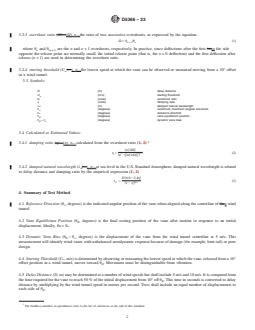
1.3 The values stated in SI units are to be regarded as Ω 5 θ /θ (1)
~n11! n
standard. No other units of measurement are included in this
where θ and θ are the n and n + 1 overshoots, respec-
n (n+1)
standard.
tively. In practice, since deflections after the first to the side
1.4 This standard does not purport to address all of the
opposite the release point are normally small, the initial re-
safety concerns, if any, associated with its use. It is the
lease point (that is, the n = 0 deflection) and the first deflec-
responsibility of the user of this standard to establish appro-
tion after release (n = 1) are used in determining the over-
priate safety, health, and environmental practices and deter-
shoot ratio.
mine the applicability of regulatory limitations prior to use.
3.2.4 starting threshold (U ), n—the lowest speed at which
o
1.5 This international standard was developed in accor-
the vane can be observed or measured moving from a 10° offset
dance with internationally recognized principles on standard-
in a wind tunnel.
ization established in the Decision on Principles for the
3.3 Symbols:
Development of International Standards, Guides and Recom-
mendations issued by the World Trade Organization Technical
D (m) delay distance
U (m/s) starting threshold
Barriers to Trade (TBT) Committee. o
Ω (none) overshoot ratio
η (none) damping ratio
2. Referenced Documents
λ (m) damped natural wavelength
d
θ (degrees) overshoot; maximum angular excursion
n
2.1 ASTM Standards: θ (degrees) reference direction
o
θ (degrees) vane equilibrium position
B
D1356 Terminology Relating to Sampling and Analysis of
θ − θ (degrees) dynamic vane bias
B o
Atmospheres
3.4 Calculated or Estimated Values:
3.4.1 damping ratio (η), n—calculated from the overshoot
ratio (1, 2).
This test method is under the jurisdiction of ASTM Committee D22 on Air
Quality and is the direct responsibility of Subcommittee D22.11 on Meteorology.
ln~1/Ω!
Current edition approved Sept. 1, 2023. Published September 2023. Originally
η 5 (2)
2 2 0.5
π 1 ln 1/Ω
~ @ ~ !# !
approved in 1993. Last previous edition approved in 2017 as D5366 – 96 (2017).
DOI: 10.1520/D5366-23.
For referenced ASTM standards, visit the ASTM website, www.astm.org, or
contact ASTM Customer Service at service@astm.org. For Annual Book of ASTM
Standards volume information, refer to the standard’s Document Summary page on The boldface numbers in parentheses refer to the list of references at the end of
the ASTM website. this standard.
Copyright © ASTM International, 100 Barr Harbor Drive, PO Box C700, West Conshohocken, PA 19428-2959. United States
D5366 − 23
3.4.2 damped natural wavelength (λ ), n—at sea level in the 1 % about the mean speed and shall exhibit a turbulence of less
d
U.S. Standard Atmosphere, damped natural wavelength is than 1 %. (Warning—Swirl in the wind tunnel may influence
related to delay distance and damping ratio by the empirical starting threshold measurements. Variations in the measure-
expression (1, 2). ment of θ at low speeds, likely, indicate the existence of
B
swirl.)
D 6.0 2 2.4η
~ !
λ 5 (3)
2 0.5 6.1.4 Calibration—The mean flow rate shall be verified at
d
~1 2 η !
the mandatory speeds of 5 m ⁄s and 10 m ⁄s by use of transfer
standards that have been calibrated by the National Institute of
4. Summary of Test Method
Standards and Technology or by a fundamental physical
4.1 Reference Direction (θ , degrees) is the indicated angu-
o
method.
lar position of the vane when aligned along the centerline of a
6.1.4.1 Speeds below 2 m/s for threshold determination
wind tunnel.
shall be verified by a sensitive anemometer or by some
4.2 Vane Equilibrium Position (θ , degrees) is the final
fundamental time and distance technique, such as measuring
B
resting position of the vane after motion in response to an
the transition time of smoke puffs, soap bubbles, or heat puffs
initial displacement. Ideally, θ = θ .
between two points separated by a known distance.
B o
6.1.5 Environment—The temperature and pressure of the
4.3 Dynamic Vane Bias (θ − θ , degrees) is the displace-
B o
environment within the wind tunnel test section shall be
ment of the vane from the wind tunnel centerline at 5 m/s. This
reported. Differences of greater than 3 % in the density of air
measurement will identify wind vanes with unbalanced aero-
within the test environment may result in poor inter-
dynamic response because of damage (for example, bent tail)
comparability of independent measurements of starting
or poor design.
threshold, delay distance, and overshoot ratio since these
4.4 Starting Threshold (U , m/s) is determined by observing
o
values are density dependent.
or measuring the lowest speed at which the vane, released from
6.2 Measuring System:
a 10° offset position in a wind tunnel, moves toward θ .
B
6.2.1 Direction—The resolution of the wind vane position-
Movement must be distinguishable from vibration.
–to–output transducer limits the resolution of the measure-
4.5 Delay Distance (D, m) may be determined at a number
ments. The accuracy of the position–to–output conversion shall
of wind speeds but shall include 5 m/s and 10 m/s. It is
be within 60.1°. (Warning—Avoid potentiometer dead spots
computed from the time required for the vane to reach 50 % of
or crossover positions while performing these procedures.)
the initial displacement from 10° off θ . This time in seconds
B
6.2.2 Time—Time resolution shall be consistent with the
is converted to delay distance by multiplying by the wind
distance accuracy required. For this reason, the time resolution
tunnel speed in metres per second. Tests shall include an equal
may change as the wind tunnel speed is changed. For example,
number of displacements to each side of θ .
B
for a distance constant measurement to 0.1 m, one must have
4.6 Overshoot Ratio (Ω) may be determined at the same
a time resolution of 0.05 s at 2 m/s and 0.01 s at 10 m/s. If time
time as the delay distance. The maximum angular excursion on
accuracy is based on commercial electrical power frequency, it
the opposite side of θ from the initial 10° displacement from will be at least an order of magnitude better than the resolution
B
θ is measured. This value is divided by the initial displace-
presented above.
B
ment to obtain Ω.
6.3 Signal Conditioning—Care shall be taken to avoid
electronic circuits in signal conditioning and recording devices
5. Significance and Use
that adversely affect the apparent vane performance.
5.1 This test method provides a standard for comparison of
(Warning—Time constants in signal conditioning and record-
wind vanes of different types. Specifications by regulatory
ing devices shall be less than 0.01 s.)
agencies and industrial societies (3-5) have stipulated perfor-
6.4 Recording Techniques—The measuring or recording
mance values. This test method provides an unambiguous
system sh
...
This document is not an ASTM standard and is intended only to provide the user of an ASTM standard an indication of what changes have been made to the previous version. Because
it may not be technically possible to adequately depict all changes accurately, ASTM recommends that users consult prior editions as appropriate. In all cases only the current version
of the standard as published by ASTM is to be considered the official document.
Designation: D5366 − 96 (Reapproved 2017) D5366 − 23
Standard Test Method for
Determining the Dynamic Performance of a Wind Vane
This standard is issued under the fixed designation D5366; the number immediately following the designation indicates the year of
original adoption or, in the case of revision, the year of last revision. A number in parentheses indicates the year of last reapproval. A
superscript epsilon (´) indicates an editorial change since the last revision or reapproval.
1. Scope
1.1 This test method covers the determination of the starting threshold, delay distance, and overshoot ratio of a wind vane from
direct measurements in a wind tunnel. This test method is applicable only to wind vanes having measurable overshoot.
1.2 This test method provides for determination of the performance of a system consisting of a wind vane and its associated
position-to-output transducer in wind tunnel flow. Use of values determined by this test method to describe performance in
atmospheric flow of a wind direction measuring system incorporating the vane must be done with an understanding of the
differences between the two systems and the two environments.
1.3 The values stated in SI units are to be regarded as standard. No other units of measurement are included in this standard.
1.4 This standard does not purport to address all of the safety concerns, if any, associated with its use. It is the responsibility
of the user of this standard to establish appropriate safety and healthsafety, health, and environmental practices and determine
the applicability of regulatory limitations prior to use.
1.5 This international standard was developed in accordance with internationally recognized principles on standardization
established in the Decision on Principles for the Development of International Standards, Guides and Recommendations issued
by the World Trade Organization Technical Barriers to Trade (TBT) Committee.
2. Referenced Documents
2.1 ASTM Standards:
D1356 Terminology Relating to Sampling and Analysis of Atmospheres
3. Terminology
3.1 For terms that areRefer to Terminology D1356 not defined herein, refer to Terminology for general terms and their
definitions.D1356.
3.2 Definitions:Definitions of Terms Specific to This Standard:
3.2.1 delay distance (D)—(D), n—the distance the air flows past a wind vane during the time it takes the vane to return to 50 %
of the initial displacement.
3.2.2 overshoot (θ )—), n—the amplitude of a deflection of a wind vane as it oscillates about θ after release from an initial
n B
displacement.
This test method is under the jurisdiction of ASTM Committee D22 on Air Quality and is the direct responsibility of Subcommittee D22.11 on Meteorology.
Current edition approved March 15, 2017Sept. 1, 2023. Published March 2017September 2023. Originally approved in 1993. Last previous edition approved in 20112017
as D5366D5366 – 96 (2017). – 96 (2011). DOI: 10.1520/D5366-96R17.DOI: 10.1520/D5366-23.
For referenced ASTM standards, visit the ASTM website, www.astm.org, or contact ASTM Customer Service at service@astm.org. For Annual Book of ASTM Standards
volume information, refer to the standard’s Document Summary page on the ASTM website.
Copyright © ASTM International, 100 Barr Harbor Drive, PO Box C700, West Conshohocken, PA 19428-2959. United States
D5366 − 23
3.2.3 overshoot ratio (Ω)—(Ω), n—the ratio of two successive overshoots, as expressed by the equation:
Ω5 θ /θ (1)
n11 n
~ !
where θ and θ are the n and n + 1 overshoots, respectively. In practice, since deflections after the first (toto the side
n (n+1)
opposite the release point are normally small, the initial release point (that is, the n = 0 deflection) and the first deflection after
release (n = 1) are used in determining the overshoot ratio.
3.2.4 starting threshold (U )—), n—the lowest speed at which the vane can be observed or measured moving from a 10° offset
o
in a wind tunnel.
3.3 Symbols:
D (m) delay distance
U (m/s) starting threshold
o
Ω (none) overshoot ratio
η (none) damping ratio
λ (m) damped natural wavelength
d
θ (degrees) overshoot; maximum angular excursion
n
θ (degrees) reference direction
o
θ (degrees) vane equilibrium position
B
θ − θ (degrees) dynamic vane bias
B o
3.4 Calculated or Estimated Values:
3.4.1 damping ratio (η)—(η), n—calculated from the overshoot ratio (1, 2).
ln 1/Ω
~ !
η5 (2)
2 2 0.5
π 1@ln 1/Ω #
~ ~ ! !
3.4.2 damped natural wavelength (λ )—), n—at sea level in the U.S. Standard Atmosphere, damped natural wavelength is related
d
to delay distance and damping ratio by the empirical expression (1, 2).
D 6.022.4η
~ !
λ 5 (3)
d 2 0.5
~12 η !
4. Summary of Test Method
4.1 Reference Direction (θ , degrees) is the indicated angular position of the vane when aligned along the centerline of thea wind
o
tunnel.
4.2 Vane Equilibrium Position (θ , degrees) is the final resting position of the vane after motion in response to an initial
B
displacement. Ideally, θ = θ .
B o
4.3 Dynamic Vane Bias (θ − θ , degrees) is the displacement of the vane from the wind tunnel centerline at 5 m/s. This
B o
measurement will identify wind vanes with unbalanced aerodynamic response because of damage (for example, bent tail) or poor
design.
4.4 Starting Threshold (U , m/s) is determined by observing or measuring the lowest speed at which the vane, released from a 10°
o
offset position in a wind tunnel, moves toward θ . Movement must be distinguishable from vibration.
B
4.5 Delay Distance (D, m) may be determined at a number of wind speeds but shall include 5 m/s and 10 m/s. It is computed from
the time required for the vane to reach 50 % of the initial displacement from 10° off θ . This time in seconds is converted to delay
B
distance by multiplying by the wind tunnel speed in metres per second. Tests shall include an equal number of displacements to
each side of θ .
B
The boldface numbers in parentheses refer to the list of references at the end of this standard.
D5366 − 23
4.6 Overshoot Ratio (Ω) may be determined at the same time as the delay distance. The maximum angular excursion on the
opposite side of θ from the initial 10° displacement fromθfrom θ is measured. This value is divided by the initial displacement
B B
to obtain Ω.
5. Significance and Use
5.1 This test method will provide provides a standard for comparison of wind vanes of different types. Specifications by regulatory
agencies and industrial societies (3-5) have stipulated performance values. This test method provides an unambiguous method for
measuring starting threshold, delay distance, and overshoot ratio.
6. Apparatus
6.1 Wind Tunnel (6):
6.1.1 Size—The wind tunnel shall be large enough so that the total projected area of supports, sensor apparatus, and the vane in
its displaced position is less than 5 % of the cross-sectional area of its test section.
6.1.2 Speed Range—The wind tunnel shall have a speed control that will allow the flow rate to be varied from 0 to at least 10 m/s.
The speed control shall maintain the flow rate within 60.2 m/s.
6.1.3 Turbulence and Swirl—Across the volume to be occupied by the vane, the flow profile shall vary by no more than 1 % about
the mean speed and shall exhibit a turbulence of less than 1 %. (Warning—Swirl in the wind tunnel may influence starting
threshold measurements. Variations in the measurement of θ a low speeds likelyat low speeds, likely, indicate the existence of
B
swirl.)
6.1.4 Calibration—The mean flow rate shall be verified at the mandatory speeds of 55 m ⁄s and 1010 m m/s ⁄s by use of transfer
standards that have been calibrated by the National Institute of Standards and Technology (formerly called the National Bureau
of Standards) or by a fundamental physical method.
6.1.4.1 Speeds below 2 m/s for threshold determination shall be verified by a sensitive anemometer or by some fundamental time
and distance technique, such as measuring the transition time of smoke puffs, soap bubbles, or heat puffs between two points
separated by a known distance.
6.1.5 Environment—The temperature and pressure of the environment within the wind tunnel test section shall be reported.
Differences of greater than 3 % in the density of air within the test environment may result in poor inter-comparability of
independent measurements of starting threshold, delay distance, and overshoot ratio since these values are density dependent.
6.2 Measuring System:
6.2.1 Direction—The resolution of the wind vane position–to–output transducer limits the resolution of the measurements. The
accuracy of the position–to–output conversion shall be within 60.1°. (Warning—Avoid potentiometer dead spots or crossover
positions while perfo
...