

ASTM F2720/F2720M-20
(Specification)Standard Specification for Glass Fiber Reinforced Polyethylene (PE-GF) Spiral Wound Large Diameter Pipe
General Information
- Abstract
SCOPE
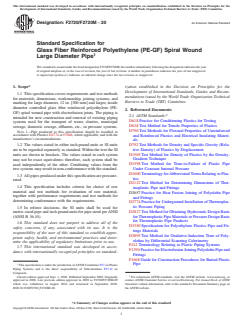
1.1 This specification covers requirements and test methods for materials, dimensions, workmanship, joining systems, and marking for large diameter, 12 in. [300 mm] and larger, inside diameter controlled glass fiber reinforced polyethylene (PE-GF) spiral wound pipe with electrofusion joints. The piping is intended for new construction and renewal of existing piping systems used for the transport of water, slurries, municipal sewage, domestic sewage, effluents, etc., in pressure systems.
Note 1: Pipe produced to this specification should be installed in accordance with Practice D2774 or F1668, where applicable, and with the manufacturer’s recommendations.
1.2 The values stated in either inch-pound units or SI units are to be regarded separately as standard. Within the text the SI units are shown in brackets. The values stated in each system may not be exact equivalents: therefore, each system shall be used independently of the other. Combining values from the two systems may result in non-conformance with the standard.
1.3 All pipes produced under this specification are pressure-rated.
1.4 This specification includes criteria for choice of raw material and test methods for evaluation of raw material, together with performance requirements and test methods for determining conformance with the requirements.
1.5 In referee decisions, the SI units shall be used for metric-sized pipe and inch-pound units for pipe sized per ANSI (ANSI B 36.10).
1.6 This standard does not purport to address all of the safety concerns, if any, associated with its use. It is the responsibility of the user of this standard to establish appropriate safety, health, and environmental practices and determine the applicability of regulatory limitations prior to use.
1.7 This international standard was developed in accordance with internationally recognized principles on standardization established in the Decision on Principles for the Development of International Standards, Guides and Recommendations issued by the World Trade Organization Technical Barriers to Trade (TBT) Committee.
- Status
- Published
- Publication Date
- 31-Aug-2020
- Technical Committee
- F17 - Plastic Piping Systems
- Drafting Committee
- F17.11 - Composite
Overview
ASTM F2720/F2720M-20 sets the standard specification for glass fiber reinforced polyethylene (PE-GF) spiral wound large diameter pipes with electrofusion joints. Developed by ASTM International, this specification addresses the requirements for materials, dimensions, joining systems, marking, and testing for pipes with a controlled inside diameter of 12 inches (300 mm) and larger. The pipes are designed for use in the construction and rehabilitation of pressurized piping systems for transporting water, slurries, sewage, effluents, and similar fluids.
Key Topics
- Materials & Construction
- Specifies PE-GF composite structure for high strength and durability.
- Covers the use of short glass fiber reinforcements within polyethylene.
- Ensures materials, including colorants and additives, meet performance tests for density, tensile strength, and hydrostatic design basis.
- Dimensions
- Provides detailed size and wall thickness requirements for both inch and metric-based systems, ensuring compatibility and standardization.
- Out-of-roundness and laying length specifications support consistent pipe quality and ease of installation.
- Joining System
- Details requirements for electrofusion joints, either as integral bell/spigot ends or couplings, promoting reliable, leak-proof connections during installation.
- Testing & Quality Assurance
- Mandates various test methods (such as ASTM D638 for tensile properties, D790 for flexural properties) to verify compliance.
- Includes sustained pressure tests at ambient and elevated temperatures to assess performance in real-world conditions.
- Sets forth inspection, marking, and sampling procedures for verifiable quality assurance.
Applications
Glass fiber reinforced polyethylene spiral wound pipes compliant with ASTM F2720/F2720M-20 offer significant advantages for a range of infrastructure and industrial projects:
- Municipal Water and Sewage Systems
- Transport of potable water, greywater, municipal sewage, and stormwater.
- Industrial Slurries & Effluent Management
- Suitable for conveying abrasive slurries and industrial effluents in pressure systems thanks to enhanced strength and chemical resistance.
- Infrastructure Rehabilitation
- Ideal for the renewal and relining of existing underground or above-ground pipes, minimizing disruption and enabling cost-effective upgrades.
- Large-Scale Civil Engineering Projects
- Reliable choice for gravity and low-pressure drainage of surface water in tunnels, highways, and urban environments.
Key benefits include:
- Corrosion resistance, extending lifespan compared to traditional materials.
- High strength-to-weight ratio, facilitating easier handling and lowering installation costs.
- Flexible installation, including underground, above-ground, and trenchless methods.
Related Standards
Several referenced standards intersect with or support ASTM F2720/F2720M-20, ensuring harmonization across the industry and facilitating compliance with international best practices:
- ASTM D2774: Practice for Underground Installation of Thermoplastic Pressure Piping
- ASTM F1668: Guide for Construction Procedures for Buried Plastic Pipe
- ASTM D638: Test Method for Tensile Properties of Plastics
- ASTM D790: Test Methods for Flexural Properties of Plastics
- ASTM D792: Test Methods for Density and Specific Gravity of Plastics
- ASTM D2122: Test Method for Determining Dimensions of Thermoplastic Pipe and Fittings
- ASTM D3895: Test Method for Oxidative-Induction Time of Polyolefins
- ASTM F1290: Practice for Electrofusion Joining Polyolefin Pipe and Fittings
- ANSI B36.10: Standard Dimensions of Steel Pipe
- ISO 13479: Polyolefin pipes - Determination of resistance to slow crack growth
Organizations and engineers specifying glass fiber reinforced PE pipes should reference these standards for design, installation, and quality control parameters.
ASTM F2720/F2720M-20 is a critical resource for manufacturers, designers, and contractors aiming to deliver durable, high-performing PE-GF spiral wound pipe infrastructure in water, wastewater, and industrial pipeline projects. Proper application of this standard ensures regulatory compliance, safety, and long-term system reliability.
Relations
- Effective Date
- 01-Apr-2020
- Effective Date
- 01-Jan-2019
- Effective Date
- 01-Jan-2019
- Refers
ASTM D1600-18 - Standard Terminology for Abbreviated Terms Relating to Plastics (Withdrawn 2024) - Effective Date
- 01-Jan-2018
- Effective Date
- 01-Aug-2017
- Effective Date
- 01-Jul-2017
- Effective Date
- 01-Feb-2017
- Effective Date
- 15-Nov-2016
- Effective Date
- 01-Aug-2016
- Effective Date
- 01-Dec-2015
- Effective Date
- 01-Dec-2015
- Effective Date
- 01-Nov-2015
- Effective Date
- 01-Jun-2015
- Refers
ASTM D2122-15 - Standard Test Method for Determining Dimensions of Thermoplastic Pipe and Fittings - Effective Date
- 15-Mar-2015
- Effective Date
- 01-Feb-2014
Get Certified
Connect with accredited certification bodies for this standard

Institut za varilstvo d.o.o. (Welding Institute)
Slovenia's leading welding institute since 1952. ISO 3834, EN 1090, pressure equipment certification, NDT personnel, welder qualification. Only IIW Au
Sponsored listings
Frequently Asked Questions
ASTM F2720/F2720M-20 is a technical specification published by ASTM International. Its full title is "Standard Specification for Glass Fiber Reinforced Polyethylene (PE-GF) Spiral Wound Large Diameter Pipe". This standard covers: SCOPE 1.1 This specification covers requirements and test methods for materials, dimensions, workmanship, joining systems, and marking for large diameter, 12 in. [300 mm] and larger, inside diameter controlled glass fiber reinforced polyethylene (PE-GF) spiral wound pipe with electrofusion joints. The piping is intended for new construction and renewal of existing piping systems used for the transport of water, slurries, municipal sewage, domestic sewage, effluents, etc., in pressure systems. Note 1: Pipe produced to this specification should be installed in accordance with Practice D2774 or F1668, where applicable, and with the manufacturer’s recommendations. 1.2 The values stated in either inch-pound units or SI units are to be regarded separately as standard. Within the text the SI units are shown in brackets. The values stated in each system may not be exact equivalents: therefore, each system shall be used independently of the other. Combining values from the two systems may result in non-conformance with the standard. 1.3 All pipes produced under this specification are pressure-rated. 1.4 This specification includes criteria for choice of raw material and test methods for evaluation of raw material, together with performance requirements and test methods for determining conformance with the requirements. 1.5 In referee decisions, the SI units shall be used for metric-sized pipe and inch-pound units for pipe sized per ANSI (ANSI B 36.10). 1.6 This standard does not purport to address all of the safety concerns, if any, associated with its use. It is the responsibility of the user of this standard to establish appropriate safety, health, and environmental practices and determine the applicability of regulatory limitations prior to use. 1.7 This international standard was developed in accordance with internationally recognized principles on standardization established in the Decision on Principles for the Development of International Standards, Guides and Recommendations issued by the World Trade Organization Technical Barriers to Trade (TBT) Committee.
SCOPE 1.1 This specification covers requirements and test methods for materials, dimensions, workmanship, joining systems, and marking for large diameter, 12 in. [300 mm] and larger, inside diameter controlled glass fiber reinforced polyethylene (PE-GF) spiral wound pipe with electrofusion joints. The piping is intended for new construction and renewal of existing piping systems used for the transport of water, slurries, municipal sewage, domestic sewage, effluents, etc., in pressure systems. Note 1: Pipe produced to this specification should be installed in accordance with Practice D2774 or F1668, where applicable, and with the manufacturer’s recommendations. 1.2 The values stated in either inch-pound units or SI units are to be regarded separately as standard. Within the text the SI units are shown in brackets. The values stated in each system may not be exact equivalents: therefore, each system shall be used independently of the other. Combining values from the two systems may result in non-conformance with the standard. 1.3 All pipes produced under this specification are pressure-rated. 1.4 This specification includes criteria for choice of raw material and test methods for evaluation of raw material, together with performance requirements and test methods for determining conformance with the requirements. 1.5 In referee decisions, the SI units shall be used for metric-sized pipe and inch-pound units for pipe sized per ANSI (ANSI B 36.10). 1.6 This standard does not purport to address all of the safety concerns, if any, associated with its use. It is the responsibility of the user of this standard to establish appropriate safety, health, and environmental practices and determine the applicability of regulatory limitations prior to use. 1.7 This international standard was developed in accordance with internationally recognized principles on standardization established in the Decision on Principles for the Development of International Standards, Guides and Recommendations issued by the World Trade Organization Technical Barriers to Trade (TBT) Committee.
ASTM F2720/F2720M-20 is classified under the following ICS (International Classification for Standards) categories: 23.040.20 - Plastics pipes. The ICS classification helps identify the subject area and facilitates finding related standards.
ASTM F2720/F2720M-20 has the following relationships with other standards: It is inter standard links to ASTM F412-20, ASTM F1290-19, ASTM F412-19, ASTM D1600-18, ASTM F412-17a, ASTM D790-17, ASTM F412-17, ASTM F412-16a, ASTM F412-16, ASTM D790-15e1, ASTM D790-15, ASTM D1598-15, ASTM F412-15, ASTM D2122-15, ASTM D1600-14. Understanding these relationships helps ensure you are using the most current and applicable version of the standard.
ASTM F2720/F2720M-20 is available in PDF format for immediate download after purchase. The document can be added to your cart and obtained through the secure checkout process. Digital delivery ensures instant access to the complete standard document.
Standards Content (Sample)
This international standard was developed in accordance with internationally recognized principles on standardization established in the Decision on Principles for the
Development of International Standards, Guides and Recommendations issued by the World Trade Organization Technical Barriers to Trade (TBT) Committee.
Designation:F2720/F2720M −20 An American National Standard
Standard Specification for
Glass Fiber Reinforced Polyethylene (PE-GF) Spiral Wound
Large Diameter Pipe
ThisstandardisissuedunderthefixeddesignationF2720/F2720M;thenumberimmediatelyfollowingthedesignationindicatestheyear
of original adoption or, in the case of revision, the year of last revision. A number in parentheses indicates the year of last reapproval.
A superscript epsilon (´) indicates an editorial change since the last revision or reapproval.
1. Scope* ization established in the Decision on Principles for the
Development of International Standards, Guides and Recom-
1.1 This specification covers requirements and test methods
mendations issued by the World Trade Organization Technical
for materials, dimensions, workmanship, joining systems, and
Barriers to Trade (TBT) Committee.
marking for large diameter, 12 in. [300 mm] and larger, inside
diameter controlled glass fiber reinforced polyethylene (PE-
2. Referenced Documents
GF) spiral wound pipe with electrofusion joints. The piping is
2.1 ASTM Standards:
intended for new construction and renewal of existing piping
D618 Practice for Conditioning Plastics for Testing
systems used for the transport of water, slurries, municipal
D638 Test Method for Tensile Properties of Plastics
sewage, domestic sewage, effluents, etc., in pressure systems.
D790 Test Methods for Flexural Properties of Unreinforced
NOTE 1—Pipe produced to this specification should be installed in
accordance with Practice D2774 or F1668, where applicable, and with the and Reinforced Plastics and Electrical Insulating Materi-
manufacturer’s recommendations.
als
D792 Test Methods for Density and Specific Gravity (Rela-
1.2 The values stated in either inch-pound units or SI units
tive Density) of Plastics by Displacement
are to be regarded separately as standard.Within the text the SI
D1505 Test Method for Density of Plastics by the Density-
units are shown in brackets. The values stated in each system
Gradient Technique
may not be exact equivalents: therefore, each system shall be
D1598 Test Method for Time-to-Failure of Plastic Pipe
used independently of the other. Combining values from the
Under Constant Internal Pressure
two systems may result in non-conformance with the standard.
D1600 Terminology forAbbreviatedTerms Relating to Plas-
1.3 All pipes produced under this specification are pressure-
tics
rated.
D2122 Test Method for Determining Dimensions of Ther-
1.4 This specification includes criteria for choice of raw
moplastic Pipe and Fittings
material and test methods for evaluation of raw material,
D2657 Practice for Heat Fusion Joining of Polyolefin Pipe
together with performance requirements and test methods for
and Fittings
determining conformance with the requirements.
D2774 PracticeforUndergroundInstallationofThermoplas-
tic Pressure Piping
1.5 In referee decisions, the SI units shall be used for
D2837 Test Method for Obtaining Hydrostatic Design Basis
metric-sizedpipeandinch-poundunitsforpipesizedperANSI
forThermoplasticPipeMaterialsorPressureDesignBasis
(ANSI B 36.10).
for Thermoplastic Pipe Products
1.6 This standard does not purport to address all of the
D3350 Specification for Polyethylene Plastics Pipe and Fit-
safety concerns, if any, associated with its use. It is the
tings Materials
responsibility of the user of this standard to establish appro-
D3895 Test Method for Oxidative-Induction Time of Poly-
priate safety, health, and environmental practices and deter-
olefins by Differential Scanning Calorimetry
mine the applicability of regulatory limitations prior to use.
F412 Terminology Relating to Plastic Piping Systems
1.7 This international standard was developed in accor-
F1290 PracticeforElectrofusionJoiningPolyolefinPipeand
dance with internationally recognized principles on standard-
Fittings
F1668 Guide for Construction Procedures for Buried Plastic
1 Pipe
This specification is under the jurisdiction ofASTM Committee F17 on Plastic
Piping Systems and is the direct responsibility of Subcommittee F17.11 on
Composite.
Current edition approved Sept. 1, 2020. Published September 2020. Originally For referenced ASTM standards, visit the ASTM website, www.astm.org, or
approved in 2008. Last previous edition approved in 2009 as F2720/F2720M-09 contact ASTM Customer Service at service@astm.org. For Annual Book of ASTM
which was withdrawn in August 2016 and reinstated in September 2020. Standards volume information, refer to the standard’s Document Summary page on
DOI:10.1520/F2720_F2720M-20. the ASTM website.
*A Summary of Changes section appears at the end of this standard
Copyright © ASTM International, 100 Barr Harbor Drive, PO Box C700, West Conshohocken, PA 19428-2959. United States
F2720/F2720M−20
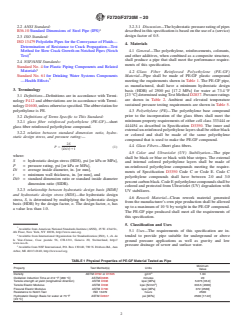
2.2 ANSI Standard: 3.2.3.1 Discussion—Thehydrostaticpressureratingofpipes
B36.10 Standard Dimensions of Steel Pipe (IPS) described in this specification is based on the use of a (service)
design factor of 0.5.
2.3 ISO Standard:
ISO 13479 Polyolefin Pipes for the Conveyance of Fluids—
4. Materials
Determination of Resistance to Crack Propagation—Test
4.1 General—The polyethylene, reinforcements, colorants,
Method for Slow Crack Growth on Notched Pipes (Notch
and other additives, when combined as a composite structure,
Test)
shall produce a pipe that shall meet the performance require-
2.4 NSF/ANSI Standards:
ments of this specification.
Standard No. 4 for Plastic Piping Components and Related
Materials 4.2 Glass Fiber Reinforced Polyethylene (PE-GF)
Standard No. 61 for Drinking Water Systems Components
Material—Pipe shall be made of PE-GF plastic compound
—Health Effects meeting the requirements shown in Table 1. The PE-GF pipe,
as manufactured, shall have a minimum hydrostatic design
3. Terminology
basis (HDB) of 2500 psi [17.2 MPa] for water at 73.4 °F
[23 °C] determined usingTest Method D2837. Pressure ratings
3.1 Definitions—Definitions are in accordance with Termi-
are shown in Table 2. Ambient and elevated temperature
nology F412 and abbreviations are in accordance with Termi-
sustained pressure testing requirements are shown in Table 5.
nologyD1600,unlessotherwisespecified.Theabbreviationfor
polyethylene is PE.
4.3 Polyethylene (PE)—The polyethylene base compound
prior to the incorporation of the glass fibers shall meet the
3.2 Definitions of Terms Specific to This Standard:
minimum property requirements of either cell class 333444 or
3.2.1 glass fiber reinforced polyethylene (PE-GF)—short
444454 as described in Specification D3350. The inner and
glass fiber reinforced polyethylene compound.
external un-reinforced polyethylene layers shall be either black
3.2.2 relation between standard dimension ratio, hydro-
or colored and shall be made of the same polyethylene
static design stress, and pressure rating:—
compound that is used to make the PE-GF compound.
2S
P 5 (1) 4.4 Glass Fibers—Short glass fibers.
Di/t 11
~ !
4.5 Color and Ultraviolet (UV) Stabilization—The pipe
where:
shall be black or blue or black with blue stripes. The external
S = hydrostatic design stress (HDS), psi [or kPa or MPa],
and internal colored polyethylene layers shall be made of
P = pressure rating, psi [or kPa or MPa],
un-reinforced polyethylene compounds meeting the require-
Di = average inside diameter, in. [or mm],
ments of Specification D3350 Code C or Code E. Code C
t = minimum wall thickness, in. [or mm], and
polyethylene compounds shall have between 2.0 and 3.0
Di/t = standard dimension ratio or standard inside diameter
percentcarbonblack.CodeEpolyethylenecompoundsshallbe
dimension ratio (SIDR).
colored and protected from Ultraviolet (UV) degradation with
3.2.3 relationship between hydrostatic design basis [HDB]
UV stabilizers.
and hydrostatic design stress (HDS)—the hydrostatic design
4.6 Rework Material—Clean rework material generated
stress, S, is determined by multiplying the hydrostatic design
from the manufacturer’s own pipe production shall be allowed
basis (HDB) by the design factor, n. The design factor, n, has
up to a maximum of 10 % by weight in the PE-GF compound.
a value less than 1.0.
The PE-GF pipe produced shall meet all the requirements of
this specification.
5. Classification and Uses
Available fromAmerican National Standards Institute (ANSI), 25 W. 43rd St.,
5.1 Uses—The requirements of this specification are in-
4th Floor, New York, NY 10036, http://www.ansi.org.
Available from International Organization for Standardization (ISO), 1, ch. de tended to provide pipe suitable for underground or above
la Voie-Creuse, Case postale 56, CH-1211, Geneva 20, Switzerland, http://
ground pressure applications as well as gravity and low
www.iso.ch.
pressure drainage of sewer and surface water.
Available from NSF International, P.O. Box 130140, 789 N. Dixboro Rd.,Ann
Arbor, MI 48113-0140, http://www.nsf.org.
TABLE 1 Physical Properties of PE-GF Material Tested as Pipe
Minimum
Property Test Method(s) Units
Value
Density ASTM D792 or D1505 g/cm 1.04
Oxidation Induction Time at 412 °F [200 °C] ASTMD3895 minutes 20
Tensile strength at yield (longitudinal direction) ASTM D638 kpsi [MPa] 5.075 [35.0]
Tensile Elastic Modulus ASTM D638 kpsi [N/mm ] 333.5 [2300]
Flexural Elastic Modulus ASTM D790 kpsi [MPa] 372 [2566]
Resistance to Notch Test ISO 13479 hours 2500
Hydrostatic Design Basis for water at 73 °F ASTM D2837 psi [MPa] 2500 [17.22]
[23 °C]
F2720/F2720M−20
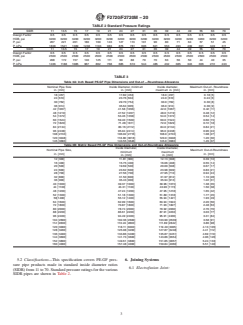
TABLE 2 Standard Pressure Ratings
SIDR 11 13.5 1517192124273135394449556370
Design Factor 0.5 0.5 0.5 0.5 0.5 0.5 0.5 0.5 0.5 0.5 0.5 0.5 0.5 0.5 0.5 0.5
HDB, psi 3200 3200 3200 3200 3200 3200 3200 3200 3200 3200 3200 3200 3200 3200 3200 3200
P, psi 267 221 201 180 160 143 127 113 101 90 80 71 64 57 51 45
P, kPa 1838 1521 1389 1238 1103 983 876 781 696 621 553 493 439 391 349 311
SIDR 11 13.5 1517192124273135394449556370
Design Factor 0.5 0.5 0.5 0.5 0.5 0.5 0.5 0.5 0.5 0.5 0.5 0.5 0.5 0.5 0.5 0.5
HDB, psi 2500 2500 2500 2500 2500 2500 2500 2500 2500 2500 2500 2500 2500 2500 2500 2500
P, psi 208 172 157 140 125 111 99 88 79 70 63 56 50 44 40 35
P, kPa 1436 1188 1085 967 862 768 685 610 544 485 432 385 343 306 272 243
TABLE 3
Table 3A: Inch Based PE-GF Pipe Dimensions and Out-of —Roundness Allowance
Nominal Pipe Size Inside Diameter, minimum Inside diameter, Maximum Out-of- Roundness
in. [mm] in. [mm] maximum in. [mm] in. [mm]
18 [457] 17.82 [453] 18.0 [457] 0.18 [5]
24 [610] 23.76 [604] 24.0 [610] 0.24 [6]
30 [762] 29.70 [754] 30.0 [762] 0.30 [8]
36 [914] 35.64 [905] 36.0 [914] 0.36 [9]
42 [1067] 41.58 [1056] 42.0 [1067] 0.42 [11]
48 [1219] 47.52 [1207] 48.0 [1219] 0.48 [12]
54 [1372] 53.46 [1358] 54.0 [1372] 0.54 [14]
60 [1524] 59.40 [1509] 60.0 [1524] 0.60 [15]
72 [1829] 71.28 [1811] 72.0 [1829] 0.72 [18]
84 [2134] 83.16 [2112] 84.0 [2134] 0.84 [21]
96 [2438] 95.04 [2414] 96.0 [2438] 0.96 [24]
108 [2743] 106.92 [2716] 108.0 [2743] 1.08 [27]
120 [3048] 118.80 [3018] 120.0 [3048] 1.20 [30]
145 [3683] 143.55 [3646] 145.0 [3683] 1.45 [37]
Table 3B: Metric Based PE-GF Pipe Dimensions and Out-of-Roundness Allowance
Inside Diameter, Inside Diameter,
Nominal Pipe Size, Maximum Out-of-Roundness
minimum maximum
in. [mm] in. [mm]
in. [mm] in. [mm]
12 [300] 11.81 [300] 12.13 [308] 0.39 [10]
16 [400] 15.75 [400] 16.06 [408] 0.55 [14]
20 [500] 19.69 [500] 20.00 [508] 0.67 [17]
24 [600] 23.62 [600] 23.98 [609] 0.83 [21]
28 [700] 27.56 [700] 27.95 [710] 0.94 [24]
32 [800] 31.50 [800] 31.97 [812] 1.10 [28]
36 [900] 35.43 [900] 35.94 [913] 1.22 [31]
40 [1000] 39.37 [1000] 39.96 [1015] 1.38 [35]
44 [1100] 43.31 [1100] 43.90 [1115] 1.50 [38]
48 [1200] 47.24 [1200] 47.95 [1218] 1.65 [42]
52 [1300] 51.18 [1300] 51.89 [1318] 1.77 [45]
56[1400] 55.12 [1400] 55.94 [1421] 1.93 [49]
64 [1600] 62.99 [1600] 63.94 [1624] 2.20 [56]
72 [1800] 70.87 [1800] 71.93 [1827] 2.48 [63]
80 [2000] 78.74 [2000] 79.92 [2030] 2.76 [70]
88 [2200] 86.61 [2200] 87.91 [2233] 3.03 [77]
96 [2400] 94.49 [2400] 95.91 [2436] 3.31 [84]
104 [2600] 102.36 [2600] 103.90 [2639] 3.58 [91]
112 [2800] 110.24 [2800] 111.89 [2842] 3.86 [98]
120 [3000] 118.11 [3000] 119.49 [3035] 4.13 [105]
128 [3200] 125.98 [3200] 127.87 [3248] 4.41 [112]
136 [3400] 133.86 [3400] 135.87 [3451] 4.69 [119]
144 [3600] 141.73 [3600] 143.86 [3654] 4.96 [126]
152 [3800] 149.61 [3800] 151.85 [3857] 5.24 [133]
160 [4000] 157.48 [4000] 159.84 [4060] 5.51 [140]
5.2 Classifications—This specification covers PE-GF pres- 6. Joining Systems
sure pipe products made in standard inside diameter ratios
6.1 Electrofusion Joint:
(SIDR) from 11 to 70. Standard pressure ratings for the various
SIDR pipes are shown in Table 2.
F2720/F2720M−20
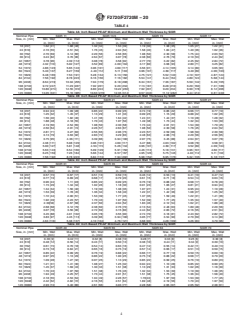
TABLE 4
Table 4A: Inch Based PE-GF Minimum and Maximum Wall Thickness by SIDR
Nominal Pipe SIDR 11 SIDR 13.5 SIDR 15 SIDR 17
Size, in. [mm] Min. Wall Max. Wall Min. Wall Max. Wall Min. Wall Max. Wall Min. Wall Max. Wall
in. [mm] in. [mm] in. [mm] in. [mm] in. [mm] in. [mm] in. [mm] in. [mm]
18 [457] 1.62 [41] 1.88 [48] 1.32 [34] 1.53 [39] 1.19 [30] 1.38 [35] 1.05 [27] 1.22 [31]
24 [610] 2.16 [55] 2.51 [64] 1.76 [45] 2.04 [52] 1.58 [40] 1.84 [47] 1.40 [36] 1.62 [36]
30 [762] 2.70 [69] 3.14 [80] 2.20 [56] 2.56 [65] 1.98 [50] 2.30 [58] 1.75 [44] 2.03 [52]
36 [914] 3.24 [82] 3.76 [96] 2.64 [67] 3.07 [78] 2.38 [60] 2.76 [70] 2.10 [53] 2.44 [62]
42 [1067] 3.78 [96] 4.39 [112] 3.08 [78] 3.58 [92] 2.77 [70] 3.22 [82] 2.45 [62] 2.84 [72]
48 [1219] 4.32 [110] 5.02 [127] 3.52 [89] 4.09 [104] 3.17 [80] 3.68 [93] 2.80 [71] 3.25 [82]
54 [1372] 4.86 [123] 5.65 [143] 3.96 [101] 4.60 [117] 3.56 [91] 4.14 [105] 3.14 [80] 3.65 [93]
60 [1524] 5.40 [137] 6.27 [159] 4.40 [112] 5.11 [130] 3.96 [101] 4.60 [117] 3.49 [89] 4.06 [103]
72 [1829] 6.48 [165] 7.53 [191] 5.28 [134] 6.13 [156] 4.75 [121] 5.52 [140] 4.19 [107] 4.87 [124]
84 [2134] 7.56 [192] 8.78 [223] 6.16 [156] 7.16 [182] 5.54 [141] 6.44 [164] 4.89 [124] 5.68 [144]
96 [2438] 8.64 [219] 10.04 [255] 7.04 [179] 8.18 [208] 6.34 [161] 7.36 [187] 5.59 [142] 6.49 [165]
108 [2743] 9.72 [247] 11.29 [287] 7.92 [201] 9.20 [234] 7.13 [181] 8.28 [210] 6.29 [160] 7.31 [186]
120 [3048] 10.80 [274] 12.55 [319] 8.80 [224] 10.22 [260] 7.92 [201] 9.20 [234] 6.99 [178] 8.12 [206]
145 [3683] 13.05 [331] 15.16 [385] 10.63 [270] 12.35 [314] 9.57 [243] 11.12 [282] 8.44 [214] 9.81 [249]
Table 4B: Inch Based PE-GF Minimum and Maximum Wall Thickness by SIDR
Nominal Pipe SIDR 19 SIDR 21 SIDR 24 SIDR 27
Size, in. [mm] Min. Wall Max. Wall Min. Wall Max. Wall Min. Wall Max. Wall Min. Wall Max. Wall
in. [mm] in. [mm] in. [mm] in. [mm] in. [mm] in. [mm] in. [mm] in. [mm]
18 [457] 0.94 [24] 1.09 [28] 0.85 [22] 0.99 [25] 0.74 [19] 0.86 [22] 0.66 [17] 0.77 [19]
24 [610] 1.25 [32] 1.45 [37] 1.13 [29] 1.31 [33] 0.99 [25] 1.15 [29] 0.88 [22] 1.02 [26]
30 [762] 1.56 [40] 1.82 [46] 1.41 [36] 1.64 [42] 1.24 [31] 1.44 [37] 1.10 [28] 1.28 [32]
36 [914] 1.88 [48] 2.18 [55] 1.70 [43] 1.97 [50] 1.49 [38] 1.73 [44] 1.32 [34] 1.53 [39]
42 [1067] 2.19 [56] 2.54 [65] 1.98 [50] 2.30 [58] 1.73 [44] 2.01 [51] 1.54 [39] 1.79 [45]
48 [1219] 2.50 [64] 2.91 [74] 2.26 [57] 2.63 [67] 1.98 [50] 2.30 [58] 1.76 [45] 2.04 [52]
54 [1372] 2.81 [71] 3.27 [83] 2.55 [65] 2.96 [75] 2.23 [57] 2.59 [66] 1.98 [50] 2.30 [58]
60 [1524] 3.13 [79] 3.63 [92] 2.83 [72] 3.29 [83] 2.48 [63] 2.88 [73] 2.20 [56] 2.56 [65]
72 [1829] 3.75 [95] 4.36 [111] 3.39 [86] 3.94 [100] 2.97 [75] 3.45 [88] 2.64 [67] 3.07 [78]
84 [2134] 4.38 [111] 5.08 [129] 3.96 [101] 4.60 [117] 3.47 [88] 4.03 [102] 3.08 [78] 3.58 [91]
96 [2438] 5.00 [127] 5.81 [148] 4.53 [115] 5.26 [134] 3.96 [101] 4.60 [117] 3.52 [89] 4.09 [104]
108 [2743] 5.63 [143] 6.54 [166] 5.09 [129] 5.91 [150] 4.46 [113] 5.18 [131] 3.96 [101] 4.60 [117]
120 [3048] 6.25 [159] 7.26 [184] 5.66 [144] 6.57 [167] 4.95 [126] 5.75 [146] 4.40 [112] 5.11 [130]
145 [3683] 7.56 [192] 8.78 [223] 6.84 [174] 7.94 [202] 5.98 [152] 6.95 [176] 5.32 [135] 6.18 [157]
Table 4C: Inch Based PE-GF Minimum and Maximum Wall Thickness by SIDR
Nominal Pipe SIDR 31 SIDR 35 SIDR 39 SIDR 44
Size, in. [mm] Min. Wall Max. Wall Min. Wall Max. Wall Min. Wall Max. Wall Min. Wall Max. Wall
in. [mm] in. [mm] in. [mm] in. [mm] in. [mm] in. [mm] in. [mm] in. [mm]
18 [457] 0.57 [15] 0.67 [17] 0.51 [13] 0.59 [15] 0.46 [12] 0.53 [13] 0.41 [10] 0.47 [12]
24 [610] 0.77 [19] 0.89 [23] 0.68 [17] 0.79 [20] 0.61 [15] 0.71 [18] 0.54 [14] 0.63 [16]
30 [762] 0.96 [24] 1.11 [28] 0.85 [22] 0.99 [25] 0.76 [19] 0.88 [22] 0.68 [17] 0.78 [20]
36 [914] 1.15 [29] 1.34 [34] 1.02 [26] 1.18 [30] 0.91 [23] 1.06 [27] 0.81 [21] 0.94 [24]
42 [1067] 1.34 [34] 1.56 [40] 1.19 [30] 1.38 [35] 1.07 [27] 1.24 [31] 0.95 [24] 1.10 [28]
48 [1219] 1.53 [39] 1.78 [45] 1.36 [34] 1.58 [40] 1.22 [31] 1.42 [36] 1.08 [27] 1.25 [32]
54 [1372] 1.72 [44] 2.00 [51] 1.53 [39] 1.77 [45] 1.37 [35] 1.59 [40] 1.22 [31] 1.41 [36]
60 [1524] 1.92 [49] 2.23 [57] 1.70 [43] 1.97 [50] 1.52 [39] 1.77 [45] 1.35 [34] 1.57 [40]
72 [1829] 2.30[58] 2.67 [68] 2.37 [60] 2.04 [52] 1.83 [46] 2.12 [54] 1.62 [41] 1.88 [48]
84 [2134] 2.68 [68] 3.12 [79] 2.38 [60] 2.76 [70] 2.13 [54] 2.48 [63] 1.89 [48] 2.20 [56]
96 [2438] 3.07 [78] 3.56 [90] 2.72 [69] 3.15 [80] 2.44 [62] 2.83 [72] 2.16 [55] 2.51 [64]
108 [2743] 3.45 [88] 4.01 [102] 3.05 [78] 3.55 [90] 2.74 [70] 3.18 [81] 2.43 [62] 2.82 [72]
120 [3048] 3.83 [97] 4.45 [113] 3.39 [86] 3.94 [100] 3.05 [77] 3.54 [90] 2.70 [69] 3.14 [80]
145 [3683] 4.63 [118] 5.38 [137] 4.10 [104] 4.76 [121] 3.68 [93] 4.28 [109] 3.26 [83] 3.79 [96]
Table 4D: Inch Based PE-GF Minimum and Maximum Wall Thickness by SIDR
Nominal Pipe SIDR 49 SIDR 55 SIDR 63 SIDR 70
Size, in. [mm] Min. Wall Max. Wall Min. Wall Max. Wall Min. Wall Max. Wall Min. Wall Max. Wall
in. [mm] in. [mm] in. [mm] in. [mm] in. [mm] in. [mm] in. [mm] in. [mm]
18 [457] 0.36 [9] 0.42 [11] 0.32 [8] 0.38 [10] 0.28 [7] 0.33 [8] 0.25 [6] 0.30 [8]
24 [610] 0.48 [12] 0.56 [14] 0.43 [11] 0.50 [13] 0.38 [10] 0.44 [11] 0.34 [9] 0.39 [10]
30 [762] 0.61 [15] 0.70 [18] 0.54 [14] 0.63 [16] 0.47 [12] 0.55 [14] 0.42 [11] 0.49 [13]
36 [914] 0.73 [18] 0.84 [21] 0.65 [16] 0.75 [19] 0.57 [14] 0.66 [17] 0.51 [13] 0.59 [15]
42 [1067] 0.85 [22] 0.99 [25] 0.76 [19] 0.88 [22] 0.66 [17] 0.77 [19] 0.59 [15] 0.69 [18]
48 [1219] 0.97 [25] 1.13 [29] 0.86 [22] 1.00 [25] 0.75 [19] 0.88 [22] 0.68 [17] 0.79 [20]
54 [1372] 1.09 [28] 1.27 [32] 0.97 [25] 1.13 [29] 0.85 [22] 0.99 [25] 0.76 [19] 0.89 [23]
60 [1524] 1.21 [31] 1.41 [36] 1.08 [27] 1.25 [32] 0.94 [24] 1.10 [28] 0.85 [22] 0.99 [25]
72 [1829] 1.45 [37] 1.69 [43] 1.30 [33] 1.51 [38] 1.13 [29] 1.31 [33] 1.02 [26] 1.18 [30]
84 [2134] 1.70 [43] 1.97 [50] 1.51 [38] 1.76 [45] 1.32 [34] 1.53 [39] 1.19 [30] 1.38 [35]
96 [2438] 1.94 [49] 2.25 [57] 1.73 [44] 2.01 [51] 1.51 [38] 1.75 [45] 1.36 [34] 1.58 [40]
108 [2743] 2.18 [55] 2.53 [64] 1.94 [49] 2.26 [57] 1.70[43] 1.97 [50] 1.53 [39] 1.77 [45]
120 [3048] 2.42 [62] 2.82 [72] 2.16 [55] 2.51 [64] 1.89 [48] 2.19 [56] 1.70 [43] 1.97 [50]
145 [3683] 2.93 [74] 3.40 [86] 2.61 [66] 3.03 [77] 2.28 [58] 2.65 [67] 2.05 [52] 2.38 [61]
F2720/F2720M−20
TABLE4 Continued
Table 4E:Metric Based PE-GF Minimum and Maximum Wall Thickness by SIDR
Nominal SIDR 11 SIDR 13.5 SIDR 15 SIDR 17
Pipe Size,
Min wall Max wall Min wall Max wall Min wall Max wall Min wall Max wall
in. [mm] in. [mm] in., [mm] in., [mm] in., [mm] in., [mm] in., [mm] in., [mm] in., [mm]
12 [300] 1.07 [27.2] 1.26 [32] 0.88 [22.4] 0.98 [25] 0.80 [20.2] 0.88 [22.4] 0.70 [17.8] 0.78 [19.7]
16 [400] 1.43 [36.4] 1.65 [42] 1.17 [29.7] 1.30 [33] 1.06 [26.9] 1.17 [29.7] 0.94 [23.8] 1.04 [26.3]
20 [500] 1.79 [45.4] 2.09 [53] 1.46 [37.1] 1.63 [41.5] 1.32 [33.6] 1.46 [37.1] 1.17 [29.7] 1.29 [32.8]
24 [600] 2.14 [54.4] 2.48 [63] 1.75 [44.5] 1.97 [50] 1.59 [40.3] 1.75 [44.5] 1.41 [35.7] 1.55 [39.4]
28 [700] 2.50 [63.5] 2.91 [74] 2.04 [51.8] 2.28 [58] 1.85 [47.0] 2.04 [51.8] 1.64 [41.6] 1.81 [45.9]
32 [800] 2.87 [73] 3.31 [84] 2.33 [59.2] 2.60 [66] 2.11 [53.7] 2.33 [59.2] 1.87 [47.5] 2.06 [52.4]
36 [900] 3.23 [82] 3.74 [95] 2.63 [66.7] 2.95 [75] 2.38 [60.5] 2.63 [66.7] 2.11 [53.5] 2.32 [59.0]
40 [1000] 3.58 [91] 4.13 [105] 2.92 [74.1] 3.27 [83] 2.65 [67.2] 2.92 [74.1] 2.34 [59.4] 2.58 [65.5]
44 [1100] 3.94 [100] 4.57 [116] 3.22 [81.7] 3.58 [91] 2.91 [74.0] 3.22 [81.7] 2.57 [65.3] 2.84 [72.1]
48 [1200] 4.29 [109] 4.96 [126] 3.50 [88.8] 3.90 [99] 3.17 [80.6] 3.50 [88.8] 2.81 [71.3] 3.09 [78.6]
52 [1300] 4.65 [118] 5.39 [137] 3.78 [96.0] 4.25 [108] 3,42 [87.0] 3.78 [96.0] 3.04 [77.2] 3.35 [85.2]
56 [1400] 5.00 [127] 5.83 [148] 4.09 [104] 4.61 [117] 3.70 [94.0] 4.08 [103.6] 3.28 [83.2] 3.61 [91.7]
64 [1600] 5.71 [145] 6.65 [169] 4.66 [118.4] 5.24 [133] 4.23 [107.5] 4.66 [118.4] 3.74 [95.1] 4.13 [104.8]
72 [1800] 6.42 [163] 7.48 [190] 5.24 [133.1] 5.91 [150] 4.76 [120.9] 5.24 [133.1] 4.21 [107.0] 4.64 [117.9]
80 [2000] 7.17 [182] 8.31 [211] 5.82 [147.9] 6.54 [166] 5.29 [134.3] 5.82 [147.9] 4.68 [118.9] 5.15 [130.9]
88 [2200] 7.87 [200] 9.13 [232] 6.41 [162.7] 7.20 [183] 5.82 [147
...