

ASTM D2862-16(2022)
(Test Method)Standard Test Method for Particle Size Distribution of Granular Activated Carbon
General Information
- Abstract
SIGNIFICANCE AND USE
4.1 It is necessary to know the distribution of particle sizes of granular activated carbon in order to provide proper contact of gases or liquid in a packed bed of the material. Changes in particle size distribution can affect the pressure drop across the bed and the rate of adsorption in a bed of a given size.
4.2 Mean particle diameter is a property of activated carbons that influences pressure drop.
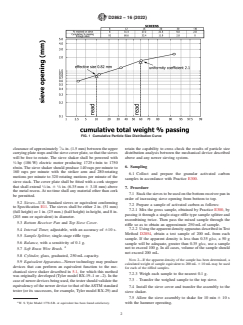
4.3 Effective size and uniformity coefficient are two properties of activated carbons often of interest in municipal water treatment applications where control of particle size is of interest.
SCOPE
1.1 This test method covers the determination of the particle size distribution of granular activated carbon. For the purposes of this test, granular activated carbon is defined as a minimum of 90 % of the sample weight being retained on a 180 μm Standard sieve. A U.S. mesh 80 sieve is equivalent to a 180 μm Standard sieve.
Note 1: For extruded carbons, as the length/diameter ratio of the particles increases, the validity of the test results might be affected.
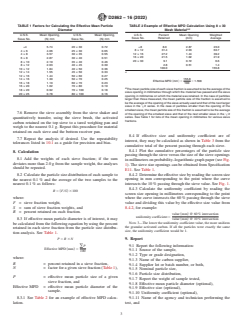
1.2 The data obtained may also be used to calculate mean particle diameter (MPD), effective size, and uniformity coefficient.
1.3 The values stated in inch-pound units are to be regarded as standard. The values given in parentheses are mathematical conversions to SI units that are provided for information only and are not considered standard.
1.3.1 Exception—All mass measurements are in SI units only.
1.4 This standard does not purport to address all of the safety concerns, if any, associated with its use. It is the responsibility of the user of this standard to establish appropriate safety, health, and environmental practices and determine the applicability of regulatory limitations prior to use.
1.5 This international standard was developed in accordance with internationally recognized principles on standardization established in the Decision on Principles for the Development of International Standards, Guides and Recommendations issued by the World Trade Organization Technical Barriers to Trade (TBT) Committee.
- Status
- Published
- Publication Date
- 31-Aug-2022
- Technical Committee
- D28 - Activated Carbon
- Drafting Committee
- D28.04 - Gas Phase Evaluation Tests
Overview
ASTM D2862-16(2022), Standard Test Method for Particle Size Distribution of Granular Activated Carbon, is an internationally recognized ASTM standard that specifies a test method to determine the particle size distribution of granular activated carbon. Particle size distribution is essential for ensuring the effective functioning and performance of granular activated carbon in a variety of filtration and adsorption applications. The method uses a mechanical sieve shaker and a stack of U.S. Standard sieves to quantify the granule sizes within a sample, supporting calculations for key parameters such as mean particle diameter (MPD), effective size, and uniformity coefficient.
Understanding the particle size distribution helps optimize the performance of granular activated carbon by impacting the contact efficiency with gases or liquids in packed beds and influencing vital operational parameters like pressure drop and adsorption rates.
Key Topics
- Granular Activated Carbon Definition: According to this method, granular activated carbon comprises at least 90% of the sample weight retained on a 180 μm standard sieve (equivalent to U.S. mesh 80).
- Test Method Scope: The procedure quantifies the proportion of carbon particles by size, allowing calculation of properties like mean particle diameter, effective size, and uniformity coefficient.
- Importance of Particle Size: Changes in distribution can impact pressure drop, flow characteristics, and adsorption efficiency in filters and packed beds.
- Parameters of Interest:
- Mean Particle Diameter (MPD): Indicates the central tendency of particle sizes, directly influencing pressure drop across a packed bed.
- Effective Size and Uniformity Coefficient: These are particularly relevant in municipal water treatment and other applications where tight control over particle size is necessary.
- Applicability: The test method applies to all granular activated carbons and is recognized for use in regulatory, environmental, and industrial contexts.
Applications
This standard is vital in industries and operations that utilize granular activated carbon for filtration, purification, and adsorption, including:
- Municipal Water Treatment: The effective size and uniformity coefficient are critical to ensuring optimal removal of contaminants and efficient filter bed performance.
- Air and Gas Purification: Proper sizing of activated carbon ensures effective contact time and efficient removal of adsorbable gases and vapors.
- Industrial Process Streams: Chemical processing relies on a consistent particle size distribution to ensure predictable adsorption rates and manageable pressure drop.
- Environmental Remediation: Particle size control is necessary to comply with environmental regulations and to achieve reliable removal of pollutants from water or air streams.
- Quality Assurance: Routine testing using ASTM D2862-16(2022) supports supplier quality monitoring and validation of carbon materials.
Related Standards
Professionals using ASTM D2862-16(2022) may also find value in the following related ASTM standards:
- ASTM D2854: Standard Test Method for Apparent Density of Activated Carbon
- ASTM E11: Specification for Woven Wire Test Sieve Cloth and Test Sieves
- ASTM E177: Practice for Use of the Terms Precision and Bias in ASTM Test Methods
- ASTM E300: Practice for Sampling Industrial Chemicals
- ASTM E691: Practice for Conducting an Interlaboratory Study to Determine the Precision of a Test Method
Conclusion
ASTM D2862-16(2022) is a foundational standard for laboratories and industries that rely on granular activated carbon. By defining a consistent method for determining particle size distribution, it supports effective performance, quality assurance, and regulatory compliance across water treatment, air purification, and industrial applications. Users are responsible for ensuring health, safety, and environmental practices when applying this standard, and staying updated with ASTM revisions and related best practices.
Keywords: ASTM D2862, particle size distribution, granular activated carbon, effective size, uniformity coefficient, mean particle diameter, water treatment, air purification, filtration, standard test method
Relations
- Effective Date
- 01-Jul-2014
- Effective Date
- 01-May-2014
- Effective Date
- 01-Oct-2013
- Effective Date
- 01-May-2013
- Effective Date
- 01-May-2013
- Effective Date
- 01-Nov-2011
- Effective Date
- 15-Jun-2011
- Effective Date
- 01-Oct-2010
- Effective Date
- 01-May-2009
- Effective Date
- 01-Apr-2009
- Effective Date
- 01-Oct-2008
- Effective Date
- 01-Oct-2008
- Refers
ASTM E177-06b - Standard Practice for Use of the Terms Precision and Bias in ASTM Test Methods - Effective Date
- 15-Nov-2006
- Refers
ASTM E177-06a - Standard Practice for Use of the Terms Precision and Bias in ASTM Test Methods - Effective Date
- 01-Nov-2006
- Effective Date
- 01-Nov-2005
Get Certified
Connect with accredited certification bodies for this standard

IMP NDT d.o.o.
Non-destructive testing services. Radiography, ultrasonic, magnetic particle, penetrant, visual inspection.
Inštitut za kovinske materiale in tehnologije
Institute of Metals and Technology. Materials testing, metallurgical analysis, NDT.
Q Techna d.o.o.
NDT and quality assurance specialist. 30+ years experience. NDT personnel certification per ISO 9712, nuclear and thermal power plant inspections, QA/
Sponsored listings
Frequently Asked Questions
ASTM D2862-16(2022) is a standard published by ASTM International. Its full title is "Standard Test Method for Particle Size Distribution of Granular Activated Carbon". This standard covers: SIGNIFICANCE AND USE 4.1 It is necessary to know the distribution of particle sizes of granular activated carbon in order to provide proper contact of gases or liquid in a packed bed of the material. Changes in particle size distribution can affect the pressure drop across the bed and the rate of adsorption in a bed of a given size. 4.2 Mean particle diameter is a property of activated carbons that influences pressure drop. 4.3 Effective size and uniformity coefficient are two properties of activated carbons often of interest in municipal water treatment applications where control of particle size is of interest. SCOPE 1.1 This test method covers the determination of the particle size distribution of granular activated carbon. For the purposes of this test, granular activated carbon is defined as a minimum of 90 % of the sample weight being retained on a 180 μm Standard sieve. A U.S. mesh 80 sieve is equivalent to a 180 μm Standard sieve. Note 1: For extruded carbons, as the length/diameter ratio of the particles increases, the validity of the test results might be affected. 1.2 The data obtained may also be used to calculate mean particle diameter (MPD), effective size, and uniformity coefficient. 1.3 The values stated in inch-pound units are to be regarded as standard. The values given in parentheses are mathematical conversions to SI units that are provided for information only and are not considered standard. 1.3.1 Exception—All mass measurements are in SI units only. 1.4 This standard does not purport to address all of the safety concerns, if any, associated with its use. It is the responsibility of the user of this standard to establish appropriate safety, health, and environmental practices and determine the applicability of regulatory limitations prior to use. 1.5 This international standard was developed in accordance with internationally recognized principles on standardization established in the Decision on Principles for the Development of International Standards, Guides and Recommendations issued by the World Trade Organization Technical Barriers to Trade (TBT) Committee.
SIGNIFICANCE AND USE 4.1 It is necessary to know the distribution of particle sizes of granular activated carbon in order to provide proper contact of gases or liquid in a packed bed of the material. Changes in particle size distribution can affect the pressure drop across the bed and the rate of adsorption in a bed of a given size. 4.2 Mean particle diameter is a property of activated carbons that influences pressure drop. 4.3 Effective size and uniformity coefficient are two properties of activated carbons often of interest in municipal water treatment applications where control of particle size is of interest. SCOPE 1.1 This test method covers the determination of the particle size distribution of granular activated carbon. For the purposes of this test, granular activated carbon is defined as a minimum of 90 % of the sample weight being retained on a 180 μm Standard sieve. A U.S. mesh 80 sieve is equivalent to a 180 μm Standard sieve. Note 1: For extruded carbons, as the length/diameter ratio of the particles increases, the validity of the test results might be affected. 1.2 The data obtained may also be used to calculate mean particle diameter (MPD), effective size, and uniformity coefficient. 1.3 The values stated in inch-pound units are to be regarded as standard. The values given in parentheses are mathematical conversions to SI units that are provided for information only and are not considered standard. 1.3.1 Exception—All mass measurements are in SI units only. 1.4 This standard does not purport to address all of the safety concerns, if any, associated with its use. It is the responsibility of the user of this standard to establish appropriate safety, health, and environmental practices and determine the applicability of regulatory limitations prior to use. 1.5 This international standard was developed in accordance with internationally recognized principles on standardization established in the Decision on Principles for the Development of International Standards, Guides and Recommendations issued by the World Trade Organization Technical Barriers to Trade (TBT) Committee.
ASTM D2862-16(2022) is classified under the following ICS (International Classification for Standards) categories: 19.120 - Particle size analysis. Sieving. The ICS classification helps identify the subject area and facilitates finding related standards.
ASTM D2862-16(2022) has the following relationships with other standards: It is inter standard links to ASTM D2854-09(2014), ASTM E177-14, ASTM E11-13, ASTM E177-13, ASTM E691-13, ASTM E691-11, ASTM D2652-11, ASTM E177-10, ASTM E11-09e1, ASTM D2854-09, ASTM E177-08, ASTM E691-08, ASTM E177-06b, ASTM E177-06a, ASTM E691-05. Understanding these relationships helps ensure you are using the most current and applicable version of the standard.
ASTM D2862-16(2022) is available in PDF format for immediate download after purchase. The document can be added to your cart and obtained through the secure checkout process. Digital delivery ensures instant access to the complete standard document.
Standards Content (Sample)
This international standard was developed in accordance with internationally recognized principles on standardization established in the Decision on Principles for the
Development of International Standards, Guides and Recommendations issued by the World Trade Organization Technical Barriers to Trade (TBT) Committee.
Designation: D2862 − 16 (Reapproved 2022)
Standard Test Method for
Particle Size Distribution of Granular Activated Carbon
This standard is issued under the fixed designation D2862; the number immediately following the designation indicates the year of
original adoption or, in the case of revision, the year of last revision. A number in parentheses indicates the year of last reapproval. A
superscript epsilon (´) indicates an editorial change since the last revision or reapproval.
This standard has been approved for use by agencies of the U.S. Department of Defense.
1. Scope D2854 Test Method for Apparent Density of Activated
Carbon
1.1 This test method covers the determination of the particle
E11 Specification for Woven Wire Test Sieve Cloth and Test
size distribution of granular activated carbon. For the purposes
Sieves
of this test, granular activated carbon is defined as a minimum
E177 Practice for Use of the Terms Precision and Bias in
of 90 % of the sample weight being retained on a 180 µm
ASTM Test Methods
Standard sieve.AU.S. mesh 80 sieve is equivalent to a 180 µm
E300 Practice for Sampling Industrial Chemicals
Standard sieve.
E691 Practice for Conducting an Interlaboratory Study to
NOTE 1—For extruded carbons, as the length/diameter ratio of the
Determine the Precision of a Test Method
particles increases, the validity of the test results might be affected.
1.2 The data obtained may also be used to calculate mean
3. Summary of Test Method
particle diameter (MPD), effective size, and uniformity coef-
3.1 A known weight of granular activated carbon is placed
ficient.
on the top sieve of a stacked set of U.S. Standard sieves and
1.3 The values stated in inch-pound units are to be regarded
shaken under standard conditions for a specific time period,
as standard. The values given in parentheses are mathematical
after which the weight percent of the total retained on each
conversions to SI units that are provided for information only
sieve and bottom pan is determined.
and are not considered standard.
4. Significance and Use
1.3.1 Exception—All mass measurements are in SI units
only.
4.1 It is necessary to know the distribution of particle sizes
1.4 This standard does not purport to address all of the
of granular activated carbon in order to provide proper contact
safety concerns, if any, associated with its use. It is the of gases or liquid in a packed bed of the material. Changes in
responsibility of the user of this standard to establish appro-
particle size distribution can affect the pressure drop across the
priate safety, health, and environmental practices and deter-
bed and the rate of adsorption in a bed of a given size.
mine the applicability of regulatory limitations prior to use.
4.2 Mean particle diameter is a property of activated car-
1.5 This international standard was developed in accor-
bons that influences pressure drop.
dance with internationally recognized principles on standard-
4.3 Effective size and uniformity coefficient are two prop-
ization established in the Decision on Principles for the
erties of activated carbons often of interest in municipal water
Development of International Standards, Guides and Recom-
treatment applications where control of particle size is of
mendations issued by the World Trade Organization Technical
interest.
Barriers to Trade (TBT) Committee.
2. Referenced Documents 5. Apparatus
2.1 ASTM Standards:
5.1 Mechanical Sieve Shaker —This is a mechanically op-
D2652 Terminology Relating to Activated Carbon
erated sieve shaker that imparts a uniform rotating and tapping
motion to a stack of 8 in. (203 mm or equivalent) sieves as
This test method is under the jurisdiction of ASTM Committee D28 on
described in 5.2. The sieve shaker should be adjusted to
Activated Carbon and is the direct responsibility of Subcommittee D28.04 on Gas
accommodate the desired number of sieves, receiver pan, and
Phase Evaluation Tests.
sieve cover. The bottom stops should be adjusted to give a
Current edition approved Sept. 1, 2022. Published October 2022. Originally
approved in 1970. Last previous edition approved in 2016 as D2862 – 16. DOI:
10.1520/D2862-16R22.
2 3
For referenced ASTM standards, visit the ASTM website, www.astm.org, or TheTyler Ro-Tap Model RX-19-1 has been used in developing this test. Newer
contact ASTM Customer Service at service@astm.org. For Annual Book of ASTM models may not produce the same separations (Model RX-19-2 is equivalent to
Standards volume information, refer to the standard’s Document Summary page on Model RX-19-1). This model is available from Fisher Scientific, Pittsburgh, PA
the ASTM website. 15238.
Copyright © ASTM International, 100 Barr Harbor Drive, PO Box C700, West Conshohocken, PA 19428-2959. United States
D2862 − 16 (2022)
FIG. 1 Cumulative Particle Size Distribution Curve
clearance of approximately ⁄16 in. (1.5 mm) between the upper retain the capability to cross check the results of particle size
carrying plate stops and the sieve cover plate, so that the sieves distribution analysis between the mechanical device described
will be free to rotate. The sieve shaker shall be powered with above and any newer sieving system.
⁄4 hp (186 W) electric motor producing 1725 r⁄min to 1750
6. Sampling
r/min. The sieve shaker should produce 140 raps per minute to
160 raps per minute with the striker arm and 280 rotating
6.1 Collect and prepare the granular activated carbon
motions per minute to 320 rotating motions per minute of the
samples in accordance with Practice E300.
sieve stack. The cover plate shall be fitted with a cork stopper
1 1
that shall extend ⁄4 in. 6 ⁄8 in. (6.35 mm 6 3.18 mm) above
7. Procedure
the metal recess.At no time shall any material other than cork
7.1 Stackthesievestobeusedonthebottomreceiverpanin
be permitted.
order of increasing sieve opening from bottom to top.
5.2 Sieves—U.S. Standard sieves or equivalent conforming
7.2 Prepare a sample of activated carbon as follows:
to Specification E11. The sieves shall be either 2 in. (51 mm)
7.2.1 Mix the gross sample, obtained by Practice E300,by
(full height) or 1 in. (25 mm.) (half height) in height, and 8 in.
passing it through a single-stage riffle type sample splitter and
(203 mm or equivalent) in diameter.
recombining twice. Then pass the mixed sample through the
5.3 Bottom Receiver Pan and Top Sieve Cover.
riffle so as to obtain an approximate 250 mL of sample.
7.2.2 Using the apparent density apparatus described inTest
5.4 Interval Timer, adjustable, with an accuracy of 610 s.
Method D2854, obtain a test sample of 200 mL from each
5.5 Sample Splitter, single-stage riffle type.
sample. If the apparent density is less than 0.35 g/cc, a 50 g
5.6 Balance, with a sensitivity of 0.1 g.
sample will be adequate, greater than 0.35 g/cc, use a sample
not to exceed 100 g. In all cases, volume of the sample should
5.7 Soft Brass Wire Brush.
not exceed 200 mL.
5.8 Cylinder, glass, graduated, 250 mL capacity.
NOTE 2—If the apparent density of the sample has been determined, a
5.9 EquivalentApparatus—Newer technology may produce
calculated weight of sample equivalent to 200 mL 6 10 mL may be used
devices that can perform an equivalent function to the me-
for each of the riffled samples.
chanical sieve shaker described in 5.1, for which this method
7.2.3 Weigh each sample to the nearest 0.1 g.
was originally developed (Tyler model RX-19–1 or –2). In the
7.3 . Transfer the weighed sample to the top sieve.
case of newer devices being used, the tester should validate the
equivalency of the newer device to that of theASTM standard
7.4 Install the sieve cover and transfer the assembly to the
tester (or its successors, for example, Tyler model RX-29) and
sieve shaker.
7.5 Allow the sieve assembly to shake for 10 min 6 10 s
W. S. Tyler Model 1778-S.B. or equivalent has been found satisfactory. with the hammer operating.
D2862 − 16 (2022)
TABLE 1 Factors for Calculating the Effective Mean Particle TABLE 2 Example of Effective MPD Calculation Using8×30
AB
Diameter Mesh Material
U.S.S. Percent Mean Opening Weighted
U.S.S. Mean Opening, U.S.S. Mean Opening,
Sieve No. Retained (mm) Average
Sieve No. (N) mm Sieve No. (N) mm
+8 8.0 2.87 23.0
+4 5.74 20 × 30 0.72
8 × 12 31.4 2.03 63.7
4×6 4.06 25×30 0.65
12 × 16 27.2 1.44 39.2
4×8 3.57 30×35 0.55
16 × 20 21.5 1.02 21.9
6×8 2.87 30×40 0.51
20 × 30 9.1 0.72 6.6
8×10 2.19 35×40 0.46
2.8 0.51 1.4
8×12 2.03 40×45 0.39
100.0 155.8
10×12 1.84 40×50 0.36
12×14 1.55 45×50 0.33 A
12×16 1.44 50×60 0.27
155.8
14×16 1.30 50×70 0.25
Effective MPD smmd5 5 1.558
16×18 1.10 60×70 0.23 100
16×20 1.02 70×80 0.19
B
The mean particle size of each sieve fraction is assumed to be the average of the
18 × 20 0.92 70 × 100 0.18
sieve opening in millimetres through which the material has passed and the sieve
20 × 25 0.78 80 × 100 0.16
opening in millimetres on which the material was retained. In the case of particles
larger than those measured, the mean particle size of this fraction is assumed to
be the average of the opening of the sieve actually used and that of the next larger
sieve in the =2 series. In the case of particles smaller than the opening of the
smallest sieve, the mean particle size of this fraction is assumed to be the average
7.6 Remove the sieve assembly from the sieve shaker and
of the opening of the smallest sieve and that of the next smaller sieve in the =2
series. See Table 1 for lists of the mean opening in millimetres for various sieve
quantitatively transfer, using the sieve brush, the activated
fractions.
carbon retained on the top sieve to a tared weighing pan and
weigh to the nearest 0.1 g. Repeat this procedure for material
retained on each sieve and the bottom receiver pan.
8.4 If effective size and uniformity coefficient are of
7.7 Repeat the analysis if desired. Use the repeatability
interest, they may be calculated as shown in Table 3
...