

ASTM C1864-17(2022)
(Test Method)Standard Test Method for Determination of Solar Reflectance of Directionally Reflective Material Using Portable Solar Reflectometer
General Information
- Abstract
SIGNIFICANCE AND USE
5.1 The solar reflectance of a DRM depends on the solar incidence angle. This method is intended to provide solar reflectance values for DRM roofing products.
SCOPE
1.1 This test method covers a technique for determining the solar reflectance of a directionally reflective material using a commercial portable solar reflectometer, including but not limited to roofing materials with granules or surface design that results in angularly dependent reflectance. The purpose of the method is to evaluate the seasonal and annual solar reflectances of a directionally reflective roofing product.
1.2 The values stated in SI units are to be regarded as standard. No other units of measurement are included in this standard.
1.3 This standard does not purport to address all of the safety concerns, if any, associated with its use. It is the responsibility of the user of this standard to establish appropriate safety, health, and environmental practices and determine the applicability of regulatory limitations prior to use.
1.4 This international standard was developed in accordance with internationally recognized principles on standardization established in the Decision on Principles for the Development of International Standards, Guides and Recommendations issued by the World Trade Organization Technical Barriers to Trade (TBT) Committee.
- Status
- Published
- Publication Date
- 31-Aug-2022
- Technical Committee
- C16 - Thermal Insulation
- Drafting Committee
- C16.30 - Thermal Measurement
Overview
ASTM C1864-17(2022): Standard Test Method for Determination of Solar Reflectance of Directionally Reflective Material Using Portable Solar Reflectometer specifies a reliable laboratory technique to measure the solar reflectance of directionally reflective materials (DRMs). DRMs, which include many modern roofing materials, exhibit reflectance properties that vary depending on the angle of solar incidence. This standard establishes best practices to ensure consistent and repeatable solar reflectance measurements using a portable solar reflectometer.
Solar reflectance is a critical performance parameter for roofing and building materials, as higher reflectance reduces heat absorption, improves building energy efficiency, and contributes to urban heat island mitigation. By following ASTM C1864-17(2022), manufacturers, specifiers, and researchers can accurately evaluate the seasonal and annual solar reflectance of directionally reflective roofing products and other relevant materials.
Key Topics
- Directionally Reflective Materials (DRMs): Materials whose solar reflectance depends on the angle of solar incidence, often due to surface texture, granules, or design features.
- Portable Solar Reflectometers: Commercial instruments used for on-site and laboratory reflectance testing, operated in accordance with established ASTM procedures.
- Measurement Protocol: The method involves placing the test specimen on a marked compass pattern, performing solar reflectance measurements at 12 azimuthal orientations (each 30° apart), and repeating the measurement sequence three times for accuracy.
- Data Reporting: The standard outlines how to report individual and average solar reflectance values for each orientation, as well as calculated summer, winter, and annual solar reflectance values.
- SI Units: All measurements are reported in standardized SI units for global consistency.
Applications
- Roofing Materials Testing: This standard is especially valuable for evaluating roofing products with directionally dependent reflectance, such as shingles, tiles, or membranes with surface granules or patterns.
- Energy Efficiency Analysis: Reliable reflectance data helps building designers and energy modelers assess and select materials that contribute to reduced cooling loads and enhanced sustainability.
- Product Performance Labeling: Manufacturers use this test method to obtain accurate, repeatable reflectance values for product certification or environmental labeling.
- Research and Development: R&D teams rely on ASTM C1864 for comparative testing of innovative materials under varied angles of solar incidence.
- Quality Control: Routine use of this method in production environments ensures consistent material performance and helps meet regulatory or voluntary specification requirements.
Related Standards
- ASTM C1549: Test Method for Determination of Solar Reflectance Near Ambient Temperature Using a Portable Solar Reflectometer - referenced for device operation and measurement procedures.
- Cool Roof Rating Standards: ASTM C1864 supports compliance with building codes, LEED, and other rating systems focused on high solar reflectance for roofing.
- ISO and International Guidelines: Developed in line with internationally recognized standardization principles, facilitating global adoption and regulatory alignment.
Keywords: ASTM C1864, solar reflectance, directionally reflective materials, roofing products, portable solar reflectometer, building materials testing, energy efficiency, sustainability, SI units, measurement method, cool roof standards.
By applying ASTM C1864-17(2022), stakeholders ensure precise and credible solar reflectance measurements for advanced roofing and building products, supporting energy savings and environmental goals.
Relations
- Effective Date
- 01-Sep-2014
- Effective Date
- 01-Nov-2009
- Effective Date
- 01-Sep-2004
- Effective Date
- 10-Oct-2002
Get Certified
Connect with accredited certification bodies for this standard

DNV
DNV is an independent assurance and risk management provider.

Lloyd's Register
Lloyd's Register is a global professional services organisation specialising in engineering and technology.
DNV Energy Systems
Energy and renewable energy certification.
Sponsored listings
Frequently Asked Questions
ASTM C1864-17(2022) is a standard published by ASTM International. Its full title is "Standard Test Method for Determination of Solar Reflectance of Directionally Reflective Material Using Portable Solar Reflectometer". This standard covers: SIGNIFICANCE AND USE 5.1 The solar reflectance of a DRM depends on the solar incidence angle. This method is intended to provide solar reflectance values for DRM roofing products. SCOPE 1.1 This test method covers a technique for determining the solar reflectance of a directionally reflective material using a commercial portable solar reflectometer, including but not limited to roofing materials with granules or surface design that results in angularly dependent reflectance. The purpose of the method is to evaluate the seasonal and annual solar reflectances of a directionally reflective roofing product. 1.2 The values stated in SI units are to be regarded as standard. No other units of measurement are included in this standard. 1.3 This standard does not purport to address all of the safety concerns, if any, associated with its use. It is the responsibility of the user of this standard to establish appropriate safety, health, and environmental practices and determine the applicability of regulatory limitations prior to use. 1.4 This international standard was developed in accordance with internationally recognized principles on standardization established in the Decision on Principles for the Development of International Standards, Guides and Recommendations issued by the World Trade Organization Technical Barriers to Trade (TBT) Committee.
SIGNIFICANCE AND USE 5.1 The solar reflectance of a DRM depends on the solar incidence angle. This method is intended to provide solar reflectance values for DRM roofing products. SCOPE 1.1 This test method covers a technique for determining the solar reflectance of a directionally reflective material using a commercial portable solar reflectometer, including but not limited to roofing materials with granules or surface design that results in angularly dependent reflectance. The purpose of the method is to evaluate the seasonal and annual solar reflectances of a directionally reflective roofing product. 1.2 The values stated in SI units are to be regarded as standard. No other units of measurement are included in this standard. 1.3 This standard does not purport to address all of the safety concerns, if any, associated with its use. It is the responsibility of the user of this standard to establish appropriate safety, health, and environmental practices and determine the applicability of regulatory limitations prior to use. 1.4 This international standard was developed in accordance with internationally recognized principles on standardization established in the Decision on Principles for the Development of International Standards, Guides and Recommendations issued by the World Trade Organization Technical Barriers to Trade (TBT) Committee.
ASTM C1864-17(2022) is classified under the following ICS (International Classification for Standards) categories: 17.180.20 - Colours and measurement of light; 27.160 - Solar energy engineering. The ICS classification helps identify the subject area and facilitates finding related standards.
ASTM C1864-17(2022) has the following relationships with other standards: It is inter standard links to ASTM C1549-09(2014), ASTM C1549-09, ASTM C1549-04, ASTM C1549-02. Understanding these relationships helps ensure you are using the most current and applicable version of the standard.
ASTM C1864-17(2022) is available in PDF format for immediate download after purchase. The document can be added to your cart and obtained through the secure checkout process. Digital delivery ensures instant access to the complete standard document.
Standards Content (Sample)
This international standard was developed in accordance with internationally recognized principles on standardization established in the Decision on Principles for the
Development of International Standards, Guides and Recommendations issued by the World Trade Organization Technical Barriers to Trade (TBT) Committee.
Designation:C1864 −17 (Reapproved 2022)
Standard Test Method for
Determination of Solar Reflectance of Directionally
Reflective Material Using Portable Solar Reflectometer
This standard is issued under the fixed designation C1864; the number immediately following the designation indicates the year of
original adoption or, in the case of revision, the year of last revision. A number in parentheses indicates the year of last reapproval. A
superscript epsilon (´) indicates an editorial change since the last revision or reapproval.
1. Scope 3.2 Definitions of Terms Specific to This Standard:
3.2.1 directionally reflective material (DRM), n—material
1.1 This test method covers a technique for determining the
with solar reflectance that varies with solar incidence angle.
solar reflectance of a directionally reflective material using a
commercial portable solar reflectometer, including but not
3.3 Symbols:
limitedtoroofingmaterialswithgranulesorsurfacedesignthat
3.3.1 ρ —solar reflectance measured by reflectometer in
J,K
results in angularly dependent reflectance. The purpose of the
azimuthal orientation J, within measurement series K.
methodistoevaluatetheseasonalandannualsolarreflectances
3.3.2 ρ —solar reflectance measured by reflectometer in
J
of a directionally reflective roofing product.
azimuthal orientation J, averaged over all measurement repeti-
1.2 The values stated in SI units are to be regarded as
tions.
standard. No other units of measurement are included in this
standard.
4. Summary of Test Method
1.3 This standard does not purport to address all of the
4.1 This method uses a hemispherical solar reflectometer to
safety concerns, if any, associated with its use. It is the
determine the solar reflectance of a DRM. The reflectometer is
responsibility of the user of this standard to establish appro-
operated in accordance with Test Method C1549, except that
priate safety, health, and environmental practices and deter-
evaluationofthesurfacefollowstheproceduredescribedin4.2
mine the applicability of regulatory limitations prior to use.
and 4.3.
1.4 This international standard was developed in accor-
dance with internationally recognized principles on standard- 4.2 The solar reflectance of a test specimen is measured 12
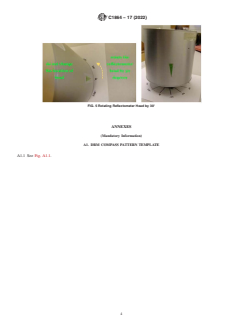
ization established in the Decision on Principles for the times by rotating the measurement head of the reflectometer in
Development of International Standards, Guides and Recom- 30° increments about the normal to the test specimen.
mendations issued by the World Trade Organization Technical
4.3 The set of 12 measurements is repeated three times to
Barriers to Trade (TBT) Committee.
calculatethesolarreflectanceineachorientationastheaverage
of the three measurements at the same orientation.
2. Referenced Documents
2.1 ASTM Standards:
5. Significance and Use
C1549 Test Method for Determination of Solar Reflectance
5.1 The solar reflectance of a DRM depends on the solar
NearAmbient Temperature Using a Portable Solar Reflec-
incidence angle. This method is intended to provide solar
tometer
reflectance values for DRM roofing products.
3. Terminology
6. Apparatus
3.1 Definitions—The definitions included in Test Method
C1549 are applicable to this method.
6.1 This test method employs a portable solar reflectometer
that is operated in accordance with Test Method C1549.
This test method is under the jurisdiction ofASTM Committee C16 on Thermal
6.2 The test specimen shall be flat (not curved) and have
Insulation and is the direct responsibility of Subcommittee C16.30 on Thermal
area sufficient to completely cover the measurement port of the
Measurement.
reflectometer.
Current edition approved Sept. 1, 2022. Published October 2022. Originally
ε1
approved in 2017. Last previous edition approved in 2017 as C1864 – 17 . DOI:
6.3 The test specimen shall be placed at the center of a
10.1520/C1864-17R22.
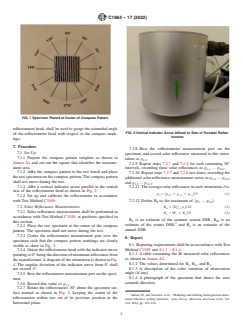
compass pattern marked in 30° increments as shown in Fig. 1.
For referenced ASTM standards, visit the ASTM website, www.astm.org, or
contact ASTM Customer Service at service@astm.org. For Annual Book of ASTM
6.4 A vertical indicator arrow, parallel to the central axis of
Standards volume information, refer to the standard’s Document Summary page on
the ASTM website. the reflectometer head and affixed to the outer wall of the
Copyright © ASTM International, 100 Barr Harbor Drive, PO Box C700, West Conshohocken, PA 19428-2959. United States
C1864−17 (2022)
FIG. 1Specimen Placed at Center of Compass Pattern
reflectometer head, shall be used to gauge the azimuthal angle
FIG. 2Vertical Indicator Arrow Affixed to Side of Portable Reflec-
of the reflectometer head with respect to the compass mark-
tometer
ings.
7. Procedure
7.2.8 Rest the reflectometer measurement port on the
7.1 Set-Up:
specimen, and record solar reflectance measured in this orien-
7.1.1 Prepare the compass pattern template as shown in
tation as ρ .
2,1
Annex A1 and cut out the square that identifies the measure-
7.2.9 Repeat steps 7.2.7 and 7.2.8 for each remaining 30°
ment area.
intervals, recording these solar reflectances as ρ …ρ .
3,1 12,1
7.1.2 Affix the compass pattern to the test bench and place
7.2.10 Repeat steps 7.2.7 and 7.2.8 two times, recording the
the test specimen on the compass pattern. The compass pattern
additional solar reflectance measurement series as ρ …ρ
1,2 12,2
shall not move during the test.
and ρ . ρ .
1,3 12,3
...