

ASTM D6376-10(2017)e1
(Test Method)Standard Test Method for Determination of Trace Metals in Petroleum Coke by Wavelength Dispersive X-ray Fluorescence Spectroscopy
General Information
- Abstract
SIGNIFICANCE AND USE
5.1 The presence and concentration of sulfur and various metallic elements in a petroleum coke are major factors determining the suitability of a coke for various purposes. This test method provides rapid means for measuring sulfur and commercially important metallic elements in coke samples.
5.2 This test method provides a guide for determining conformance to material specifications for use by buyers and sellers in a commercial transfer of petroleum coke.
5.3 Sulfur contents can be used to evaluate the potential formation of sulfur oxides (SOx), a source of atmospheric pollution.
SCOPE
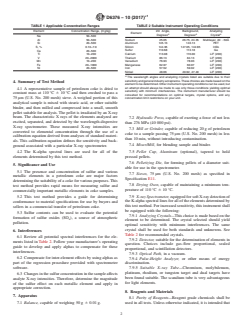
1.1 This test method covers the X-ray fluorescence spectrometric determination of total sulfur and trace metals in samples of raw or calcined petroleum coke. Elements determined using this test method are listed in Table 1.
1.2 Detection limits, sensitivity, and optimal element ranges will vary with matrices, spectrometer type, analyzing crystal, and other instrument conditions and parameters.
1.3 All analytes are determined as the element and reported as such. These include all elements listed in Table 1. This test method may be applicable to additional elements or concentration ranges if sufficient standards are available to produce proper calibration equations.
1.4 The values stated in SI units are to be regarded as standard. No other units of measurement are included in this standard.
1.5 This standard does not purport to address all of the safety concerns, if any, associated with its use. It is the responsibility of the user of this standard to establish appropriate safety and health practices and determine the applicability of regulatory limitations prior to use.
- Status
- Published
- Publication Date
- 31-Dec-2016
- Technical Committee
- D02 - Petroleum Products, Liquid Fuels, and Lubricants
- Drafting Committee
- D02.05 - Properties of Fuels, Petroleum Coke and Carbon Material
Overview
ASTM D6376-10(2017)e1 specifies a standard test method for the determination of trace metals and total sulfur in samples of raw or calcined petroleum coke using wavelength dispersive X-ray fluorescence (WDXRF) spectroscopy. This method enables accurate, rapid analysis of sulfur and key metallic elements, including sodium, aluminum, silicon, calcium, titanium, vanadium, manganese, iron, and nickel, which are critical to evaluating petroleum coke quality for industrial applications and environmental compliance.
Key Topics
- Elemental Analysis: Guidelines for quantifying total sulfur (0.10–7.0% concentration range) and common trace metals (such as Na, Al, Si, Ca, Ti, V, Mn, Fe, Ni) in petroleum coke.
- Sample Preparation: Requirements for preparing representative petroleum coke samples, including grinding to pass a 75 µm (U.S. No. 200 mesh) sieve, drying, pelletizing with a suitable binder, and ensuring consistency across reference and analytical samples.
- Instrument Calibration: Use of reference samples, calibration equations, and correction factors (alphas) to minimize spectral and inter-element interference, ensuring measurement precision and reliability.
- Operational Recommendations: Instrument and reagent specifications, sample handling, and step-by-step procedural guidance for analyzing petroleum coke samples using WDXRF.
- Quality Control: Guidance on repeatability and reproducibility, recommendations for instrument drift monitoring, and calibration verification with well-characterized reference materials.
Applications
The ASTM D6376-10(2017)e1 standard test method is widely used in the petroleum and carbon materials industry for several practical reasons:
- Quality Control and Specification Compliance: Allows producers and consumers to rapidly test petroleum coke for sulfur and metal content to determine suitability for end uses such as aluminum production, fuel, and chemical manufacturing. The results support the verification of compliance with material specifications.
- Commercial Transactions: Provides a reliable basis for determining conformance to specifications during the buying and selling of petroleum coke, reducing disputes and ensuring material consistency in supply chains.
- Environmental Impact Assessment: Sulfur determinations are critical for evaluating potential emissions of sulfur oxides (SOx), important contributors to atmospheric pollution. Accurate analysis supports regulatory compliance and environmental risk management.
- Process Optimization: Regular elemental analysis helps in monitoring raw and calcined coke processing, enabling manufacturers to adjust operational parameters for optimal product quality.
Related Standards
Several other ASTM standards complement or provide alternative methods for trace metal and sulfur determination in petroleum coke:
- ASTM D346: Practice for Collection and Preparation of Coke Samples for Laboratory Analysis
- ASTM D1552: Test Method for Sulfur in Petroleum Products by High Temperature Combustion and IR or TCD Detection
- ASTM D4057: Practice for Manual Sampling of Petroleum and Petroleum Products
- ASTM D5056: Test Method for Trace Metals in Petroleum Coke by Atomic Absorption
- ASTM D5600: Test Method for Trace Metals in Petroleum Coke by ICP Atomic Emission Spectrometry (ICP-AES)
- ASTM D6969 / D6970: Practices for Preparation and Collection of Calcined Petroleum Coke Samples
- ASTM E11: Specification for Woven Wire Test Sieve Cloth and Test Sieves
Practical Value
Adhering to ASTM D6376 ensures consistent, accurate measurement of trace metals and sulfur in petroleum coke, optimizing technological, commercial, and environmental outcomes. The method’s rapid turnaround supports decision-making in real time, and the flexibility in adapting to additional analytes expands its usability across a range of industrial and compliance scenarios. By following this well-established standard, laboratories and organizations can ensure their results meet international expectations for accuracy and reliability.
Relations
- Effective Date
- 01-Dec-2019
- Effective Date
- 01-Jul-2016
- Refers
ASTM D6969-16 - Standard Practice for Preparation of Calcined Petroleum Coke Samples for Analysis - Effective Date
- 01-Jun-2016
- Refers
ASTM D6969-15 - Standard Practice for Preparation of Calcined Petroleum Coke Samples for Analysis - Effective Date
- 01-Jun-2015
- Effective Date
- 01-Jun-2015
- Effective Date
- 15-Jun-2014
- Effective Date
- 01-Oct-2013
- Refers
ASTM D4057-06(2011) - Standard Practice for Manual Sampling of Petroleum and Petroleum Products - Effective Date
- 01-Jun-2011
- Refers
ASTM D5056-04(2010) - Standard Test Method for Trace Metals in Petroleum Coke by Atomic Absorption - Effective Date
- 01-May-2010
- Effective Date
- 01-May-2010
- Effective Date
- 01-Oct-2009
- Effective Date
- 01-May-2009
- Refers
ASTM D1552-08 - Standard Test Method for Sulfur in Petroleum Products (High-Temperature Method) - Effective Date
- 01-Dec-2008
- Effective Date
- 15-Oct-2008
- Effective Date
- 15-Oct-2008
Get Certified
Connect with accredited certification bodies for this standard

Element Materials Technology
Materials testing and product certification.

ABS Group Brazil
ABS Group certification services in Brazil.

ABS Quality Evaluations Inc.
American Bureau of Shipping quality certification.
Sponsored listings
Frequently Asked Questions
ASTM D6376-10(2017)e1 is a standard published by ASTM International. Its full title is "Standard Test Method for Determination of Trace Metals in Petroleum Coke by Wavelength Dispersive X-ray Fluorescence Spectroscopy". This standard covers: SIGNIFICANCE AND USE 5.1 The presence and concentration of sulfur and various metallic elements in a petroleum coke are major factors determining the suitability of a coke for various purposes. This test method provides rapid means for measuring sulfur and commercially important metallic elements in coke samples. 5.2 This test method provides a guide for determining conformance to material specifications for use by buyers and sellers in a commercial transfer of petroleum coke. 5.3 Sulfur contents can be used to evaluate the potential formation of sulfur oxides (SOx), a source of atmospheric pollution. SCOPE 1.1 This test method covers the X-ray fluorescence spectrometric determination of total sulfur and trace metals in samples of raw or calcined petroleum coke. Elements determined using this test method are listed in Table 1. 1.2 Detection limits, sensitivity, and optimal element ranges will vary with matrices, spectrometer type, analyzing crystal, and other instrument conditions and parameters. 1.3 All analytes are determined as the element and reported as such. These include all elements listed in Table 1. This test method may be applicable to additional elements or concentration ranges if sufficient standards are available to produce proper calibration equations. 1.4 The values stated in SI units are to be regarded as standard. No other units of measurement are included in this standard. 1.5 This standard does not purport to address all of the safety concerns, if any, associated with its use. It is the responsibility of the user of this standard to establish appropriate safety and health practices and determine the applicability of regulatory limitations prior to use.
SIGNIFICANCE AND USE 5.1 The presence and concentration of sulfur and various metallic elements in a petroleum coke are major factors determining the suitability of a coke for various purposes. This test method provides rapid means for measuring sulfur and commercially important metallic elements in coke samples. 5.2 This test method provides a guide for determining conformance to material specifications for use by buyers and sellers in a commercial transfer of petroleum coke. 5.3 Sulfur contents can be used to evaluate the potential formation of sulfur oxides (SOx), a source of atmospheric pollution. SCOPE 1.1 This test method covers the X-ray fluorescence spectrometric determination of total sulfur and trace metals in samples of raw or calcined petroleum coke. Elements determined using this test method are listed in Table 1. 1.2 Detection limits, sensitivity, and optimal element ranges will vary with matrices, spectrometer type, analyzing crystal, and other instrument conditions and parameters. 1.3 All analytes are determined as the element and reported as such. These include all elements listed in Table 1. This test method may be applicable to additional elements or concentration ranges if sufficient standards are available to produce proper calibration equations. 1.4 The values stated in SI units are to be regarded as standard. No other units of measurement are included in this standard. 1.5 This standard does not purport to address all of the safety concerns, if any, associated with its use. It is the responsibility of the user of this standard to establish appropriate safety and health practices and determine the applicability of regulatory limitations prior to use.
ASTM D6376-10(2017)e1 is classified under the following ICS (International Classification for Standards) categories: 75.160.10 - Solid fuels. The ICS classification helps identify the subject area and facilitates finding related standards.
ASTM D6376-10(2017)e1 has the following relationships with other standards: It is inter standard links to ASTM D6970-03(2019), ASTM D1552-16, ASTM D6969-16, ASTM D6969-15, ASTM D5056-15, ASTM D1552-08(2014), ASTM E11-13, ASTM D4057-06(2011), ASTM D5056-04(2010), ASTM D346-04(2010), ASTM D5600-09, ASTM E11-09e1, ASTM D1552-08, ASTM D6969-03(2008), ASTM D6970-03(2013)e1. Understanding these relationships helps ensure you are using the most current and applicable version of the standard.
ASTM D6376-10(2017)e1 is available in PDF format for immediate download after purchase. The document can be added to your cart and obtained through the secure checkout process. Digital delivery ensures instant access to the complete standard document.
Standards Content (Sample)
This international standard was developed in accordance with internationally recognized principles on standardization established in the Decision on Principles for the
Development of International Standards, Guides and Recommendations issued by the World Trade Organization Technical Barriers to Trade (TBT) Committee.
´1
Designation: D6376 − 10 (Reapproved 2017)
Standard Test Method for
Determination of Trace Metals in Petroleum Coke by
Wavelength Dispersive X-ray Fluorescence Spectroscopy
This standard is issued under the fixed designation D6376; the number immediately following the designation indicates the year of
original adoption or, in the case of revision, the year of last revision. A number in parentheses indicates the year of last reapproval. A
superscript epsilon (´) indicates an editorial change since the last revision or reapproval.
ε NOTE—Units formatting was corrected editorially in February 2017.
1. Scope D4057 Practice for Manual Sampling of Petroleum and
Petroleum Products
1.1 This test method covers the X-ray fluorescence spectro-
D5056 Test Method for Trace Metals in Petroleum Coke by
metricdeterminationoftotalsulfurandtracemetalsinsamples
Atomic Absorption
of raw or calcined petroleum coke. Elements determined using
D5600 Test Method for Trace Metals in Petroleum Coke by
this test method are listed in Table 1.
Inductively Coupled Plasma Atomic Emission Spectrom-
1.2 Detection limits, sensitivity, and optimal element ranges
etry (ICP-AES)
will vary with matrices, spectrometer type, analyzing crystal,
D6969 Practice for Preparation of Calcined Petroleum Coke
and other instrument conditions and parameters.
Samples for Analysis
1.3 All analytes are determined as the element and reported
D6970 Practice for Collection of Calcined Petroleum Coke
as such. These include all elements listed in Table 1. This test
Samples for Analysis
method may be applicable to additional elements or concen-
E11 Specification for Woven Wire Test Sieve Cloth and Test
tration ranges if sufficient standards are available to produce
Sieves
proper calibration equations.
3. Terminology
1.4 The values stated in SI units are to be regarded as
standard. No other units of measurement are included in this
3.1 Definitions:
standard.
3.1.1 calcined petroleum coke, n—petroleum coke that has
1.5 This standard does not purport to address all of the
been thermally treated to drive off the volatile matter and to
safety concerns, if any, associated with its use. It is the
develop crystalline structure.
responsibility of the user of this standard to establish appro-
3.1.2 green petroleum coke, n—same as raw petroleum
priate safety and health practices and determine the applica-
coke.
bility of regulatory limitations prior to use.
3.1.3 petroleum coke, n—a solid, carbonaceous residue
2. Referenced Documents
produced by thermal decomposition of heavy petroleum frac-
tions or cracked stocks, or both
2.1 ASTM Standards:
D346 Practice for Collection and Preparation of Coke
3.1.4 raw petroleum coke, n—petroleum coke that has not
Samples for Laboratory Analysis
been calcined.
D1552 Test Method for Sulfur in Petroleum Products by
3.2 Definitions of Terms Specific to This Standard:
High Temperature Combustion and Infrared (IR) Detec-
3.2.1 alpha, n—correction factor used to compensate for
tion or Thermal Conductivity Detection (TCD)
interferences.
3.2.2 analytical sample, n—a representative fraction taken
This test method is under the jurisdiction of ASTM Committee D02 on
from a larger mass of petroleum coke and reduced by grinding
Petroleum Products, Liquid Fuels, and Lubricants and is the direct responsibility of
to pass a 75 µm (U.S. No. 200 mesh) sieve.
SubcommitteeD02.05onPropertiesofFuels,PetroleumCokeandCarbonMaterial.
Current edition approved Jan. 1, 2017. Published February 2017. Originally
3.2.3 pellet, n—a blend of dried sample and binder milled
approved in 1999. Last previous edition approved in 2010 as D6376 – 10. DOI:
together and then formed into a pellet by pressure.
10.1520/D6376-10R17E01.
For referenced ASTM standards, visit the ASTM website, www.astm.org, or
3.2.4 reference samples, n—samples of known concentra-
contact ASTM Customer Service at service@astm.org. For Annual Book of ASTM
tions to be used in the calibration of the X-ray fluorescence
Standards volume information, refer to the standard’s Document Summary page on
the ASTM website. spectrometer.
Copyright © ASTM International, 100 Barr Harbor Drive, PO Box C700, West Conshohocken, PA 19428-2959. United States
´1
D6376 − 10 (2017)
TABLE 1 Applicable Concentration Ranges TABLE 2 Suitable Instrument Operating Conditions
Element Concentration Range, (mg/kg) 2Θ Angle, Background, Analyzing
Element
A A A
Degrees Degrees Crystal
Na 50–500
Al 50–500 Sodium 25.05 26.75, 24.35 Multilayer, 2d ;50Å
Si 20–500 Aluminum 145.13 143.13 PET
S, % 0.10–7.0 Silicon 144.95 147.05, 142.85 InSb
Ca 20–500 Sulfur 110.68 113.18 Ge
Ti 10–200 Calcium 113.08 116.00 LiF (200)
V 20–2000 Titanium 86.13 84.13 LiF (200)
Mn 10–200 Vanadium 76.93 78.93 LiF (200)
Fe 20–1000 Manganese 62.97 60.97 LiF (200)
Ni 20–500 Iron 57.52 59.02 LiF (200)
Nickel 48.66 49.92, 47.40 LiF (200)
A
The wavelength angles and analyzing crystals listed are suitable due to their
sensitivityandgeneralindustryacceptance.Thesechoicesaremadebasedonthe
4. Summary of Test Method
elementtobedetermined.Otherinstrumentoperatingconditionscanbeused,but
an attempt should always be made to use only those conditions yielding optimal
4.1 A representative sample of petroleum coke is dried to
sensitivity with minimum interferences. The instrument manufacturer should be
constant mass at 110 °C 6 10 °C and then crushed to pass a
consulted for recommendations on optimal targets, crystal options, and any
75 µm (U.S. No. 200 mesh) sieve. A weighed portion of this
concentration limit restrictions on your unit.
analytical sample is mixed with stearic acid, or other suitable
binder, and then milled and compressed into a small, smooth
pellet suitable for analysis. The pellet is irradiated by an X-ray
beam. The characteristic X rays of the elements analyzed are
7.2 Hydraulic Press, capable of exerting a force of not less
excited, separated, and detected by the wavelength-dispersive
than 276 MPa (40 000 psi).
X-ray spectrometer. These measured X-ray intensities are
7.3 Mill or Grinder, capable of reducing 20 g of petroleum
converted to elemental concentration through the use of a
coke to a sample passing 75 µm (U.S. No. 200 mesh) in less
calibration equation derived from analyses of standard materi-
than 10 min, without introducing contamination.
als. This calibration equation defines the sensitivity and back-
7.4 Mixer/Mill, for blending sample and binder.
ground associated with a particular X-ray spectrometer.
7.5 Pellet Cup, Aluminum (optional), tapered to hold
4.2 The K-alpha spectral lines are used for all of the
pressed pellets.
elements determined by this test method.
7.6 Pelletizing Die, for forming pellets of a diameter suit-
5. Significance and Use
able for use in the spectrometer.
5.1 The presence and concentration of sulfur and various
7.7 Sieves, 75 µm (U.S. No. 200 mesh) as specified in
metallic elements in a petroleum coke are major factors
Specification E11.
determining the suitability of a coke for various purposes.This
7.8 Drying Oven, capable of maintaining a minimum tem-
test method provides rapid means for measuring sulfur and
perature of 110 °C 6 10 °C.
commercially important metallic elements in coke samples.
7.9 X-ray Spectrometer,equippedforsoftX-raydetectionof
5.2 This test method provides a guide for determining
the K-alpha spectral lines for all of the elements determined by
conformance to material specifications for use by buyers and
this test method. For increased sensitivity, this instrument shall
sellers in a commercial transfer of petroleum coke.
be equipped with the following:
5.3 Sulfur contents can be used to evaluate the potential
7.9.1 Analyzing Crystals—This choice is made based on the
formation of sulfur oxides (SO ), a source of atmospheric
x
element to be determined. The crystal selected should yield
pollution.
optimal sensitivity with minimum interferences. The same
crystal shall be used for both standards and unknowns. See
6. Interferences
Table 2 for recommended crystals.
6.1 Review all potential spectral interferences for the ele-
7.9.2 Detector, suitable for the determination of elements in
ments listed in Table 2. Follow your manufacturer’s operating
question. Choices include gas-flow proportional, sealed
guide to develop and apply alphas to compensate for these
proportional, and scintillation detectors.
interferences.
7.9.3 Optical Path, in a vacuum.
6.2 Compensate for inter-element effects by using alphas as
7.9.4 Pulse-Height Analyzer, or other means of energy
part of the regression procedure provided with spectrometer
discrimination.
software.
7.9.5 Suitable X-ray Tube—Chromium, molybdenum,
platinum, rhodium, or tungsten target and dual targets have
6.3 Changesinthesulfurconcentrationinthesampleaffects
been found suitable. The scandium tube is very advantageous
analyte X-ray intensities. Therefore, determine the magnitude
for light elements.
of the sulfur effect on each metallic element and apply in
appropriate correction.
8. Reagents and Materials
7. Apparatus
8.1 Purity of Reagents—Reagent grade chemicals shall be
7.1 Balance, capable of weighing 50 g 6 0.01 g. used in all tests. Unless otherwise indicated, it is intended that
´1
D6376 − 10 (2017)
all reagents shall conform to the specifications of the Commit- 9.3.3 Add 1 g 6 0.01 g of binder and mill for a minimum of
tee on Analytical Reagents of the American Chemical Society 20 s. Binder/coke ratio shall remain constant for samples and
3,4
where such specifications are available. Other grades may
standards.
be used, provided they are of sufficiently high purity to permit
9.3.3.1 Suitable grinding times to produce particles passing
use without diminishing the accuracy of the determination.
a 75 µm (U.S. No. 200 mesh) sieve depends on the type of
grinder used and coke variations. Further grinding time im-
8.2 Detector Gas—P-10 gas (90 % argon, 10 % methane) is
used with gas-flow proportional detectors. pacts element intensities. It is important that grinding time be
thoroughly investigated and optimized.
8.3 Pellet Binder Material—Stearic acid, or other suitable
binder, providing no spectral interferences shall be used.
NOTE 2—It is essential that the same sample preparation procedure
(including sample mass, binder mass and ratio, grinding, and so forth) be
8.4 Reference Samples, of petroleum coke bracketing the
followed precisely for all analytical and reference samples. Even a small
element ranges of the analytical samples. Commercial refer-
change in procedure requires making all new reference samples match the
ence samples of this type are available from s
...