

ASTM D4125/D4125M-21
(Test Method)Standard Test Methods for Asphalt Content of Asphalt Mixtures by the Nuclear Method
General Information
- Abstract
SIGNIFICANCE AND USE
3.1 These test methods are useful as a rapid, nondestructive technique for determination of asphalt content of asphalt mixtures.
3.2 These test methods are suitable for quality control and acceptance testing for construction and for research and development applications. The test method is used for determination of asphalt content only as it does not provide extracted aggregate for gradation analysis.
3.3 The nondestructive nature of the test allows repetitive measurements to be made on a single test sample for statistical analysis of test data.
3.4 These test methods determine the asphalt content of a test sample by comparing the measured asphalt content with previously established calibration data.
3.4.1 The asphalt content of a material expressed as a percentage is the ratio of the mass of asphalt in a given mass of material to the total mass of the sample or to the mass of the solid material particles.
SCOPE
1.1 These test methods cover the procedures for determining the asphalt content of samples of uncompacted asphalt mixtures (Test Method A), and of laboratory compacted specimens of asphalt mixtures (Test Method B) by examining a test sample with an apparatus that utilizes neutron thermalization techniques.
1.2 The values stated in either SI units or inch-pound units are to be regarded separately as standard. The values stated in each system may not be exact equivalents; therefore, each system shall be used independently of the other. Combining values from the two systems may result in nonconformance with the standard.
1.3 A precision and bias statement for Method B in this standard has not been developed at this time. Therefore, Method B should not be used for acceptance or rejection of a material for purchasing purposes.
1.4 This standard does not purport to address all of the safety concerns, if any, associated with its use. It is the responsibility of the user of this standard to establish appropriate safety, health, and environmental practices and determine the applicability of regulatory limitations prior to use. See Section 6 and 8.4.2, 8.5.6, and Note 4 for specific hazards.
1.5 This international standard was developed in accordance with internationally recognized principles on standardization established in the Decision on Principles for the Development of International Standards, Guides and Recommendations issued by the World Trade Organization Technical Barriers to Trade (TBT) Committee.
- Status
- Published
- Publication Date
- 31-Mar-2021
- Technical Committee
- D04 - Road and Paving Materials
- Drafting Committee
- D04.25 - Analysis of Asphalt Mixtures
Buy Documents
ASTM D4125/D4125M-21 - Standard Test Methods for Asphalt Content of Asphalt Mixtures by the Nuclear Method
REDLINE ASTM D4125/D4125M-21 - Standard Test Methods for Asphalt Content of Asphalt Mixtures by the Nuclear Method
Overview
ASTM D4125/D4125M-21: Standard Test Methods for Asphalt Content of Asphalt Mixtures by the Nuclear Method is an essential standard developed by ASTM International for the rapid and nondestructive determination of asphalt content in bituminous/asphalt mixtures. This standard outlines procedures utilizing neutron thermalization techniques to measure asphalt content both in uncompacted and laboratory-compacted mixtures, enabling efficient quality control and acceptance testing in construction and research environments. The nuclear asphalt content method offers significant advantages, including minimal sample preparation, the ability to perform repetitive analyses on the same sample, and immediate results without damaging the test material.
Key Topics
Rapid Nondestructive Testing:
The nuclear method provides fast, nondestructive measurement of asphalt content, making it ideal for on-site and laboratory testing.Quality Control and Acceptance Testing:
Used extensively in construction projects, this method enables continuous monitoring and verification of asphalt mixture quality.Calibration and Precision:
The standard requires calibration for each mix type and apparatus, ensuring accurate results across various aggregate and asphalt sources. Test Method A (uncompacted mixture) is validated for acceptance testing; Test Method B (compacted specimen) is intended for research and is not recommended for purchasing decisions due to the lack of established precision/bias statements.Measurement Principle:
Asphalt content is determined by comparing measurements from the nuclear apparatus with calibration data, using the ratio of asphalt mass to the total sample mass.Test Method Scope:
- Test Method A: For uncompacted asphalt mixtures.
- Test Method B: For laboratory-compacted specimens.
Safety Considerations:
Since the technique uses radioactive materials, strict safety protocols and regulatory compliance are required during handling and operation.
Applications
Roadway and Highway Construction:
The nuclear asphalt content method is widely applied for quality control of asphalt pavement production, ensuring compliance with mix designs and contractual specifications.Research and Development:
Laboratories use the technique for developing and evaluating new asphalt mixtures, as well as conducting statistical analyses using repetitive measurements on the same sample.Routine Quality Assurance:
Agencies and contractors rely on these methods to monitor ongoing production and verify as-built conditions for construction acceptance.Statistical Measurement:
The nondestructive nature allows for repeated measurements on a single sample, supporting advanced data analysis and process optimization.
Key benefits include:
- Quick turnaround and immediate feedback
- Preserving sample integrity for further testing
- Reducing waste and material handling
- Enabling on-site decision-making
Related Standards
Several ASTM standards are referenced to complement and support the use of ASTM D4125/D4125M-21, including:
- ASTM C670: Practice for Preparing Precision and Bias Statements for Test Methods for Construction Materials
- ASTM D75/D75M: Practice for Sampling Aggregates
- ASTM D140/D140M: Practice for Sampling Asphalt Materials
- ASTM D979/D979M: Practice for Sampling Bituminous Paving Mixtures
- ASTM D1461: Test Method for Moisture or Volatile Distillates in Asphalt Mixtures
- ASTM D1559: Test Method for Resistance to Plastic Flow of Bituminous Mixtures Using Marshall Apparatus (Withdrawn 1998)
- ASTM D1561/D1561M: Practice for Preparation of Bituminous Mixture Test Specimens by Means of California Kneading Compactor
Practitioners should always consult these and other relevant standards for best practices in sample preparation, calibration, and interpretation of results.
Keywords: ASTM D4125, nuclear asphalt content, asphalt mixtures, bituminous mixtures, quality control, nondestructive testing, construction standards, paving materials, neutron thermalization, asphalt testing
Relations
- Effective Date
- 01-Feb-2024
- Effective Date
- 01-Jan-2024
- Effective Date
- 01-Dec-2023
- Effective Date
- 01-Nov-2019
- Effective Date
- 01-Jun-2016
- Effective Date
- 01-Jun-2015
- Effective Date
- 01-Jun-2014
- Effective Date
- 15-Dec-2013
- Effective Date
- 01-Jul-2013
- Effective Date
- 01-Feb-2012
- Effective Date
- 15-Dec-2011
- Effective Date
- 01-Aug-2011
- Effective Date
- 15-Jun-2011
- Effective Date
- 01-Oct-2010
- Effective Date
- 01-Jul-2009
Buy Documents
ASTM D4125/D4125M-21 - Standard Test Methods for Asphalt Content of Asphalt Mixtures by the Nuclear Method
REDLINE ASTM D4125/D4125M-21 - Standard Test Methods for Asphalt Content of Asphalt Mixtures by the Nuclear Method
Get Certified
Connect with accredited certification bodies for this standard

Zavod za gradbeništvo Slovenije (ZAG) - Inšpekcija
ZAG inspection body for construction products, structures, and materials.
Sponsored listings
Frequently Asked Questions
ASTM D4125/D4125M-21 is a standard published by ASTM International. Its full title is "Standard Test Methods for Asphalt Content of Asphalt Mixtures by the Nuclear Method". This standard covers: SIGNIFICANCE AND USE 3.1 These test methods are useful as a rapid, nondestructive technique for determination of asphalt content of asphalt mixtures. 3.2 These test methods are suitable for quality control and acceptance testing for construction and for research and development applications. The test method is used for determination of asphalt content only as it does not provide extracted aggregate for gradation analysis. 3.3 The nondestructive nature of the test allows repetitive measurements to be made on a single test sample for statistical analysis of test data. 3.4 These test methods determine the asphalt content of a test sample by comparing the measured asphalt content with previously established calibration data. 3.4.1 The asphalt content of a material expressed as a percentage is the ratio of the mass of asphalt in a given mass of material to the total mass of the sample or to the mass of the solid material particles. SCOPE 1.1 These test methods cover the procedures for determining the asphalt content of samples of uncompacted asphalt mixtures (Test Method A), and of laboratory compacted specimens of asphalt mixtures (Test Method B) by examining a test sample with an apparatus that utilizes neutron thermalization techniques. 1.2 The values stated in either SI units or inch-pound units are to be regarded separately as standard. The values stated in each system may not be exact equivalents; therefore, each system shall be used independently of the other. Combining values from the two systems may result in nonconformance with the standard. 1.3 A precision and bias statement for Method B in this standard has not been developed at this time. Therefore, Method B should not be used for acceptance or rejection of a material for purchasing purposes. 1.4 This standard does not purport to address all of the safety concerns, if any, associated with its use. It is the responsibility of the user of this standard to establish appropriate safety, health, and environmental practices and determine the applicability of regulatory limitations prior to use. See Section 6 and 8.4.2, 8.5.6, and Note 4 for specific hazards. 1.5 This international standard was developed in accordance with internationally recognized principles on standardization established in the Decision on Principles for the Development of International Standards, Guides and Recommendations issued by the World Trade Organization Technical Barriers to Trade (TBT) Committee.
SIGNIFICANCE AND USE 3.1 These test methods are useful as a rapid, nondestructive technique for determination of asphalt content of asphalt mixtures. 3.2 These test methods are suitable for quality control and acceptance testing for construction and for research and development applications. The test method is used for determination of asphalt content only as it does not provide extracted aggregate for gradation analysis. 3.3 The nondestructive nature of the test allows repetitive measurements to be made on a single test sample for statistical analysis of test data. 3.4 These test methods determine the asphalt content of a test sample by comparing the measured asphalt content with previously established calibration data. 3.4.1 The asphalt content of a material expressed as a percentage is the ratio of the mass of asphalt in a given mass of material to the total mass of the sample or to the mass of the solid material particles. SCOPE 1.1 These test methods cover the procedures for determining the asphalt content of samples of uncompacted asphalt mixtures (Test Method A), and of laboratory compacted specimens of asphalt mixtures (Test Method B) by examining a test sample with an apparatus that utilizes neutron thermalization techniques. 1.2 The values stated in either SI units or inch-pound units are to be regarded separately as standard. The values stated in each system may not be exact equivalents; therefore, each system shall be used independently of the other. Combining values from the two systems may result in nonconformance with the standard. 1.3 A precision and bias statement for Method B in this standard has not been developed at this time. Therefore, Method B should not be used for acceptance or rejection of a material for purchasing purposes. 1.4 This standard does not purport to address all of the safety concerns, if any, associated with its use. It is the responsibility of the user of this standard to establish appropriate safety, health, and environmental practices and determine the applicability of regulatory limitations prior to use. See Section 6 and 8.4.2, 8.5.6, and Note 4 for specific hazards. 1.5 This international standard was developed in accordance with internationally recognized principles on standardization established in the Decision on Principles for the Development of International Standards, Guides and Recommendations issued by the World Trade Organization Technical Barriers to Trade (TBT) Committee.
ASTM D4125/D4125M-21 is classified under the following ICS (International Classification for Standards) categories: 93.080.20 - Road construction materials. The ICS classification helps identify the subject area and facilitates finding related standards.
ASTM D4125/D4125M-21 has the following relationships with other standards: It is inter standard links to ASTM C670-24a, ASTM C670-24, ASTM D140/D140M-16(2023), ASTM D75/D75M-19, ASTM D140/D140M-16, ASTM D140/D140M-15, ASTM D140/D140M-14, ASTM D75/D75M-13, ASTM C670-13, ASTM D979/D979M-12, ASTM D1461-11, ASTM D3387-11, ASTM D979/D979M-11, ASTM C670-10, ASTM D4013-09. Understanding these relationships helps ensure you are using the most current and applicable version of the standard.
ASTM D4125/D4125M-21 is available in PDF format for immediate download after purchase. The document can be added to your cart and obtained through the secure checkout process. Digital delivery ensures instant access to the complete standard document.
Standards Content (Sample)
This international standard was developed in accordance with internationally recognized principles on standardization established in the Decision on Principles for the
Development of International Standards, Guides and Recommendations issued by the World Trade Organization Technical Barriers to Trade (TBT) Committee.
Designation: D4125/D4125M − 21
Standard Test Methods for
Asphalt Content of Asphalt Mixtures by the Nuclear Method
This standard is issued under the fixed designation D4125/D4125M; the number immediately following the designation indicates the
year of original adoption or, in the case of revision, the year of last revision. A number in parentheses indicates the year of last
reapproval. A superscript epsilon (´) indicates an editorial change since the last revision or reapproval.
1. Scope for Test Methods for Construction Materials
D75/D75M Practice for Sampling Aggregates
1.1 These test methods cover the procedures for determin-
D140/D140M Practice for Sampling Asphalt Materials
ing the asphalt content of samples of uncompacted asphalt
D979/D979M Practice for Sampling Bituminous Paving
mixtures (Test Method A), and of laboratory compacted
Mixtures
specimens of asphalt mixtures (Test Method B) by examining
D1461 Test Method for Moisture or Volatile Distillates in
a test sample with an apparatus that utilizes neutron thermal-
Asphalt Mixtures
ization techniques.
D1559 Test Method for Resistance to Plastic Flow of Bitu-
1.2 The values stated in either SI units or inch-pound units
minous Mixtures Using Marshall Apparatus (Withdrawn
are to be regarded separately as standard. The values stated in
1998)
each system may not be exact equivalents; therefore, each
D1561/D1561M Practice for Preparation of Bituminous
system shall be used independently of the other. Combining
MixtureTest Specimens by Means of California Kneading
values from the two systems may result in nonconformance
Compactor
with the standard.
D3387 Test Method for Compaction and Shear Properties of
1.3 A precision and bias statement for Method B in this Bituminous Mixtures by Means of the U.S. Corps of
Engineers Gyratory Testing Machine (GTM) (Withdrawn
standard has not been developed at this time. Therefore,
Method B should not be used for acceptance or rejection of a 2020)
D4013 Practice for Preparation of Test Specimens of Bitu-
material for purchasing purposes.
minous Mixtures by Means of Gyratory Shear Compactor
1.4 This standard does not purport to address all of the
(Withdrawn 2013)
safety concerns, if any, associated with its use. It is the
responsibility of the user of this standard to establish appro-
3. Significance and Use
priate safety, health, and environmental practices and deter-
3.1 These test methods are useful as a rapid, nondestructive
mine the applicability of regulatory limitations prior to use.
technique for determination of asphalt content of asphalt
See Section 6 and 8.4.2, 8.5.6, and Note 4 for specific hazards.
mixtures.
1.5 This international standard was developed in accor-
dance with internationally recognized principles on standard-
3.2 These test methods are suitable for quality control and
ization established in the Decision on Principles for the
acceptance testing for construction and for research and
Development of International Standards, Guides and Recom-
development applications. The test method is used for deter-
mendations issued by the World Trade Organization Technical
mination of asphalt content only as it does not provide
Barriers to Trade (TBT) Committee.
extracted aggregate for gradation analysis.
3.3 The nondestructive nature of the test allows repetitive
2. Referenced Documents
measurements to be made on a single test sample for statistical
2.1 ASTM Standards:
analysis of test data.
C670 Practice for Preparing Precision and Bias Statements
3.4 These test methods determine the asphalt content of a
test sample by comparing the measured asphalt content with
1 previously established calibration data.
These test methods are under the jurisdiction of ASTM Committee D04 on
Road and Paving Materials and are the direct responsibility of Subcommittee
3.4.1 The asphalt content of a material expressed as a
D04.25 on Analysis of Asphalt Mixtures.
percentage is the ratio of the mass of asphalt in a given mass
Current edition approved April 1, 2021. Published April 2021. Originally
of material to the total mass of the sample or to the mass of the
approved in 1983. Last previous edition approved in 2016 as D4125/D4125M – 10
solid material particles.
(2016). DOI: 10.1520/D4125_D4125M-21.
For referenced ASTM standards, visit the ASTM website, www.astm.org, or
contact ASTM Customer Service at service@astm.org. For Annual Book of ASTM
Standards volume information, refer to the standard’s Document Summary page on The last approved version of this historical standard is referenced on
the ASTM website. www.astm.org.
Copyright © ASTM International, 100 Barr Harbor Drive, PO Box C700, West Conshohocken, PA 19428-2959. United States
D4125/D4125M − 21
4. Interferences
4.1 The fundamental assumptions inherent in this test
method are that the material under test is homogeneous and
that hydrogen present is in the form of asphalt or has been
otherwise accounted for in the calibration process.
4.2 Accurate results will be dependent upon proper calibra-
tion of the apparatus to the material being tested.
4.3 Thisapparatusmeasuresthetotalamountofhydrogenin
the sample, including hydrogen present in the form of water.
Unlessthetestsampleisfreeofwater,suchpercentagemustbe
determined in accordance with the provisions of Test Method
D1461 and the percentage determined subtracted from the
asphalt percentage as measured by the apparatus.
4.3.1 Alternatively, the sample may be dried to a constant
massinanovenat110 65 °C[230 69 °F],therebynullifying
the need for the correction.
4.4 This apparatus may be sensitive to outside influences;
therefore, any other source of neutron radiation shall be kept at
least 10 m [30 ft] from the apparatus during use. The area
around the apparatus shall be kept free of large amounts of
hydrogenous material such as water, plastics, or asphalt during
use.
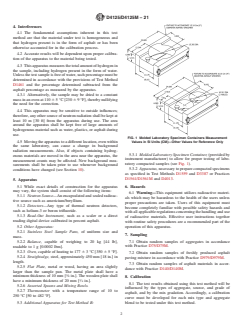
FIG. 1 Molded Laboratory Specimen Containers Measurement
4.5 Movingtheapparatustoadifferentlocation,evenwithin
Values in SI Units (CM)—Other Values for Reference Only
the same laboratory, can cause a change in background
radiation measurements. Also, if objects containing hydrog-
5.3.1 Molded Laboratory Specimen Container, (provided by
enous materials are moved in the area near the apparatus, the
instrument manufacturer) to allow for proper testing of labo-
measurement counts may be affected. New background mea-
ratory compacted samples (see Fig. 1).
surements shall be taken prior to use whenever background
5.3.2 Apparatus,necessarytopreparecompactedspecimens
conditions have changed (see Section 10).
as specified in Test Methods D1559 and D3387 or Practices
D1561/D1561M and D4013.
5. Apparatus
5.1 While exact details of construction for the apparatus
6. Hazards
may vary, the system shall consist of the following items:
6.1 Warning—This equipment utilizes radioactive materi-
5.1.1 Neutron Source—An encapsulated and sealed radioac-
als which may be hazardous to the health of the users unless
tive source such as americium/beryllium.
proper precautions are taken. Users of this equipment must
5.1.2 Detectors—Any type of thermal neutron detectors,
become completely familiar with possible safety hazards and
such as helium-3 or boron trifluoride.
with all applicable regulations concerning the handling and use
5.1.3 Read-Out Instrument, such as a scaler or a direct
of radioactive materials. Effective user instructions together
reading digital device calibrated in percent asphalt.
with routine safety procedures are a recommended part of the
operation of this apparatus.
5.2 Other Apparatus:
5.2.1 Stainless Steel Sample Pans, of uniform size and
7. Sampling
mass.
7.1 Obtain random samples of aggregates in accordance
5.2.2 Balance, capable of weighing to 20 kg [44 lb],
with Practice D75/D75M.
readable to 1 g [0.0002 lbm].
5.2.3 Oven, capable of heating to 177 6 3 °C [350 6 5 °F].
7.2 Obtain random samples of freshly produced asphalt
5.2.4 Straightedge, steel, approximately 450 mm [18 in.] in
paving mixture in accordance with Practice D979/D979M.
length.
7.3 Obtain random samples of asphalt materials in accor-
5.2.5 Flat Plate, metal or wood, having an area slightly
dance with Practice D140/D140M.
larger than the sample pan. The metal plate shall have a
minimum thickness of 10 mm [ ⁄8 in.]. The wooden plate shall
8. Calibration
have a minimum thickness of 20 mm [ ⁄4 in.].
8.1 The test results obtained using this test method will be
5.2.6 Assorted Spoons and Mixing Bowls.
influenced by the types of aggregate, source, and grade of
5.2.7 Thermometer with a temperature range of 10 to
asphalt, and by the mix gradation. Accordingly, a calibration
250 °C [50 to 482 °F].
curve must be developed for each mix type and aggregate
5.3 Additional Apparatus for Test Method B: blend to be tested under this test method.
D4125/D4125M − 21
8.1.1 A new calibration curve shall be developed whenever 8.5 Prepare a minimum of three calibration samples using
there is a change in the source of asphalt or aggregate or a the following procedures:
significant change in aggregate gradation.
8.5.1 Heat the aggregates and asphalt cement to approxi-
8.1.2 Anewcalibrationcurveshallbeestablishedfornewor mately 150 °C [300 °F]. Heat all bowls, sample pans, and tools
repaired apparatus. to approximately 150 °C [300 °F].
8.5.2 To prevent samples from being biased by residual
8.2 For Test Method A, calibrate the apparatus using the
asphalt retained in the mixing bowl, do not clean the bowl after
following procedures:
each mixing of the samples. Scrape it clean, leaving a coating
8.2.1 Sample the aggregates in accordance with 7.1 and
of asphalt mix residue. This allows for a more accurate mixing
blend the aggregates in the proper proportions. Obtain enough
of samples. Prior to mixing the first sample, a mixture of
aggregate for a minimum of three samples. Approximately
asphalt and aggregate fines may be used as a light coating on
30 kg [65 lb] will be required, and
the interior of the mixing bowl.
8.2.2 Sample the asphalt materials in accordance with 7.3.
8.5.3 Using an aggregate sample of sufficient size to fill the
Approximately 2.5 kg [5.5 lb] will be required.
sample pan, add the proper amount of asphalt (within 1 g
8.3 Use a minimum of three prepared samples to establish
[0.002 lb] of desired percent by mass) and mix thoroughly in
the calibration curve. The range of asphalt contents shall vary
the mixing bowl.
by at least 2 % asphalt content from the lowest to the highest
8.5.4 Fill the sample pan in three layers.After placing each
contents in the samples. The range shall encompass the asphalt
layer in the sample pan, using a scoop or spatula, distribute the
content of the proposed mix design. The mass of the samples
layer of material evenly in the pan to reduce voids and
shall be within 10 g [0.02 lb] of each other.
segregation. Lift the pan approximately 20 to 50 mm [1 to
8.3.1 Unless the apparatus makes provision for temperature
2 in.] and tap it on the working surface two or three times to
corrections, all calibration samples shall be tested at a uniform
settle the contents. The last layer should fill the pan to a point
temperature within 65 °C [9 °F]. Calibration samples should
slightly above the top edge.
be prepared and tested as closely as possible to the temperature
8.5.5 Determine the mass of the sample and add or subtract
of test samples of completed mixes.
material until the mass is within 10 g [0.02 lb] of the mass of
the blank sample.
8.4 Prepare a blank sample (sample of hot, dry aggregate
without asphalt) to determine the mass to be used for calibra-
NOTE 2—The mass of the blank sample may not be sufficient to
tion and plant mix samples. Using this mass will ensure the
completelyfillthecalibrationandplantmixtestsamplepansforallmixes.
The asphalt cement may act as a lubricant allowing additional consolida-
same average density for all test samples.
tion of the aggregate particles. An adjusted blank sample mass may be
8.4.1 Thoroughly mix at least 10 kg [22 lb] of the aggregate
determined by preparing a calibration sample using these procedures and
after heating and drying it to a constant mass and temperature.
using the mass of this sample as the blank sample mass for this and all
8.4.2 Fill a sample pan with the aggregate in two or three
remaining samples.
layers, avoiding segregation. Using a scoop or spatula, distrib-
8.5.6 Using a flat plate of wood or metal as a press,
ute the aggregate to reduce voids and segregation. For each
compress the sample until it is level with the top edge of the
layer raise the pan approximately 20 to 50 mm [1 to 2 in.] from
pan. Waxed paper may be used under the press to prevent
the working s
...
This document is not an ASTM standard and is intended only to provide the user of an ASTM standard an indication of what changes have been made to the previous version. Because
it may not be technically possible to adequately depict all changes accurately, ASTM recommends that users consult prior editions as appropriate. In all cases only the current version
of the standard as published by ASTM is to be considered the official document.
Designation: D4125/D4125M − 10 (Reapproved 2016) D4125/D4125M − 21
Standard Test Methods for
Asphalt Content of BituminousAsphalt Mixtures by the
Nuclear Method
This standard is issued under the fixed designation D4125/D4125M; the number immediately following the designation indicates the
year of original adoption or, in the case of revision, the year of last revision. A number in parentheses indicates the year of last
reapproval. A superscript epsilon (´) indicates an editorial change since the last revision or reapproval.
1. Scope
1.1 These test methods cover the procedures for determining the asphalt content of samples of uncompacted bituminousasphalt
mixtures (Test Method A), and of laboratory compacted specimens of bituminousasphalt mixtures (Test Method B) by examining
a test sample with an apparatus that utilizes neutron thermalization techniques.
1.2 The values stated in either SI units or inch-pound units are to be regarded separately as standard. The values stated in each
system may not be exact equivalents; therefore, each system shall be used independently of the other. Combining values from the
two systems may result in non-conformancenonconformance with the standard.
1.3 A precision and bias statement for Method B in this standard has not been developed at this time. Therefore, Method B should
not be used for acceptance or rejection of a material for purchasing purposes.
1.4 This standard does not purport to address all of the safety concerns, if any, associated with its use. It is the responsibility
of the user of this standard to establish appropriate safety safety, health, and healthenvironmental practices and determine the
applicability of regulatory limitations prior to use. See Section 6 and 8.4.2, 8.5.6, and Note 4, for specific hazards.
1.5 This international standard was developed in accordance with internationally recognized principles on standardization
established in the Decision on Principles for the Development of International Standards, Guides and Recommendations issued
by the World Trade Organization Technical Barriers to Trade (TBT) Committee.
2. Referenced Documents
2.1 ASTM Standards:
C670 Practice for Preparing Precision and Bias Statements for Test Methods for Construction Materials
D75D75/D75M Practice for Sampling Aggregates
D140D140/D140M Practice for Sampling Asphalt Materials
D979D979/D979M Practice for Sampling Bituminous Paving Mixtures
D1461 Test Method for Moisture or Volatile Distillates in Asphalt Mixtures
D1559 Test Method for Resistance to Plastic Flow of Bituminous Mixtures Using Marshall Apparatus (Withdrawn 1998)
D1561D1561/D1561M Practice for Preparation of Bituminous Mixture Test Specimens by Means of California Kneading
Compactor
These test methods are under the jurisdiction of ASTM Committee D04 on Road and Paving Materials and isare the direct responsibility of Subcommittee D04.25 on
Analysis of Asphalt Mixtures.
Current edition approved Oct. 1, 2016April 1, 2021. Published October 2016April 2021. Originally approved in 1983. Last previous edition approved in 20102016 as
D4125/D4125M – 10.D4125/D4125M – 10 (2016). DOI: 10.1520/D4125_D4125M-10R16.10.1520/D4125_D4125M-21.
For referenced ASTM standards, visit the ASTM website, www.astm.org, or contact ASTM Customer Service at service@astm.org. For Annual Book of ASTM Standards
volume information, refer to the standard’s Document Summary page on the ASTM website.
The last approved version of this historical standard is referenced on www.astm.org.
Copyright © ASTM International, 100 Barr Harbor Drive, PO Box C700, West Conshohocken, PA 19428-2959. United States
D4125/D4125M − 21
D3387 Test Method for Compaction and Shear Properties of Bituminous Mixtures by Means of the U.S. Corps of Engineers
Gyratory Testing Machine (GTM) (Withdrawn 2020)
D4013 Practice for Preparation of Test Specimens of Bituminous Mixtures by Means of Gyratory Shear Compactor (Withdrawn
2013)
3. Significance and Use
3.1 These test methods are useful as a rapid, nondestructive technique for determination of asphalt content of bituminousasphalt
mixtures.
3.2 These test methods are suitable for quality control and acceptance testing for construction and for research and development
applications. The test method is used for determination of asphalt content only as it does not provide extracted aggregate for
gradation analysis.
3.3 The non-destructivenondestructive nature of the test allows repetitive measurements to be made on a single test sample for
statistical analysis of test data.
3.4 These test methods determine the asphalt content of a test sample by comparing the measured asphalt content with previously
established calibration data.
3.4.1 The asphalt content of a material expressed as a percentage,percentage is the ratio of the mass of asphalt in a given mass
of material to the total mass of the sample or to the mass of the solid material particles.
4. Interferences
4.1 The fundamental assumptions inherent in this test method are that the material under test is homogeneous and that hydrogen
present is in the form of asphalt or has been otherwise accounted for in the calibration process.
4.2 Accurate results will be dependent upon proper calibration of the apparatus to the material being tested.
4.3 This apparatus measures the total amount of hydrogen in the sample, including hydrogen present in the form of water. Unless
the test sample is free of water, such percentage must be determined in accordance with the provisions of Test Method D1461 and
the percentage determined subtracted from the asphalt percentage as measured by the apparatus.
4.3.1 Alternatively, the sample may be dried to a constant mass in an oven at 110 6 5°C5 °C [230 6 9°F],9 °F], thereby nullifying
the need for the correction.
4.4 This apparatus may be sensitive to outside influences,influences; therefore, any other source of neutron radiation shall be kept
at least 10 m [30 ft] from the apparatus during use. The area around the apparatus shall be kept free of large amounts of
hydrogenous material,material such as water, plastics, or asphalt during use.
4.5 Moving the apparatus to a different location, even within the same laboratory, can cause a change in background radiation
measurements. Also, if objects containing hydrogenous materials are moved in the area near the apparatus, the measurement counts
may be affected. New background measurements shall be taken prior to use whenever background conditions have changed (see
Section 10).
5. Apparatus
5.1 While exact details of construction for the apparatus may vary, the system shall consist of the following items:
5.1.1 Neutron Source—An encapsulated and sealed radioactive source such as americium/beryllium.
5.1.2 Detectors—Any type of thermal neutron detectors, such as helium-3 or boron trifluoride.
5.1.3 Read-Out Instrument, such as a scaler or a direct reading digital device calibrated in percent asphalt.
D4125/D4125M − 21
FIG. 1 Molded Laboratory Specimen-Containers Specimen Containers Measurement Values in SI Units (CM)—Other Values for Refer-
ence Only
5.2 Other Apparatus:
5.2.1 Stainless Steel Sample Pans, of uniform size and mass.
5.2.2 Balance, capable of weighing to 20 kg [44 lb], readable to 1 g [0.0002 lbm].
5.2.3 Oven, capable of heating to 177 6 3°C3 °C [350 6 5°F].5 °F].
5.2.4 Straightedge, steel, approximately 450 mm [18 in.] in length.
5.2.5 Flat Plate, metal or wood, having an area slightly larger than the sample pan. The metal plate shall have a minimum
3 3
thickness of 10 mm [ ⁄8 in.]. The wooden plate shall have a minimum thickness of 20 mm [ ⁄4 in.].
5.2.6 Assorted Spoons and Mixing Bowls.
5.2.7 Thermometer with a temperature range of 10 to 250°C250 °C [50 to 482°F].482 °F].
5.3 Additional Apparatus for Test Method B:
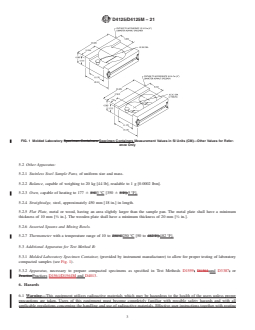
5.3.1 Molded Laboratory Specimen Container, (provided by instrument manufacturer) to allow for proper testing of laboratory
compacted samples (see Fig. 1).
5.3.2 Apparatus, necessary to prepare compacted specimens as specified in Test Methods D1559, D1561,and D3387, or
PracticePractices D1561/D1561M and D4013.
6. Hazards
6.1 Warning—This equipment utilizes radioactive materials which may be hazardous to the health of the users unless proper
precautions are taken. Users of this equipment must become completely familiar with possible safety hazards and with all
applicable regulations concerning the handling and use of radioactive materials. Effective user instructions together with routine
D4125/D4125M − 21
safety procedures are a recommended part of the operation of this apparatus.Warning—This equipment utilizes radioactive
materials which may be hazardous to the health of the users unless proper precautions are taken. Users of this equipment must
become completely familiar with possible safety hazards and with all applicable regulations concerning the handling and use of
radioactive materials. Effective user instructions together with routine safety procedures are a recommended part of the operation
of this apparatus.
7. Sampling
7.1 Obtain random samples of aggregates in accordance with Practice D75D75/D75M.
7.2 Obtain random samples of freshly produced bituminousasphalt paving mixture in accordance with Practice D979D979/
D979M.
7.3 Obtain random samples of bituminousasphalt materials in accordance with Practice D140D140/D140M.
8. Calibration
8.1 The test results obtained using this test method will be influenced by the types of aggregate, source, and grade of asphalt, and
by the mix gradation. Accordingly, a calibration curve must be developed for each mix type and aggregate blend to be tested under
this test method.
8.1.1 A new calibration curve shall be developed whenever there is a change in the source of asphalt or aggregate or a significant
change in aggregate gradation.
8.1.2 A new calibration curve shall be established for new or repaired apparatus.
8.2 For Test Method A, calibrate the apparatus using the following procedures:
8.2.1 Sample the aggregates in accordance with 7.1 and blend the aggregates in the proper proportions. Obtain enough aggregate
for a minimum of three samples. Approximately 30 kg 30 kg [65 lb] will be required, and
8.2.2 Sample the bituminousasphalt materials in accordance with 7.3. Approximately 2.5 kg [5.5 lb] will be required.
8.3 Use a minimum of three prepared samples to establish the calibration curve. The range of asphalt contents shall vary by at
least two percent 2 % asphalt content from the lowest to the highest contents in the samples. The range shall encompass the asphalt
content of the proposed mix design. The mass of the samples shall be within 10 g [0.02 lb] of each other.
8.3.1 Unless the apparatus makes provision for temperature corrections, all calibration samples shall be tested at a uniform
temperature,temperature within 65°C [9°F].65 °C [9 °F]. Calibration samples should be prepared and tested as closeclosely as
possible to the temperature of test samples of completed mixes.
8.4 Prepare a blank sample (sample of hot, dry aggregate without asphalt) to determine the mass to be used for calibration and
plant mix samples. Using this mass will ensure the same average density for all test samples.
8.4.1 Thoroughly mix at least 10 kg [22 lb] of the aggregate after heating and drying it to a constant mass and temperature.
8.4.2 Fill a sample pan with the aggregate in two or three layers, avoiding segregation. Using a scoop or spatula, distribute the
aggregate to reduce voids and segregation. For each layer raise the pan approximately 20 to 50 mm [1 to 2 in.] from the working
surface and tap the pan against the working surface two or three times to settle the contents. Fill the pan to a point slightly above
the top edge. Slide a straightedge along the top of the pan until the aggregate is absolutely flush with the top edge of the pan.
(Caution—Do not compact the sample.)
8.4.3 Determine the mass of the blank sample to the nearest gram and record data. Use this mass for all calibration and plant mix
test samples. (See Note 2.)
8.4.4 Place the pan containing the blank sample in the apparatus and take a measurement in accordance with the manufacturer’s
instructions.
D4125/D4125M − 21
8.4.5 Record the blank sample count.
8.4.6 To detect changes in aggregate that may affect test results, a sample of aggregate may be prepared and tested each day as
described herein. If a significant change in the count [60.5 %](60.5 %) has occurred, then check the calibration as described in
9.3. If necessary, prepare a new calibration curve as outlined in 8.5 (see Note 1).
NOTE 1—Batch plant hot bin samples may be used to obtain the dry aggregate count. Care must be taken to ensure that the aggregate is completely dried
and properly mixed before testing when using hot bin samples.
8.5 Prepare a minimum of three calibration samples using the following procedures:
8.5.1 Heat the aggregates and asphalt cement to approximately 150°C [300°F].150 °C [300 °F]. Heat all bowls, sample pans, and
tools to approximately 150°C [300°F].150 °C [300 °F].
8.5.2 To prevent samples from being biased by residual asphalt retained in the mixing bowl, do not clean the bowl after each
mixing of the samples. Scrape it clean, leaving a coat
...