

ASTM D4167-21
(Specification)Standard Specification for Fiber-Reinforced Plastic Fans and Blowers
General Information
- Abstract
ABSTRACT
This specification covers the minimum requirements for construction of fiber-reinforced thermoset plastic fans (both centrifugal and axial) and blowers, and provides for a common basis for determining safe operating speeds. The fan housing shall be of laminate construction consisting of a resin-rich inner surface layer reinforced with a chemical-resistant glass-fiber or organic-fiber surface mat and an interior layer made of resin reinforced only with noncontinuous glass-fiber strands. Fan wheels shall be manufactured from a corrosion-resistant material as well, with visible defects limited only to the requirements specified. Further rendering the fan wheel and housing electrostatically conductive shall result in a spark-resistant fan. Tests for balance, fan aerodynamic rating, and safe operating speed shall be performed and shall conform to the requirements specified.
SCOPE
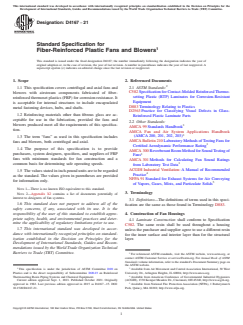
1.1 This specification covers centrifugal and axial fans and blowers with airstream components fabricated of fiber-reinforced thermoset plastics (FRP) for corrosion resistance. It is acceptable for internal structures to include encapsulated metal fastening devices, hubs, and shafts.
1.2 Reinforcing materials other than fibrous glass are acceptable for use in the fabrication, provided the fans and blowers produced meet all the requirements of this specification.
1.3 The term “fans” as used in this specification includes fans and blowers, both centrifugal and axial.
1.4 The purpose of this specification is to provide purchasers, system designers, specifiers, and suppliers of FRP fans with minimum standards for fan construction and a common basis for determining safe operating speeds.
1.5 The values stated in inch-pound units are to be regarded as the standard. The values given in parentheses are provided for information only.
Note 1: There is no known ISO equivalent to this standard.
Note 2: Appendix X2 contains a list of documents potentially of interest to designers of fan systems.
1.6 This standard does not purport to address all of the safety concerns, if any, associated with its use. It is the responsibility of the user of this standard to establish appropriate safety, health, and environmental practices and determine the applicability of regulatory limitations prior to use.
1.7 This international standard was developed in accordance with internationally recognized principles on standardization established in the Decision on Principles for the Development of International Standards, Guides and Recommendations issued by the World Trade Organization Technical Barriers to Trade (TBT) Committee.
- Status
- Published
- Publication Date
- 31-Aug-2021
- Technical Committee
- D20 - Plastics
Buy Documents
ASTM D4167-21 - Standard Specification for Fiber-Reinforced Plastic Fans and Blowers
REDLINE ASTM D4167-21 - Standard Specification for Fiber-Reinforced Plastic Fans and Blowers
Overview
ASTM D4167-21 is the current standard specification developed by ASTM International for fiber-reinforced plastic fans and blowers. This standard outlines the minimum requirements for the construction, testing, and performance of fiber-reinforced thermoset plastic (FRP) centrifugal and axial fans and blowers. Its primary purpose is to ensure that FRP fans are constructed with proven corrosion resistance, safety, and reliability for use in various industrial applications. The specification also establishes a common basis for determining safe operating speeds, supporting system designers, manufacturers, purchasers, and specifiers in selecting suitable equipment for demanding environments.
Key Topics
Scope and Purpose
- Covers fans and blowers with airstream components fabricated of fiber-reinforced thermoset plastics.
- Includes requirements for both centrifugal and axial fans.
- Provides criteria to determine safe operating speeds, ensuring reliability under different operational conditions.
Construction Requirements
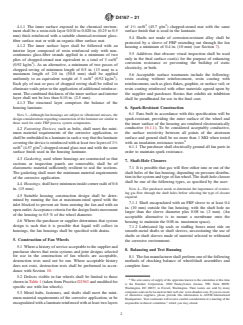
- Fan housings must be laminate construction with a resin-rich inner surface, reinforced with a chemical-resistant mat, and an interior layer with noncontinuous glass-fiber strands.
- Internal structures may include encapsulated metal fasteners, hubs, and shafts, provided they meet corrosion resistance requirements.
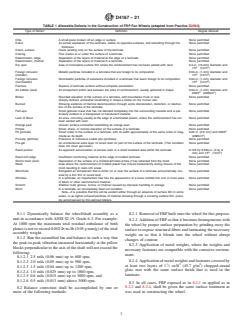
- Stringent defect allowances for fan wheels and housings to maintain structural integrity.
Testing and Performance
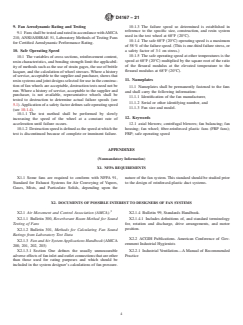
- Balance, aerodynamic rating, and safe operating speed tests are required to ensure proper function.
- Spark-resistant construction provisions for applications where electrostatic discharge must be controlled.
- Surface treatments to enhance corrosion resistance and reduce static buildup are permitted with restrictions.
Marking and Identification
- Nameplates must be permanently affixed, displaying manufacturer information, serial numbers, size, and model.
Applications
ASTM D4167-21 is widely recognized across industries requiring robust corrosion resistance and operational safety, especially in systems where chemical or corrosive environments present a challenge to standard materials. Common applications include:
- Chemical Processing: Handling and ventilation of corrosive gases, fumes, and vapors.
- Wastewater Treatment: Exhaust systems exposed to aggressive atmospheres.
- Industrial Ventilation: Systems requiring spark-resistant and corrosion-resistant fans, such as exhaust for mists, vapors, and particulate-laden air.
- Pharmaceutical and Food Processing: Where non-metallic construction is favored for cleanliness or process compatibility.
The standard also supports compliance with guidelines from related organizations such as NFPA 91 for exhaust systems, ensuring broader safety and performance.
Related Standards
ASTM D4167-21 references and complements several standards to ensure comprehensive requirements for FRP fan construction:
- ASTM C582: Specification for Contact-Molded Reinforced Thermosetting Plastic (RTP) Laminates for Corrosion-Resistant Equipment.
- ASTM D883: Terminology Relating to Plastics.
- ASTM D2563: Practice for Classifying Visual Defects in Glass-Reinforced Plastic Laminate Parts.
- AMCA 210 (ANSI/ASHRAE 51): Laboratory Methods of Testing Fans for Certified Aerodynamic Performance Rating.
- NFPA 91: Standard for Exhaust Systems for Air Conveying of Vapors, Gases, Mists, and Particulate Solids.
- ACGIH Industrial Ventilation: A Manual of Recommended Practice for industrial hygiene applications.
By adhering to ASTM D4167-21, organizations can effectively design, manufacture, and specify FRP fans and blowers with assurance of corrosion resistance, safety, and performance in compliance with internationally recognized industry standards.
Keywords: ASTM D4167-21, fiber-reinforced plastic fans, FRP blowers, corrosion-resistant fans, industrial ventilation standards, safe operating speed, spark-resistant fan construction.
Relations
- Effective Date
- 01-Feb-2024
- Effective Date
- 01-Nov-2023
- Effective Date
- 01-Jan-2020
- Effective Date
- 01-Aug-2019
- Effective Date
- 15-Apr-2019
- Effective Date
- 01-Feb-2019
- Effective Date
- 01-Dec-2018
- Effective Date
- 01-Nov-2018
- Effective Date
- 15-Aug-2017
- Effective Date
- 01-Sep-2015
- Effective Date
- 15-Nov-2012
- Effective Date
- 15-May-2011
- Effective Date
- 01-Apr-2009
- Effective Date
- 01-May-2008
- Effective Date
- 01-Mar-2008
Buy Documents
ASTM D4167-21 - Standard Specification for Fiber-Reinforced Plastic Fans and Blowers
REDLINE ASTM D4167-21 - Standard Specification for Fiber-Reinforced Plastic Fans and Blowers
Get Certified
Connect with accredited certification bodies for this standard

Institut za varilstvo d.o.o. (Welding Institute)
Slovenia's leading welding institute since 1952. ISO 3834, EN 1090, pressure equipment certification, NDT personnel, welder qualification. Only IIW Au
Sponsored listings
Frequently Asked Questions
ASTM D4167-21 is a technical specification published by ASTM International. Its full title is "Standard Specification for Fiber-Reinforced Plastic Fans and Blowers". This standard covers: ABSTRACT This specification covers the minimum requirements for construction of fiber-reinforced thermoset plastic fans (both centrifugal and axial) and blowers, and provides for a common basis for determining safe operating speeds. The fan housing shall be of laminate construction consisting of a resin-rich inner surface layer reinforced with a chemical-resistant glass-fiber or organic-fiber surface mat and an interior layer made of resin reinforced only with noncontinuous glass-fiber strands. Fan wheels shall be manufactured from a corrosion-resistant material as well, with visible defects limited only to the requirements specified. Further rendering the fan wheel and housing electrostatically conductive shall result in a spark-resistant fan. Tests for balance, fan aerodynamic rating, and safe operating speed shall be performed and shall conform to the requirements specified. SCOPE 1.1 This specification covers centrifugal and axial fans and blowers with airstream components fabricated of fiber-reinforced thermoset plastics (FRP) for corrosion resistance. It is acceptable for internal structures to include encapsulated metal fastening devices, hubs, and shafts. 1.2 Reinforcing materials other than fibrous glass are acceptable for use in the fabrication, provided the fans and blowers produced meet all the requirements of this specification. 1.3 The term “fans” as used in this specification includes fans and blowers, both centrifugal and axial. 1.4 The purpose of this specification is to provide purchasers, system designers, specifiers, and suppliers of FRP fans with minimum standards for fan construction and a common basis for determining safe operating speeds. 1.5 The values stated in inch-pound units are to be regarded as the standard. The values given in parentheses are provided for information only. Note 1: There is no known ISO equivalent to this standard. Note 2: Appendix X2 contains a list of documents potentially of interest to designers of fan systems. 1.6 This standard does not purport to address all of the safety concerns, if any, associated with its use. It is the responsibility of the user of this standard to establish appropriate safety, health, and environmental practices and determine the applicability of regulatory limitations prior to use. 1.7 This international standard was developed in accordance with internationally recognized principles on standardization established in the Decision on Principles for the Development of International Standards, Guides and Recommendations issued by the World Trade Organization Technical Barriers to Trade (TBT) Committee.
ABSTRACT This specification covers the minimum requirements for construction of fiber-reinforced thermoset plastic fans (both centrifugal and axial) and blowers, and provides for a common basis for determining safe operating speeds. The fan housing shall be of laminate construction consisting of a resin-rich inner surface layer reinforced with a chemical-resistant glass-fiber or organic-fiber surface mat and an interior layer made of resin reinforced only with noncontinuous glass-fiber strands. Fan wheels shall be manufactured from a corrosion-resistant material as well, with visible defects limited only to the requirements specified. Further rendering the fan wheel and housing electrostatically conductive shall result in a spark-resistant fan. Tests for balance, fan aerodynamic rating, and safe operating speed shall be performed and shall conform to the requirements specified. SCOPE 1.1 This specification covers centrifugal and axial fans and blowers with airstream components fabricated of fiber-reinforced thermoset plastics (FRP) for corrosion resistance. It is acceptable for internal structures to include encapsulated metal fastening devices, hubs, and shafts. 1.2 Reinforcing materials other than fibrous glass are acceptable for use in the fabrication, provided the fans and blowers produced meet all the requirements of this specification. 1.3 The term “fans” as used in this specification includes fans and blowers, both centrifugal and axial. 1.4 The purpose of this specification is to provide purchasers, system designers, specifiers, and suppliers of FRP fans with minimum standards for fan construction and a common basis for determining safe operating speeds. 1.5 The values stated in inch-pound units are to be regarded as the standard. The values given in parentheses are provided for information only. Note 1: There is no known ISO equivalent to this standard. Note 2: Appendix X2 contains a list of documents potentially of interest to designers of fan systems. 1.6 This standard does not purport to address all of the safety concerns, if any, associated with its use. It is the responsibility of the user of this standard to establish appropriate safety, health, and environmental practices and determine the applicability of regulatory limitations prior to use. 1.7 This international standard was developed in accordance with internationally recognized principles on standardization established in the Decision on Principles for the Development of International Standards, Guides and Recommendations issued by the World Trade Organization Technical Barriers to Trade (TBT) Committee.
ASTM D4167-21 is classified under the following ICS (International Classification for Standards) categories: 23.120 - Ventilators. Fans. Air-conditioners. The ICS classification helps identify the subject area and facilitates finding related standards.
ASTM D4167-21 has the following relationships with other standards: It is inter standard links to ASTM D883-24, ASTM D883-23, ASTM D883-20, ASTM D883-19c, ASTM D883-19a, ASTM D883-19, ASTM D883-18a, ASTM D883-18, ASTM D883-17, ASTM D2563-08(2015), ASTM D883-12e1, ASTM D883-11, ASTM C582-09, ASTM D2563-08, ASTM D883-08. Understanding these relationships helps ensure you are using the most current and applicable version of the standard.
ASTM D4167-21 is available in PDF format for immediate download after purchase. The document can be added to your cart and obtained through the secure checkout process. Digital delivery ensures instant access to the complete standard document.
Standards Content (Sample)
This international standard was developed in accordance with internationally recognized principles on standardization established in the Decision on Principles for the
Development of International Standards, Guides and Recommendations issued by the World Trade Organization Technical Barriers to Trade (TBT) Committee.
Designation:D4167 −21
Standard Specification for
Fiber-Reinforced Plastic Fans and Blowers
This standard is issued under the fixed designation D4167; the number immediately following the designation indicates the year of
original adoption or, in the case of revision, the year of last revision. A number in parentheses indicates the year of last reapproval. A
superscript epsilon (´) indicates an editorial change since the last revision or reapproval.
1. Scope 2. Referenced Documents
2.1 ASTM Standards:
1.1 This specification covers centrifugal and axial fans and
C582 Specification for Contact-Molded ReinforcedThermo-
blowers with airstream components fabricated of fiber-
setting Plastic (RTP) Laminates for Corrosion-Resistant
reinforced thermoset plastics (FRP) for corrosion resistance. It
Equipment
is acceptable for internal structures to include encapsulated
D883 Terminology Relating to Plastics
metal fastening devices, hubs, and shafts.
D2563 Practice for Classifying Visual Defects in Glass-
1.2 Reinforcing materials other than fibrous glass are ac-
Reinforced Plastic Laminate Parts
ceptable for use in the fabrication, provided the fans and
2.2 Other Standards:
blowers produced meet all the requirements of this specifica-
AMCA 99 Standards Handbook
tion.
AMCA Fan and Air System Applications Handbook
(AMCA 200, 201, 202, 203)
1.3 The term “fans” as used in this specification includes
AMCABulletin210 LaboratoryMethodsofTestingFansfor
fans and blowers, both centrifugal and axial.
Certified Aerodynamic Performance Rating
1.4 The purpose of this specification is to provide
AMCA 300 ReverberantRoomMethodforSoundTestingof
purchasers, system designers, specifiers, and suppliers of FRP
Fans
fans with minimum standards for fan construction and a
AMCA 301 Methods for Calculating Fan Sound Ratings
common basis for determining safe operating speeds.
from Laboratory Test Data
ACGIH Industrial Ventilation: A Manual of Recommended
1.5 The values stated in inch-pound units are to be regarded
Practice
as the standard. The values given in parentheses are provided
NFPA 91 Standard for Exhaust Systems for Air Conveying
for information only.
of Vapors, Gases, Mists, and Particulate Solids
NOTE 1—There is no known ISO equivalent to this standard.
NOTE 2—Appendix X2 contains a list of documents potentially of 3. Terminology
interest to designers of fan systems.
3.1 Definitions—The definitions of terms used in this speci-
1.6 This standard does not purport to address all of the
fication are the same as those found in Terminology D883.
safety concerns, if any, associated with its use. It is the
responsibility of the user of this standard to establish appro- 4. Construction of Fan Housings
priate safety, health, and environmental practices and deter-
4.1 Laminate Construction shall conform to Specification
mine the applicability of regulatory limitations prior to use.
C582. The same resin shall be used throughout a housing
1.7 This international standard was developed in accor-
unless the purchaser and supplier agree to use a different resin
dance with internationally recognized principles on standard-
for the inner surface and interior layer than for the structural
ization established in the Decision on Principles for the
layer.
Development of International Standards, Guides and Recom-
mendations issued by the World Trade Organization Technical
Barriers to Trade (TBT) Committee.
For referenced ASTM standards, visit the ASTM website, www.astm.org, or
contact ASTM Customer Service at service@astm.org. For Annual Book of ASTM
Standards volume information, refer to the standard’s Document Summary page on
the ASTM website.
1 3
This specification is under the jurisdiction of ASTM Committee D20 on Available from Air Movement and Control Association International, 30 West
Plastics and is the direct responsibility of Subcommittee D20.23 on Reinforced University Dr., Arlington Heights, IL 60004, http://www.amca.org.
Thermosetting Resin Piping Systems and Chemical Equipment. Available from American Conference of Governmental Industrial Hygienists
Current edition approved Sept. 1, 2021. Published October 2021. Originally (ACGIH), 1330 Kemper Meadow Dr., Cincinnati, OH 45240, http://www.acgih.org.
approved in 1982. Last previous edition approved in 2015 as D4167 –15. DOI: Available from National Fire Protection Association (NFPA), 1 Batterymarch
10.1520/D4167-21. Park, Quincy, MA 02269, http://www.nfpa.org.
Copyright © ASTM International, 100 Barr Harbor Drive, PO Box C700, West Conshohocken, PA 19428-2959. United States
D4167−21
2 2
4.1.1 The inner surface exposed to the chemical environ- of 1 ⁄2 oz/ft (45.7 g/m ) chopped-strand mat with the same
ment shall be a resin-rich layer 0.010 to 0.020 in. (0.25 to 0.5 surface finish that is used in the laminate.
mm) thick reinforced with a suitable chemical-resistant glass-
5.4 Shafts not made of corrosion-resistant alloy shall be
fiber surface mat or with an organic-fiber surface mat.
protected by a sleeve of FRP extending out through the fan
4.1.2 The inner surface layer shall be followed with an
housing a minimum of 0.4 in. (10 mm) (see Section 7).
interior layer composed of resin reinforced only with non-
5.5 Additives that obscure visual inspection shall be used
continuous glass-fiber strands applied in a minimum of two
only in the final surface coat(s) for the purpose of enhancing
plies of chopped-strand mat equivalent to a total of 3 oz/ft
corrosion resistance or preventing the buildup of static
(0.92 kg/m ). As an alternative, a minimum of two passes of
electricity, or both.
chopped roving of minimum length of 0.5 in. (13 mm) to a
maximum length of 2.0 in. (50.8 mm) shall be applied
5.6 Acceptable surface treatments include the following:
2 2
uniformly to an equivalent weight of 3 oz/ft (0.92 kg/m ). resin coating without reinforcement, resin coating with
Each ply of mat or pass of chopped roving shall be rolled to
reinforcement, such as glass flakes, graphite, or surface veil; or
eliminate voids prior to the application of additional reinforce- resin coating reinforced with other materials agreed upon by
ment. The combined thickness of the inner surface and interior the supplier and purchaser. Resins that exhibit air inhibition
layer shall not be less than 0.10 in. (2.5 mm).
shall be paraffinated for use in the final coat.
4.1.3 The structural layer comprises the balance of the
housing laminate. 6. Spark-Resistant Construction
6.1 Fans built in accordance with this specification will be
NOTE 3—Although fan housings are subject to vibrational stresses, the
design considerations regarding construction of the laminate are similar to
spark-resistant, providing the outer surface of the wheel and
those used for static FRP process system components.
the inner surface of the housing are rendered electrostatically
4.2 Fastening Devices, such as bolts, shall meet the mini- conductive (6.1.1). To be considered acceptably conductive,
the surface resistivity between all points of the airstream
mum material requirements of the corrosive application, or
shallbeembeddedinalaminateinsuchawaythatthelaminate surface and ground shall be no more than 1 MΩ when tested
with an insulation resistance tester.
covering the device is reinforced with at least two layers of 1 ⁄2
2 2
oz/ft (4.57 g/m ) chopped-strand glass mat and with the same 6.1.1 The purchaser shall electrically ground all fan parts in
order to maintain spark resistance.
surface finish used in the housing laminate.
4.3 Gasketing, used where housings are constructed so that
7. Shaft-Hole Closures
sections or inspection panels are removable, shall be of
7.1 It is possible that gas will flow either into or out of the
elastomeric material sufficiently resilient to seal the sections.
shaft holes of the fan housing, depending on pressure distribu-
The gasketing shall meet the minimum material requirements
tioninthesystemandtypeoffanwheel.Theshaft-holeclosure
of the corrosive application.
shall be one of the following types, as specified by the user:
4.4 Housings, shall have minimum inside corner radii of 0.6
NOTE 4—The purchaser needs to determine the importance of restrict-
in. (15 mm).
ing gas flow through the shaft holes before selecting the type of closure
4.5 Suitable housing construction design shall be deter-
required.
mined by running the fan at maximum-rated speed with the
7.1.1 Shaft encapsulated with an FRP sleeve to at least 0.4
inlet blocked to prevent air from entering the fan and with an
in. (10 mm) outside the fan housing, with the shaft hole no
openoutlet.Acceptancecriteriaforthedesignlimitsmovement
larger than the sleeve diameter plus 0.08 in. (2 mm). (An
of the housing to 0.5 % of the wheel diameter.
acceptable alternative is to mount a membrane onto the
4.6 Where the purchaser or supplier determines that system
housing to maintain the 0.08-in. maximum space).
design is such that it is possible that liquid will collect in
7.1.2 Lubricated lip seals or stuffing boxes must ride on
housings, the fan housings shall be specified with drains.
smooth metal shafts or shaft sleeves, necessitating the use of
shafts or shaft sleeves made of material selected to withstand
5. Construction of Fan Wheels
the corrosive environment.
5.1 Whereahistoryofserviceacceptabletothesupplierand
8. Balancing and Test Running
purchaser shows that resin systems and joint designs selected
for use in the construction of fan wheels are acceptable, 8.1 Thefanmanufacturershallperformoneofthefollowing
destruction tests need not be run. Where acceptable history methods of checking balance of wheel/shaft assemblies and
does not exist, destruction tests shall be performed in accor- complete fans:
dance with Section 10.
5.2 Defects visible in fan wheels shall be limited to those
The sole source of supply of the apparatus known to the committee at this time
shown in Table 1 (taken from Practice D2563 and modified for
is the Danaher Corporation, 2200 Pennsylvania Avenue, NW, Suite 800W,
specific use with fan wheels).
Washington, DC 20037, to Everett, Washington. Their testers are sold by many
companiesandcanbelocatedontheirwebsite:www.danaher.com.Ifyouareaware
5.3 Metal hubs, fasteners, and shafts shall meet the mini-
of alternative suppliers, please provide this information to ASTM International
mum material requirements of the corrosive application, or be
Headquarters.Your comments will receive careful consideration at a meeting of the
encapsulatedwithalaminatereinforcedwithatleasttwolayers responsible technical committee, which you may attend.
D4167−21
TABLE 1 Allowable Defects in the Construction of FRP Fan Wheels (adapted from Practice D2563)
Type of Defect Defin
...
This document is not an ASTM standard and is intended only to provide the user of an ASTM standard an indication of what changes have been made to the previous version. Because
it may not be technically possible to adequately depict all changes accurately, ASTM recommends that users consult prior editions as appropriate. In all cases only the current version
of the standard as published by ASTM is to be considered the official document.
Designation: D4167 − 15 D4167 − 21
Standard Specification for
Fiber-Reinforced Plastic Fans and Blowers
This standard is issued under the fixed designation D4167; the number immediately following the designation indicates the year of
original adoption or, in the case of revision, the year of last revision. A number in parentheses indicates the year of last reapproval. A
superscript epsilon (´) indicates an editorial change since the last revision or reapproval.
1. Scope*Scope
1.1 This specification covers centrifugal and axial fans and blowers with airstream components fabricated of fiber-reinforced
thermoset plastics (FRP) for corrosion resistance. It is acceptable for internal structures to include encapsulated metal fastening
devices, hubs, and shafts.
1.2 Reinforcing materials other than fibrous glass are acceptable for use in the fabrication, provided the fans and blowers produced
meet all the requirements of this specification.
1.3 The term “fans” as used in this specification includes fans and blowers, both centrifugal and axial.
1.4 The purpose of this specification is to provide users,purchasers, system designers, specifiers, and manufacturerssuppliers of
FRP fans with minimum standards for fan construction and a common basis for determining safe operating speeds.
1.5 The values stated in inch-pound units are to be regarded as the standard. The values given in parentheses are provided for
information only.
NOTE 1—There is no known ISO equivalent to this standard.
NOTE 2—Appendix X2 contains a list of documents potentially of interest to designers of fan systems.
1.6 This standard does not purport to address all of the safety concerns, if any, associated with its use. It is the responsibility
of the user of this standard to establish appropriate safety, health, and environmental practices and determine the applicability of
regulatory limitations prior to use.
1.7 This international standard was developed in accordance with internationally recognized principles on standardization
established in the Decision on Principles for the Development of International Standards, Guides and Recommendations issued
by the World Trade Organization Technical Barriers to Trade (TBT) Committee.
2. Referenced Documents
2.1 ASTM Standards:
C582 Specification for Contact-Molded Reinforced Thermosetting Plastic (RTP) Laminates for Corrosion-Resistant Equipment
D883 Terminology Relating to Plastics
This specification is under the jurisdiction of ASTM Committee D20 on Plastics and is the direct responsibility of Subcommittee D20.23 on Reinforced Plastic
Thermosetting Resin Piping Systems and Chemical Equipment.
Current edition approved Dec. 1, 2015Sept. 1, 2021. Published January 2016October 2021. Originally approved in 1982. Last previous edition approved in 20072015 as
D4167 –97(2007). –15. DOI: 10.1520/D4167-15.10.1520/D4167-21.
For referenced ASTM standards, visit the ASTM website, www.astm.org, or contact ASTM Customer Service at service@astm.org. For Annual Book of ASTM Standards
volume information, refer to the standard’s Document Summary page on the ASTM website.
*A Summary of Changes section appears at the end of this standard
Copyright © ASTM International, 100 Barr Harbor Drive, PO Box C700, West Conshohocken, PA 19428-2959. United States
D4167 − 21
D2563 Practice for Classifying Visual Defects in Glass-Reinforced Plastic Laminate Parts
2.2 Other Standards:
AMCA 99 Standards Handbook
AMCA Fan and Air System Applications Handbook (AMCA 200, 201, 202, 203)
AMCA Bulletin 210 Laboratory Methods of Testing Fans for Certified Aerodynamic Performance Rating
AMCA 300 Reverberant Room Method for Sound Testing of Fans
AMCA 301 Methods for Calculating Fan Sound Ratings from Laboratory Test Data
ACGIH Industrial Ventilation: A Manual of Recommended Practice
NFPA 91 Standard for Exhaust Systems for Air Conveying of Vapors, Gases, Mists, and Particulate Solids
3. Terminology
3.1 Definitions—The definitions of terms used in this specification are the same as those found in Terminology D883.
4. Construction of Fan Housings
4.1 Laminate Construction shall conform to Specification C582. The same resin shall be used throughout a housing unless the
userpurchaser and manufacturersupplier agree to use a different resin for the inner surface and interior layer than for the structural
layer.
4.1.1 The inner surface exposed to the chemical environment shall be a resin-rich layer 0.010 to 0.020 in. (0.25 to 0.5 mm) thick
reinforced with a suitable chemical-resistant glass-fiber surface mat or with an organic-fiber surface mat.
4.1.2 The inner surface layer shall be followed with an interior layer composed of resin reinforced only with non-continuous
2 2
glass-fiber strands applied in a minimum of two plies of chopped-strand mat equivalent to a total of 3 oz/ft (0.92 kg/m ). As an
alternative, a minimum of two passes of chopped roving of minimum length of 0.5 in. (13 mm) to a maximum length of 2.0 in.
2 2
(50.8 mm) shall be applied uniformly to an equivalent weight of 3 oz/ft (0.92 kg/m ). Each ply of mat or pass of chopped roving
shall be well rolled rolled to eliminate voids prior to the application of additional reinforcement. The combined thickness of the
inner surface and interior layer shall not be less than 0.10 in. (2.5 mm).
4.1.3 The structural layer comprises the balance of the housing laminate.
NOTE 3—Although fan housings are subject to vibrational stresses, the design considerations regarding construction of the laminate are similar to those
used for static FRP process system components.
4.2 Fastening Devices, such as bolts, shall be made of material the user and manufacturer agree is at least as corrosion-resistant
to the specified corrosive environment as is the laminate construction, meet the minimum material requirements of the corrosive
application, or shall be embedded in a laminate in such a way that the laminate covering the device is reinforced with at least two
2 2
layers of 1 ⁄2 oz/ft (4.57 g/m ) chopped-strand glass mat and with the same surface finish used in the housing laminate.
4.3 Gasketing, used where housings are constructed so that sections or inspection panels are removable, shall be of elastomeric
material sufficiently resilient to seal the sections. The gasketing shall be of material the user and manufacturer agree is suitable for
the corrosive environment.meet the minimum material requirements of the corrosive application.
4.4 Housings, shall have minimum inside corner radii of 0.6 in. (15 mm).
4.5 Suitable housing construction design shall be determined by running the fan at maximum-rated speed with the inlet blocked
tight to prevent air from entering the fan and with an open outlet. The design will be deemed acceptable if the test does not cause
any part Acceptance criteria for the design limits movement of the housing to move more than a distance equal to 0.5 % ⁄2of 1 %
of the wheel diameter from the position with the fan not running. the wheel diameter.
4.6 Where the user purchaser or supplier determines that system design is such that it is possible that liquid will collect in
housings, the fan housings shall be specified with drains.
Available from Air Movement and Control Association International, 30 West University Dr., Arlington Heights, IL 60004, http://www.amca.org.
Available from American Conference of Governmental Industrial Hygienists (ACGIH), 1330 Kemper Meadow Dr., Cincinnati, OH 45240, http://www.acgih.org.
Available from National Fire Protection Association (NFPA), 1 Batterymarch Park, Quincy, MA 02269, http://www.nfpa.org.
D4167 − 21
5. Construction of Fan Wheels
5.1 Where a history of service acceptable to the manufacturersupplier and the user purchaser shows that resin systems and joint
designs selected for use in the construction of fan wheels are acceptable, destruction tests need not be run. Where acceptable history
does not exist, destruction tests shall be performed in accordance with Section 10.
5.2 Defects visible in fan wheels shall be limited to those shown in Table 1 (taken from Practice D2563 and modified for specific
use with fan wheels).
5.3 Metal hubs, fasteners, and shafts shall be made of material at least as corrosion-resistant to the specified corrosive environment
as is the laminate construction,meet the minimum material requirements of the corrosive application, or be encapsulated with a
2 2
laminate reinforced with at least two layers of 1 ⁄2 oz/ft (45.7 g/m ) chopped-strand mat with the same surface finish that is used
in the laminate.
5.4 Shafts not made of corrosion-resistant alloy shall be protected by a sleeve of FRP extending out through the fan housing a
minimum of 0.4 in. (10 mm) (see Section 7).
TABLE 1 Allowable Defects in the Construction of FRP Fan Wheels (adapted from Practice D2563)
Type of Defect Definition Degree Allowed
Chip A small piece broken off an edge or surface None permitted
Crack An actual separation of the laminate, visible on opposite surfaces, and extending through the None permitted
thickness
Crack, surface Crack existing only on the surface of the laminate None permitted
Crazing Fine cracks at or under the surface of a laminate None permitted
Delamination, edge Separation of the layers of material at the edge of a laminate None permitted
Delamination, internal Separation of the layers of material in a laminate None permitted
Dry spot Area of incomplete surface film where the reinforcement has not been wetted with resin 0.4-in. (10-mm) diameter and
2 2
1/ft (12/m )
Foreign inclusion Metallic particles included in a laminate that are foreign to its composition 0.04-in. (1-mm) diameter and
2 2
(metallic) 1/ft (12/m )
Foreign inclusion Nonmetallic particles of substance included in a laminate that seem foreign to its composition 0.04-in. (1-mm) diameter and
2 2
(nonmetallic) 1/ft (12/m )
Fracture Rupture of laminate surface without complete penetration None permitted
Air bubble (void) Air entrapment within and between the plies of reinforcement, usually spherical in shape 0.04-in. (1-mm) diameter and
2 2
200/ft (2000/m )
Blister Rounded elevation of the surface of a laminate, with boundaries more or less None permitted
sharply defined, somewhat resembling in shape a blister on the human skin
Burned Showing evidence of thermal decomposition through some discoloration, distortion, or destruc- None permitted
tion of the surface of the laminate
Fish-eye Small globular mass that has not blended completely into the surrounding material and is par- None permitted
ticularly evident in a transparent or translucent material
Lack of fillout An area, occurring usually at the edge of a laminated plastic, where the reinforcement has not None permitted
been wetted with resin
Orange peel Uneven surface somewhat resembling an orange peel None permitted
Pimple Small, sharp, or conical elevation on the surface of a laminate None permitted
Pit (pinhole) Small crater in the surface of a laminate, with its width approximately of the same order of mag- 0.02 in. (0.5 mm) and 200/ft
nitude as its depth (2000/m )
Porosity (pinhole) Presence of numerous visible pits (pinholes) None permitted
Pre-gel An unintentional extra layer of cured resin on part of the surface of the laminate. (This condition None permitted
does not cover gel coats.)
Resin pocket An apparent accumulation of excess resin in a small localized area within the laminate 0.125 by 0.250-in. (3 by 6
2 2
mm) and 1/ft (12/m )
Resin-rich edge Insufficient reinforcing material at
...