


ASTM E1947-98(2014)
(Specification)Standard Specification for Analytical Data Interchange Protocol for Chromatographic Data
Standard Specification for Analytical Data Interchange Protocol for Chromatographic Data
ABSTRACT
This specification covers an analytical data interchange protocol for chromatographic data representation and a software vehicle to affect the transfer of chromatographic data between instrument data systems. This protocol, which is designed to benefit users of analytical instruments and increase laboratory productivity and efficiency, provides a standardized format for the creation of raw data files or results files in the ".cdf" extension. The contents of the file include typical header in formation like instrument, column, detector, and operator description followed by raw or processed data, or both. Once data have been written or converted to this protocol, they can be read and processed by software packages that support the protocol. The end purpose of this protocol is intended to (1) transfer data between various vendors' instrument systems, (2) provide LIMS communications, (3) link data to document processing applications, (4) link data to spreadsheet applications, and ( 5) archive analytical data, or a combination thereof.
SCOPE
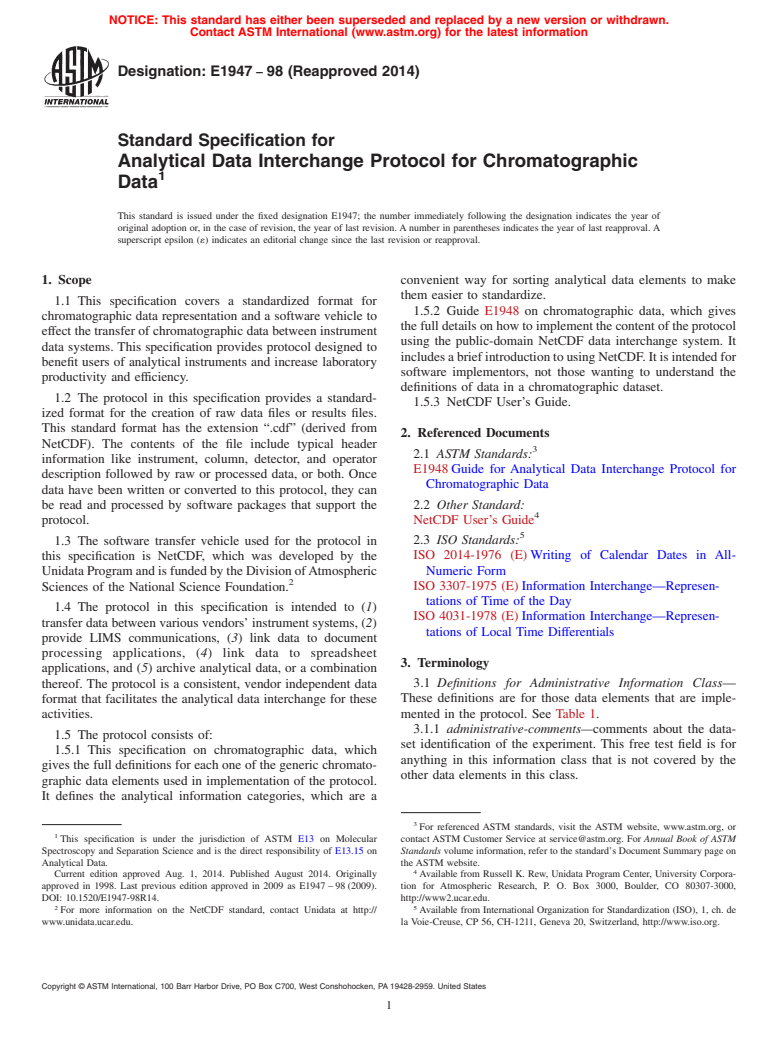
1.1 This specification covers a standardized format for chromatographic data representation and a software vehicle to effect the transfer of chromatographic data between instrument data systems. This specification provides protocol designed to benefit users of analytical instruments and increase laboratory productivity and efficiency.
1.2 The protocol in this specification provides a standardized format for the creation of raw data files or results files. This standard format has the extension “.cdf” (derived from NetCDF). The contents of the file include typical header information like instrument, column, detector, and operator description followed by raw or processed data, or both. Once data have been written or converted to this protocol, they can be read and processed by software packages that support the protocol.
1.3 The software transfer vehicle used for the protocol in this specification is NetCDF, which was developed by the Unidata Program and is funded by the Division of Atmospheric Sciences of the National Science Foundation.2
1.4 The protocol in this specification is intended to (1) transfer data between various vendors' instrument systems, (2) provide LIMS communications, (3) link data to document processing applications, (4) link data to spreadsheet applications, and (5) archive analytical data, or a combination thereof. The protocol is a consistent, vendor independent data format that facilitates the analytical data interchange for these activities.
1.5 The protocol consists of:
1.5.1 This specification on chromatographic data, which gives the full definitions for each one of the generic chromatographic data elements used in implementation of the protocol. It defines the analytical information categories, which are a convenient way for sorting analytical data elements to make them easier to standardize.
1.5.2 Guide E1948 on chromatographic data, which gives the full details on how to implement the content of the protocol using the public-domain NetCDF data interchange system. It includes a brief introduction to using NetCDF. It is intended for software implementors, not those wanting to understand the definitions of data in a chromatographic dataset.
1.5.3 NetCDF User’s Guide.
General Information
Buy Standard
Standards Content (Sample)
NOTICE: This standard has either been superseded and replaced by a new version or withdrawn.
Contact ASTM International (www.astm.org) for the latest information
Designation:E1947 −98 (Reapproved 2014)
Standard Specification for
Analytical Data Interchange Protocol for Chromatographic
Data
This standard is issued under the fixed designation E1947; the number immediately following the designation indicates the year of
original adoption or, in the case of revision, the year of last revision. A number in parentheses indicates the year of last reapproval. A
superscript epsilon (´) indicates an editorial change since the last revision or reapproval.
1. Scope convenient way for sorting analytical data elements to make
them easier to standardize.
1.1 This specification covers a standardized format for
1.5.2 Guide E1948 on chromatographic data, which gives
chromatographic data representation and a software vehicle to
thefulldetailsonhowtoimplementthecontentoftheprotocol
effect the transfer of chromatographic data between instrument
using the public-domain NetCDF data interchange system. It
data systems. This specification provides protocol designed to
includesabriefintroductiontousingNetCDF.Itisintendedfor
benefit users of analytical instruments and increase laboratory
software implementors, not those wanting to understand the
productivity and efficiency.
definitions of data in a chromatographic dataset.
1.2 The protocol in this specification provides a standard-
1.5.3 NetCDF User’s Guide.
ized format for the creation of raw data files or results files.
This standard format has the extension “.cdf” (derived from
2. Referenced Documents
NetCDF). The contents of the file include typical header
2.1 ASTM Standards:
information like instrument, column, detector, and operator
E1948 Guide for Analytical Data Interchange Protocol for
description followed by raw or processed data, or both. Once
Chromatographic Data
data have been written or converted to this protocol, they can
2.2 Other Standard:
be read and processed by software packages that support the
protocol. NetCDF User’s Guide
2.3 ISO Standards:
1.3 The software transfer vehicle used for the protocol in
ISO 2014-1976 (E) Writing of Calendar Dates in All-
this specification is NetCDF, which was developed by the
Numeric Form
UnidataProgramandisfundedbytheDivisionofAtmospheric
ISO 3307-1975 (E) Information Interchange—Represen-
Sciences of the National Science Foundation.
tations of Time of the Day
1.4 The protocol in this specification is intended to (1)
ISO 4031-1978 (E) Information Interchange—Represen-
transfer data between various vendors’ instrument systems, (2)
tations of Local Time Differentials
provide LIMS communications, (3) link data to document
processing applications, (4) link data to spreadsheet
3. Terminology
applications, and (5) archive analytical data, or a combination
3.1 Definitions for Administrative Information Class—
thereof. The protocol is a consistent, vendor independent data
format that facilitates the analytical data interchange for these These definitions are for those data elements that are imple-
mented in the protocol. See Table 1.
activities.
3.1.1 administrative-comments—comments about the data-
1.5 The protocol consists of:
set identification of the experiment. This free test field is for
1.5.1 This specification on chromatographic data, which
anything in this information class that is not covered by the
gives the full definitions for each one of the generic chromato-
other data elements in this class.
graphic data elements used in implementation of the protocol.
It defines the analytical information categories, which are a
For referenced ASTM standards, visit the ASTM website, www.astm.org, or
This specification is under the jurisdiction of ASTM E13 on Molecular contact ASTM Customer Service at service@astm.org. For Annual Book of ASTM
Spectroscopy and Separation Science and is the direct responsibility of E13.15 on Standards volume information, refer to the standard’s Document Summary page on
Analytical Data. the ASTM website.
Current edition approved Aug. 1, 2014. Published August 2014. Originally Available from Russell K. Rew, Unidata Program Center, University Corpora-
approved in 1998. Last previous edition approved in 2009 as E1947 – 98 (2009). tion for Atmospheric Research, P. O. Box 3000, Boulder, CO 80307-3000,
DOI: 10.1520/E1947-98R14. http://www2.ucar.edu.
2 5
For more information on the NetCDF standard, contact Unidata at http:// Available from International Organization for Standardization (ISO), 1, ch. de
www.unidata.ucar.edu. la Voie-Creuse, CP 56, CH-1211, Geneva 20, Switzerland, http://www.iso.org.
Copyright © ASTM International, 100 Barr Harbor Drive, PO Box C700, West Conshohocken, PA 19428-2959. United States
E1947−98 (2014)
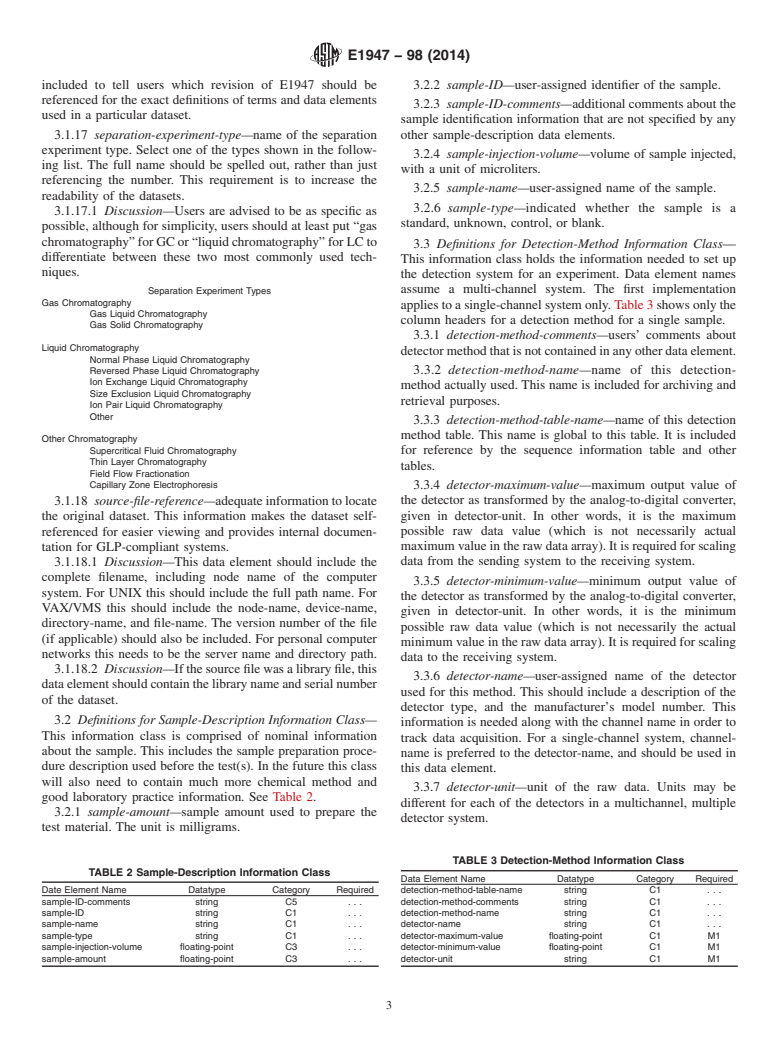
TABLE 1 Administrative Information Class
zero, this indicates a zero hour, zero minute, and zero second
difference from Greenwich Mean Time.
NOTE 1—Particular analytical information categories (C1, C2, C3, C4,
or C5) are assigned to each data element under the Category column. The 3.1.5.3 Discussion—An example of a value for this date
meaning of this category assignment is explained in Section 5.
element would be: 1991,08,01,12:30:23-0500 or
19910801123023-0500. In human terms this is 12:30 PM on
NOTE 2—The Required column indicates whether a data element is
August 1, 1991 in NewYork City. Note that the -0500 hours is
required, and if required, for which categories. For example, M1234
indicates that that particular data element is required for any dataset that
5 full hours time behind Greenwich Mean Time. The ISO
includes information from Category 1, 2, 3, or 4. M4 indicates that a data
standards permit the use of separators as shown, if they are
element is only required for Category 4 datasets.
required to facilitate human understanding. However, separa-
NOTE 3—Unless otherwise specified, data elements are generally
tors are not required and consequently shall not be used to
recorded to be their actual test values, instead of the nominal values that
separate date and time for interchange among data processing
were used at the initiation of a test.
systems.
Data Element Name Datatype Category Required
3.1.5.4 Discussion—The numerical value for the month of
dataset-completeness string C1 M12345
the year is used, because this eliminates problems with the
protocol-template-revision string C1 M12345
netCDF-revision string C1 M12345
different month abbreviations used in different human lan-
languages string C5 . . .
guages.
administrative-comments string C1 or C2 . . .
dataset-origin string C1 M5
3.1.6 dataset-origin—name of the organization, address,
dataset-owner string C1 . . .
telephone number, electronic mail nodes, and names of indi-
dataset-date-time-stamp string C1 . . .
injection-date-time-stamp string C1 M12345 vidual contributors, including operator(s), and any other infor-
experiment-title string C1 . . .
mation as appropriate. This is where the dataset originated.
operator-name string C1 M5
separation-experiment-type spring C1 . . . 3.1.7 dataset-owner—name of the owner of a proprietary
company-method-name string C1 . . .
dataset. The person or organization named here is responsible
company-method-ID string C1 . . .
for this field’s accuracy. Copyrighted data should be indicated
pre-experiment-program-name string C5 . . .
post-experiment-program- string C5 . . . here.
name
3.1.8 error-log—information that serves as a log for failures
source-file-reference string C5 M5
error-log string C5 . . .
of any type, such as instrument control, data acquisition, data
processing or others.
3.1.9 experiment-title—user-readable, meaningful name for
the experiment or test that is given by the scientist.
3.1.2 company-method-ID—internal method ID of the
3.1.10 injection-date-time-stamp—indicates the absolute
sample analysis method used by the company.
time of sample injection relative to Greenwich Mean Time.
3.1.3 company-method-name—internal method name of the
Expressed as the synthetic datetime given in the form:
+
sample analysis method used by the company.
YYYYMMDDhhmmss ⁄- ffff. See dataset-date-time-stamp for
details of the ISO standard definition of a date-time-stamp.
3.1.4 dataset-completeness—indicates which analytical in-
formation categories are contained in the dataset. The string
3.1.11 languages—optional list of natural (human) lan-
shouldexactlylistthecategoryvalues,asappropriate,asoneor
guages and programming languages delineated for processing
more of the following “C1+C2+C3+C4+C5,” in a string
by language tools.
separated by plus (+) signs. This data element is used to check
3.1.11.1 ISO-639-language—indicated a language symbol
for completeness of the analytical dataset being transferred.
and country code from Annex B and D of the ISO-639
3.1.5 dataset-date-time-stamp—indicates the absolute time
Standard.
of dataset creation relative to Greenwich Mean Time. Ex-
3.1.11.2 other-language—indicates the languages and dia-
pressed as the synthetic datetime given in the form:
lect using a user-readable name; applies only for those lan-
YYYYMMDDhhmmss6ffff.
guages and dialects not covered by ISO 639 (such as program-
3.1.5.1 Discussion—This is a synthesis of ISO 2014-1976
ming language).
(E), ISO 3307-1975 (E), and ISO 4031-1978 (E), which
3.1.12 NetCDF-revision—current revision level of the
compensates for local time variations.
NetCDF data interchange system software being used for data
3.1.5.2 Discussion—The time differential factor (ffff) ex-
transfer.
presses the hours and minutes between local time and the
Coordinated Universal Time (UTC or Greenwich Mean Time,
3.1.13 operator-name—name of the person who ran the
as disseminated by time signals), as defined in ISO 3307-1975
experiment or test that generated the current dataset.
(E). The time differential factor (ffff) is represented by a
3.1.14 post-test-program-name—name of the program or
four-digit number preceded by a plus (+) or a minus (-) sign,
subroutine that is run after the analytical test is finished.
indicating the number of hour and minutes that local time
3.1.15 pre-test-program-name—name of the program or
differs from the UTC. Local times vary throughout the world
subroutine that is run before the analytical test is finished.
from UTC by as much -1200 hours (west of the Greenwich
Meridian) and by as much as +1300 hours (east of the 3.1.16 protocol-template-revision—revision level of the
Greenwich Meridian). When the time differential factor equals template being used by implementors. This needs to be
E1947−98 (2014)
included to tell users which revision of E1947 should be 3.2.2 sample-ID—user-assigned identifier of the sample.
referenced for the exact definitions of terms and data elements
3.2.3 sample-ID-comments—additional comments about the
used in a particular dataset.
sample identification information that are not specified by any
3.1.17 separation-experiment-type—name of the separation other sample-description data elements.
experiment type. Select one of the types shown in the follow-
3.2.4 sample-injection-volume—volume of sample injected,
ing list. The full name should be spelled out, rather than just
with a unit of microliters.
referencing the number. This requirement is to increase the
3.2.5 sample-name—user-assigned name of the sample.
readability of the datasets.
3.2.6 sample-type—indicated whether the sample is a
3.1.17.1 Discussion—Users are advised to be as specific as
standard, unknown, control, or blank.
possible, although for simplicity, users should at least put “gas
chromatography”forGCor“liquidchromatography”forLCto
3.3 Definitions for Detection-Method Information Class—
differentiate between these two most commonly used tech-
This information class holds the information needed to set up
niques.
the detection system for an experiment. Data element names
Separation Experiment Types assume a multi-channel system. The first implementation
Gas Chromatography
appliestoasingle-channelsystemonly.Table3showsonlythe
Gas Liquid Chromatography
column headers for a detection method for a single sample.
Gas Solid Chromatography
3.3.1 detection-method-comments—users’ comments about
Liquid Chromatography
detectormethodthatisnotcontainedinanyotherdataelement.
Normal Phase Liquid Chromatography
Reversed Phase Liquid Chromatography 3.3.2 detection-method-name—name of this detection-
Ion Exchange Liquid Chromatography
method actually used. This name is included for archiving and
Size Exclusion Liquid Chromatography
retrieval purposes.
Ion Pair Liquid Chromatography
Other
3.3.3 detection-method-table-name—name of this detection
method table. This name is global to this table. It is included
Other Chromatography
Supercritical Fluid Chromatography
for reference by the sequence information table and other
Thin Layer Chromatography
tables.
Field Flow Fractionation
Capillary Zone Electrophoresis
3.3.4 detector-maximum-value—maximum output value of
the detector as transformed by the analog-to-digital converter,
3.1.18 source-file-reference—adequateinformationtolocate
the original dataset. This information makes the dataset self- given in detector-unit. In other words, it is the maximum
possible raw data value (which is not necessarily actual
referenced for easier viewing and provides internal documen-
tation for GLP-compliant systems. maximumvalueintherawdataarray).Itisrequiredforscaling
data from the sending system to the receiving system.
3.1.18.1 Discussion—This data element should include the
complete filename, including node name of the computer
3.3.5 detector-minimum-value—minimum output value of
system. For UNIX this should include the full path name. For
the detector as transformed by the analog-to-digital converter,
VAX/VMS this should include the node-name, device-name,
given in detector-unit. In other words, it is the minimum
directory-name, and file-name. The version number of the file
possible raw data value (which is not necessarily the actual
(if applicable) should also be included. For personal computer
minimum value in the raw data array). It is required for scaling
networks this needs to be the server name and directory path.
data to the receiving system.
3.1.18.2 Discussion—Ifthesourcefilewasalibraryfile,this
3.3.6 detector-name—user-assigned name of the detector
dataelementshouldcontainthelibrarynameandserialnumber
used for this method. This should include a description of the
of the dataset.
detector type, and the manufacturer’s model number. This
3.2 Definitions for Sample-Description Information Class—
information is needed along with the channel name in order to
This information class is comprised of nominal information
track data acquisition. For a single-channel system, channel-
about the sample. This includes the sample preparation proce-
name is preferred to the detector-name, and should be used in
dure desc
...
This document is not an ASTM standard and is intended only to provide the user of an ASTM standard an indication of what changes have been made to the previous version. Because
it may not be technically possible to adequately depict all changes accurately, ASTM recommends that users consult prior editions as appropriate. In all cases only the current version
of the standard as published by ASTM is to be considered the official document.
Designation: E1947 − 98 (Reapproved 2009) E1947 − 98 (Reapproved 2014)
Standard Specification for
Analytical Data Interchange Protocol for Chromatographic
Data
This standard is issued under the fixed designation E1947; the number immediately following the designation indicates the year of
original adoption or, in the case of revision, the year of last revision. A number in parentheses indicates the year of last reapproval. A
superscript epsilon (´) indicates an editorial change since the last revision or reapproval.
1. Scope
1.1 This specification covers a standardized format for chromatographic data representation and a software vehicle to effect the
transfer of chromatographic data between instrument data systems. This specification provides protocol designed to benefit users
of analytical instruments and increase laboratory productivity and efficiency.
1.2 The protocol in this specification provides a standardized format for the creation of raw data files or results files. This
standard format has the extension “.cdf” (derived from NetCDF). The contents of the file include typical header information like
instrument, column, detector, and operator description followed by raw or processed data, or both. Once data have been written
or converted to this protocol, they can be read and processed by software packages that support the protocol.
1.3 The software transfer vehicle used for the protocol in this specification is NetCDF, which was developed by the Unidata
Program and is funded by the Division of Atmospheric Sciences of the National Science Foundation.
1.4 The protocol in this specification is intended to (1) transfer data between various vendors’ instrument systems, (2) provide
LIMS communications, (3) link data to document processing applications, (4) link data to spreadsheet applications, and (5) archive
analytical data, or a combination thereof. The protocol is a consistent, vendor independent data format that facilitates the analytical
data interchange for these activities.
1.5 The protocol consists of:
1.5.1 This specification on chromatographic data, which gives the full definitions for each one of the generic chromatographic
data elements used in implementation of the protocol. It defines the analytical information categories, which are a convenient way
for sorting analytical data elements to make them easier to standardize.
1.5.2 Guide E1948 on chromatographic data, which gives the full details on how to implement the content of the protocol using
the public-domain NetCDF data interchange system. It includes a brief introduction to using NetCDF. It is intended for software
implementors, not those wanting to understand the definitions of data in a chromatographic dataset.
1.5.3 NetCDF User’s Guide.
2. Referenced Documents
2.1 ASTM Standards:
E1948 Guide for Analytical Data Interchange Protocol for Chromatographic Data
2.2 Other Standard:
NetCDF User’s Guide
2.3 ISO Standards:
ISO 2014-1976 (E) Writing of Calendar Dates in All-Numeric Form
ISO 3307-1975 (E) Information Interchange—RepresentationsInterchange—Represen-
tations of Time of the Day
This specification is under the jurisdiction of ASTM E13 on Molecular Spectroscopy and Separation Science and is the direct responsibility of E13.15 on Analytical Data.
Current edition approved Oct. 1, 2009Aug. 1, 2014. Published December 2009August 2014. Originally approved in 1998. Last previous edition approved in 20042009
as E1947 – 98 (2004).(2009). DOI: 10.1520/E1947-98R09.10.1520/E1947-98R14.
For more information on the NetCDF standard, contact Unidata at
www.unidata.ucar.edu.http://www.unidata.ucar.edu.
For referenced ASTM standards, visit the ASTM website, www.astm.org, or contact ASTM Customer Service at service@astm.org. For Annual Book of ASTM Standards
volume information, refer to the standard’s Document Summary page on the ASTM website.
Available from Russell K. Rew, Unidata Program Center, University Corporation for Atmospheric Research, P.O. P. O. Box 3000, Boulder, CO 80307-3000,
http://www2.ucar.edu.
Available from International Organization for Standardization (ISO), 1, ch. de la Voie-Creuse, Case postale CP 56, CH-1211, Geneva 20, Switzerland,
http://www.iso.ch.http://www.iso.org.
Copyright © ASTM International, 100 Barr Harbor Drive, PO Box C700, West Conshohocken, PA 19428-2959. United States
E1947 − 98 (2014)
ISO 4031-1978 (E) Information Interchange—RepresentationsInterchange—Represen-
tations of Local Time Differentials
3. Terminology
3.1 Definitions for Administrative Information Class—These definitions are for those data elements that are implemented in the
protocol. See Table 1.
3.1.1 administrative-comments—comments about the dataset identification of the experiment. This free test field is for anything
in this information class that is not covered by the other data elements in this class.
3.1.2 company-method-ID—internal method ID of the sample analysis method used by the company.
3.1.3 company-method-name—internal method name of the sample analysis method used by the company.
3.1.4 dataset-completeness—indicates which analytical information categories are contained in the dataset. The string should
exactly list the category values, as appropriate, as one or more of the following “C1+C2+C3+C4+C5,” in a string separated by plus
(+) signs. This data element is used to check for completeness of the analytical dataset being transferred.
3.1.5 dataset-date-time-stamp—indicates the absolute time of dataset creation relative to Greenwich Mean Time. Expressed as
the synthetic datetime given in the form:
YYYYMMDDhhmmss6ffff.
3.1.5.1 Discussion—
This is a synthesis of ISO 2014-1976 (E), ISO 3307-1975 (E), and ISO 4031-1978 (E), which compensates for local time
variations.
3.1.5.2 Discussion—
The time differential factor (ffff) expresses the hours and minutes between local time and the Coordinated Universal Time (UTC
or Greenwich Mean Time, as disseminated by time signals), as defined in ISO 3307-1975 (E). The time differential factor (ffff)
is represented by a four-digit number preceded by a plus (+) or a minus (-) sign, indicating the number of hour and minutes that
local time differs from the UTC. Local times vary throughout the world from UTC by as much -1200 hours (west of the Greenwich
TABLE 1 Administrative Information Class
NOTE 1—Particular analytical information categories (C1, C2, C3, C4,
or C5) are assigned to each data element under the Category column. The
meaning of this category assignment is explained in Section 5.
NOTE 2—The Required column indicates whether a data element is
required, and if required, for which categories. For example, M1234
indicates that that particular data element is required for any dataset that
includes information from Category 1, 2, 3, or 4. M4 indicates that a data
element is only required for Category 4 datasets.
NOTE 3—Unless otherwise specified, data elements are generally
recorded to be their actual test values, instead of the nominal values that
were used at the initiation of a test.
Data Element Name Datatype Category Required
dataset-completeness string C1 M12345
protocol-template-revision string C1 M12345
netCDF-revision string C1 M12345
languages string C5 . . .
administrative-comments string C1 or C2 . . .
dataset-origin string C1 M5
dataset-owner string C1 . . .
dataset-date-time-stamp string C1 . . .
injection-date-time-stamp string C1 M12345
experiment-title string C1 . . .
operator-name string C1 M5
separation-experiment-type spring C1 . . .
company-method-name string C1 . . .
company-method-ID string C1 . . .
pre-experiment-program-name string C5 . . .
post-experiment-program- string C5 . . .
name
source-file-reference string C5 M5
error-log string C5 . . .
E1947 − 98 (2014)
Meridian) and by as much as +1300 hours (east of the Greenwich Meridian). When the time differential factor equals zero, this
indicates a zero hour, zero minute, and zero second difference from Greenwich Mean Time.
3.1.5.3 Discussion—
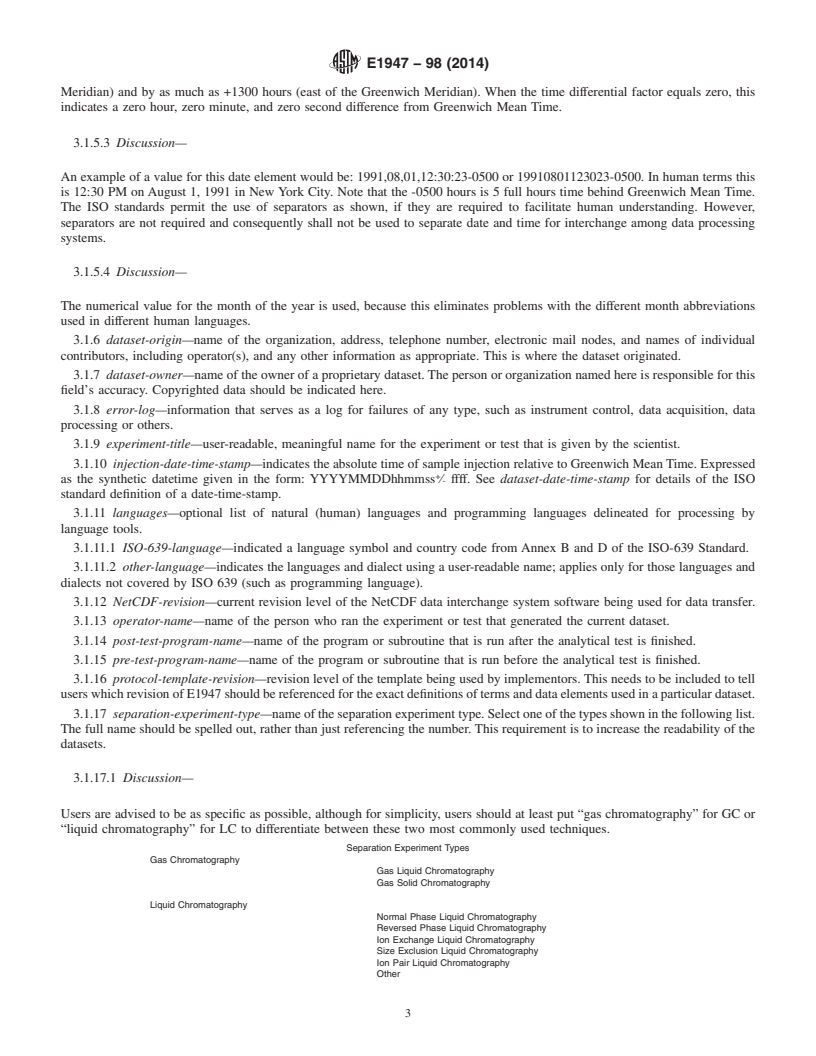
An example of a value for this date element would be: 1991,08,01,12:30:23-0500 or 19910801123023-0500. In human terms this
is 12:30 PM on August 1, 1991 in New York City. Note that the -0500 hours is 5 full hours time behind Greenwich Mean Time.
The ISO standards permit the use of separators as shown, if they are required to facilitate human understanding. However,
separators are not required and consequently shall not be used to separate date and time for interchange among data processing
systems.
3.1.5.4 Discussion—
The numerical value for the month of the year is used, because this eliminates problems with the different month abbreviations
used in different human languages.
3.1.6 dataset-origin—name of the organization, address, telephone number, electronic mail nodes, and names of individual
contributors, including operator(s), and any other information as appropriate. This is where the dataset originated.
3.1.7 dataset-owner—name of the owner of a proprietary dataset. The person or organization named here is responsible for this
field’s accuracy. Copyrighted data should be indicated here.
3.1.8 error-log—information that serves as a log for failures of any type, such as instrument control, data acquisition, data
processing or others.
3.1.9 experiment-title—user-readable, meaningful name for the experiment or test that is given by the scientist.
3.1.10 injection-date-time-stamp—indicates the absolute time of sample injection relative to Greenwich Mean Time. Expressed
+
as the synthetic datetime given in the form: YYYYMMDDhhmmss ⁄- ffff. See dataset-date-time-stamp for details of the ISO
standard definition of a date-time-stamp.
3.1.11 languages—optional list of natural (human) languages and programming languages delineated for processing by
language tools.
3.1.11.1 ISO-639-language—indicated a language symbol and country code from Annex B and D of the ISO-639 Standard.
3.1.11.2 other-language—indicates the languages and dialect using a user-readable name; applies only for those languages and
dialects not covered by ISO 639 (such as programming language).
3.1.12 NetCDF-revision—current revision level of the NetCDF data interchange system software being used for data transfer.
3.1.13 operator-name—name of the person who ran the experiment or test that generated the current dataset.
3.1.14 post-test-program-name—name of the program or subroutine that is run after the analytical test is finished.
3.1.15 pre-test-program-name—name of the program or subroutine that is run before the analytical test is finished.
3.1.16 protocol-template-revision—revision level of the template being used by implementors. This needs to be included to tell
users which revision of E1947 should be referenced for the exact definitions of terms and data elements used in a particular dataset.
3.1.17 separation-experiment-type—name of the separation experiment type. Select one of the types shown in the following list.
The full name should be spelled out, rather than just referencing the number. This requirement is to increase the readability of the
datasets.
3.1.17.1 Discussion—
Users are advised to be as specific as possible, although for simplicity, users should at least put “gas chromatography” for GC or
“liquid chromatography” for LC to differentiate between these two most commonly used techniques.
Separation Experiment Types
Gas Chromatography
Gas Liquid Chromatography
Gas Solid Chromatography
Liquid Chromatography
Normal Phase Liquid Chromatography
Reversed Phase Liquid Chromatography
Ion Exchange Liquid Chromatography
Size Exclusion Liquid Chromatography
Ion Pair Liquid Chromatography
Other
E1947 − 98 (2014)
Separation Experiment Types
Other Chromatography
Supercritical Fluid Chromatography
Thin Layer Chromatography
Field Flow Fractionation
Capillary Zone Electrophoresis
3.1.18 source-file-reference—adequate information to locate the original dataset. This information makes the dataset
self-referenced for easier viewing and provides internal documentation for GLP-compliant systems.
3.1.18.1 Discussion—
This data element should include the complete filename, including node name of the computer system. For UNIX this should
include the full path name. For VAX/VMS this should include the node-name, device-name, directory-name, and file-name. The
version number of the file (if applicable) should also be included. For personal computer networks this needs to be the server name
and directory path.
3.1.18.2 Discussion—
If the source file was a library file, this data element should contain the library name and serial number of the dataset.
3.2 Definitions for Sample-Description Information Class—This information class is comprised of nominal information about
the sample. This includes the sample preparation procedure description used before the test(s). In the future this class will also need
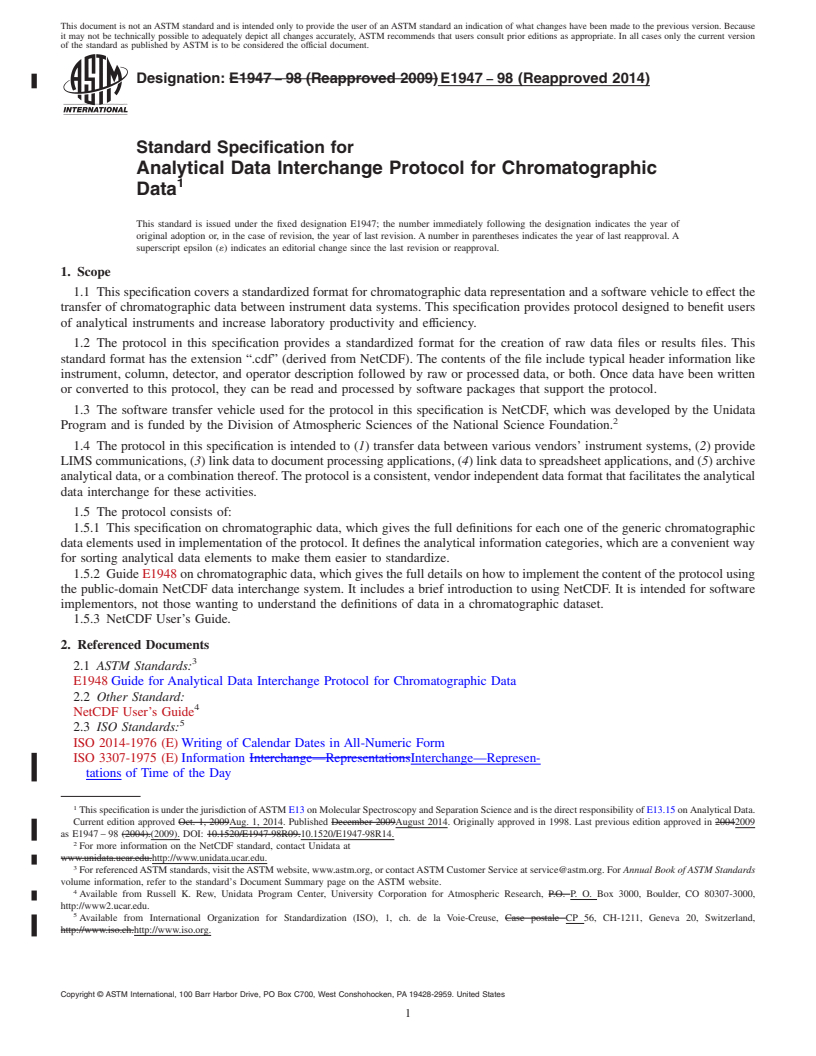
to contain much more chemical method and good laboratory practice information. See Table 2.
3.2.1 sample-amount—sample amount used to prepare the test material. The unit is milligrams.
3.2.2 sample-ID—user-assigned identifier of the sample.
3.2.3 sample-ID-comments—additional comments about the sample identification information that are not specified by any other
sample-description data elements.
3.2.4 sample-injection-volume—volume of sample injected, with a unit of microliters.
3.2.5 sample-name—user-assigned name of the sample.
3.2.6 sample-type—indicated whether the sample is a standard, unknown, control, or blank.
3.3 Definitions for Detection-Method Information Class—This information class holds the information needed to set up the
detection system for an experiment. Data element names assume a multi-channel system. The first implementation applies to a
single-channel system only. Table 3 shows only the column headers for a detection method for a single sample.
3.3.1 detection-method-comments—users’ comments about detector method that is not contained in any other data element.
3.3.2 detection-method-name—name of this detection-method actually used. This name is included for archiving and retrieval
purposes.
3.3.3 detection-method-table-name—name of this detection method table. This name is global to this table. It is included for
reference by the sequence information table and other tables.
3.3.4 detector-maximum-value—maximum output value of the detector as transformed by the analog-to-digital converter, given
in detector-uni
...
Questions, Comments and Discussion
Ask us and Technical Secretary will try to provide an answer. You can facilitate discussion about the standard in here.