

ASTM E1684/E1684M-19
(Specification)Standard Specification for Miniature Thermocouple Connectors
General Information
- Abstract
ABSTRACT
This specification covers separable single-circuit miniature thermocouple connectors with two flat pins. Connectors covered by this specification must be rated for continuous use to at least 300 °F (150 °C), but they may optionally be rated higher. This specification does not cover multiple-circuit connectors, multi-pin connectors, standard size connectors, connectors intended primarily for panel mounting, or high-temperature connectors (for example, those designed for continuous use at temperatures significantly above approximately 500 °F (260 °C)). The connectors shall be rated based on their performance during contact resistance, thermal gradient, and insulation resistance tests.
SCOPE
1.1 This specification covers separable single-circuit miniature thermocouple connectors with two flat pins. Connectors covered by this specification must be rated for continuous use to at least 300 °F (150 °C), but they may optionally be rated to a higher temperature.
1.2 This specification does not cover multiple-circuit connectors, multi-pin connectors, standard size connectors, or connectors intended primarily for panel mounting. High-temperature connectors (for example, those designed for continuous use at temperatures significantly above approximately 500 °F [260 °C]) are not intended to be covered by this specification.
1.3 The values stated in either SI units or inch-pound units are to be regarded separately as standard. The values stated in brackets are not conversions to the values they succeed and therefore shall be used independently of the preceding values. The values given in parentheses are conversions of the values they succeed. Combining values from the two systems may result in non-conformance with the standard.
1.4 The plug and jack may be ordered separately but many of the connector characteristics (see Table 1) are qualified as a mated pair. The requirements in this standard are applicable for the connector pair supplied by the same manufacturer.
1.5 The following precautionary statement pertains only to the Test Methods portion, Section 9, of this specification: This standard does not purport to address all of the safety concerns, if any, associated with its use. It is the responsibility of the user of this standard to establish appropriate safety, health, and environmental practices and determine the applicability of regulatory limitations prior to use.
1.6 This international standard was developed in accordance with internationally recognized principles on standardization established in the Decision on Principles for the Development of International Standards, Guides and Recommendations issued by the World Trade Organization Technical Barriers to Trade (TBT) Committee.
- Status
- Published
- Publication Date
- 31-Oct-2019
- Technical Committee
- E20 - Temperature Measurement
- Drafting Committee
- E20.13 - Thermocouples - Materials and Accessories Specifications
Buy Documents
ASTM E1684/E1684M-19 - Standard Specification for Miniature Thermocouple Connectors
REDLINE ASTM E1684/E1684M-19 - Standard Specification for Miniature Thermocouple Connectors
Overview
ASTM E1684/E1684M-19: Standard Specification for Miniature Thermocouple Connectors defines the requirements for separable single-circuit miniature thermocouple connectors with two flat pins. These connectors are designed for reliable use in temperature measurement systems, supporting continuous operation at temperatures up to at least 300 °F (150 °C). The specification ensures performance, safety, and compatibility in industrial, laboratory, and process control environments.
The standard outlines connector dimensions, material characteristics, identification methods, and performance criteria. Connections covered by this specification do not include multiple-circuit connectors, multi-pin versions, standard size, high-temperature, or primarily panel-mounted types.
Key Topics
Scope and Limitations
- Applies to single-circuit (two-pin) miniature thermocouple connectors
- Rated for continuous use at temperatures up to 300 °F (150 °C)
- Connectors exclude multi-pin, multi-circuit, standard size, and high-temperature designs
Performance Requirements
- Contact resistance: Maximum of 0.04 Ω per leg
- Thermal gradient: Difference limited to ±2 °F (±1.1 °C)
- Insulation resistance: Minimum of 10 Ω at room temperature and 300 °F (150 °C)
- Service life: Minimum of 5000 operational hours
- Disengagement force: At least 8 ozf (2.2 N)
- Repeated cycles: Qualified for at least 25 connection/disconnection cycles
Ordering and Identification
- Plug and jack can be ordered separately, but many requirements apply to the mated pair from the same manufacturer
- Color coding of connector bodies aligns with ANSI/ASTM thermocouple type (e.g., blue for Type T, yellow for Type K)
- Permanent markings indicate positive and negative contacts, source identification, and thermocouple type
Physical and Material Characteristics
- Strict dimensional tolerances ensure compatibility and safety
- Insulating barrier within the body prevents accidental contact between wires
- Construction allows for wire securement via screw or clamp for wire sizes 30-20 AWG
Applications
Miniature thermocouple connectors specified by ASTM E1684/E1684M-19 are widely used where precision temperature measurement is required. Typical applications include:
- Industrial temperature sensing: For process control, automation, and equipment monitoring
- Laboratory environments: Supporting accurate data collection in test setups and experiments
- Field instrumentation: Fast, secure connections and disconnections for portable measuring devices
- Maintenance and calibration: Easy replacement and verification of thermocouple assemblies in serviceable systems
- OEM integration: Standardized interface for equipment manufacturers using thermocouples for thermal management
These connectors enable reliable, repeatable performance, supporting both AC and DC thermocouple circuits, with high durability over long service lifespans.
Related Standards
Organizations deploying ASTM E1684/E1684M-19 miniature thermocouple connectors may also reference the following standards for comprehensive temperature measurement systems:
- ASTM E230/E230M: Specification for Temperature-Electromotive Force (emf) Tables for Standardized Thermocouples
- ASTM E344: Terminology Relating to Thermometry and Hydrometry
- ASTM E608/E608M: Mineral-Insulated, Metal-Sheathed Base Metal Thermocouples
- ASTM E220: Test Method for Calibration of Thermocouples By Comparison Techniques
- ASTM E2820: Test Method for Evaluating Thermal EMF Properties of Base-Metal Thermocouple Connectors
Ensuring compatibility with these related standards helps maintain accuracy, interchangeability, and regulatory compliance in diverse temperature measurement applications.
Keywords: ASTM E1684/E1684M-19, miniature thermocouple connectors, temperature measurement connectors, contact resistance, insulation resistance, thermocouple plug, thermocouple jack, connector specification, industrial temperature sensor connectors, ASTM thermocouple standard
Relations
- Effective Date
- 01-Dec-2023
- Effective Date
- 01-Nov-2023
- Effective Date
- 01-May-2023
- Effective Date
- 01-Sep-2019
- Effective Date
- 01-Apr-2018
- Effective Date
- 01-Nov-2016
- Effective Date
- 01-Nov-2013
- Effective Date
- 01-May-2013
- Effective Date
- 01-May-2013
- Effective Date
- 01-May-2012
- Effective Date
- 15-May-2011
- Effective Date
- 15-May-2011
- Effective Date
- 01-May-2011
- Effective Date
- 01-Nov-2010
- Effective Date
- 15-Nov-2008
Buy Documents
ASTM E1684/E1684M-19 - Standard Specification for Miniature Thermocouple Connectors
REDLINE ASTM E1684/E1684M-19 - Standard Specification for Miniature Thermocouple Connectors
Get Certified
Connect with accredited certification bodies for this standard

BSMI (Bureau of Standards, Metrology and Inspection)
Taiwan's standards and inspection authority.
Sponsored listings
Frequently Asked Questions
ASTM E1684/E1684M-19 is a technical specification published by ASTM International. Its full title is "Standard Specification for Miniature Thermocouple Connectors". This standard covers: ABSTRACT This specification covers separable single-circuit miniature thermocouple connectors with two flat pins. Connectors covered by this specification must be rated for continuous use to at least 300 °F (150 °C), but they may optionally be rated higher. This specification does not cover multiple-circuit connectors, multi-pin connectors, standard size connectors, connectors intended primarily for panel mounting, or high-temperature connectors (for example, those designed for continuous use at temperatures significantly above approximately 500 °F (260 °C)). The connectors shall be rated based on their performance during contact resistance, thermal gradient, and insulation resistance tests. SCOPE 1.1 This specification covers separable single-circuit miniature thermocouple connectors with two flat pins. Connectors covered by this specification must be rated for continuous use to at least 300 °F (150 °C), but they may optionally be rated to a higher temperature. 1.2 This specification does not cover multiple-circuit connectors, multi-pin connectors, standard size connectors, or connectors intended primarily for panel mounting. High-temperature connectors (for example, those designed for continuous use at temperatures significantly above approximately 500 °F [260 °C]) are not intended to be covered by this specification. 1.3 The values stated in either SI units or inch-pound units are to be regarded separately as standard. The values stated in brackets are not conversions to the values they succeed and therefore shall be used independently of the preceding values. The values given in parentheses are conversions of the values they succeed. Combining values from the two systems may result in non-conformance with the standard. 1.4 The plug and jack may be ordered separately but many of the connector characteristics (see Table 1) are qualified as a mated pair. The requirements in this standard are applicable for the connector pair supplied by the same manufacturer. 1.5 The following precautionary statement pertains only to the Test Methods portion, Section 9, of this specification: This standard does not purport to address all of the safety concerns, if any, associated with its use. It is the responsibility of the user of this standard to establish appropriate safety, health, and environmental practices and determine the applicability of regulatory limitations prior to use. 1.6 This international standard was developed in accordance with internationally recognized principles on standardization established in the Decision on Principles for the Development of International Standards, Guides and Recommendations issued by the World Trade Organization Technical Barriers to Trade (TBT) Committee.
ABSTRACT This specification covers separable single-circuit miniature thermocouple connectors with two flat pins. Connectors covered by this specification must be rated for continuous use to at least 300 °F (150 °C), but they may optionally be rated higher. This specification does not cover multiple-circuit connectors, multi-pin connectors, standard size connectors, connectors intended primarily for panel mounting, or high-temperature connectors (for example, those designed for continuous use at temperatures significantly above approximately 500 °F (260 °C)). The connectors shall be rated based on their performance during contact resistance, thermal gradient, and insulation resistance tests. SCOPE 1.1 This specification covers separable single-circuit miniature thermocouple connectors with two flat pins. Connectors covered by this specification must be rated for continuous use to at least 300 °F (150 °C), but they may optionally be rated to a higher temperature. 1.2 This specification does not cover multiple-circuit connectors, multi-pin connectors, standard size connectors, or connectors intended primarily for panel mounting. High-temperature connectors (for example, those designed for continuous use at temperatures significantly above approximately 500 °F [260 °C]) are not intended to be covered by this specification. 1.3 The values stated in either SI units or inch-pound units are to be regarded separately as standard. The values stated in brackets are not conversions to the values they succeed and therefore shall be used independently of the preceding values. The values given in parentheses are conversions of the values they succeed. Combining values from the two systems may result in non-conformance with the standard. 1.4 The plug and jack may be ordered separately but many of the connector characteristics (see Table 1) are qualified as a mated pair. The requirements in this standard are applicable for the connector pair supplied by the same manufacturer. 1.5 The following precautionary statement pertains only to the Test Methods portion, Section 9, of this specification: This standard does not purport to address all of the safety concerns, if any, associated with its use. It is the responsibility of the user of this standard to establish appropriate safety, health, and environmental practices and determine the applicability of regulatory limitations prior to use. 1.6 This international standard was developed in accordance with internationally recognized principles on standardization established in the Decision on Principles for the Development of International Standards, Guides and Recommendations issued by the World Trade Organization Technical Barriers to Trade (TBT) Committee.
ASTM E1684/E1684M-19 is classified under the following ICS (International Classification for Standards) categories: 17.200.20 - Temperature-measuring instruments. The ICS classification helps identify the subject area and facilitates finding related standards.
ASTM E1684/E1684M-19 has the following relationships with other standards: It is inter standard links to ASTM E344-23, ASTM E230/E230M-23a, ASTM E230/E230M-23, ASTM E344-19, ASTM E344-18, ASTM E344-16, ASTM E220-13, ASTM E344-13, ASTM E2820-13, ASTM E344-12, ASTM E230/E230M-11, ASTM E230/E230M-11e1, ASTM E2820-11, ASTM E344-10, ASTM E344-08. Understanding these relationships helps ensure you are using the most current and applicable version of the standard.
ASTM E1684/E1684M-19 is available in PDF format for immediate download after purchase. The document can be added to your cart and obtained through the secure checkout process. Digital delivery ensures instant access to the complete standard document.
Standards Content (Sample)
This international standard was developed in accordance with internationally recognized principles on standardization established in the Decision on Principles for the
Development of International Standards, Guides and Recommendations issued by the World Trade Organization Technical Barriers to Trade (TBT) Committee.
Designation: E1684/E1684M −19 An American National Standard
Standard Specification for
Miniature Thermocouple Connectors
ThisstandardisissuedunderthefixeddesignationE1684/E1684M;thenumberimmediatelyfollowingthedesignationindicatestheyear
of original adoption or, in the case of revision, the year of last revision. A number in parentheses indicates the year of last reapproval.
A superscript epsilon (´) indicates an editorial change since the last revision or reapproval.
1. Scope mendations issued by the World Trade Organization Technical
Barriers to Trade (TBT) Committee.
1.1 This specification covers separable single-circuit minia-
ture thermocouple connectors with two flat pins. Connectors
2. Referenced Documents
covered by this specification must be rated for continuous use
2.1 The following documents of the latest issue form a part
to at least 300 °F (150 °C), but they may optionally be rated to
of this specification to the extent referenced herein. In case of
a higher temperature.
conflict between this specification and another referenced
1.2 This specification does not cover multiple-circuit
document, this specification shall take precedence.
connectors, multi-pin connectors, standard size connectors, or
2.2 ASTM Standards:
connectors intended primarily for panel mounting. High-
E230/E230M Specification for Temperature-Electromotive
temperature connectors (for example, those designed for con-
Force (emf) Tables for Standardized Thermocouples
tinuous use at temperatures significantly above approximately
E344 Terminology Relating to Thermometry and Hydrom-
500 °F [260 °C]) are not intended to be covered by this
etry
specification.
E608/E608M Specification for Mineral-Insulated, Metal-
1.3 The values stated in either SI units or inch-pound units
Sheathed Base Metal Thermocouples
are to be regarded separately as standard. The values stated in
E220 Test Method for Calibration of Thermocouples By
brackets are not conversions to the values they succeed and
Comparison Techniques
therefore shall be used independently of the preceding values.
E2820 Test Method for Evaluating Thermal EMF Properties
The values given in parentheses are conversions of the values
of Base-Metal Thermocouple Connectors
they succeed. Combining values from the two systems may
result in non-conformance with the standard.
3. Terminology
1.4 The plug and jack may be ordered separately but many
3.1 Definitions—The definitions given inTerminology E344
of the connector characteristics (see Table 1) are qualified as a
shall apply.
mated pair.The requirements in this standard are applicable for
3.2 Definitions of Terms Specific to This Standard:
the connector pair supplied by the same manufacturer.
3.2.1 connector pair, n—assembly consisting of a plug and
1.5 The following precautionary statement pertains only to
a jack, each having both positive and negative inserts, that will
the Test Methods portion, Section 9, of this specification: This
connect two parts of an electrical circuit and provide a means
standard does not purport to address all of the safety concerns,
of physically disconnecting the two parts without the use of a
if any, associated with its use. It is the responsibility of the user
tool.
of this standard to establish appropriate safety, health, and
3.2.2 contact insert, n—a metallic conductor assemblies
environmental practices and determine the applicability of
that, when installed in connector bodies, provides connections
regulatory limitations prior to use.
between two parts of an electrical circuit. Plug connectors will
1.6 This international standard was developed in accor-
contain projecting prong contacts, while jack connectors will
dance with internationally recognized principles on standard-
contain recessed socket or receptacle contacts.
ization established in the Decision on Principles for the
3.2.3 service life, n—period of time over which a connector
Development of International Standards, Guides and Recom-
assembly can be put to use and retain all physical and
thermoelectric properties.
This specification is under the jurisdiction of ASTM Committee E20 on
Temperature Measurement and is the direct responsibility of Subcommittee E20.13
on Thermocouples - Materials and Accessories Specifications. For referenced ASTM standards, visit the ASTM website, www.astm.org, or
Current edition approved Nov. 1, 2019. Published November 2019. Originally contact ASTM Customer Service at service@astm.org. For Annual Book of ASTM
approved in 1995. Last previous edition approved in 2015 as E1684/E1684M – 15. Standards volume information, refer to the standard’s Document Summary page on
DOI: 10.1520/E1684-19. the ASTM website.
Copyright © ASTM International, 100 Barr Harbor Drive, PO Box C700, West Conshohocken, PA 19428-2959. United States
E1684/E1684M − 19
TABLE 1 Ratings
Characteristic Min Max Requirement Test Procedure
Operating temperature 0 °F [-18 °C] 300 °F [150 °C] 7.1.2 9.7
Contact resistance (each leg) . 0.04Ω 7.2.6 9.2
Insulation resistance at room temperature 10 Ω . 7.3.4 9.4
Insulation resistance at 300 °F (150 °C) 10 Ω . 7.3.4 9.4
Thermal gradient test difference . ±2 °F [±1.1 °C] 7.2.7 9.3
Repeated cycles 25 . 7.2.4 9.6
Service life 5000 h . 7.3.5 9.7
Disengagement force 8 ozf [2.2 N] . 7.2.3 9.5
3.2.4 test difference, n—thermoelectric emf value attribut-
able to mated connectors observed by the test procedure of this
specification.
4. Significance and Use
4.1 The widespread use of thermocouple connectors re-
quires standardization of mating dimensions and performance
characteristics.
4.2 This specification describes miniature thermocouple
connector dimensions and capabilities and includes test proce-
dures suitable for evaluating the performance of a particular
specimen or design. The tests described are not intended for
routineinspectionorrapidtestingoflargegroupsofconnectors
or for quality control purposes.
5. Classification
5.1 Plugs or Jacks:
5.1.1 Connectors shall be constructed as either plugs or
jacks, and these two forms shall be designed to connect with
each other.
FIG. 1 Miniature Thermocouple Connector Dimensions
5.1.2 Plug connectors shall have two external prong con-
(see Table 2)
tacts of different dimensions to prevent improper mating. The
negative prong shall be the wider, as indicated in Table 2 and
TABLE 3 Identification
Fig. 1.
ANSI/ASTM Type Body Color Coding
5.1.3 Jack connectors shall have two internal socket con-
T blue
tacts sized and spaced to receive and accommodate the prong
J black
contacts of the mating plug. Jack connectors shall also include
E purple
K yellow
a means of producing and maintaining sufficient contact
N orange
pressuretomeetalltheotherrequirementsofthisspecification.
R or S green
A
B (Cu/Cu) white
5.2 ANSI/ASTM Type:
Cred
5.2.1 Connectors shall be produced in versions to match
A
Uncompensated (Cu/Cu) connectors are customarily used with Type B
each of the standardized ANSI/ASTM thermocouple types as
thermocouples.
given in Table 3.
TABLE 2 Dimensions
5.2.2 The insert materials of each plug and jack shall have
Minimum Size, Maximum Size,
A
thermoelectric properties conforming to the nominal character-
Dimension Symbol
in. (mm) in. (mm)
istics of the corresponding thermocouple type as given in
Plug body length PL . 0.788 (20.00)
Specification E230/E230M over the operating temperature
Jack body length JL . 1.069 (27.13)
range specified in Table 1.
Body width W . 0.635 (16.10)
Body thickness T . 0.385 (9.78)
5.2.3 Calibration conformance and gradient testing are not
Length of prong P 0.406 (10.31) 0.515 (13.10)
applicable to Type B thermoelectrically neutral (Cu/Cu) con-
Depth of socket J 0.515 (13.10) .
nectors.
Prong spacing X 0.307 (7.80) 0.317 (8.05)
Positive pin width W1 0.090 (2.28) 0.098 (2.49)
Negative pin width W2 0.121 (3.07) 0.129 (3.27)
6. Ordering Information
Pin thickness T1 0.030 (0.73) 0.034 (0.86)
A 6.1 Orders for connectors under this specification shall
Symbol reference corresponds to Fig. 1.
include the following:
E1684/E1684M − 19
6.1.1 Quantity of plugs or jacks (specify which); 7.3.4 The assembled connector shall be capable of passing
the insulation resistance requirements listed in Table 1 at the
6.1.2 ANSI/ASTM thermocouple type (see Table 3);
temperatures listed.
6.1.3 Any optional accessories that may be required, such as
7.3.5 The materials and construction used in the connector
those listed in 7.4.3;
shall be such that the connector will meet all of the specified
6.1.4 Special testing requirements; and
requirements for the service life
...
This document is not an ASTM standard and is intended only to provide the user of an ASTM standard an indication of what changes have been made to the previous version. Because
it may not be technically possible to adequately depict all changes accurately, ASTM recommends that users consult prior editions as appropriate. In all cases only the current version
of the standard as published by ASTM is to be considered the official document.
Designation: E1684/E1684M − 15 E1684/E1684M − 19
Standard Specification for
Miniature Thermocouple Connectors
This standard is issued under the fixed designation E1684/E1684M; the number immediately following the designation indicates the year
of original adoption or, in the case of revision, the year of last revision. A number in parentheses indicates the year of last reapproval.
A superscript epsilon (´) indicates an editorial change since the last revision or reapproval.
1. Scope
1.1 This specification covers separable single-circuit miniature thermocouple connectors with two flat pins. Connectors covered
by this specification must be rated for continuous use to at least 300°F (150°C),300 °F (150 °C), but they may optionally be rated
to a higher temperature.
1.2 This specification does not cover multiple-circuit connectors, multi-pin connectors, standard size connectors, or connectors
intended primarily for panel mounting. High-temperature connectors (for example, those designed for continuous use at
temperatures significantly above approximately 500°F [260°C])500 °F [260 °C]) are not intended to be covered by this
specification.
1.3 The values stated in either SI units or inch-pound units are to be regarded separately as standard. The values stated in
brackets are not conversions to the values they succeed and therefore shall be used independently of the preceding values. The
values given in parentheses are conversions of the values they succeed. Combining values from the two systems may result in
non-conformance with the standard.
1.4 The plug and jack may be ordered separately but many of the connector characteristics (see Table 1) are qualified as a mated
pair. The requirements in this standard are applicable for the connector pair supplied by the same manufacturer.
1.5 The following precautionary statement pertains only to the Test Methods portion, Section 9, of this specification: This
standard does not purport to address all of the safety concerns, if any, associated with its use. It is the responsibility of the user
of this standard to establish appropriate safety safety, health, and healthenvironmental practices and determine the applicability
of regulatory limitations prior to use.
1.6 This international standard was developed in accordance with internationally recognized principles on standardization
established in the Decision on Principles for the Development of International Standards, Guides and Recommendations issued
by the World Trade Organization Technical Barriers to Trade (TBT) Committee.
2. Referenced Documents
2.1 The following documents of the latest issue form a part of this specification to the extent referenced herein. In case of
conflict between this specification and another referenced document, this specification shall take precedence.
2.2 ASTM Standards:
E230/E230M Specification for Temperature-Electromotive Force (emf) Tables for Standardized Thermocouples
E344 Terminology Relating to Thermometry and Hydrometry
E608/E608M Specification for Mineral-Insulated, Metal-Sheathed Base Metal Thermocouples
E220 Test Method for Calibration of Thermocouples By Comparison Techniques
E2820 Test Method for Evaluating Thermal EMF Properties of Base-Metal Thermocouple Connectors
3. Terminology
3.1 Definitions—The definitions given in Terminology E344 shall apply.
3.2 Definitions of Terms Specific to This Standard:
This specification is under the jurisdiction of ASTM Committee E20 on Temperature Measurement and is the direct responsibility of Subcommittee E20.13 on
Thermocouples - Materials and Accessories Specifications.
Current edition approved Dec. 1, 2015Nov. 1, 2019. Published January 2016November 2019. Originally approved in 1995. Last previous edition approved in 20102015
as E1684 – 10.E1684/E1684M – 15. DOI: 10.1520/E1684-15.10.1520/E1684-19.
For referenced ASTM standards, visit the ASTM website, www.astm.org, or contact ASTM Customer Service at service@astm.org. For Annual Book of ASTM Standards
volume information, refer to the standard’s Document Summary page on the ASTM website.
Copyright © ASTM International, 100 Barr Harbor Drive, PO Box C700, West Conshohocken, PA 19428-2959. United States
E1684/E1684M − 19
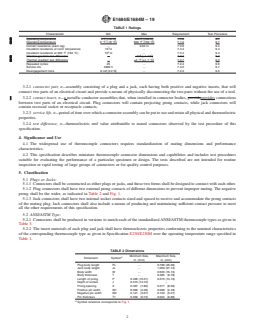
TABLE 1 Ratings
Characteristic Min Max Requirement Test Procedure
Operating temperature 0°F [-18°C] 300°F [150°C] 7.1.2 9.7
Operating temperature 0 °F [-18 °C] 300 °F [150 °C] 7.1.2 9.7
Contact resistance (each leg) . 0.04 Ω 7.2.6 9.2
Insulation resistance at room temperature 10 Ω . 7.3.4 9.4
Insulation resistance at 300 °F (150 °C) 10 Ω . 7.3.4 9.4
Thermal gradient test difference . ±2°F [±1.1°C] 7.2.7 9.3
Thermal gradient test difference . ±2 °F [±1.1 °C] 7.2.7 9.3
Repeated cycles 25 . 7.2.4 9.6
Service life 5000 h . 7.3.5 9.7
Disengagement force 8 ozf [2.2 N] . 7.2.3 9.5
3.2.1 connector pair, n—assembly consisting of a plug and a jack, each having both positive and negative inserts, that will
connect two parts of an electrical circuit and provide a means of physically disconnecting the two parts without the use of a tool.
3.2.2 contact insert, n—a metallic conductor assemblies that, when installed in connector bodies, provideprovides connections
between two parts of an electrical circuit. Plug connectors will contain projecting prong contacts, while jack connectors will
contain recessed socket or receptacle contacts.
3.2.3 service life, n—period of time over which a connector assembly can be put to use and retain all physical and thermoelectric
properties.
3.2.4 test difference, n—thermoelectric emf value attributable to mated connectors observed by the test procedure of this
specification.
4. Significance and Use
4.1 The widespread use of thermocouple connectors requires standardization of mating dimensions and performance
characteristics.
4.2 This specification describes miniature thermocouple connector dimensions and capabilities and includes test procedures
suitable for evaluating the performance of a particular specimen or design. The tests described are not intended for routine
inspection or rapid testing of large groups of connectors or for quality control purposes.
5. Classification
5.1 Plugs or Jacks:
5.1.1 Connectors shall be constructed as either plugs or jacks, and these two forms shall be designed to connect with each other.
5.1.2 Plug connectors shall have two external prong contacts of different dimensions to prevent improper mating. The negative
prong shall be the wider, as indicated in Table 2 and Fig. 1.
5.1.3 Jack connectors shall have two internal socket contacts sized and spaced to receive and accommodate the prong contacts
of the mating plug. Jack connectors shall also include a means of producing and maintaining sufficient contact pressure to meet
all the other requirements of this specification.
5.2 ANSI/ASTM Type:
5.2.1 Connectors shall be produced in versions to match each of the standardized ANSI/ASTM thermocouple types as given in
Table 3.
5.2.2 The insert materials of each plug and jack shall have thermoelectric properties conforming to the nominal characteristics
of the corresponding thermocouple type as given in Specification E230/E230M over the operating temperature range specified in
Table 1.
TABLE 2 Dimensions
Minimum Size, Maximum Size,
A
Dimension Symbol
in. (mm) in. (mm)
Plug body length PL . 0.788 (20.00)
Jack body length JL . 1.069 (27.13)
Body width W . 0.635 (16.10)
Body thickness T . 0.385 (9.78)
Length of prong P 0.406 (10.31) 0.515 (13.10)
Depth of socket J 0.515 (13.10) .
Prong spacing X 0.307 (7.80) 0.317 (8.05)
Positive pin width W1 0.090 (2.28) 0.098 (2.49)
Negative pin width W2 0.121 (3.07) 0.129 (3.27)
Pin thickness T1 0.030 (0.73) 0.034 (0.86)
A
Symbol reference corresponds to Fig. 1.
E1684/E1684M − 19
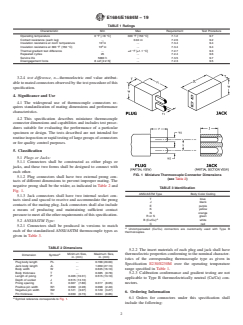
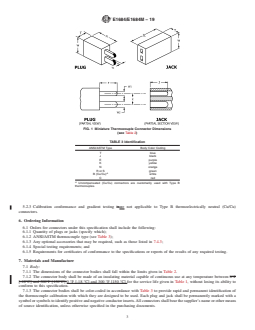
FIG. 1 Miniature Thermocouple Connector Dimensions
(see Table 2)
TABLE 3 Identification
ANSI/ASTM Type Body Color Coding
T blue
J black
E purple
K yellow
N orange
R or S green
A
B (Cu/Cu) white
C red
A
Uncompensated (Cu/Cu) connectors are customarily used with Type B
thermocouples.
5.2.3 Calibration conformance and gradient testing isare not applicable to Type B thermoelectrically neutral (Cu/Cu)
connectors.
6. Ordering Information
6.1 Orders for connectors under this specification shall include the following:
6.1.1 Quantity of plugs or jacks (specify which);
6.1.2 ANSI/ASTM thermocouple type (see Table 3);
6.1.3 Any optional accessories that may be required, such as those listed in 7.4.3;
6.1.4 Special testing requirements; and
6.1.5 Requirements for certificates of conformance to the specifications or reports of the results of any required testing.
7. Materials and Manufacture
7.1 Body:
7.1.1 The dimensions of the connector bodies shall fall within the limits given in
...