

ASTM D5359-98(2021)
(Specification)Standard Specification for Glass Cullet Recovered from Waste for Use in Manufacture of Glass Fiber
General Information
- Abstract
ABSTRACT
This specification describes glass cullet recovered from municipal waste destined for disposal, but intended for the manufacture of glass fiber for use in insulation-type products. The glass cullet shall primarily be soda-lime bottle glass and shall be one of three grades depending upon the total usage rate requirement of the user. The three grades shall satisfy the specified chemical composition, color mix, contamination, and particle size requirements.
SCOPE
1.1 This specification describes glass cullet recovered from municipal waste destined for disposal. The recovered cullet is intended for use in the manufacture of glass fiber used for insulation-type products.
1.2 This international standard was developed in accordance with internationally recognized principles on standardization established in the Decision on Principles for the Development of International Standards, Guides and Recommendations issued by the World Trade Organization Technical Barriers to Trade (TBT) Committee.
- Status
- Published
- Publication Date
- 30-Apr-2021
- Technical Committee
- D34 - Waste Management
- Drafting Committee
- D34.03 - Treatment, Recovery and Reuse


Overview
ASTM D5359-98(2021) is the internationally recognized standard specification for glass cullet recovered from municipal waste for use in the manufacture of glass fiber, particularly for insulation-type products. Developed by ASTM International, this standard outlines the essential requirements for glass cullet, focusing on its suitability for use in fiberglass production. The document defines the chemical composition, color mix, contamination levels, and particle size specifications that must be met to ensure optimal performance and environmental compliance in glass fiber manufacturing.
Key Topics
Glass Cullet Grades: The standard categorizes recovered glass cullet into three grades, primarily made from soda-lime bottle glass. These grades are based on the proportion of cullet used in the glass fiber production batch.
- Grade 1: Up to 5% cullet in the batch
- Grade 2: 5% to 15% cullet in the batch
- Grade 3: Greater than 15% cullet in the batch
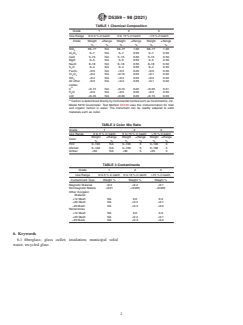
Chemical Composition: ASTM D5359 specifies limits for key oxides, such as SiO₂, Al₂O₃, CaO, MgO, Na₂O, K₂O, Fe₂O₃, and others, to ensure batch consistency and fiberglass quality.
Color Mix Control: The standard addresses acceptable ratios of flint, green, and amber glass in the recovered cullet, as these affect the melt chemistry and resulting fiber properties.
Contamination Limits: Strict maximum allowable levels are set for metals (both magnetic and nonmagnetic), inorganics, and refractories, safeguarding furnace operation and the integrity of the fiberglass product.
Particle Size Requirements: Defined ranges for particle size distribution are established, with both upper and lower thresholds. The specific particle size specification within these ranges is determined by agreement between suppliers and users.
Applications
Insulation Glass Fiber Production: The primary application of ASTM D5359-standardized glass cullet is as a raw material in the manufacture of glass fiber used for insulation products. The standard ensures that the cullet is of consistent and reliable quality, which supports both process efficiency and the performance of the final insulation materials.
Waste Stream Valorization: The specification enables more effective recycling of municipal solid waste by setting clear criteria for glass cullet recovery, thus supporting sustainability initiatives and local recycling programs.
Quality Control for Manufacturers and Recyclers: By adhering to ASTM D5359, glass fiber manufacturers and waste processors can align with industry best practices and regulatory requirements, improving traceability and reducing the risks associated with contaminants and inconsistent material quality.
Related Standards
ASTM C162 - Terminology of Glass and Glass Products
- Provides key definitions and terms referenced in ASTM D5359 for clarity and alignment in glass manufacturing.
ASTM D4129 - Test Method for Total and Organic Carbon in Water by High Temperature Oxidation and by Coulometric Detection
- Recommended for assessing carbon content in glass cullet, with methods adaptable for solid materials.
ASTM E688 (Withdrawn 2019) - Test Methods for Waste Glass as a Raw Material for Glass Manufacturing
- Formerly referenced for sampling and testing procedures relevant to glass cullet quality assessment.
World Trade Organization Technical Barriers to Trade (TBT) Committee Guidelines
- This standard was developed in accordance with international principles recognized by the WTO TBT, underlining its global relevance.
Keywords: glass cullet, ASTM D5359, fiberglass, insulation, recycled glass, municipal solid waste, glass fiber manufacturing, quality standard, contamination control
By following ASTM D5359-98(2021), industry stakeholders can ensure that recycled glass cullet meets stringent quality standards, facilitating sustainable manufacturing and contributing to circular economy goals.
Relations
- Effective Date
- 01-Oct-2023
- Effective Date
- 01-Jan-2020
- Effective Date
- 01-Nov-2015
- Effective Date
- 01-Jul-2011
- Refers
ASTM E688-94(2006) - Standard Test Methods for Waste Glass as a Raw Material for Glass Manufacturing - Effective Date
- 15-Jan-2006
- Effective Date
- 01-Oct-2005
- Effective Date
- 01-Oct-2005
- Effective Date
- 01-Mar-2005
- Effective Date
- 01-Jun-2004
- Effective Date
- 10-Jul-2003
- Refers
ASTM E688-94(1999) - Standard Test Methods for Waste Glass as a Raw Material for Glass Manufacturing - Effective Date
- 10-Sep-1999
- Effective Date
- 10-May-1999
- Effective Date
- 10-Dec-1998
- Effective Date
- 10-Dec-1998
Frequently Asked Questions
ASTM D5359-98(2021) is a technical specification published by ASTM International. Its full title is "Standard Specification for Glass Cullet Recovered from Waste for Use in Manufacture of Glass Fiber". This standard covers: ABSTRACT This specification describes glass cullet recovered from municipal waste destined for disposal, but intended for the manufacture of glass fiber for use in insulation-type products. The glass cullet shall primarily be soda-lime bottle glass and shall be one of three grades depending upon the total usage rate requirement of the user. The three grades shall satisfy the specified chemical composition, color mix, contamination, and particle size requirements. SCOPE 1.1 This specification describes glass cullet recovered from municipal waste destined for disposal. The recovered cullet is intended for use in the manufacture of glass fiber used for insulation-type products. 1.2 This international standard was developed in accordance with internationally recognized principles on standardization established in the Decision on Principles for the Development of International Standards, Guides and Recommendations issued by the World Trade Organization Technical Barriers to Trade (TBT) Committee.
ABSTRACT This specification describes glass cullet recovered from municipal waste destined for disposal, but intended for the manufacture of glass fiber for use in insulation-type products. The glass cullet shall primarily be soda-lime bottle glass and shall be one of three grades depending upon the total usage rate requirement of the user. The three grades shall satisfy the specified chemical composition, color mix, contamination, and particle size requirements. SCOPE 1.1 This specification describes glass cullet recovered from municipal waste destined for disposal. The recovered cullet is intended for use in the manufacture of glass fiber used for insulation-type products. 1.2 This international standard was developed in accordance with internationally recognized principles on standardization established in the Decision on Principles for the Development of International Standards, Guides and Recommendations issued by the World Trade Organization Technical Barriers to Trade (TBT) Committee.
ASTM D5359-98(2021) is classified under the following ICS (International Classification for Standards) categories: 81.040.10 - Raw materials and raw glass. The ICS classification helps identify the subject area and facilitates finding related standards.
ASTM D5359-98(2021) has the following relationships with other standards: It is inter standard links to ASTM C162-23, ASTM D4129-05(2020), ASTM C162-05(2015), ASTM E688-94(2011), ASTM E688-94(2006), ASTM C162-05, ASTM C162-05(2010), ASTM D4129-05, ASTM C162-04, ASTM C162-03, ASTM E688-94(1999), ASTM C162-99, ASTM D4129-98, ASTM D4129-98(2003). Understanding these relationships helps ensure you are using the most current and applicable version of the standard.
ASTM D5359-98(2021) is available in PDF format for immediate download after purchase. The document can be added to your cart and obtained through the secure checkout process. Digital delivery ensures instant access to the complete standard document.
Standards Content (Sample)
This international standard was developed in accordance with internationally recognized principles on standardization established in the Decision on Principles for the
Development of International Standards, Guides and Recommendations issued by the World Trade Organization Technical Barriers to Trade (TBT) Committee.
Designation:D5359 −98 (Reapproved 2021)
Standard Specification for
Glass Cullet Recovered from Waste for Use in Manufacture
of Glass Fiber
This standard is issued under the fixed designation D5359; the number immediately following the designation indicates the year of
original adoption or, in the case of revision, the year of last revision. A number in parentheses indicates the year of last reapproval. A
superscript epsilon (´) indicates an editorial change since the last revision or reapproval.
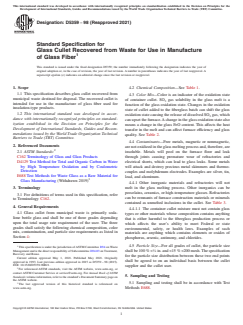
1. Scope 4.2 Chemical Composition—See Table 1.
1.1 This specification describes glass cullet recovered from
4.3 Color Mix—Color is an indicator of the oxidation state
municipal waste destined for disposal. The recovered cullet is
of container cullet. SO gas solubility in the glass melt is a
intended for use in the manufacture of glass fiber used for
function of the glass oxidation state. Changes in the oxidation
insulation-type products.
state of cullet added to the fiberglass batch can shift the glass
1.2 This international standard was developed in accor-
oxidation state causing the release of dissolved SO gas, which
dance with internationally recognized principles on standard-
can upset the furnace.Achange in the glass oxidation state also
ization established in the Decision on Principles for the
means a change in the glass FeO content. This affects the heat
Development of International Standards, Guides and Recom-
transfer in the melt and can affect furnace efficiency and glass
mendations issued by the World Trade Organization Technical
quality. See Table 2.
Barriers to Trade (TBT) Committee.
4.4 Contaminants—Free metals, magnetic or nonmagnetic,
2. Referenced Documents
are not oxidized in the glass melting process and, therefore, are
2.1 ASTM Standards:
insoluble. Metals will pool on the furnace floor and leak
C162 Terminology of Glass and Glass Products
through joints causing premature wear of refractories and
D4129 Test Method for Total and Organic Carbon in Water
electrical shorts, which can lead to glass leaks. Some metals
by High Temperature Oxidation and by Coulometric
will attack and destroy precious metal skimmers and thermo-
Detection
couples and molybdenum electrodes. Examples are silver, tin,
E688 Test Methods for Waste Glass as a Raw Material for
lead, and aluminum.
Glass Manufacturing (Withdrawn 2019)
4.4.1 Other inorganic materials and refractories will not
melt in the glass melting process. Other inorganics can be
3. Terminology
porcelains, ceramics, or high-temperature glasses. Refractories
3.1 For definitions of terms used in this specification, refer
can be remnants of furnace construction materials or minerals
to Terminology C162.
contained as unmelted inclusions in the cullet. See Table 3.
4. General Requirements
4.4.1.1 The container cullet mixture must not contain glass
4.1 Glass cullet from municipal waste is primarily soda-
types or other materials whose composition contains anything
lime bottle glass and shall be one of three grades depending
that is either harmful to the fiberglass production process or
upon the total usage rate requirement of the user. The three
which affects the user’s ability to meet Federal or state
grades shall satisfy the following chemical composition, color
environmental, safety, or health laws. Examples of such
mix, contamination, and particle size requirements as listed in
materials are anything which contains elements or oxides of
Section 4:
phosphorus, arsenic, antimony, and chlorides.
1 4.5 Particle Size—For all grades of cullet, the particle size
This specification is under the jurisdiction ofASTM Committee D34 on Waste
Management and is the direct responsibility of Subcommittee D34.03 on Treatment,
shallbe100 %< ⁄4in.and<15 %<200mesh.Thespecification
Recovery and Reuse.
for the particle s
...