

ASTM E1928-13(2019)
(Practice)Standard Practice for Estimating the Approximate Residual Circumferential Stress in Straight Thin-walled Tubing
General Information
- Abstract
SIGNIFICANCE AND USE
4.1 Residual stresses in tubing may be detrimental to the future performance of the tubing. Such stresses may, for example, influence the susceptibility of a tube to stress corrosion cracking when the tube is exposed to certain environments.
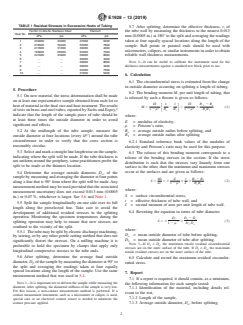
4.2 Residual stresses in new thin-walled tubing are very sensitive to the parameters of the fabrication process, and small variations in these parameters can produce significant changes in the residual stresses. See, for example, Table 1, which shows the residual stresses measured by this practice in samples from successive heats of a ferritic Cr-Mo-Ni stainless steel tube and a titanium condenser tube. This practice provides a means for estimating the residual stresses in samples from each and every heat.
4.2.1 This practice may also be used to estimate the residual stresses that remain in tubes after removal from service in different environments and operating conditions.
4.3 This practice assumes a linear stress distribution through the wall thickness. This assumption is usually reasonable for thin-walled tubes, that is, for tubes in which the wall thickness does not exceed one tenth of the outside diameter. Even in cases where the assumption is not strictly justified, experience has shown that the approximate stresses estimated by this practice frequently serve as useful indicators of the susceptibility to stress corrosion cracking of the tubing of certain metal alloys when exposed to specific environments.
4.3.1 Because of this questionable assumption regarding the stress distribution in the tubing, the user is cautioned against using the results of this practice for design, manufacturing control, localized surface residual stress evaluation, or other purposes without supplementary information that supports the application.
4.4 This practice has primarily been used to estimate residual fabrication stresses in new thin-walled tubing between 19 mm (0.75 in.) and 25 mm (1 in.) outside diameter and 1.3 mm (0.05 ...
SCOPE
1.1 A qualitative estimate of the residual circumferential stress in thin-walled tubing may be calculated from the change in outside diameter that occurs upon splitting a length of thin-walled tubing. This practice assumes a linear stress distribution through the tube wall thickness and will not provide an estimate of local stress distributions such as surface stresses. (Very high local residual stress gradients are common at the surface of metal tubing due to cold drawing, peening, grinding, etc.) The Hatfield and Thirkell formula, as later modified by Sachs and Espey,2 provides a simple method for calculating the approximate circumferential stress from the change in diameter of straight, thin-walled, metal tubing.
1.2 This standard does not purport to address all of the safety concerns, if any, associated with its use. It is the responsibility of the user of this standard to establish appropriate safety, health, and environmental practices and determine the applicability of regulatory limitations prior to use.
1.3 This international standard was developed in accordance with internationally recognized principles on standardization established in the Decision on Principles for the Development of International Standards, Guides and Recommendations issued by the World Trade Organization Technical Barriers to Trade (TBT) Committee.
- Status
- Published
- Publication Date
- 30-Sep-2019
- Technical Committee
- E28 - Mechanical Testing
- Drafting Committee
- E28.13 - Residual Stress Measurement


Overview
ASTM E1928-13(2019), titled Standard Practice for Estimating the Approximate Residual Circumferential Stress in Straight Thin-walled Tubing, provides a standardized method for qualitatively estimating residual stresses in thin-walled metal tubes. Developed by ASTM, this international standard plays a critical role in assessing the potential impact of residual stresses on tubing performance, particularly in industrial processes and applications where stress corrosion cracking can pose significant operational risks.
This practice is especially relevant for straight, thin-walled tubing where the wall thickness does not exceed one-tenth of the outside diameter. The standard outlines a procedure based on measuring the change in outside diameter after splitting the tubing lengthwise, which provides an approximate value of circumferential residual stress across the tube wall. While the method assumes a linear stress distribution, it offers valuable insights into fabrication quality and potential service concerns.
Key Topics
- Residual Circumferential Stress: The practice focuses on identifying and estimating stresses locked in the tube from manufacturing or service, which can affect performance and longevity.
- Splitting Methodology: Residual stress is estimated by measuring the change in outside diameter before and after splitting the tubing, using a formula derived from modifications of the Hatfield and Thirkell technique.
- Qualitative Estimation: The approach provides only an approximate value and does not account for highly localized surface stresses that might result from processes like cold drawing, grinding, or peening.
- Applicability: Primarily applies to thin-walled tubing with a wall thickness up to 1/10th of the outer diameter, commonly used in industrial, chemical, and power generation sectors.
- Cautions and Limitations: Results should not be used directly for design or manufacturing control unless accompanied by further supporting data due to assumptions about stress distribution.
Applications
The ASTM E1928-13(2019) standard practice has several valuable industrial and research applications, particularly where residual stress evaluation is critical for safety and performance:
- Material Quality Assurance: Used by manufacturers to assess residual stresses in newly fabricated thin-walled tubing, ensuring consistent product quality across different heats or production lots.
- Post-Service Assessment: Supports evaluation of tubing removed from service, offering insight into stress changes resulting from operating conditions or environmental exposure.
- Industrial Tubing Materials: Beneficial for various tube materials, such as ferritic Cr-Mo-Ni stainless steel and titanium condenser tubes, ensuring application suitability in corrosive or high-stress environments.
- Performance Prediction: Acts as a practical indicator of susceptibility to stress corrosion cracking in specific metal alloys, helping users manage maintenance, replacement, or preventive measures.
- Comparative Studies: Assists in monitoring residual stress variations between different manufacturing practices or fabrication parameters, facilitating process optimization and historical recordkeeping.
Related Standards
For broader context and integration into quality systems, ASTM E1928-13(2019) is often used in conjunction with other ASTM and international standards related to mechanical properties and residual stress measurement, including:
- ASTM E6: Terminology Relating to Methods of Mechanical Testing
- ISO and ASTM Standards on Residual Stress Measurement: Complementary documents for advanced or alternate residual stress analysis techniques
- Industry-Specific Codes: Referenced in quality assurance programs for industries such as chemical processing, power generation, and aerospace where thin-walled tubing plays a vital role
Keywords: Residual circumferential stress, thin-walled tubing, ASTM E1928-13, residual stress measurement, stress corrosion cracking, tubing quality, industrial standards, fabrication stress, mechanical testing.
Relations
- Effective Date
- 01-Oct-2019
- Effective Date
- 15-May-2009
- Effective Date
- 15-May-2009
- Effective Date
- 01-Apr-2009
- Effective Date
- 01-Jan-2009
- Effective Date
- 01-Oct-2008
- Effective Date
- 01-Feb-2008
- Effective Date
- 01-Nov-2007
- Effective Date
- 01-Jun-2007
- Effective Date
- 01-Mar-2007
- Effective Date
- 01-Apr-2006
- Effective Date
- 10-Jun-2003
- Effective Date
- 10-Jun-2003
- Effective Date
- 10-Aug-2002
- Effective Date
- 10-Jul-1999
Get Certified
Connect with accredited certification bodies for this standard

Institut za varilstvo d.o.o. (Welding Institute)
Slovenia's leading welding institute since 1952. ISO 3834, EN 1090, pressure equipment certification, NDT personnel, welder qualification. Only IIW Au
Sponsored listings
Frequently Asked Questions
ASTM E1928-13(2019) is a standard published by ASTM International. Its full title is "Standard Practice for Estimating the Approximate Residual Circumferential Stress in Straight Thin-walled Tubing". This standard covers: SIGNIFICANCE AND USE 4.1 Residual stresses in tubing may be detrimental to the future performance of the tubing. Such stresses may, for example, influence the susceptibility of a tube to stress corrosion cracking when the tube is exposed to certain environments. 4.2 Residual stresses in new thin-walled tubing are very sensitive to the parameters of the fabrication process, and small variations in these parameters can produce significant changes in the residual stresses. See, for example, Table 1, which shows the residual stresses measured by this practice in samples from successive heats of a ferritic Cr-Mo-Ni stainless steel tube and a titanium condenser tube. This practice provides a means for estimating the residual stresses in samples from each and every heat. 4.2.1 This practice may also be used to estimate the residual stresses that remain in tubes after removal from service in different environments and operating conditions. 4.3 This practice assumes a linear stress distribution through the wall thickness. This assumption is usually reasonable for thin-walled tubes, that is, for tubes in which the wall thickness does not exceed one tenth of the outside diameter. Even in cases where the assumption is not strictly justified, experience has shown that the approximate stresses estimated by this practice frequently serve as useful indicators of the susceptibility to stress corrosion cracking of the tubing of certain metal alloys when exposed to specific environments. 4.3.1 Because of this questionable assumption regarding the stress distribution in the tubing, the user is cautioned against using the results of this practice for design, manufacturing control, localized surface residual stress evaluation, or other purposes without supplementary information that supports the application. 4.4 This practice has primarily been used to estimate residual fabrication stresses in new thin-walled tubing between 19 mm (0.75 in.) and 25 mm (1 in.) outside diameter and 1.3 mm (0.05 ... SCOPE 1.1 A qualitative estimate of the residual circumferential stress in thin-walled tubing may be calculated from the change in outside diameter that occurs upon splitting a length of thin-walled tubing. This practice assumes a linear stress distribution through the tube wall thickness and will not provide an estimate of local stress distributions such as surface stresses. (Very high local residual stress gradients are common at the surface of metal tubing due to cold drawing, peening, grinding, etc.) The Hatfield and Thirkell formula, as later modified by Sachs and Espey,2 provides a simple method for calculating the approximate circumferential stress from the change in diameter of straight, thin-walled, metal tubing. 1.2 This standard does not purport to address all of the safety concerns, if any, associated with its use. It is the responsibility of the user of this standard to establish appropriate safety, health, and environmental practices and determine the applicability of regulatory limitations prior to use. 1.3 This international standard was developed in accordance with internationally recognized principles on standardization established in the Decision on Principles for the Development of International Standards, Guides and Recommendations issued by the World Trade Organization Technical Barriers to Trade (TBT) Committee.
SIGNIFICANCE AND USE 4.1 Residual stresses in tubing may be detrimental to the future performance of the tubing. Such stresses may, for example, influence the susceptibility of a tube to stress corrosion cracking when the tube is exposed to certain environments. 4.2 Residual stresses in new thin-walled tubing are very sensitive to the parameters of the fabrication process, and small variations in these parameters can produce significant changes in the residual stresses. See, for example, Table 1, which shows the residual stresses measured by this practice in samples from successive heats of a ferritic Cr-Mo-Ni stainless steel tube and a titanium condenser tube. This practice provides a means for estimating the residual stresses in samples from each and every heat. 4.2.1 This practice may also be used to estimate the residual stresses that remain in tubes after removal from service in different environments and operating conditions. 4.3 This practice assumes a linear stress distribution through the wall thickness. This assumption is usually reasonable for thin-walled tubes, that is, for tubes in which the wall thickness does not exceed one tenth of the outside diameter. Even in cases where the assumption is not strictly justified, experience has shown that the approximate stresses estimated by this practice frequently serve as useful indicators of the susceptibility to stress corrosion cracking of the tubing of certain metal alloys when exposed to specific environments. 4.3.1 Because of this questionable assumption regarding the stress distribution in the tubing, the user is cautioned against using the results of this practice for design, manufacturing control, localized surface residual stress evaluation, or other purposes without supplementary information that supports the application. 4.4 This practice has primarily been used to estimate residual fabrication stresses in new thin-walled tubing between 19 mm (0.75 in.) and 25 mm (1 in.) outside diameter and 1.3 mm (0.05 ... SCOPE 1.1 A qualitative estimate of the residual circumferential stress in thin-walled tubing may be calculated from the change in outside diameter that occurs upon splitting a length of thin-walled tubing. This practice assumes a linear stress distribution through the tube wall thickness and will not provide an estimate of local stress distributions such as surface stresses. (Very high local residual stress gradients are common at the surface of metal tubing due to cold drawing, peening, grinding, etc.) The Hatfield and Thirkell formula, as later modified by Sachs and Espey,2 provides a simple method for calculating the approximate circumferential stress from the change in diameter of straight, thin-walled, metal tubing. 1.2 This standard does not purport to address all of the safety concerns, if any, associated with its use. It is the responsibility of the user of this standard to establish appropriate safety, health, and environmental practices and determine the applicability of regulatory limitations prior to use. 1.3 This international standard was developed in accordance with internationally recognized principles on standardization established in the Decision on Principles for the Development of International Standards, Guides and Recommendations issued by the World Trade Organization Technical Barriers to Trade (TBT) Committee.
ASTM E1928-13(2019) is classified under the following ICS (International Classification for Standards) categories: 23.040.10 - Iron and steel pipes; 23.040.15 - Non-ferrous metal pipes. The ICS classification helps identify the subject area and facilitates finding related standards.
ASTM E1928-13(2019) has the following relationships with other standards: It is inter standard links to ASTM E1928-13, ASTM E6-09be1, ASTM E6-09b, ASTM E6-09a, ASTM E6-09, ASTM E6-08a, ASTM E6-08, ASTM E6-07b, ASTM E6-07a, ASTM E6-07, ASTM E6-06, ASTM E6-03, ASTM E6-03e1, ASTM E6-02a, ASTM E6-99e1. Understanding these relationships helps ensure you are using the most current and applicable version of the standard.
ASTM E1928-13(2019) is available in PDF format for immediate download after purchase. The document can be added to your cart and obtained through the secure checkout process. Digital delivery ensures instant access to the complete standard document.
Standards Content (Sample)
This international standard was developed in accordance with internationally recognized principles on standardization established in the Decision on Principles for the
Development of International Standards, Guides and Recommendations issued by the World Trade Organization Technical Barriers to Trade (TBT) Committee.
Designation: E1928 − 13 (Reapproved 2019)
Standard Practice for
Estimating the Approximate Residual Circumferential Stress
in Straight Thin-walled Tubing
This standard is issued under the fixed designation E1928; the number immediately following the designation indicates the year of
original adoption or, in the case of revision, the year of last revision. A number in parentheses indicates the year of last reapproval. A
superscript epsilon (´) indicates an editorial change since the last revision or reapproval.
1. Scope* 4. Significance and Use
1.1 A qualitative estimate of the residual circumferential
4.1 Residual stresses in tubing may be detrimental to the
stress in thin-walled tubing may be calculated from the change
future performance of the tubing. Such stresses may, for
in outside diameter that occurs upon splitting a length of
example, influence the susceptibility of a tube to stress corro-
thin-walled tubing. This practice assumes a linear stress
sion cracking when the tube is exposed to certain environ-
distribution through the tube wall thickness and will not
ments.
provide an estimate of local stress distributions such as surface
4.2 Residual stresses in new thin-walled tubing are very
stresses. (Very high local residual stress gradients are common
sensitivetotheparametersofthefabricationprocess,andsmall
at the surface of metal tubing due to cold drawing, peening,
variations in these parameters can produce significant changes
grinding, etc.) The Hatfield and Thirkell formula, as later
intheresidualstresses.See,forexample,Table1,whichshows
modified by Sachs and Espey, provides a simple method for
the residual stresses measured by this practice in samples from
calculating the approximate circumferential stress from the
successive heats of a ferritic Cr-Mo-Ni stainless steel tube and
change in diameter of straight, thin-walled, metal tubing.
a titanium condenser tube. This practice provides a means for
1.2 This standard does not purport to address all of the
estimating the residual stresses in samples from each and every
safety concerns, if any, associated with its use. It is the
heat.
responsibility of the user of this standard to establish appro-
4.2.1 This practice may also be used to estimate the residual
priate safety, health, and environmental practices and deter-
stresses that remain in tubes after removal from service in
mine the applicability of regulatory limitations prior to use.
different environments and operating conditions.
1.3 This international standard was developed in accor-
dance with internationally recognized principles on standard-
4.3 Thispracticeassumesalinearstressdistributionthrough
ization established in the Decision on Principles for the
the wall thickness. This assumption is usually reasonable for
Development of International Standards, Guides and Recom-
thin-walled tubes, that is, for tubes in which the wall thickness
mendations issued by the World Trade Organization Technical
does not exceed one tenth of the outside diameter. Even in
Barriers to Trade (TBT) Committee.
cases where the assumption is not strictly justified, experience
2. Referenced Documents has shown that the approximate stresses estimated by this
3 practice frequently serve as useful indicators of the suscepti-
2.1 ASTM Standards:
bility to stress corrosion cracking of the tubing of certain metal
E6 Terminology Relating to Methods of Mechanical Testing
alloys when exposed to specific environments.
3. Terminology
4.3.1 Because of this questionable assumption regarding the
3.1 The definitions in this practice are in accordance with stress distribution in the tubing, the user is cautioned against
using the results of this practice for design, manufacturing
Terminology E6.
control, localized surface residual stress evaluation, or other
This practice is under the jurisdiction ofASTM Committee E28 on Mechanical purposes without supplementary information that supports the
Testing and is the direct responsibility of Subcommittee E28.13 on Residual Stress
application.
Measurement.
Current edition approved Oct. 1, 2019. Published November 2019. Originally
4.4 This practice has primarily been used to estimate re-
approved in 1998. Last previous edition approved in 2013 as E1928–13. DOI:
sidual fabrication stresses in new thin-walled tubing between
10.1520/E1928-13R19.
19 mm (0.75 in.) and 25 mm (1 in.) outside diameter and
Sachs, G. and Espey, G., “A New Method for Determination of Stress
Distribution in Thin-walled Tubing,” Transactions of the AIME, Vol 147, 1942.
1.3 mm (0.05 in.) or less wall thickness. While measurement
For referenced ASTM standards, visit the ASTM website, www.astm.org, or
difficulties may be encountered with smaller or larger tubes,
contact ASTM Customer Service at service@astm.org. For Annual Book of ASTM
there does not appear to be any theoretical size limitation on
Standards volume information, refer to the standard’s Document Summary page on
the ASTM website. the applicability of this practice.
*A Summary of Changes section appears at the end of this standard
Copyright © ASTM International, 100 Barr Harbor Drive, PO Box C700, West Conshohocken, PA 19428-2959. United States
E1928 − 13 (2019)
TABLE 1 Residual Stresses in Successive Heats of Tubing
5.7 After splitting, determine the effective thickness, t,of
Ferritic Cr-Mo-Ni Stainless Steel Titanium the tube wall by measuring the thickness to the nearest 0.013
Heat No.
kPa psi kPa psi mm (0.0005 in.) at 180° to the split and averaging the readings
1 234000 34000 37000 5400 taken at four equally spaced locations along the length of the
2 272000 39400 52000 7600
sample. Ball points or pointed ends should be used with
3 217000 31500 30000 4300
micrometers, calipers, or similar instruments in order to obtain
4 183000 26500 52000 7500
5 241000 34900 59000 8600 reliable wall thickness measurements.
6 . . 30000 4300
7 . . 59000 8600 NOTE 2—It can be useful to calibrate the instrument used for the
8 . . 30000 4300 thickness measurements against a standard test block prior to use.
9 . . 52000 7500
10 . . 37000 5400
6. Calculation
6.1 The circumferential stress is estimated from the change
in outside diameter occurring on splitting a length of tubing.
5. Procedure
6.2 The bending moment M, per unit length of tubing, that
5.1 On new material, the stress determination shall be made
is released by such a flexure is given as follows:
on at least one representative sample obtained from each lot or
R 2 R
EI 1 1 EI
1 o
heat of material in the final size and heat treatment.The results
M 5 2 5 3 (1)
F G
2 2
1 2 µ R R 1 2 µ R R
o 1 o 1
of tests on brass and steel tubes, reported by Sachs and Espey,
indicate that the length of the sample piece of tube should be
where:
at least three times the outside diameter in order to avoid
E = modulus of elasticity,
significant end effects.
µ = Poisson’s ratio,
R = average outside radius before splitting, and
5.2 At the midlength of the tube sample, measure the
o
R = average outside radius after splitting
outside diameter at four locations (every 45°) around the tube
circumference in order to verify that the cross section is
6.2.1 Standard reference book values of the modulus of
reasonably circular.
elasticity
...