

ASTM D6704-22
(Test Method)Standard Test Method for Determining the Workability of Asphalt Cold Mix Patching Material
General Information
- Abstract
SIGNIFICANCE AND USE
5.1 This test method may be used to generate information concerning the potential characteristics of handling, placing, compaction, and performance of an asphalt cold mix.
5.2 Workability is one of the main factors that influences the suitability and ultimately the performance of asphalt cold mix suitability for use as a roadway patching material.
5.3 This test method is applicable to asphalt cold mixes manufactured with modified or unmodified emulsified asphalts, cutback asphalts, or combinations thereof.
Note 1: The quality of the results produced by this standard are dependent on the competence of the personnel performing the procedure and the capability, calibration, and maintenance of the equipment used. Agencies that meet the criteria of Specification D3666 are generally considered capable of competent and objective testing, sampling, inspection, etc. Users of this standard are cautioned that compliance with Specification D3666 alone does not completely ensure reliable results. Reliable results depend on many factors; following the suggestions of Specification D3666 or some similar acceptable guideline provides a means of evaluating and controlling some of those factors.
SCOPE
1.1 This test method provides a procedure for determination of the workability of asphalt cold mix patching materials.
1.2 This test method is applicable to asphalt cold mix patching materials that will be stockpiled or packaged in containers, subjected to different climatic conditions, and later used for roadway patching operations.
1.3 The within-laboratory repeatability standard deviation has been determined to be 10 % based on one lab, three test replicates, and two different samples. Therefore, this test method should not be used for purchasing purposes.
1.4 The values stated in SI units are to be regarded as standard. No other units of measurement are included in this standard.
1.5 The text of this standard references notes and footnotes which provide explanatory material. These notes and footnotes (excluding those in tables and figures) shall not be considered as requirements of the standard.
1.6 This standard does not purport to address all of the safety concerns, if any, associated with its use. It is the responsibility of the user of this standard to establish appropriate safety, health, and environmental practices and determine the applicability of regulatory limitations prior to use. This procedure may involve hazardous materials, operations, and equipment.
1.7 This international standard was developed in accordance with internationally recognized principles on standardization established in the Decision on Principles for the Development of International Standards, Guides and Recommendations issued by the World Trade Organization Technical Barriers to Trade (TBT) Committee.
- Status
- Published
- Publication Date
- 30-Apr-2022
- Technical Committee
- D04 - Road and Paving Materials
- Drafting Committee
- D04.27 - Cold Mix Asphalts
Buy Documents

ASTM D6704-22 - Standard Test Method for Determining the Workability of Asphalt Cold Mix Patching Material
REDLINE ASTM D6704-22 - Standard Test Method for Determining the Workability of Asphalt Cold Mix Patching Material
Overview
ASTM D6704-22 is the internationally recognized standard test method for determining the workability of asphalt cold mix patching material. Developed by ASTM International, this method is designed to assess a critical property - workability - that directly impacts the handling, placement, compaction, and ultimate performance of cold mix asphalt used in roadway patching. The standard applies to cold mix patching materials that are stockpiled or packaged for later use and exposed to varying climatic conditions before application.
Key Topics
- Workability Evaluation: The standard provides a procedure to measure the resistance to penetration (workability) of a cold mix patch using a prescribed apparatus and laboratory method.
- Material Applicability: Designed for asphalt cold mixes made with modified or unmodified emulsified asphalts, cutback asphalts, or their combinations.
- Testing Procedure: Involves sample preparation, controlled cooling, compaction, and measurement of resistance using a penetration blade and load-measuring device.
- Repeatability and Limitations: Within-laboratory repeatability is quantified (standard deviation: 10%), but ASTM D6704-22 is not intended for use in purchasing specifications due to reproducibility considerations.
- Laboratory Competence: Emphasizes the importance of qualified personnel, properly calibrated equipment, and adherence to related standards such as ASTM D3666 for reliable testing results.
- Safety Guidance: Alerts users to general laboratory safety and specific material handling precautions.
Applications
- Roadway Patching: This test method supports highway agencies, contractors, and material manufacturers in evaluating the suitability of cold mix asphalt for stockpiling, packaging, and on-site repair or maintenance of pavements.
- Material Selection: Engineers and project planners use these workability results to compare formulations and select materials likely to perform well under expected climatic and handling conditions.
- Quality Control: The method aids in process control during manufacturing, ensuring that cold patch materials maintain consistent properties for workability and performance.
- Research & Development: Laboratories and research entities employ this standard to develop improved cold mix products by correlating composition, mixing technique, and workability.
Related Standards
ASTM D6704-22 references and aligns with several important standards to ensure consistency and reliability:
- ASTM D8: Terminology Relating to Materials for Roads and Pavements
- ASTM D75/D75M: Practice for Sampling Aggregates
- ASTM C702/C702M: Practice for Reducing Samples of Aggregate to Testing Size
- ASTM D3665: Practice for Random Sampling of Construction Materials
- ASTM D3666: Specification for Minimum Requirements for Agencies Testing and Inspecting Road and Paving Materials
- ASTM D4753: Guide for Evaluating, Selecting, and Specifying Balances and Standard Masses for Use in Soil, Rock, and Construction Materials Testing
- ASTM D5581: Test Method for Resistance to Plastic Flow of Bituminous Mixtures Using Marshall Apparatus
Practical Value
ASTM D6704-22 is an essential standard for ensuring the reliability and suitability of asphalt cold mix patching materials. By following the prescribed workability test, users can:
- Minimize failures in cold patch applications due to poor mix properties
- Ensure materials handled on site are suitable for field placement and compaction
- Improve the consistency and quality of road repairs in diverse weather conditions
- Support compliance with industry best practices and international standardization
Keywords: ASTM D6704-22, asphalt cold mix, patching material workability test, roadway patching standards, cold mix asphalt performance, ASTM paving materials, asphalt material quality control
Relations
- Effective Date
- 01-Feb-2024
- Effective Date
- 01-Nov-2019
- Effective Date
- 01-Aug-2019
- Effective Date
- 15-Dec-2018
- Effective Date
- 15-Aug-2018
- Effective Date
- 01-Jul-2018
- Effective Date
- 01-Feb-2018
- Effective Date
- 15-Jul-2017
- Effective Date
- 15-Jun-2017
- Effective Date
- 01-May-2017
- Effective Date
- 01-Mar-2017
- Effective Date
- 01-Dec-2016
- Effective Date
- 01-Oct-2016
- Effective Date
- 15-Sep-2016
- Effective Date
- 01-Sep-2016
Buy Documents
ASTM D6704-22 - Standard Test Method for Determining the Workability of Asphalt Cold Mix Patching Material
REDLINE ASTM D6704-22 - Standard Test Method for Determining the Workability of Asphalt Cold Mix Patching Material
Get Certified
Connect with accredited certification bodies for this standard

Zavod za gradbeništvo Slovenije (ZAG) - Inšpekcija
ZAG inspection body for construction products, structures, and materials.
Sponsored listings
Frequently Asked Questions
ASTM D6704-22 is a standard published by ASTM International. Its full title is "Standard Test Method for Determining the Workability of Asphalt Cold Mix Patching Material". This standard covers: SIGNIFICANCE AND USE 5.1 This test method may be used to generate information concerning the potential characteristics of handling, placing, compaction, and performance of an asphalt cold mix. 5.2 Workability is one of the main factors that influences the suitability and ultimately the performance of asphalt cold mix suitability for use as a roadway patching material. 5.3 This test method is applicable to asphalt cold mixes manufactured with modified or unmodified emulsified asphalts, cutback asphalts, or combinations thereof. Note 1: The quality of the results produced by this standard are dependent on the competence of the personnel performing the procedure and the capability, calibration, and maintenance of the equipment used. Agencies that meet the criteria of Specification D3666 are generally considered capable of competent and objective testing, sampling, inspection, etc. Users of this standard are cautioned that compliance with Specification D3666 alone does not completely ensure reliable results. Reliable results depend on many factors; following the suggestions of Specification D3666 or some similar acceptable guideline provides a means of evaluating and controlling some of those factors. SCOPE 1.1 This test method provides a procedure for determination of the workability of asphalt cold mix patching materials. 1.2 This test method is applicable to asphalt cold mix patching materials that will be stockpiled or packaged in containers, subjected to different climatic conditions, and later used for roadway patching operations. 1.3 The within-laboratory repeatability standard deviation has been determined to be 10 % based on one lab, three test replicates, and two different samples. Therefore, this test method should not be used for purchasing purposes. 1.4 The values stated in SI units are to be regarded as standard. No other units of measurement are included in this standard. 1.5 The text of this standard references notes and footnotes which provide explanatory material. These notes and footnotes (excluding those in tables and figures) shall not be considered as requirements of the standard. 1.6 This standard does not purport to address all of the safety concerns, if any, associated with its use. It is the responsibility of the user of this standard to establish appropriate safety, health, and environmental practices and determine the applicability of regulatory limitations prior to use. This procedure may involve hazardous materials, operations, and equipment. 1.7 This international standard was developed in accordance with internationally recognized principles on standardization established in the Decision on Principles for the Development of International Standards, Guides and Recommendations issued by the World Trade Organization Technical Barriers to Trade (TBT) Committee.
SIGNIFICANCE AND USE 5.1 This test method may be used to generate information concerning the potential characteristics of handling, placing, compaction, and performance of an asphalt cold mix. 5.2 Workability is one of the main factors that influences the suitability and ultimately the performance of asphalt cold mix suitability for use as a roadway patching material. 5.3 This test method is applicable to asphalt cold mixes manufactured with modified or unmodified emulsified asphalts, cutback asphalts, or combinations thereof. Note 1: The quality of the results produced by this standard are dependent on the competence of the personnel performing the procedure and the capability, calibration, and maintenance of the equipment used. Agencies that meet the criteria of Specification D3666 are generally considered capable of competent and objective testing, sampling, inspection, etc. Users of this standard are cautioned that compliance with Specification D3666 alone does not completely ensure reliable results. Reliable results depend on many factors; following the suggestions of Specification D3666 or some similar acceptable guideline provides a means of evaluating and controlling some of those factors. SCOPE 1.1 This test method provides a procedure for determination of the workability of asphalt cold mix patching materials. 1.2 This test method is applicable to asphalt cold mix patching materials that will be stockpiled or packaged in containers, subjected to different climatic conditions, and later used for roadway patching operations. 1.3 The within-laboratory repeatability standard deviation has been determined to be 10 % based on one lab, three test replicates, and two different samples. Therefore, this test method should not be used for purchasing purposes. 1.4 The values stated in SI units are to be regarded as standard. No other units of measurement are included in this standard. 1.5 The text of this standard references notes and footnotes which provide explanatory material. These notes and footnotes (excluding those in tables and figures) shall not be considered as requirements of the standard. 1.6 This standard does not purport to address all of the safety concerns, if any, associated with its use. It is the responsibility of the user of this standard to establish appropriate safety, health, and environmental practices and determine the applicability of regulatory limitations prior to use. This procedure may involve hazardous materials, operations, and equipment. 1.7 This international standard was developed in accordance with internationally recognized principles on standardization established in the Decision on Principles for the Development of International Standards, Guides and Recommendations issued by the World Trade Organization Technical Barriers to Trade (TBT) Committee.
ASTM D6704-22 is classified under the following ICS (International Classification for Standards) categories: 93.080.20 - Road construction materials. The ICS classification helps identify the subject area and facilitates finding related standards.
ASTM D6704-22 has the following relationships with other standards: It is inter standard links to ASTM D4753-24, ASTM D75/D75M-19, ASTM D8-19, ASTM D8-18c, ASTM D8-18b, ASTM D8-18a, ASTM D8-18, ASTM D8-17c, ASTM D8-17b, ASTM D8-17a, ASTM D8-17, ASTM D8-16b, ASTM D3666-16, ASTM D8-16a, ASTM D8-16. Understanding these relationships helps ensure you are using the most current and applicable version of the standard.
ASTM D6704-22 is available in PDF format for immediate download after purchase. The document can be added to your cart and obtained through the secure checkout process. Digital delivery ensures instant access to the complete standard document.
Standards Content (Sample)
This international standard was developed in accordance with internationally recognized principles on standardization established in the Decision on Principles for the
Development of International Standards, Guides and Recommendations issued by the World Trade Organization Technical Barriers to Trade (TBT) Committee.
Designation: D6704 − 22
Standard Test Method for
Determining the Workability of Asphalt Cold Mix Patching
Material
This standard is issued under the fixed designation D6704; the number immediately following the designation indicates the year of
original adoption or, in the case of revision, the year of last revision. A number in parentheses indicates the year of last reapproval. A
superscript epsilon (´) indicates an editorial change since the last revision or reapproval.
1. Scope 2. Referenced Documents
1.1 This test method provides a procedure for determination 2.1 ASTM Standards:
C702/C702M Practice for Reducing Samples of Aggregate
of the workability of asphalt cold mix patching materials.
to Testing Size
1.2 This test method is applicable to asphalt cold mix
D8 Terminology Relating to Materials for Roads and Pave-
patching materials that will be stockpiled or packaged in
ments
containers, subjected to different climatic conditions, and later
D75/D75M Practice for Sampling Aggregates
used for roadway patching operations.
D3665 Practice for Random Sampling of Construction Ma-
terials
1.3 The within-laboratory repeatability standard deviation
D3666 Specification for Minimum Requirements for Agen-
has been determined to be 10 % based on one lab, three test
cies Testing and Inspecting Road and Paving Materials
replicates, and two different samples. Therefore, this test
D4753 Guide for Evaluating, Selecting, and Specifying Bal-
method should not be used for purchasing purposes.
ances and Standard Masses for Use in Soil, Rock, and
1.4 The values stated in SI units are to be regarded as
Construction Materials Testing
standard. No other units of measurement are included in this D5581 Test Method for Resistance to Plastic Flow of Bitu-
standard. minous Mixtures Using Marshall Apparatus (6 in. Diam-
eter Specimen)
1.5 The text of this standard references notes and footnotes
which provide explanatory material. These notes and footnotes
3. Terminology
(excluding those in tables and figures) shall not be considered
3.1 Definitions of Terms Specific to This Standard:
as requirements of the standard.
3.1.1 workability—the average maximum resistance to pen-
1.6 This standard does not purport to address all of the
etration by a designated penetrometer into a compacted asphalt
safety concerns, if any, associated with its use. It is the
cold mix that is confined in a designated box.
responsibility of the user of this standard to establish appro-
3.2 Definitions for other terms used in this test method may
priate safety, health, and environmental practices and deter-
be found in Terminology D8 or a standard unabridged diction-
mine the applicability of regulatory limitations prior to use.
ary.
This procedure may involve hazardous materials, operations,
and equipment.
4. Summary of Test Method
1.7 This international standard was developed in accor-
dance with internationally recognized principles on standard-
4.1 This test method is used to determine the relative value
ization established in the Decision on Principles for the
for workability of an asphalt cold mix patching material to be
Development of International Standards, Guides and Recom-
used under different climatic conditions.
mendations issued by the World Trade Organization Technical
4.2 Cold patching samples are obtained from the asphalt
Barriers to Trade (TBT) Committee.
cold mix stockpile or removed from its container, cooled to a
specified temperature, and measured for workability.
This test method is under the jurisdiction of ASTM Committee D04 on Road
and Paving Materials and is the direct responsibility of Subcommittee D04.27 on
Cold Mix Asphalts. For referenced ASTM standards, visit the ASTM website, www.astm.org, or
Current edition approved May 1, 2022. Published May 2022. Originally contact ASTM Customer Service at service@astm.org. For Annual Book of ASTM
approved in 2001. Last previous edition approved in 2015 as D6704 – 08 (2015). Standards volume information, refer to the standard’s Document Summary page on
DOI: 10.1520/D6704-22. the ASTM website.
Copyright © ASTM International, 100 Barr Harbor Drive, PO Box C700, West Conshohocken, PA 19428-2959. United States
D6704 − 22
5. Significance and Use
5.1 This test method may be used to generate information
concerning the potential characteristics of handling, placing,
compaction, and performance of an asphalt cold mix.
5.2 Workabilityisoneofthemainfactorsthatinfluencesthe
suitability and ultimately the performance of asphalt cold mix
suitability for use as a roadway patching material.
5.3 This test method is applicable to asphalt cold mixes
manufacturedwithmodifiedorunmodifiedemulsifiedasphalts,
cutback asphalts, or combinations thereof.
NOTE 1—The quality of the results produced by this standard are
dependent on the competence of the personnel performing the procedure
FIG. 2 Flat Tamping Foot
and the capability, calibration, and maintenance of the equipment used.
Agencies that meet the criteria of Specification D3666 are generally
considered capable of competent and objective testing, sampling,
thick attached to the bottom of the hammer and a 4536 g
inspection, etc. Users of this standard are cautioned that compliance with
sliding weight with a free fall of 457.2 mm.
Specification D3666 alone does not completely ensure reliable results.
Reliable results depend on many factors; following the suggestions of
7.5 Compression Testing Machine, as specified in Test
Specification D3666 or some similar acceptable guideline provides a
Method D5581 and modified as necessary to provide at least
means of evaluating and controlling some of those factors.
45 s of loading.
6. Interferences
NOTE 2—Instead of the compression testing machine, any suitable
load-measuring device may be used provided capacity and sensitivity
6.1 Differences in the aggregate gradation, size, shape, and
meet the above requirements.
surface properties, and the residual asphalt binder can signifi-
7.6 Blade, a flat steel penetration blade (Fig. 3) measuring
cantly affect the workability test method values.
130mmwide,50mminheight,and3mmthickattachedtothe
6.2 Procedure variances can affect the values obtained.
adapter at the bottom of the proving ring.
Carefu
...
This document is not an ASTM standard and is intended only to provide the user of an ASTM standard an indication of what changes have been made to the previous version. Because
it may not be technically possible to adequately depict all changes accurately, ASTM recommends that users consult prior editions as appropriate. In all cases only the current version
of the standard as published by ASTM is to be considered the official document.
Designation: D6704 − 08 (Reapproved 2015) D6704 − 22
Standard Test Method for
Determining the Workability of Asphalt Cold Mix Patching
Material
This standard is issued under the fixed designation D6704; the number immediately following the designation indicates the year of
original adoption or, in the case of revision, the year of last revision. A number in parentheses indicates the year of last reapproval. A
superscript epsilon (´) indicates an editorial change since the last revision or reapproval.
1. Scope
1.1 This test method provides a procedure for determination of the workability of asphalt cold mix patching materials.
1.2 This test method is applicable to asphalt cold mix patching materials that will be stockpiled or packaged in containers,
subjected to different climatic conditions, and later used for roadway patching operations.
1.3 The within-laboratory repeatability standard deviation has been determined to be 10 % based on one lab, three test replicates,
and two different samples. The between-laboratory reproducibility of this test method is being determined and will be available
on or before August 2013. Therefore, this test method should not be used for purchasing purposes.
1.4 The values stated in SI units are to be regarded as standard. No other units of measurement are included in this standard.
1.5 The text of this standard references notes and footnotes which provide explanatory material. These notes and footnotes
(excluding those in tables and figures) shall not be considered as requirements of the standard.
1.6 This procedure may involve hazardous materials, operations, and equipment. This standard does not purport to address all
of the safety concerns, if any, associated with its use. It is the responsibility of the user of this standard to establish appropriate
safety safety, health, and healthenvironmental practices and determine the applicability of regulatory limitations prior to use. This
procedure may involve hazardous materials, operations, and equipment.
1.7 This international standard was developed in accordance with internationally recognized principles on standardization
established in the Decision on Principles for the Development of International Standards, Guides and Recommendations issued
by the World Trade Organization Technical Barriers to Trade (TBT) Committee.
2. Referenced Documents
2.1 ASTM Standards:
C702C702/C702M Practice for Reducing Samples of Aggregate to Testing Size
D8 Terminology Relating to Materials for Roads and Pavements
D75D75/D75M Practice for Sampling Aggregates
D3665 Practice for Random Sampling of Construction Materials
D3666 Specification for Minimum Requirements for Agencies Testing and Inspecting Road and Paving Materials
This test method is under the jurisdiction of ASTM Committee D04 on Road and Paving Materials and is the direct responsibility of Subcommittee D04.27 on Cold Mix
Asphalts.
Current edition approved June 1, 2015May 1, 2022. Published July 2015May 2022. Originally approved in 2001. Last previous edition approved in 20082015 as
D6704 – 08.D6704 – 08 (2015). DOI: 10.1520/D6704-08R15.10.1520/D6704-22.
For referenced ASTM standards, visit the ASTM website, www.astm.org, or contact ASTM Customer Service at service@astm.org. For Annual Book of ASTM Standards
volume information, refer to the standard’s Document Summary page on the ASTM website.
Copyright © ASTM International, 100 Barr Harbor Drive, PO Box C700, West Conshohocken, PA 19428-2959. United States
D6704 − 22
D4753 Guide for Evaluating, Selecting, and Specifying Balances and Standard Masses for Use in Soil, Rock, and Construction
Materials Testing
D5581 Test Method for Resistance to Plastic Flow of Bituminous Mixtures Using Marshall Apparatus (6 in. Diameter Specimen)
3. Terminology
3.1 Definitions of Terms Specific to This Standard:
3.1.1 workability—the average maximum resistance to penetration by a designated penetrometer into a compacted asphalt cold
mix that is confined in a designated box.
3.2 Definitions for other terms used in this test method may be found in Terminology D8 or a standard unabridged dictionary.
4. Summary of Test Method
4.1 This test method is used to determine the relative value for workability of an asphalt cold mix patching material to be used
under different climatic conditions.
4.2 Cold patching samples are obtained from the asphalt cold mix stockpile or removed from its container, cooled to a specified
temperature, and measured for workability.
5. Significance and Use
5.1 This test method may be used to generate information concerning the potential characteristics of handling, placing,
compaction, and performance of an asphalt cold mix.
5.2 Workability is one of the main factors that influences the suitability and ultimately the performance of asphalt cold mix
suitability for use as a roadway patching material.
5.3 This test method is applicable to asphalt cold mixes manufactured with modified or unmodified asphalt emulsions,emulsified
asphalts, cutback asphalts, or combinations thereof.
NOTE 1—The quality of the results produced by this standard are dependent on the competence of the personnel performing the procedure and the
capability, calibration, and maintenance of the equipment used. Agencies that meet the criteria of Specification D3666 are generally considered capable
of competent and objective testing, sampling, inspection, etc. Users of this standard are cautioned that compliance with Specification D3666 alone does
not completely ensure reliable results. Reliable results depend on many factors; following the suggestions of Specification D3666 or some similar
acceptable guideline provides a means of evaluating and controlling some of those factors.
6. Interferences
6.1 Differences in the aggregate gradation, size, shape, and surface properties, and the residual asphalt binder can significantly
affect the workability test method values.
6.2 Procedure variances can affect the values obtained. Careful adherence to this test method will decrease the likelihood of
differences caused by departures from procedure parameters.
7. Apparatus
7.1 Freezer, capable of maintaining a temperature of –10 6 1°C.1 °C.
7.2 Balance, conforming to the requirements of SpecificationGuide D4753, Class GP5.
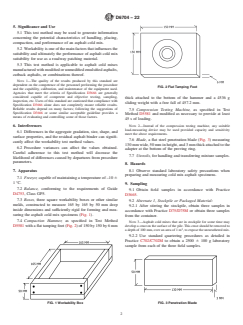
7.3 Boxes, three square workability boxes or other similar molds, constructed to measure 165 by 165 by 50-mm 50 mm deep inside
dimensions and sufficiently rigid for forming and measuring the asphalt cold mix specimens (Fig. 1).
7.4 Compaction Hammer, as specified in Test Method D5581 with a flat tamping foot (Fig. 2) of 150 by 150 by 6-mm 6 mm thick
attached to the bottom of the hammer and a 4536-g 4536 g sliding weight with a free fall of 457.2 mm.
---------------
...