


ASTM B545-13
(Specification)Standard Specification for Electrodeposited Coatings of Tin
Standard Specification for Electrodeposited Coatings of Tin
ABSTRACT
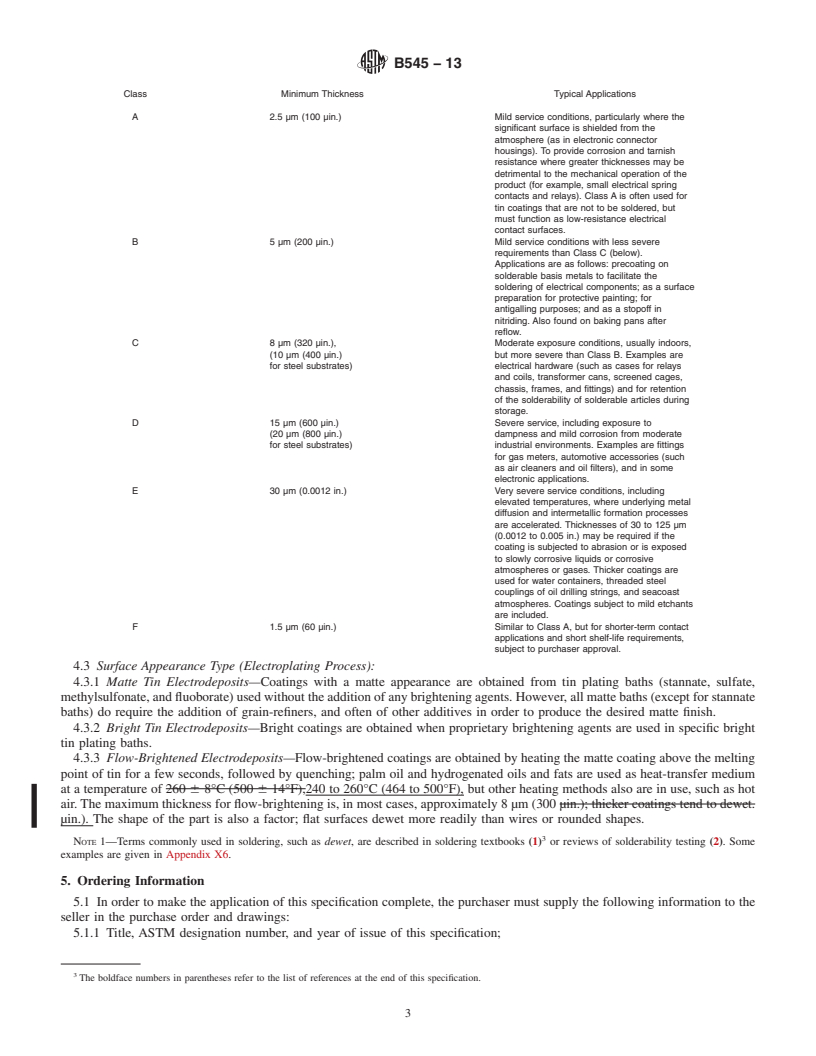
This specification covers the requirements for electrodeposited tin coatings applied to metallic articles to provide a low contact resistance surface, to protect against corrosion, to facilitate soldering, to provide anti-galling properties, and to be a stop-off coating in the nitriding of high-strength steels. This specification does not cover hot-dipped tin or other non-electrodeposited coatings, and mill products. Coatings shall be grouped into six service classes, which is based on the minimum thickness and severity of service required for the coating, and three surface appearance types, which is based on the type electroplating process employed. The surface appearance types are matte tin electrodeposits, bright tin electrodeposits, and flow-brightened electrodeposits. Coatings shall be sampled, tested and conform accordingly to specified requirements as to appearance, purity, local and mean thickness, integrity (including gross defects, mechanical damage, and porosity), adhesion, solderability, and hydrogen embrittlement relief.
SCOPE
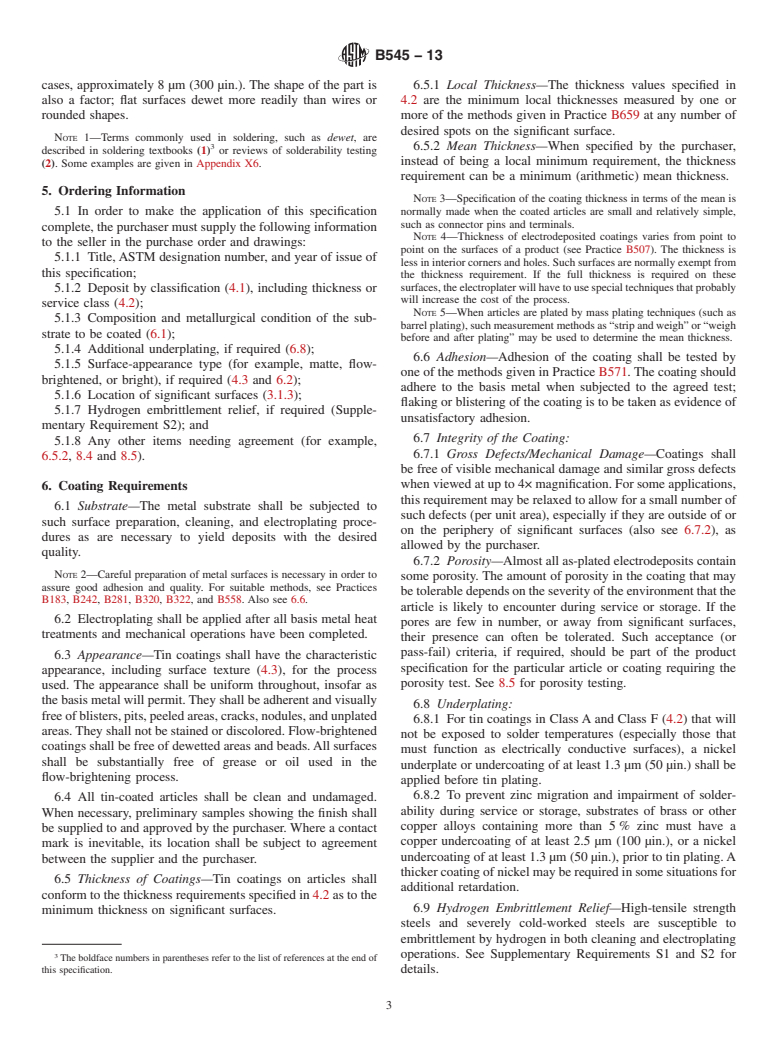
1.1 This specification covers the requirements for electrodeposited (electroplated) coatings of tin applied to metallic articles. Tin coatings are used to provide a low contact-resistance surface, to protect against corrosion (see 1.2), to facilitate soldering, to provide anti-galling properties, and to be a stopoff coating in the nitriding of high-strength steels.
1.2 Some corrosion can be expected from tin coatings exposed outdoors. In normal indoor exposure, tin is protective on iron, steel, nickel, copper, and their alloys. Corrosion can be expected at discontinuities in the coating (such as pores) due to galvanic couples formed between the tin and the underlying metal through the discontinuities, especially in humid atmospheres. Porosity increases as the coating thickness decreases, so that minimum thicknesses must be specified for each application. Parts coated with tin can be assembled safely in contact with iron and steel, tin-coated aluminum, yellow chromated zinc, cadmium, and solder coatings. (See X5.1 for oxidation and corrosion properties.)
1.3 This specification applies to electroplated coatings of not less than 99 % tin (except where deliberately alloyed for special purposes, as stated in X6.3) obtained from any of the available tin electroplating processes (see 4.3).
1.4 This specification does not apply to hot-dipped tin or other non-electrodeposited coating; it also does not apply to mill products. For mill products, refer to Specifications A623 or A623M.
1.5 The values stated in SI units are to be regarded as the standard. The values given in parentheses are for information only.
1.6 This standard does not purport to address all of the safety concerns, if any, associated with its use. It is the responsibility of the user of this standard to establish appropriate safety and health practices and determine the applicability of regulatory limitations prior to use.
General Information
Buy Standard


Standards Content (Sample)
NOTICE: This standard has either been superseded and replaced by a new version or withdrawn.
Contact ASTM International (www.astm.org) for the latest information
Designation:B545 −13
Standard Specification for
1
Electrodeposited Coatings of Tin
This standard is issued under the fixed designation B545; the number immediately following the designation indicates the year of
original adoption or, in the case of revision, the year of last revision.Anumber in parentheses indicates the year of last reapproval.A
superscript epsilon (´) indicates an editorial change since the last revision or reapproval.
This standard has been approved for use by agencies of the Department of Defense.
1. Scope 2. Referenced Documents
2
1.1 Thisspecificationcoverstherequirementsforelectrode- 2.1 ASTM Standards:
posited (electroplated) coatings of tin applied to metallic A623Specification for Tin Mill Products, General Require-
articles. Tin coatings are used to provide a low contact- ments
resistance surface, to protect against corrosion (see 1.2), to A623MSpecification for Tin Mill Products, General Re-
facilitatesoldering,toprovideanti-gallingproperties,andtobe quirements [Metric]
a stopoff coating in the nitriding of high-strength steels. B32Specification for Solder Metal
B183Practice for Preparation of Low-Carbon Steel for
1.2 Some corrosion can be expected from tin coatings
Electroplating
exposed outdoors. In normal indoor exposure, tin is protective
B242Guide for Preparation of High-Carbon Steel for Elec-
oniron,steel,nickel,copper,andtheiralloys.Corrosioncanbe
troplating
expectedatdiscontinuitiesinthecoating(suchaspores)dueto
B246Specification for Tinned Hard-Drawn and Medium-
galvanic couples formed between the tin and the underlying
Hard-Drawn Copper Wire for Electrical Purposes
metal through the discontinuities, especially in humid atmo-
B281Practice for Preparation of Copper and Copper-Base
spheres. Porosity increases as the coating thickness decreases,
Alloys for Electroplating and Conversion Coatings
so that minimum thicknesses must be specified for each
B320Practice for Preparation of Iron Castings for Electro-
application. Parts coated with tin can be assembled safely in
plating
contact with iron and steel, tin-coated aluminum, yellow
B322Guide for Cleaning Metals Prior to Electroplating
chromated zinc, cadmium, and solder coatings. (See X5.1 for
B374Terminology Relating to Electroplating
oxidation and corrosion properties.)
B487Test Method for Measurement of Metal and Oxide
1.3 This specification applies to electroplated coatings of
Coating Thickness by Microscopical Examination of
not less than 99% tin (except where deliberately alloyed for
Cross Section
special purposes, as stated in X6.3) obtained from any of the
B499Test Method for Measurement of CoatingThicknesses
available tin electroplating processes (see 4.3).
by the Magnetic Method: Nonmagnetic Coatings on
Magnetic Basis Metals
1.4 This specification does not apply to hot-dipped tin or
other non-electrodeposited coating; it also does not apply to B504Test Method for Measurement of Thickness of Metal-
lic Coatings by the Coulometric Method
mill products. For mill products, refer to Specifications A623
or A623M. B507Practice for Design ofArticles to Be Electroplated on
Racks
1.5 The values stated in SI units are to be regarded as the
B542Terminology Relating to Electrical Contacts andTheir
standard. The values given in parentheses are for information
Use
only.
B558Practice for Preparation of Nickel Alloys for Electro-
1.6 This standard does not purport to address all of the
plating
safety concerns, if any, associated with its use. It is the
B567Test Method for Measurement of Coating Thickness
responsibility of the user of this standard to establish appro-
by the Beta Backscatter Method
priate safety and health practices and determine the applica-
B568Test Method for Measurement of Coating Thickness
bility of regulatory limitations prior to use.
by X-Ray Spectrometry
1
This specification is under the jurisdiction of ASTM Committee B08 on
Metallic and Inorganic Coatings and is the direct responsibility of Subcommittee
2
B08.06 on Soft Metals. For referenced ASTM standards, visit the ASTM website, www.astm.org, or
CurrenteditionapprovedMay1,2013.PublishedJuly2013.Originallyapproved contact ASTM Customer Service at service@astm.org. For Annual Book of ASTM
in 1971. Last previous edition approved in 2009 as B545–97 (2009). DOI: Standards volume information, refer to the standard’s Document Summary page on
10.1520/B0545-13. the ASTM website.
Copyright © ASTM International, 100 Barr Harbor Drive, PO Box C700, West Conshohocken, PA 19428-2959. United States
1
---------------------- Page: 1 ----------------------
B545−13
B571Practice for Qualitative Adhesion Testing of Metallic 4.2 Service Class:
Coatings
Class Minimum Thickness Typical Applications
B602Test Method for Attribute Sampling of Metallic and
A 2.5 µm (100 µin.) Mild service conditions, particularly where the
Inorga
...
This document is not an ASTM standard and is intended only to provide the user of an ASTM standard an indication of what changes have been made to the previous version. Because
it may not be technically possible to adequately depict all changes accurately, ASTM recommends that users consult prior editions as appropriate. In all cases only the current version
of the standard as published by ASTM is to be considered the official document.
Designation: B545 − 97 (Reapproved 2009) B545 − 13
Standard Specification for
1
Electrodeposited Coatings of Tin
This standard is issued under the fixed designation B545; the number immediately following the designation indicates the year of
original adoption or, in the case of revision, the year of last revision. A number in parentheses indicates the year of last reapproval. A
superscript epsilon (´) indicates an editorial change since the last revision or reapproval.
This standard has been approved for use by agencies of the Department of Defense.
1. Scope
1.1 This specification covers the requirements for electrodeposited (electroplated) coatings of tin applied to metallic articles. Tin
coatings are used to provide a low contact-resistance surface, to protect against corrosion (see 1.2), to facilitate soldering, to
provide anti-galling properties, and to be a stopoff coating in the nitriding of high-strength steels.
1.2 Some corrosion can be expected from tin coatings exposed outdoors. In normal indoor exposure, tin is protective on iron,
steel, nickel, copper, and their alloys. Corrosion can be expected at discontinuities in the coating (such as pores) due to galvanic
couples formed between the tin and the underlying metal through the discontinuities, especially in humid atmospheres. Porosity
increases as the coating thickness decreases, so that minimum thicknesses must be specified for each application. Parts coated with
tin can be assembled safely in contact with iron and steel, tin-coated aluminum, yellow chromated zinc, cadmium, and solder
coatings. (See X5.2X5.1 for oxidation and corrosion properties.)
1.3 This specification applies to electroplated coatings of not less than 99 % tin (except where deliberately alloyed for special
purposes, as stated in X6.3) obtained from any of the available tin electroplating processes (see 4.3).
1.4 This specification does not apply to hot-dipped tin or other non-electrodeposited coating; it also does not apply to mill
products. For mill products, refer to Specifications A623 or A623M.
1.5 The values stated in SI units are to be regarded as the standard. The values given in parentheses are for information only.
1.6 This standard does not purport to address all of the safety concerns, if any, associated with its use. It is the responsibility
of the user of this standard to establish appropriate safety and health practices and determine the applicability of regulatory
limitations prior to use.
2. Referenced Documents
2
2.1 ASTM Standards:
A623 Specification for Tin Mill Products, General Requirements
A623M Specification for Tin Mill Products, General Requirements [Metric]
B32 Specification for Solder Metal
B183 Practice for Preparation of Low-Carbon Steel for Electroplating
B242 Guide for Preparation of High-Carbon Steel for Electroplating
B246 Specification for Tinned Hard-Drawn and Medium-Hard-Drawn Copper Wire for Electrical Purposes
B281 Practice for Preparation of Copper and Copper-Base Alloys for Electroplating and Conversion Coatings
B320 Practice for Preparation of Iron Castings for Electroplating
B322 Guide for Cleaning Metals Prior to Electroplating
B374 Terminology Relating to Electroplating
B487 Test Method for Measurement of Metal and Oxide Coating Thickness by Microscopical Examination of Cross Section
B499 Test Method for Measurement of Coating Thicknesses by the Magnetic Method: Nonmagnetic Coatings on Magnetic Basis
Metals
B504 Test Method for Measurement of Thickness of Metallic Coatings by the Coulometric Method
1
This specification is under the jurisdiction of ASTM Committee B08 on Metallic and Inorganic Coatings and is the direct responsibility of Subcommittee B08.06 on Soft
Metals.
Current edition approved Sept. 1, 2009May 1, 2013. Published December 2009July 2013. Originally approved in 1971. Last previous edition approved in 20042009 as
ε1
B545 – 97 (2004)(2009). . DOI: 10.1520/B0545-97R09.10.1520/B0545-13.
2
For referenced ASTM standards, visit the ASTM website, www.astm.org, or contact ASTM Customer Service at service@astm.org. For Annual Book of ASTM Standards
volume information, refer to the standard’s Document Summary page on the ASTM website.
Copyright © ASTM International, 100 Barr Harbor Drive, PO Box C700, West Conshohocken, PA 19428-2959. United States
1
---------------------- Page: 1 ----------------------
B545 − 13
B507 Practice for Design of Articles to Be Electroplated on Racks
B542 Terminology Relating to Electrical Contacts and Their Use
B558 Practice for Preparation of Nickel Alloys for Electroplat
...
Questions, Comments and Discussion
Ask us and Technical Secretary will try to provide an answer. You can facilitate discussion about the standard in here.