

ASTM D6290-19
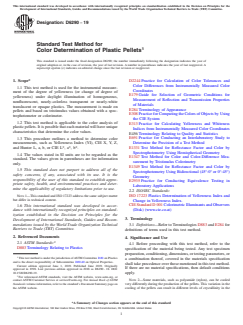
(Test Method)Standard Test Method for Color Determination of Plastic Pellets
General Information
- Abstract
SIGNIFICANCE AND USE
4.1 Before proceeding with this test method, refer to the specification of the material being tested. Any test specimen preparation, conditioning, dimensions, or testing parameters, or a combination thereof, covered in the materials specification shall take precedence over those mentioned in this test method. If there are no material specifications, then default conditions apply.
Note 2: Some materials, such as polyamide (nylon), can be cooled very differently during the production of the pellets. This variation in the cooling of the pellets can result in different levels of crystallinity in the pellets only. More crystalline nylons will be more opaque than amorphous nylons. This will result in differences in pellet opacity. The pellet shape is independent of the crystallinity of the material. This variation in pellet appearance, due to varying levels of crystallinity, does not affect final properties.
Note 3: This test method should not be used for general material specifications.
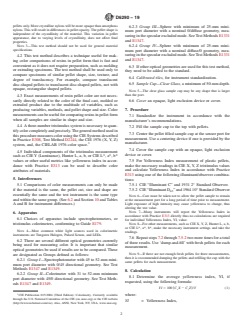
4.2 This test method describes a technique useful for making color comparisons of resins in pellet form that is fast and convenient as it does not require preparation, such as molding or extruding specimens. The test method shall be used only to compare specimens of similar pellet shape, size, texture, and degree of translucency. For example, compare translucent disc-shaped pellets to translucent disc-shaped pellets, not with opaque, rectangular shaped pellets.
4.3 Exact measurements of resin pellet color are not necessarily directly related to the color of the final cast, molded or extruded product due to the multitude of variables, such as producing variables, methods, and pellet shape and size. Color measurements can be useful for comparing resins in pellet form when all samples are similar in shape and size.
4.4 A three-number tristimulus system is necessary to quantify color completely and precisely. The general method used in this procedure measures color using the CIE ...
SCOPE
1.1 This test method is used for the instrumental measurement of the degree of yellowness (or change of degree of yellowness) under daylight illumination of homogeneous, nonfluorescent, nearly-colorless transparent or nearly-white translucent or opaque plastics. The measurement is made on pellets and based on tristimulus values obtained with a spectrophotometer or colorimeter.
1.2 This test method is applicable to the color analysis of plastic pellets. It is possible that each material will have unique characteristics that determine the color values.
1.3 This procedure outlines a method to determine color measurements, such as Yellowness Index (YI), CIE X, Y, Z, and Hunter L, a, b, or CIE L*, a*, b*.
1.4 The values stated in SI units are to be regarded as the standard. The values given in parentheses are for information only.
1.5 This standard does not purport to address all of the safety concerns, if any, associated with its use. It is the responsibility of the user of this standard to establish appropriate safety, health, and environmental practices and determine the applicability of regulatory limitations prior to use.
Note 1: This standard and ISO 17223 address the same subject matter but differ in technical content.
1.6 This international standard was developed in accordance with internationally recognized principles on standardization established in the Decision on Principles for the Development of International Standards, Guides and Recommendations issued by the World Trade Organization Technical Barriers to Trade (TBT) Committee.
- Status
- Published
- Publication Date
- 31-May-2019
- Technical Committee
- D20 - Plastics
- Drafting Committee
- D20.40 - Optical Properties
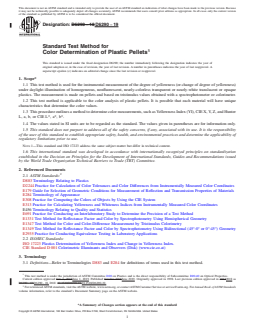
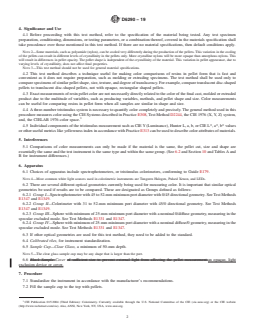
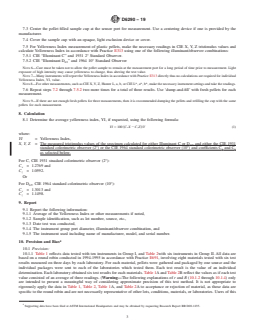
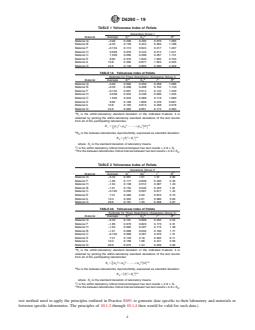
Overview
ASTM D6290-19 is a standard test method for the instrumental color determination of plastic pellets, developed by ASTM International. This procedure focuses on the measurement of color attributes such as the degree of yellowness in homogeneous, nonfluorescent, nearly-colorless transparent or nearly-white plastic pellets. Employed primarily in material quality control and polymer manufacturing, this method enables fast, convenient, and objective comparisons without the need for sample preparation such as molding or extrusion. The method utilizes spectrophotometric or colorimetric analysis to obtain precise tristimulus values, which can then be used to calculate indices including Yellowness Index (YI) and standard color space coordinates.
Key Topics
Scope of Application
- Applies to plastic pellets that are homogeneous, nonfluorescent, and nearly-colorless, whether transparent, translucent, or opaque.
- Designed for measuring and comparing the degree of yellowness and related color parameters.
Measurement Techniques
- Employs spectrophotometers or tristimulus colorimeters compliant with standard geometric and optical requirements.
- Utilizes recognized color spaces and indices such as CIE XYZ, CIE L*a*b*, Hunter L, a, b, and the Yellowness Index.
- Measurements are made under specified daylight illumination conditions to promote consistency.
Limitations & Key Considerations
- Applicable only when comparing samples with similar pellet shape, size, texture, and translucency.
- Color measurement of pellets is not always directly representative of the color in molded or finished plastic products due to variables like production processes and pellet crystallinity.
- Should not be used for general material specifications but rather for comparative purposes within batches or lots.
Instrument Groupings
- Recognizes different groups of instruments and geometries (such as 0/45, 45/0, sphere geometry) that may affect results and require standardization for valid comparisons.
Applications
ASTM D6290-19 is widely used across the plastics industry for:
- Quality Control: Monitoring color consistency and batch-to-batch variation in plastic resin manufacturing.
- Resin Formulation: Comparing color properties of different resin lots or during development of new polymer grades.
- Supplier Evaluation: Ensuring incoming raw materials meet color or yellowness criteria before processing.
- Process Optimization: Identifying process parameters-such as cooling rates in pellet production-that impact color or opacity in polyamide (nylon) and other polymers.
- Objective Reporting: Utilizing standardized metrics for tristimulus values and Yellowness Index in technical documentation and customer specifications.
By facilitating objective, reproducible color measurement, this standard increases confidence in material conformity and supplier consistency, minimizing risks associated with color variations in downstream applications.
Related Standards
ASTM D6290-19 references or is closely aligned with several other important standards for color and appearance measurement, including:
- ASTM D2244: Calculation of color tolerances and differences from instrumentally measured color coordinates.
- ASTM E179: Guide for selection of geometric conditions for reflection and transmission measurements.
- ASTM E308: Practice for computing object colors using the CIE System.
- ASTM E313: Calculating Yellowness and Whiteness Indices.
- ASTM E1331 & E1347: Test methods for spectrophotometric and tristimulus colorimetry measurements.
- ISO 17223: Plastics - Determination of Yellowness Index and change in Yellowness Index.
- ASTM D883 & E284: Terminology relating to plastics and visual appearance.
- CIE Publications: Standards on colorimetric illuminants and observers.
Practical Value
By adopting ASTM D6290-19, laboratories and manufacturers benefit from standardized, reproducible measurements of color and yellowness in plastic pellets, facilitating quality assurance, regulatory compliance, and efficient production of visually consistent polymer products. This test method is essential for resin producers, compounders, quality assurance professionals, and researchers striving to maintain or improve color uniformity in plastic materials.
Keywords: ASTM D6290, color determination, plastic pellets, yellowness index, polymer color measurement, spectrophotometer, color quality control, resin testing, plastics industry standards.
Relations
- Effective Date
- 01-Feb-2024
- Effective Date
- 01-Nov-2023
- Effective Date
- 01-Nov-2023
- Effective Date
- 01-Apr-2022
- Effective Date
- 01-May-2020
- Effective Date
- 01-Jan-2020
- Effective Date
- 01-Nov-2019
- Effective Date
- 01-Aug-2019
- Effective Date
- 15-Apr-2019
- Effective Date
- 01-Feb-2019
- Effective Date
- 01-Dec-2018
- Effective Date
- 01-Nov-2018
- Effective Date
- 01-Oct-2017
- Effective Date
- 01-Oct-2017
- Refers
ASTM E2935-17 - Standard Practice for Conducting Equivalence Testing in Laboratory Applications - Effective Date
- 01-Oct-2017
Get Certified
Connect with accredited certification bodies for this standard

DIN CERTCO
DIN Group product certification.
BSMI (Bureau of Standards, Metrology and Inspection)
Taiwan's standards and inspection authority.

Smithers Quality Assessments
US management systems and product certification.
Sponsored listings
Frequently Asked Questions
ASTM D6290-19 is a standard published by ASTM International. Its full title is "Standard Test Method for Color Determination of Plastic Pellets". This standard covers: SIGNIFICANCE AND USE 4.1 Before proceeding with this test method, refer to the specification of the material being tested. Any test specimen preparation, conditioning, dimensions, or testing parameters, or a combination thereof, covered in the materials specification shall take precedence over those mentioned in this test method. If there are no material specifications, then default conditions apply. Note 2: Some materials, such as polyamide (nylon), can be cooled very differently during the production of the pellets. This variation in the cooling of the pellets can result in different levels of crystallinity in the pellets only. More crystalline nylons will be more opaque than amorphous nylons. This will result in differences in pellet opacity. The pellet shape is independent of the crystallinity of the material. This variation in pellet appearance, due to varying levels of crystallinity, does not affect final properties. Note 3: This test method should not be used for general material specifications. 4.2 This test method describes a technique useful for making color comparisons of resins in pellet form that is fast and convenient as it does not require preparation, such as molding or extruding specimens. The test method shall be used only to compare specimens of similar pellet shape, size, texture, and degree of translucency. For example, compare translucent disc-shaped pellets to translucent disc-shaped pellets, not with opaque, rectangular shaped pellets. 4.3 Exact measurements of resin pellet color are not necessarily directly related to the color of the final cast, molded or extruded product due to the multitude of variables, such as producing variables, methods, and pellet shape and size. Color measurements can be useful for comparing resins in pellet form when all samples are similar in shape and size. 4.4 A three-number tristimulus system is necessary to quantify color completely and precisely. The general method used in this procedure measures color using the CIE ... SCOPE 1.1 This test method is used for the instrumental measurement of the degree of yellowness (or change of degree of yellowness) under daylight illumination of homogeneous, nonfluorescent, nearly-colorless transparent or nearly-white translucent or opaque plastics. The measurement is made on pellets and based on tristimulus values obtained with a spectrophotometer or colorimeter. 1.2 This test method is applicable to the color analysis of plastic pellets. It is possible that each material will have unique characteristics that determine the color values. 1.3 This procedure outlines a method to determine color measurements, such as Yellowness Index (YI), CIE X, Y, Z, and Hunter L, a, b, or CIE L*, a*, b*. 1.4 The values stated in SI units are to be regarded as the standard. The values given in parentheses are for information only. 1.5 This standard does not purport to address all of the safety concerns, if any, associated with its use. It is the responsibility of the user of this standard to establish appropriate safety, health, and environmental practices and determine the applicability of regulatory limitations prior to use. Note 1: This standard and ISO 17223 address the same subject matter but differ in technical content. 1.6 This international standard was developed in accordance with internationally recognized principles on standardization established in the Decision on Principles for the Development of International Standards, Guides and Recommendations issued by the World Trade Organization Technical Barriers to Trade (TBT) Committee.
SIGNIFICANCE AND USE 4.1 Before proceeding with this test method, refer to the specification of the material being tested. Any test specimen preparation, conditioning, dimensions, or testing parameters, or a combination thereof, covered in the materials specification shall take precedence over those mentioned in this test method. If there are no material specifications, then default conditions apply. Note 2: Some materials, such as polyamide (nylon), can be cooled very differently during the production of the pellets. This variation in the cooling of the pellets can result in different levels of crystallinity in the pellets only. More crystalline nylons will be more opaque than amorphous nylons. This will result in differences in pellet opacity. The pellet shape is independent of the crystallinity of the material. This variation in pellet appearance, due to varying levels of crystallinity, does not affect final properties. Note 3: This test method should not be used for general material specifications. 4.2 This test method describes a technique useful for making color comparisons of resins in pellet form that is fast and convenient as it does not require preparation, such as molding or extruding specimens. The test method shall be used only to compare specimens of similar pellet shape, size, texture, and degree of translucency. For example, compare translucent disc-shaped pellets to translucent disc-shaped pellets, not with opaque, rectangular shaped pellets. 4.3 Exact measurements of resin pellet color are not necessarily directly related to the color of the final cast, molded or extruded product due to the multitude of variables, such as producing variables, methods, and pellet shape and size. Color measurements can be useful for comparing resins in pellet form when all samples are similar in shape and size. 4.4 A three-number tristimulus system is necessary to quantify color completely and precisely. The general method used in this procedure measures color using the CIE ... SCOPE 1.1 This test method is used for the instrumental measurement of the degree of yellowness (or change of degree of yellowness) under daylight illumination of homogeneous, nonfluorescent, nearly-colorless transparent or nearly-white translucent or opaque plastics. The measurement is made on pellets and based on tristimulus values obtained with a spectrophotometer or colorimeter. 1.2 This test method is applicable to the color analysis of plastic pellets. It is possible that each material will have unique characteristics that determine the color values. 1.3 This procedure outlines a method to determine color measurements, such as Yellowness Index (YI), CIE X, Y, Z, and Hunter L, a, b, or CIE L*, a*, b*. 1.4 The values stated in SI units are to be regarded as the standard. The values given in parentheses are for information only. 1.5 This standard does not purport to address all of the safety concerns, if any, associated with its use. It is the responsibility of the user of this standard to establish appropriate safety, health, and environmental practices and determine the applicability of regulatory limitations prior to use. Note 1: This standard and ISO 17223 address the same subject matter but differ in technical content. 1.6 This international standard was developed in accordance with internationally recognized principles on standardization established in the Decision on Principles for the Development of International Standards, Guides and Recommendations issued by the World Trade Organization Technical Barriers to Trade (TBT) Committee.
ASTM D6290-19 is classified under the following ICS (International Classification for Standards) categories: 17.180.20 - Colours and measurement of light; 83.080.01 - Plastics in general. The ICS classification helps identify the subject area and facilitates finding related standards.
ASTM D6290-19 has the following relationships with other standards: It is inter standard links to ASTM D883-24, ASTM D883-23, ASTM E1331-15(2023), ASTM E456-13a(2022)e1, ASTM E1347-06(2020), ASTM D883-20, ASTM E1331-15(2019), ASTM D883-19c, ASTM D883-19a, ASTM D883-19, ASTM D883-18a, ASTM D883-18, ASTM E456-13A(2017)e3, ASTM E456-13A(2017)e1, ASTM E2935-17. Understanding these relationships helps ensure you are using the most current and applicable version of the standard.
ASTM D6290-19 is available in PDF format for immediate download after purchase. The document can be added to your cart and obtained through the secure checkout process. Digital delivery ensures instant access to the complete standard document.
Standards Content (Sample)
This international standard was developed in accordance with internationally recognized principles on standardization established in the Decision on Principles for the
Development of International Standards, Guides and Recommendations issued by the World Trade Organization Technical Barriers to Trade (TBT) Committee.
Designation: D6290 − 19
Standard Test Method for
Color Determination of Plastic Pellets
This standard is issued under the fixed designation D6290; the number immediately following the designation indicates the year of
original adoption or, in the case of revision, the year of last revision. A number in parentheses indicates the year of last reapproval. A
superscript epsilon (´) indicates an editorial change since the last revision or reapproval.
1. Scope* D2244 Practice for Calculation of Color Tolerances and
Color Differences from Instrumentally Measured Color
1.1 This test method is used for the instrumental measure-
Coordinates
ment of the degree of yellowness (or change of degree of
E179 Guide for Selection of Geometric Conditions for
yellowness) under daylight illumination of homogeneous,
Measurement of Reflection and Transmission Properties
nonfluorescent, nearly-colorless transparent or nearly-white
of Materials
translucent or opaque plastics. The measurement is made on
E284 Terminology of Appearance
pellets and based on tristimulus values obtained with a spec-
E308 PracticeforComputingtheColorsofObjectsbyUsing
trophotometer or colorimeter.
the CIE System
1.2 This test method is applicable to the color analysis of
E313 Practice for Calculating Yellowness and Whiteness
plasticpellets.Itispossiblethateachmaterialwillhaveunique
Indices from Instrumentally Measured Color Coordinates
characteristics that determine the color values.
E456 Terminology Relating to Quality and Statistics
1.3 This procedure outlines a method to determine color E691 Practice for Conducting an Interlaboratory Study to
Determine the Precision of a Test Method
measurements, such as Yellowness Index (YI), CIE X, Y, Z,
and Hunter L, a, b, or CIE L*, a*, b*. E1331 Test Method for Reflectance Factor and Color by
Spectrophotometry Using Hemispherical Geometry
1.4 The values stated in SI units are to be regarded as the
E1347 Test Method for Color and Color-Difference Mea-
standard. The values given in parentheses are for information
surement by Tristimulus Colorimetry
only.
E1349 Test Method for Reflectance Factor and Color by
1.5 This standard does not purport to address all of the
Spectrophotometry Using Bidirectional (45°:0° or 0°:45°)
safety concerns, if any, associated with its use. It is the
Geometry
responsibility of the user of this standard to establish appro-
E2935 Practice for Conducting Equivalence Testing in
priate safety, health, and environmental practices and deter-
Laboratory Applications
mine the applicability of regulatory limitations prior to use.
2.2 ISO/IEC Standards:
NOTE 1—This standard and ISO 17223 address the same subject matter ISO 17223 Plastics Determination of Yellowness Index and
but differ in technical content.
Change in Yellowness Index.
1.6 This international standard was developed in accor- CIEStandardD 001 ColorimetricIlluminantsandObservers
(Disk) (www.cie.co.at)
dance with internationally recognized principles on standard-
ization established in the Decision on Principles for the
3. Terminology
Development of International Standards, Guides and Recom-
mendations issued by the World Trade Organization Technical
3.1 Definitions—Refer toTerminologies D883 and E284 for
Barriers to Trade (TBT) Committee. definitions of terms used in this test method.
2. Referenced Documents
4. Significance and Use
2.1 ASTM Standards:
4.1 Before proceeding with this test method, refer to the
D883 Terminology Relating to Plastics
specification of the material being tested. Any test specimen
preparation,conditioning,dimensions,ortestingparameters,or
This test method is under the jurisdiction ofASTM Committee D20 on Plastics
a combination thereof, covered in the materials specification
and is the direct responsibility of Subcommittee D20.40 on Optical Properties.
shall take precedence over those mentioned in this test method.
Current edition approved June 1, 2019. Published June 2019. Originally
If there are no material specifications, then default conditions
approved in 1998. Last previous edition approved in 2018 as D6290 - 18. DOI:
10.1520/D6290-19.
apply.
For referenced ASTM standards, visit the ASTM website, www.astm.org, or
NOTE 2—Some materials, such as polyamide (nylon), can be cooled
contact ASTM Customer Service at service@astm.org. For Annual Book of ASTM
Standards volume information, refer to the standard’s Document Summary page on very differently during the production of the pellets. This variation in the
the ASTM website. cooling of the pellets can result in different levels of crystallinity in the
*A Summary of Changes section appears at the end of this standard
Copyright © ASTM International, 100 Barr Harbor Drive, PO Box C700, West Conshohocken, PA 19428-2959. United States
D6290 − 19
pellets only. More crystalline nylons will be more opaque than amorphous
6.2.3 Group III—Sphere with minimum of 25-mm mini-
nylons. This will result in differences in pellet opacity. The pellet shape is
mum port diameter with a nominal 0/diffuse geometry, mea-
independent of the crystallinity of the material. This variation in pellet
suringinthespecularexcludedmode.SeeTestMethodsE1331
appearance, due to varying levels of crystallinity, does not affect final
and E1347.
properties.
6.2.4 Group IV—Sphere with minimum of 25-mm mini-
NOTE 3—This test method should not be used for general material
specifications.
mum port diameter with a nominal diffuse/0 geometry, mea-
suringinthespecularexcludedmode.SeeTestMethodsE1331
4.2 This test method describes a technique useful for mak-
and E1347.
ing color comparisons of resins in pellet form that is fast and
convenient as it does not require preparation, such as molding
6.3 If other optical geometries are used for this test method,
or extruding specimens. The test method shall be used only to
they need to be added to the standard.
compare specimens of similar pellet shape, size, texture, and
6.4 Calibrated tiles, for instrument standardization.
degree of translucency. For example, compare translucent
6.5 Sample Cup—Clear Glass,aminimumof50-mmdepth.
disc-shaped pellets to translucent disc-shaped pellets, not with
opaque, rectangular shaped pellets.
NOTE 5—The clear glass sample cup may be any shape that is larger
than the port.
4.3 Exact measurements of resin pellet color are not neces-
sarily directly related to the color of the final cast, molded or
6.6 Cover an opaque, light exclusion device or cover.
extruded product due to the multitude of variables, such as
7. Procedure
producing variables, methods, and pellet shape and size. Color
measurementscanbeusefulforcomparingresinsinpelletform
7.1 Standardize the instrument in accordance with the
when all samples are similar in shape and size.
manufacturer’s recommendations.
4.4 Athree-number tristimulus system is necessary to quan-
7.2 Fill the sample cup to the top with pellets.
tifycolorcompletelyandprecisely.Thegeneralmethodusedin
7.3 Center the pellet filled sample cup at the sensor port for
thisproceduremeasurescolorusingtheCIESystemsdescribed
measurement. Use a centering device if one is provided by the
in Practice E308, Test Method D2244, the CIE 1976 (X, Y, Z)
3 manufacturer.
system, and, the CIELAB 1976 color space.
7.4 Cover the sample cup with an opaque, light exclusion
4.5 Individual components of the tristimulus measurement
device or cover.
such as CIE Y (Luminance), Hunter L, a, b, or CIE L*, a*, b*
7.5 For Yellowness Index measurement of plastic pellets,
values or other useful metrics like yellowness index in accor-
make the necessary readings in CIE X, Y, Z tristimulus values
dance with Practice E313 can be used to describe color
and calculate Yellowness Index in accordance with Practice
attributes of materials.
E313 using one of the following illuminant/observer combina-
5. Interferences
tions:
7.5.1 CIE “Illuminant C” and 1931 2° Standard Observer.
5.1 Comparisons of color measurements can only be made
7.5.2 CIE“IlluminantD ”and196410°StandardObserver
if the material is the same, the pellet cut, size and shape are
essentially the same and the test instrument is the same type
NOTE 6—Care must be taken not to allow the pellet sample to remain
and within the same group. (See 6.2 and Section 10 andTables
at the measurement port for a long period of time prior to measurement.
Light exposure of high intensity may cause yellowness to change, thus
A and B for instrument differences.)
altering the test value.
NOTE 7—Many instruments will report the Yellowness Index in
6. Apparatus
accordance with Practice E313 directly thus no calculations are required
6.1 Choices of apparatus include spectrophotometers, or
for individual Yellowness Index, YI, value.
tristimulus colorimeters, conforming to Guide E179.
NOTE 8—For other measurements, such as CIE X,Y, Z, Hunter L, a, b,
or CIE L*, a*, b*, make the necessary instrument settings and take the
NOTE 4—Most common white light sources used in colorimetric
readings.
instruments are Tungsten Halogen, Pulsed Xenon, and LEDs.
7.6 Repeatsteps7.2through7.5.2twomoretimesforatotal
6.2 There are several different optical geometries currently
of three results. Use ‘dump-and-fill’with fresh pellets for each
being used for measuring color. It is important that similar
measurement.
optical geometries be used if results are to be compared.These
NOTE 9—If there are not enough fresh pellets for three measurements,
are designated as Groups defined as follows:
then it is recommended dumping the pellets and refilling the cup with the
6.2.1 Group I—Spectrophotometer with 45 to 52-mm mini-
same pellets for each measurement.
mum port diameter with 0/45 directional geometry. See Test
Methods E1347 and E1349.
8. Calculation
6.2.2 Group II—Colorimeter with 31 to 52-mm minimum
8.1 Determine the average yellowness index, YI, if
port diameter with 45/0 directional geometry. See Test Meth-
requested, using the following formula:
ods E1347 and E1349.
YI 5 100 ~C X 2 C Z!/Y (1)
x z
CIE Publication 015:2004 (Third Edition): Colorimetry. Currently available where:
through the U.S. National Committee of the CIE (cie-usnc.org) or the CIE website
YI = Yellowness Index,
(http://www.techstreet.com/cie). Also, ANSI, New York, NY, USA, www.ansi.org.
D6290 − 19
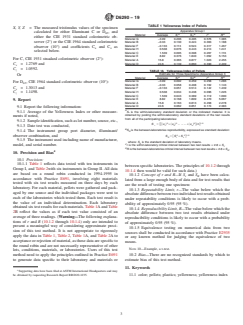
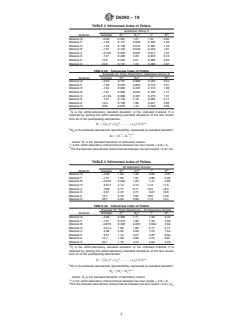
TABLE 1 Yellowness Index of Pellets
X, Y, Z = The measured tristimulus values of the specimen
Apparatus Group I
calculated for either Illuminant C or D , and
A B C D
Material Average S S r R
r R
either the CIE 1931 standard colorimetric ob-
Material G –3.99 0.206 0.495 0.576 1.385
server (2°) or the CIE 1964 standard colorimetric Material B –0.33 0.130 0.424 0.363 1.188
Material F –0.133 0.113 0.524 0.317 1.467
observer (10°) and coefficients C and C as
x z
Material H 0.538 0.076 0.443 0.214 1.241
selected below.
Material C 1.539 0.095 0.398 0.267 1.116
Material E 8.82 0.376 1.840 1.052 5.153
For C, CIE 1931 stnadard
...
This document is not an ASTM standard and is intended only to provide the user of an ASTM standard an indication of what changes have been made to the previous version. Because
it may not be technically possible to adequately depict all changes accurately, ASTM recommends that users consult prior editions as appropriate. In all cases only the current version
of the standard as published by ASTM is to be considered the official document.
Designation: D6290 − 18 D6290 − 19
Standard Test Method for
Color Determination of Plastic Pellets
This standard is issued under the fixed designation D6290; the number immediately following the designation indicates the year of
original adoption or, in the case of revision, the year of last revision. A number in parentheses indicates the year of last reapproval. A
superscript epsilon (´) indicates an editorial change since the last revision or reapproval.
1. Scope*
1.1 This test method is used for the instrumental measurement of the degree of yellowness (or change of degree of yellowness)
under daylight illumination of homogeneous, nonfluorescent, nearly-colorless transparent or nearly-white translucent or opaque
plastics. The measurement is made on pellets and based on tristimulus values obtained with a spectrophotometer or colorimeter.
1.2 This test method is applicable to the color analysis of plastic pellets. It is possible that each material will have unique
characteristics that determine the color values.
1.3 This procedure outlines a method to determine color measurements, such as Yellowness Index (YI), CIE X, Y, Z, and Hunter
L, a, b, or CIE L*, a*, b*.
1.4 The values stated in SI units are to be regarded as the standard. The values given in parentheses are for information only.
1.5 This standard does not purport to address all of the safety concerns, if any, associated with its use. It is the responsibility
of the user of this standard to establish appropriate safety, health, and environmental practices and determine the applicability of
regulatory limitations prior to use.
NOTE 1—This standard and ISO 17223 address the same subject matter but differ in technical content.
1.6 This international standard was developed in accordance with internationally recognized principles on standardization
established in the Decision on Principles for the Development of International Standards, Guides and Recommendations issued
by the World Trade Organization Technical Barriers to Trade (TBT) Committee.
2. Referenced Documents
2.1 ASTM Standards:
D883 Terminology Relating to Plastics
D2244 Practice for Calculation of Color Tolerances and Color Differences from Instrumentally Measured Color Coordinates
E179 Guide for Selection of Geometric Conditions for Measurement of Reflection and Transmission Properties of Materials
E284 Terminology of Appearance
E308 Practice for Computing the Colors of Objects by Using the CIE System
E313 Practice for Calculating Yellowness and Whiteness Indices from Instrumentally Measured Color Coordinates
E456 Terminology Relating to Quality and Statistics
E691 Practice for Conducting an Interlaboratory Study to Determine the Precision of a Test Method
E1331 Test Method for Reflectance Factor and Color by Spectrophotometry Using Hemispherical Geometry
E1347 Test Method for Color and Color-Difference Measurement by Tristimulus Colorimetry
E1349 Test Method for Reflectance Factor and Color by Spectrophotometry Using Bidirectional (45°:0° or 0°:45°) Geometry
E2935 Practice for Conducting Equivalence Testing in Laboratory Applications
2.2 ISO/IEC Standards:
ISO 17223 Plastics Determination of Yellowness Index and Change in Yellowness Index.
CIE Standard D 001 Colorimetric Illuminants and Observers (Disk) (www.cie.co.at)
3. Terminology
3.1 Definitions—Refer to Terminologies D883 and E284 for definitions of terms used in this test method.
This test method is under the jurisdiction of ASTM Committee D20 on Plastics and is the direct responsibility of Subcommittee D20.40 on Optical Properties.
Current edition approved Oct. 1, 2018June 1, 2019. Published October 2018June 2019. Originally approved in 1998. Last previous edition approved in 20132018 as
D6290 - 13.D6290 - 18. DOI: 10.1520/D6290-18.10.1520/D6290-19.
For referenced ASTM standards, visit the ASTM website, www.astm.org, or contact ASTM Customer Service at service@astm.org. For Annual Book of ASTM Standards
volume information, refer to the standard’s Document Summary page on the ASTM website.
*A Summary of Changes section appears at the end of this standard
Copyright © ASTM International, 100 Barr Harbor Drive, PO Box C700, West Conshohocken, PA 19428-2959. United States
D6290 − 19
4. Significance and Use
4.1 Before proceeding with this test method, refer to the specification of the material being tested. Any test specimen
preparation, conditioning, dimensions, or testing parameters, or a combination thereof, covered in the materials specification shall
take precedence over those mentioned in this test method. If there are no material specifications, then default conditions apply.
NOTE 2—Some materials, such as polyamide (nylon), can be cooled very differently during the production of the pellets. This variation in the cooling
of the pellets can result in different levels of crystallinity in the pellets only. More crystalline nylons will be more opaque than amorphous nylons. This
will result in differences in pellet opacity. The pellet shape is independent of the crystallinity of the material. This variation in pellet appearance, due to
varying levels of crystallinity, does not affect final properties.
NOTE 3—This test method should not be used for general material specifications.
4.2 This test method describes a technique useful for making color comparisons of resins in pellet form that is fast and
convenient as it does not require preparation, such as molding or extruding specimens. The test method shall be used only to
compare specimens of similar pellet shape, size, texture, and degree of translucency. For example, compare translucent disc-shaped
pellets to translucent disc-shaped pellets, not with opaque, rectangular shaped pellets.
4.3 Exact measurements of resin pellet color are not necessarily directly related to the color of the final cast, molded or extruded
product due to the multitude of variables, such as producing variables, methods, and pellet shape and size. Color measurements
can be useful for comparing resins in pellet form when all samples are similar in shape and size.
4.4 A three-number tristimulus system is necessary to quantify color completely and precisely. The general method used in this
procedure measures color using the CIE Systems described in Practice E308, Test Method D2244, the CIE 1976 (X, Y, Z) system,
and, the CIELAB 1976 color space.
4.5 Individual components of the tristimulus measurement such as CIE Y (Luminance), Hunter L, a, b, or CIE L*, a*, b* values
or other useful metrics like yellowness index in accordance with Practice E313 can be used to describe color attributes of materials.
5. Interferences
5.1 Comparisons of color measurements can only be made if the material is the same, the pellet cut, size and shape are
essentially the same and the test instrument is the same type and within the same group. (See 6.2 and Section 10 and Tables A and
B for instrument differences.)
6. Apparatus
6.1 Choices of apparatus include spectrophotometers, or tristimulus colorimeters, conforming to Guide E179.
NOTE 4—Most common white light sources used in colorimetric instruments are Tungsten Halogen, Pulsed Xenon, and LEDs.
6.2 There are several different optical geometries currently being used for measuring color. It is important that similar optical
geometries be used if results are to be compared. These are designated as Groups defined as follows:
6.2.1 Group I—Spectrophotometer with 45 to 52-mm minimum port diameter with 0/45 directional geometry. See Test Methods
E1347 and E1349.
6.2.2 Group II—Colorimeter with 31 to 52-mm minimum port diameter with 45/0 directional geometry. See Test Methods
E1347 and E1349.
6.2.3 Group III—Sphere with minimum of 25-mm minimum port diameter with a nominal 0/diffuse geometry, measuring in the
specular excluded mode. See Test Methods E1331 and E1347.
6.2.4 Group IV—Sphere with minimum of 25-mm minimum port diameter with a nominal diffuse/0 geometry, measuring in the
specular excluded mode. See Test Methods E1331 and E1347.
6.3 If other optical geometries are used for this test method, they need to be added to the standard.
6.4 Calibrated tiles, for instrument standardization.
6.5 Sample Cup—Clear Glass, a minimum of 50-mm depth.
NOTE 5—The clear glass sample cup may be any shape that is larger than the port.
6.6 Black Sample Cover of sufficient size to prevent external light from affecting the pellet measurement.an opaque, light
exclusion device or cover.
7. Procedure
7.1 Standardize the instrument in accordance with the manufacturer’s recommendations.
7.2 Fill the sample cup to the top with pellets.
CIE Publication 015:2004 (Third Edition): Colorimetry. Currently available through the U.S. National Committee of the CIE (cie-usnc.org) or the CIE website
(http://www.techstreet.com/cie). Also, ANSI, New York, NY, USA, www.ansi.org.
D6290 − 19
7.3 Center the pellet filled sample cup at the sensor port for measurement. Use a centering device if one is provided by the
manufacturer.
7.4 Cover the sample cup with an opaque, light exclusion device or cover.
7.5 For Yellowness Index measurement of plastic pellets, make the necessary readings in CIE X, Y, Z tristimulus values and
calculate Yellowness Index in accordance with Practice E313 using one of the following illuminant/observer combinations:
7.5.1 CIE “Illuminant C” and 1931 2° Standard Observer.
7.5.2 CIE “Illuminant D ” and 1964 10° Standard Observer
NOTE 6—Care must be taken not to allow the pellet sample to remain at the measurement port for a long period of time prior to measurement. Light
exposure of high intensity may cause yellowness to change, thus altering the test value.
NOTE 7—Many instruments will report the Yellowness Index in accordance with Practice E313 directly thus no calculations are required for individual
Yellowness Index, YI, value.
NOTE 8—For other measurements, such as CIE X, Y, Z, Hunter L, a, b, or CIE L*, a*, b*, make the necessary instrument settings and take the readings.
7.6 Repeat steps 7.2 through 7.5.2 two more times for a total of three results. Use ‘dump-and-fill’ with fresh pellets for each
measurement.
NOTE 9—If there are not enough fresh pellets for three measurements, then it is recommended dumping the pellets and refilling the cup with the same
pellets for each measurement.
8. Calculation
8.1 Determine the average yellowness index, YI, if requested, using the following formula:
YI 5 100 ~C X 2 C Z!/Y (1)
x z
where:
YI = Yellowness Index,
X, Y, Z = The measured tristimulus values of the specimen calculated for either Illuminant C or D , and either the CIE 1931
standard colorimetric observer (2°) or the CIE 1964 standard colorimetric observer (10°) and coefficients C and C
x z
as selected below.
For C, CIE 1931 stnadard colorimetric observer (2°):
C = 1.2769 and
x
C = 1.0592.
z
Or
For D , CIE 1964 standard colorimetric observer (10°):
C = 1.3013 and
x
C = 1.1498.
z
9. Report
9.1 Report the following information:
9.1.1 Average of the Yellowness Index or other measurements if
...