

ASTM D8138-23
(Specification)Standard Specification for Preformed Silicone Joint Sealing System for Bridges
General Information
- Abstract
ABSTRACT
This specification covers the material, manufacturing, and physical requirements for preformed silicone joint seals used in bridges. The seal consists of a silicone rubber gland preformed to a continuous length and is designed to prevent any tension from occurring in the seal or bonding point during normal movement. The seal is installed by bonding it to the joint header with a silicone-based adhesive, sealing the joint to prevent liquid intrusion. Physical requirements for the preformed silicone joint seal gland cover resistance to accelerated weathering, tensile strength, elongation at break, hardness, tear strength, compression set, and heat-aged properties, whereas physical requirements for the silicone-based adhesive cover tensile strength, elongation at break, sag/flow, tack-free time, resistance to UV, and cure through to 1/4-in. thickness.
SCOPE
1.1 This specification covers the material requirements for preformed silicone joint seals for bridges. The seal consists of a silicone rubber gland preformed to a continuous length. Its design shall prevent any tension from occurring in the seal or bonding point during normal movement. The seal is installed by bonding it to the joint header with a silicone-based adhesive and is designed to seal the joint, preventing liquid intrusion.
1.2 The values given in parentheses are mathematical conversions to SI units that are provided for information only and are not considered standard.
1.3 This standard does not purport to address all of the safety concerns, if any, associated with its use. It is the responsibility of the user of this standard to establish appropriate safety, health, and environmental practices and determine the applicability of regulatory limitations prior to use.
1.4 This international standard was developed in accordance with internationally recognized principles on standardization established in the Decision on Principles for the Development of International Standards, Guides and Recommendations issued by the World Trade Organization Technical Barriers to Trade (TBT) Committee.
- Status
- Published
- Publication Date
- 30-Apr-2023
- Technical Committee
- D04 - Road and Paving Materials
- Drafting Committee
- D04.32 - Bridges and Structures
Buy Documents


ASTM D8138-23 - Standard Specification for Preformed Silicone Joint Sealing System for Bridges

REDLINE ASTM D8138-23 - Standard Specification for Preformed Silicone Joint Sealing System for Bridges
Overview
ASTM D8138-23: Standard Specification for Preformed Silicone Joint Sealing System for Bridges establishes requirements for preformed silicone joint seals specifically designed for use in bridge construction and maintenance. By defining the necessary material, manufacturing, and physical properties, this standard ensures that preformed silicone seals provide durable, effective joint protection against liquid intrusion and environmental exposure. It addresses both silicone rubber gland and silicone-based adhesive components, focusing on performance criteria crucial for long-term bridge integrity.
Key Topics
- Material Requirements: The standard specifies that joint seals must be formed from continuous lengths of silicone rubber, offering resilience and flexibility. The silicone-based adhesive must ensure strong, reliable bonding to the joint header.
- Performance Characteristics:
- Resistance to accelerated weathering and UV degradation
- High tensile strength and elongation at break
- Sufficient hardness and tear strength for structural performance
- Low compression set and resistance to heat-aging
- Adhesive properties: optimal sag/flow, tack-free time, and curing through to specified thickness
- Dimensional Tolerances: Precise measurements are required for size, shape, and tolerances to ensure proper fit and function within bridge joints.
- Testing Methods: Referenced ASTM methods outline how to evaluate physical properties, weathering resistance, and adhesive performance.
- Sampling and Certification: Details procedures for sample selection and acceptance criteria, including manufacturer certification or independent testing.
Applications
Preformed silicone joint sealing systems as specified by ASTM D8138-23 are engineered for use in a variety of bridge construction and maintenance scenarios where reliable, long-lasting joint protection is critical. Typical applications include:
- Expansion joint sealing: Accommodates bridge movements while preventing the ingress of water, debris, and chemicals that can lead to deterioration or failure.
- Retrofit and repair: Used in maintenance or upgrade projects to prolong bridge service life.
- New bridge construction: Ensures compliance with modern durability and performance expectations.
- Multi-material compatibility: The system bonds effectively to both steel and concrete surfaces, supporting a wide range of bridge designs.
Key benefits include:
- Enhanced durability and lifespan of bridge joints
- Reduction in maintenance costs and downtime
- Improvement of bridge safety and performance by minimizing water intrusion
Related Standards
ASTM D8138-23 references several related ASTM test methods and standards to ensure comprehensive evaluation and performance consistency:
- ASTM C639 - Test Method for Rheological (Flow) Properties of Elastomeric Sealants
- ASTM C679 - Test Method for Tack-Free Time of Elastomeric Sealants
- ASTM C793 - Test Method for Effects of Laboratory Accelerated Weathering on Elastomeric Joint Sealants
- ASTM D395 - Test Methods for Rubber Property-Compression Set
- ASTM D412 - Test Methods for Vulcanized Rubber and Thermoplastic Elastomers-Tension
- ASTM D573 - Test Method for Rubber-Deterioration in an Air Oven
- ASTM D624 - Test Method for Tear Strength of Conventional Vulcanized Rubber and Thermoplastic Elastomers
- ASTM D2240 - Test Method for Rubber Property-Durometer Hardness
By adhering to ASTM D8138-23, bridge owners, engineers, and contractors ensure that their preformed silicone joint sealing systems meet stringent industry standards for quality and performance, supporting safer and more reliable bridge infrastructure.
Relations
- Refers
ASTM C639-15(2020) - Standard Test Method for Rheological (Flow) Properties of Elastomeric Sealants - Effective Date
- 01-May-2020
- Effective Date
- 01-Jun-2015
- Refers
ASTM C639-01(2011) - Standard Test Method for Rheological (Flow) Properties of Elastomeric Sealants - Effective Date
- 01-Jun-2011
- Effective Date
- 01-Jun-2010
- Effective Date
- 01-Jan-2009
- Refers
ASTM C639-01(2007) - Standard Test Method for Rheological (Flow) Properties of Elastomeric Sealants - Effective Date
- 01-Jun-2007
- Effective Date
- 01-Jul-2005
- Effective Date
- 01-Jul-2004
- Effective Date
- 10-May-2003
- Effective Date
- 10-May-2002
- Effective Date
- 10-Jun-2001
- Effective Date
- 10-Jun-2001
- Effective Date
- 10-Jun-1997
- Effective Date
- 10-Jun-1997
Buy Documents
ASTM D8138-23 - Standard Specification for Preformed Silicone Joint Sealing System for Bridges
REDLINE ASTM D8138-23 - Standard Specification for Preformed Silicone Joint Sealing System for Bridges
Get Certified
Connect with accredited certification bodies for this standard

DIBt (Deutsches Institut für Bautechnik)
German Institute for Building Technology.
DIN CERTCO
DIN Group product certification.

Aboma Certification B.V.
Specialized in construction, metal, and transport sectors.
Sponsored listings
Frequently Asked Questions
ASTM D8138-23 is a technical specification published by ASTM International. Its full title is "Standard Specification for Preformed Silicone Joint Sealing System for Bridges". This standard covers: ABSTRACT This specification covers the material, manufacturing, and physical requirements for preformed silicone joint seals used in bridges. The seal consists of a silicone rubber gland preformed to a continuous length and is designed to prevent any tension from occurring in the seal or bonding point during normal movement. The seal is installed by bonding it to the joint header with a silicone-based adhesive, sealing the joint to prevent liquid intrusion. Physical requirements for the preformed silicone joint seal gland cover resistance to accelerated weathering, tensile strength, elongation at break, hardness, tear strength, compression set, and heat-aged properties, whereas physical requirements for the silicone-based adhesive cover tensile strength, elongation at break, sag/flow, tack-free time, resistance to UV, and cure through to 1/4-in. thickness. SCOPE 1.1 This specification covers the material requirements for preformed silicone joint seals for bridges. The seal consists of a silicone rubber gland preformed to a continuous length. Its design shall prevent any tension from occurring in the seal or bonding point during normal movement. The seal is installed by bonding it to the joint header with a silicone-based adhesive and is designed to seal the joint, preventing liquid intrusion. 1.2 The values given in parentheses are mathematical conversions to SI units that are provided for information only and are not considered standard. 1.3 This standard does not purport to address all of the safety concerns, if any, associated with its use. It is the responsibility of the user of this standard to establish appropriate safety, health, and environmental practices and determine the applicability of regulatory limitations prior to use. 1.4 This international standard was developed in accordance with internationally recognized principles on standardization established in the Decision on Principles for the Development of International Standards, Guides and Recommendations issued by the World Trade Organization Technical Barriers to Trade (TBT) Committee.
ABSTRACT This specification covers the material, manufacturing, and physical requirements for preformed silicone joint seals used in bridges. The seal consists of a silicone rubber gland preformed to a continuous length and is designed to prevent any tension from occurring in the seal or bonding point during normal movement. The seal is installed by bonding it to the joint header with a silicone-based adhesive, sealing the joint to prevent liquid intrusion. Physical requirements for the preformed silicone joint seal gland cover resistance to accelerated weathering, tensile strength, elongation at break, hardness, tear strength, compression set, and heat-aged properties, whereas physical requirements for the silicone-based adhesive cover tensile strength, elongation at break, sag/flow, tack-free time, resistance to UV, and cure through to 1/4-in. thickness. SCOPE 1.1 This specification covers the material requirements for preformed silicone joint seals for bridges. The seal consists of a silicone rubber gland preformed to a continuous length. Its design shall prevent any tension from occurring in the seal or bonding point during normal movement. The seal is installed by bonding it to the joint header with a silicone-based adhesive and is designed to seal the joint, preventing liquid intrusion. 1.2 The values given in parentheses are mathematical conversions to SI units that are provided for information only and are not considered standard. 1.3 This standard does not purport to address all of the safety concerns, if any, associated with its use. It is the responsibility of the user of this standard to establish appropriate safety, health, and environmental practices and determine the applicability of regulatory limitations prior to use. 1.4 This international standard was developed in accordance with internationally recognized principles on standardization established in the Decision on Principles for the Development of International Standards, Guides and Recommendations issued by the World Trade Organization Technical Barriers to Trade (TBT) Committee.
ASTM D8138-23 is classified under the following ICS (International Classification for Standards) categories: 91.100.50 - Binders. Sealing materials. The ICS classification helps identify the subject area and facilitates finding related standards.
ASTM D8138-23 has the following relationships with other standards: It is inter standard links to ASTM C639-15(2020), ASTM C639-15, ASTM C639-01(2011), ASTM C793-05(2010), ASTM C679-03(2009)e1, ASTM C639-01(2007), ASTM C793-05, ASTM C793-04, ASTM C679-03, ASTM C793-02, ASTM C639-95, ASTM C639-01, ASTM C679-87(1997)e1, ASTM C793-91(1997)e1. Understanding these relationships helps ensure you are using the most current and applicable version of the standard.
ASTM D8138-23 is available in PDF format for immediate download after purchase. The document can be added to your cart and obtained through the secure checkout process. Digital delivery ensures instant access to the complete standard document.
Standards Content (Sample)
This international standard was developed in accordance with internationally recognized principles on standardization established in the Decision on Principles for the
Development of International Standards, Guides and Recommendations issued by the World Trade Organization Technical Barriers to Trade (TBT) Committee.
Designation: D8138 − 23
Standard Specification for
Preformed Silicone Joint Sealing System for Bridges
This standard is issued under the fixed designation D8138; the number immediately following the designation indicates the year of
original adoption or, in the case of revision, the year of last revision. A number in parentheses indicates the year of last reapproval. A
superscript epsilon (´) indicates an editorial change since the last revision or reapproval.
1. Scope tic Elastomers—Tension
D573 Test Method for Rubber—Deterioration in an Air
1.1 This specification covers the material requirements for
Oven
preformed silicone joint seals for bridges. The seal consists of
D624 Test Method for Tear Strength of Conventional Vul-
a silicone rubber gland preformed to a continuous length. Its
canized Rubber and Thermoplastic Elastomers
design shall prevent any tension from occurring in the seal or
D2240 Test Method for Rubber Property—Durometer Hard-
bonding point during normal movement. The seal is installed
ness
by bonding it to the joint header with a silicone-based adhesive
and is designed to seal the joint, preventing liquid intrusion.
3. Materials and Manufacture
1.2 The values given in parentheses are mathematical con-
3.1 The seals shall be preformed to a continuous length, and
versions to SI units that are provided for information only and
the material shall be silicone rubber.
are not considered standard.
3.2 The adhesive shall be a silicone-based adhesive.
1.3 This standard does not purport to address all of the
safety concerns, if any, associated with its use. It is the
4. Physical Requirements
responsibility of the user of this standard to establish appro-
priate safety, health, and environmental practices and deter- 4.1 The materials for the seal shall conform to the physical
mine the applicability of regulatory limitations prior to use. properties prescribed in Table 1.
1.4 This international standard was developed in accor-
4.2 The materials for the adhesive shall conform to the
dance with internationally recognized principles on standard-
physical properties prescribed in Table 2.
ization established in the Decision on Principles for the
4.3 In the applicable requirements of Table 1 and the test
Development of International Standards, Guides and Recom-
method, all deflection shall be based on the nominal width.
mendations issued by the World Trade Organization Technical
Barriers to Trade (TBT) Committee.
5. Dimensions and Working Parameters
2. Referenced Documents
5.1 The size, shape, and dimensional tolerances shall be as
outlined in 5.2.
2.1 ASTM Standards:
C639 Test Method for Rheological (Flow) Properties of
5.2 Measurements used for physical laboratory testing shall
Elastomeric Sealants
be taken to the nearest 0.01 in. (0.3 mm) and reported/recorded
C679 Test Method for Tack-Free Time of Elastomeric Seal-
to the nearest 0.1 in. (3 mm) as the average of the measure-
ants
ments. The measured width shall be greater than or equal to the
C793 Test Method for Effects of Laboratory Accelerated
nominal width. Measurements shall be taken at quarter points
Weathering on Elastomeric Joint Sealants
of the sample.
D395 Test Methods for Rubber Property—Compression Set
5.3 The lengths of samples for performance testing purposes
D412 Test Methods for Vulcanized Rubber and Thermoplas-
shall be 2 ft 6 0.25 in. (601 6 6 mm) length for the seal and
appropriate amount of silicone-based adhesive per manufac-
turer’s recommendation.
This specification is under the jurisdiction of ASTM Committee D04 on Road
and Paving Materials and is the direct responsibility of Subcommittee D04.32 on
6. Sampling
Bridges and Structures.
Current edition approved May 1, 2023. Published May 2023. Originally
6.1 Samples shall be taken at random from each shipment of
approved in 2018. Last previous edition approved in 2018 as D8138 – 18. DOI:
material. If the shipment consists of more than one lot, each lot
10.1520/D8138-23.
For referenced ASTM standards, visit the ASTM website, www.astm.org, or shall be sampled.
contact ASTM Customer Service at service@astm.org. For Annual Book of ASTM
6.2 A lot shall consist of the quantity for each copious
Standards volume information, refer to the standard’s Document Summary page on
the ASTM website. section agreed upon between the purchaser and the supplier.
Copyright © ASTM International, 100 Barr Harbor Drive, PO Box C700, West Conshohocken, PA 19428-2959. United States
D8138 − 23
TABLE 1 Physical Requirements for Preformed Silicone Joint Seal Gland
Requirements ASTM Test Method
Resistance to accelerated weathering, 5000 h No cracking or degradation C793 – Fluorescent UV accelerated weathering tester (QUV)
Tensile st
...
This document is not an ASTM standard and is intended only to provide the user of an ASTM standard an indication of what changes have been made to the previous version. Because
it may not be technically possible to adequately depict all changes accurately, ASTM recommends that users consult prior editions as appropriate. In all cases only the current version
of the standard as published by ASTM is to be considered the official document.
Designation: D8138 − 18 D8138 − 23
Standard Specification for
Preformed Silicone Joint Sealing System for Bridges
This standard is issued under the fixed designation D8138; the number immediately following the designation indicates the year of
original adoption or, in the case of revision, the year of last revision. A number in parentheses indicates the year of last reapproval. A
superscript epsilon (´) indicates an editorial change since the last revision or reapproval.
1. Scope
1.1 This specification covers the material requirements for preformed silicone joint seals for bridges. The seal consists of a silicone
rubber gland preformed to a continuous length. Its design shall prevent any tension from occurring in the seal or bonding point
during normal movement. The seal is installed by bonding it to the joint header with a silicone-based adhesive and is designed to
seal the joint, preventing liquid intrusion.
1.2 The values given in parentheses are mathematical conversions to SI units that are provided for information only and are not
considered standard.
1.3 This standard does not purport to address all of the safety concerns, if any, associated with its use. It is the responsibility
of the user of this standard to establish appropriate safety, health, and environmental practices and determine the applicability of
regulatory limitations prior to use.
1.4 This international standard was developed in accordance with internationally recognized principles on standardization
established in the Decision on Principles for the Development of International Standards, Guides and Recommendations issued
by the World Trade Organization Technical Barriers to Trade (TBT) Committee.
2. Referenced Documents
2.1 ASTM Standards:
C639 Test Method for Rheological (Flow) Properties of Elastomeric Sealants
C679 Test Method for Tack-Free Time of Elastomeric Sealants
C793 Test Method for Effects of Laboratory Accelerated Weathering on Elastomeric Joint Sealants
D395 Test Methods for Rubber Property—Compression Set
D412 Test Methods for Vulcanized Rubber and Thermoplastic Elastomers—Tension
D573 Test Method for Rubber—Deterioration in an Air Oven
D624 Test Method for Tear Strength of Conventional Vulcanized Rubber and Thermoplastic Elastomers
D2240 Test Method for Rubber Property—Durometer Hardness
3. Materials and Manufacture
3.1 The seals shall be preformed to a continuous length, and the material shall be silicone rubber.
3.2 The adhesive shall be a silicone-based adhesive.
This specification is under the jurisdiction of ASTM Committee D04 on Road and Paving Materials and is the direct responsibility of Subcommittee D04.32 on Bridges
and Structures.
Current edition approved April 1, 2018May 1, 2023. Published April 2018May 2023. Originally approved in 2018. Last previous edition approved in 2018 as D8138 – 18.
DOI: 10.1520/D8138-18.10.1520/D8138-23.
For referenced ASTM standards, visit the ASTM website, www.astm.org, or contact ASTM Customer Service at service@astm.org. For Annual Book of ASTM Standards
volume information, refer to the standard’s Document Summary page on the ASTM website.
Copyright © ASTM International, 100 Barr Harbor Drive, PO Box C700, West Conshohocken, PA 19428-2959. United States
D8138 − 23
4. Physical Requirements
4.1 The materials for the seal shall conform to the physical properties prescribed in Table 1.
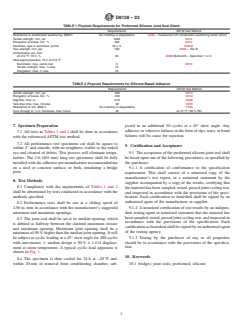
4.2 The materials for the adhesive shall conform to the physical properties prescribed in Table 2.
4.3 In the applicable requirements of Table 1 and the test method, all deflection shall be based on the nominal width.
5. Dimensions and Working Parameters
5.1 The size, shape, and dimensional tolerances shall be as outlined in 5.2.
5.2 Measurements used for physical laboratory testing shall be taken to the nearest 0.01 in. (0.3 mm) and reported/recorded to the
nearest 0.1 in. (3 mm) as the average of the measurements. The measured width shall be greater than or equal to the nominal width.
Measurements shall be taken at quarter points of the sample.
5.3 The lengths of samples for performance testing purposes shall be 2 ft 6 0.25 in. (601 6 6 mm) length for the seal and
appropriate amount of silicone-based adhesive per manufacturer’s recommendation.
6. Sampling
6.1 Samples shall be taken at random from each shipment of material. If the shipment consists of more than one lot, each lot shall
be sampled.
6.2 A lot shall consist of the quantity for each copious section agreed upon between the purchaser and the supplier.
7. Specimen Preparation
7.1 All tests in Tables 1 and 2 shall be done in accordance with the referenced ASTM test method.
7.2 All performance test specimens cut shall be square to within 2° and smooth, with no roughness visible to the n
...